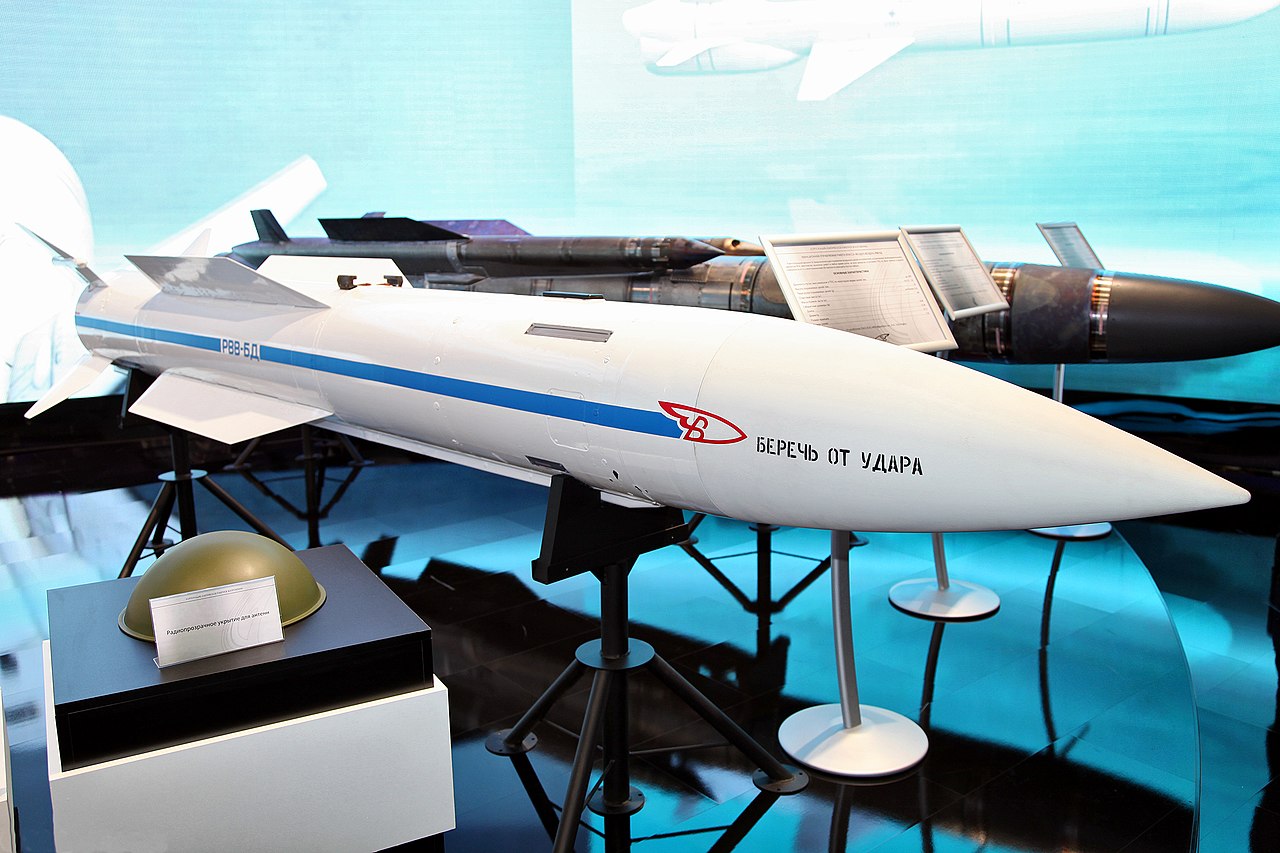
The R-37 is also known as izdeliye 610 (Product 610), RVV-BD, and in NATO designation as AA-13 Axehead.
History of the R-37 Design and Development
The concept of the R-37 was intended as a replacement for the R-33 missile. Its design was assigned to the Vympel design bureau, the same company that developed the R-33. The R-33, or AA-9 Amos, was a large missile weighing 490 kg with a range of 160 km (E variant). It entered service in 1981 and remains in use with the Russian Air Force and CIS states. The missile could be deployed on MiG-25 and MiG-31 interceptors, and in testing was reported to have successfully engaged a target at 304 km.
The new missile had to be smaller than the R-33 while offering greater range, enabling it to strike standoff targets such as AWACS and refueling aircraft. It also needed to be compatible with simpler fighter radars beyond the MiG-31.
The R-37 project began in the early 1980s, with the first successful test launch recorded in 1989. Testing continued for about a decade until 1998, but development was halted due to budget constraints and the limited number of launch platforms. Work resumed in 2006, and by 2014 the missile was formally adopted by the Russian Air Force, with serial production initiated.
In 2018, the updated R-37M variant completed its trials. The R-37M is the modernized version of the R-37, also known as RVV-BD. Sources cite its range as over 300 km, with a top speed of Mach 6 (7,400 km/h). It is deployable on the MiG-31BM interceptor, as well as the Su-35S multirole fighter and the Su-57 fifth-generation fighter.
R-37M missile under the export designation RVV-BD at the MAKS 2013 air show
Body and Components of the R-37 Missile
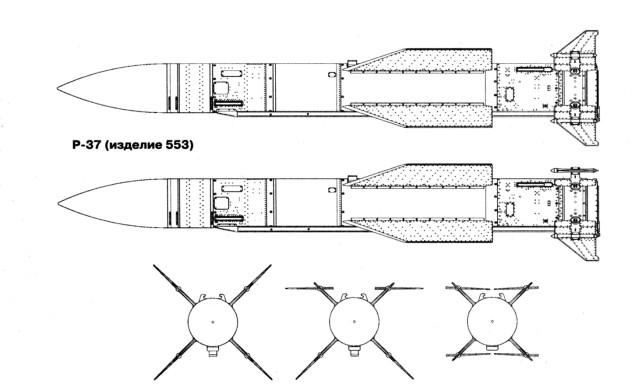
The R-37 air-to-air missile has two sets of fins; the mid-body fins act as stabilizers, while the rear fins are used for guidance and directional control. The rear fins are longer than the mid-body fins and can be folded to reduce the space they occupy.
At the nose section, the missile contains its radar seeker. Behind the seeker is the warhead, followed by the solid-fuel propellant, and finally at the rear is the dual-pulse rocket motor.
An image of the R37 missile’s layout and fins is also clear, as is how the rear fins fold.
The R-37, with an overall weight of 510 kg and a high-explosive fragmentation warhead weighing 60 kg, is considered a heavy air-to-air missile. This missile has a length of 4.06 m, a diameter of 38 cm, and a wingspan of 72 cm. The range of the R-37M is cited in various sources as between 300 and 400 km.
The dual-pulse solid-fuel rocket motor used on the R-37 was chosen to extend the missile’s range. In a pulsed solid-fuel design, the propellant is divided into separate charges that ignite sequentially with a delay. In the dual-pulse motor, the number of pulses is limited to two, and the chamber is designed accordingly to deliver fuel in separated stages. The purpose of the dual-pulse system is to limit the missile’s maximum speed while increasing its effective range. This powerful motor propels the 510 kg R-37 to a speed of Mach 6.
Guidance and Navigation of the R-37 Missile:
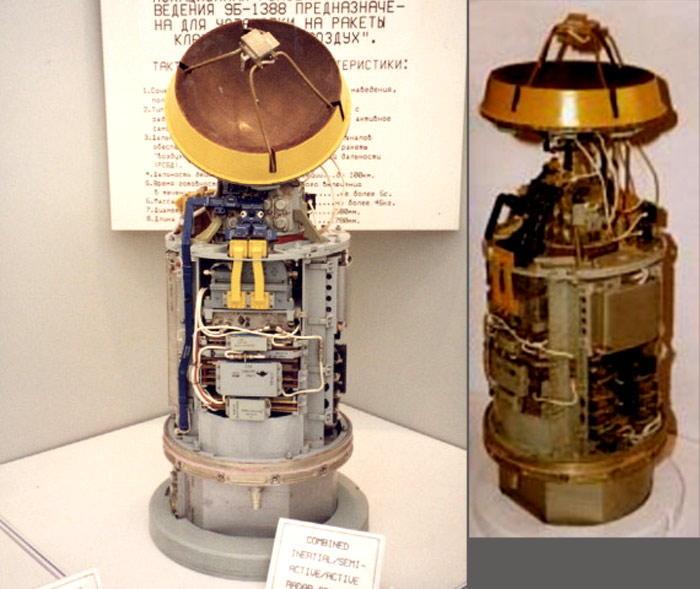
The R-37 uses an active radar seeker called Agat 9B-1388 in its nose, which allows the missile to independently detect and track targets. Given its range of over 300 km, continuous radar seeker guidance throughout the flight is not possible, as with all missiles of this class. Therefore, the missile employs a multi-channel combined guidance system: it is launched in a fire-and-forget mode, but requires mid-course corrections.
The missile is fired with target data and initially flies toward the target using inertial navigation. In the mid-course phase, its trajectory is updated via datalink corrections from the launch aircraft’s radar, ensuring adjustments if the target changes course. In the final phase, the missile closes in and uses its own radar seeker to acquire and engage the target.
Based on limited published data, the 9B-1388 seeker has a diameter of approximately 380 mm, a weight of about 40 kg, the ability to detect a target with a radar cross-section of 5 m² at a distance of around 40 km, and requires about 5 seconds after pre-heating to reach operational readiness. It also supports a radio correction link with an approximate range of 100 km.
Agat 9B-1388 radar seeker for the R-37 missile
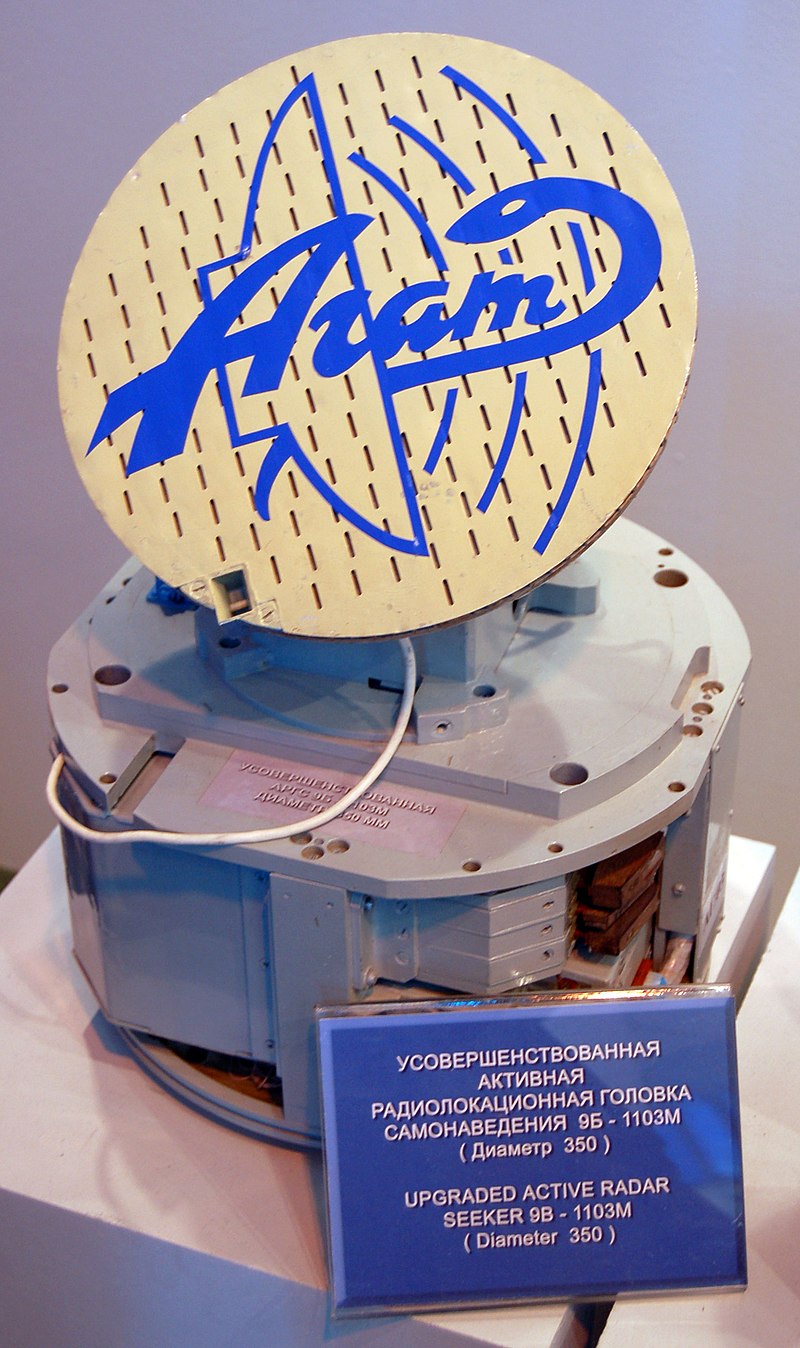
Russia has introduced another radar seeker called 9B-1103M-350, designed for installation on R-37 missiles and other long-range systems such as the KS-172. This seeker incorporates a newly miniaturized digital signal processor with enhanced memory capacity and improved processing speed.
Instead of conventional mechanical gyroscopes, it employs fiber-optic gyroscopes along with fast-activation mechanical gyroscopes, resulting in a shorter missile preparation time before launch.
The radar seeker of this missile is equipped with an antenna measuring 330 mm in length and 350 mm in diameter, with a total weight of 13 kg. Its digital processing system is capable of performing at least 50 million operations per second and can detect a target with a radar cross-section of 5 m² at a minimum distance of 40 km. After two minutes of pre-heating, the seeker reaches full operational readiness within one second.
This new radar seeker offers a high level of standardization and adaptability, making it suitable for use across a wide range of missiles, including both air-defense systems and air-to-air missiles, within the 200 to 400 mm caliber range.
Radar seeker 9B-1103M-350 (seeker head section)
Launch Platforms: The missile is primarily deployed on the MiG-31BM interceptor as its main operational fighter. It is also integrated on the Su-35S and Su-57 multirole fighters. When loaded onto the Su-35, up to five long-range R-37M air-to-air missiles can be mounted on hardpoints 1, 3, 4, 11, and 12.
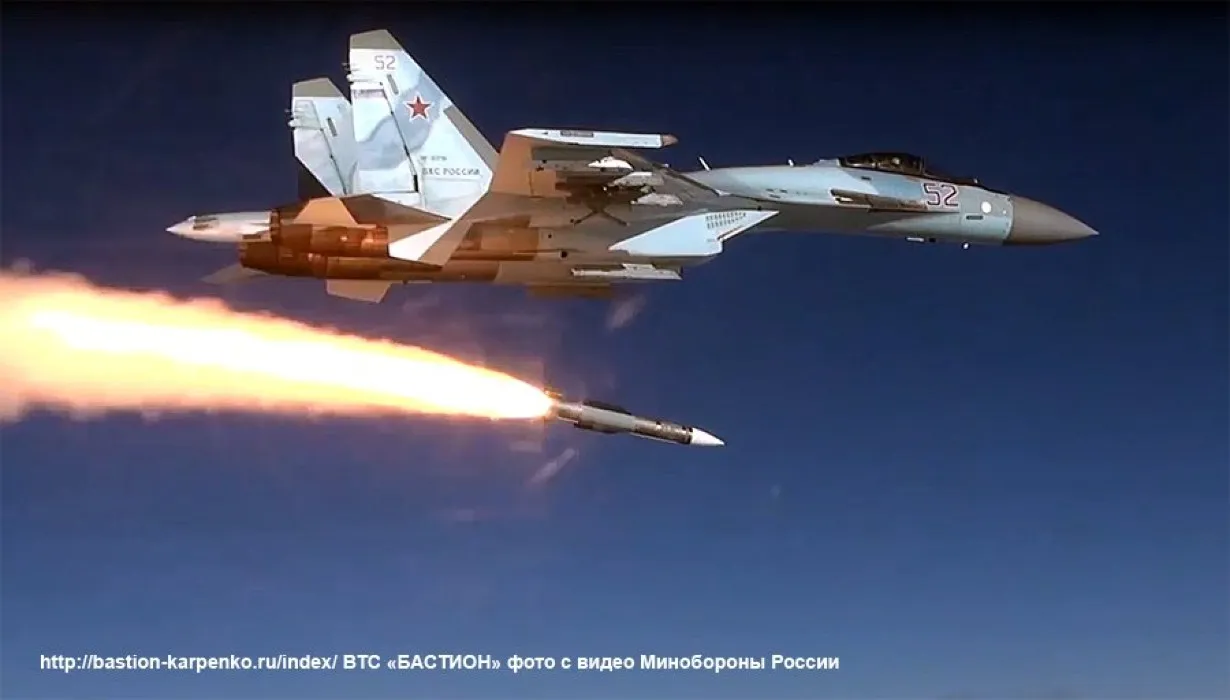
Russian fighter jet firing an R-37 long-range missile
Operators of the R-37M Missile
The R-37M is currently in service with the Russian Aerospace Forces, operational on the MiG-31BM, Su-35S, and Su-57 fighters. There have also been reports of the missile being offered to India for use on the Su-30MKI, as well as speculation about a potential order by Iran alongside its acquisition of Su-35 fighters.
If Iranian Su-35s are equipped with the long-range R-37M missiles—with a range of over 300 km and speeds reaching Mach 6—they would pose a serious threat to aerial refueling tankers and AWACS aircraft belonging to Israel and the United States. The combination of the R-37M with the powerful Irbis-E radar on the Su-35 enables targeting from safe standoff distances, meaning that in any potential confrontation, a significant portion of the offensive and surveillance air capabilities of Tel Aviv and Washington could be affected.
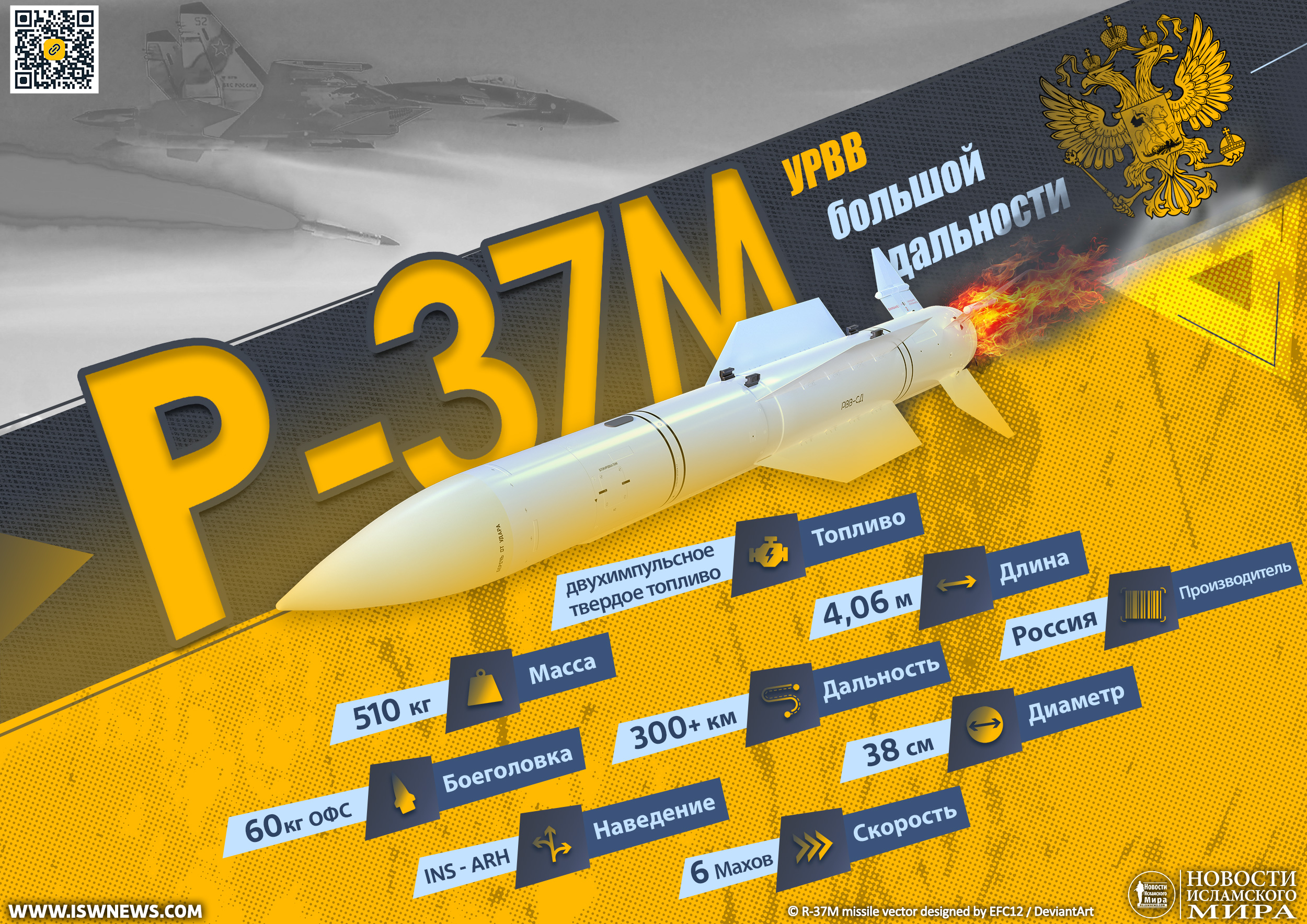
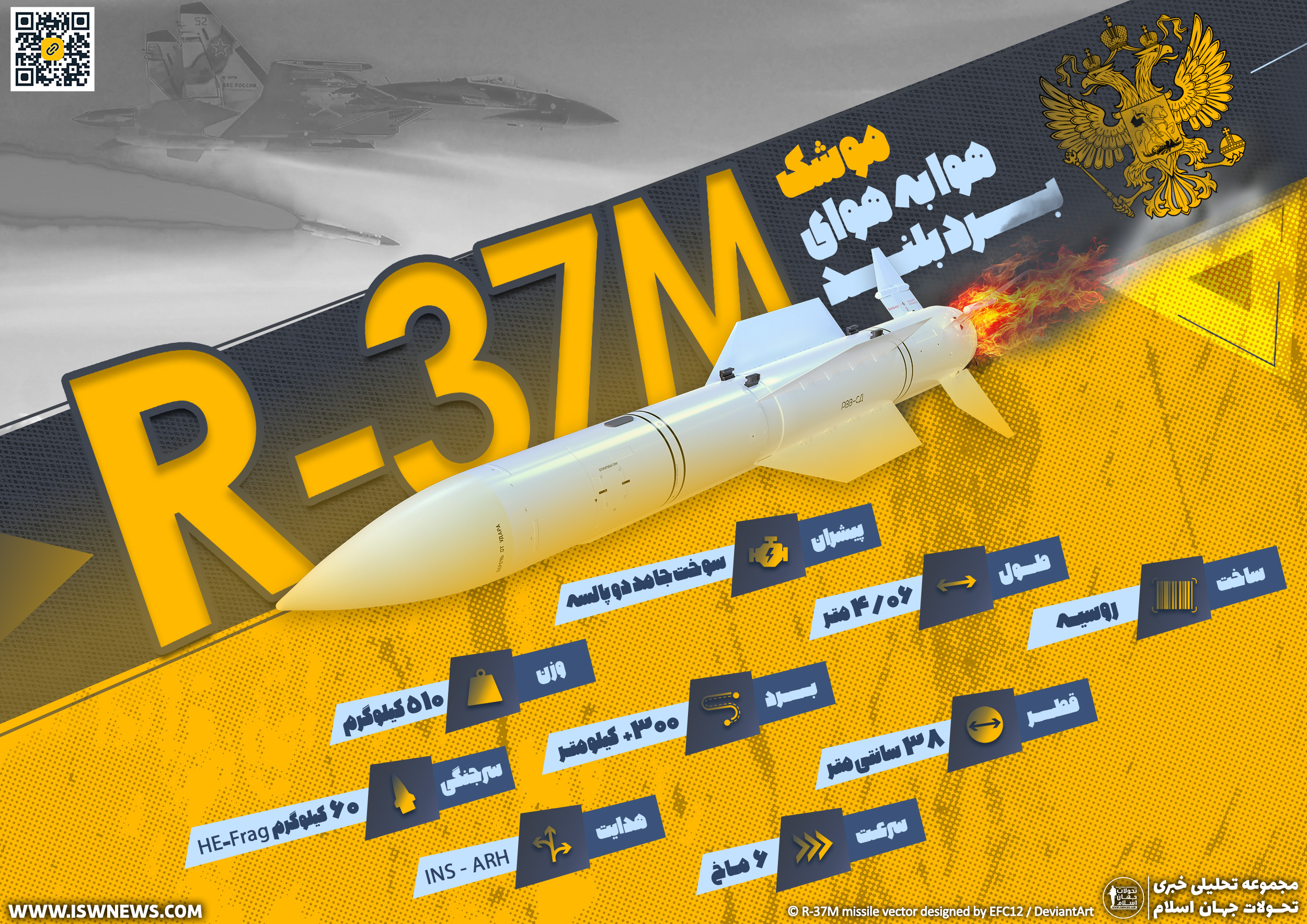
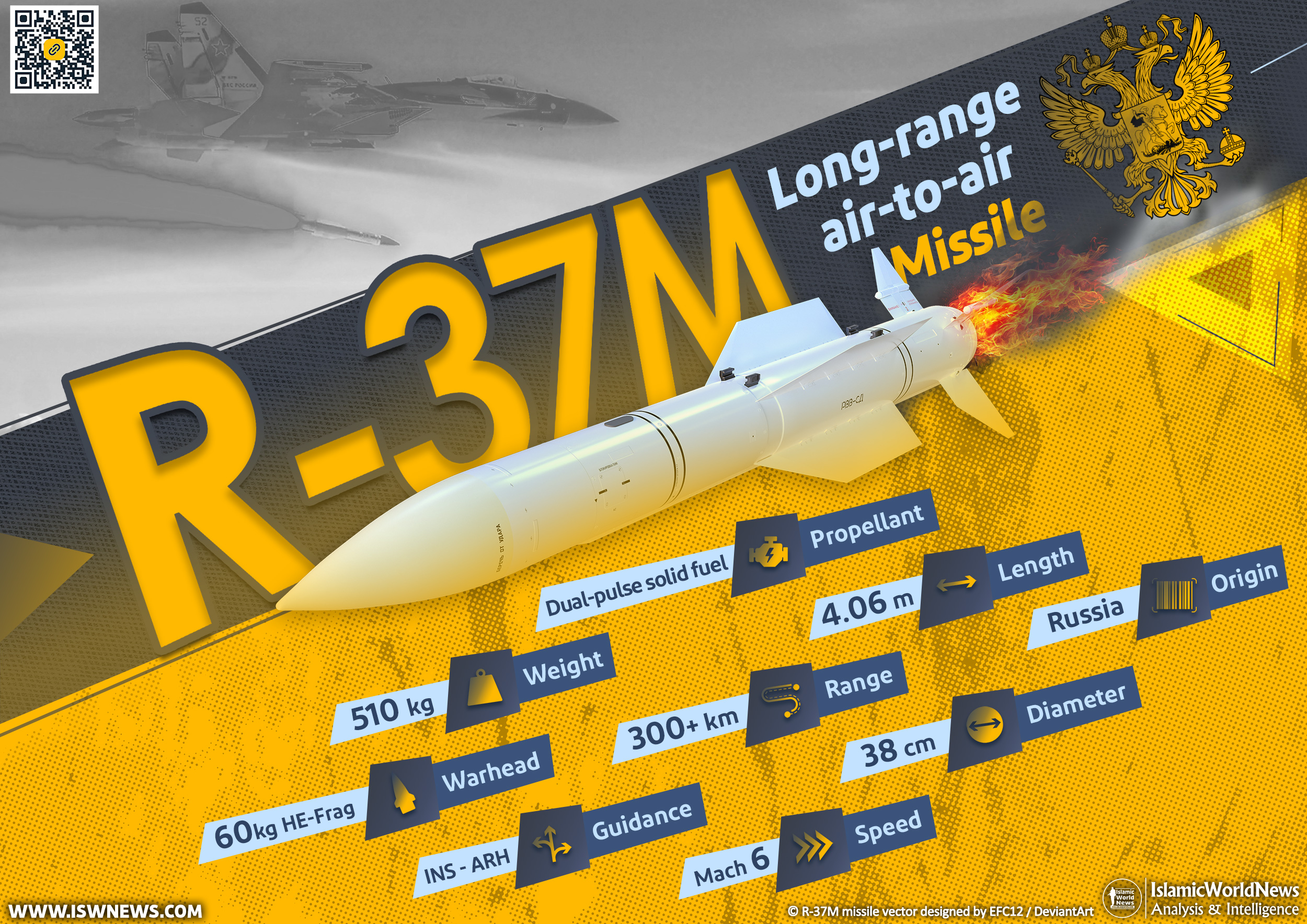
Type: Long-range air-to-air missile Origin: Russia Manufacturer: Vympel NPO Service Entry: 2014 Length: 4.06 m Wingspan: 72 cm Diameter: 38 cm Propulsion: Dual-pulse solid-fuel rocket motor Range: 300–400 km Speed: Mach 6 Weight: 510 kg Warhead: 60 kg high-explosive fragmentation Launch Platforms: MiG-31BM, Su-35S, Su-57
R-37M air-to-air missile – click to view images in full size
Work on the R-73 began in 1973, with the goal of replacing the R-60 (AA-8 ‘Aphid’) missile. The R-60 was considered the lightest infrared missile in the world, weighing only 43.5 kilograms, but its small warhead of 3 kilograms made it largely ineffective against fighter aircraft. After twelve years of development, the R-73 entered service with the Soviet Air Force in 1985.
At the nose of the R-73 is an infrared seeker, responsible for directly tracking the target. Behind it are four proximity fuzes, which allow the missile to detonate when it comes close to the target. Following this section are two rows of canards, placed sequentially, enabling rapid directional changes. Next comes the control unit and additional sensors, followed by the warhead, then the solid-fuel propellant and rocket motor. At the rear, in addition to the motor, the missile is equipped with four stabilizing fins to ensure flight stability.
R-73 missile components
The seeker of the R-73 missile is an infrared seeker that tracks the heat emitted by aircraft—particularly from the engine section—and can detect targets up to 60 degrees off the missile’s central line of sight. The R-73 also features an “off-boresight” capability. This means that a helmet-mounted sight (HMS) allows the pilot to simply look at a target and fire, without turning the aircraft toward it. In this mode, the missile rotates in the direction of the pilot’s gaze, locks on with its nose-mounted seeker, and then attacks the target.
After the reunification of Germany in 1990, several R-73 missiles came into the possession of the United States. Tests revealed that the R-73 was superior to the American AIM-9M Sidewinder. Compared to the Sidewinder M variant, the R-73 demonstrated greater maneuverability and stronger target acquisition and tracking capabilities. However, its performance was degraded in cloudy conditions. This limitation prompted the development of newer short-range infrared missiles such as the AIM-132 ASRAAM, IRIS-T, MICA IR, Python IV, and AIM-9X, all designed to surpass the R-73.
R-73 missile (AA-11 Archer)
R-73 missile variants
The R-73 missile has been produced since 1994 under the designation R-73M, also known as R-74EM, and entered service with the Commonwealth of Independent States (CIS) in 1997. This upgraded missile was designed to resist Infrared Counter-Counter Measures (IRCCM). It is carried by aircraft such as the MiG-29, Su-27, Su-34, and Su-35, and can also be deployed by newer versions of the MiG-21, MiG-23, Su-24, and Su-25. Additionally, it is compatible with Russian attack helicopters including the Mil Mi-24, Mil Mi-28, and Kamov Ka-50. India has also sought to integrate this missile into its light combat aircraft.
In 2009, a version called RVV-MD was introduced as the export model of the R-74 (izdeliye 740). These missiles are expected to complement earlier R-73 variants still in service.
An enhanced version was unveiled in 2016 under the name R-74M (izdeliye 750). This model features fully digital, reprogrammable systems and is designed for use on advanced fighters such as the MiG-35, MiG-29K/M/M2, Su-27SM, Su-30MK, and Su-35S.
An image of the RVV-MD missile, an export version of the R-74M, with its infrared seeker in its nose and control fins.
A more advanced version, designated R-74M2 (izdeliye 760), has been developed specifically for the fifth-generation Su-57 fighter jet. This missile is equipped with an inertial navigation system, features a smaller radar cross-section, and its fin span has been reduced to 434 millimeters to fit inside the Su-57’s internal weapons bay.
The R-74M2 incorporates Infrared Counter-Countermeasure (IRCCM) technology, designed to achieve performance comparable to the AIM-9X, IRIS-T, and ASRAAM. Testing of the R-74M2 was completed in 2019, and its export version, known as RVV-MD2, was unveiled in 2023.
RVV-MD2 mock-up at the 2023 Dubai Airshow
A futuristic design project known as K-MD (izdeliye 300) is currently under development as a short-range air-to-air missile intended for close combat. It is expected that this version will eventually replace the R-74M2.
The Yemeni military also possesses a variant of this missile, designated Thaqib-1, which has been modified for use as a surface-to-air defense weapon. This version was unveiled by Yemen in March 2020 and has reportedly achieved several successful interceptions of fighter aircraft and drones.
Specifications of the R-73 Air-to-Air Missile
Type: Short-range air-to-air missile Designer: Former Soviet Union and Russian Federation Manufacturer: Vympel NPO Design Year: 1973 Service Entry: 1985 Length: 2.93 meters Wingspan: 0.51 meters (51 cm) Diameter: 0.165 meters (16.5 cm) Weight: 105 kilograms Engine: Single-stage solid-fuel rocket motor Range: Up to 30 kilometers Speed: Maximum of Mach 2.5 Warhead: 7.4 kilograms Guidance: Passive infrared homing with proximity fuse Seeker Off-Boresight Angle: ±45° to ±75° depending on variant Launch Platforms: MiG-29, Su-27, Su-34, Su-35; selected versions of MiG-21, MiG-23, Su-24, Su-25 and Mil Mi-24, Mil Mi-28, Kamov Ka-50
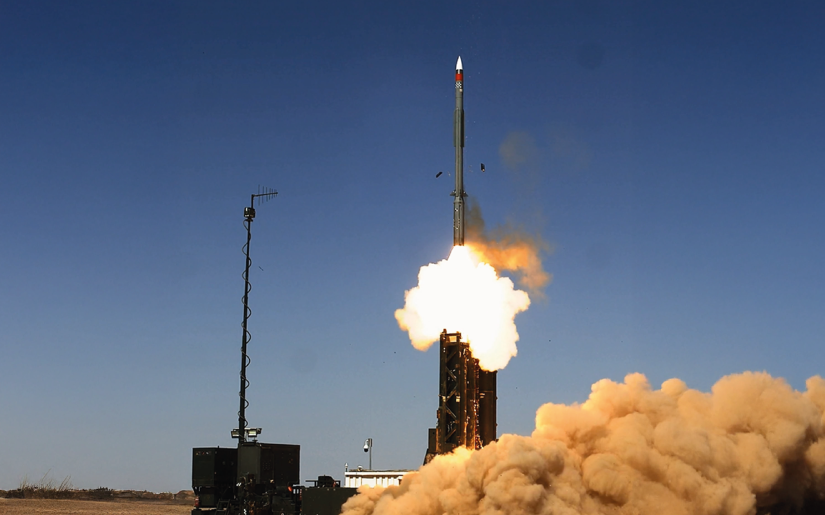
The Barak MX air defense system was designed to establish a flexible, multi-layered defensive structure against a wide range of aerial threats, including fighter jets, helicopters, drones, cruise missiles, anti-ship missiles, and tactical ballistic missiles. The term “MX” in its name stands for Mix of system elements for Maximum performance and flexibility, highlighting its modular, software-driven, and adaptable nature, while its hardware foundation is based on the earlier Barak system.
The origins of Israel Aerospace Industries (IAI) with the “Barak” system date back to the 1990s, when the company, in cooperation with Rafael, developed the Barak 1 missile to protect Israeli naval vessels against aircraft and anti-ship missiles. With a range of about 10 kilometers, its first operational use did not occur in the 1990s but rather in July 2022—nearly three decades later—when Hezbollah launched three drones toward the Karish gas platforms. One was shot down by an F-16 fighter jet, while the other two were intercepted by a Sa’ar-class corvette using Barak 1 missiles.
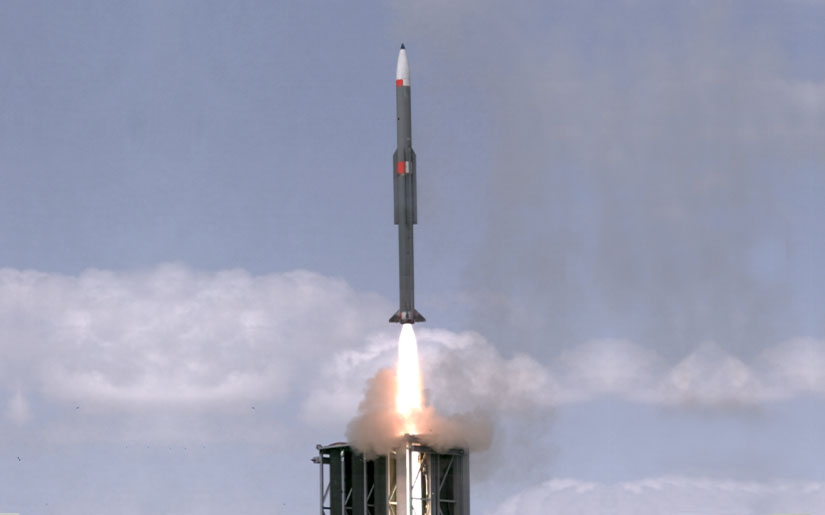
Barak 1 fired from a Sa’ar-class corvette
In 2007, the then–CEO signed an agreement with India’s Defence Research and Development Organisation (DRDO) to develop a new version of the missile with a range of 70 kilometers for the Indian Navy—later known as Barak-8. The contract, valued at around $1.5 billion, was considered one of the largest projects in IAI’s history. The missile’s engine was developed by the Indian side, while nearly all other system components were produced by Israel.
Barak-8 became operational in 2015 and entered service aboard India’s new destroyers. Over time, various missile types with different ranges were integrated into a comprehensive system.
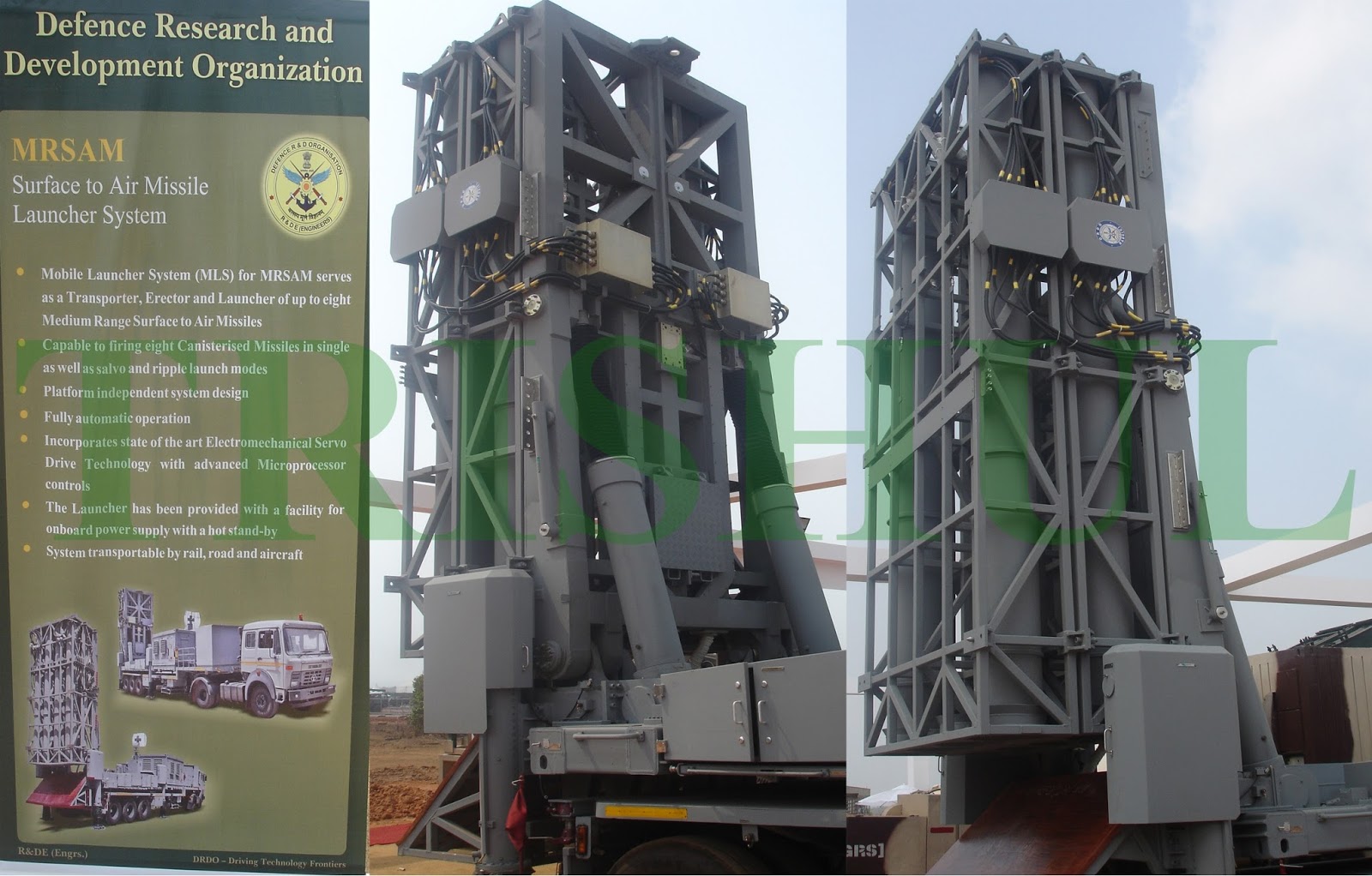
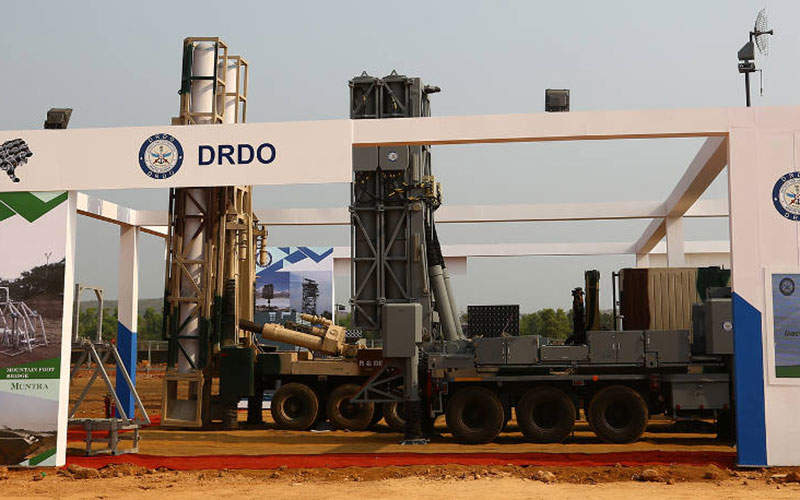
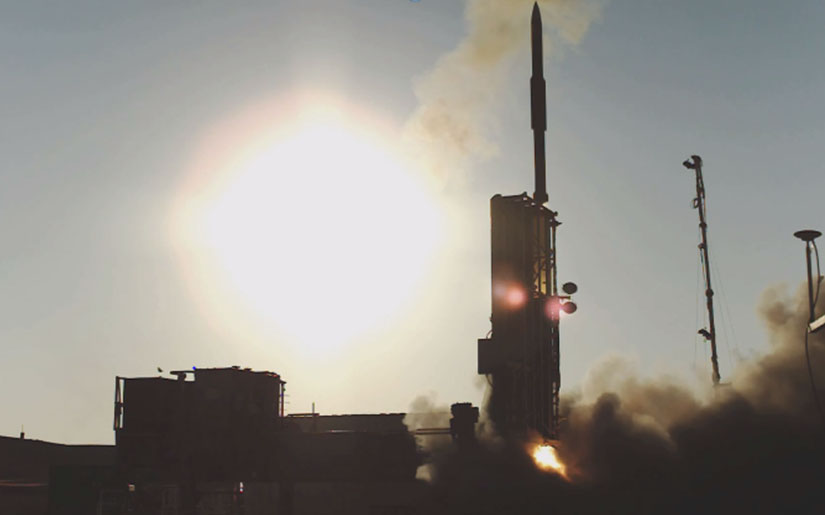
Land-based version of the Barak system at India’s Defense Research and Development Organization
Barak MX Defense System Components:
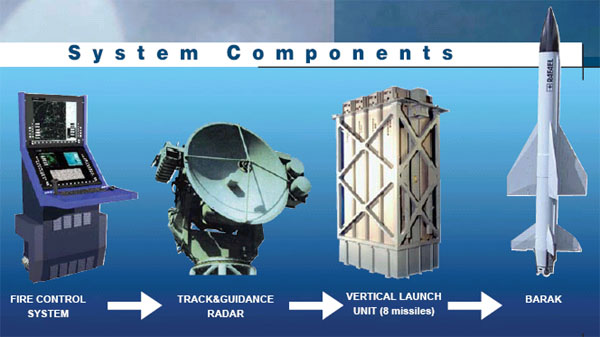
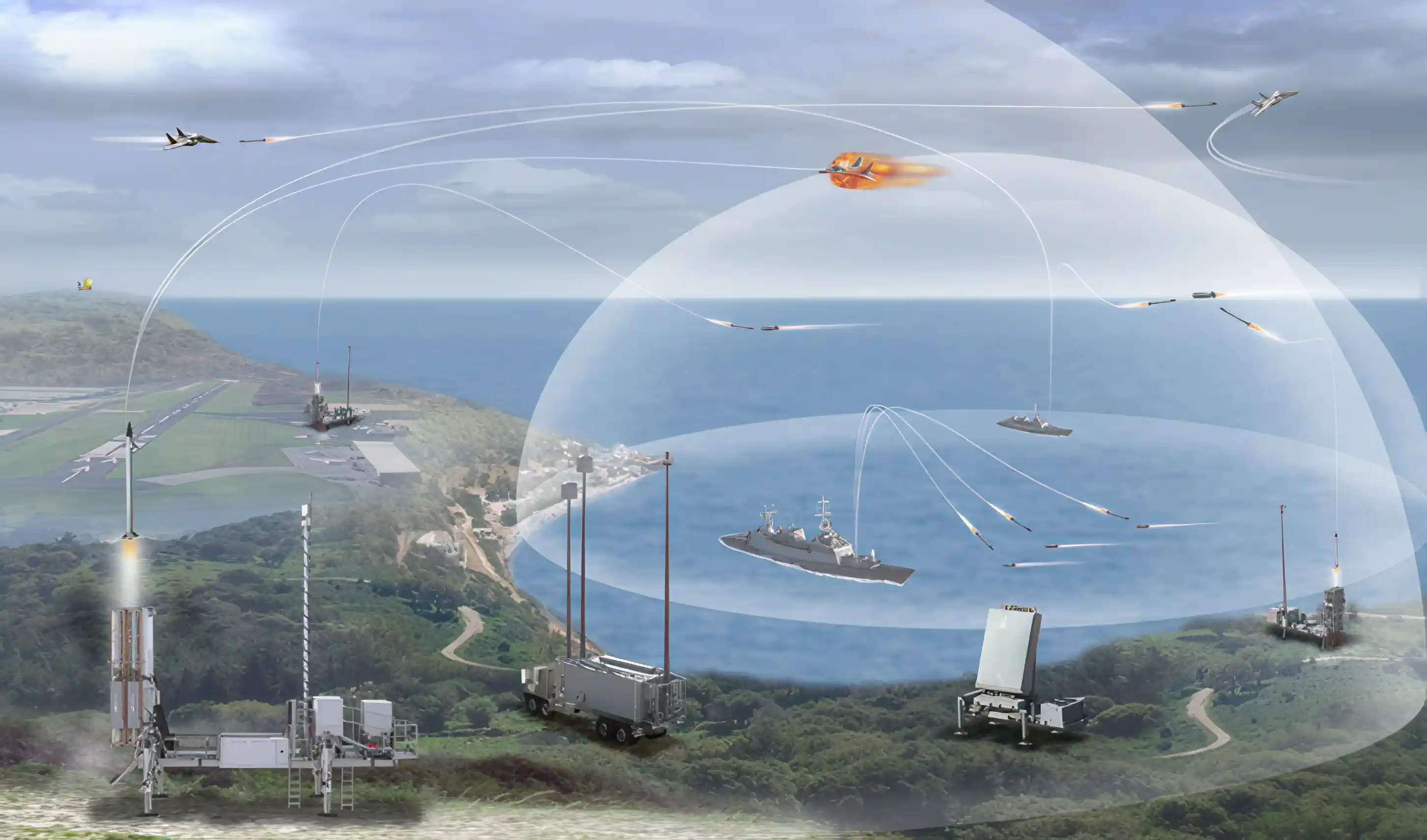
The Barak MX system is composed of three primary elements: the Battle Management Center (BMC), the EL/M-2084 Multi-Mission Phased Array Radar (MMR), and a family of interceptor missiles with varying ranges, each of which will be examined separately.
Barak MX defense system
Battle Management Center (BMC): The BMC serves as the brain of the system, functioning in the domains of command, control, and communications. It integrates data collected from radars and various sensors to generate a unified air situation picture. One of the system’s unique features is the Launch Over Relay (LOR) capability, which allows fire units to launch missiles at targets detected by another unit’s radar. This function is particularly valuable in complex battlefields, enabling optimal use of all interceptors and preventing redundant engagements against the same target. The BMC can be deployed in fixed facilities, semi-mobile platforms, or fully mobile units.
Barak System Radars
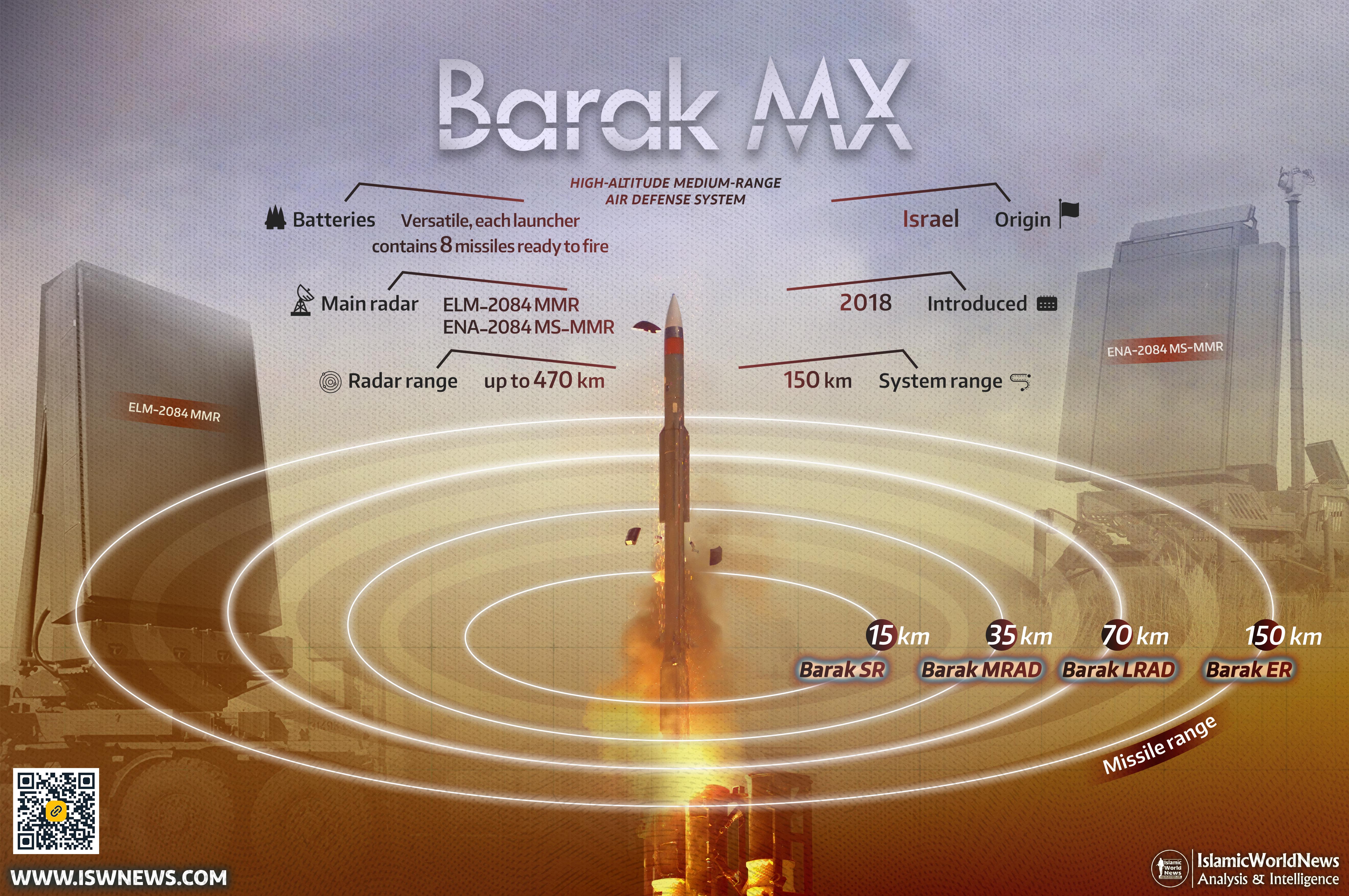
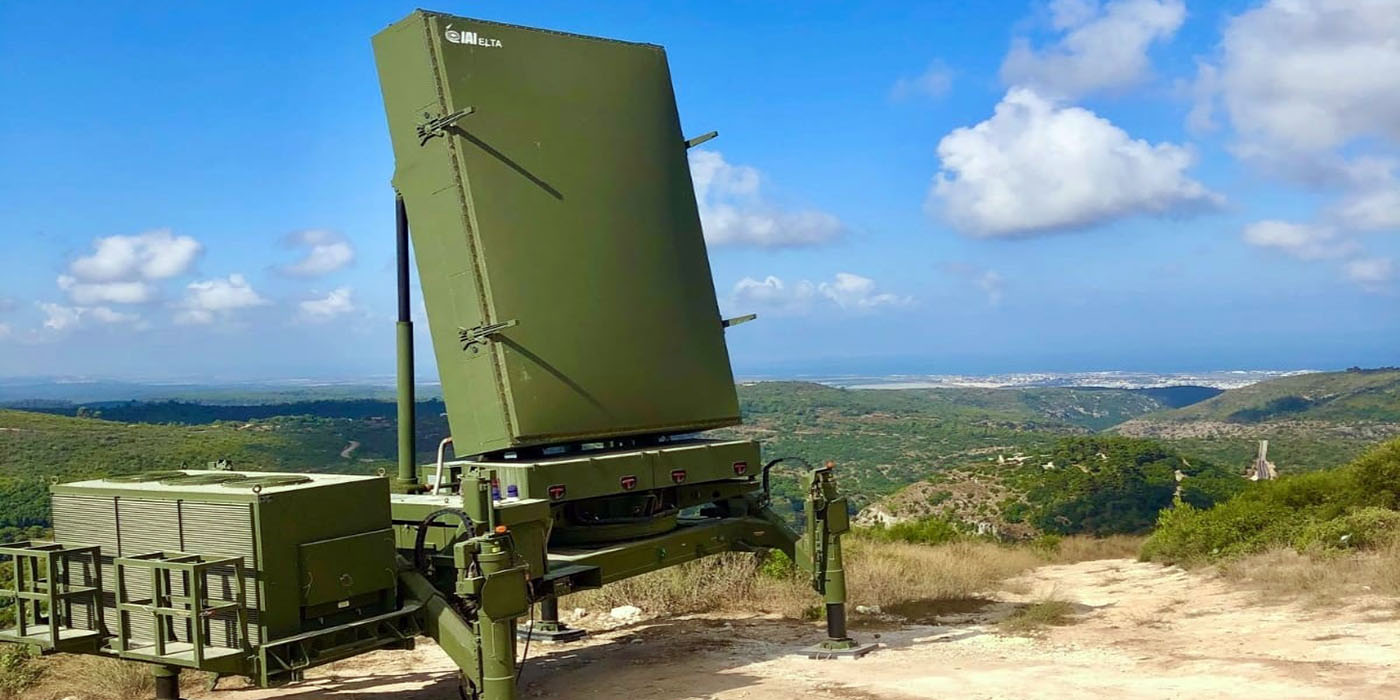
ELM-2084 MMR: Barak was developed based on radar architecture already established within Israel Aerospace Industries. As such, the EL/M-2084 multi-mission radar family, under development since 2002, is employed in this system. This radar is also used in the Iron Dome and David’s Sling systems, with its first operational record dating back to 2011. This commonality allows rapid deployment of Barak MX launchers alongside other systems using the same radar. Notably, during the 12-day war, Barak MX was urgently and temporarily deployed in the occupied territories at the request of the Israeli military.
Israel Aerospace Industries has delivered more than 250 units of this radar family to clients worldwide. Among them is a 2009 contract for 34 EL/M-2084 radars signed by India. Other known users include Vietnam, Singapore, Hungary, Finland, the Czech Republic, Canada, Azerbaijan, and the United Arab Emirates, employing the radar either within the Barak air defense system or as part of other IAI products.
ELM-2084 MMR radar
Manufactured by Elta Systems, the ELM-2084 serves as the primary sensor of the system. Operating in the S-band with Active Electronically Steered Array (AESA) technology, it offers high mobility and rapid frequency agility, enabling simultaneous detection of up to 1,200 targets. The radar’s maximum detection range is cited as 470 km, while its optimal tracking range is estimated at 256 km. It also provides artillery weapon location capabilities, detecting firing positions within a 100 km radius at a rate of 200 targets per minute, while calculating probable impact points. Coverage extends to 120° in static mode and 360° in rotating mode, with vertical coverage up to 50°, reaching altitudes of approximately 30 km.
The system is built on a modular design philosophy and an “open radar interface,” allowing users to integrate different radars according to their existing infrastructure. This reduces dependency on a single supplier and enables gradual, cost-effective upgrades. Thanks to its modular architecture, the Barak MX system can also support other radars from the same family, consolidating complementary data from multiple sensors.
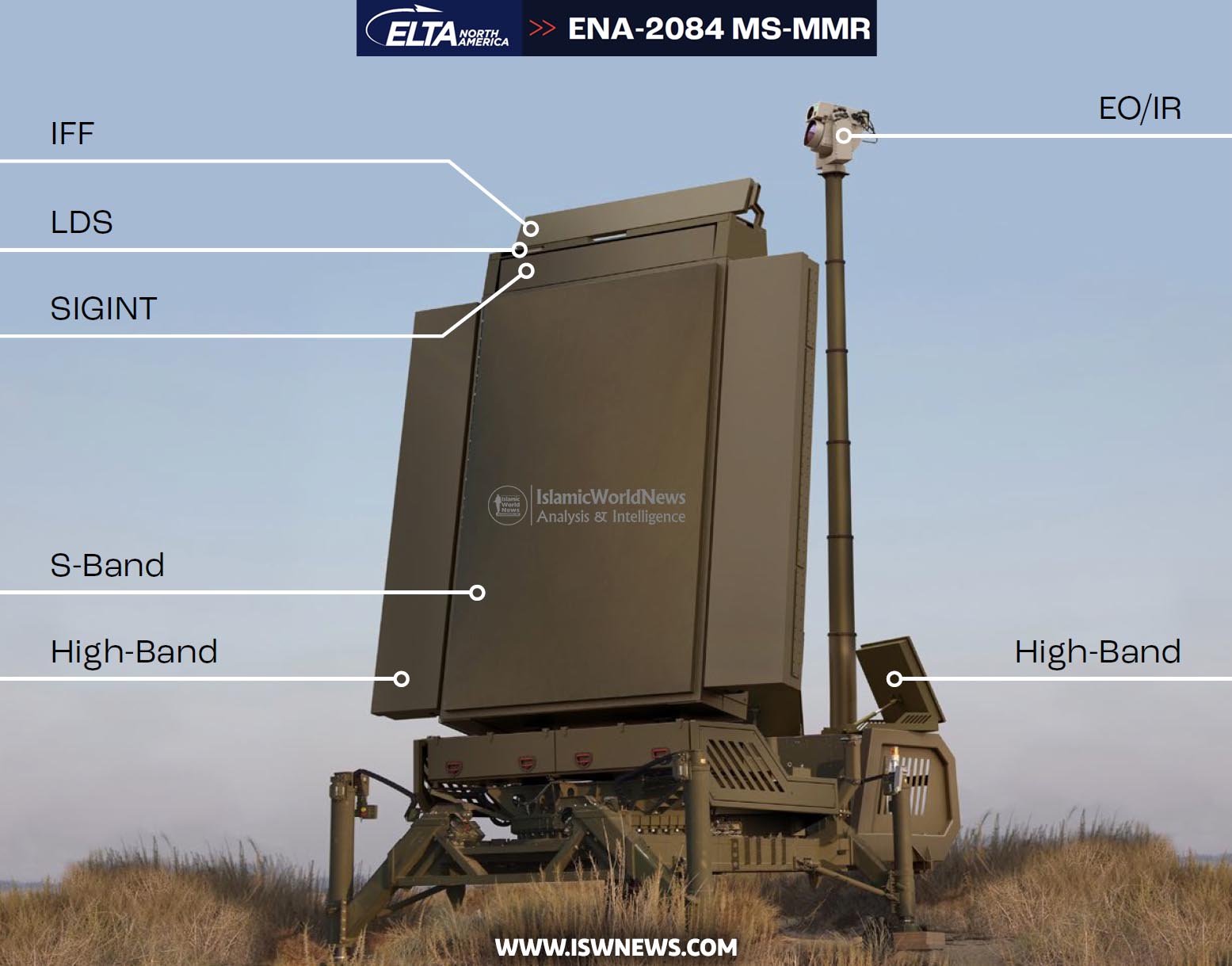
ENA-2084 MS-MMR: The enhanced multi-sensor version, known as MS-MMR (or ENA-2084 MS-MMR), integrates both active and passive sensors to deliver a higher-quality Air Situation Picture (ASP) and more effective support for weapon systems. The MS-MMR platform combines multiple bands and multi-spectral sensors, including a high-band radar, Identification Friend or Foe (IFF) system, SIGINT modules, electro-optical and infrared (EO/IR) sensors, and Launch Detection Sensors (LDS).
ENA-2084 MS-MMR radar
ENA-2311 C-MMR Radar: Another version of this radar, known as C-MMR (Compact Multi-Mission Radar), has been introduced with a smaller physical footprint. The ENA-2311 is highly mobile and can be rapidly deployed on a single vehicle for field forces. It employs a 3D AESA (Active Electronically Steered Array) antenna. The main components of the C-band Doppler radar include a phased-array antenna, cooling unit, power supply unit, and operator consoles equipped with communication systems.
The C-MMR is designed for Air Defense (AD) missions with a detection range of up to 250 km, and for Artillery Weapon Location (WLR) missions with a range of 70 km. In artillery mode, the radar can identify the launch and impact points of mortars, cannon shells, rockets, and missiles.
ENA-2311 C-MMR radar
ELM-2138M Green Rock Radar: The ELM-2138M Green Rock variant of this radar family is capable of detecting around 100 targets at ranges of up to 250 km. Designed specifically for deployment on tactical vehicles, it places particular emphasis on tracking small, low-RCS targets flying at low altitude and slow speed.
Its maximum effective range is 100 km, and it can be integrated into a fire unit as a complementary sensor for detecting miniature aerial threats and cruise missiles.
ELM-2138M Green Rock Radar
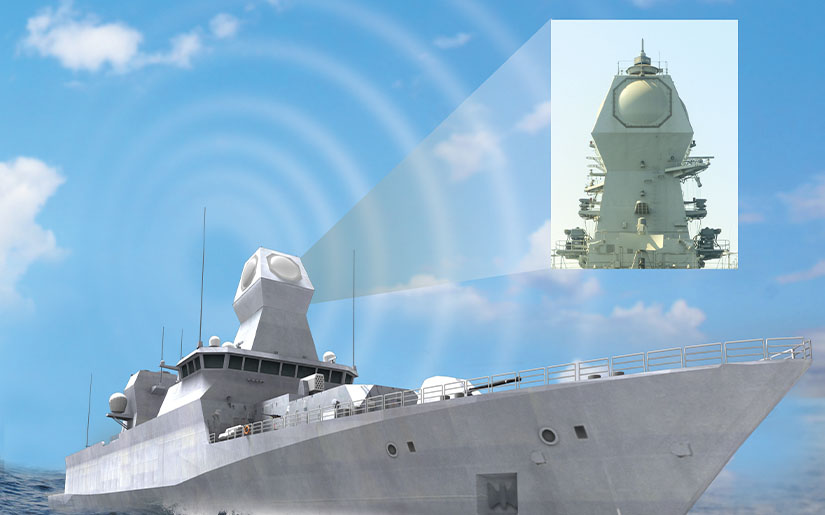
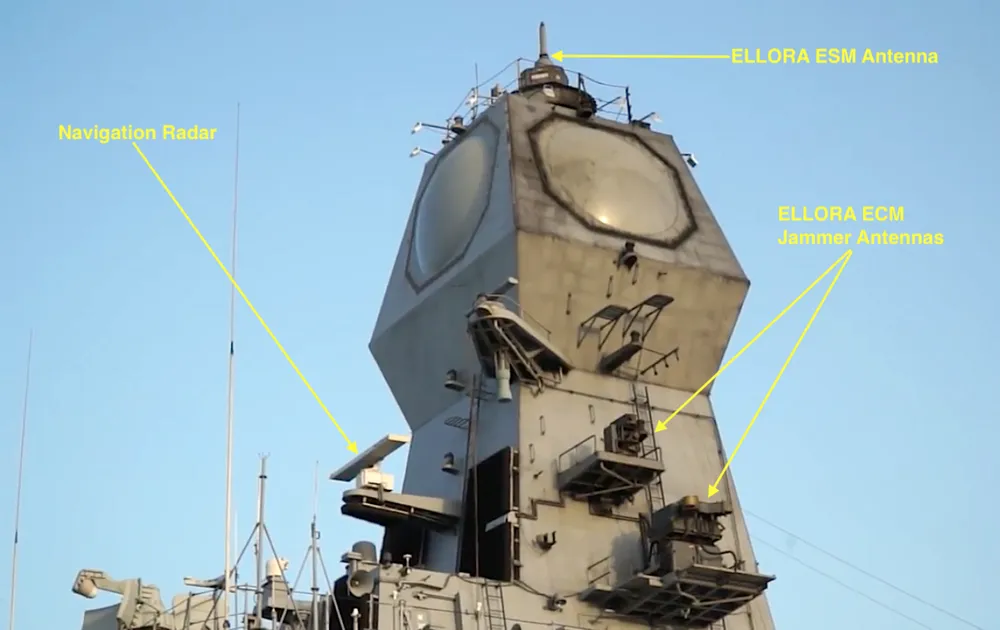
ELM-2248 MF-STAR Radar: In its naval variant, the Barak MX system employs the ELM-2248 MF-STAR, a multi-function digital S-band AESA radar designed for search and target acquisition. The MF-STAR’s primary array consists of four scalable panels, which can be configured and dimensioned according to the type of vessel on which they are installed.
EL/M-2248 MF-STAR radar
In the corvette version, each radar panel weighs about 500 kg and measures 1 × 2 meters. The below-deck equipment adds around 1,300 kg, bringing the total system weight to approximately 3,300 kg. In the frigate version, each radar panel has a diameter of 3 meters and weighs about 1,500 kg. The below-deck equipment in this model weighs about 4,000 kg, resulting in a total system weight of nearly 10,000 kg. In this configuration, the radar’s detection range increases from 250 km to about 450 km.
Barak MX Interceptor Missiles
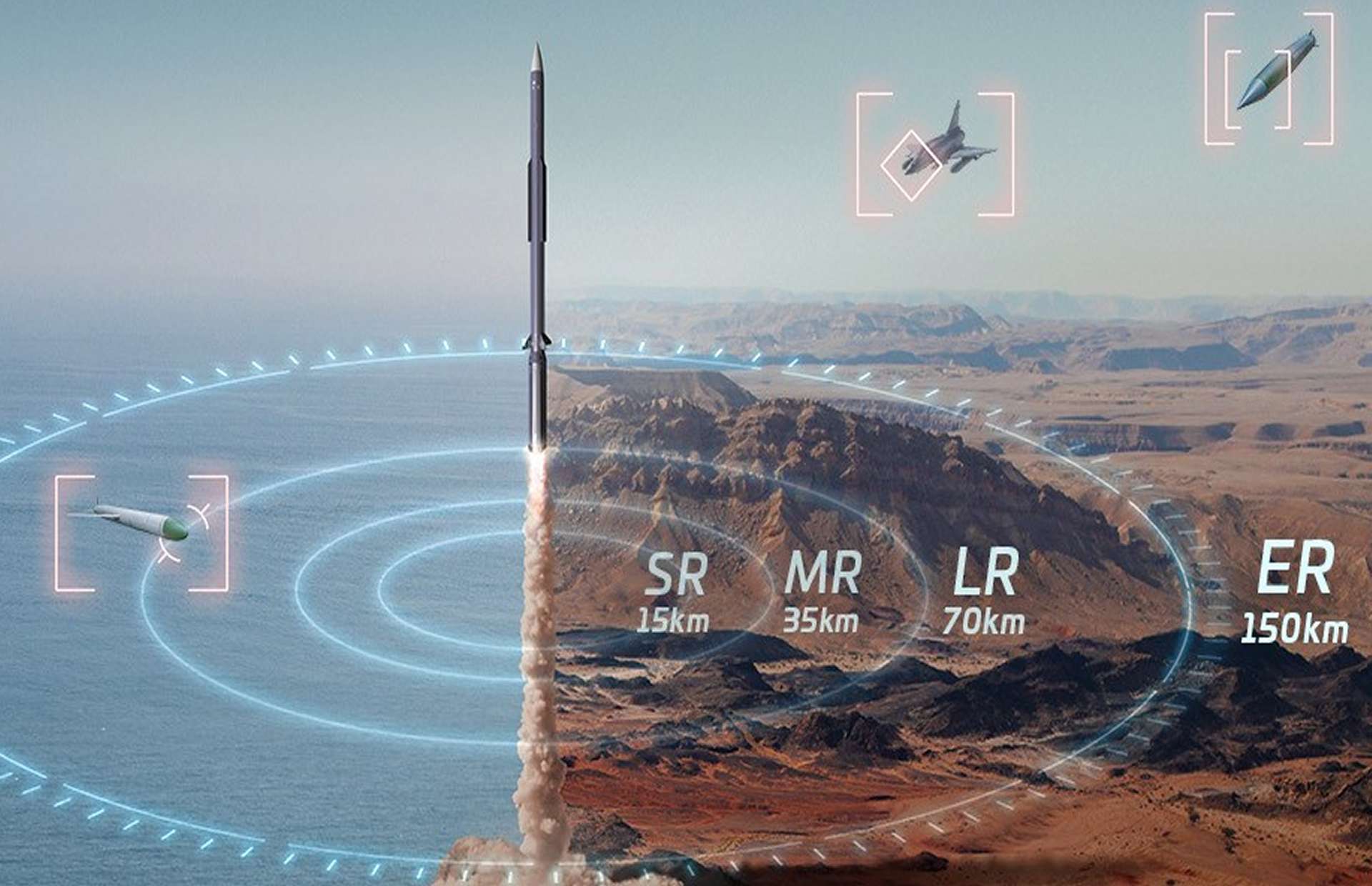
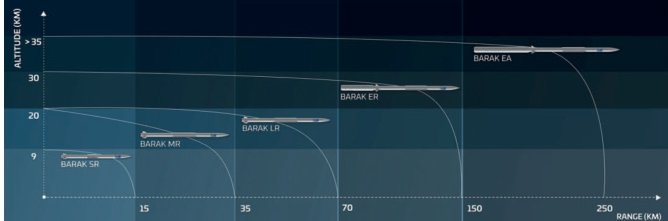
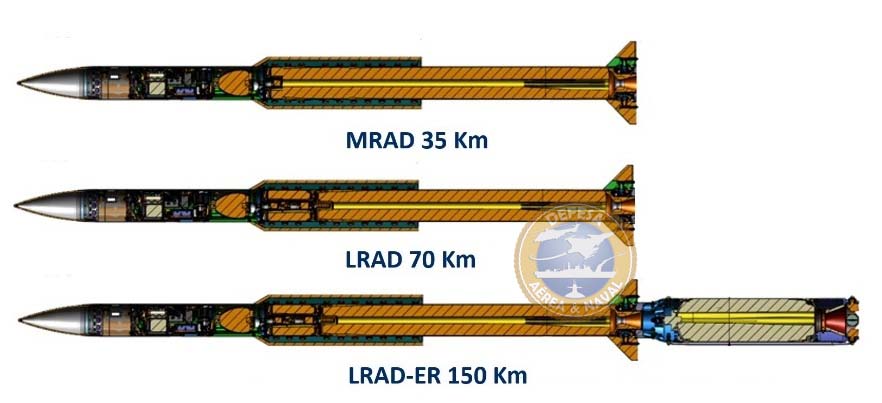
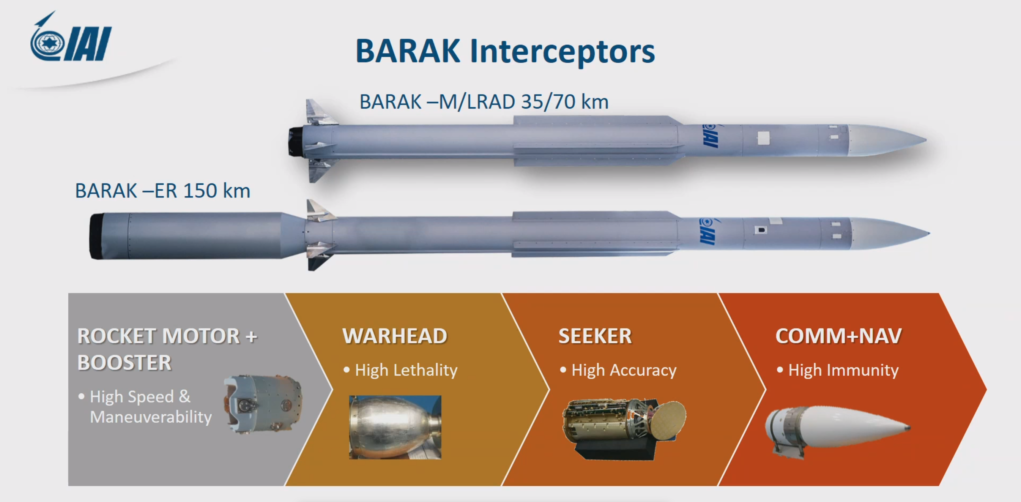
The missile family of the Barak MX system consists of four vertically launched interceptors: the Barak SRAD with a range of 15 km, the Barak MRAD with a range of 35 km, the Barak LRAD with a range of 70 km, and the Barak ERAD with a range of 150 km and a flight ceiling of 30 km. All of these missiles are of dedicated design and, unlike many conventional air defense interceptors, are not adapted from air-to-air missiles. This design choice allowed engineers to use a larger body diameter, enabling the integration of a more powerful radar seeker, a bigger warhead, and a more efficient propulsion system.
Barak MX interceptor missiles
Long-range Barak interceptors such as the Barak ER employ a vertical launch booster and dual-pulse solid-fuel rocket motors. The second pulse is activated during the terminal phase to enhance maneuverability and preserve energy for interception. The MRAD variant, equipped with a single-pulse motor, offers maneuverability of up to 50 g and is designed to counter fast and agile targets at shorter ranges.
During the mid-course phase of flight, in addition to the onboard navigation system, a two-way datalink with the Battle Management Center (BMC) provides real-time trajectory corrections. All missiles in the family are equipped with active radar seekers for terminal guidance, granting them true “fire-and-forget” capability.
From left to right, Barak MRAD, LRAD, and ERAD missiles, respectively.
The 60 kg warheads of these missiles are fragmentation-explosive types equipped with proximity fuzes, detonating at the optimal distance from the target to multiply the probability of destruction. The combination of high maneuverability, dual-pulse propulsion, and active radar guidance enables the Barak family to successfully intercept threats such as low-flying cruise missiles or ballistic missiles in their terminal phase with a high likelihood of success.
Barak MX Users
Since becoming operational in 2016, the system has been adopted by at least seven countries.
In the South Caucasus, the Republic of Azerbaijan is one of the key operators of Barak MX. The acquisition of this system is part of a broader military cooperation with Israel, which also includes LORA missile systems and loitering munitions. According to observers, Azerbaijan’s use of these technologies in recent regional conflicts has strengthened Israel’s position in the regional balance of power and, from Tel Aviv’s perspective, serves as a counterweight to Iranian influence.
Republic of Azerbaijan’s Barak MX system
In the Eastern Mediterranean, the deployment of this system in Cyprus triggered significant geopolitical reactions. Nicosia purchased the Barak MX with the aim of strengthening its air defense against regional threats. Turkey, however, regarded this move as a destabilizing factor.
The United Arab Emirates, Slovakia, and Morocco are also considered among the potential operators of the Barak-8 system
Conclusion: From an operational standpoint, the Barak MX is recognized as a Beyond Visual Range (BVR) engagement system. Its Launch Over Relay (LOR) capability allows a missile to be fired by one unit while receiving target data from a radar located elsewhere. This feature extends the effective interception range and makes the system highly suitable for modern network-centric warfare. In addition, the digital, anti-jamming design of the MMR radar and the system’s open architecture ensure sustained functionality even in environments with heavy electronic interference, and guarantee continued performance even if parts of the network are disabled.
Barak MX Air Defense System Specifications:
Type: Medium-Range High-Altitude Missile Defense Origin: Israel Manufacturer: Israel Aerospace Industries Introduced: 2018
System Range: 150 km Radars: ELM-2084 MMR and ENA-2084 MS-MMR radars as primary radars and ENA-2311 and ELM-2138M radars as adaptive radars Radar Range: ELM-2084 radar up to 470 km ENA-2311 radar up to 250 km ELM-2138M radar up to 100 km
Batteries: Versatile, each launcher containing 8 missiles ready to fire
Missiles: Barak SR missile with a range of 15 km Barak MRAD missile with a range of 35 km Barak LRAD missile with a range of 70 km Barak ER missile with a range of 150 km
Barak MX System – Click to view poster in full size
Development of the Tomahawk began in the 1970s under General Dynamics, with the goal of producing a sea-land cruise missile capable of penetrating deep into enemy territory. The first versions entered U.S. Navy service in the 1980s, and since then the missile has undergone multiple generations and block upgrades. Companies such as McDonnell Douglas, Hughes, and ultimately Raytheon took responsibility for its continued development and modernization. Over time, guidance technologies (TERCOM, DSMAC, GPS) and communication capabilities were added, enabling not only high accuracy but also in-flight target changes and loitering around designated areas. Newer versions like Block IV and V introduced network-centric features, two-way communication, and retargeting capabilities, significantly enhancing operational effectiveness. The Tomahawk’s role in conflicts such as Operation Desert Storm, the Balkan bombings, and later campaigns cemented its status as a symbol of U.S. naval strike power.
As noted, Raytheon is the primary contractor for Tomahawk production, but manufacturing requires collaboration with dozens of suppliers and subcontractors across the United States and allied nations. The accompanying illustration highlights the key partners and suppliers involved in the missile’s production within the U.S.
Key partners and suppliers of Tomahawk missile components
Dimensions and Aerodynamic Features of the Tomahawk Missile
The Tomahawk is a missile with a cylindrical body and foldable wings, designed for launch from vertical launch systems (VLS) or submarine torpedo tubes. The general dimensions of the Tomahawk cruise missile are reported as follows: length approximately 5.5 to 6.25 meters (depending on variant and booster), diameter about 52 centimeters, and launch weight in the range of 1,200–1,350 kilograms.
Tomahawk Block IV cruise missile
After exiting the launch tube, the missile’s wings unfold to provide the aerodynamic characteristics required for low-level flight. The Tomahawk’s body is constructed from lightweight yet durable alloys, optimized for low-altitude penetration and radar evasion. Its design enables it to remain undetected by radar systems while navigating complex flight paths to bypass enemy air defenses.
Internal Components of the Tomahawk Missile
In general, the Tomahawk consists of several main sections: the guidance and navigation system, the warhead, the fuel tank, the engine, and the booster. It should be noted that the placement of these components varies depending on the specific model of the missile.
General diagram of the main parts of the Tomahawk cruise missile
– Guidance and Navigation System The Tomahawk missile employs a hybrid guidance system. Its navigation suite includes INS for initial navigation, GPS for enhanced positional accuracy along the route, and TERCOM and DSMAC for terrain and terminal guidance.
TERCOM (Terrain Contour Matching) operates during the mid-course phase of flight. The missile stores preloaded TERCOM and DSMAC terrain maps in its memory and compares them with altimeter readings and inertial navigation data to detect and correct deviations. This method is particularly effective for low-level flight over uneven terrain and provides resilience against satellite interference such as GPS jamming.
DSMAC (Digital Scene Matching Area Correlation) is used in the terminal phase for final target acquisition. A nose-mounted camera captures real-time imagery of the target area and compares it with stored reference images, enabling precise target location and final flight corrections. This technology significantly improves strike accuracy and allows for pinpoint targeting.
TERCOM and DSMAC
The Block IV and Block V variants of the Tomahawk are equipped with a two-way data link, enabling in-flight retargeting, transmission of imagery, and operator-directed course changes. This enhanced guidance suite allows the missile to achieve accuracy within just a few meters (low CEP) and significantly improves its ability to penetrate heavily defended airspace.
– Warhead The warhead is located in the forward section of the missile. Most Tomahawk variants are equipped with a high-explosive warhead weighing around 310 kilograms, containing approximately 120 kilograms of PBXN-107 explosive material. This configuration is designed to destroy buildings, infrastructure, and other high-value targets. Certain versions have also been produced with specialized or anti-ship warheads tailored for specific missions.
– Fuel Tank The fuel tank is positioned in the central body section and is engineered to provide the long range required for operations. The exact fuel capacity varies depending on the missile’s configuration and model.
– Propulsion and Booster For launch from surface platforms or submarines, the Tomahawk uses a solid-fuel booster that accelerates the missile to the speed necessary for its turbofan engine. Once the booster separates, the main engine takes over, managing thrust and fuel consumption. This design enables launches from confined submarine tubes or vertical launch systems (VLS) aboard warships. The Tomahawk’s flight is powered by a compact liquid-fuel turbofan engine, typically from the Williams F107 family or similar equivalents, providing speeds in the range of 880 to 920 kilometers per hour.
Variants of the Tomahawk Missile
To begin with, the Tomahawk missile is designated within the U.S. Armed Forces nomenclature system under the identifiers RGM-109, UGM-109, and BGM-109. The first letter in the code indicates the launch platform: RGM for surface-ship launch, UGM for submarine launch, and BGM-109 for ground-based launchers. The letter following the number (A, B, C, D, E) denotes the configuration and generation of the missile.
BGM-109A TLAM-N (Block I): This was the first operational model of the Tomahawk, equipped with a nuclear warhead, and entered service in the 1980s. The TLAM-N carried the W80 warhead with variable yield (5 to 200 kilotons) and could be launched from surface ships using armored box launchers (now retired) as well as from submarines. Developed under Block I, it had a range of about 2,500 kilometers and was designed for strategic strikes during the Cold War. Following arms reduction treaties, this nuclear-armed variant was retired in the 1990s.
On the missile’s designation: Initially, since the Tomahawk was being developed for multiple platforms—land, sea, and submarine—the general code BGM-109 was assigned, with the prefix “B” marking it as the first missile of this family. This designation remained in official records, even though the missile was never operationally deployed or launched from land-based systems.
BGM-109A TLAM-N missile parts diagram
BGM-109G Gryphon: This variant was developed specifically for the U.S. Air Force and launched from mobile ground-based platforms. The Gryphon carried a W84 nuclear warhead and had a range of approximately 2,780 kilometers. It was deployed in Europe to strengthen deterrence against the Soviet Union. Following the signing of the INF Treaty in 1987, all medium-range ground-launched missiles, including the Gryphon, were retired from service.
RGM/UGM-109B TASM (Block I) This Tomahawk variant, with a range of 460 kilometers, was designed for anti-ship missions and developed under Block I. The TASM utilized active radar guidance and was intended for long-range attacks against enemy vessels. With the introduction of more advanced anti-ship missiles such as the Harpoon and NSM, this model was retired in 1994 and converted into the TLAM-E Block IV version.
RGM/UGM-109B TASM missile parts diagram
RGM/UGM-109C TLAM-C (Block II and Block III): This variant was developed with a conventional warhead and enhanced navigation through the addition of TERCOM and DSMAC systems for greater accuracy. The TLAM-C initially carried the WDU-25/B warhead, weighing 450 kilograms and containing 171 kilograms of powerful explosives (Picratol and H-6 composite). Its operational range was about 1,300 kilometers.
From 1993 onward, the WDU-25/B was replaced with the lighter WDU-36/B warhead, weighing 310 kilograms and containing 120 kilograms of PBXN-107 high explosive. The reduced warhead size allowed for a larger fuel tank, extending the maximum range to 1,700 kilometers. This upgraded version was designated TLAM-C Block III. It became one of the most widely used Tomahawk models in U.S. military operations in recent decades.
BGM-109C TLAM-C Block 2 and 3 missile parts diagram
RGM/UGM-109D TLAM-D (Block III): This model was developed under Block III and designed to carry a cluster warhead. The TLAM-D was equipped with 166 BLU-97/B submunitions, which were released at a designated altitude above the target. It was intended for strikes against wide-area targets such as airfields and military concentrations. The range of this version was reported to be around 1,300 kilometers. Cluster-armed Tomahawk missiles are no longer in service, as they were converted to unitary warhead configurations.
BGM-109D TLAM-D missile parts diagram
Block IV (RGM/UGM-109E / TLAM-E): Block IV marked a major milestone in the evolution of the Tomahawk. The TLAM-E is an upgraded version of the TLAM-C Block III and was introduced in 2004. TLAM-E Block IV missiles feature an improved turbofan engine that allows them to reduce fuel consumption during flight and adjust their speed as needed.
The official unveiling ceremony of the Tomahawk Block IV missile in Washington, D.C., September 29, 2004.
This version is equipped with electro-optical sensors and a two-way satellite data link with the command center, enabling it to receive updated information during flight and redirect toward new targets. The electro-optical sensors can transmit imagery back to command via satellite, allowing real-time battle damage assessment, even moments before impact.
Additionally, this variant has the ability to loiter over an area, return toward the launch region, and be retargeted as needed. With reduced production costs and enhanced operational flexibility, Block IV has become one of the most effective Tomahawk versions. Its reported range is approximately 1,600 kilometers.
BGM-109E TLAM-E Block IV missile parts diagram
Block V: This block is the latest Tomahawk variant, developed in recent years and entering U.S. Navy service in 2021. The Block V (baseline) is an upgraded version of Block IV, featuring new communication systems, electronic warfare enhancements, improved accuracy, network-centric capabilities, and the ability to strike moving maritime targets such as ships. Block V is divided into two sub-models: Block Va (MST) which is the anti-ship variant with a range of 500–700 kilometers; and Block Vb (JMEWS) which is quipped with a penetrating warhead for land-attack missions and destruction of hardened targets. The range of this version is reported to be between 1,600 and 1,800 kilometers.
A Block V Tomahawk missile on the Raytheon production line in Camden, Arkansas, in March 2021.
In 2020, the spokesperson for the U.S. Navy’s Tomahawk program announced that all Block IV Tomahawks would be upgraded to the Block V standard, while the remaining Block III missiles would gradually be retired and decommissioned.
In summary, the evolution of Tomahawk missiles is shown in the table below:
Tomahawk Missile Launch Platforms
The Tomahawk cruise missile is designed to be launched from multiple platforms. Below, the different launch systems for this missile are described in detail.
– Naval Launchers Tomahawk missiles are widely launched from U.S. Navy surface warships such as Arleigh Burke-class destroyers and Ticonderoga-class cruisers. These vessels are equipped with the Vertical Launch System (VLS), which enables rapid missile firing. Each VLS cell can house a single Tomahawk missile. Due to their quick readiness and ability to fire multiple missiles simultaneously, these launchers play a critical role in offensive operations.
Royal Australian Navy HMAS Brisbane fires a Tomahawk missile from a Mk-41 VLS launcher
– Submarine Launchers Los Angeles-class, Virginia-class, and Ohio-class submarines are capable of launching Tomahawk missiles. In Ohio-class submarines, the missiles are fired through vertical launch systems integrated into the hull, while in Los Angeles-class and Virginia-class submarines, they are launched through torpedo tubes. Launching from submarines provides the advantages of stealth and surprise, enabling strikes from positions hidden from the enemy’s view.
Tomahawk missile fired from a submarine
– Land-based Launchers During the Cold War, the land-based version of the Tomahawk, known as the BGM-109G Gryphon, was developed by the U.S. Air Force. This missile was launched from mobile ground-based Transporter Erector Launchers (TEL) and deployed in Europe. The Gryphon was equipped with a nuclear warhead and designed for strategic strikes against targets within Soviet territory. With the signing of the INF Treaty in 1987, this variant and its land-based launchers were retired from service.
BGM-109G Gryphon Tomahawk missile fired from a ground-based launcher
Important Note on Tomahawk Launchers: Although the land-based version of the Tomahawk, the BGM-109G, was retired, naval Tomahawk missiles can still be prepared for launch using Mk-41 vertical launchers mounted on trailers. This approach effectively bypasses the restriction on ground-based deployment of the missile. The U.S. military addressed this issue through the Typhon project, also known as the “Strategic Mid-Range Fires System” (SMRF).
Each Typhon missile system consists of four Mk-41 vertical launch boxes installed within a 12-meter ISO container. These launchers are capable of firing both SM-6 standard missiles and Tomahawk cruise missiles.
Typhoon missile system for launching Tomahawk missiles from the groundTest firing a Tomahawk missile from an MK-41 VLS launcher in 2019
Operational History of the Tomahawk Missile
Since entering service in 1983, the Tomahawk cruise missile has played a key role in numerous military operations conducted by the United States and its allies.
Persian Gulf War (1991): The first large-scale use of the Tomahawk occurred during Operation Desert Storm against Iraq. More than 288 missiles were launched from U.S. ships and submarines, striking targets such as command centers, air defense sites, and military facilities.
Balkans (1995–1999): During NATO operations against Yugoslavia, Tomahawks were used to attack Serbian army positions, radar stations, and communication infrastructure. These strikes significantly weakened Belgrade’s military capabilities.
Sudan and Afghanistan (1998): In response to the bombings of U.S. embassies in Kenya and Tanzania, the United States launched about 75 Tomahawks against the Al-Shifa pharmaceutical plant in Khartoum, Sudan—alleged to be involved in chemical weapons production—and against al-Qaeda training camps in Khost, Afghanistan.
Afghanistan War (2001): At the start of Operation Enduring Freedom, more than 50 Tomahawks targeted al-Qaeda training camps, Taliban hideouts, and command centers in Afghanistan’s mountainous regions.
Iraq War (2003): During Operation Iraqi Freedom, over 725 Tomahawks were fired. These strikes extensively targeted military infrastructure, command centers, and Saddam Hussein’s shelters. The use of Tomahawks in this war became a hallmark of “precision warfare.”
Yemen (2010–2020): As part of the campaign against al-Qaeda in the Arabian Peninsula (AQAP), the United States employed Tomahawks to strike hideouts and training camps in the provinces of Shabwah, Ma’rib, and Hadhramaut.
Libya (2011): In NATO’s operation to enforce a no-fly zone and support rebel forces, more than 112 Tomahawks were launched against Libyan air defense sites and command centers.
Syria (2017 and 2018): The United States, citing alleged use of chemical weapons by the Syrian government, employed Tomahawks in two strikes. In 2017, 59 missiles targeted the Shayrat airbase, and in 2018, over 100 missiles struck research facilities in Damascus and Homs.
Yemen (2025): Amid the Red Sea crisis and U.S. support for Israel, the United States and the United Kingdom launched more than 35 Tomahawks against Ansar Allah positions in Yemen.
Iran (2025): On June 22, 2025, the United States, in a joint operation with Israel, carried out a major strike on Iran’s nuclear facilities at Fordow, Natanz, and Isfahan. 30 Tomahawks were launched from a U.S. Navy Ohio-class submarine against Natanz and the Isfahan nuclear site.
Defensive Interceptions: In several of these operations, air defense systems successfully intercepted or diverted Tomahawk missiles. For example, during the 2025 U.S. strike on Iran, some missiles were shot down by Iranian defense systems. This was confirmed through images of Tomahawk wreckage recovered after the attacks.
The remains of several Tomahawk cruise missiles that were shot down by Iranian defense systems.
Export Market and Countries Operating the Tomahawk Missile
The export market for the Tomahawk cruise missile is highly restricted and tightly controlled by the United States, as the weapon is considered a strategic asset. To date, only a few close U.S. allies have been able to acquire or place orders for the missile. The United Kingdom was the first and remains the only foreign country to operate the submarine-launched version of the Tomahawk, which it has employed in military operations. Australia and Japan have, in recent years, signed contracts to purchase Block V variants to enhance the offensive capabilities of their naval fleets. Poland and Canada have also expressed interest in acquiring the missile and have engaged in negotiations.
In 2025, the Ukrainian government publicly requested Tomahawk cruise missiles from the United States to strengthen its offensive capability against strategic targets in Russian territory. The Pentagon approved the transfer of Tomahawks to Ukraine, but the final decision was left to the U.S. President.
With an export price of approximately $4 million (export version) per missile and given the geopolitical sensitivities, Tomahawk exports remain limited to nations with close security ties to Washington.
Final Summary With features such as long range, high accuracy, sea-launch capability, in-flight retargeting, and flexibility in carrying different warheads, the Tomahawk is one of the most effective long-range offensive weapons in the U.S. arsenal. Beyond its battlefield role, it plays a vital part in U.S. deterrence doctrine and military power projection. The development of new, network-enabled versions ensures the missile’s continued relevance in current conflicts and for decades to come.
Click to view full-size image
Specifications of the Tomahawk Cruise Missile:
Type: Long-range subsonic cruise missile Origin: United States Manufacturer: Raytheon Service Entry: 1983 Length: 5.56 meters Wingspan: 2.67 meters Diameter: 0.52 meters Weight: 1,300 kilograms Engine: F107-WR-402 turbofan Range: 1,600 + kilometers (Block V) Flight Altitude: 30–50 meters AGL Speed: 920 km/h (Mach 0.74) Warhead: 120 kg PBXN-107 high explosive Guidance Systems: GPS, INS, TERCOM, DSMAC, ARH
Tomahawk cruise missile – Click to view full-size image
The Su-30 project was initiated in the late 1980s by the Sukhoi Aerospace Corporation. The main goal behind designing this fighter was to create an upgraded version of the Su-27 that could not only perform air interception missions but also take part in offensive operations against ground and naval targets. While Su-27 fighters had a decent operational range, the Soviet military was seeking a fighter with extended reach to ensure full coverage of Soviet territory. Thus, the development of the Su-27PU began in 1986, which was considered a more advanced version of the Su-27 and capable of serving both as an interceptor and airborne command post.
The twin-seat Su-27UB was chosen as the design base for the Su-27PU due to its two-seat configuration. The first prototype of this fighter flew on June 6, 1987, and after successful testing, construction of two additional versions commenced. The first full-scale version of the Su-27PU flew on December 31, 1989, at the Irkut facility, and the first of three pre-production models flew on April 14, 1992, officially entering operational service with the Russian Air Force.
Between 1994 and 1996, the first batch of this fighter, consisting of five units, was delivered to the Russian Ministry of Defense, which in the same year renamed the aircraft from Su-27PU to Su-30.
As mentioned earlier, the Su-30 is built on the Su-27 platform and has been transformed into a multirole fighter by adding a two-seat cockpit, advanced avionics systems, aerial refueling capability, and upgraded flight control systems. Its design includes an aerodynamic airframe with movable control surfaces, large air intakes, and twin vertical stabilizers. Production of this fighter has been carried out by Irkut and KnAAPO, and its export variants have been developed in collaboration with purchasing countries. It is worth noting that both companies are subsidiaries of Sukhoi. The internal design of this aircraft incorporates digital fly-by-wire flight controls, threat warning systems, electronic warfare capabilities, and secure communications, enhancing its operational performance in complex environments.
Dimensions and Aerodynamic Features of the Su-30
The Su-30 has a length of 21.9 meters, a wingspan of 14.7 meters, and a height of 6.36 meters. Its empty weight is approximately 17,700 kilograms, and its maximum takeoff weight reaches up to 34,500 kilograms. The aerodynamic design of this fighter—with large wings, movable control surfaces, twin vertical stabilizers, and thrust-vectoring engine nozzles—enables it to perform a wide range of complex and high-intensity aerial maneuvers such as the “Cobra,” “Tail Slide,” and “Flat Spin.”
Su-30 fighter jet performs the Cobra maneuver, a favorite maneuver of Russian fighters
The digital flight control system enhances stability and precision during maneuvers, ensuring reliable performance at high altitudes and high speeds. These features have granted the Su-30 a significant edge in aerial combat, making it exceptionally maneuverable in dogfight scenarios.
Su-30 performing the Low Pass Fly
Engine and Propulsion System of the Su-30
The Su-30 is powered by two Saturn AL-31FL/FP turbofan engines, each capable of generating 12,500 kilograms of thrust. These engines are equipped with thrust-vectoring nozzles, which significantly enhance the aircraft’s maneuverability. The fighter can reach a maximum speed of approximately Mach 2 (2,120 kilometers per hour), and its service ceiling is 17,300 meters.
The Su-30 has a climb rate of approximately 230 meters per second and is capable of flying in harsh conditions and undertaking long-duration missions. Its engines, known for high reliability and ease of maintenance, play a crucial role in the aircraft’s operational success.
Internal and External Fuel Tanks and Maximum Range of the Su-30
The Su-30 is equipped with standard internal fuel tanks holding approximately 9,640 liters, integrated within the fuselage and wings. These tanks are sufficient for medium-range missions, but for long-range operations or extended patrols, the aircraft is also designed to carry external fuel tanks.
This fighter can mount up to three external fuel tanks on pylons beneath the wings and fuselage. Each external tank typically holds around 1,200 liters. With these additional tanks, the aircraft’s operational range increases significantly. Moreover, advanced variants such as the Su-30MKI and Su-30SM are fitted with aerial refueling systems, allowing them to receive fuel mid-flight from tanker aircraft. This capability is especially critical for long-duration missions and operations in remote areas.
The flight range of the Su-30 varies depending on configuration and mission profile. Under standard conditions using only internal fuel, it can fly up to approximately 3,000 kilometers. With external tanks added, this range extends to around 4,500 kilometers. In ferry mode, with aerial refueling, the range can exceed 5,200 kilometers. These figures demonstrate the Su-30’s ability to participate in long-distance missions or maritime patrols without relying on nearby bases.
Radar and Detection Systems of the Su-30
The Su-30 fighter, across its various versions, is equipped with two advanced radar systems that play a critical role in enhancing combat capability, target detection, and weapon guidance. These two radars are the N011M Bars and the Irbis-E, installed respectively in the standard and upgraded variants of the aircraft.
The N011M Bars is a pulse-Doppler radar with a Passive Electronically Scanned Array (PESA) configuration. It is deployed in models such as the Su-30SM (Russia), Su-30SME, Su-30MKI (India), Su-30MKM (Malaysia), and Su-30MKA (Algeria). This radar can detect large aerial targets at distances of up to 350 kilometers, track up to 15 targets simultaneously, and engage 4 targets at once. Its capabilities include ground and sea target detection, surface mapping, digital terrain imaging, and guidance for precision weapons.
N011 Bars radar
The Bars radar is integrated with the fighter’s avionics systems and is capable of countering electronic warfare threats. It is engineered to deliver stable and reliable performance during combined air-to-air and air-to-surface missions. Additionally, by supporting medium- and long-range missiles such as the R-77 and Kh-31, it plays a vital role in enhancing the accuracy and effectiveness of the aircraft’s weapon systems.
Irbis-E Radar – A Leap Toward 4.5-Generation Capabilities
The Irbis-E radar is an upgraded member of the Bars family and is installed in advanced Su-30 variants such as the Su-30SM2, and most notably in the Su-35 fighter. Like its predecessor, it features a Passive Electronically Scanned Array (PESA), but with higher output power and more advanced processors, delivering significantly enhanced performance. The Irbis-E can detect aerial targets at ranges up to 400 kilometers and is capable of tracking up to 30 targets simultaneously while engaging 8 of them at once.
Irbis-E radar
One of the standout features of the Irbis-E radar is its ability to detect low radar cross-section (RCS) targets such as drones, cruise missiles, and stealth aircraft. It maintains stable performance in complex environments with multiple threats and integrates seamlessly with electronic warfare systems and secure communications. Its capabilities in guiding advanced weaponry, precise terrain mapping, and resistance to electronic interference make the Irbis-E one of the most powerful radars installed on 4.5-generation fighters.
OLS-30 Infrared Search and Track System (IRST)
Mounted on the front-right section of the Su-30’s windshield is the OLS-30 infrared search and track system. This IRST unit includes a thermal sensor, a laser rangefinder, and a television camera.
The OLS-30 provides ±60 degrees azimuth coverage with an elevation range of +60 to -10 degrees. It can detect and track enemy aircraft approaching head-on at a distance of 50 kilometers and from the rear at up to 90 kilometers. The laser rangefinder supports targeting for laser-guided weapons up to 3 kilometers for aerial targets and up to 10 kilometers for ground targets.
Additionally, the OLS-30 features two fields of view: a wide mode (20° × 5°) and a narrow mode (3° × 3°), with the latter optimized for precise targeting in both beyond-visual-range (BVR) and within-visual-range (WVR) air combat.
OLS-30 Infrared Search and Track (IRST) system
The Su-30 is also equipped with the SPO-150 radar warning receiver system, designed to detect radar lock signals from enemy aircraft and surface-to-air missiles. Working in conjunction with electronic counter-countermeasure (ECCM) systems, this setup provides the Su-30 with a reliable layer of defensive protection against modern electronic threats.
Avionics and Cockpit of the Su-30
The Su-30 features a two-seat cockpit accommodating both the pilot and co-pilot. Each position is equipped with K-36DM ejection seats. In advanced variants such as the Su-30MKI and Su-30SM, the cockpit includes multiple color LCD multifunction displays (MFDs) that simultaneously present flight data, weapon status, digital maps, and radar information..
Su-30SM at MAKS 2015
The Head-Up Display (HUD) is mounted in front of the pilot and presents critical flight information—such as speed, altitude, angle of attack, target status, and flight path—without requiring the pilot to look down. This HUD is designed for round-the-clock use and remains effective under various weather conditions.
Front and rear cabin views of the Su-30SM
The Su-30’s avionics suite includes satellite navigation systems (GLONASS and GPS), secure communications, and precision weapon guidance capabilities. In certain variants, an optical targeting system (IRST) is also installed, which uses infrared sensors to detect targets without emitting radar signals. This feature is particularly effective in stealth operations and counter-electronic warfare scenarios.
In terms of communications, the aircraft is equipped with encrypted VHF/UHF radios, enabling secure links with ground stations and other aircraft. It also features tactical data transmission systems. Some versions, such as the Su-30MKI, are fitted with data links that allow real-time information sharing with other aircraft and drones, supporting network-centric warfare operations.
Weapons Stations and Armament of the Su-30
The Su-30 is equipped with 12 external hardpoints capable of carrying up to 8,000 kilograms of ordnance. This multirole fighter can deploy a wide range of weaponry, including air-to-air missiles such as the R-77 and R-73, air-to-surface missiles like the Kh-29, Kh-31, and Kh-59, as well as guided and unguided bombs, auxiliary fuel tanks, reconnaissance pods, and electronic warfare equipment. In line with standard Sukhoi fighter configurations, the Su-30 is also fitted with a 30mm GSh-30-1 autocannon mounted on the right side of the fuselage near the cockpit.
12 external Su-30 hardpoints with a weapons carrying capacity of up to 8,000 kgA Royal Malaysian Air Force SU-30MKM fighter jet fires a 30mm GSh-30-1 cannon during the “Ababil 2021” military exercise (Photo by Syairazie Sabiyar)
Variants of the Su-30
The Su-30, considered the second generation of the Flanker family following the Su-27, has been produced in multiple variants, each tailored to meet specific operational requirements. The Su-30MKI variant, developed for India, features French and Israeli avionics, thrust-vectoring engines, and compatibility with Western systems. The Su-30MKK, designed for China, incorporates indigenous systems and is capable of deploying Chinese munitions. The Su-30MKM, built for Malaysia, includes Western avionics and advanced electronic warfare systems. Similarly, the Su-30MKA for Algeria shares many features with the MKI.
It is worth noting that all variants bearing the “MK” suffix are export-oriented models of the Su-30. The abbreviation “MK” stands for Modernizirovannyi Kommercheskiy, meaning “Modern Commercial.”
The Su-30SM variant was specifically developed for the Russian military and is equipped with the Bars-R radar and AL-31FP engines, enabling it to perform combined mission profiles. This diversity of configurations highlights the Su-30 platform’s high adaptability to a wide range of operational demands.
Below we will introduce the different models of this fighter in more detail.
Early Versions of the Su-30 Fighter:
1- Su-30 (Su-27PU): This variant is a modernized version of the Su-27UB, with only five units produced. It was specifically used by Russian air defense forces.
Su-27PU
2- Su-30MK Variant: An export-oriented version of the Su-30M, first introduced in 1993. Export models featured navigation and communication systems developed by India’s HAL corporation. 3- Su-30K Variant: An export version of the Su-30, purchased by the Indian Air Force in the late 1990s. 4- Su-30KI Variant: A proposal by Sukhoi to upgrade older Su-27S fighters. This version was also offered for export to Indonesia, which initially ordered 24 units, but the acquisition was halted in 1997 due to the Asian financial crisis. 5- Su-30KN Variant: An upgrade program for Su-27UB, Su-30, and Su-30K aircraft. Although the project was canceled in Russia, it later evolved into the Su-30M2. Belarus upgraded Indian Su-30K fighters to the Su-30KN standard.
Sukhoi Su-30MK
6- Su-30MKI Variant: This export version was developed for India in collaboration with Hindustan Aeronautics Limited (HAL). It is the first member of the Su-30 family to feature thrust-vectoring engines. Additionally, it is equipped with electronic systems jointly produced by Russia, India, France, and Israel.
Su-30MKI
7- Su-30MKA Variant: An export version developed for Algeria, equipped with Russian and French electronic systems. 8- Su-30MKM Variant: A Russian/Indian derivative of the Su-30MKI, custom-built for the Royal Malaysian Air Force. This variant features thrust-vectoring engines, helmet-mounted displays, French-made laser guidance systems, South African laser warning sensors, a Russian phased-array radar, and advanced electronic warfare systems.
9- Su-30SM Variant:A specialized model of the Su-30MKI, manufactured by Irkut for the Russian Air Force and designated by NATO as Flanker-H. Classified as a 4+ generation fighter, the Su-30SM is equipped with upgraded radar systems, advanced radio communications, IFF (Identification Friend or Foe) systems, modern ejection seats, updated weaponry, and new electronic systems. It uses the N011M Bars radar with a detection range of up to 400 kilometers. Additionally, each wingtip can be fitted with SAP-518 electronic warfare pods.
Su-30SM
10- Su-30SM1/SMD Variant: An upgrade program for Russia’s Su-30SM fighters, featuring the N035 Irbis radar and AL-41F1S engines—both originally developed for the Su-35. This radar can detect an F-15 from distances exceeding 300 kilometers. The upgraded aircraft are capable of carrying and launching a wide array of modern bombs and missiles.
11- Su-30MK2V Variant: A modified version of the Su-30MK2 designed specifically for Vietnam. 12- Su-30SME Variant: An export version of the Su-30SM, first unveiled at the Singapore Airshow in 2016. 13- Su-30MKK Variant: An export model developed for China, also known by its NATO designation Flanker-G. 14- Su-30MK2 Variant: A more advanced version of China’s Su-30MKK, exported to countries like Indonesia and Uganda, featuring upgraded weapons and systems. 15- Su-30MKV Variant: An export version of the Su-30MK2 tailored for Venezuela.
16- Su-30M2 Variant: A derivative of the Su-30MK2, produced by the KnAAPO plant for the Russian Air Force. The first order was placed in 2009, and twenty units were delivered in 2012. Most of these aircraft are primarily used as training platforms.
17- Su-30MK3 Variant: A proposed model equipped with the Zhuk-MSF radar system.
Export Market and Operators of the Su-30
The Su-30 has been exported to 14 countries and remains in active service. Nations operating this fighter include India, China, Algeria, Malaysia, Venezuela, Vietnam, Armenia, Belarus, Indonesia, Kazakhstan, Angola, Uganda, Ethiopia, and Myanmar. Among these, India is the largest operator, with 272 units in service. Following India, Russia operates around 134 aircraft, China has 97 units, and Algeria possesses 59 aircraft. The estimated export price per unit is approximately $47 million.
It is reported that the Su-30 has also been offered to Iran’s armed forces. Speculation about its potential delivery to Iran intensified following the 12-day conflict between Israel and Iran, though no official confirmation has been made.
Key Features of the Su-30 and Its Complementary Role with the Su-35
One of the Su-30’s most notable attributes is its high maneuverability, enabled by thrust-vectoring engines, which give it a significant edge in close-range aerial combat. Its ability to perform air-to-surface missions, reconnaissance, close air support, and long-range interception makes it a truly multirole fighter.
Alongside the more advanced Su-35, the Su-30 serves as a complementary platform. While the Su-35 is designed for air superiority with a more powerful radar and advanced avionics, the Su-30 excels in flexible multirole operations, including support and combined missions. Together, these aircraft can significantly strengthen the defensive capabilities of countries that operate both models.
Thanks to its upgrade potential and adaptability to various systems, the Su-30 remains a top choice for nations seeking to enhance their air power. Paired with advanced fighters like the Su-35, it plays a strategic role in modern air defense structures.
Su-30 Fighter Specifications
Type: Multirole fighter Origin: Russia Design Bureau: Sukhoi Manufacturers: KnAAPO / Irkut Corporation First Flight: December 31, 1989 Production Period: 1992 to present Total Units Built: Over 630 Crew: 2 Length: 21.935 meters Wingspan: 14.7 meters Height: 6.36 meters Empty Weight: 17,700 kg Maximum Takeoff Weight: 34,500 kg Engine Type: Two Saturn AL-31FL/FP afterburning turbofan engines Maximum Speed: 2,120 km/h Combat Radius: 3,000 km Service Ceiling: 17,300 meters
Armament Capabilities of the Su-30:
Cannon: 30mm GSh-30-1 autocannon
External Hardpoints: 12 stations with a total payload capacity of up to 8,000 kg
The origins of the HQ-9 air defense system trace back to the 1980s, driven by the strategic need of the People’s Liberation Army (PLA) to deploy a modern, long-range air defense solution capable of replacing outdated Soviet-era systems. This initiative, commonly referred to as “Project 9,” aimed to create a platform capable of countering advanced aerial threats posed by the United States and NATO—particularly those employing sophisticated electronic warfare tactics and suppression of enemy air defenses (SEAD).
HQ-9 launcher at China’s 60th anniversary parade in 2009.
While the People’s Republic of China initially pursued the acquisition of Russian S-300PMU systems, it ultimately concluded that national defense could not rely solely on imported technologies, especially given the risks of foreign political pressure and inherent technological limitations. The development of the domestic defense system under “Project 9” involved major state-owned enterprises such as the China Aerospace Science and Industry Corporation (CASIC) and the China Electronics Technology Group Corporation (CETC). The project aimed to integrate the best available technologies to create a system specifically tailored to counter a broad and evolving spectrum of aerial threats.
HQ-9 system components
The HQ-9 system is widely recognized in open-source literature as a hybrid platform that merges design elements from Russia’s S-300 missile series with distinctly non-Eastern technologies. The most critical aspect of this integration lies in its radar architecture. The HT-233 fire-control radar, the most advanced radar employed by the HQ-9, exhibits design characteristics that closely resemble the American AN/MPQ-53 radar used in the Patriot system—particularly its use of a passive electronically scanned array (PESA) with a unique lens configuration, diverging from the more conventional PESA layouts found in Russia’s 30N6 series.
This specific architectural choice is believed to reflect a deliberate effort to incorporate PESA technology that enables faster beam steering, higher target tracking rates, and robust electronic counter-countermeasures (ECCM)—capabilities deemed essential for survivability against U.S. and NATO suppression of enemy air defenses (SEAD) operations. Some accounts attribute these architectural similarities to alleged reverse engineering of the Patriot missile system via third-party access, although such claims remain unverified.
Prototype of the HQ-9 HT-233 3D phased array radar (PAR) for surveillance and target identification.
Documentation indicates that the initial version of the HQ-9 system entered service in the late 1990s. The first stable variant, designated HQ-9A, was officially commissioned in 2001. In 2006, the second generation—HQ-9B—underwent testing and saw rapid expansion by 2016. This version features upgraded electronics and an extended engagement range. At present, China has operationalized the third generation of the system.
The evolution of the various generations of this system is primarily defined by increased range and enhanced capabilities. The base HQ-9 model had an operational range of approximately 120 kilometers. The current main operational version, HQ-9B, extended this range to around 260–300 kilometers and raised the engagement ceiling to 50 kilometers. This variant notably employs a dual-mode seeker—combining radar and passive infrared—to maintain high lethality against targets with low radar cross-sections or those equipped with advanced electronic warfare capabilities.
The newer HQ-9C variant is specifically designed and optimized for terminal-phase ballistic missile defense. This version utilizes slimmer interceptor missiles, allowing each mobile launcher to carry twice as many interceptors—effectively increasing its capacity to eight missiles per launcher.
HQ-9 Battalion Structure and Fire Unit Components:
As the backbone of China’s air defense network, the HQ-9 system is built around a complex and multilayered organizational structure. Its design prioritizes maximum coverage, high survivability, and seamless integration into China’s broader integrated air and missile defense architecture.
Each HQ-9 battery typically consists of 6 to 8 mobile launchers connected to an HT-233 radar and operated under the control of a TWS-312 command post. These batteries function as part of a larger battalion-level organizational structure.
In the Chinese armed forces, a full HQ-9 battalion typically consists of one central command vehicle, six control vehicles, six target acquisition radars, a variable number of search radars, 48 mobile launchers carrying a total of 192 ready-to-fire missiles, and various support vehicles responsible for power supply, communications, positioning, and logistics. Chinese sources claim that HQ-9 battery components can be networked using fixed fiber-optic cables, directional microwave line-of-sight links, or other radio data transmission channels.
The system’s command center functions as the operational nerve hub, integrating input from various land-, sea-, and air-based search and tracking radars to deliver a unified picture of the aerial battlespace. Its integrated control capabilities are designed so that the HQ-9 can operate beyond its organic sensors, utilizing external data sources such as AWACS and long-range surveillance radars. This level of integration enables mid-course updates for missiles and significantly enhances tracking accuracy over extended ranges. The HQ-9 is capable of simultaneously guiding 4 to 8 missiles to intercept multiple targets.
The YLC-2V self-propelled vehicle on the left with its three support vehicles, and in the background, the HT-233 engagement radar.The loader is in the front and the HT-233 radar is on the right. The loader is based on the 8×8 Taian TAS-5380 chassis.HQ-9 battery
HQ-9 Radar Network and Detection Systems:
The HQ-9 system is equipped with a multilayered radar network designed to ensure comprehensive coverage across various ranges and altitudes.
HT-233 Fire-Control Radar: To achieve maximum combat effectiveness, a dedicated fire-control radar was developed specifically for the HQ-9 system. Commonly deployed alongside HQ-9 batteries, this radar—known as HT-233—is the most advanced fire-control unit available for the system. Its design closely resembles the AN/MPQ-53 radar used in the American Patriot system. Some sources attribute this similarity to a possible transfer of Patriot technology to China. The Chinese version is capable of simultaneously guiding six missiles toward six separate targets, or alternatively, concentrating two missiles on each of three targets.
HT-233 engagement radar and HQ-9 system launcher
The HT-233 radar is capable of conducting searches within a 120-degree azimuth arc and an elevation angle range from 0 to 90 degrees, with a maximum range of up to 300 kilometers. Its peak output power is reported at 1 megawatt, with an average of 60 kilowatts. Utilizing a passive electronically scanned array (PESA) composed of approximately 4,000 elements, the radar can track over 100 targets and engage more than 50 simultaneously. For comparison, the AN/MPQ-53 and Russia’s 30N6E radars each feature around 10,000 elements.
Additionally, the HT-233 is mounted on a mobile Tai’an TAS5501 chassis with a 10×10 configuration and operates in the C-band with a bandwidth of 300 MHz. At the brigade level, this radar can also serve as a search radar, while other fire-control radars such as the SJ-212, H-200, or SJ-231 may be deployed alongside it.
H-200 radar
Type-305 Radar: The LLQ-305 radar, available in two variants—A and B—is a mobile, three-dimensional active phased array target acquisition radar. Since its introduction into service in 1997, it has been widely deployed across the Chinese military and integrated with various defense systems. This radar is capable of supporting up to four HT-233 fire-control radars and has an estimated maximum range of 350 kilometers.
The Type 305A, also known as LLQ-305A, is one of the target acquisition radars used in the HQ-9 system. It is an AESA-type radar specifically designed to enhance the HQ-9’s ballistic missile defense capabilities. Its external design closely resembles the Thales Ground Master 400 AESA radar. Limited information is publicly available about this radar, aside from its ability to function as a fire-control radar and its estimated range of approximately 350 kilometers.
Type 305A search and acquisition radar
The Type 305B radar, also known as LLQ-305B, is an advanced development based on the YLC-2 radar. It is a three-dimensional system equipped with a 3.5-meter-high antenna and constructed using 60 waveguides, each measuring 350 millimeters. The radar operates in the S-band frequency range.
Type 305B search and acquisition radar
Type-120 Radar: The Type 120 radar, also known as LLQ-120, is a low-altitude search radar. It appears to be an evolved design derived from the JY-29/LSS-1 series. This telescopic radar features an antenna that measures 2.3 meters when retracted and extends to 7 meters when deployed. It utilizes a feed network composed of 16 waveguides, each 230 millimeters in diameter. The radar can rotate at a maximum speed of 10 revolutions per minute and operates in the L-band with a wavelength of 23.75 centimeters.
Type 120 radar
The Type-120 radar is likely co-located with the Type-305, and both systems transmit target tracking data to a command post responsible for managing HQ-9 and/or HQ-12 batteries. The Type-120 contributes frequency diversity and expands radar horizon coverage for detecting low-altitude aerial threats such as terrain-following aircraft and cruise missiles.
YLC-20 Radar: Although the Type-305 radar series is claimed to be capable of detecting stealth aircraft like the F-22 and F-35, identifying fully stealthy platforms such as the B-2 remains a significant challenge. The passive YLC-20 radar was developed based on the KRTP-91 Tamara passive sensor concept and incorporates lessons learned from China’s unsuccessful attempt to acquire six VERA sensors from the Czech Republic. The YLC-20 was first introduced in 2006.
YLC-20 radar
DWL002 Radar: The DWL002 passive radar is considered an upgraded version of the YLC-20 and was developed based on the Kolchuga passive sensor system, of which four units were reportedly sold to China. The radar is said to have a maximum detection range of approximately 500 kilometers.
DWL002 radarHQ-9 digital radar display
HQ-9 Launchers and Missiles:
The primary launcher system for the HQ-9 family is the Chinese-made Taian TA580/TAS5380 8×8 heavy-duty truck. This high-mobility chassis enables the system to execute “shoot-and-scoot” tactics, enhancing the battery’s survivability. The standard HQ-9/A/B launcher carries four ready-to-fire missile canisters, which are launched vertically.
HQ-9 system launcher
The latest variant, the HQ-9C launcher system, features a key architectural change: the interceptor missile has been made slimmer, allowing each launcher to carry up to eight interceptors. This doubling of ready-to-fire munitions significantly boosts the battery’s immediate firepower, which is especially critical for maximizing kill probability against multiple targets or ballistic missiles that require dual-shot engagement strategies.
HQ-9C launcherHQ-9B launcher (right image) next to HQ-9C launcher (left image)
HQ-9 Missile: The HQ-9 missile is a large, two-stage interceptor designed for high-speed performance and long-range engagements. According to the most reliable sources, its total weight is estimated to be close to 2 tons, with a length ranging between 6.8 and 9 meters. The missile’s structure consists of a large first stage with a diameter of 700 millimeters, followed by a slimmer second stage measuring 560 millimeters in diameter.
HQ-9A missile
Propulsion for the HQ-9 missile is provided by a two-stage solid-fuel rocket motor. According to reports, newer versions utilize low-smoke hydroxyl-terminated polybutadiene (HTPB) propellant. The missile is capable of reaching a maximum speed of Mach 4.2. One of the distinct design features that sets the HQ-9 apart from certain S-300 derivatives is the presence of exposed thrust vector control (TVC) fins, which enhance maneuverability during the initial launch phase.
The FD-2000 missile, which is the export version of the HQ-9 missile with a range of 120 km.
The HQ-9 missile employs a sophisticated guidance regime that has evolved significantly across its variants to improve accuracy and resistance to electronic interference. The base HQ-9 model uses an inertial guidance system during the mid-course phase, supplemented by frequent radio command updates from the fire-control radar. In the terminal phase, it relies on a technique known as Track-Via-Missile (TVM), which combines the advantages of semi-active radar homing (SARH) and command guidance. The estimated range of this version is between 120 and 150 kilometers.
HQ-9B Missile: The HQ-9B interceptor introduces a passive infrared seeker. The inclusion of an electro-optical/passive infrared channel is essential for maintaining target tracking against stealth aircraft that emit reduced radar signatures but still produce significant thermal emissions—especially under heavy electronic jamming. If the system’s radar is forced to shut down to avoid anti-radiation missile attacks, the HQ-9B can continue tracking using its passive thermal signature, significantly enhancing its survivability and overall radar resilience. The range of this variant is reported to be between 260 and 300 kilometers.
HQ-9C Missile: The HQ-9C interceptor is an upgraded version of the HQ-9B, with added ballistic missile defense capabilities. It is capable of performing both conventional air defense and low-altitude ballistic missile interception during the terminal phase. Compared to the standard HQ-9, the HQ-9C is slightly slimmer and longer, allowing each launch vehicle to carry eight missiles. Its range is estimated to be between 150 and 200 kilometers.
It is believed that both HQ-9B and HQ-9C variants are equipped with active radar homing (ARH) guidance. This enables the missile to operate in a true fire-and-forget mode after the internal seeker locks onto the target.
HQ-9B and HQ-9C missiles
HQ-9 Warhead: The HQ-9 missile is equipped with a heavy 180-kilogram high-explosive warhead, designed for maximum lethality. Its destructive power is ensured by a proximity fuze, which activates when the missile reaches within 5 kilometers of the target, guaranteeing detonation at the closest possible point. The warhead’s fragmentation blast has an effective radius of approximately 35 meters.
HQ-9 missile
Naval Variants of the HQ-9 Missile: All land-based versions of the HQ-9 missile have corresponding silo-launched naval variants, designated as HHQ-9A, HHQ-9B, and HHQ-9C. HHQ-9A missiles are launched from six-tube vertical launch systems (VLS) installed on Type-052C class destroyers. HHQ-9B missiles are fired from linear VLS arrays deployed aboard Type-052D and Type-055 class destroyers.
HHQ-9A VLSHHQ-9B VLSLaunchers for the naval version of the HQ-9 interceptorHHQ-9 naval interceptor missileHHQ-9B naval interceptor missileHHQ-9C naval interceptor missile
HQ-9 Air Defense System Operators:
The HQ-9 air defense system family is operated by the People’s Liberation Army Air Force (PLAAF), the air defense brigades of the PLA Rocket Force, and its naval variants by the PLA Navy.
Deployment of HQ-9 systems on disputed islands in the South China Sea is a key element of Beijing’s strategy to project military power. Satellite imagery confirmed HQ-9 batteries on Yongxing Island as of February 2016. Images from 2023 show the construction of hardened air defense facilities with retractable roofs on Woody Island, similar to those identified on Fiery Cross, Mischief, and Subi Reefs.
Pakistan: Pakistan confirmed the purchase of the HQ-9P system (similar to the FD-2000) in 2021. This variant was customized for Pakistan and includes two types of missiles with ranges of 100 km and 250 km. The system is operated by both the Pakistan Army’s air defense units and the Pakistan Air Force. Pakistan also uses the YLC-8E radar with a 700 km range for early warning.
Egypt: Egypt has recently deployed the advanced HQ-9B variant at strategic locations in the Sinai Peninsula.
Potential Operator – Iran: In 2025, various media sources reported that Iran may be considering the acquisition of the HQ-9 system. Interest grew following the system’s performance during the India–Pakistan conflict and the reported destruction of Iranian S-300 systems during a 12-day engagement.
Unsuccessful Proposal – Turkey: In 2013, Turkey, a NATO member, temporarily selected the FD-2000 export variant. However, the deal was canceled due to strong political pressure from NATO allies and the inclusion of China’s Precision Machinery Import-Export Corporation on the U.S. sanctions list under the Iran, North Korea, and Syria Nonproliferation Act.
Variants and Sub-Variants of the HQ-9 Missile System
Below is a list of the main variants and sub-variants of the HQ-9 surface-to-air missile system:
HQ-9 — The original and baseline version of the system.
HHQ-9 — The navalized version of the HQ-9 for shipborne deployment.
HQ-9A — An improved variant; first tested in 1999 and entered service in 2001.
HQ-9B — An upgraded version featuring a passive infrared seeker and an extended range of 260–300 km.
HHQ-9B — The naval counterpart of the HQ-9B variant.
HQ-9C — A further enhanced version with terminal-phase ballistic missile interception capability.
HHQ-9C — The naval version of the HQ-9C interceptor.
HQ-9P — A customized variant for Pakistan; reported to have a range of approximately 125 km for aircraft interception and 25 km for cruise missile defense.
FD-2000 — The standard export version with a range of 125 km.
FD-2000B — An export variant with an extended range of up to 250 km.
FD-2000BE — The most advanced export version available to international customers.
Official information provided by the manufacturer of the FD-2000 and FD-2000B export system
HQ-9 Air Defense System – Technical Specifications:
Type: Long-range, high-altitude air defense and anti-ballistic missile system Origin: China Manufacturer: China Aerospace Science and Industry Corporation (CASIC) Service Entry: 2001
System Range: 300 km Engagement Range: Up to 300 km Engagement Altitude: 50 km Tracking Capability: Over 100 targets Simultaneous Engagements: Over 50 targets Battery Composition: Each battery includes 6 to 8 mobile launchers
Radars: Fire-control radar: Passive electronically scanned array HT-233 with a range of 300 km Acquisition radar: Active electronically scanned 3D radar Type 305A/B with a range of 350 km Low-altitude search radar: Type 120 Passive detection radar: YLC-20 Passive detection radar: DWL002 with a range of 500 km
Missiles: HQ-9A/B/C
HQ-9A/B missile Range: 120 to 150 km HQ-9A 260 to 300 km HQ-9B Speed: Mach 4.2 Altitude: 50 km HQ-9B Length: 6.8 m Weight: 2000 kg Warhead: 180 kg
HQ-9C Missile: An upgraded version of the HQ-9B equipped with ballistic missile interception capability.
HQ-9 missile System – Click to view full-size image
Aeronautics Ltd. began its journey in the late 1990s, focusing on the development of cost-effective unmanned aerial vehicles. This vision led to the creation of the Orbiter drone family. In 2019, the company was acquired by Israeli defense firm Rafael and private investor Avichay Stolero. The merger significantly enhanced Aeronautics’ technical and operational capabilities, granting it broader access to advanced technologies and resources.
Early models such as the Orbiter-1K and Orbiter-2 were initially designed for short-duration missions. However, as operational demands evolved, Aeronautics Ltd. introduced more advanced versions—first the Orbiter-4, and ultimately the Orbiter-5—to meet the growing complexity of tactical requirements.
Orbiter-5 was officially unveiled in June 2023 during the Paris Air Show, marking a major milestone in Aeronautics Ltd.’s tactical UAV development. Designed to deliver capabilities comparable to MALE (Medium Altitude Long Endurance) drones, Orbiter-5 stands out for its lightweight and portable design. As the most advanced member of the Orbiter family, it combines extended flight endurance, increased payload capacity, and enhanced operational intelligence in a compact tactical platform.
Orbiter Drone Variants:
The Orbiter UAV family includes a range of models, each tailored for specific mission profiles:
Orbiter-1K: Designed for strike missions, with a flight endurance of approximately 3 hours.
Orbiter-2: Built for short-range tactical reconnaissance.
Orbiter-3: Offers capabilities for surveillance and target acquisition.
Orbiter-4: Suited for extensive land and maritime operations.
Orbiter-5: The most advanced model, featuring over 25 hours of flight time and a payload capacity exceeding 25 kg.
Together, these drones cover a wide spectrum of operational needs, from rapid tactical missions to long-endurance strategic deployments.
At the IDEX 2025 exhibition, Aeronautics Ltd. showcased a loitering munition variant of the Orbiter-2 (pictured below), along with a tactical Orbiter-4 drone equipped with an additional VTOL (Vertical Take-Off and Landing) kit. (Photo credit: P. Felstead)
Technical Features of the Orbiter-5 UAV:
The Orbiter-5 drone boasts technical specifications with a wingspan of 6.4 meters, a body length of 2 meters, and a takeoff weight of 75 kilograms, it is built for endurance missions. It can reach an operational ceiling of 5,486 meters and a top speed of 130 km/h. Powered by a 600-watt four-stroke electric engine, the Orbiter-5 is equipped to perform long-duration tactical operations with efficiency and reliability.
The drone’s navigation system enables precise operation even in GPS-denied environments. Additionally, its dual avionics setup, dual-combustion engine, and automatic recovery capability in emergency situations significantly enhance its operational safety.
This drone is launched either via a rail-based launcher or directly from a vehicle, and it uses a parachute system for recovery upon landing.
Quick assembly—even in hostile territory—and easy transportability are among the key advantages of this drone, making it ideal for mobile and tactical operations. This capability is clearly demonstrated in the promotional video released by the manufacturer.
Aeronautics Ltd’s promotional video of the Orbiter-5 drone; from preparation to operation and landing
Payload and Sensors of Orbiter-5:
The Orbiter-5 is engineered to carry two separate payloads simultaneously, with a combined weight capacity of up to 25 kilograms—a significant leap compared to earlier Orbiter models. Its payload options include EO/IR (Electro-Optical/Infrared) sensors, SAR (Synthetic Aperture Radar), compact maritime surveillance radars (micro radars), communication and data transmission systems, and lightweight electronic warfare modules.
One of Orbiter-5’s key advantages is its modular payload design. This feature allows operators to quickly swap payload types based on mission requirements. For instance, the unit showcased at the 2023 Paris Air Show was equipped with a micro maritime patrol radar (MPR) from Bird Aerosystems and EO/IR sensors from Controp, demonstrating its adaptability and mission-specific configuration capabilities.
At the 2023 Paris Air Show, the Orbiter-5 was showcased equipped with a micro maritime patrol radar (MPR) developed by Bird Aerosystems, along with EO/IR (Electro-Optical/Infrared) sensors manufactured by Controp.
Satellite Communication Capability of Orbiter-5:
One of the most significant strengths of the Orbiter-5 UAV is its satellite communication system and ability to transmit live imagery. This feature sets it apart from many other drones in its class. It plays a crucial role in reconnaissance, surveillance, and precision targeting missions—especially in environments where ground-based communication or GPS signals are disrupted.
Prior to the 12-day conflict between Israel and Iran, the satellite communication capability of the Orbiter-5 drone was largely unknown, and it was not widely believed that the UAV was equipped with such technology. When operating via direct line-of-sight with a ground control station, Orbiter-5 has a maximum range of 110 kilometers. However, when connected through satellite communication, its operational range is determined by its flight endurance duration.
The Orbiter-5 drone, bearing serial number 8373 and equipped with a satellite communication antenna, was downed on June 24, 2025 in Zanjan, Iran.
During the 12-day conflict between Israel and Iran, the Israeli Air Force deployed the Orbiter-5 drone for precision reconnaissance, monitoring troop movements, and guiding aerial strikes against Iranian targets. Notably, Iran’s air defense systems succeeded in downing at least one Orbiter-5 unit in the western provinces of the country.
UAVs in the same class as the Orbiter-5—given its weight and dimensions—are typically deployed as tactical drones on the front lines. However, the Orbiter-5 unit downed in Iran was equipped with a satellite communication antenna, effectively overcoming the 110-kilometer range limitation of ground-based control stations. This upgrade elevated its role beyond that of a standard tactical drone, enabling Israel to extend its surveillance capabilities deeper into Iranian territory.
In summary, the Orbiter-5 has secured its place within Israel’s drone fleet by combining long flight endurance, satellite connectivity, and operational simplicity. As a cost-effective tactical UAV, it has significantly enhanced Israel’s reconnaissance and surveillance reach into rival territories.
Orbiter-5 drone specifications:
Type: Reconnaissance and surveillance Origin: Israel Manufacturer: Aeronautics Ltd. Unveiled: 2023 Length: 2 meters Wingspan: 6.4 meters Engine: Four-stroke electric motor Range: 110 km (via ground control station) Maximum Speed: 130 km/h Operational Ceiling: 5,486 meters Endurance: 25 hours Maximum Takeoff Weight: 75 kg Payload Capacity: 25 kg
Orbiter-5 reconnaissance drone / Click to view full-size image
The Qassem Basir is an evolution of the Haj Qassem missile, first revealed in August 2020. That missile, itself a development of the Fateh tactical missile family (Fateh-110, Fateh-313, Zulfaqar), featured a larger diameter—90 cm compared to Zulfaqar’s 68 cm—and extended its range to 1,400 km thanks to a more powerful engine. Its warhead and guidance systems were derived from the Zulfaqar design.
Just a month after Haj Qassem’s debut, Iran showcased the Zulfaqar Basir at the Aerospace National Park. Like the Persian Gulf missile and Fateh-110 upgrades, it incorporated an optical seeker, resulting in a 700 km-range anti-ship ballistic missile. Given the similarities between Zulfaqar and Haj Qassem’s warhead design, experts anticipated a future upgrade—now realized with the Qassem Basir.
Optical Seekers: The Missing Link in Iranian Missile Accuracy
Iranian ballistic missiles traditionally rely on inertial navigation systems (INS) using precision gyroscopes, supplemented by satellite-based GPS for mid-course corrections. While INS alone can achieve sub-10-meter accuracy at short ranges (<500 km), longer-range precision has depended on GPS—an Achilles’ heel in electronic warfare environments.
A clear example is Operation True Promise II, where Iranian missiles penetrated enemy defenses but suffered from degraded accuracy due to GPS signal disruption near the target zone.
The Qassem Basir addresses this vulnerability by eliminating reliance on satellite navigation. It uses INS for mid-course guidance and switches to its onboard optical seeker during the final phase, enabling high-precision targeting even under GPS-denied conditions.
Speed, Maneuverability, and Resilience
With mid-phase speeds exceeding Mach 10 and terminal speeds around Mach 5, combined with a maneuverable warhead, the Qassem Basir is designed to evade advanced Israeli and American missile defense systems. The integration of an optical seeker in the nose cone minimizes terminal-phase error, ensuring the warhead strikes its target with exceptional accuracy.
This innovation marks a strategic shift in Iran’s missile doctrine—enhancing survivability, precision, and independence from vulnerable navigation systems. Whether this represents a permanent solution or a transitional upgrade, it undeniably raises the bar for Iran’s long-range strike capabilities.
Video of the unveiling of the Qassem Basir missile and how it works
However, integrating an optical seeker into ballistic missile warheads presents a significant technical challenge namely, the limitations imposed by high terminal speeds. For instance, missiles like the Persian Gulf and Zulfaqar Basir reach speeds of around Mach 3 before impact. In contrast, more advanced systems like the Haj Qassem missile strike their targets at speeds between Mach 4.5 and 5, even without executing evasive maneuvers.
At such velocities or potentially even higher, the performance of optical seekers can degrade. The intense aerodynamic and thermal stress may interfere with the seeker’s functionality or even damage its protective glass covering. In a recently released video, a completely black screen appears at a distance of 161 kilometers from the target, which could indicate either that the seeker was inactive or that a retractable protective cover was still in place.
The latter explanation seems more plausible, given the extreme reentry speeds involved. Without adequate shielding, the seeker’s optics could be compromised before it has a chance to engage the target. This highlights the delicate balance between precision guidance and survivability in high-speed missile design.
Similarity of the nose of the Qassem Basir missile (left image) with the nose and protective covering of the Fateh Mobin missile (right image)
Will Optical Seekers Ultimately Prove Effective in Iranian Ballistic Missiles?
Iran’s ballistic missiles in the 1,200–1,700 km range have demonstrated the ability to penetrate enemy missile defense systems in large numbers and reach their targets. However, accuracy has occasionally suffered due to reliance on GPS, which is vulnerable to jamming and signal disruption. These missiles typically rely on maneuverable warheads and high terminal speeds to evade interception. Yet, with the introduction of optical seekers such as in the Qassem Basir missile, there appears to be a shift in design priorities.
To protect the seeker and ensure precise targeting, Qassem Basir’s warhead reportedly performs more aggressive maneuvers during the final phase of flight, likely to reduce speed and allow the seeker to lock onto its target without damage. While this upgrade significantly improves accuracy, it introduces a new vulnerability: reduced terminal velocity, which could make the warhead more susceptible to interception in heavily defended zones.
Qassem Basir missile – Click to view full-size image
Despite this trade-off, Qassem Basir represents a cost-effective and accessible solution for enhancing Iran’s missile precision. It may not be ideal as a first-strike weapon against areas protected by dense missile shields, but it could serve effectively as a follow-up missile, launched after enemy defenses are saturated, to strike with high confidence.
According to available reports, this warhead upgrade is being applied to other Iranian ballistic systems as well, marking a major leap in precision capabilities. This evolution not only strengthens Iran’s strategic arsenal but also sends a powerful message to adversaries across land and sea.
Specifications of Qassem Basir missile:
Type: Ballistic Origin: Iran Manufacturer: Ministry of Defence and Armed Forces Logistics Launched: 2025 Length: 10.9 meters Diameter: 0.9 meters Engine: Single stage Fuel: Solid composite Range: 1200 km Speed in intermediate phase: +10 Mach Speed in terminal phase: Unknown CEP: 1 meter Weight: 7 tons Warhead: Detachable MaRV Warhead weight: 500 kg Guidance: INS – IIR
Qassem Basir missile – Click to view full-size image
The RQ-4 Global Hawk features a modular design implemented through a series of distinct operational blocks—from the early Block 10 (RQ-4A) to the multi-role Block 30 (RQ-4B) and the MTI-focused Block 40. This architecture allows the drone to adapt to evolving military requirements. Its versatility has established it as a multi-purpose platform capable of supporting various sensor payloads and specialized missions, such as communications relay in the EQ-4B variant and maritime surveillance in the MQ-4C Triton.
Constructed with advanced composite materials and powered by a high-performance turbofan engine, the Global Hawk achieves impressive operational benchmarks, including over 34 hours of flight endurance and an altitude ceiling of 60,000 feet. Its global operational footprint is extensive, with deployments by both the U.S. Air Force and Navy, as well as allied nations like Japan, South Korea, Australia, and NATO under the Alliance Ground Surveillance (AGS) program.
RQ-4 Global Hawk
The development of the Global Hawk was a direct response to emerging strategic needs in the post–Cold War era. Military planners at the time identified a growing demand for persistent, wide-area surveillance capabilities—functions that exceeded the limitations of manned reconnaissance aircraft. In 1994, this led to the launch of the High-Altitude Endurance Unmanned Aerial Vehicle Advanced Concept Technology Demonstration (HAE UAV ACTD), a joint initiative between the Defense Advanced Research Projects Agency (DARPA) and the Defense Airborne Reconnaissance Office. The goal was to create a new generation of unmanned aircraft that could enhance military efficiency while delivering advanced ISR capabilities to operational forces.
Within the ACTD framework, two competing designs emerged, each offering a distinct approach to achieving long-endurance, high-altitude flight:
Northrop Grumman’s Global Hawk, a large, conventionally designed unmanned aircraft that relies on extended flight endurance and a diverse array of sensors to deliver broad-area coverage.
Lockheed Martin’s RQ-3 DarkStar, a stealth-oriented platform with more limited reconnaissance capabilities, specifically engineered to penetrate heavily defended airspace without detection. While DarkStar was tailored for covert, deep-infiltration missions, the Global Hawk took a different approach—focusing on high-altitude operations conducted at long distances from conflict zones, enabling it to deliver broad and persistent surveillance coverage.
Lockheed Martin RQ-3 Darkstar
Faced with budget constraints, the U.S. Air Force was compelled to choose between the two competing UAV designs and chart a path forward. The Global Hawk was ultimately selected due to its superior range and payload capacity—advantages deemed more critical for long-duration surveillance missions than the stealth features offered by DarkStar. As a result, the DarkStar program was terminated in January 1999. The aircraft had logged only 6.5 hours of flight time and crashed during its second flight, never getting the chance to prove its operational viability.
In contrast, the Global Hawk accumulated substantial flight experience, and its success cemented its role as the backbone of the U.S. long-range UAV fleet—a position it continues to hold to this day.
Operational history of the RQ-4 drone:
The Global Hawk made its maiden flight on February 28, 1998, at Edwards Air Force Base in California. Subsequently, seven initial units were built under the ACTD program with DARPA’s support for evaluation purposes. In an unusual move—especially for a system still in development—the drone entered low-rate initial production due to high operational demand, particularly from the Middle East. By November 2001, the Global Hawk was deployed in urgent overseas missions, with early prototypes actively used by the U.S. Air Force during the war in Afghanistan.
Northrop Grumman RQ-4 Global Hawk
RQ-4 drone manufacturers:
The Global Hawk program is led by Northrop Grumman as the primary contractor. Key subcontractors include Raytheon, responsible for designing and manufacturing the ISS and EISS sensor suites, and L3Harris, which plays a significant role in system integration. The drone’s extensive supply chain also features Rolls-Royce North America, which produces the F137-RR-100 engine; Aurora Flight Sciences, tasked with fabricating advanced composite components such as the V-tail and engine housing; and Scaled Composites, contributing to specialized structural elements.
RQ-4 drone contractors
RQ-4 Platform Design and Manufacturing Engineering:
Aerodynamics and Materials Engineering: The fuselage of the Global Hawk UAV is constructed from aluminum and designed with a semi-monocoque structure, which provides high structural integrity and a robust framework for housing internal systems and payloads. Other sections of the aircraft utilize lighter, more advanced materials. For instance, the wings, V-tail, engine nacelle, and rear fuselage are made from advanced graphite composites. These lightweight materials enable the drone to achieve an impressive wingspan of 40 meters and a high lift-to-drag ratio of approximately 33—key factors that allow this large UAV to sustain continuous flight for over 30 hours.
Additionally, external components such as fairings and radomes are made from fiberglass composites, further optimizing weight and aerodynamic efficiency.
Comparison of RQ-4 wingspan with other aircraftGlobal Hawk drone body
Propulsion System: The Global Hawk is powered by a Rolls-Royce North American F137-RR-100 turbofan engine, commonly referred to as the F137. This engine is derived from the Rolls-Royce AE 3007H, originally developed by Allison Engine Company. It delivers 7,600 pounds of thrust, providing the necessary power to reach operational altitudes and maintain the drone’s impressive endurance. The engine is manufactured at Rolls-Royce’s facility in Indianapolis, Indiana.
Phil Burkholder, Head of Rolls-Royce Defence, at the ribbon-cutting ceremony for the new F137 engine maintenance line
Control Station: The Global Hawk is not a standalone aircraft but part of a comprehensive system that includes the aerial vehicle and supporting ground stations. It is operated remotely by a three-person team: a UAV pilot, a mission control pilot (MCE), and a sensor operator. The ground segment is divided into two key components—one dedicated to flight control and the other to mission management and sensor operations.
RQ-4 Ground Control Station
Launch and Recovery Element (LRE): Located at the host airbase and responsible for managing the takeoff and landing of the drone on site.
Mission Control Element (MCE): Once the Global Hawk reaches its designated mission area, the Mission Control Element (MCE) takes over to manage the aircraft and its sensors throughout the ISR operation. This segment is operated by a team of pilots and sensor operators who use satellite data links to enable dynamic, real-time control. Notably, the drone’s ground operations are based at Beale Air Force Base in California and Grand Forks Air Force Base in North Dakota.
Avionics, Communications, and Navigation: The Global Hawk’s navigation system integrates an inertial navigation system (INS) complemented by GPS updates, enabling the UAV to conduct long-duration autonomous flights with high precision.
Command, Control, and Data Transmission: For command, control, and data transfer, the system utilizes a military-grade X-band satellite link to transmit information to the Mission Control Element (MCE). Additionally, a shared data link enables direct image downloads when the UAV is within line-of-sight of compatible ground stations.
RQ-4 satellite antenna and data link
Review of RQ-4 missions and sensors:
The primary mission of the Global Hawk is to provide a broad spectrum of intelligence, surveillance, and reconnaissance (ISR) data. It achieves near-real-time and persistent coverage by leveraging three main types of intelligence sources:
Imagery Intelligence (IMINT): Involves the collection and analysis of still images captured by electro-optical (EO) and infrared (IR) sensors.
Signals Intelligence (SIGINT): Involves the interception and collection of electromagnetic signals using specialized radio frequency sensors.
Moving Target Indicator (MTI): Detects and tracks moving targets on land or at sea using synthetic aperture radar (SAR) technology.
Mission-Configured Sensor Systems
Integrated Sensor Suite (ISS) / Enhanced Integrated Sensor Suite (EISS): The ISS and EISS are the primary payloads of the RQ-4A Block 10 and RQ-4B Block 20 Global Hawk UAVs. These sensor suites combine a synthetic aperture radar (SAR), a digital electro-optical (EO) camera, and an infrared (IR) thermal imaging system. The SAR includes a Ground Moving Target Indicator (GMTI) mode, allowing it to detect and track moving targets on the ground. Notably, the radar can operate simultaneously with either the EO or IR sensors, enabling multi-modal data collection during missions.
Starting from Block 20 onward, the Enhanced Integrated Sensor Suite (EISS) features optimized radar and EO/IR sensor ranges—boosted by up to 50% in some cases. It also incorporates a unified signal processor that fuses multi-sensor data, enhancing the system’s ability to deliver comprehensive and synchronized ISR intelligence.
The SAR radar operates in two main modes: Strip Map mode, capable of covering an area of 138,000 square kilometers in 24 hours in strips 10 kilometers wide, with 1-meter resolution up to a range of 200 kilometers; and Spotlight mode, which enables the acquisition of 1,900 spot images per mission, each quarter-sized and 2 kilometers long, with 30-centimeter resolution, also up to 200 kilometers.
Additionally, the radar features GMTI capability, detecting ground targets moving at a minimum speed of 2.1 meters per second (equivalent to 4 knots). The radar operates in the X-band with a bandwidth of 600 MHz and a peak power of 3.5 kilowatts, using a planar array antenna with a ±45-degree field of view relative to the fuselage axis.
SAR radar of RQ-4
Alongside the radar, the EO/IR suite includes a digital CCD camera for daytime imaging and an infrared sensor operating in the 3–5 micron band, based on the AN/AAQ-16B model. This suite achieves an image quality level of 6 NIIRS in optical mode and 5.5 NIIRS in infrared mode. Overall, the electro-optical and infrared sensors can produce 1-meter resolution images of wide areas (up to 40,000 square miles per mission) and up to 1,900 spot images with 30-centimeter resolution. These data are transmitted to ground stations via line-of-sight links at transfer rates ranging from 1.5 to 274 Mbps, or via satellite links in Ku and UHF bands at rates between 1.5 and 50 Mbps.
EO/IR sensors of RQ-4 drone
Airborne Signals Intelligence Payload (ASIP): In the Block 30 model, the Global Hawk has been upgraded to a “multi-intelligence platform.” In this version, the EISS sensor is integrated with an expanded SIGINT sensor known as ASIP. This combination enables simultaneous collection of imagery and electronic signals, providing a more comprehensive picture of the operational environment. Additionally, this version is equipped with a universal payload adapter that allows it to carry unique payloads similar to those used on the U-2 aircraft, including sensors like MS-177, SYERS, and OBC, offering capabilities comparable to a reconnaissance aircraft. However, available information indicates that use of this adapter has been limited.
MS-177, SYERS, OBC sensorsMS-177 system specificationsSYERS system specifications
Multi-Platform Radar Technology Insertion Program (MP-RTIP): The Block 40 model is equipped with the MP-RTIP radar—a phased array radar with Active Electronically Scanned Array (AESA) capability that can generate both SAR and MTI data. This system enables wide-area surveillance of stationary and moving targets, and it improves GMTI and SAR imaging capabilities compared to previous generations.
Global Hawk models and operational blocks:
The Global Hawk UAV has evolved through multiple upgrade phases, known as “Blocks.” Each Block introduced specific improvements in design, payload capacity, or sensor systems, gradually transforming the drone from a simple imagery reconnaissance tool into a versatile multi-intelligence platform.
RQ-4A Block 10: The first operational version of the Global Hawk was Block 10. A total of nine units of this model were built, seven of which were produced under the ACTD program. This model was configured for imagery intelligence (IMINT) collection and had the capacity to carry a 2,000-pound payload. All seven Block 10 units were retired from U.S. Air Force service by 2011, although two were transferred to the U.S. Navy.
RQ-4B Block 20: Block 20 is the first model in the RQ-4B series, distinguished by an optimized fuselage design, a redesigned nose section, and longer wings compared to the A model. These modifications increased the payload capacity to 3,000 pounds. The first Block 20 unit was unveiled on August 25, 2006, and conducted its maiden flight on March 1, 2007.
RQ-4B Block 30: Block 30 marks a turning point in the evolution of the Global Hawk, as it became a multi-intelligence (Multi-INT) platform. This model is capable of simultaneously collecting data from electro-optical, infrared, SAR sensors, as well as an advanced signals intelligence (SIGINT) system. Its primary payload is the Enhanced Integrated Sensor Suite (EISS), combined with the Airborne Signals Intelligence Payload (ASIP).
RQ-4B Block 40: The most advanced current version is Block 40, which is equipped with the Multi-Platform Radar Technology Insertion Program (MP-RTIP) radar. This radar features an Active Electronically Scanned Array (AESA) and provides both SAR imaging and Ground Moving Target Indicator (GMTI) capabilities. These features make Block 40 the most optimized model for wide-area surveillance missions targeting both stationary and moving objects. All other Global Hawk variants, except Block 40, will be retired by 2027.
Different RQ-4 blocksDifferent RQ-4 blocks and export variants
In addition to the main blocks, several specialized blocks have been developed for unique mission sets.
EQ-4B: This model carries the Battlefield Airborne Communications Node (BACN) payload, which functions as a communications relay to enable real-time information exchange and situational awareness on the battlefield. The “E” in its designation indicates its communications-specific configuration.
EQ-4B
MQ-4C Triton: The U.S. Navy’s version of the Global Hawk, originally known as RQ-4N before its renaming in 2010, is specifically designed for Broad Area Maritime Surveillance (BAMS). The MQ-4C Triton is effectively considered the primary successor to the RQ-4. While it closely resembles the Global Hawk in appearance, Triton’s wings and internal fuselage structure have been reinforced to withstand the stresses of rapid altitude changes. It also features additional components such as anti-icing systems and lightning protection, along with a distinct set of sensors.
MQ-4C Triton
BAMS-D: Since 2009, the U.S. Navy has operated the RQ-4A UAV under the Broad Area Maritime Surveillance – Demonstrator (BAMS-D) program in Southwest Asia. For this purpose, five RQ-4A Block 10 drones were acquired from the Air Force and stationed at Patuxent River Naval Air Station. Over the years, this fleet was alternately commanded by Patrol Reconnaissance Wings 5, 2, and 11, with at least one aircraft consistently deployed at a base in the Persian Gulf region. These UAVs have now been replaced by the Triton and transferred to NASA. During their operational period, BAMS-D drones provided over 50% of the maritime ISR (Intelligence, Surveillance, Reconnaissance) required by the U.S. in combat zones. The fleet accumulated a total of 42,500 flight hours across 2,069 overseas missions.
BAMS-D
RQ-4D Phoenix: Fifteen allied countries have procured five RQ-4B Block 40 units along with their associated ground control stations. This system, known as RQ-4D Phoenix, is intended to be operated and maintained by all 28 NATO member states, with each country contributing financially to its establishment and lifecycle support.
RQ-4D Phoenix
Foreign military users and sales of the RQ-4:
United States Air Force (USAF): The USAF is the primary operator of the Global Hawk, with aircraft assigned to the 12th Reconnaissance Squadron at Beale Air Force Base, California, and the 348th Reconnaissance Squadron at Grand Forks Air Force Base, North Dakota. The aircraft are globally rotated among operational detachments, including the 4th Reconnaissance Squadron at Andersen Air Force Base, Guam, and the 7th Reconnaissance Squadron at Naval Air Station Sigonella, Italy. The 1st Reconnaissance Squadron at Beale and the 348th at Grand Forks serve as official training units for Global Hawk pilots and sensor operators.
United States Navy (USN): The Navy initially received two RQ-4A Block 10 aircraft for the Global Hawk Maritime Demonstration (GHMD) program, which validated the platform’s maritime surveillance capabilities. These aircraft were later replaced by the MQ-4C Triton, which was specifically developed for the Navy’s Broad Area Maritime Surveillance (BAMS) program.
NASA: The National Aeronautics and Space Administration (NASA) participated in the early development of this project and operates prototype Global Hawk units for various research programs, including atmospheric and climate studies.
NATO: Under the Alliance Ground Surveillance (AGS) program, NATO procured five RQ-4D Phoenix aircraft, which are Block 40 models, to be operated from Naval Air Station Sigonella in Italy.
Japan: The Japan Air Self-Defense Force has ordered three RQ-4B Global Hawk aircraft, with the first unit delivered to Japan in March 2022. These aircraft are intended to provide intelligence and surveillance capabilities as needed to monitor and deter regional threats.
Republic of Korea: South Korea ordered four RQ-4 Global Hawk aircraft at a cost of $812 million, with the final delivery completed in October 2020. These aircraft are operated from Osan Air Base.
Australia: Australia has ordered four out of a planned seven MQ-4C Triton aircraft for maritime surveillance and search-and-rescue missions, intended to operate in tandem with its fleet of Boeing P-8 Poseidon maritime patrol aircraft.
Other Countries: The Global Hawk and Triton platforms have also been offered to other nations. The Indian Navy has considered the MQ-4C Triton as a complementary asset to its fleet of P-8I Poseidon aircraft. Norway is also likely to employ the Triton for its maritime surveillance needs. Germany had considered the Triton to fulfill its signals intelligence role following the cancellation of its previous EuroHawk program, which was based on the Global Hawk.
Operational History and Incidents of the RQ-4:
The operational history of the Global Hawk has included several notable incidents. On December 30, 2001, an RQ-4 supporting military operations in Afghanistan crashed. The Air Force classified the cause of the incident as non-combat related.
In June 2017, an RQ-4B crashed near Lone Pine, California due to a malfunction in one of its navigation systems. The system had produced incorrect data, and backup systems failed to detect the error. As a result, the aircraft lost control and disintegrated under structural stress beyond its design limits.
One year later, in June 2018, an RQ-4B belonging to the 348th Reconnaissance Squadron crashed into the sea off the coast of Rota, Spain. Investigations revealed that a crack in one of the oil lines had caused a leak, ultimately leading to engine shutdown. The absence of a suitable emergency landing site in the mission plan prompted the pilot to steer the UAV into the sea to avoid a crash over populated areas.
The most significant incident involving this platform occurred on June 20, 2019, when an RQ-4A belonging to the BAMS-D program was shot down by Iran’s 3rd Khordad air defense system over the Strait of Hormuz.
Wreckage of RQ-4A shot down by Iran
These high-altitude unmanned aerial vehicles rely on a suite of advanced sensors—including electro-optical (EO), infrared (IR), and synthetic aperture radar systems (SAR/GMTI)—to generate reconnaissance and surveillance data with exceptional resolution and range. Such capabilities enable continuous and precise intelligence gathering across a wide spectrum of combat and defense activities.
It is worth noting that early generations of the RQ-4 Global Hawk faced limitations, such as a 45-degree radar coverage angle and a 16-degree field of view for the optical system. However, in upgraded models—particularly Block 40 and the maritime variant MQ-4C Triton—these constraints have been overcome, enabling full 360-degree omnidirectional coverage. With effective surveillance capabilities extending beyond 200 kilometers, these aircraft can monitor vast stretches of coastal territory of adversaries simply by operating within international airspace.
Another key mission of this UAV family is conducting signals intelligence (SIGINT) operations and electronic support measures (ESM). These aircraft, operating in coordination with other manned and unmanned platforms, are capable of continuously intercepting and monitoring radar emissions and radio communications, transmitting raw data in real time to ground-based command and processing centers. Designed for long-range operations, these drones inherently have low survivability when faced with various threats.
RQ-4 Global Hawk drone specifications:
Type: Surveillance and reconnaissance Origin: United States Manufacturer: Northrop Grumman Year built: 1998 Entered service: 2001 Length: 14.5 m Wingspan: 40 m Height: 4.7 m Engine: Rolls-Royce AE3007 Range: 22,800 km Speed: 630 km/h Service ceiling: 18,000 m (60,000 ft) Endurance: 34 + hours Maximum takeoff weight: 14,628 kg Payload weight: 1,360 kg
RQ-4 Global Hawk drone – click to view larger image
The Eitan UAV is rooted in Israel’s legacy of innovation in unmanned aerial systems. The primary driver behind the development of advanced drones in Israel was the intelligence failures during the 1973 Yom Kippur War—an experience that underscored the urgent need for real-time, persistent situational awareness for ground and air forces, without risking pilot lives. Today, UAVs account for nearly 80% of the Israeli Air Force’s total operational flight hours, highlighting their central role in modern military strategy.
Israel Aerospace Industries (IAI), originally founded in 1953 under the name Bedek Aviation, evolved from a modest aircraft repair facility into a leading aerospace and defense manufacturer. It took on the mission of bridging the intelligence gap exposed by past conflicts.
The predecessor to the Eitan—marketed as Heron TP—is the highly successful Heron-1, also known as Shoval or Machatz-1, which first flew in 1994. Heron became the backbone of Israel’s drone fleet, logging hundreds of thousands of operational flight hours both domestically and with over 13 international clients. It played a critical role in strategic and tactical ISR (Intelligence, Surveillance, Reconnaissance) missions, including operations in Gaza and Lebanon. Heron’s design philosophy centered on three pillars: long endurance, multi-role flexibility, and high levels of automation—principles that later formed the foundation for the more advanced Eitan platform.
The Heron-1 has the following specifications: its wingspan is 16.6 meters and its length is 8.5 meters long. The drone is capable of climbing to an altitude of 10,000 meters (30,000 feet) and has an endurance of more than 50 hours. The Heron-1 has a maximum takeoff weight of about 1,150 kilograms and can carry up to 250 kilograms of surveillance and combat payload under the wings.
The evolution of the Heron series drones to the Eitan (Heron TP)
Strategic Shift and Operational Demands
In the early 2000s, Israel’s strategic threat landscape underwent significant transformation. The Israeli regime faced a complex network of non-state actors equipped with advanced technologies, as well as hostile state adversaries located beyond its immediate borders. These evolving threats exposed the limitations of existing UAVs like the Heron, particularly in terms of altitude, range, and payload capacity.
This shift created an urgent operational need for a High-Altitude Long-Endurance (HALE) platform capable of multi-role intelligence gathering across vast geographic areas. The new UAV had to sustain flight for over 24 hours, carry heavy payloads—including advanced radar systems, optical sensors, and signal intelligence equipment—and operate at altitudes that would place it beyond the reach of most air defense systems.
More than just an intelligence-gathering tool, this platform was designed to support the entire operational cycle, including joint missions with fighter aircraft. Its role was to reinforce Israel’s proactive military doctrine known as the “campaign between wars,” aimed at neutralizing threats before they escalate into full-scale conflict.
The Heron drone, the drone on which Eitan (Heron TP) was developed.
Israel’s “Campaign Between Wars” strategy is built on the premise that the country periodically faces short but significant military confrontations. The core objective of this doctrine is to delay the onset of future conflicts while simultaneously strengthening Israel’s strategic posture—ensuring that the quasi-state regime is well-prepared for the next round of tensions.
The development path of the Eitan UAV reflects Israel’s distinctive model of defense innovation, which prioritizes rapid advancement and operational feedback over linear, incremental progress. The program was first publicly acknowledged in April 2004 by the Israeli Air Force magazine, which reported the flight of two prototype units. In March 2005, a brief collaboration was initiated with the U.S.-based Aurora Flight Sciences to develop a platform named “Orion,” though the effort did not yield results. Conflicting reports about Eitan’s maiden flight—citing both July 2006 and January 2007—suggest a development process marked by continuous testing and iterative refinement.
The drone was officially unveiled on October 8, 2007, at Tel Nof Airbase. The showcased configuration featured a large Synthetic Aperture Radar (SAR) pod mounted beneath the fuselage, a multispectral electro-optical sensor suite, and signal intelligence (SIGINT) arrays—confirming its role as a versatile, multi-mission platform.
Notably, Eitan was reportedly deployed during Operation Cast Lead in Gaza (2008–2009), prior to its formal induction into the Israeli Air Force’s 210th “White Eagle” Squadron in December 2010. This pattern of combat deployment before official service entry exemplifies Israel’s “spiral” development approach, where systems are battle-tested before public rollout—a critical advantage in the competitive global defense market.
Heron TP drone – Eitan
Technical Specifications and Design Features of the Eitan UAV
The Eitan is a large unmanned aerial vehicle, measuring 14 meters in length with a wingspan of 26 meters—comparable to that of a Boeing 737 passenger jet. These dimensions are essential for generating sufficient lift to support long-endurance, high-altitude missions.
Its airframe is constructed entirely from lightweight composite materials, offering a high strength-to-weight ratio that enhances both performance and durability. The aerodynamic design features a cantilever wing structure and a twin-boom tail configuration. This layout not only provides excellent flight stability but also preserves unobstructed space beneath the fuselage, allowing for the integration of large payloads such as advanced sensors and radar systems.
Heron TP drone – Eitan
The Eitan UAV is powered by a Pratt & Whitney Canada PT6A-67A turboprop engine, delivering 1,200 horsepower. This robust propulsion system enables the drone to reach altitudes exceeding 45,000 feet (approximately 14,000 meters)—well above commercial air traffic and beyond the effective range of most short-range air defense systems.
With a top speed of 407 kilometers per hour, Eitan offers sufficient velocity for tactical responsiveness, allowing it to adapt quickly to dynamic mission requirements while maintaining high-altitude endurance.
Pratt & Whitney Canada PT6A-67A turboprop engine
Estimates regarding the Eitan UAV’s range and endurance vary across sources. Typically, its flight endurance is reported between 30 and approximately 70 hours, with a maximum range exceeding 7,400 kilometers. Its operational Beyond-Line-of-Sight (BLOS) range surpasses 1,000 kilometers, though this is primarily constrained by command-and-control limitations rather than fuel capacity.
In armed missions carrying heavier payloads, endurance naturally decreases. The drone’s maximum takeoff weight is reported to range between 4,650 and 5,670 kilograms, while its standard payload capacity is around 1,000 kilograms—sufficient for a wide array of surveillance and combat equipment.
For export purposes, the Heron TP-XP variant has been introduced with a reduced payload capacity of 450 kilograms to comply with the Missile Technology Control Regime (MTCR) restrictions. This ensures the platform remains within international arms control guidelines while still offering robust ISR capabilities to foreign clients.
Avionics, Autonomy, and Data Link Systems of the Eitan UAV
The Eitan UAV is equipped with a triple-redundant avionics architecture, ensuring that the failure of a single subsystem does not compromise the integrity or control of the platform. This robust design enhances mission reliability and survivability in contested environments.
Eitan is capable of fully autonomous operation—from takeoff to landing—thanks to its advanced Automatic Takeoff and Landing (ATOL) systems. These allow the drone to follow pre-programmed flight profiles with minimal operator intervention, significantly reducing workload and enabling safe return in the event of communication loss.
The platform is also equipped with de-icing systems and is engineered to operate in harsh weather conditions, expanding its mission envelope across diverse climates.
To counter electronic warfare threats, Eitan integrates advanced anti-jamming GNSS and communication systems, including IAI’s proprietary ADA system. These technologies ensure resilient positioning, navigation, and secure data transmission even under electronic attack.
As a Multi-INT platform, Eitan can simultaneously carry and operate multiple high-end sensors. Its modular design allows flexible sensor integration tailored to specific mission requirements. Key payloads include:
Electro-Optical/Infrared (EO/IR): Featuring multi-sensor suites such as the Tamam M-19HD and AMPS systems, equipped with HD cameras, laser rangefinders, and laser designators for precision targeting and surveillance.
Electro-optical and infrared sensors of the Eitan drone
• Radar Systems: Eitan is equipped with a high-resolution Synthetic Aperture Radar (SAR), enabling detailed imaging in all weather conditions and across day-night cycles. It also features Ground Moving Target Indicator (GMTI) functionality for tracking mobile ground targets in real time. Additionally, the platform includes a maritime patrol radar with Identification Friend or Foe (IFF) and Automatic Identification System (AIS) capabilities, allowing it to monitor and classify naval traffic with precision.
• Signal and Electronic Intelligence (SIGINT/ELINT): The UAV carries advanced antenna arrays designed for intercepting and analyzing radar emissions and radio communications. These systems enable Eitan to perform strategic electronic surveillance, contributing to situational awareness and threat assessment across multiple domains.
Antenna arrays for analyzing radar and radio communications activities
Collected data is transmitted in real time to the command center via direct Line-of-Sight (LOS) links and satellite communications (SATCOM). Israel’s collaboration with Western partners such as Thales has enabled NATO-compatible data links (STANAG 7085) for export users like Germany. Additionally, advanced Software-Defined Radios (SDRs), such as the ARC-840 ELTA, ensure interoperability among various forces.
Combat and Strike Capabilities of the Eitan UAV
Although the Israeli military maintains a policy of ambiguity regarding the arming of its drones, various reports and analyses describe Eitan as a potent strike platform. It is believed to be capable of carrying a range of Israeli-made guided munitions, including missiles from the Spike family.
Germany’s decision to arm its Heron TP fleet—following extensive political debate—further validates the drone’s weaponization potential. This confirms that Eitan’s role extends well beyond intelligence gathering.
Mission Profile and Operational Roles
Eitan serves as a persistent Intelligence, Surveillance, and Reconnaissance (ISR) platform. Its primary function is to act as an “ever-watchful eye in the sky,” delivering a continuous, real-time stream of high-precision data to battlefield commanders. This capability underpins nearly all modern military operations. With its extended flight endurance, Eitan can loiter over target areas for days, enabling intelligence analysts to build detailed assessments of enemy movement patterns and behavioral profiles—tasks that are impractical for manned aircraft with limited flight durations.
Beyond ISR, Eitan excels in target acquisition. Using advanced EO/IR sensors and laser designators, it can precisely locate and mark targets for engagement by other assets such as artillery, attack helicopters, or fighter jets. After a strike, it performs Battle Damage Assessment (BDA), using its sensors to provide immediate feedback on the effectiveness of the attack.
Eitan also functions as a critical airborne node for Command, Control, Communications, Computers, and Intelligence (C4I). Its altitude and endurance allow it to serve as a stable relay, connecting ground forces, naval units, and other aircraft that may be beyond each other’s line of sight. This capability is foundational to network-centric warfare, ensuring a shared operational picture across all levels of the combat force.
Electronic Warfare (EW) and Cyber Support
Eitan is a powerful electronic warfare platform. It can map the enemy’s electromagnetic spectrum, identifying command nodes, communication links, and radar frequencies. This intelligence can then be used to jam or deceive enemy systems, effectively blinding and silencing them at critical moments during operations.
Eitan’s versatility extends to the maritime domain, where it is deployed for patrol missions within Israel’s Exclusive Economic Zone (EEZ) and for monitoring offshore infrastructure. Its long-range sensors and endurance make it ideal for persistent surveillance over vast oceanic areas.
Operational History
Gaza: Eitan, alongside the broader Heron family, has been a cornerstone of Israeli operations in Gaza for over a decade. It played key roles in major campaigns such as Operation Cast Lead (2008–09), Operation Protective Edge (2014), and Operation Iron Swords (2023). In densely populated urban environments, its ability to provide 24/7 surveillance has been critical. During Operation Iron Swords, which began on October 7, 2023, Heron and Eitan drones were among the first assets deployed. With ground command posts caught off guard by Hamas’s initial assault, these UAVs became the primary source of real-time intelligence for higher command levels.
Northern Front (Syria and Lebanon): Eitan is routinely used for surveillance along the Lebanese border and for deep reconnaissance and strike missions inside Syria. These missions often target weapons shipments and military infrastructure linked to Iranian interests. Its high altitude and long range allow it to monitor vast territories and engage fleeting targets with precision.
Eitan’s flight over Lebanon
Export and International Operators of the Eitan UAV
Germany: The acquisition of Heron TP drones by Germany marked a significant milestone in defense cooperation between Tel Aviv and Berlin. For Germany, the platform serves as a critical interim solution to bridge operational capability gaps in the HALE UAV domain until the joint European “Eurodrone” becomes operational. The 2022 Russian invasion of Ukraine acted as a key geopolitical catalyst, accelerating political decisions to arm the fleet.
India: India operates a large fleet of Heron-1 drones and has procured the more advanced Heron TP variant—referred to as Heron Mk2—to enhance its surveillance and strike capabilities along its tense borders with China and Pakistan.
Greece: Amid rising tensions with Turkey, the Hellenic Air Force has temporarily leased the Heron TP in a maritime configuration, using it for coastal surveillance and strategic monitoring in the Aegean region.
Eitan (Heron TP) drone specifications:
Type: Surveillance and reconnaissance (and possibly combat) Origin: Israel Manufacturer: Israel Aerospace Industries First flight: 2004 Unveiled: 2007 Length: 14 m Wingspan: 26 m Engine: PT6-67A, 1,200 hp Range: 7,400 km Speed: 400 km/h Service ceiling: 14,000 m (46,000 ft) Endurance: +30 hours Maximum takeoff weight: 5,400 kg Payload weight: 2,700 kg
Eitan Drone – Heron TP / Click to view in full size
Introduction: Getting to Know the Hermes 900 Drone
The Hermes 900 drone was designed and developed as the direct successor—and essentially the “big brother”—of the highly successful Hermes 450. Its development was shaped by field experience and operational lessons learned from the extensive deployment of the Hermes 450 in conflict zones. These insights highlighted the need for greater flight endurance, a higher operational ceiling, and increased payload capacity.
Elbit Systems’ design philosophy for this project was clearly rooted in evolution, not revolutionary change. The goal was to create a platform that would perform twice as well as the Hermes 450, while maintaining maximum compatibility with existing operational infrastructure. As a result, operators familiar with the Hermes 450 could transition to the Hermes 900 with minimal additional training.
Hermes 900 drone
The Hermes 900 successfully completed its maiden flight on December 9, 2009. Between 2010 and 2012, it was introduced to the global market, with its first export contract signed in July 2011 with Chile. Although full operational deployment was initially scheduled for the end of 2015, urgent needs led to its emergency use during Operation Protective Edge in Gaza in July 2014.
The drone officially entered service with the Israeli Air Force on November 11, 2015. As of 2024, the Israeli Air Force has established Squadron 147, named Ram, at Palmachim Airbase specifically for Hermes 900 operations. Additionally, Squadron 166 has also adopted the drone for its missions.
Hermes family drones
Technical Specifications and Design Features of the Hermes 900 Drone:
Aerodynamics: In terms of design, the Hermes 900 has a conventional structure for MALE-class drones. This design includes a cylindrical fuselage, high-aspect-ratio wings to achieve greater aerodynamic efficiency and long flight endurance, and a V-shaped tail configuration. Prominent aerodynamic features include retractable landing gear to reduce drag, and full-length flaperons that optimize wing performance under various flight conditions. This indicates that the Hermes 900 sacrifices high-speed flight capability in favor of long-endurance performance.
Aerodynamics of the Hermes 900
Structure and Airframe: The main body structure of the Hermes 900 is primarily composed of lightweight composite materials. Kanfit Ltd, half-owned by Rafael, is recognized as the certified supplier of composite components and structural assemblies for the Hermes 900.
Hermes 900
Propulsion: The base model of the Hermes 900 is equipped with a four-cylinder turbocharged Rotax 914 engine, delivering an output of approximately 74.6 kilowatts (equivalent to 100 to 115 horsepower). Upgraded variants, such as the Hermes 900 StarLiner, are fitted with more powerful engines. Some sources mention the Rotax 916 engine with 160 kilowatts of power and the Rotax 915 iS engine with a maximum continuous output of 114 kilowatts, likely used for heavier models like the StarLiner.
Performance Specifications: In various sources, differences can be observed regarding the physical specifications of the Hermes 900 drone. These discrepancies are primarily due to the existence of multiple versions (including the base model, maritime variant, and StarLiner), as well as custom modifications tailored for purchasing countries.
The base model of the Hermes 900 has a fuselage length of approximately 8.3 meters and a wingspan of 15 meters. Its maximum takeoff weight is reported to range between 970 and 1,180 kilograms. In advanced versions such as the StarLiner or the maritime patrol model, the fuselage length remains unchanged, but the wingspan is extended to 17 meters to enhance aerodynamic performance and flight endurance. Meanwhile, the maximum takeoff weight in upgraded variants like the Hermes 900 StarLiner and the Indian export version, Adani Drishti StarLiner, has increased to around 1,600 kilograms.
Adani Drishti Starliner drone in service with IndiaHermes 900 Starliner drone in service with SwitzerlandHermes 900 export variants
Payload Capacity and Operational Ceiling: The payload capacity of the Hermes 900 varies depending on the version. The base model is capable of carrying between 300 to 350 kilograms, while heavier variants can support up to 450 kilograms. The drone’s maximum operational altitude is typically reported to be 30,000 feet (9,100 meters).
Flight Endurance and Operational Range: The flight endurance of the Hermes 900 varies depending on the payload and version, and is typically reported to exceed 30 hours. Maximum endurance is often cited as up to 36 hours, with some sources even suggesting a figure of 40 hours.
The Hermes 900 has a top speed ranging between 220 to 222 kilometers per hour. Its cruising speed generally falls within the range of 103 to 112 kilometers per hour.
The drone’s operational range is largely tied to its endurance. Utilizing satellite communications (SATCOM), the Hermes 900 is capable of operating at distances exceeding 1,000 kilometers from its ground control station.
A view of the electro-optical payload and the location of satellite communications equipment in the dome-shaped nose of the drone.
Avionics, Autonomy, and Data Link Review: The Hermes 900 features a high level of autonomy and is capable of performing all flight phases—from takeoff to landing—completely automatically. It is equipped with an advanced flight control system that includes the Integrated Autonomous Takeoff and Landing (IATOL) system, enabling precise landings even on runways lacking ground-based equipment.
Additionally, the drone incorporates an Automatic Launch and Recovery (ALR) system. This system ensures safe landing in the event of communication loss with the ground control station, preventing potential accidents. To further enhance safety, the Hermes 900 is equipped with internal autonomous emergency procedures.
The Hermes 900 drone is equipped with a dual communication architecture that enables connectivity in both Line-of-Sight (LOS) and Beyond-Line-of-Sight (BLOS) modes.
In line-of-sight (LOS) mode, a broadband digital data link is used, which communicates via a Ground Data Terminal (GDT). For beyond-line-of-sight (BLOS) flights, the Hermes 900 utilizes an integrated satellite communication terminal, typically housed in the drone’s dome-shaped nose. This system enables control and data transmission over distances exceeding 1,000 kilometers.
The Hermes 900 drone is operated via Elbit Systems’ ground control station known as UGCS—a system designed for unified control of the entire Hermes UAV family, including the H450 and H900. The UGCS station can be deployed either as a fixed installation or in a mobile configuration, such as within a standard S-280 military shelter. A single UGCS unit is capable of simultaneously managing two independent UAV missions using two separate data links. Optionally, the UGCS station supports NATO’s STANAG 4586 standard.
Elbit Systems Ground Control StationHermes 900 satellite communication antennaHermes 900 Line-of-Sight AntennaClick to view full size image
Combat and Offensive Capabilities of the Hermes 900 Drone:
One of the most significant strengths of the Hermes 900 is its ability to carry a wide range of multi-purpose combat and reconnaissance payloads. The drone features a large internal payload bay measuring 2.5 meters in length, capable of accommodating up to 250 kilograms of sensor equipment. This space allows for the installation of complex and advanced sensor arrays.
The drone’s nose houses two fixed forward-looking cameras. Beneath the nose and at the rear of the fuselage, two dedicated mounts are provided for electro-optical systems. In addition to the internal bay, the Hermes 900 is equipped with four hardpoints under its wings, enabling it to carry additional payloads such as sensor pods or guided munitions.
Internal cargo compartment and hardpoints in Hermes 900
Electro-Optical / Infrared Systems of Hermes 900: The main sensor of this drone is the DCoMPASS, manufactured by Elbit Systems. This 39-kilogram sensor with a diameter of 370 mm includes a high-definition color TV camera, a large-format thermal imager (FLIR), a laser rangefinder, and a laser designator/illuminator for guiding semi-active laser munitions. This system also features an internal inertial measurement unit (IMU), advanced image processing for fog penetration or resolution enhancement, and automatic target tracking capability.
Alongside DCoMPASS, the Hermes 900 can also be equipped with other optical systems such as SPECTRO XR, SkEye, and AMPS.
DCoMPASS sensor specificationsDCoMPASSELOP AMPS sensor specificationsELOP AMPS sensorSPECTRO XR Sensor SpecificationsSPECTRO XR sensorSkEye WAPS Sensor SpecificationsSkEye WAPS Sensor Configuration of Hermes 900 sensorsHermes 900 electro-optical systems and sensors
Radar Systems: The Hermes 900 drone supports a variety of advanced radar systems for different mission profiles. One commonly used option is the Synthetic Aperture Radar (SAR) with Ground Moving Target Indicator (GMTI) capability, designed for detecting moving targets, generating high-resolution ground imagery, and conducting round-the-clock surveillance in all weather conditions.
For maritime missions, the drone is typically equipped with the Gabbiano T-200 maritime patrol radar, manufactured by Leonardo.
Gabbiano T-20 radar
Electronic Warfare and Signals Intelligence:
ELINT System: The primary ELINT system onboard this drone is the AES-210V Emerald, developed by Elbit/Elisra. It is designed to intercept, classify, and locate radar emissions from ground, sea, and air sources. Its advanced version, the AES-212, covers a broader frequency range from 0.1 to 40 GHz and is capable of identifying over 10,000 transmitters.
Communications Intelligence (COMINT): The Skyfix system is designed for intercepting and locating communication signals, covering a range between 30 MHz and 3 GHz. It can monitor advanced low-probability-of-intercept (LPI) communications such as frequency-hopping systems. Versions of this system are also available for intercepting mobile (GSM) and satellite communications.
Communications Jamming (COMJAM): Alongside Skyfix, the Skyjam system is used for conducting communication jamming operations. It can operate automatically or manually across multiple sub-frequency bands to disrupt enemy communications during electronic warfare missions.
Skyjam system
Armaments: In its combat missions, the Hermes 900 is capable of carrying twin or quad pods of a type of air-dropped bomb. This capability has been documented and confirmed following the downing of several drones in Iran. However, no official information regarding this specific payload has been publicly released.
The wreckage of an Israeli Hermes 900 drone that was shot down over Iran, along with evidence of the weapons it carried
Operational History of the Hermes 900:
The Hermes 900 drone made its combat debut during Operation “Protective Edge” in Gaza in 2014. In this operation, it was deployed for intelligence gathering, reconnaissance, targeting, and surveillance roles, as well as for precision strikes against high-value targets.
In the Nagorno-Karabakh conflict, Azerbaijan confirmed ownership of 15 Hermes 900 drones by 2018 and used them during the 2020 clashes against Armenia. Although Armenia claimed to have shot down one of these drones, Azerbaijan denied the claim. The use of Israeli drones—especially the Hermes 900—is considered one of the key factors behind Azerbaijan’s military successes in that conflict.
A satellite image (March 2023) of the military base in Baku at the Yevlakh airport shows at least one Hermes 450 and three Hermes 900 drones stationed there, located approximately 125 kilometers from the Iranian border. It is believed that Azerbaijan may have supported Israel during the 12-day war against Iran.
During the conflicts in Lebanon throughout 2024 and 2025, as well as cross-border and reconnaissance operations over Iranian territory, the Hermes 900 UAV was extensively deployed for surveillance missions and precision strikes targeting Hezbollah and other strategic assets.
At least three of these drones were shot down by Hezbollah forces, while another three were intercepted and destroyed by Iranian air defenses.
Operators and Export History of the Hermes 900 UAV
Israel As the launch customer, the Israeli Air Force introduced the Hermes 900 under the official name Kochav (meaning “Star”). Operational deployment began in 2014, with both standard and maritime patrol variants in service. The exact number of active units remains undisclosed.
Azerbaijan The Azerbaijani Armed Forces have acquired up to 15 Hermes 900 drones. Their official operational use was confirmed in 2018, and the country operates the standard variant.
Brazil The Brazilian Air Force maintains a mixed fleet of Hermes 450 and Hermes 900 UAVs.
Canada Transport Canada purchased a single Hermes 900 StarLiner for Arctic surveillance missions.
Chile Chile became the first export customer in 2011, acquiring three units for its Air Force.
Colombia The Colombian Air Force also operates a combined fleet of Hermes 450 and Hermes 900 drones.
European Union The European Maritime Safety Agency (EMSA) employs the Hermes 900 for maritime patrol and border security. The number of units in use has not been publicly disclosed.
Iceland Iceland’s Coast Guard uses the maritime patrol version of the Hermes 900 to monitor its Exclusive Economic Zone (EEZ). Operational quantities are unknown.
India India’s Navy and Army have inducted at least four Drishti-10 StarLiner drones, a customized version developed in partnership with Adani. These are tailored for maritime surveillance and reconnaissance.
Mexico Mexico’s Federal Police acquired at least two standard Hermes 900 UAVs under a $50 million contract signed in 2012.
Philippines The Philippine Air Force operates nine standard Hermes 900 drones as part of a $175 million defense procurement deal.
Switzerland The Swiss Air Force ordered six Hermes 900 StarLiner (HFE) units. However, full delivery has been delayed due to technical issues and regulatory requirements.
Thailand In 2022, the Royal Thai Navy signed a $120 million contract for the maritime patrol version of the Hermes 900. Details on the number of units have not been released.
Hermes 900 UAV specifications:
Type: Combat and reconnaissance Origin: Israeli regime Manufacturer: Elbit Systems First Flight: 2009 Unveiled: 2010 Length: 8.3 meters Wingspan: 15 meters Engine: Rotax 914, 115 horsepower Range: Over 1,000 kilometers Cruising Speed: 220 km/h Operational Altitude: 9,100 meters (30,000 feet) Endurance: Up to 36 hours Maximum Takeoff Weight: 1,120 kilograms Payload Capacity: 450 kilograms
Introduction to Multi-Spectral Targeting Systems (MTS):
Multi-Spectral Targeting Systems (MTS) are advanced sensors that operate by receiving and processing data across several electromagnetic spectrum bands. At the heart of these systems is the fusion of electro-optical (EO) technology in the visible and infrared (IR) ranges. This technology gained prominence with the expansion of long-range reconnaissance UAV usage, allowing military drones to take on roles traditionally reserved for manned reconnaissance aircraft.
Unlike conventional imaging systems that are limited to a single spectral range, MTS combines images from multiple bands—including Long-Wave Infrared (LWIR: 8–12 µm), Mid-Wave Infrared (MWIR: 3–5 µm), Short-Wave Infrared (SWIR: 1–2.5 µm), and Near-Infrared (NIR: 0.7–1 µm)—making it effective not only in daylight and nighttime but also in challenging weather conditions like dust, smoke, and fog.
Raytheon, now part of the RTX group, has secured a significant portion of the market for this technology by leveraging extensive operational experience and close collaboration with the U.S. armed forces. The MTS system family is one of Raytheon’s most distinguished achievements, developed in 44 different versions for use on 21 different platforms.
In the following, the flagship models will be introduced in more detail.
MTS-A & MTS-B SensorsMTS-DThe Raytheon MTS Sensor Family
MTS-A: Foundational Multi-Spectral Targeting System (AN/AAS-52 and AN/AAS-44C)
The MTS-A model, known by designations AN/AAS-52 (used by the U.S. Air Force) and AN/AAS-44C(V) (used by the U.S. Navy), is considered one of the earliest members of Raytheon’s Multi-Spectral Targeting System family. This system integrates core electro-optical (EO) capabilities in the visible and infrared (IR) spectrum with laser range-finding, laser designation, and laser illumination functions.
These features enable long-range surveillance and reconnaissance, target detection and identification, tracking of moving targets, precise distance measurement to targets, and most importantly, accurate laser designation for guiding various laser-guided munitions such as the AGM-114 Hellfire missile and other precision-guided weapons.
MTS-A targeting system
Operational History of MTS-A
MTS-A entered operational service in the late 1990s, with the AN/AAS-52 deployed on MQ-1 Predator UAVs by the U.S. Air Force during covert operations in Kosovo, and later in Afghanistan following the events of September 11. At the time, the U.S. Air Force was heavily focused on arming Predator drones with Hellfire missiles, and the MTS-A system played a pivotal role in enabling that capability.
Beyond the Air Force, the U.S. Navy adopted MTS-A with the designation AN/AAS-44V on SH-60B and HH-60H helicopters, and the AN/AAS-44C variant on MH-60S and MH-60R helicopters.
Raytheon also declared that the MTS-A system is suitable for installation on fixed-wing aircraft.
AN/AAS-44C on MH-60 SeahawkANAAS-44C sensors AN/AAS-52 on MQ-1 PredatorAN/AAS-52 on MQ-1 PredatorSensors of MTS-A
Special Operations Variant: AN-ZSQ-2
The MH-47 and MH-60M helicopters used by the U.S. Army’s Special Operations Aviation Regiment (SOAR) are equipped with an evolved sensor variant based on MTS-A and MTS-B, designated AN-ZSQ-2, which is mounted on the aircraft’s nose.
AN-ZSQ-2 sensor on the MH-60MAN-ZSQ-2
Technical Specifications of MTS-A:
Payload Weight:
Sensor Module: approx. 59 kg
Control & Processing Unit: 11.3 kg
Dimensions:
Sensor Module Diameter: 45.7 cm
Control & Processing Unit: 36.6 × 12.4 × 19.3 cm
Field of View (FOV):
Wide: 34 × 45° – battlefield overview
Semi-wide: 17 × 22° – focused regional scans
Medium: 5.7 × 7.6° – balance between scope and detail
Semi-narrow: 2.8 × 3.7° – targets at mid-range
Narrow: 1.2 × 1.6° – for tracking moving targets
Ultra-narrow IR: 0.6 × 0.8° – precise night targeting
In November 2007, the United States Army selected Raytheon to provide the Common Sensor Payload (CSP) for use on a variety of manned and unmanned aircraft. The sensor is based on technologies used in the MTS-A system. The AN/AAS-53 CSP was initially intended for installation on the ARH-70A armed reconnaissance helicopter (which was later canceled) and for installation on the MQ-1C Grey Eagle multirole unmanned aerial vehicle.
AN/AAS-53 sensor installed on MQ-1C Grey EagleAN/AAS-53 CSP
MTS-B: Advanced System for High-Altitude, Long-Range Surveillance (AN/DAS-1)
The MTS-B system, designated AN/DAS-1, is an evolved version of the earlier MTS-A model, optimized specifically for high-altitude operational environments. It’s larger in size and tailored for long-endurance, high-flying platforms such as the MQ-9 Reaper (Predator B) UAV.
MTS-B is a multi-functional system that incorporates electro-optical (EO) and infrared (IR) sensors along with laser detection, range-finding, and target tracking technologies. This system is capable of performing:
Long-range surveillance missions
Precision target acquisition
Continuous tracking of moving targets
Laser designation for air-to-ground munitions
Besides the MQ-9 Reaper, the MTS-B system is also used on U.S. Navy’s MQ-4C Triton UAVs.
MTS-B system
Technical Specifications of MTS-B:
Payload Weight:
Sensor Module: 104 kg
Control & Processing Unit: 11.3 kg
Dimensions:
Sensor Module Diameter: 56 cm
Processing Unit: 36.6 × 12.4 × 19.3 cm
Field of View (FOV):
Wide: 34 × 45° – broad coverage for reconnaissance missions
Semi-wide: 17 × 22° – moderate area focus
Medium: 5.7 × 7.6° – balance between clarity and scope
Semi-narrow: 2.8 × 3.7° – mid-range target focus
Narrow: 0.47 × 0.63° – effective for target tracking
Ultra-narrow TV: 0.08 × 0.11° – extremely high resolution
Digital Zoom: 2× and 4× magnification
Motion Range:
Azimuth (horizontal): 360° continuous rotation
Elevation (vertical): from +40° to –135°
Rotation Speed: Up to 2 radians/second in elevation axis
Auto-tracker Modes: Three types: centroid, regional, and selective
Data & Control Interface: MIL-STD-1553 data bus
Video Output Formats: RS-170 (525 lines), digital, and other formats
Power Requirement:28V DC from aircraft supply
MTS-D: Next-Generation Multi-Spectral Targeting System (AN/DAS-4)
The AN/DAS-4, also known as MTS-D, is the latest and most sophisticated evolution in Raytheon’s family of multi-spectral targeting systems. This new generation was developed in 2016 under a $90 million contract with the U.S. Air Force, featuring significant upgrades—especially in fire control and target location accuracy. The system is deployed on platforms such as the MQ-9 Reaper UAV and the MQ-4C Triton long-range maritime surveillance UAV used by the U.S. Navy.
MTS-A, MTS-B, MTS-D systems in one frame
Core Advancements and Capabilities
At the heart of MTS-D lies an advanced suite of electro-optical sensors that includes four high-resolution cameras capable of capturing imagery across five distinct spectral bands. This multi-spectral imaging capability allows for the breakdown of visuals into varying optical wavelengths, enabling the extraction of fine details and intelligence not discernible to the naked eye or single-band systems.
Aboard the MQ-9 Reaper equipped with the AN/DAS-4, these capabilities enhance both situational awareness and precision engagement.
MQ-9 Reaper drone equipped with MTS-D AN/DAS-4 system
Laser Targeting and Tracking Enhancements
The AN/DAS-4 system is equipped with a three-color diode-pump laser designator/rangefinder, which provides highly accurate targeting data. It also supports Laser Spot Search and Track—a feature that allows the system to detect and lock onto targets designated by another source using laser markers. Automatic alignment between sensor and laser components ensures consistent targeting precision while minimizing the need for frequent manual calibration.
MTS-D AN/DAS-4
Intelligent Target Acquisition
The system supports three target tracking modes and includes automatic target acquisition capabilities. Combined with the standard MTS features—such as multi-mode fields of view and digital zoom—these intelligent enhancements significantly streamline and speed up the processes of detection, locking, and tracking of both stationary and moving targets.
The AN/DAS-4 system can provide precision laser tracking and designation for a wide range of laser-guided munitions used by U.S. and NATO armed forces, including missiles like Griffin and bombs such as the Paveway series.
MS-110 & MS-177: Strategic-Level ISR Sensors
These advanced members of Raytheon’s MTS family are built for intelligence, surveillance, and reconnaissance (ISR) missions, offering superior imaging capabilities at long ranges and high altitudes. Unlike MTS-A/B/D systems that are typically mounted on tactical UAVs and helicopters, MS-110 and MS-177 are designed for integration into larger fixed-wing aircraft.
MS-110: Tactical Electro-Optical Imaging System
Developed to deliver long-range, high-resolution imagery using multiple spectral bands.
Often installed on aircraft such as the U-2 Dragon Lady or RQ-4 Global Hawk.
It uses improved optics and sensor resolution over previous systems for detailed reconnaissance missions.
MS-110 sensor
MS-177: Enhanced Long-Range Surveillance Sensor
A successor to MS-110, boasting even higher fidelity and more powerful imaging capabilities.
Can operate across multiple spectral bands, including visible, infrared, and short-wave infrared.
Provides automated target detection and classification, improving real-time battlefield awareness.
Compatible with various platforms including E-8 JSTARS, RQ-4 Global Hawk, and other long-endurance aircraft.
Supports modular payload architecture, allowing easy upgrades and adaptations for new missions.