Category: Graphics

  • Military Knowledge: Raad Suicide Drones

    Military Knowledge: Raad Suicide Drones

    An overview of the Raad drone family

    The Raad family of drones is among the first Iranian unmanned munitions specifically designed for infantry use. These drones feature a standard aerodynamic design similar to other models like the Russian Lancet and the Israeli Hero. With a cylindrical body, two rows of wings, and electric propulsion, along with an electro-optical system integrated into the nose, the Raad drones have a familiar appearance.

    Read more: Military Knowledge: Lancet-3 Suicide Drone

    After modeling itself on Switchblade drones and developing an indigenous version called Meraj 521, the IRGC Ground Force has now also begun to explore the use of other prominent global models.

    Military Knowledge: Meraj-521 Loitering Munition

    Raad-1 drone:

    Currently, there are no available details regarding this drone, leaving its specifications and capabilities shrouded in mystery.

    Raad-2 drone:

    The Raad-2 suicide drone features a wingspan of 1.8 meters and a fuselage length of 1.5 meters. It is capable of flying for up to 17 minutes using an electric motor. With a declared operational range of 20 kilometers, the drone can achieve speeds estimated between 60 and 70 kilometers per hour. Additionally, the Raad-2 carries a 5-kilogram warhead, which can be fitted with various types of fragmentation or explosive warheads.

    It’s worth mentioning that prior to its official unveiling during the second phase of the Great Prophet-19 exercise in 2025, the Ra’ad-2 suicide drone was informally referred to as the Rezvan drone.

    Raad-3 drone:

    The Raad-3 drone has a mission similar to that of the Raad-2, but with some enhancements. It features an increased wingspan of approximately 1.85 meters and a slightly larger fuselage measuring about 2 meters in length. These larger dimensions, along with a more powerful engine, likely enable the drone to carry a greater energy storage capacity. As a result, its flight duration has been extended to 40 minutes, and it can now support a warhead weighing up to 12 kilograms.

    Despite the fact that the Raad family of drones, which have been produced in three versions so far, all use electric propulsion, their launching method is different.

    The Raad-2 UAV features a compact design with retractable wings, enabling efficient storage and launch from a cylindrical chamber. Its wings, each attached by a spring joint, are compressed towards the nose when in the chamber. Upon launch, a rocket booster propels the UAV out of the chamber, and the wings deploy by rotating 90 degrees. This innovative design allows the UAV to be stored and launched from a confined space using a hot gas blast.

    The moment the Raad-2 drone launches and exits the cylindrical chamber
    Launch of the Ra’ad-2 drone during the Great Prophet-19 exercise in 2025

    On the other hand, the box-launching capability of the Raad-2 UAV has enabled the development of multi-launchers for this drone. A specialized multi-purpose launcher has been created for both the Raad-2 and Ghaem-118 UAVs, allowing for the deployment of up to 8 box launchers on Toyota tactical vehicles as well as on the Aras family of vehicles.

    Ra’ad-2 multiple launchers on a tactical vehicle

    Unlike the Raad-2, the Raad-3 features fixed wings and is launched from a rail with the assistance of a rocket booster. The use of rail launchers to provide initial acceleration for drones is common, utilizing hydraulic, pneumatic, or JATO (Jet-Assisted Take-Off) systems. This approach is seen, for example, in different variants of the Russian Lancet-E and other similar drones.

    Raad-3 drone launched from the rail

    The Raad family of drones is equipped with an electro-optical system located in the nose, likely a simple and cost-effective type of television camera. This capability allows the drone to transmit images to the operator via radio communication with low latency. Consequently, the operator can use these images to identify the environment or make decisions about targeting specific objectives.

    It is expected that Raad drones, similar to their foreign counterparts, will eventually be capable of being outfitted with more advanced and multifunctional electro-optical systems, such as thermal or semi-visible cameras for nighttime operations. However, there is currently no official information confirming this.

    Regardless, it is evident that the development of loitering ammunition for infantry and special forces is crucial on modern battlefields.

    Raad-3 UAV Electro-Optical System

    In modern warfare, mobility has become a fundamental principle in the design of ground combat systems. Enhancing the survivability of weapons on the battlefield—especially against enemy counterfire and other threats—demands agility and rapid movement. In this context, mobile multiple rocket launcher systems (MLRS) and self-propelled guns equipped with automatic loading systems are effective weapons. They enable precise and rapid attacks while allowing for immediate repositioning after each operation. This strategy not only boosts firepower but also decreases the likelihood of detection and destruction by the enemy, which is crucial in dynamic, rapid-response combat scenarios. Thus, the significance of the Ra’ad family of drones can be understood within this framework.

    Raad-2 and Raad-3 suicide drones

    It is important to note that, in addition to the Raad family of drones, the IRGC Ground Forces also utilize another similar type of drone known as the Saeqeh family. According to available information, this family was produced as a more cost-effective option and comes in three versions.

    The Saeqeh-1 drone has a flight endurance of 30 minutes and an operational range of 20 kilometers, with the capacity to carry a 1-kilogram warhead. At least in the Saeqeh-1 version, this family of drones is equipped with only a small fixed forward-looking camera located in the nose.

    Saegheh-1 drone

    The concurrent development of these two families of drones raises questions about their roles within the IRGC Ground Forces combat organization. One key question is whether these drones can operate in a network-based manner. This would allow an operator to simultaneously control multiple drones, utilizing one Raad family drone for reconnaissance while deploying several Saeqeh drones for attack missions.

    Today, loitering munitions have evolved beyond their traditional roles, becoming essential in both offensive and defensive missions, including the suppression of enemy air defenses (SEAD). Recent conflicts in the Middle East and Ukraine have underscored the need for tactical advancements that meet infantry requirements, and this has become a pivotal focus for enhancing combat effectiveness. The Iranian armed forces have keenly recognized this trend, dedicating significant attention to developing new technologies and operational capabilities. Notably, this includes innovations such as the Ra’ad and Sa’eqeh suicide drones from the IRGC Ground Force, showcasing a commitment to advancing military strategies. It’s exciting to see how these developments can shape future operations and strengthen Iraninan defense systems!

    The history and evolution of loitering ammunition:

    The concept of “loitering” was first introduced in the military field in the early 1980s. It emerged in response to the widespread development of mobile air defense systems in the Soviet Union and, subsequently, in Eastern Bloc countries. Systems like the SAM-6 (SA-6 Gainful) challenged the doctrine of Western air superiority because, unlike traditional fixed defense systems, they were not permanently stationed in one location. Instead, these mobile systems were activated only when a threat arose and then concealed again after completing their mission.

    At that time, advanced reconnaissance technologies such as modern drones and imaging satellites with today’s capabilities did not exist. Existing spy planes were limited to the technology available during that era. Consequently, detecting mobile defense systems became one of the most challenging military problems.

    SAM6 air defense system mounted on an armored chassis

    For this reason, the United States, as one of the two main poles of the Cold War, along with the Zionist regime, which was involved in severe conflicts with Arab countries at that time, sought to develop weapons that could remain in the operational area for an extended period after launch. These weapons were designed to eliminate targets as soon as they were identified, unlike conventional air-launched or cruise missiles.

    The roots of this strategy can be traced back to the painful experiences of Israeli forces during the Yom Kippur War, where they faced the Soviet-made defense systems of Syria and Egypt. However, new tactics were quickly implemented during Operation Mole Cricket 19 in 1982, aimed at suppressing Syrian air defenses. In this operation, a significant number of unmanned aerial vehicles were used as bait to provoke ground-based defense systems, creating opportunities for the use of anti-radar weapons.

    The successful results of this operation encouraged further investment in drones and loitering munitions throughout the 1980s.

    The Harpy drone, which is based on the South African ARD-10 Lark, along with the American Tacit Rainbow anti-radar missile, were some of the earliest weapons to have this capability in the 1980s. These weapons could essentially “scroll” through the sky to identify and destroy targets at the appropriate moment. However, due to the absence of advanced optical sensors, complex image processing algorithms, and limited radio and satellite communications, these weapons relied heavily on anti-radiation seekers.

    Read more: Military Knowledge: Harop Suicide Drone

    As the 2000s progressed, the limitations of loitering munitions diminished, allowing their role to expand beyond suppressing enemy air defenses (SEAD). The integration of electro-optical systems with advanced image processing and sensors shaped the modern concept of these drones. A notable example is the transformation of the Harpy drone into the Harop. While militaries worldwide began to adopt drones during this period, the focus largely remained on cruise missiles and air-launched weapons. However, this perspective shifted significantly over the following two decades.

    The evolution of loitering munitions advanced with the creation of special forces and infantry versions, emphasizing drone miniaturization to reduce mass and occupied space. This allowed for faster transport and deployment by infantry. Traditional aerodynamic designs like delta wings proved less effective, prompting the exploration of unconventional alternatives. During the 2000s, the United States experimented with small-sized battlefield drones through projects like GLUAV, CCLR, and SBIR, which largely met with limited success. However, these efforts culminated in the development of the Switchblade Block-0 drone in 2004.

    Read more: Military Knowledge: Switchblade Loitering Munition

    Switch-blade drone

    Besides the Switchblade, the Hero series of drones, developed by Israel’s UVision Industries, was among the earliest operational models in this category. Established in 2011, UVision introduced the innovative X-wing design, which has since become a widely adopted standard across various drone manufacturers.

    Hero-30, Hero-120 and Hero-400 drones

    Raad drone posters in Farsi, Russian, Arabic and Hebrew:

  • Military Knowledge: Rampage Missile and EXTRA Rocket; Israel’s Most Widely Used Weapons Against Adversaries!

    Military Knowledge: Rampage Missile and EXTRA Rocket; Israel’s Most Widely Used Weapons Against Adversaries!

    An overview of the development and production history of the Rampage missile:

    The Rampage missile emerged from a collaboration between Israel Military Industries (IMI) and Israel Aerospace Industries (IAI). This partnership traces its origins to the development of the EXTRA series rockets at IMI, from which an air-launched version was created in collaboration with IAI. Initially named MARS (Multi-purpose, Air-launched Rocket System), this version was later marketed as Rampage and is currently produced by the military company Elbit Systems.

    The EXTRA (Extended Range Artillery) is a type of artillery rocket developed by Israel Military Industries (IMI) and has been used by the Israeli army, the Baku government, Vietnam, and Kazakhstan since 2013.

    The EXTRA rocket boasts a maximum range of 150 km, equipped with a 120 kg warhead, and maintains an accuracy of 10 meters at its maximum range.

    Its design features a solid-fuel propellant, stabilizing wings at the rear of the fuselage, and guide fins near the nose. The guidance and control system enhances the missile’s accuracy by four times that of unguided rockets, adjusting the ballistic trajectory to counteract wind drift and other meteorological effects.

    Extended Range Artillery Rocket – EXTRA

    The warhead of this guided rocket is also modular, suitable for carrying different types of submunitions or a single warhead. For example, the EXTRA can carry up to 400 bomblets, anti-runaway munitions or penetrating warheads.

    The Extra rocket is commonly used in the PULS rocket launcher system, formerly known as Lynx. The launcher was originally developed by Israel Military Industries (IMI) and was called Lynx. When IMI was sold to Elbit Systems, the launcher was upgraded and renamed PULS, which stands for Precise & Universal Launching System.

    Elbit Systems promotional video for the PULS Multiple Launch Rocket System

    The PULS system can carry two separate launch pods, each of which can host up to 18 Accular-122 rocket pods with a range of 36 km, 10 Accular-160 rocket pods with a range of 40 km, 4 EXTRA guided rocket pods with a range of 150 km, or two Predator Hawk tactical ballistic missiles.

    Due to the remarkable success of the EXTRA rocket, the development of its air-launched version was also commissioned.

    Rampage missile:

    The Rampage long-range air-to-surface missile is engineered for precision strikes against strategic targets from a safe distance. It minimizes risks to the aircraft and crew, enabling operations beyond the range of enemy air defenses. This offers a significant advantage when targeting high-value fixed or mobile assets, including command centers and air force bases.

    Officially unveiled in June 2018, the Rampage missile was initially developed by Israel Military Industries (IMI) and Israel Aerospace Industries (IAI). On November 25, 2018, Elbit Systems acquired IMI and rebranded it as Elbit Systems Land. Today, Elbit Industries produces the missile.

    Measuring 4.7 meters in length, 306 millimeters in diameter, and weighing 580 kilograms, the Rampage missile boasts excellent operational flexibility. It is compatible with a wide range of Eastern and Western fighter aircraft, eliminating the need for avionics changes. Rampage can be adapted to fighter jets through various methods, such as reprogramming the weapon system or deploying a separate avionics kit in the cockpit.

    The missile’s capability to operate in all weather conditions makes it a reliable option for quick-response attacks, functioning effectively both day and night.

    Additional features of this weapon include pre-programmed or in-flight mission execution, allowing target coordinates to be directly provided to the missile’s flight computer before firing.

    Guidance for the Rampage missile relies on a combination of satellite navigation and internal inertial navigation, with anti-jamming and fire-and-forget capabilities.

    The Rampage missile can be deployed by single-engine or so-called small fighter aircraft, each capable of carrying up to four missiles. The missile’s ease of use allows it to engage a single target or multiple targets simultaneously.

    Rampage missiles can be launched from altitudes of 3,000 to 4,000 feet, at speeds of Mach 0.7 to 0.95, and at angles of 0 to 35 degrees. Depending on the launch type, the missile hits the target at speeds of 350 to 550 meters per second (Mach 1.6), with an accuracy of less than 10 meters, and at a maximum angle of 90 degrees.

    The maximum range of this missile is stated in various sources to be up to 250 kilometers.

    It should be added that this missile is capable of using a diverse range of warheads, including multipurpose, bunker-busting, and fragmentation warheads.

    Operational history:

    The Israeli regime air force uses the Rampage missile extensively. The weapon’s operational history includes the assassination of Mustafa Ahmed Shahdi, deputy commander of Hezbollah’s Radwan forces, and Israeli airstrikes in Yemen.

    On December 26, 2024, the Israeli Air Force targeted several locations in Yemen, including Sana’a International Airport, the Haziz power plants in Sana’a and Ras Qanateb in northern Hodeidah, and military infrastructure in the ports of Hudaydah, Al-Salif, and Ras Qanateb on the west coast of Hudaydah. The operations were primarily carried out by F-15D Eagle, F-16I fighter jets, and KC-707 tankers. The F-16I fighter jets involved in these operations were armed with two Rampage air-launched missiles.

    Israeli attack on Sanaa airport control tower with Rampage air-launched missile

    It is likely that Israeli warplanes used Rampage air-launched missiles in the October 26 attacks against Iran, targeting the Qadir defense installations and radar site in Ahvaz, the Ilam radar site, and the Abadan refinery. The proximity of these targets, all located less than 200 kilometers from the southwestern border with Iraq, supports this possibility.

    Users of Rampage rocket:

    Israel: The Israeli Air Force is the first user of the Rampage missile. This weapon is typically seen in combination with F-16 fighters. Retired Kfir fighters can also be equipped with this missile. Sri Lanka, Ecuador, and Colombia still have this fighter jet in service and are considered potential customers of the Rampage missile.

    India: The Indian Air Force selected the Rampage missile for service in 2024. The force’s fleet includes Sukhoi-30 and MiG-29 fighters. The Indian Navy’s MiG-29 fighters also use this missile.

    Greece: The Hellenic Air Force is considering introducing the Rampage missile for its F-15 fighters.

    Rampage missile specifications:
    Type: Standoff air-to-surface missile
    Manufacturer: Israeli regime
    Unveiled: 2018
    Length: 4.7 meters
    Diameter: 306 mm
    Range: up to 250 km
    Speed: 1.6 Mach
    Accuracy: 10 meters CEP
    Weight: 580 kg
    Warhead: Multipurpose
    Warhead weight: 150 kg
    Flight altitude: 12,190 meters
    Guidance: GPS/INS – IR

    Rampage air-to-surface missile – click to view in full size

    More images of Rampage missile:

    Posters of Rampage missiles in Farsi, Russian and Arabic:

    Source:
    Rampage missile
    Cost effective rocket for aircraft unveiled
    IMI develops air-launched missile that sounds familiar
    New multiple rocket launchers for the Spanish Army
    EXTRA Long-range high precision rocket
    EXTRA – Extended range Rocket System
    Rampage Air-to-Ground Precise Strike Weapon, Israel

  • Military Knowledge: 358 Missile; The World’s First Drone-Based Air Defense Missile!

    Military Knowledge: 358 Missile; The World’s First Drone-Based Air Defense Missile!

    The 358 missile is the world’s first UAV-based defense missile, introducing a groundbreaking defense concept that combines the capabilities of unmanned aerial vehicles (UAVs) and missiles to target hostile aircraft effectively. Iran is the first nation to deploy this type of system in real battlefield conditions. Evidence suggests that this system was first employed by Iran’s regional ally, the Yemeni army (Ansar Allah Movement).

    History:

    According to information disclosed by the IRGC in the documentary “Parchamdar” (Flagship), footage has been released showing the moment an MQ-1B drone was shot down by a 358 missile. So far, four drones of this type have been shot down in Yemen, and the released video likely dates back to 2016 or 2017, during the field testing phase of the 358 missile. Consequently, the design and development of this weapon must have occurred one or two years before the destruction of the MQ-1B drone.

    Image of the destruction of an American MQ-1B belonging to the UAE on the Yemeni front by a 358 missile

    But the official sighting of this missile dates back to 2018 and 2019. In 2018, its wreckage was discovered by the Saudi army, and in 2019, an American warship intercepted and seized a shipment of Iranian weapons en route to Yemen in the Gulf of Aden.

    358 missile design:

    The 358 missile features a cylindrical body measuring 150 mm in diameter and 2.7 meters in length. It employs an infrared imaging seeker (IIR) in its nose to locate and lock onto targets.

    Following the camera, there is a 360-degree laser proximity sensor, and beyond the proximity sensors, a 10-kg fragmentation warhead with an effective radius of 30 meters.

    Components of the 358 missile

    At the front of the missile, just after the warhead, are four movable canards used for guidance. These canards are similar in appearance and function to those on the R-27 missile. They start narrow and sharp, widening towards the tip, and are large enough to provide part of the necessary lift force.

    Alongside the large steering canards, there are four very small triangular fins designed to stabilize airflow during extremely fast, unbalancing turns.

    The middle section of the missile contains the inertial guidance equipment and the missile computer. Additionally, because the antenna is located in this section, the communication equipment is also housed here.

    In the middle section, near the rear of the rocket, are four large fixed wings that generate lift. This section also houses the rocket’s fuel tank.

    At the rear of the missile are four small fixed stabilizer fins and the missile’s mini-jet engine. The engine has four air intakes recessed into the fuselage.

    This missile cannot take off independently, so a rocket booster is installed at the bottom of the missile to assist in the initial launch.

    An examination of shipments seized in 2019 and 2022 by the US and UK reveals that the engine used in the 358 drone is a Titan type from the Dutch company AMT. A review of the supply chain indicates that the engine was purchased indirectly from the manufacturer by a company in Hong Kong.

    The Titan engine has a diameter of 147 mm and a length of 385 mm. It weighs 3645 grams without a starter and 5211 grams with a starter. This engine provides a thrust of 392 newtons, which is equivalent to 88.12 pound-forces, and has a fuel consumption of 43.3 grams per kilonewton per second.

    Announced specifications of the Titan series engines produced by the Dutch company AMT

    The 358 missile has a loitering range of 100 km, a flight ceiling of 8,500 meters, and a speed of 700 km/h, with a total weight of 58 kilograms.

    There is no evidence that the missile can be recovered after firing, so it is used as a loiterer only in areas with a high probability of enemy aircraft. In other scenarios, the 358 missile is kept ready for launch when targets are detected by surveillance cameras and radars.

    The missile can be launched from simple launchers, similar to suicide drones. Additionally, truck launchers have been developed for this missile to enhance stealth.

    One of the most intriguing aspects of the 358 missile is its high level of customization. In its full configuration, the missile has 16 wings and fins. The operator can adjust the number of fins or change the position of the main wing based on specific needs and field conditions. This flexibility significantly enhances the missile’s maneuverability and usability.

    Installation location of the 358 missile wings and fins

    For example, during the official unveiling and hot testing of this missile in the joint air defense exercise “Eghtedar 1403“, the very small triangular fins on the front of the missile, as well as the small fins at the end of the missile, were removed.

    The use of the 358 missile in the Eghtedar 1403 exercise without the small triangular fins on the front section and the small fins at the end of the missile

    How it works:

    The 358 drone-based system consists of two main components: the 358 missile and thermal search cameras. This system can be utilized in two ways:
    The first method involves ground-based thermal search cameras scanning for targets such as drones and helicopters to introduce them to the 358 drone. Radar, serving as an auxiliary element of the system, can help determine the search direction for the ground-based cameras. Once the target is located, the 358 drone is launched and moves towards it. In the final stage, the drone locks onto the target with its thermal seeker and engages it.

    A type of thermal camera used to find aerial targets that has been used in Yemen.

    The second method involves the 358 missile loitering the skies of the battle area where helicopters and drones are likely to be present. By patrolling the tense battle zone, the drone searches for targets preloaded into its computer, such as helicopters and drones. In this mode, the 358 missile can operate either completely independently based on the information in its computer or receive target direction and location updates from the operator. Once it acquires the target, it locks on and engages.

    Promotional video of the preparation and firing of the 358 missile during the Eqtedar 1403 exercise

    Users:

    The 358 missile has been used by Iran, the Iraqi Islamic Resistance, Hezbollah, as well as Ansar Allah and the Yemeni army. Russia could also become a user of this missile if the need arises.

    In 2023, Russian Defense Minister Major General Sergei Shoigu visited an exhibition of Iranian military achievements. During this visit, Brigadier General Hajizadeh, Commander of the IRGC Aerospace Force, introduced the 358 missile and its truck-mounted launcher to Shoigu.

    Similar variants in Yemen:

    As mentioned, the 358 missile is also used by the Yemeni army and has demonstrated significant success in shooting down American and Saudi coalition aircraft.

    It is likely that Yemen has localized the production of this missile. In Yemen, the 358 missile is produced and used under the names Saqar-1 and Saqar-2. The Saqar-1 missile is similar to the 358 missile, while the Saqar-2 missile is an improved version of the Saqar-1 missile.

    Saqar-1 missile

    According to the information officially announced by the Yemeni army regarding the Saqar-1 missile, its specifications are identical to those of the Iranian 358 missile in all its components. However, the specifications of the Saqar-2 resemble those of the Iranian 359 missile, which we will discuss later in the article.

    Based on the information released by the Yemeni army about the Saqar-2 missile, this missile boasts a range of 150 kilometers, which is 50 kilometers more than the Saqar-1 (358 missile). Additionally, the flight altitude has increased from 28,000 feet (8,500 meters) in the Saqar-1 to 35,000 feet (10,600 meters). However, the images published during the latest Yemeni army parade on the occasion of the September 21 Revolution of the Saqar-2 missile actually show the same Saqar-1 missile (missile 358) with a configuration lacking the small triangular fins and fins at the end, as seen in the test and unveiling of the 358 missile in Iran’s Eqtedar 1403 exercise.

    An infographic of the Saqar-2 missile has also been released, stating the missile’s length to be 6 meters. However, upon examining the published images of the Saqar-2 missile during the Yemeni army parade, it is evident that the displayed missile is approximately 3 meters long, similar to the Saqar-1. Therefore, it is likely that the Yemeni army has not published the actual image of the Saqar-2 missile for security reasons. Alternatively, in the most optimistic scenario, a more powerful engine has been used in this version.

    359 missile:

    In 2025, during the broadcast of a television documentary, the Islamic Revolutionary Guard Corps of Iran unveiled a more advanced version of the 358 missile, known as the 359 missile.

    Based on the images and information provided, the 359 missile has larger dimensions than the 358 missile, and its length and diameter have almost doubled.

    Unveiling of the 359 missile in the television documentary Guardian of the Sky

    The missile is equipped with four movable canards at the front and four large fixed wings at the rear. The wings are enlarged in proportion to the fuselage. One of the interesting features of the fixed wings is that small control surfaces are used at the ends of the wings, which improve the maneuverability and control of the missile.

    Control surfaces at the ends of the 359 missile’s rear wings

    The 359 missile features a new and larger engine, which increases its speed to 1,000 kilometers per hour. It has a range of over 150 kilometers and a flight altitude of over 30,000 feet (9,200 meters).

    The warhead of the 359 missile is larger and has greater destructive and explosive power compared to the 358 missile. Additionally, if necessary, the 359 missile can be equipped with an electro-optical payload for reconnaissance and surveillance operations instead of a high-explosive warhead.

    Another notable feature of the 359 missile is its recoverability. According to published images, unlike the 358 missile, which was not recoverable, the 359 missile is equipped with a recovery parachute. Therefore, if the interception of hostile targets is unsuccessful for any reason, or if the 359 missile is used for reconnaissance and surveillance operations, it can be recovered using a parachute.

    Recovery parachute in 359 missile

    More images of the 359 missile:

    It’s worth noting that in 2020, the United States, inspired by the Iranian 358 defense missile, designed and developed a defense system called LIDS. The Coyote-2 interceptor in this system operates in a manner very similar to the 358 missile.

    Military Knowledge: FS-LIDS And M-LIDS Anti-Drone Systems

    358 missile specifications:
    Type: Loitering anti-aircraft missile
    Manufacturer: Islamic Revolutionary Guard Corps
    Country of manufacture: Iran
    Entered service: 2016 to 2019
    Length: 2.7 meters
    Diameter: 150 mm
    Wingspan: Approximately 1 meter
    Missile weight: 58 kg
    Warhead weight: 10 kg high-explosive fragmentation
    Warhead impact radius: 30 meters
    Maximum speed: 700 km/h
    Loitering range: 100 km
    Flying altitude: 8,500 meters (28,000 feet)

    Missile 358 posters in Persian, English, Russian, Chinese, Arabic and Hebrew:

  • Shahid Bagheri Drone Carrier Joins IRGC Navy Fleet (Video)

    Shahid Bagheri Drone Carrier Joins IRGC Navy Fleet (Video)

    Shahid Bagheri (C110-4) drone carrier was officially inducted into the Islamic Revolutionary Guard Corps Navy fleet on February 6. The ceremony was attended by Major General Mohammad Hossein Bagheri, Chief of Staff of the Armed Forces, Major General Hossein Salami, Commander of the IRGC, and Admiral Alireza Tangsiri, Commander of the IRGC Navy.

    Shahid Bagheri drone carrier measures 240 meters in length, 32 meters in width, and has a draft of 12 meters.

    This drone carrier features a 180-meter runway and an upwardly curved ramp, similar to those found on aircraft carriers, to facilitate drone takeoff. The ship is capable of carrying and operating various types of drones and helicopters. Additionally, it has a large space on the lower levels for housing multiple drones, missile-capable speedboats, and more.

    It is reported that the Shahid Bagheri drone carrier has the capacity to carry 60 drones and 30 fast missile boats. This capability significantly enhances its operational flexibility and firepower.

    Like all aircraft carrier or drone carrier class ships, this vessel utilizes an elevator to transport aircraft and other essential items from the hangar to the deck. Behind the bridge, there is a sizable area with a helicopter pad, designated for the ship’s primary helicopter(s). On the unveiling day, this section was covered with a tent for the ceremony and the commanders’ presence. Additionally, it appears that the main missile weapons of the Bagheri drone carrier are situated in this section as well.

    The videos show the 60% scale variant of the Qaem drone being transferred to the ship’s deck by elevator and the 20% scale variant undergoing a flight test. These videos are archived and are not from the day of the joining ceremony.

    Regarding armament, the Bagheri drone carrier is currently equipped with eight Kowsar 222 air defense missiles, each with a range of 17 km, positioned at the front and rear of the ship. Additionally, there are eight anti-ship missiles from the Qader/Nasir series, comprising four twin launchers, located behind the bridge. There is also a container in this section that probably contains two ballistic missiles. The vessel also features a single-barreled 30 mm cannon with an electro-optical system at the front and two triple-barreled 20 mm Asefeh Gatling guns situated at the rear and stern.

    Admiral Tangsiri’s explanation about IRIS Shahid Baqeri

    According to Admiral Tangsiri, Commander of the IRGC Navy, the Shahid Bahman Bagheri drone carrier is equipped with the following specifications and features:

    • Speed of 22 knots
    • Fast attack boats capable of firing missiles with a range of 30 kilometers
    • Drone combat group (reconnaissance, surveillance, and combat)
    • Attack and support helicopter combat flotilla
    • Submarine combat team
    • Six-bed specialized hospital and various medical and welfare facilities
    • 180-meter runway
    • Three separate fueling stations for helicopters, drones, and vessels
    • Electronic warfare teams
    • Missile defense systems
    • Special commando operations capabilities
    • Diving team
    • Long-range surface-to-surface missiles
    • Drone and helicopter control tower
    • Drone squadron
    • Eight two-story hangars
    • Ability to operate continuously for one year

    One of the most intriguing aspects of adding this drone carrier is the unveiling and deployment of the Qaem Jet drones. The Qaem (Ghaem) drone, also known as Qaher 313, has been observed in two versions—60% and 20%—on Shahid Bagheri drone carrier. It remains uncertain if the 100% scale variant of the Qaem drone will also be deployed on this carrier.

    As previously mentioned, Shahid Bagheri drone carrier is equipped with missile-launching fast craft. These fast craft are launched into the water using overhead cranes located on the sides of the ship.

    Iran can utilize drone carriers as floating bases in nearby waters or international waters to conduct various operations, including reconnaissance, intelligence, and combat missions. The United States, China, Russia, and Turkey have previously employed this capability at sea.

    The name of this ship, Shahid Bagheri, honors martyr Bahman Bagheri, who was martyred in 1988 during the Iran-Iraq War at Faw. Bahman Bagheri was a prominent martyr of the IRGC and served as the commander of communications at the IRGC Navy’s Nuh Base during the war.

    Ababil-3 drone landing and takeoff from the deck of the IRGC Navy’s Shahid Bahman Bagheri drone carrier

    Shahid Bagheri Drone Carrier specifications:
    Commissioned: February 6, 2025
    Length: 240 meters
    Beam: 32 meters
    Draft: 12 meters
    Speed: 22 kn
    Displacement: 42,000 tons
    Endurance: 1,000 days
    Missile arsenal:
    8 air defensive missiles
    8 anti-ship missiles
    Guns:
    1x 30 mm automatic cannon
    2x 20 mm Asefeh cannons
    Aircraft carried: 60 UAVs and various types of helicopters
    Boat carried: 30 fast missile boats
    Made by: Iran

  • Yemeni Army: The Annihilator of American MQ-9 Drones!

    Yemeni Army: The Annihilator of American MQ-9 Drones!

    14 out of these 18 drones were eliminated during the Yemeni operation named “Promised Conquest and Holy Jihad,” conducted to support the people and Palestinian resistance.

    General Atomics MQ-9 Reaper is a versatile and heavy drone used by the US Army for reconnaissance, surveillance, and offensive operations, including assassinations in Iraq, Afghanistan, and Syria since 2001. As of 2023, each MQ-9 drone costs approximately $32 million to produce, resulting in $576 million in damage inflicted by Ansar Allah through the destruction of 18 drones.

    The dates and locations of the destroyed MQ-9 drones in Yemen are as follows:

    1. Sanaa, 01 October 2017
    2. Hudaydah, 06 June 2019
    3. Dhamar, 20 August 2019
    4. Marib, 23 March 2021
    5. Hudaydah, 08 November 2023
    6. Hudaydah, 19 February 2024
    7. Saada, 26 April 2024
    8. Marib, 17 May 2024
    9. Al-Bayda, 21 May 2024
    10. Marib, 29 May 2024
    11. Saada, 04 August 2024
    12. Marib, 07 September 2024
    13. Saada, 10 September 2024
    14. Dhamar, 15 September 2024
    15. Saada, 30 September 2024
    16. Al-Jawf, 08 November 2024
    17. Al-Bayda, 28 December 2024
    18. Marib, 31 December 2024

    The extensive destruction of reconnaissance and attack drones from the Saudi-American coalition in Yemen stands as one of the Yemeni Armed Forces’ significant achievements over a decade-long war. During this period, the Yemeni Army has downed over 100 military aircraft belonging to Saudi Arabia, the UAE, the US, Jordan, Morocco, and Bahrain, 20 of which were American.

    Since the onset of the Palestine war, the US Army has dispatched numerous MQ-9 drones to Yemen to monitor military installations and equipment, and to carry out assassination missions. However, the Yemeni Army’s air defense forces have successfully disrupted these drone operations in Yemen through their intelligence and persistent efforts.

    Click to view full size
  • Military Knowledge: Sparrow Air-Launched Ballistic Missiles And ROCKS Missile

    Military Knowledge: Sparrow Air-Launched Ballistic Missiles And ROCKS Missile

    Air-launched ballistic missiles, launched from fighter jets, can be highly effective and strategically advantageous for attacking targets. Their significance is especially notable when surprise and rapid deep strikes are required in environments with sophisticated and impenetrable defense systems.

    Sparrow missiles gained great attention after their remnants were discovered following the Israeli attacks on Iran on April 19 and then again on October 26. The missile boosters from the first attack were found in Al-Azizia, Wasit Province, which is 100 kilometers from the Iranian border and near Baghdad. In the second attack, the remnants were located in Salahuddin Province.

    Ballistic missiles pose a significant threat to Israel, with Iran being one of the most formidable adversaries in this domain. Iran’s advancements in ballistic missile technology have made it a powerful force, causing considerable concern for Israel.

    The Israelis initiated the development of anti-ballistic missile defense systems to mitigate the threat posed by ballistic missiles. However, testing these systems necessitated the use of ballistic missiles, which European countries did not possess in their arsenals. Additionally, treaties like the INF prevented the United States from supplying Israel with these types of missiles.

    This situation gave the Israeli regime a viable excuse, with American assistance, to develop high-speed, maneuverable target missiles to test and enhance its anti-ballistic capabilities. Additionally, producing these missiles could enable the Israeli regime to use them offensively, if necessary, to strike distant targets and enemy defense systems.

    The Israelis designed the missile to be carried and launched by a fighter jet. This approach could significantly enhance the strategic offensive capabilities of their fighter jets.

    The development of this target missile, known as Project Sparrow, was initiated by Israel’s Rafael Military Industries with support from the American company Raytheon.

    The Sparrow missile family consists of three models: Black Sparrow, Blue Sparrow, and Silver Sparrow. Depending on the mission requirements, the warheads can be of three different types: liquid-filled warheads, high-explosive warheads, and inert warheads.

    Sparrow missile warheads

    Equipped with explosive warheads, Sparrow missiles offer strategic advantages to the Israeli Air Force. Carried by fighters or bombers, these missiles can cover greater distances than ground-launched variants, thanks to the increased range provided by the aircraft and the launch altitude. Their speed and high maneuverability make them particularly effective against heavily defended, deep, and strategic targets.

    Furthermore, there is the potential for Sparrow missiles to be equipped with nuclear warhead. Due to Israel’s policy of nuclear ambiguity, this capability is not officially listed in the Sparrow catalog. However, if Israel were to pursue this option, it would undoubtedly pose a significant and dangerous threat.

    The official catalog from Rafael Military Industries outlines three flight profiles for these missiles: ballistic trajectory to mimic Scud-level missiles with conventional warheads, barrel roll, and maneuvering to simulate stealthy competitors like Iranian missiles with maneuverable warheads.

    Three flight profiles for Sparrow missiles

    Let’s take a closer look at the different models in the Sparrow series. As previously mentioned, there are three models: Black Sparrow, Blue Sparrow, and Silver Sparrow. According to the official catalog, two of these missiles are equipped with detachable warheads.

    Sparrow missiles, from top to bottom: Black Sparrow, Blue Sparrow, and Silver Sparrow

    Black Sparrow and ROCKS missile:
    The Black Sparrow is designed as a Scud-B missile simulator. While its speed is unknown, its range is estimated to be between 600 and 800 kilometers. This missile can be launched from F-16 and F-15 fighters. The Black Sparrow measures 4.85 meters in length, weighs 1,275 kilograms, and uses inertial/GPS guidance.

    Black Sparrow missile test by Israeli F-15 fighter jet
    A video of Black Sparrow ballistic missile (the early version)

    Israel has developed another missile based on the Black Sparrow, called the ROCKS missile. This missile closely resembles the Black Sparrow in both dimensions and appearance.

    The ROCKS missile was displayed at the 2019 Aero India air show in Bengaluru, India.

    The ROCKS missile at the Aero India air show in Bengaluru, India, 2015

    According to available information, the ROCKS missile is a supersonic missile with a speed of approximately Mach 3. It utilizes inertial guidance and GPS for mid-course navigation. Additionally, during the final phase to reach its target, the ROCKS missile is equipped with an electro-optical seeker, and an alleged anti-radiation homing system to enhance its anti-radar capabilities.

    The circular error probable (CEP), or the accuracy of this missile, is estimated to be around 3 meters.

    The ROCKS ballistic missile can be outfitted with either a penetrating or high-explosive warhead. When equipped with a delay warhead, it becomes particularly effective against fortified targets buried deep underground.

    From the limited images available of the ROCKS missile, it appears that the warhead is approximately 1.2 meters in length and has a diameter of about 500 millimeters. Based on the missile’s overall length and weight, and comparing these dimensions with the warhead, it is estimated that the warhead weighs around 150 kilograms.

    The range of this missile is estimated to be up to 800 kilometers.

    Footage of a ROCKS missile test targeting a sea-based objective captures the final moments of impact from the electro-optical seeker’s viewpoint.

    A key question is whether radar-absorbing materials are used in the ROCKS version. While Israel has access to this technology through the U.S., its application in ROCKS is uncertain. The Israelis place significant emphasis on the electro-optical and anti-radiation systems, highlighting their potential to enhance the missile’s targeting accuracy. This emphasis likely stems from their awareness of Iran’s advanced electronic warfare capabilities.

    Blue Sparrow missile:
    The Blue Sparrow missile features a detachable warhead equipped with a Divert Attitude Control System (DACS). DACS consists of small rocket thrusters mounted on the projectile. When activated and fired at short intervals, these thrusters cause the projectile to rotate or change its angle of motion, enabling it to maneuver towards the target. In its role as a target missile, the Blue Sparrow simulates Iranian missiles with maneuverable warheads. When used offensively, it functions as a high-speed, maneuverable ballistic missile.

    NASA tests control thrusters on Orion launch abort system

    The Blue Sparrow missile boasts a range of approximately 1,000 kilometers and can reach speeds between Mach 5 and 9, classifying it as a hypersonic ballistic missile.

    The Blue Sparrow missile uses a GPS and dual inertial guidance system. The implementation of dual inertia significantly reduces the potential for error. The missile’s accuracy, or circular error probable (CEP), is estimated to be approximately 3 meters.

    The Blue Sparrow measures 6.51 meters in length and weighs 1,900 kilograms. Published images indicate that its detachable warhead, including the guidance system, is 2.8 meters long with a diameter of about 530 millimeters.

    Given the dimensions of the warhead and the overall weight of the missile, the Blue Sparrow warhead’s weight, similar to the ROCKS, is estimated to be around 150 kilograms.

    In classified U.S. documents related to the Israeli attack on Iran, leaked on October 15, 2024, this missile is referred to by the code name “Golden Horizon.”

    Silver Sparrow missile:
    The Silver Sparrow missile is another variant in the Sparrow series. Similar to the Blue Sparrow, it features a detachable warhead. However, it is larger and heavier in terms of both dimensions and weight.

    The Silver Sparrow has been reported to measure 8.39 meters in length and weigh 3,130 kilograms.

    There are no images of the Silver Sparrow missile or its tests available. Reportedly, due to its high weight, the first test launch was conducted by a C-130 aircraft. The Silver Sparrow was initially tested on September 2, 2013. The launch, originating from the Mediterranean Sea, was detected by the Russian missile early warning radar in Armavir, and the Israelis confirmed the test shortly thereafter.

    Based on the available information, the Silver Sparrow warhead appears to be very similar in size to the Blue Sparrow’s. However, a larger booster has been used to extend its range, which is estimated to be up to 1,500 kilometers.

    Based on official catalog information, the missile’s guidance system utilizes both GPS and inertial navigation. Its accuracy is estimated to be around 3 meters, similar to the Blue Sparrow missile.

    Specifications of the Sparrow family missiles:
    Type: Air-launched ballistic missile
    Manufacturer: Rafael Advanced Defense Systems
    Origin: Israel

    Black Sparrow missile:
    Range: up to 800 km
    Length: 4.85 m
    Weight: 1275 kg
    Propulsion: single stage solid propellant
    Guidance: GPS/INS

    ROCKS missile:
    Range: up to 800 km
    Length: 4.85 m
    Weight: 1275 kg
    Warhead length: ~ 1.2 m
    Warhead diameter: ~ 500 mm
    Warhead weight: ~ 150 kg
    Propulsion: single stage solid propellant
    Guidance: GPS/INS – EO seeker
    Speed: ~ Mach 3
    Accuracy: ~ 3 m CEP

    Blue Sparrow Missile:
    Range: up to 1000 km
    Length: 6.51 m
    Weight: 1900 kg
    Warhead length: 2.8 m
    Warhead diameter: ~ 530 mm
    Warhead weight: ~ 150 kg
    Propulsion: single stage solid propellant
    Guidance: GPS – Dual INS
    Speed: Mach 5 +
    Accuracy: ~ 3 m CEP

    Silver Sparrow Missile:
    Range: up to 2000 km
    Length: 8.39 m
    Weight: 3130 kg
    Warhead length: 2.8 m
    Warhead diameter: ~ 530 mm
    Warhead weight: ~ 150 kg
    Propulsion: single stage solid propellant
    Guidance: GPS – Dual INS
    Speed: Mach 5 +
    Accuracy: ~ 3 m CEP

    Sparrow and ROCKS missiles – click to view in full size

    Sparrow and ROCKS missile posters in Persian and Russian:

    Sources:
    Sparrow target missile
    ROCKS (missile)
    Israel’s Rafael Eyeing to Sell Rocks to India

  • Yemeni Army Unveiled Palestine-2 Hypersonic Ballistic Missile

    Yemeni Army Unveiled Palestine-2 Hypersonic Ballistic Missile

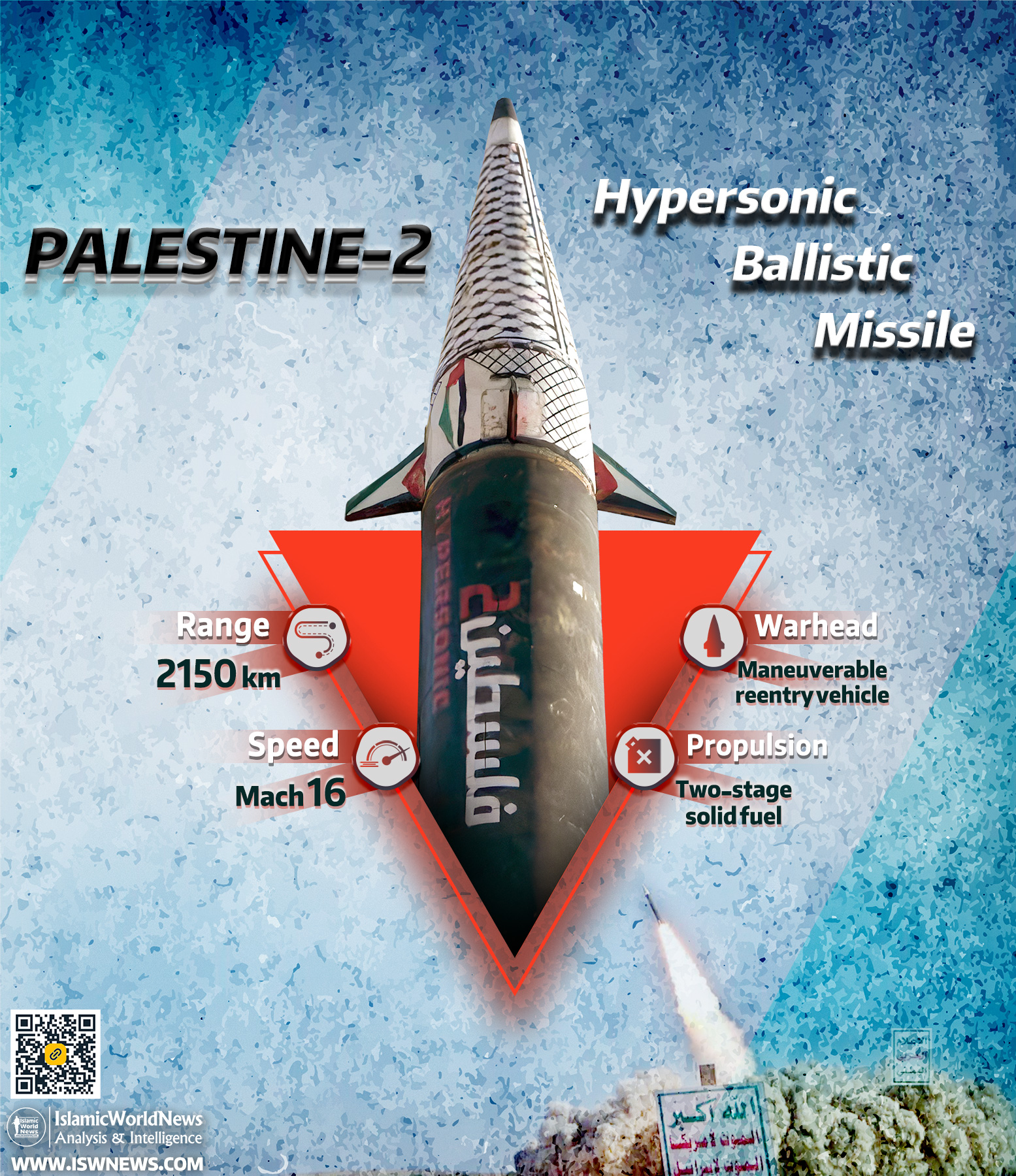
    Palestine-2 hypersonic missile, is a two-stage solid-fueled missile with a speed of Mach 16, and its warhead is capable of maneuvering inside atmosphere.

    The Palestine 2 missile is Yemen’s adaptation of the Iranian Kheibar Shekan 2 missile. To enhance its capability to strike deeper into Israeli-occupied territories, Yemen has reduced the missile’s warhead weight and extended its range to 2,150 kilometers.

    Palestine-2 missile

    In general, the Palestine and Hatem class missiles of the Yemeni army are derived from the Iranian Kheibar Shekan 1 and 2 missiles.

    The Hatem 1 and 2 missiles have a three-cone warhead similar to the Iranian Kheibar Shekan-1 missile, and the Palestine 1 and 2 missiles have a single-cone warhead derived from the Iranian Kheibar Shekan-2 missile.

    The range of the Palestine-1 missile is 1,800 kilometers, like the Iranian Khaybar Shekan-2. However, the range of the Palestine-2 missile has been slightly increased to about 2,150 kilometers.

    Download the high quality poster of Palestine-2 missile

  • Latest Statistic Of Israeli Aggression On Gaza; Day 280

    Latest Statistic Of Israeli Aggression On Gaza; Day 280

    The Information Office of the Palestinian Authority in the Gaza Strip announced the latest statistics of martyrs, wounded and damages of the war in the Gaza Strip.

    The statistics are as follow:

    • The Israeli regime committed 3,388 massacres in the Gaza Strip during the 280 days of war.
    • So far, 48,345 people were martyred and missing in the Gaza Strip.
    • 10,000 people are missing and 38,345 people were martyred and their bodies were taken to hospitals.
    • 16,054 of the martyrs are children.
    • 34 of these children died as a result of starvation.
    • 10,700 of the martyrs are also women.
    • 500 medical staff were killed.
    • 75 people of rescue and relief forces were martyred.
    • 158 journalists were martyred.
    • The Israeli regime has created 7 mass graves inside the hospitals of the Gaza Strip. The bodies of 520 martyrs were found in these seven mass graves.
    • 159 refugee centers have been attacked by the Israeli regime.
    • 88,295 people have been injured so far.
    • 70% of the victims of this war are women and children.
    • 17,000 children lost their parents or one of them since the beginning of the war.
    • 3,500 children are at risk of death due to malnutrition and lack of medicine.
    • 12,000 wounded need to be sent abroad for treatment.
    • 10,000 cancer patients are struggling with death.
    • 3,000 people suffering from various diseases need to be sent abroad.
    • 1,737,524 were infected with infectious diseases due to displacement.
    • 71,338 people were infected with liver inflammation due to displacement.
    • About 60,000 pregnant women are at risk due to the lack of medical care.
    • 350,000 people with chronic diseases are at risk due to the lack of medicine.
    • Since the beginning of the war, 5,000 people have been arrested in the Gaza Strip.
    • 310 of those arrested are from medical and therapeutic staff.
    • So far, 23 journalists have been arrested.
    • Two million people were displaced and homeless in the Gaza Strip.
    • 197 government center was completely destroyed.
    • 115 universities and schools have been completely destroyed.
    • 328 other universities and schools were also damaged.
    • 609 mosques have been completely destroyed.
    • 211 other mosques were also damaged.
    • The occupiers have bombed and destroyed 3 churches.
    • 150,000 residential units are completely destroyed and uninhabitable.
    • Another 200,000 residential units have also been damaged.
    • Since the beginning of the war, 80,000 tons of explosives have been dropped on the people of Gaza.
    • 34 hospitals are completely out of service.
    • 66 health and treatment centers are also out of service.
    • The invaders targeted 161 medical centers.
    • 131 ambulances have also been targeted.
    • 206 historical and ancient places have been targeted and destroyed.
    • The Israeli regime destroyed 3,030 km of the electricity grid in the Gaza Strip.
    • The initial direct damage of the war is estimated at 33 billion dollars.
    Latest statistic of war in Gaza; day 280 – click to view full size
  • Military Knowledge: Shahed-238 Suicide Drone; Advanced Version Of Shahed-136 Equipped With Jet Engine

    Military Knowledge: Shahed-238 Suicide Drone; Advanced Version Of Shahed-136 Equipped With Jet Engine

    The Shahed-238 suicide drone was first unveiled informally in October 2023 in the Parchamdar (Flagship) Documentary. This drone has a similar platform and the same dimensions to the Shahed-136, but the fundamental difference is the use of a mini-turbojet engine instead of a piston engine.

    The Shahed-136, despite its low radar cross-section (RCS), due to its piston engine, low speed, and distinctive loud noise, provided the enemy’s air defense systems and even ground forces with enough time to identify it. However, the use of a turbojet engine in the Shahed-238, while increasing the speed and reducing the noise, along with the drone’s specialized airframe, provides much better protection against heavy machine guns and anti-aircraft cannon, improving the overall success rate of the drone.

    Read more: Military Knowledge: Shahed-136 Loitering Munition

    A video of the flagship documentary in which the new version of Shahed-136 (now, known as Shahed-238) with micro-turbojet engine can be seen.

    Examination of the available turbojet engines produced in Iran, as well as images of the Russian version of this drone from the Ukraine war, suggests the likelihood of using the Toloue-10 engine on the Shahed-238 drones.

    The Tolou-10 turbojet engine with a thrust of 1100 to 1200 Newtons increases the speed of the Shahed-238 to 500 to 600 kilometers per hour.

    The change in propulsion and engine design increases the weight of the drone. The piston engine MD550 or a similar engine used in the Shahed-136 weighs 17.59 kilograms, while the Toloue-10 turbojet engine weighs around 20.5 kilograms. Additionally, the placement of the micro-turbojet engine within the airframe reduces the space available for carrying fuel. Modifications have also been made to the upper part of the fuselage to accommodate the air intake, which further increases the weight and reduces the drone’s fuel carrying capacity. The fuel type has also been changed from gasoline to Jet-A, primarily due to the fuel requirements of the new engine.

    All of these factors, in addition to the increased speed, mean a reduction in the endurance of this drone. It is worth noting that with the changes made, the maximum takeoff weight has increased from 250 kilograms to 380 kilograms.

    Air intake for the micro turbojet engine in the Shahed-238 drone

    This is not the first time the Toloue-10 engine has been used in Iranian drones. In the past, the Toloue-10 engine had also been used on the Shahed-191 drone.

    Read more: Military Knowledge: Shahed 171 (Simorgh) And Shahed Stealth Drones Family

    The use of a jet engine, while turning the Shahed-238 into a fast suicide drone, also has its disadvantages. The piston engine of the Shahed-136 has a very low thermal signature, which made it difficult for infrared-guided missiles like shoulder-launched missiles to lock onto the drone. However, with the change from a piston to a jet engine, more heat is generated, making it easier for infrared-guided missiles to lock onto the drone.

    Shahed-238 variants:

    The jet-powered Shahed-238 suicide drone has been displayed in three classes so far: a basic and standard model, a model equipped with an imaging infrared (IIR) seeker in the nose, and a model (possibly) equipped with a passive anti-radar seeker.

    From right to left: the model equipped with an imaging infrared seeker in the nose, the basic and standard model, and the model equipped with a passive anti-radar seeker.

    The standard version of the Shahed-238 drone, like the Shahed-136, is equipped with inertial and satellite guidance and is used to attack fixed ground targets.

    The model equipped with a thermal seeker is guided by inertial and satellite navigation to the target area and uses the seeker in the final dive phase to select and lock onto the target. The use of the imaging infrared seeker in the nose significantly increases the accuracy and allows the drone to be used against moving targets as well.

    Shahed-238 equipped with thermal seeker

    The model equipped with a passive anti-radar seeker is used to suppress the enemy’s radar systems. In this version, the drone enters the target area using inertial and satellite guidance, and then the anti-radar seeker, after detecting radar signals, locks onto the enemy’s radar systems or radio towers and attacks them.

    Shahed-238 equipped with anti-radar seeker

    It should be noted that the leaked documents show that a drone similar to the Shahed-238, which has been supplied by Iran to Russia and is being produced in that country, is known as the M-237 in the Russian Federation.

    After the release of these documents, due to the presence of thermal seekers in the Russian drones, some people mistakenly thought that this drone was a new and different version of the Shahed-238, and therefore the name of the Iranian drones equipped with thermal seekers is also Shahed-237. However, it should be noted that according to the official information published by Iran, the official name of all versions of this drone is the Shahed-238, and only the exported or licensed version is known as the M-237, which can be renamed again in the destination country. Changing the name of exported weapons is a common and normal practice in Iran’s military industries.

    All the information published in these documents is almost completely consistent with the information presented on the banner of the Shahed-238 drone at the Iranian National Aerospace Park. But an interesting point that was not available before is that the thermal seeker-equipped version of this drone, in addition to the ability to attack ground targets, also has the ability to attack air targets such as drones. The leaked document shows that the Shahed-238, or the M-237, has locked onto a US MQ-9 Reaper drone.

    In addition to all the mentioned models, there is another version of the Shahed-238 drone that has been displayed in one of the promotional videos, but has not been exhibited in any exhibitions so far and no information about it is available. In this model, the Shahed-238 is equipped with an electro-optical camera under the nose. One can speculate that the features of this drone are similar to other Shahed-238 models, and the only difference is the version of camera. Therefore, this model, in addition to the capability of being a suicide drone, also has reconnaissance and surveillance capabilities, and helps the operator in selecting visual targets.

    Shahed-238 equipped with an electro-optical camera

    Due to the use of a jet engine and increased power, the flap actuators (high-lift devices) also need to be reinforced. For this reason, the Shahed-238 uses eight actuators on the wings, while the Shahed-136 had four actuators on its wings.

    The difference between the actuators in Shahed-238 and Shahed-136

    According to the available information, the maximum takeoff weight of the Shahed-238 drone is around 380 kilograms, and it is equipped with a 50-kilogram warhead.

    The launch and take-off method of the Shahed-238 drone is similar to the Shahed-136. This drone can be launched with the help of a vehicle or using a rocket booster (JATO). There are also speculations about the launch of this drone from fighter jets, which, given the limitations of this task, will most likely remain speculative. However, if this is true, the limitation of the reduced range of this drone compared to the Shahed-136 model will also be eliminated.

    Specifications of Shahed-238 suicide drone:
    Type: Suicide drone
    Country of Origin: Iran
    Unveiled: 2023
    Length: 3.5 meters
    Wingspan: 3 meters
    Engine: Toloue-10 jet engine
    Range: up to 1200 km
    Speed: up to 600 km/h
    Impact speed: + 700 km/h
    Flight ceiling: 30 thousand feet (9144 meters) (equivalent to Shahed-191)
    Flight endurance: 2 hours
    Guidance system: GPS/INS – GNSS
    Warhead weight: 50 kg
    Max take-off weight: 380 kg
    Launch platform: JATO or vehicle-assisted
    Landing type: With parachute

    Shahed 238 suicide drone – click to view in larger size

    More images of Shahed 238 suicide drone:

    Shahed-238 posters in Persian, Russian, Chinese, Arabic and Hebrew:

  • Infographic: Saudi Coalition And US Aircraft Losses In Yemen War

    Infographic: Saudi Coalition And US Aircraft Losses In Yemen War

    1- Saudi F15S fighter on March 27, 2015, Gulf of Aden
    2- Saudi AH-64D helicopter on May 7, 2015, Al-Boqa, Saada area
    3- Moroccan F16C fighter on May 10, 2015, Wadi Nashur
    4- Saudi Seeker400 UAV, July 3, 2015, Al-Boqa
    5- Saudi AH-64D helicopter, August 5, 2015, Jizan
    6- Saudi AH-64D helicopter, August 21, 2015, Jizan
    7- UAE Schiebel Camcopter S-100, August 25, 2015, Makiras, Abyan Province
    8- UAE Schiebel Camcopter S-100, October 25, 2015, Al-Abdiyah, Marib Province
    9- Bahrain F16C fighter, December 30, 2015, Jizan
    10- UAE MQ-1 Predator UAV, January 19, 2016, Sanaa
    11- Saudi Selex ES Falco UAV, February 3, 2016, Midi, Hajjah province
    12- UAE Schiebel Camcopter S-100, February 27, 2016, Dhubab, Taiz province
    13- UAE Mirage 2000 fighter, March 13, 2016, Al-Bariqa, Aden
    14- UAE AH-64D UAE helicopter, June 12, 2016, Gulf of Aden
    15- UAE NSA407 helicopter, June 13, 2016, Al-Bariqa, Aden
    16- Saudi AH-64D helicopter, July 25, 2016, Beer Al-Maraziq, Al-Jawf
    17- Saudi Seeker400 UAV, August 16, 2016, Kataf, Saada province
    18- UAE Wing Loong UAV, September 26, 2016, Kholan, Sanaa province
    19- Saudi AH-64D helicopter, December 30, 2016, Najran
    20- US V-22 Osprey Helicopter, January 29, 2017, Al-Baydha province
    21- Saudi SA 365F Helicopter, January 30, 2017, Al-Hudaydah coast (on the Al-Madinah frigate)
    22- UAE MQ-1B Predator UAV, February 14, 2017, Al-Manin, Marib province
    23- Jordanian F16A fighter, February 24, 2017, Najran
    24- Saudi S-70A helicopter, April 18, 2017, Marib province
    25- UAE Schiebel Camcopter S-100, June 21, 2017, Dhubab, Taiz province
    26- UAE AH-60L helicopter, August 11, 2017, Wadi Amaqin, Shabwa province
    27- Saudi Seeker 400 UAV, August 15, 2017, Al-Boqa, Saada province
    28- US UH-60M helicopter, August 25, 2017, Gulf of Aden
    29- UAE AT-802U aircraft, September 11, 2017, Gulf of Aden
    30- Saudi Eurofighter Typhoon fighter, September 13, 2017, Abyan province
    31- US MQ-9 UAV, October 1, 2017, Sanaa city
    32- UAE AH-64D Helicopter, October 17, 2017, Khab and Shaaf, Jawf province
    33- Saudi S-70A helicopter, November 5, 2017, Abha
    34- Saudi Panavia Tornado fighter, January 7, 2018, Kataf, Saada province
    35- Saudi F-15S fighter, March 21, 2018, Saada province
    36- Saudi CH-4B UAV, July 12, 2018, Al-Rabu’ah
    37- Saudi Panavia Tornado fighter, July 12, 2018, Asir
    38- Saudi CH-4B UAV, August 30, 2018, Jizan
    39- UAE Schiebel Camcopter S-100, September 2, 2018, Al-Jah, Hudaydah province
    40- Saudi AH-64D helicopter, September 14, 2018, Al-Mahra province
    41- Seeker 400 UAE UAV, November 26, 2018, Al-Jabaliya, Hudaydah province
    42- Saudi CH-4V UAV, December 23, 2018, Saada province
    43- US MQ-9 UAV, June 6, 2019, Hudaydah province
    44- Saudi CH-4B UAV, April 11, 2019, Hadhramaut province
    45- UAE Wing Loong, April 19, 2019, Saada province
    46- UAE RQ-1E Predator UAV, May 15, 2019, Bani Matar, Sanaa
    47- UAE Schiebel Camcopter S-100, June 2, 2019, Hays, Hudaydah area
    48- US MQ-9 UAV, August 21, 2019, Dhamar province
    49- US MQ-9 UAV, March 23, 2021, Marib province
    50- UAE Shiebel Camcopter S-100, November 1, 2019, Raas Issa, Hudaydah province
    51- Saudi AH-64D helicopter, November 29, 2019, Asir
    52- Saudi Wing Loong UAV, November 30, 2019, Hayran, Hajjah province
    53- Saudi Luna X2000 UAV, December 4, 2019, Saada province
    54- Saudi Karayel UAV, December 30, 2019, Al-Salif, Hudaydah province
    55- Saudi CH-4V UAV, January 7, 2020, Khab and Shaaf, Jawf province
    56- Saudi Panavia Tornado fighter, February 14, 2020, Jawf province
    57- Saudi RQ-20 UAV, August 2, 2021, Haradh, Al-Hajjah province
    58- Saudi CH-4B UAV, December 21, 2020, Marib Province
    59- Saudi Karayel UAV, January 6, 2021, Jawf province
    60- Saudi CH-4B UAV, February 12, 2021, Marib province
    61- Saudi Karayel UAV, March 7, 2021, Jawf province
    62- Saudi CH-4B UAV, March 23, 2021, Sarwah, Marib province
    63- Saudi Wing Loong UAV, May 21, 2021, Najran
    64- Saudi CH-4B drone, May 23, 2021, Jawf province
    65- Saudi Scan Eagle UAV, June 19, 2021, Marib province
    66- Saudi Scan Eagle UAV, June 21, 2021, Marib province
    67- Saudi Scan Eagle UAV, August 14, 2021, Madghal, Marib province
    68- Saudi Wing Loong UAV, September 13, 2021, Kataf, Saada province
    69- Saudi Scan Eagle UAV, September 27, 2021, Madghal, Marib province
    70- Saudi CH-4 UAV, October 6, 2021, Jubah, Marib province
    71- Saudi RQ-20 UAV, October 7, 2021, at the Jizan border
    72- Saudi Scan Eagle UAV, November 9, 2021, Al-Juba, Marib province
    73- Saudi Scan Eagle UAV, November 13, 2021, Al-Juba, Marib province
    74- Saudi CH-4 UAV, December 1, 2021, in Al-Amshia area, Amran province
    75- Saudi Scan Eagle UAV, December 4, 2021, Al-Juba, Marib province
    76- Saudi Scan Eagle UAV, December 8, 2021, Al-Juba, Marib province
    77- Saudi CH-4 UAV, December 8, 2021, Al-Wadi, Marib province
    78- Saudi Scan Eagle UAV, December 10, 2021, Sarwah, Marib province
    79- Saudi CH-4 UAV, December 14, 2021, Usaylan, Shabwa province
    80- Saudi Scan Eagle UAV, December 16, 2021, Al-Wadi, Marib province
    81- Saudi Scan Eagle UAV, December 25, 2021, Yatmah, Khab and Al-Shaaf, Al-Jawf province
    82- UAE Wing Loong UAV, January 5, 2022, Usaylan, Shabwa province
    83- UAE Wing Loong UAV, January 11, 2022, Ain Shabwah province
    84- Saudi Scan Eagle UAV, January 29, 2022, Al Juba, Marib Province
    85- Saudi CH-4 UAV, February 10, 2022, Harad, Hajjah province
    86- UAE MQ-1 UAV, February 25, 2022, Al-Jawf province
    87- Saudi Scan Eagle UAV, February 25, 2022, Al Juba, Marib Province
    88- Saudi Scan Eagle UAV, February 28, 2022, Harad, Hajjah province
    89- Saudi Scan Eagle UAV, March 8, 2022, Harad, Hajjah province
    90- Saudi Scan Eagle UAV, March 29, 2022, Al-Wadi, Marib province
    91- Saudi CH-4 UAV, May 4, 2022, Harad, Hajjah province
    92- Saudi Karayel UAV, May 21, 2022, Hayran, Hajjah province
    93- Saudi CH-4 UAV, May 23, 2022, Sana’a, Sana’a province
    94- Saudi Wing Loong UAV, May 24, 2022, Kataf, Saada province
    95- US MQ-9 drone, November 8, 2023, Hudaydah province
    96- US MQ-9 drone, February 19, 2024, north of Hudaydah province
    97- US MQ-9 drone, April 25, 2024, Saada province
    98- UAE Wing Loong 1 drone, April 29, 2024, Al-Rawdha district, Shabwah province
    99- US MQ-9 drone, May 16, 2024, Al-Wadi district, Marib province
    100- US MQ-9 drone, May 21, 2024, Al Bayda province
    101- US MQ-9 drone, May 29, 2024, Marib province

    (Last update on 29 May 2024)

    Click to view full size
  • ISIS Carried out 129 Operations In Syria So Far This Year

    ISIS Carried out 129 Operations In Syria So Far This Year

    ISIS terrorists have carried out 72 attacks against the Syrian Democratic Forces (SDF), 41 attacks against the Syrian army forces, 7 attacks against Iran-backed forces, and 9 attacks against Syrian civilians, most of which took place in the Deir ez-Zor Governorate and the desert of Homs Governorate.

    In total, ISIS terrorists targeted 400 individuals, both military and civilian, in various operations. Among these individuals, 192, including 119 Syrian soldiers, 35 SDF forces, 11 Iran-backed forces, and 5 Syrian National Defense Forces members lost their lives. Additionally, 208 individuals, including 46 SDF forces, 146 Syrian soldiers, and 6 Iran-backed forces, were injured during these terrorist attacks.

    It is vital to mention that since the beginning of the year 2024, the number of ISIS operations in Syria has increased compared to 2023. The ISIS group has conducted terrorist attacks against SDF forces, the Syrian army, and their allies to prove that it is an organized entity. Despite continuous operations and clearing of various areas in Syria, ISIS has maintained its operational capabilities.

    Click to view full size
  • Military Knowledge: Azarakhsh Air Defense System

    Military Knowledge: Azarakhsh Air Defense System

    The Azarakhsh defense system is very agile and, considering its dimensions, components, and overall weight, it can be installed on various vehicles and deployed against aerial targets from any location in the shortest possible time.

    When it comes to the detection and tracking section, the Azarakhsh defense system simultaneously utilizes passive phased array radar with 360-degree coverage and an electro-optical and infrared imaging system for detecting and tracking targets. According to official sources, the radar detection range of the Azarakhsh defense system is reported to be 50 kilometers, and the electro-optical and thermal system has a range of 25 kilometers.

    In the missile section, as the name suggests, this system uses four ready-to-launch ‘Azarakhsh’ air-to-air missiles, which now acts as a surface-to-air missile for target destruction.

    The Azarakhsh missile, also known as the Iranian Sidewinder, is a missile with a “fire-and-forget” capability, requiring no guidance after launch. It utilizes an infrared search and track (IRST) system in its nose cone to be able to engage targets. It should be noted that due to the change in the missile’s performance from air-to-air to surface-to-air, the structure of its infrared search and track system has likely undergone changes.

    The Azarakhsh missile has four movable fins at the missile head and four fixed stabilizing fins at the rear section. The end sections of rear fins are also movable.

    Based on the provided information, the maximum range of the Azarakhsh missile system is 10 kilometers, and its infrared search and track system locks onto targets within a 6-kilometer range. The total weight of the missile is 70 kilograms, and its warhead is high-explosive fragmentation (HE-frag) type weighing approximately 4.5 kilograms. The length and diameter of the Azarakhsh missile are 3000 and 127 millimeters, respectively.

    The Azarakhsh missile’s propulsion system has not been disclosed so far, but based on the released video of the missile’s launch, it can be speculated that its solid fuel propulsion system has also undergone improvements compared to previous versions of the Azarakhsh missile, making it more advanced. The speed of this missile is estimated to be around Mach 1.8.

    It is worth mentioning that this system is capable of operating in various weather conditions and at any time of day or night, and it can be linked with other Iranian air defense systems.

    Video of live test and performance of Azarakhsh air defense system

    Specifications of Azarakhsh air defense system:
    Type: fully mobile short-range low-altitude air defense system
    Origin: Iran
    Manufacturer: Defense Industries Organization (Sâzmân-e Sanâye’-e Defâ’ – SASAD)
    Unveiled: 17 February 2024
    Radar detection range: 50 km
    Electro-optical tracking range: 25 km
    Ready to launch missiles: 4 missiles
    Azarakhsh missile:
    Length: 3000 mm
    Diameter: 127 mm
    Missile weight: 70 kg
    Warhead weight: 4.5 kg HE-Frag
    Range: 10 km
    Speed: Mach 1.8

    Azarakhsh short-range air defense system – click to view in full size

    Infographics of Azarakhsh air defense system in Russian and Farsi: