On October 18, Iraqi resistance groups announced the formation of a joint operations room named Tufan al-Aqsa (Al-Aqsa Storm) in Iraq to carry out their religious duty and support the Operation Al-Aqsa Storm in the Gaza Strip.
After the announcement was released, the Tashkil al-Waritheen resistance group declared that at 12 pm on Wednesday, the US military headquarters at Al-Harir Air Base in northeastern Erbil, were targeted by a drone attack by their group.
Statement of the Joint Operations Room in Iraq
In addition to the attack, the Tashkil al-Warithin resistance group has a record of drone attacks on American terrorists’ positions in Kuwait as well as in Homs Governorate in Syria.
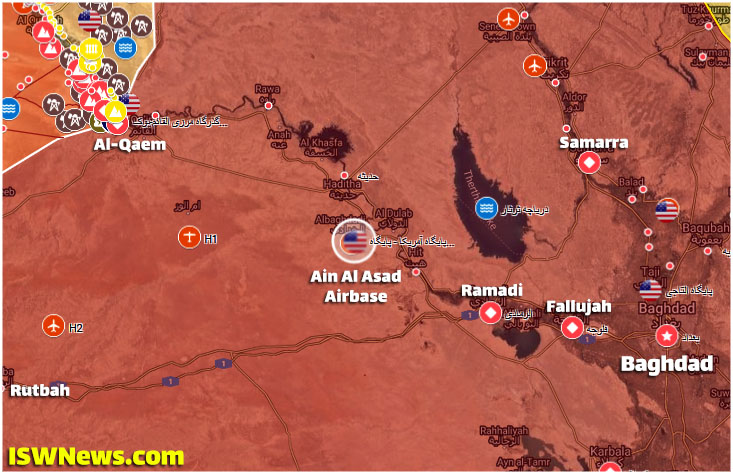
According to this report, two US officials in a conversation with Reuters stated that the US military foiled a drone attack against US forces at the Ain al-Asad airbase. The attacking drones reportedly were intercepted and destroyed before hitting the targets.
Hours after this attack, the Iraqi resistance took responsibility for the attack.
The Iraqi resistance released the video of the launch of drones on Ain al-Asad Air Base.
This attack took place hours after last night’s Israeli attack on al-Ma’amadani (al-Ahli) hospital in Gaza, which resulted in the death of at least 500 civilians. After this incident, widespread protests were sparked worldwide against Israel’s crimes against the Gaza Strip, and people of different countries took to the streets and expressed their protest and anger towards the Zionist regime of Israel and its supporter, the United States.
The attack of Iraqi resistance groups on the Ain al-Asad Air Base was also an attempt to retaliate for Israel’s crime last night.
Considering the tense situation in the region and people’s anger at Israel’s crimes, it seems that in the coming days we will see an increase in these attacks against America and even Israel at the regional level.
According to the Ministry of National Defense, the Turkish soldier was injured during a clash with PKK forces on September 11 in northern Iraq and succumbed to his injuries on October 5.
Consequently, the number of casualties among the Turkish army personnel in the Operation Claw-Eagle, which began on April 18, 2022, has increased to 88. The Operation Claw-Eagle was launched by orders of former Turkish Defense Minister Hulusi Akar to demolish PKK militants in northern Iraq.
Following the terrorist attack in front of the Turkish Interior Ministry and accepting responsibility for the operation by the PKK, Turkiye’s Ministry of National Defense announced an attack on Kurdistan Workers’ Party hideouts in the north of the neighboring country.
According to reports published by some Turkish media outlets, Turkish warplanes bombed and destroyed about 20 headquarters belonging to the Kurdistan Workers’ Party in northern Iraq on Sunday evening.
Turkiye’s Ministry of National Defense announced that the Turkish armed forces will continue to fight terrorism in order to preserve the security of the nation and its borders.
The Turkish Interior Ministry in Ankara was targeted in a terrorist attack by two members of the PKK group on Sunday, which came to an end when both attackers were killed and two Turkish police officers were wounded.
ISWNews Analysis Group – The Dutch government has stated that within the framework of the North Atlantic Treaty Organization’s presence in Iraq, at least 120 soldiers and three military helicopters will be deployed to the Arab country.
The main responsibility of the Dutch forces will be logistical support, including providing food for the NATO troops, and the deployed helicopters will be used for the transportation of personnel and equipment.
It is worth mentioning that in June 2022, the Dutch government approved the deployment of 145 soldiers to Iraq by the start of November 2023.
It is noteworthy that on August 17, 2023, the North Atlantic Treaty Organization announced that it will increase its military activities in Iraq at the official request of the Iraqi government.
According to the decision of the North Atlantic Council (NAC), in addition to advisory missions, NATO’s mission in Iraq will also include capacity-building in support of the Ministry of Interior and the Federal Police Command in Iraq.
It should be noted that the NATO office in Baghdad was established in 2018 and announced its goal of providing advisory and capacity-building mission to Iraqi military and security officials in the Ministry of Defense, National Security Adviser Office, National Operations Center (affiliated with the Prime Minister’s Office). Under the cover of these missions, the NATO member countries are slowly and smoothly implementing their destructive plots against Iraq’s national security and resistance groups.
Considering the destruction of ISIS caliphate and also the increase in the capabilities of the Iraqi armed forces in the fight against terrorist groups, the increase or continuation of the presence of NATO troops in Iraq is illogical, and it seems that NATO activitues are in line with the destructive goals of the Western countries against the regional countries and the axis of Resistance,
1- Baghdad: The Iraqi National Intelligence Service (INIS) announced the demolition of a dangerous terrorist group in capital Baghdad and the arrest of its elements. The members of this terrorist team, who were elements of the ISIS terrorist group, intended to carry out suicide operations in Mawakibs (special makeshift places for providing pilgrims of Imam Hussain’s holy shrine with necessary items particularly during Arbaeen pilgrimage), police centers, checkpoints, and markets in Baghdad.
2- Sulaymaniyah: On September 18, a Turkish drone targeted the Arbat airport located in Sulaymaniyah city in the east of the Kurdistan Region of Iraq, which left at least three people dead and three others injured.
3- Al Anbar: Some tribal leaders and commanders of the Popular Mobilization Forces in Al Anbar Governorate of Iraq announced that this western province is not ready to accept anti-Iranian armed groups.
4- Kirkuk: The Iraqi Joint Operations Command declared the destruction of a hideout belonging to the ISIS terrorist group by F-16 fighter jets of the Iraqi army in the operational environment of Kirkuk Governorate.
5- The Al-Rusafa Central Criminal Court issued a death sentence for the perpetrator of the 2022 explosion in Al-Taji rural town (north of Baghdad), which took place on the route of Samarra’s pilgrims. According to the announcement of the Supreme Judicial Council of Iraq, the perpetrator of the explosion, who was a member of the ISIS terrorist group, filmed the aftermath of the blast following the terrorist incident.
6- Minister of Defense and Armed Forces Logistics of Iran Brigadier General Mohammad Reza Ashtiani referred to a security agreement between Tehran and Baghdad on disarming and expelling of terrorists from Iraqi Kurdistan region, saying that the Islamic Republic does not accept any extension of the deadline for the implementation of the accord; so, we will act based on the security agreement in due time.
7- An informed source in the government of Kurdistan region of Iraq claimed in an interview with Deutsche Welle (Germany’s state-owned international broadcaster) that after three decades, the Democratic Party of Iranian Kurdistan (HDK) has left its main headquarters in Koy Sanjaq also known as “Democrat Castle”.
On September 18, a Turkish drone targeted the Arbat airport in Sulaymaniyah city in the east of the Kurdistan Region of Iraq, during which at least three people were killed and three others were injured.
The United Nations Assistance Mission for Iraq (UNAMI) condemned the attack on the Arbat airport in Sulaymaniyah and called for the resolution of security issues through dialogue.
No individual or group has claimed responsibility for this attack so far, but spokesman for Commander-In-Chief of the Iraqi Armed Forces Major General Yahya Rasool announced that a drone entered Iraq’s air space from the Turkish border and bombed the Arbat airport in Sulaymaniyah of Iraq’s Kurdistan region at 17:00 on Monday.
He went on to say that this drone attack is a violation of Iraq’s sovereignty and territorial integrity, which threatens peace and security in the region and the world; so, it is a violation of international laws and the United Nations Charter.
The informed source also claimed in an interview with Deutsche Welle that the KDPI left behind its main headquarters in the Koysinjaq town dubbed “Democratic Castle” after three decades of being stationed there.
It is said that Komala Kurdistan Party and the Komala of the Toilers of Kurdistan have also retreated from their positions in Iran-Iraq border areas.
Following the withdrawal of anti-Iran armed groups, Iraqi National Security Advisor Qasim al-Araji, heading a high-level security delegation traveled to Erbil on September 18 in a bid to follow up on the implementation of a security agreement between Tehran and Baghdad.
This visit was carried out on the orders of Prime Minister and Commander-in-Chief of the Iraqi Armed Forces Mohammed Shia’ al-Sudani.
Simultaneously, Iranian armed forces deployed armored, artillery, missile, drone, and helicopter units to the country’s northwestern borders.
Less than 24 hours remain until the end of the deadline determined by Iran, in particular the Ground Forces of the Islamic Revolution Guards Corps’ (IRGC) ultimatum to disarm all terrorists in the Kurdistan Region of Iraq; if the Iraqi government fails to act according to the terms of the security agreement with Iran, the Iranian armed forces will initiate operations against anti-Iran armed groups stationed in the Kurdistan Region of Iraq.
On September 17, Brigadier General Mohammad-Reza Gharaei Ashtiani, Iran’s Minister of Defense and Armed Forces Logistics, referred to the agreement between Iran and Iraq to disarm and expel terrorists from the Kurdistan region, noting that the Islamic Republic will not extend the deadline, and that Tehran will act according to the agreement we made at due time.
In an interview with Iran newspaper, Ashtiani pointed to the actions taken by Iraq in this respect, stating that some actions have been taken; we will evaluate in the last minute and make a decision based on the evaluation.
The statements come as in recent days, armored units, artillery, missiles, drones, and helicopters of the Ground Forces of the Islamic Revolution Guards Corps (IRGC) have been deployed to the northwestern borders of the country.
Earlier, Brigadier deputy commander for operations of the Islamic Revolution Guards Corps (IRGC) General Abbas Nilforoushan, emphasized that September 19 is the deadline for the Iraqi government to disarm terrorist groups in the Kurdistan region of Iraq.
The National Intelligence Service of Iraq announced the destruction of a dangerous terrorist gang in Baghdad and the arrest of its members.
The members of this team, who were elements of the ISIS terrorist group, intended to carry out suicide operations in Arbaeen processions, police centers, checkpoints and markets in Baghdad.
While there are talks about the plan to transfer anti-Iranian terrorist groups to the far west of Iraq in Anbar province, the representatives and heads of tribes and commanders of Hashd al-Shaabi (PMU) in this province emphasized their opposition to this plan.
The representatives, heads of tribes and commanders of the Popular Mobilization Organization in Anbar province of Iraq emphasized that this province is not ready to accept a new problem and the transfer of anti-Iran armed groups to this province.
Abdul Wahab Al-Bilawi, a member of the Anbar Tribal Sheik Council, also stated that such a plan is completely rejected and absolutely unacceptable and added: “We do not want the province to be involved in international conflicts, while these militants cause security problems in the province.”
These words were mentioned while the Iraqi Foreign Minister, Fuad Hussein, stated yesterday before his visit to Iran, that the Iraqi government has started the process of transferring anti-Iranian armed groups from areas close to Iran’s borders to camps far from the border as part of the security agreement between Tehran and Iran.
It is worth mentioning that the Iran’s deadline for the Iraqi government to disarm terrorist groups in the Kurdistan region ends on September 19, 2023.
Recently, the deputy commander of the IRGC said in an interview with an Iranian media outlet that “we [Iran] expect from our brothers in the Kurdistan region to show brotherliness, because providing terrorists with safe haven in that region, which has become a source of operations against our country, is not consistent with brotherliness or good neighborliness.”
In this regard, Iraqi Foreign Minister Fuad Hussein arrived in Tehran on September 13 and met and discussed with Hossein Amirabdollahian, Minister of Foreign Affairs of Iran. Fuad Hussein emphasized that the central government of Iraq has fully committed to the Iran-Iraq security agreement and the border security program and the withdrawal of terrorists from the border areas will be carried out by September 15.
The deputy commander of the IRGC said in an interview with an Iranian media outlet that we expect from our brothers in the Kurdistan region to show brotherliness, because providing terrorists with safe haven in that region, which has become a source of operations against our country, is not consistent with brotherliness or good neighborliness.
After uninterrupted negotiations, we finally signed an agreement with the central government in Baghdad as well as the Kurdistan region, and the deadline of the accord to become operational is on September 19 in terms of scheduling and agreed-upon provisions, he argued.
The brigadier general went on to say that we are committed to all the provisions of the agreement, not one word less or one word more; thus, we expect the other party to also abide by the agreement in the same way as the Islamic Republic of Iran has fulfilled its obligations. Otherwise, the situation will come back to its previous state, and we will be forced to protect the interests of the Iranian people, he warned.
It should be noted that some time ago, Chief of Staff of the Iranian Armed Forces Major General Mohammad Hossein Bagheri stated at a meeting with commanders of the Ground Forces of the Islamic Revolution Guards Corps that the Iraqi government has time up to September in order to eradicate separatist groups in the Kurdistan region of the Arab country.
Prime Minister of Iraq Mohammed Shia’ al-Sudani also emphasized the seriousness of his government to implement the provisions of the Tehran-Baghdad security agreement completely. He made the remark in a meeting with a delegation of senior managers from Iranian media outlets yesterday.
The Iraqi premier said that for various reasons, we as the Iraqi government feel obligated to address Tehran’s security concerns regarding terrorist activities, which are being committed from the Kurdistan region in Iraq. To this end, we have spent over $200 million on this issue and deployed more than 3,000 National Army forces along Iran’s borders and throughout the region, he noted.
In recent months, senior commanders of the Iranian armed forces have warned the Iraqi government and officials in the Kurdistan region of Iraq about the illegal and terrorist movements of certain outlawed groups.
Given the continued presence of anti-Iran armed groups in the Kurdistan region of Iraq as well as the Iraqi sides’ failure to make proper decisions and implement practical plans to expel or disarm terrorist groups from Iraq’s border areas, the Islamic Republic of reserves its rights to resort to all available capacities to establish security along its western borders after the end of the September 19 deadline.
Map of the distribution of terrorist groups in the western borders of Iran – click to view in full size