A central focus of these maneuvers is logistical and operational support for Israeli fighter jets. During the previous 12-day war between Iran and Israel, American tankers played a crucial role in refueling Israeli aircraft over Iraq and Syria, particularly in the airspace above Syria’s Deir ez-Zor province. Now, with at least 30 Boeing KC-46 Pegasus and KC-135 Stratotanker aircraft reportedly in the region, aerial refueling operations could take place even closer to Iran’s borders.
Although the issue of Israeli jets entering Iraqi airspace was discussed in a recent meeting between Iraq’s National Security Advisor Qasim al-Araji and Iranian military intelligence chief General Mirahmadi, the current U.S. deployment suggests refueling may occur near the Iran–Iraq border regardless.
If Iran’s air defense systems are suppressed or rendered ineffective, eastern Iran could become vulnerable to Israeli airstrikes. Refueled near the border, Israeli jets could target strategic sites deep inside Iran. There’s also a growing possibility of direct U.S. involvement, with American fighter jets and refueling support contributing to future operations. In such a case, a division of roles may emerge—with Israel attacking from the west and the U.S. from the south.
Another critical element is the ongoing surveillance by the U.S. Navy’s MQ-4C Triton drone over the Persian Gulf. These flights aim to gather real-time intelligence on Iranian military movements and air defense activity in the south. The Triton conducts radar and visual reconnaissance over Iran’s coastal zones, complementing broader strategic monitoring.
Overall, these developments suggest a shift toward a new phase of hybrid pressure against Iran—reminiscent of Western preparations prior to the 12-day war. While the exact timing of any escalation remains uncertain, the scale of U.S. deployments and the influx of weaponry into Israeli territory indicate that a new round of conflict may be inevitable.
Upon arrival, Larijani praised Lebanon’s role as a “strong barrier” against Israel, stating that the legacy of martyr Nasrallah has become increasingly evident. He condemned the recent Israeli attack on Doha, calling it a clear sign of the regime’s aggressive nature.
During his visit, Larijani is expected to meet with senior Lebanese officials to discuss bilateral ties and regional developments. Speaking to the media, he emphasized the importance of regional cooperation: “Our hope is for strong, independent governments. In the face of Israeli conspiracies, countries in the region must work together and set aside their differences.”
He also voiced support for Sheikh Naim Qassem’s outreach to Saudi Arabia, describing it as a constructive step for Lebanon’s stability. “Saudi Arabia is a brotherly Muslim nation, and we’ve held consultations. Sheikh Qassem’s initiative is aimed at easing tensions and improving conditions for the Lebanese people.”
Responding to claims of Iran’s continued support for Hezbollah, Larijani dismissed the accusations as politically motivated. “I believe Mr. Barak made that statement out of anger. Hezbollah is strong enough not to depend on external arms.”
Larijani criticized U.S. involvement in Lebanon’s internal affairs, asserting that decisions should be made by the Lebanese themselves. “Would a proud Lebanese citizen accept losing their interests under American pressure? That’s for the people of Lebanon to decide.”
On the possibility of conflict, Larijani warned that Iran is prepared for any scenario. “I don’t think the Israelis would act recklessly. But if they attack Iran, they will receive a firm response.”
A summary of the most important points is as follows:
The 12-Day War “The enemy’s primary goal was not merely to target military commanders — that was just a means. They believed that by assassinating military leaders and influential figures, unrest would erupt, especially in Tehran, where their agents would incite chaos and draw people into the streets to act against the Islamic Republic. Their ultimate aim was to destabilize the system, provoke street riots, mobilize factions, and uproot Islam from the country. This plan failed in its early stages. The unity and solidarity of the Iranian people during the 12-day war shattered the enemy’s hopes.”
Nuclear Energy and Negotiations with the U.S. “Under current circumstances — though things may change in 20 or 30 years — negotiating with the U.S. government does not serve our national interests. It brings no benefit and does not remove any harm. On the contrary, such negotiations today pose serious risks to the country, some of which may be irreversible. The American side has already predetermined the outcome: they want talks that end with Iran dismantling its nuclear activities and enrichment. That is not negotiation — it is dictation, it is imposition. Sitting down to negotiate with a party that insists the result must be exactly what they demand — is that really negotiation?!
We have not and will not surrender to pressure — not in this matter (uranium enrichment) nor in any other. The American side is adamant that Iran must abandon enrichment altogether. Previous administrations demanded we limit enrichment or not keep enriched material inside the country — which we also rejected. Now he [Trump] says there should be no enrichment at all. What does that mean? It means erasing a major national achievement — one that took immense effort, cost, and sacrifice. To abandon enrichment is to discard all that. Clearly, a proud nation like Iran will reject such demands outright.”
Built with reinforced concrete and steel, they are designed to withstand nearby explosions. In peacetime, these rooms can serve as bedrooms, storage spaces, or home offices—but in times of crisis, they become secure havens for residents.
The military is also considering upgrades such as emergency radio communication lines and thicker walls to enhance safety. Moshe Shlomo, head of engineering at Israel’s Home Front Command, emphasized that having such shelters inside homes offers immediate protection when warning sirens go off. Public shelters, he noted, are not always accessible, making in-home safe rooms a necessity.
However, this development carries deeper social and psychological consequences. Turning homes into bunkers signals a shift in Israel’s security paradigm—from relying on military deterrence to seeking refuge behind concrete walls. Over time, this could erode public confidence in the military’s capabilities and widen internal divisions.
This decision to build more shelters is not merely technical—it’s a clear sign that Israel is bracing for another round of conflict with Iran and its allies. The experience of the recent war convinced Tel Aviv that missile and drone threats are too severe to be countered by air defense systems alone.
Israeli officials are also concerned about the psychological toll of future wars. Civilian casualties in recent conflicts have intensified domestic pressure on the government and even triggered reverse migration from the occupied territories. By constructing in-home shelters, Israel hopes to reduce casualties and preserve public trust. In essence, these concrete rooms act as psychological shields to prevent the collapse of social cohesion during wartime.
Still, given the destructive power of Iranian ballistic missiles—capable of leveling several blocks—the real effectiveness of these shelters remains in question.
Maj. Gen. Amir Baram, Director General of the Defense Ministry, stated:
“Our recent military operation in Iran ended in a decisive Israeli victory, but further phases are imminent. Iran, feeling deeply humiliated, is rapidly investing in its defense capabilities—unlike Israel, where such decisions take longer to implement.”
Baram emphasized the financial burden of war, including costs for reserve troops, ammunition, and rehabilitation of wounded soldiers. He noted that:
Each strike on Yemen costs approximately ₪50 million ($15 million)
Total war expenditures have exceeded ₪205 billion ($61 billion)
A single Arrow-3 interceptor costs between ₪15–30 million ($4–9 million)
A failed interception, such as the Iranian missile strike on Bat Yam, can cause up to ₪300 million ($90 million) in damage
To sustain its military edge, Israel is ramping up domestic weapons production and reducing reliance on foreign suppliers. The newly formed council will coordinate efforts across defense, finance, and national security sectors.
Baram also acknowledged that Israel cannot sustain heavy combat on both the Iranian and Yemeni fronts simultaneously. As a result, it will rely on complementary strategies, including covert operations and alliances with local actors. Notably, Israeli operatives have conducted field visits to southern Yemen, and there are signs of renewed activity by remnants of Ali Abdullah Saleh’s network in Marib.
In an interview with Israel’s Channel 12, Gallant criticized the Israeli intelligence agency Mossad’s earlier plans to counter Iran’s nuclear ambitions, calling them “ineffective and impractical.” He disclosed that the plans were officially scrapped in December 2024 after internal reviews concluded they lacked sufficient lethality, were too complex to execute, and failed to match the pace of Iran’s nuclear development.
To reassess Israel’s strategy, Gallant formed a “Red Team” led by former Defense Minister Shaul Mofaz and a group of retired military commanders. Their conclusion: a full rejection of Mossad’s approach. Gallant now advocates for a large-scale aerial campaign, stating, “Hundreds of aircraft must drop tens of thousands of bombs over Iran to establish air dominance.”
He also warned that any future strike must anticipate Hezbollah’s immediate involvement. However, Israel faces a critical ammunition shortage, exacerbated by the transfer of artillery shells to Ukraine.
Gallant outlined four key outcomes of the recent Israeli military operation against Iran:
Collapse of Iran’s regional network: Hezbollah, Hamas, and affiliated forces in Syria were severely weakened, dismantling infrastructure built over four decades.
Destruction of air defense systems: Iran’s missile shield was neutralized, with uncertain prospects for recovery.
Damage to missile capabilities: Explosive production centers, over 200 launchers, and a significant portion of Iran’s missile stockpile were destroyed.
Strikes on nuclear facilities: The Isfahan site was nearly obliterated, Natanz suffered major damage, and the U.S. targeted Fordow with bunker-busting bombs.
Gallant claimed that Israel’s deep intelligence penetration into Iran has unnerved Iranian officials and may be accelerating their pursuit of nuclear weapons. “We must remain on alert,” he said, “because the next round of war is coming.”
When asked about targeting Iran’s Supreme Leader, Gallant admitted that such an operation was attempted during the initial strike but failed. He suggested it should remain part of future plans, whether against the current leader or his successor.
He concluded with a warning to Tehran: “If Iran seeks revenge, it would be a grave mistake. We are now stronger, and they are weaker. The next round will be different—and we will have the upper hand.”
Despite the assertive tone, Gallant’s remarks also reflect an acknowledgment of Israel’s limited deterrence. His admission that Iran could rebuild its missile, air defense, and nuclear infrastructure points to the temporary nature of recent military gains. Analysts suggest this could escalate regional tensions and prompt Iran to expand its own deterrence strategies.
The former minister’s comments underscore a growing consensus in Tel Aviv: the conflict with Iran is far from over, and a second phase may be imminent.
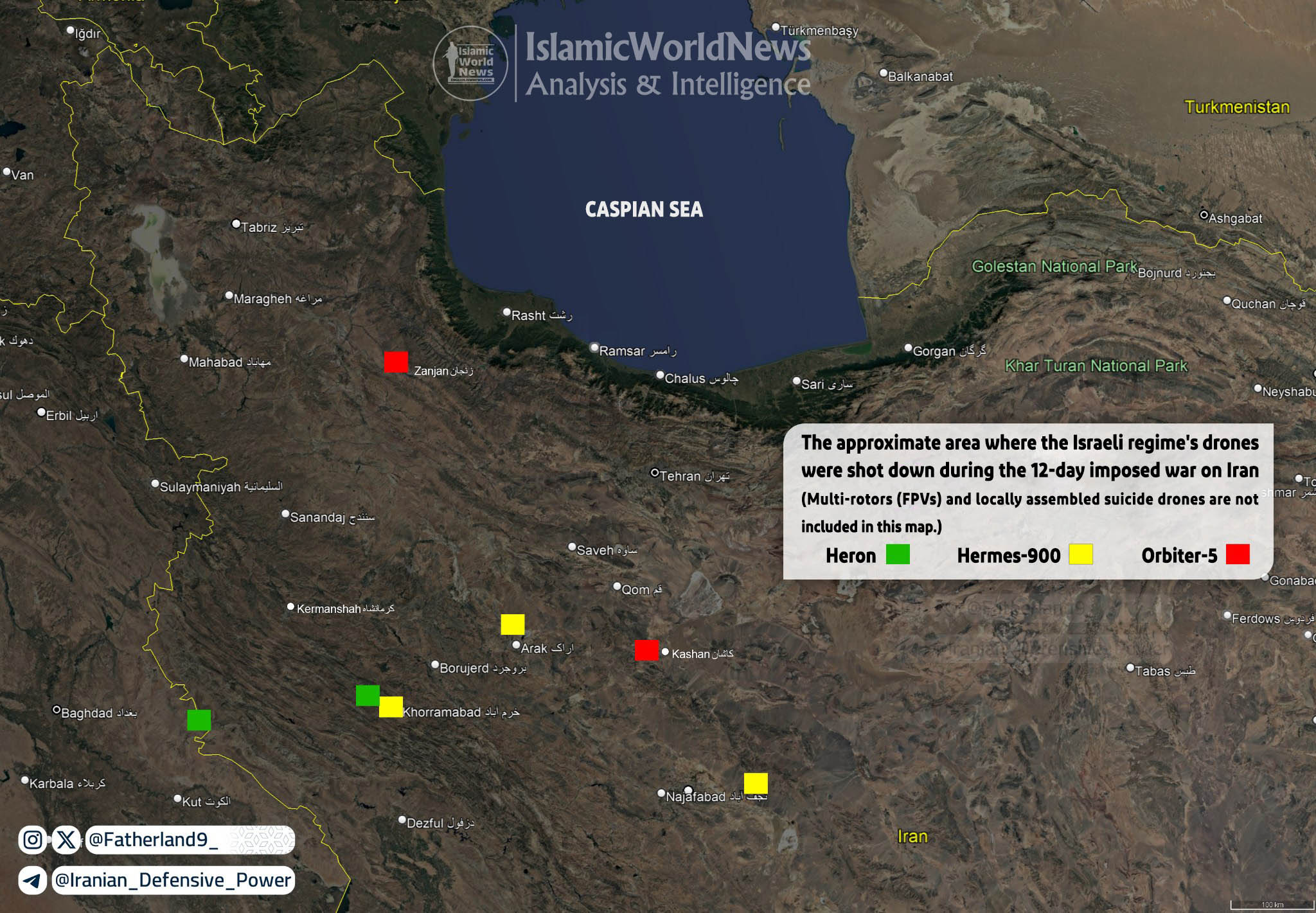
A Hermes 900 drone was downed on June 18 near Isfahan city
Heron drone with serial number 298 was downed on June 19 near Iran’s western borders in Ilam province. It was destroyed by the short-range Majid air defense system. Analysis of the wreckage and archival images revealed that this Heron lacked a satellite communication antenna and had to be guided by ground stations, giving it a range of about 300 km. This suggests it was likely operated from a ground station in Iraqi Kurdistan or a U.S. base in Iraq.
Destruction of a Heron drone on the country’s western borders in Ilam provinceThe Heron drone with serial number 298 was shot down on the western borders of the country in Ilam province.
Another Heron drone with serial number 248 was shot down on June 19 in the mountainous areas of Lorestan province. Visual evidence shows this drone was equipped with a satellite antenna.
Destruction of a Heron drone in the heights of Lorestan provinceHeron drone with serial number 248 that was shot down in Lorestan province
An Orbiter-5 drone with serial number 8312 was downed on June 21 in Kashan.
An Orbiter-5 drone with serial number 8312 downed on June 21 in Kashan
A Hermes 900 drone with serial number 939 was shot down on June 22 in Markazi province.
Images of a Hermes 900 drone with serial number 939 downed on June 22 in Markazi province
Another Hermes 900 was downed on June 23 in Khorramabad, Lorestan province.
The moment a Hermes 900 drone was targeted and downed over Lorestan provinceWreckage of Hermes 900 drone downed on June 23 in Khorramabad. The Rotax 914 engine is visible in the footage.
An Orbiter-5 drone with serial number 8373 was shot down on June 24 in Zanjan. Interestingly, this drone featured a satellite communication antenna—something not previously seen in Orbiter-5 models. Drones of this class, due to their size and weight, are typically used as tactical drones on the front lines. However, the Orbiter-5 downed in Iran had extended capabilities thanks to its satellite link, overcoming the usual 100 km range limitation of ground control stations. This enhancement gave it a role beyond that of a tactical drone, allowing Israel to extend its surveillance deeper into Iranian territory.
The video released by the IRGC regarding the shot down of a Orbiter-5 drone in Zanjan provinceAn Orbiter-5 drone with serial number 8373 downed on June 24 in Zanjan
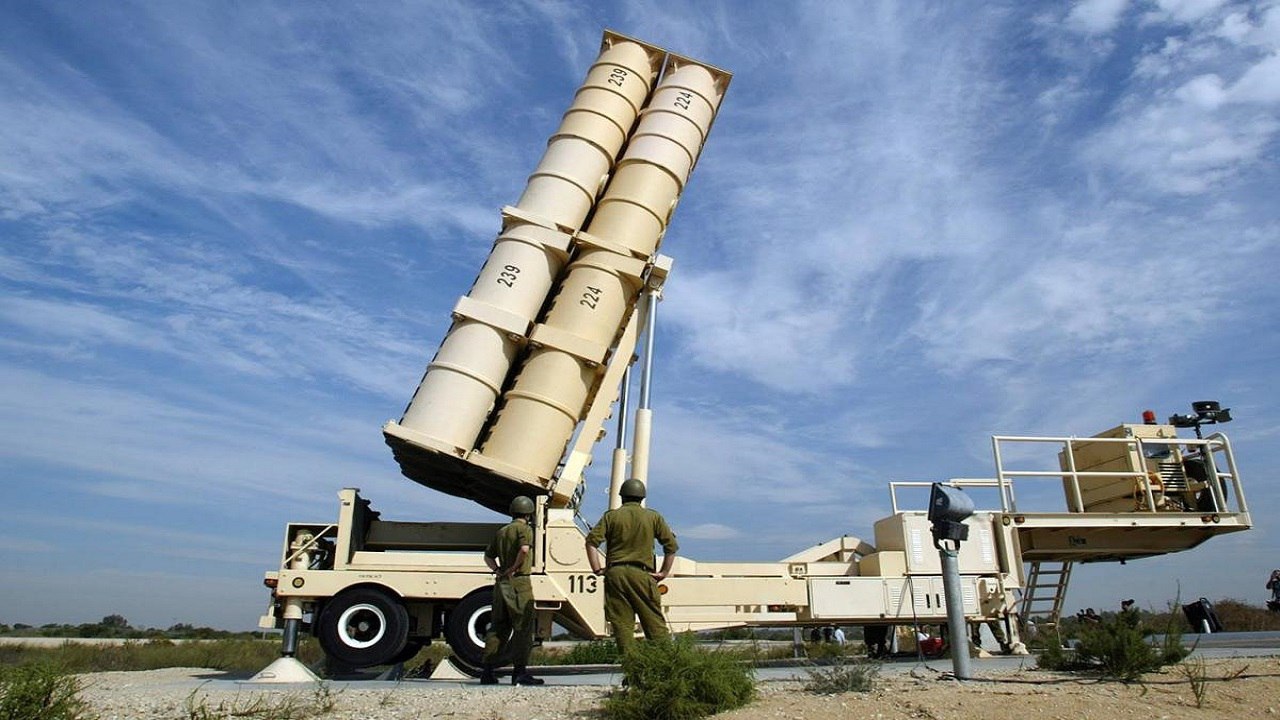
This strategy includes new laser and radar technologies, along with classified systems. The Iron Dome protects against short-range rockets and drones; David’s Sling intercepts cruise and tactical ballistic missiles; Arrow 2 and Arrow 3 handle long-range and extra-atmospheric missiles, with Arrow 4 still under development for advanced missile threats inside and outside the atmosphere.
Last month, Israel’s Defense Ministry agreed to ramp up Arrow missile production. These steps follow the recent 12-day conflict between Tel Aviv and Tehran, during which, according to Israeli claims, Iran launched over 500 ballistic missiles and 1,100 suicide drones, damaging residential areas, killing 29, and injuring over 3,000. Yemen’s Ansar Allah has also increased missile and drone attacks on occupied Palestine since March 18, with nearly 70 ballistic missiles and 20 drones fired.
Meanwhile, IDF Chief Eyal Zamir warned that Israel might carry out new strikes against Iran if needed.
The accelerated military buildup highlights Israel’s growing concern over its deterrent capacity against Iran and resistance groups, especially after recent attacks that exposed weaknesses in its defense systems, creating political and psychological pressure.
Furthermore, the significant investment in layered defenses suggests preparation for a prolonged, multi-front regional conflict. The active presence of Yemen’s Ansar Allah fighting Israel and potential involvement of other resistance axis members indicate Israel aims to establish a broad defense umbrella against threats from Iran, Yemen, Lebanon, and Iraq, signaling that the region may be nearing a new round of conflicts.
PJAK was established in 2004 by Iranian members of the Kurdistan Workers’ Party (PKK). Its military branch, the “Eastern Kurdistan Units,” operates across Iranian Kurdistan and Qandil in Iraq. Due to its origins, PJAK is influenced by the Turkish PKK, and the United States also regards it as an affiliate of the PKK.
Over the past two decades, multiple clashes have occurred between Iranian forces and PJAK. One of the most significant confrontations took place in the summer of 2011, when the Iranian army launched a large-scale operation against PJAK positions in Qandil, which ended with a ceasefire declared on September 29 of that year. Nevertheless, sporadic skirmishes continued in the following years.
PJAK is led jointly by Amir Karimi and Peyman Wiyan. The group is part of the Kurdistan Communities Union (KCK) and regards Abdullah Öcalan as its ideological leader. After the collapse of the peace process between Turkey and the PKK in 2015, a significant number of Iranian Kurds joined the KCK’s ranks, now making up roughly 35% of its military forces. This has strengthened PJAK’s role in both regional and international contexts.
With the resumption of talks between Turkey and Öcalan in 2024, along with the PKK’s announcement of its withdrawal from armed struggle, the future of the PJAK remains uncertain. Some believe that the PKK’s military and guerrilla capabilities may shift to the PJAK, which could create significant security challenges for Iran. Maybe it’s worth revisiting Öcalan’s earlier statements; since 2008, he has expressed concerns regarding Iran’s interference in the peace process and in 2013, recommended boosting PJAK forces to 40,000 to confront Iranian dangers.
Global developments—from the war in Ukraine and the Syrian crisis to Iran-Turkey rivalry, the role of Israel, and NATO tensions—have influenced Turkey’s strategic calculations regarding Iran. Turkey’s experiences in Syria and Iraq have shown that the Kurds act as a balance of power. Ankara now seeks engagement and coordination with PJAK instead of direct confrontation.
In this context, Netanyahu’s focus on destabilizing Iran has pushed Turkey to develop a more calculated approach toward Iranian affairs. It seems Ankara has concluded that it cannot play an effective role in Iran’s future developments without considering PJAK’s influence. All these factors are compelling Turkey to seriously revise and prepare its strategic agenda concerning Iran. One indication of this may be the Turkish leadership’s intention to align the PKK’s congress with its own interests in renegotiation and potential rearmament.
The Necessity of PJAK in Turkey’s New Strategy In 2015, the Democratic Party of Iranian Kurdistan (PDKI), along with several other Kurdish parties, attempted to reclaim their former position in Iranian Kurdistan’s political and social scene through a campaign called “Rasan,” aiming to curb PJAK’s growing influence. Clashes occurred in the mountainous region of Kileh Shin, allegedly part of an operation orchestrated by the Turkish government. Media outlets close to the PDKI and to some extent Komala subtly confirmed Turkey’s role in these events.
However, these efforts failed, and the Iranian Kurdish parties were unsuccessful in achieving their objectives. Following this setback, Turkey began looking for a more effective alternative force in the region—and that force was PJAK. Simultaneously, Israel unofficially conveyed a message to these Kurdish parties suggesting that significant developments were approaching in Iran and that Kurds could play a key role in shaping them.
PJAK in Turkey’s Strategic Calculations PJAK has yet to hold a congress to formally disarm or dissolve, and this process has stalled, with Qandil attributing the deadlock to Öcalan’s absence from the process. Even if a decision to end armed struggle is made, the guerrilla forces would not immediately lay down their arms. Integrating them into formal politics would require a transitional structure—something PJAK could provide, but only if a comprehensive agreement is reached between Turkey and Öcalan, and anti-Turkish elements within PJAK shift their stance.
Turkey aims to use PJAK as a tool to manage potential developments in Iran and prevent the Kurds from aligning with Israeli interests, thereby avoiding a repeat of the Syrian scenario. For this reason, Ankara seeks to incorporate PJAK into any future peace agreements. According to a Kurdish journalist, Turkey envisions PJAK playing a role in Iran similar to that of the Syrian National Army (SNA) in Syria.
Iran’s Position in the Turkey-PJAK Equation Since 2013, when PKK guerrillas withdrew toward Iran’s borders, Tehran has grown increasingly concerned about the implications of the Turkey-PKK peace process. In meetings with the PKK and Kurdish parties in Iraq, Iran explicitly warned about the expanded presence of these forces near its borders, questioning who would control PJAK in the event of a Turkey-Öcalan agreement. This concern led to a widening rift between Iran and Qandil.
This concern was not solely security-related; it also stemmed from a deeper geopolitical rivalry between Iran and Turkey. From Tehran’s perspective, PJAK could become a tool of Turkish influence if the group aligns itself with Ankara. As a regional actor, Iran must maintain ties with Qandil and use political tools to prevent the balance from tipping solely in Turkey’s favor.
The future role of PJAK depends on the PKK’s orientation toward Iran. If relations between Qandil and Tehran deteriorate, it would signal a full alignment of the PKK with Turkey—a scenario that seems unlikely for now without concrete assurances. For the sake of regional stability, both Iran and Qandil will likely be forced to maintain engagement.
“Roozbeh Vadi… was executed following judicial proceedings and confirmation of his sentence by the Supreme Court,” the judiciary’s Mizan Online website said, adding that the man had leaked information about a “nuclear scientist who was assassinated during the Zionist regime’s recent aggression.”
The execution was carried out by hanging, it added, noting that Mizan reported that Vadi worked at one of Iran’s “key and sensitive organizations” and that his access enabled him to pass on “classified information” after being recruited online by Mossad.
Israel started the war on June 13, stating that its goal was to cripple Iran’s nuclear program. The war ended when a ceasefire was suddenly announced on June 24, just two days after the United States joined the war by attacking three key nuclear sites in Iran.
During the war, over a dozen Iranian nuclear scientists were assassinated by the Israeli military and intelligence. More than 30 of the Islamic Republic’s top military commanders were also killed.
Mossad rule in the war was not limited to assassinations, however. The agency’s special forces led a covert attack on Iranian air defenses and ballistic missiles, deploying suicide drones and guided missiles from within the territories of the Islamic Republic.
Some 700 people suspected of working for Mossad were arrested by Iranian security forces during the war. At least few have already been convicted and executed.
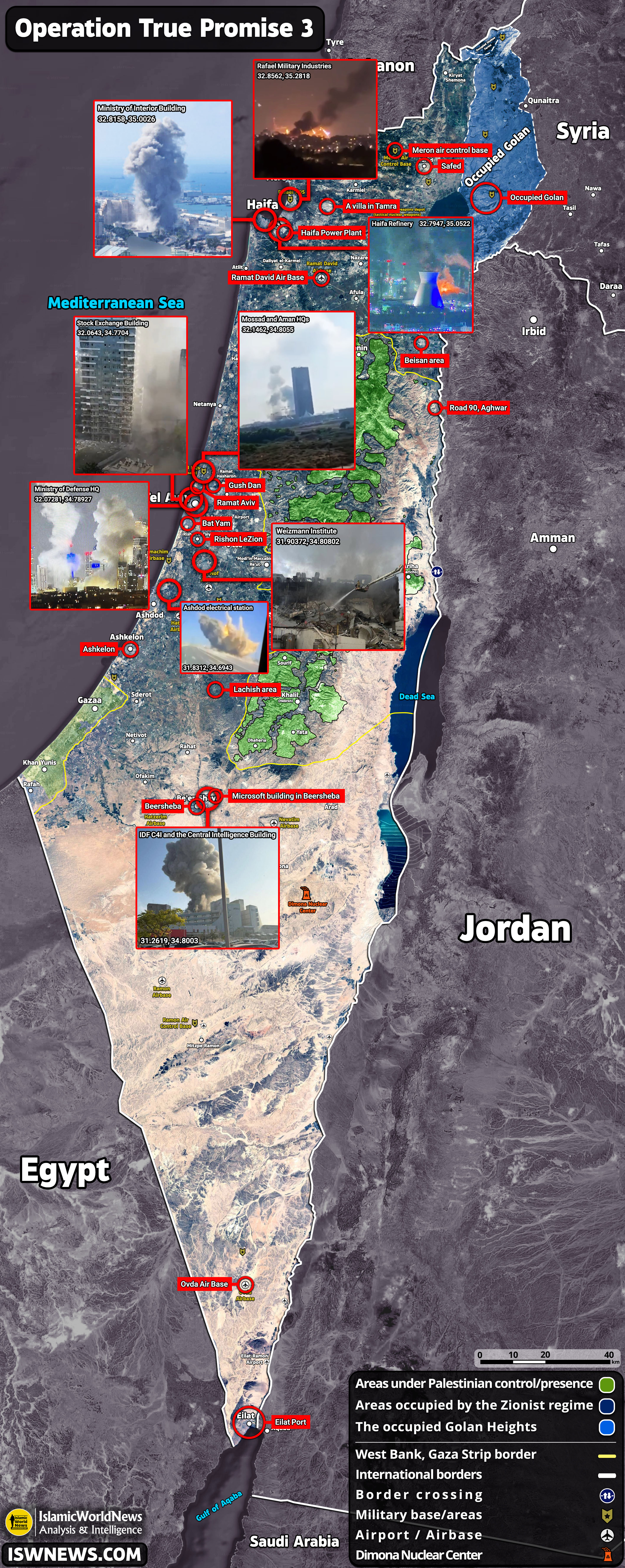
The Iranian armed forces launched the ‘Operation True Promise 3’ shortly after the Zionist regime’s aggression on Iran on June 13, And attacked Israeli positions across occupied Palestine. During the operation, Iranians utilized a variety of ballistic missiles, such as Emad, Qadr, Kheibar-Shekan, Sejjil, Hajj Qassem, Fattah-1 hypersonic missile, and Shahed-136 and 238 suicide drones, along with Arash-1 and 2 suicide drones. It also involved cruise missiles and other cyber and intelligence tools.
Areas that were targeted in Israel by Iranian missiles during ‘Operation True Promise 3″
This operation was conducted daily in multiple stages, targeting various Israeli military assets including military and intelligence centers, air bases, fuel production sites, energy supply facilities, defense infrastructure, military industrial complexes, command and control hubs, and operational support units.
Based on our investigations and gathered information, the Iranian armed forces have targeted and attacked the following locations during Operation True Promise 3.
– June 13 and 14; first and second days 1- Israeli Defense Ministry headquarters in Tel Aviv: 32.0728, 34.7892 2- Rishon Lezion: 31.9701, 34.7904
Iranian missile hits Israeli Defense Ministry headquarters in Tel AvivThe moment an Iranian hypersonic missile hit the Israeli Defense Ministry headquarters in Tel AvivThe moment an Iranian hypersonic missile hit the Israeli Defense Ministry headquarters in Tel Aviv – another angleThe moment at least 15 Iranian ballistic missiles hit Tel AvivThe moment an Iranian ballistic missile hit the Rishon LeZion area south of Tel AvivImages from the site of the Iranian ballistic missile strike on the Rishon Letzion area south of Tel Aviv
– June 15, Day 3 1- Haifa Refinery: 32.7947, 35.0522 2- A Villa in Tamra near Haifa 3- Eilat Port 4- Tel Aviv (various areas): Weizmann Institute in Rehovot area: 31.9037, 34.8080 Bat Yam area 5- Ramat David Air Base: 32.6680, 35.18174
Ramat David Air Base is the primary Israeli Air Force installation in northern the occupied Palestinian territory. Situated on the southeastern edge of Haifa, 46 kilometers from Lebanon, it features three runways. The base hosts multiple squadrons, including F-16 fighter jets, Heron drones, and attack helicopters. It has been a crucial part of Israel’s operations in Lebanon and was frequently targeted by Hezbollah rockets and drones during the recent conflict.
The moment an Iranian ballistic missile hit the city of HaifaFire breaks out at Haifa refinery after Iranian missiles hitIranian missile hits villa in Tamra town near HaifaTwo Iranian Shahed-238 drones hit the port of Eilat. This is the first officially recorded successful operation using this type of jet-powered suicide drone.Iranian missiles hit various areas in Tel Aviv, including the Bat Yam areaThe moment Iranian missiles hit points in Tel AvivIranian missiles hit and caused extensive damage to the Weizmann Institute of Science in the town of Rehovot, located in the southern suburbs of Tel Aviv.
– June 16, Day 4 1- Rafael Military Industries in Haifa: 32.8562, 35.2818 2- A snagogue in Lachish area 3- Haifa Power Plant: 32.7910, 35.06526 4- Tel Aviv, Gush Dan area, disruption of air defense systems and hit on Arrow 3 system
Iranian missile hits Rafael military industries in HaifaIranian missile hits synagogue in Lachish areaThe moment two Iranian missiles hit the Haifa power plant and a fire broke out in the area. As you can see, a large number of interceptor missiles were fired in the final stage, but they did nothing and out of the three missiles, two missiles hit the targets. These interceptors are the final stage and before that, the exo-atmospheric interceptors had also failed.A rare angle shot of the moment an Iranian missile hit a target in Haifa. The missile came straight at the cameraman. Fast and scary!Two Iranian missiles hit Tel AvivIranian missile strikes hit Tel Aviv, including the Bani Barak areaVideo showing the Israeli army’s Arrow 3 defense system malfunctioning amid a missile attack at dawn on the fourth day of the war. The IRGC stated it had disrupted Israel’s defense systems. In this footage, we observe the disruption described by the IRGC, along with an Israeli interceptor missile striking another launcher.
– June 17, Day 51 1- Disruption of Israel’s air defense systems and the downing of an interceptor missile in Tel Aviv 2- Aman military intelligence center and Mossad headquarters in Herzliya
The interceptor missile failed and returned and hit a point in Tel Aviv.Iranian missiles hit Mossad facilities in the Herzliya area of Tel Aviv. The cameraman also says in the video: “Wow… they even managed to hit Mossad!”Another video of Iran’s missile attack on the Mossad headquarters in Herzliya. In this video, at least three missiles hit the area around the headquarters and one missile hits the headquarters itself.On the fifth day of the war, during the IRGC missile attacks, the Aman logistics center in Herzliya, which is part of the Israeli Army’s military intelligence branch, was also targeted.
– June 18, Day 6 1- Disruption of Israel’s air defense systems and the fall of an interceptor missile in Tel Aviv for the third time. 2- Tel Aviv
In this video, the Israeli interceptor missile malfunctioned and crashed after launch, causing a fire in Tel Aviv. These malfunctions are likely accidentals, as Iranian jamming systems disrupt Israeli defenses.The moment two more missiles hit Tel AvivBreathtaking moments of Iranian missiles reaching Tel Aviv and Israeli interceptors firing. In this video, it is confirmed that 3 Iranian missiles hit.
– June 19, Day 7 1- Occupied Golan 2- Tel Aviv, a high-rise building near Stock Exchange Building in Ramat Gan: 32.0643, 34.7704 and Ministry of Defense facilities in Tel Aviv 3- Israeli army’s Command and Intelligence (IDF C4I) headquarters and the Intelligence HQ in the Gav-Yam Technology Park in Beersheba 4- Microsoft Building in Beersheba
The moment one of the Iranian army’s suicide drones (probably the Arash type) hit Israeli positions. The strikes captured by a surveillance camera in the occupied Golan.A video depicts two missiles, possibly Sejjil-type, striking Tel Aviv. The Israeli regime heavily censored news about the Iranian missile strikes on the seventh day of the war.Iranian missiles hit Tel Aviv, near stock exchange building in Ramat Gan areaThe moment an Iranian missile hit the IDF C4I HQ and the intelligence headquarters in the Gav-Yam Technology Park in the city of Beersheba. Iranian missile hits IDF C4I HQ and central intelligence HQs in Gav-Yam Technology Park in BeershebaAn Iranian missile hit the Microsoft building in Beersheba, with Israeli defenses failing to intercept it. The company has partnered with the Zionist regime on AI, drones, and cybersecurity services for the Israeli army.
– June 20, Day 8 1- Ministry of Interior Building in Haifa: 32.8159, 35.0027 2- Beersheba 3- Ashkelon 4- Radar system in the occupied Golan with suicide drone
An Iranian missile hits near the Interior Ministry in HaifaIranian missile hit BeershebaIranian missile hit BeershebaIranian missile hit AshkelonIranian suicide drone hits Israeli army radar system in occupied Golan Heights
– June 21, Day 9 1- Tel Aviv 2- Beisan area, drone attack 3- Occupied Golan, drone attack 4- Road 90, Aghwar area, Jordan Valley
The moment two Iranian missiles hit Tel AvivThe location of the Iranian suicide drone strikes in the occupied Golan Heights and Road 90 in the Aghwar area in eastern occupied Palestine.The site of the suicide drone strike in the Baysan area in occupied PalestineThe moment a Shahed-136 drone of the Iranian armed forces hit the Baysan area in northern occupied Palestine.
– June 22, Day 10 1- Haifa 2- Tel Aviv, Ramat Aviv
Iranian missile hits a target in Haifa portThe moment multiple Iranian missiles hit Tel AvivOne or more Iranian missiles hit the Ramat Aviv area of Tel Aviv, causing widespread destruction. According to Zionist media reports, the Iranian armed forces launched 22 missiles in one phase and five more missiles in a second phase towards the occupied territories.Images show widespread destruction at the site of an Iranian missile strike in Tel Aviv. Ramat Aviv, a residential area in northwest Tel Aviv founded by Zionists originally from Eastern Europe, was targeted, possibly due to the presence of security and military centers in the area.
– June 23, Day 11 1- Ashdod Power Plant: 31.8312, 34.6943 2- Ashkelon 3- Safed 4- Al-Udeid Air Base in Qatar: 25.1154, 51.3164
The moment a missile hit the Ashdod power plant, located along a road in the occupied territories towards Tel Aviv. According to the Israeli Energy Minister, 8,000 customers lost their electricity after the missile hit.This video appears to have been recorded by a Zionist settler, likely in Ashkelon. It shows the sound of several missiles hitting the occupied territories, with the Israeli commenting on the Iranian missile strikes, saying: “What is that sound? Wow, wow, wow.”Iranian missile hits the town of Safed in northern occupied PalestineAnother missile hit northern occupied PalestineIranian missile hits unspecified point in northern occupied Palestine
– June 24, Day 12 1- Beersheba city
The moment a missile hits a seven-story building in Beersheba.
The attack sites listed are based on image and video evidence of Iranian strikes in the occupied territories. Additionally, sites such as Ben Gurion Airport, Nevatim Air Base, Hatzerim Air Base, the Sail Tower in central Haifa hosting AI12 Labs, the Hadera Power Plant, Ovda Air Base in the southern Negev, the Kiryat Gat semiconductor industrial zone, and Meron Air Control Base in northern occupied Palestine have also been targeted by Iranian strikes, according to IRGC statements and other international media reports.
Some notable outcomes of Iran’s strikes on Israel:
Haifa Oil Refinery Shuts Down: The Haifa Oil Refinery has shut down following extensive damage from an Iranian missile attack on June 16, according to Yedioth Ahronoth. The Zionist economic newspaper Calcalist also reported that Sonol, one of Israel’s largest fuel companies, contacted its customers after damage to Bazan Company caused by Iranian missile strikes. They announced that, “Under these circumstances and due to the situation being out of our control, we are forced to reduce or cease fuel supplies to our customers.”
The destruction of the Weizmann Institute of Science and Technology: On June 15, Hajj Qasem tactical ballistic missiles struck the Weizmann Institute, causing extensive damage. The institute’s leader reported that the attack destroyed two research buildings and damaged 112 units, including 60 laboratories and 52 other structures. The head highlighted the institute’s difficulty in obtaining compensation and estimated the total damage at 2 billion shekels (approximately $590 million). Rebuilding is expected to take around five years.
The Weizmann Institute of Science is Israel’s leading and largest center for education and research in nuclear, military, and artificial intelligence fields. Founded 14 years before the Israeli regime in occupied Palestine, it trains students in physics, chemistry, electronics, and related disciplines at both master’s and doctoral levels. The institute has housed human data samples, biological databases, and trillions of bioinformatics records. Additionally, some alumni have contributed to the development of weapons for the Zionist military and are employed across its various scientific divisions.
Images showing the Weizmann Institute following an attack by Iranian tactical ballistic missiles.
Suspension of Maersk Shipping Company’s activities: Maersk, the largest international shipping company, announced that it will suspend all commercial transportation to the port of Haifa.
Suspension of flights at airports in occupied Palestine: Flights into and out of Ben Gurion Airport and other Israeli airports were completely suspended.
Ashdod power outage: Following an Iranian missile accurately hitting the Ashdod electrical station, the Israeli Minister of Energy announced that 8,000 customers have lost their electricity and Ashdod is experiencing a blackout.
Displacement of 18,000 settlers from the Bat Yam area: According to the Israeli economic-analytical newspaper Calcalist, the Iranian missile attack turned Bat Yam, one of Israel’s three most populous towns, into a ruined city akin to Gaza. About 18,000 residents have evacuated their homes due to damage and destruction. Of these, 12,000 have moved to hotels, while others are in rented apartments or temporary shelters. Additionally, four towns—Bat Yam, Tel Aviv, Rehovot, and Ramat Gan—are experiencing a severe housing shortage for displaced residents caused by the attacks. This destruction is expected to impact housing prices in the occupied territories over the medium term.
The residents of occupied Palestine experiencing the aftermath of the Iranian attacks; Zionists in the occupied territories sleeping in metro stations due to fear of Iranian missiles.
Moroccan soldiers killed in Iranian attack: A leaked document reports that two Moroccan soldiers killed when an Iranian missile struck Meron air control base in northern occupied Palestine. These casualties included a captain and a senior Moroccan commander who were there for joint exercises with Israeli forces. Additionally, another Moroccan soldier and officer were wounded and treated in Haifa. Notably, if Moroccans were killed in the attack, then Israeli casualties likely occurred as well. However, these Israeli losses are typically kept from the public view, as has often been the case.
Statistics and Israeli casualties from Iran’s Operation True Promise 3:
According to the latest reports from the Israeli media, the Israeli regime’s casualties include 33 deaths (including Arabs in northern Palestine) and 3238 injuries. Of the injured, 23 are reported to be in serious condition and 111 in moderate condition. It is important to note that these figures are based on information from media outlets and institutions linked to the Israeli regime, while the number of casualties in military and security zones remains concealed and censored, consistent with the regulations established by the regime’s army since the war’s outset.
International reactions to Israel’s aggression on Iran; Yemen’s military support and Pakistan’s political support for Iran:
Many countries worldwide and within the Islamic world, such as Russia, China, Pakistan, Yemen, Saudi Arabia, and Egypt, condemned Israel’s attack on Iran. Notably, Pakistan’s stance was more prominent in terms of broad political support, while Yemen offered significant political, social, and military backing. An emergency UN Security Council meeting on June 14 to discuss Israel’s assaults on Iran resulted in minimal action, with officials only expressing concern and urging Iran to exercise restraint. Western governments including the United States, France, Germany, England, and Canada also supported Israel.
A rally supporting Iran took place in Pakistan, where Defense Minister Khawaja Muhammad Asif expressed Pakistan’s stance. He stated: “Israel has targeted Yemen, Iran, and Palestine. If the Islamic world does not unite now, we all risk facing the same fate. Pakistan stands with Iran. Silence is no longer an option. The Organization of Islamic Cooperation should convene a meeting to develop a unified strategy. I urge all Islamic countries to immediately cut diplomatic ties with Israel.”
On June 15, the Yemeni Armed Forces announced they launched several Palestine 2 hypersonic ballistic missiles at different times, coordinating military operations with Iran and the IRGC targeting key Israeli sites in Tel Aviv region. Brigadier General Yahya Saree, spokesman for the Yemeni Armed Forces, stated: “The Yemeni Armed Forces salute the Islamic Republic of Iran, its nation, army, and leadership for bravely and determinedly confronting the brutal Zionist attack. Relying on God, they strike successive blows at its facilities, headquarters, and bases. While observing these developments, we proudly reaffirm our commitment to the people of Gaza and its loyal Mujahideen until the war and siege against Gaza end.”
According to the leader of Ansar Allah, the Yemeni army has continued its support for Palestine against the Zionist regime during Dhul-Hijjah (from May 28 to June 26). They reportedly utilized 25 ballistic missiles, hypersonic missiles, and suicide drones. Studies from Islamic World News indicate that Yemeni forces collaborated with Iranian forces on five occasions, launching a total of eight ballistic missiles and suicide drones targeting locations in Tel Aviv, Haifa, Beersheba, and Eilat. Additionally, they emphasized that in response to U.S. military strikes against Iran’s nuclear facilities, if the U.S. engages directly in the conflict with Iran, they will target all American ships in the Red Sea.
Yemeni people march in support of Iran
Conclusion: Iran’s Operation True Promise 3, which was a legitimate defense of Iran’s territory and airspace against widespread Israeli aggression, involved 22 waves of missile attacks and 10 stages of drone attacks that began on June 13 and lasted for 12 days. The positive effects of this operation inside and outside Iran led to the failure of the declared plan by Israeli regime leaders to destroy Iran’s nuclear program, change the political system of the Islamic Republic, and eliminate Iran’s military capabilities, especially its missile forces.
Zionist media and the military spokesperson for the regime claim that during the twelve-day war, the Iranian armed forces launched over 510 ballistic missiles, as well as more than 680 (with some reports claiming more than 1,000) suicide drones and cruise missiles towards the occupied territories. Israel also claims that only 55 of these missiles struck occupied Palestinian territory, while the rest were intercepted and destroyed by the air defenses.
However, this claim exaggerates the number of missiles, and the reported hits have been censored. The Israeli army’s statistics do not match the actual field conditions. Based on investigations by Islamic World News and visual evidence presented in this article, there are documented cases of 90 missile hits and 7 drone hits. Additionally, the Iranian armed forces reportedly launched around 300 to 350 missiles during Operation True Promise 3. Also, it should be noted, the exact count of drones and cruise missiles remains uncertain due to the lack of available visual documentation.
Undoubtedly, this figure is not definitive because of widespread censorship by the media and security institutions of the Zionist regime. The actual number of missiles hit is likely higher than the estimate provided. Overall, Operation True Promise 3 was a significant military effort with impactful results, prompting the leaders of the United States and Israel to agree to a temporary ceasefire.
The Israeli think tank INSS has published an article outlining the 2025–2026 Israeli security doctrine. Within this document, confrontation with Iran stands out as a fundamental issue and a major threat, with the name of Iran appearing nearly 60 times. Prominent elements in the document include: Iran’s nuclear program, the future of the Axis of Resistance, the nature of cooperation with the United States on Iran-related matters, and potential nuclear agreements. Notably, Iran’s relationships with Russia and the Resistance Axis are highlighted as strategic points. The doctrine presents various scenarios, followed by actionable strategies.
Battlefronts In the introduction of the doctrine document, Israel defines its surrounding adversaries and adopts an aggressive, security-driven approach toward regional states. Iran and Syria emerge as primary concerns. Regarding Iran, three potential scenarios are outlined:
1. A New Iran–U.S. Nuclear Deal: Tel Aviv should not oppose the agreement outright but rather seek a role in shaping it to ensure Tehran is prevented from acquiring nuclear weapons.
2. Iran Achieves Nuclear Capability: Immediate military action is required, preferably in coordination with the United States.
3. A Prolonged Stalemate: Continuous economic pressure and covert operations should be applied to weaken Iran steadily.
One noteworthy feature in this document is the grouping of China, Russia, Iran, and North Korea under the acronym “CRINGE”, portraying them as a united front opposing the liberal-democratic world order. According to Israeli analysis, despite deep ideological differences and conflicting interests, these states are cooperating to challenge Western hegemony. The doctrine paints a dire global picture—dominated by authoritarianism, communism, and rising Islamic sentiment in liberal societies—while warning of rising extremist factions reshaping political landscapes. Ultimately, Iran is described as the leader of the Axis of Resistance, an integrated coalition that seeks Israel’s destruction.
A Shifting Strategic Environment Over a year into a multi-front war, Israel claims it has increased its strategic flexibility and gained greater maneuvering space in the short term. Before assessing Israel’s core national security challenges, the doctrine reviews broader changes in its strategic outlook.
1. Undermining Iran’s Security Doctrine From Israel’s viewpoint, Iran’s military capabilities are insufficient to deter a direct attack, and even reaching nuclear threshold status has not produced the expected deterrence. Israelis believe Iran’s resistance strategy has failed to contain Israel’s actions, and the resistance network is collapsing. The fall of Assad, they argue, has further weakened Iran’s regional strategy, eliminating Syria’s role. In this altered landscape, Iran will struggle to restore Hezbollah’s prior threat level against Tel Aviv. Opportunity: Iran is perceived as being at an unprecedented point of weakness, offering Israel expanded freedom of action. This opens opportunities to push for a tougher nuclear deal, reduce Iran’s regional influence, and even pursue military options to halt its nuclear program. Threat: If Iran concludes that nuclear threshold status is insufficient for deterrence, it may accelerate its nuclear weapon development, thereby altering the regional balance of power in its favor.
2. Shifting Regional Power Dynamics
Opportunity: Advancing the Abraham Accords can curtail Iranian influence. Potential diplomatic moves include: securing Israel’s northern border by leveraging Hezbollah’s weakness, forming a non-aggression pact with a new Syrian government (which may also ease tensions with Turkey), and finalizing normalization with Saudi Arabia. Close coordination with the United States would aid in realizing these goals.
Threat: Assad’s fall could produce unpredictable consequences, including jeopardizing Israel’s peace treaties with Jordan and Egypt. The emergence of a radical Sunni axis—led by a resurgent Muslim Brotherhood in Syria and beyond—could present a formidable new threat, potentially as dangerous as the former “Ring of Fire” led by Iran.
Iran’s Nuclear Threat: Three Strategic Scenarios
1. If an Agreement Is Reached: Tel Aviv should actively influence any potential nuclear deal. The agreement must ensure the following:
A) Immediate Halt to Nuclear Progress B) Comprehensive Threat Mitigation:
Fissile Material: Caps on uranium enrichment levels and stockpile quantities; dismantling of advanced centrifuges installed after 2018; intrusive and comprehensive inspections.
Delivery Systems: Restrictions on ballistic missile range and technology; limits on missile stockpiles; nonproliferation enforcement.
Weaponization: Oversight of nuclear research institutions and bans on any weapons-related nuclear activity.
These steps are deemed essential for safeguarding Israel’s security and preventing Iran’s military nuclear capability.
2. If No Agreement Is Achieved: Israel must ensure stringent enforcement of sanctions and maintain close intelligence and diplomatic ties with the United States. Enriching uranium to 90 percent should be declared a red line that justifies military action—with or without U.S. support. Since Iran aims to outlast the Trump presidency and anticipates policy shifts under a new administration (especially a rollback of maximum pressure), this period should be used to weaken Iran via covert operations, while avoiding visible foreign fingerprints. These actions are considered vital to blocking Iran’s nuclear advancement and preserving Israeli security.
3. If Iran Builds a Nuclear Weapon: This scenario involves Iran withdrawing from the NPT, enriching uranium to 90 percent, and conducting nuclear weapon tests. Israel believes that Iran’s nuclear facilities must be destroyed immediately in response. The U.S. should be urged to issue a decisive warning to Iran before any military action. To prevent a regional arms race and nuclear terrorism, Israel must act decisively. While coordination with the U.S. is essential, Israel’s independent military capabilities must be fully developed to ensure mission success.
New U.S–Israel Relations: Opportunities and Challenges
Opportunities: A second Trump term could strengthen U.S.–Israel relations through appointments of pro-Israel officials. This would provide Israel with greater regional autonomy, bolster deterrence against Iran, and establish a credible military threat to Tehran’s ambitions.
Challenges: Rising criticism within the Democratic Party—especially due to Israel’s internal policies—could erode bipartisan U.S. support. Israel must pursue a defense agreement as part of a broader regional strategy to counter isolation efforts. Such an agreement would also enhance deterrence against Iran’s nuclear threat and maintain U.S. military and technological support. Shaping future Memoranda of Understanding (MoU) with Washington to preserve Israel’s qualitative military edge is crucial.
Economic and Diplomatic Strategies
To counter Iran’s influence and boost economic ties, Israel must strategically expand its relations with Europe. This may require taking a firmer stance on Russia, while preserving key diplomatic channels. Such a strategy could undermine the Iran–Russia axis and curtail Tehran’s regional clout.
The Iran–Israel War Doctrine
According to Israel’s security doctrine, the October 7th attack was the moment when Tel Aviv finally awakened to the nature of the war Iran has been waging against it. The more Israel focused on Iran’s nuclear threat, the less it recognized that Iran’s strategy also hinges—perhaps even more—on its Axis of Resistance as a weapon against Zionism. Although Tehran’s “proxy war” strategy had long been discussed in Israeli defense circles, Tel Aviv failed to develop a suitable strategic or operational response. Thus, the October 7th war caused a dual disruption to Israel’s long-standing strategic thinking. The war represents a collision between two visions: one meticulously prepared by Iran’s axis, and the other rooted in Israel’s outdated military conceptions shaped by its belief in “wars with clear endings.” This outdated doctrine failed to address new types of threats. The fact that Israel was caught off guard, despite having prior intelligence, underscores its misjudgment of enemy strategies. The doctrine concludes that the war’s gains and failures must be analyzed through the tension between counterterrorism approaches and military-war theory—two frameworks that are not interchangeable.