During a parade held on April 18th, 2022 in Tehran, a new drone called “Ababil 5” (also known as Ababil-V or AB-V) was revealed to the public. Prior to this event, no official information about the Ababil 5 drone had been released. Although the exact specifications of the Ababil-5 drone have not been officially disclosed, we will analyze the available footage to review its specifications and features in this article.
The aerodynamic design of this UAV is generally akin to that of the Mohajer-6. While the Mohajer-6 features a High Boom Tail configuration, the Ababil-5 employs a Boom Tail configuration. This design choice not only shortens the runway length needed for landing and takeoff but also enhances the drone’s ability to perform more intense maneuvers.

The body of this drone has sharp angles and lines, which are clearly designed to reduce the radar cross section from the front, i.e., when the bird is approaching the radar.

Considering the dimensions of the truck floor, the Ababil-5 drone is estimated to have a wingspan of approximately 12 meters.
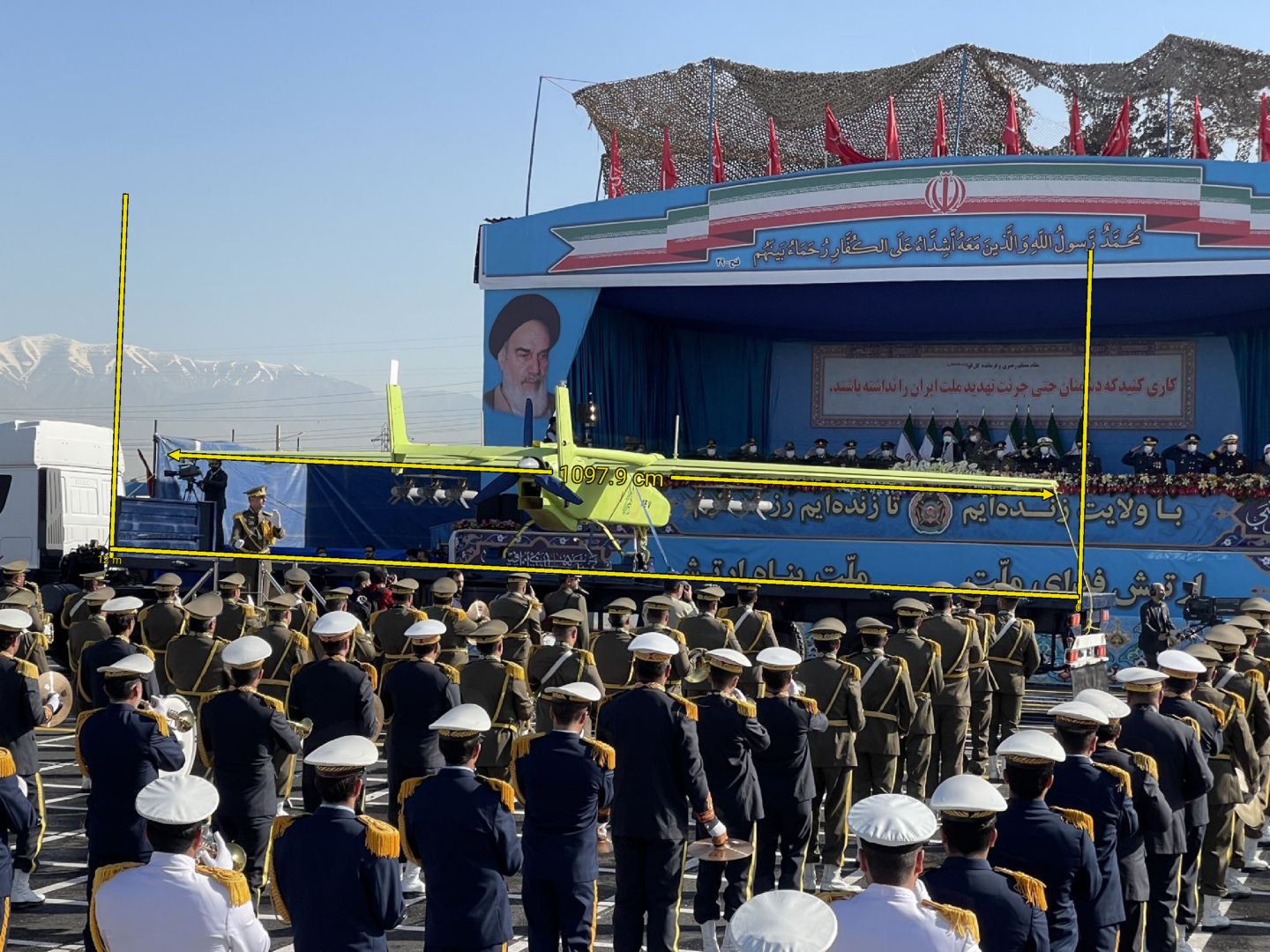
The Ababil-5 boasts a wingspan that is 20% larger than that of the Mohajer-6. This increase in wing area allows for a greater cargo mass, enabling the Ababil-5 to carry six Qaem-1 bombs, compared to the Mohajer-6, which can carry up to four bombs.


The landing gear is designed to retract, which helps to reduce drag and minimize the radar cross-section. This reduction in drag, facilitated by the retractable landing gear, enhances the UAV’s cruise speed, flight endurance, and range.
Another reason for incorporating retractable landing gear at the front of the body is to prevent obstruction of the electro-optical’s view. If the camera system were placed in front of the landing gear, as seen in the Mohajer-6, the increased distance from the drone’s center of mass would require additional balance weight, potentially affecting the drone’s performance. Therefore, retractable landing gear is utilized to avoid these issues.

The rear wheel landing gear is fixed type. According to the published images, the base of the rear wheels are connected to each other by a wire, which limits the amount of final bending of the landing wear during landing and prevents the body from hitting the runway surface.

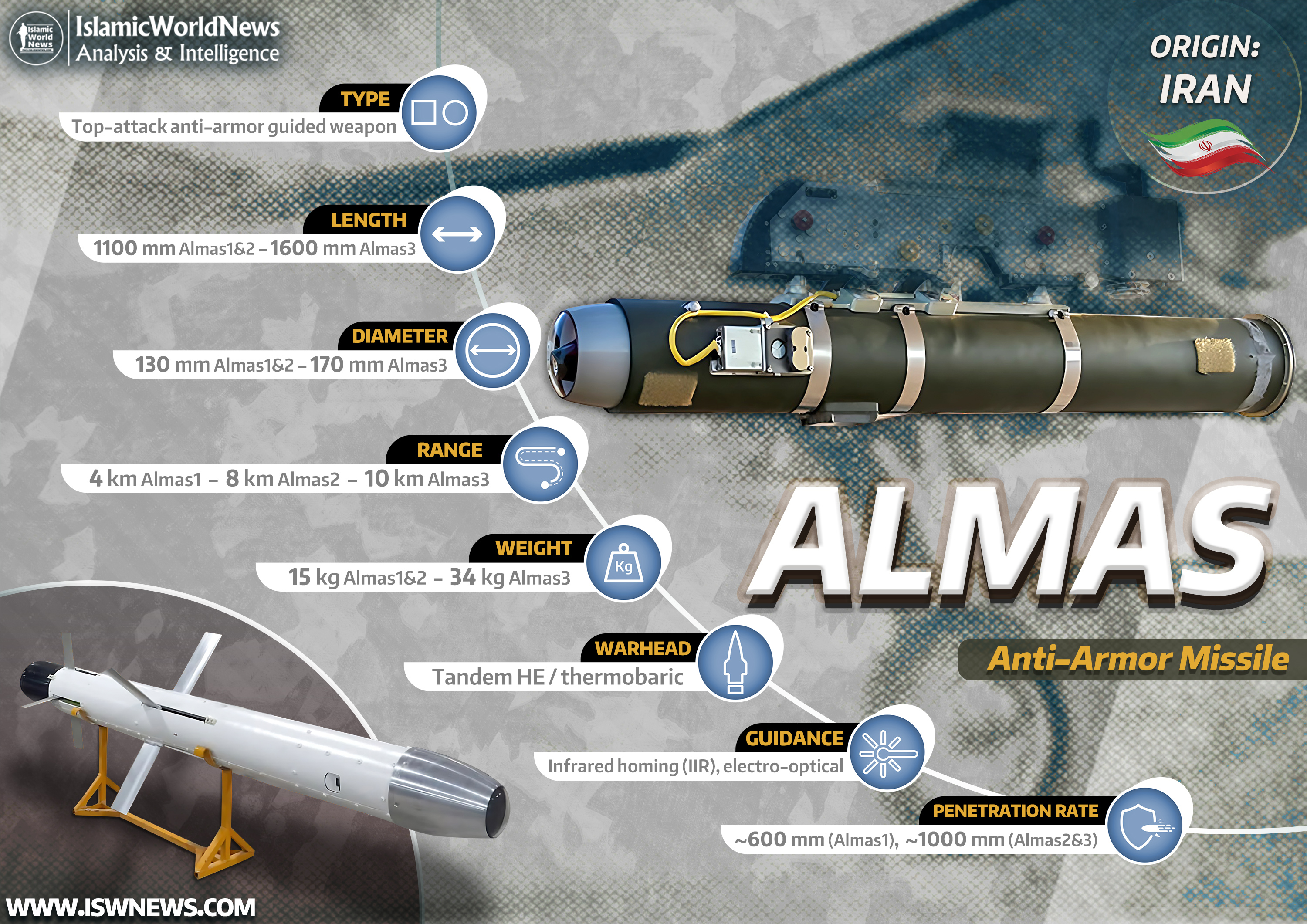
When it comes to weaponry, the Ababil-5 has been observed equipped with Qaem Glide bombs, Almas missiles, and Arman-1 bombs. This drone is capable of carrying six Ghaem-1 bombs and four Ghaem-5 bombs.
Read more:
Military Knowledge: Qaem Smart Bombs
Military Knowledge: Almas Missile


Given that the Ababil-5 has been adopted by both the Iranian Army and the IRGC, and considering it is manufactured by the Iran Ministry of Defense, there’s a possibility that the ammunition used in the Mohajer-6 could be compatible with the Ababil-5, due to the similarity of some of their components.


Carrying a larger number of bombs or cargo effectively increases the lethality of the UAV, and economically, it destroys targets with fewer sorties and hunts targets at a lower cost. Also, reducing the number of flight sorties can be important both in terms of maintenance and increasing the operational rate of the fleet.
In terms of camera system, the Ababil-5 drone can be equipped with a more advanced electro-optical system, in addition to using older electro-optical systems such as the Eagle 4 models. This advanced camera features at least 60x zoom capabilities, along with a thermal imaging camera and a laser rangefinder.

This drone is powered by a piston engine. Images from the NAZAJA exercise in February 2024 reveal that the Ababil-5 is equipped with a Rotax 915 iS engine or a similar model. The Rotax 915 engine delivers up to 141 horsepower at its peak performance.


Overall, Rotax engines are commonly employed in many Iranian drones. Due to sanctions targeting Iran’s military and aviation sectors, direct procurement from Rotax is not feasible. Consequently, to cater to the varied requirements of drones in Iran, numerous components of different Rotax engines have been domestically produced, with some models achieving a complete localization rate of 100%.
With the Rotax 915 iS engine, the Ababil-5 achieves a flight ceiling of approximately 7,000 meters (23,000 feet) and a speed of around 210 kilometers per hour. Its maximum takeoff weight is estimated to be about 1,000 kilograms.
The Ababil-5 drone boasts a flight duration of 12 hours in combat mode, and up to 24 hours in reconnaissance mode without a combat payload. It has a maximum range of up to 2,400 kilometers.
Ababil-5 UCAV specifications:
Length: ~ 8 meters
Wingspan: ~ 12 meters
Maximum range: up to 2,400 kilometers
Flight ceiling: 7,000 meters
Flight endurance: 12 hours combat – 24 hours reconnaissance
Engine type: Rotax 915 – 141 horsepower (at its peak)
Speed: 210 km/h
Hardpoints: 2, with the ability to carry 6 missiles and bombs
Maximum takeoff weight: ~ 1,000 kilograms
Weapons payload: up to 150 kilograms
Origin: Iran

More images of Ababil-5 drone:


“Ababil 5” UAV poster collection in Farsi, Russian, Arabic, Chinese and Hebrew:


