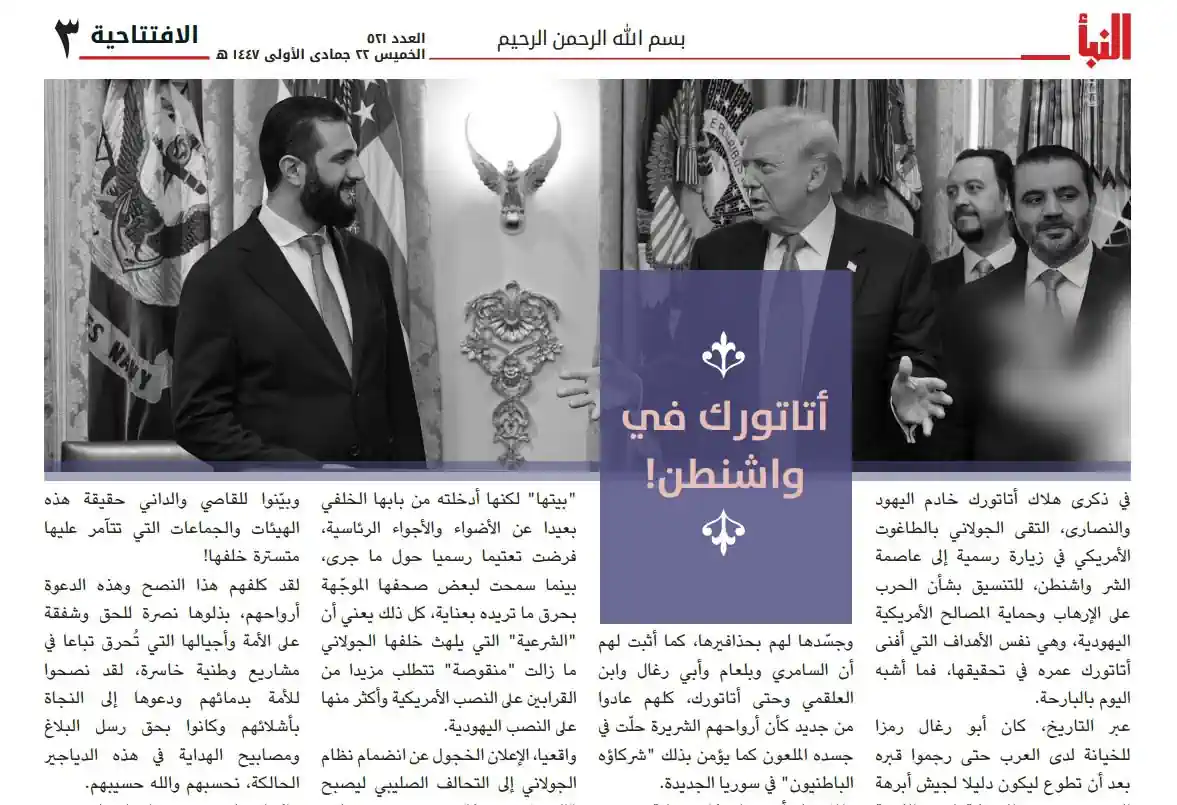
Tag: Abu Mohammad al-Julani

  • ISIS Narrative on Julani’s Trip to the U.S.: “Atatürk in Washington”

    ISIS Narrative on Julani’s Trip to the U.S.: “Atatürk in Washington”

    ISIS in the latest editorial of its al-Naba weekly describes Jolani’s recent trip to Washington as a repeat of the same “betrayal show.” They frame the visit as a direct link between him and the “capital of evil.” In this narrative, Jolani is not seen as a political actor but as a figure resurrected from a history of treachery—an extension of all those whom ISIS associates with a dark past.

    Beginning of the Narrative: Betrayal Returns in a New Form
    ISIS does not view Jolani’s trip to the U.S. as a simple event. For them, it is a continuation of Atatürk’s path—someone who, in their perception, lived and fought to advance Western goals. Thus, Jolani’s visit is symbolically placed alongside Atatürk’s legacy: an act aimed at weakening the Muslim community and serving the interests of America and its allies.

    The comparison is not limited to Atatürk. Jolani is depicted as a new link in a long chain of historical traitors—figures who, in ISIS’s view, paved the way for enemies and served foreign powers. The purpose of these comparisons is to cement Jolani’s image as a “symbol of betrayal” in the minds of their audience.

    Prelude to the Trip: A Path Built Behind the Scenes
    ISIS claims Jolani’s journey was the result of months of consultations and contacts with U.S. officials, portraying him as someone who had to “prove himself” step by step to gain Washington’s trust. Each meeting with American officials is described as offering “new concessions,” ultimately leading to the main encounter with the U.S. president. The narrative paints Jolani as a man who must pay the price of political advancement through security and political actions against others.

    Media Displays: Signs of “New Loyalty”
    ISIS interprets Jolani’s promotional videos—especially those showing him engaged in sports—as staged symbols of “victory displays.” These images are seen as part of a performance to show that each new collaboration with the U.S. translates into fresh political gains. A photo of him alongside American commanders is presented as further evidence that Jolani has now secured a place within Western military and political structures.

    Political Dimensions: From Containing Iran to Rebuilding Syria
    ISIS situates Jolani’s trip within broader regional dynamics. They argue that the U.S. seeks to diminish Iran’s influence in Syria, while Turkey supports Jolani as a more pragmatic alternative for Syria’s future—an actor capable of playing a role in the country’s new political framework. In this context, the lifting of U.S. sanctions on Jolani is interpreted as granting him “semi-legitimacy,” though ISIS insists it is incomplete and will demand further concessions.

    From Hidden Cooperation to Open Partnership
    ISIS asserts that Jolani’s formal alignment with the international anti-terror coalition is merely the public declaration of a partnership that has existed covertly for years. They cite recent security operations by Jolani’s forces—arrests and pursuits of individuals linked to jihadist groups, coinciding with Israeli strikes in southern Syria—as proof. His silence in the face of Israeli attacks is portrayed as evidence that “his weapons are aimed in only one direction.”

    Propaganda Use: Invoking the Legacy of ISIS Leaders
    To reinforce its narrative, ISIS references the words and guidance of its slain leaders, aiming to restore moral and ideological legitimacy. The account honors those who “gave their lives on this path” and calls for the return of former ISIS fighters.

    Final Message: “The End of Jolani’s Path”
    In conclusion, ISIS presents Jolani’s trip as the ultimate symbol of his “complete transformation”—a man who abandoned jihad and entered the service of global powers. For ISIS, this serves as a cautionary tale: an example of how someone once listed as a “terrorist” can become a “partner of the West.”

  • Tripartite Meeting in Damascus: Al-Jolani Meets SDF Commander and U.S. CENTCOM Commander

    Tripartite Meeting in Damascus: Al-Jolani Meets SDF Commander and U.S. CENTCOM Commander

    A key focus of the meeting was the implementation framework of a recent agreement between al-Jolani’s administration and the Syrian Democratic Forces (SDF), with both sides emphasizing Syria’s territorial integrity and national sovereignty.

    Simultaneously, an SDF delegation led by Mazloum Abdi arrived in Damascus to discuss the political transition process and security challenges in northeastern Syria with senior Syrian officials.

    The concurrent presence of the U.S. envoy and the SDF commander in Damascus signals a coordinated push between Washington and Damascus toward a new political roadmap. This meeting is one of the few high-level meetings between the Syrian presidency, US representatives and the commanders of the Syrian Democratic Forces; this meeting could initiate a new phase of talks between the main actors in the Syrian crisis.

  • Iraqi Intelligence Chief Meets with Al-Julani; Damascus and Baghdad Agree to Increase Cooperation

    Iraqi Intelligence Chief Meets with Al-Julani; Damascus and Baghdad Agree to Increase Cooperation

    During the meeting, Al-Shatri delivered a message from Prime Minister Muhammad Al-Shi’a Al-Sudani, inviting Al-Julani to attend the upcoming Arab League summit in Baghdad.

    The discussion focused on strategies for combating terrorism and enhancing security along the border between the two countries. Additionally, they emphasized the importance of expanding trade opportunities and developing economic cooperation between Baghdad and Damascus. The Iraqi delegation expressed its support for Syria’s unity, stability, and national sovereignty.

    A significant topic of conversation was the Al-Tanf border crossing. Al-Shatri and Al-Julani agreed on the establishment of a new mechanism to manage the Al-Tanf-Al-Walid border crossing.

    Al-Tanf region

    It is important to note that the Al-Tanf region has been occupied by American forces for years, housing one of the strategic U.S. bases located in the border triangle of Syria, Iraq, and Jordan. Syrian and Iraqi soldiers are restricted from approaching within a 55-kilometer radius of this base.

    Interestingly, following the fall of Bashar al-Assad’s government and the rise of Al-Julani’s leadership, there seems to be a new agreement between Damascus and Washington regarding the management of the Al-Tanf-Al-Walid border crossing. Increasing cooperation through this crossing will likely require consent and approval from the Americans.

  • Syrian Officers’ Coup Against al-Julani Foiled!

    Syrian Officers’ Coup Against al-Julani Foiled!

    During a press conference, Khattab stated that, thanks to the extensive efforts of the security forces and the support of the Syrian people, a significant threat to national security was averted.

    According to the Interior Minister, the operation was executed based on accurate intelligence and in full coordination with the Syrian Ministry of Defense. No statements have been released by the Ministry of Defense or the presidential office so far.

    Anas Khattab described the individuals behind the plot as agents of the former Syrian government but did not provide further details, such as the names of those involved, their military ranks, or the intended timing of the coup.

  • Al-Julani’s Anti-Iranism as a Format of Pro-Zionist Discourse of the New Rulers of Syria

    Al-Julani’s Anti-Iranism as a Format of Pro-Zionist Discourse of the New Rulers of Syria

    Al-Julani made another mistake when he started lying about Iran to Western and Arabian media and portraying himself as a defender against “Iranian influence.” The leader of Tahrir al-Sham is not a very intelligent person, so it is quite possible that he thinks that the “Alawite Baath” and the ideology of Velayat al-Faqih are the same thing. If the former leader of al-Qaeda knows the difference, then he is simply a provocateur and a liar whose goal is to gain access to funding for Arabian autocracies and to receive covert recognition from the Zionists.

    Discussing the “Iranian threat,” al-Julani attributes to the Iranians plans to threaten Arab autocracies and support Syrian drug trafficking. Again, his words are based on the propaganda of the Arabian media and, accordingly, there is no factual basis. Again, his words are based on the propaganda of the Arabian media and, accordingly, there is no factual basis.

    The leader of the so-called “salvation government” is so fixated on Iran that he ignores decades of open relations between the Gulf states and the Zionists, and the topic of occupied Palestine does not bother him at all. On the contrary, his words to Western diplomats that “if Israel does not stop attacks against Syria, this could cause the return of the Iranians” should be seen in the context of a conciliatory tone towards the Zionists and a readiness for “peaceful coexistence” with the occupiers.

    Discussing the return of the Iranians, the head of the “salvation government” simply admits that only the Islamic Republic and its allies are truly against Zionism, and if the occupiers want to sleep peacefully, then, according to al-Julani, Zionism must simply recognize Tahrir al-Sham as a “legitimate neighbor.”

    The Syrian Takfirists have gotten involved in a dangerous game, on the one hand they are trying to flirt with everyone in a row against others, but ultimately they will face bitter consequences, since it is impossible to govern a country based on the puritanical logic of the Middle Ages coupled with naive views on foreign policy.

    Ahmed al-Sharaa is already irritating representatives of the national Syrian coalition, with his inclination to rule alone, and disappointment in him by regional powers is not far off, because Tahrir al-Sham will certainly not be able to “please everyone.” Especially when the Saudi establishment has taken it upon itself to “help” the former al-Qaeda in terms of governing Syria.

    Information about the activity of the Saudi diplomatic mission in Syria has leaked to a number of media outlets, writing about the presence of 40 experts who are present in important hotels in Damascus. The Saudi team in Syria assures that their task is to collect information about Saudi jihadists who are still present in the ranks of Tahrir al-Sham and to coordinate with the Turkish and Qatari sides in the matter of “stabilizing” Syria.

    However, the anti-Iranian attacks of Mohammad al-Julani and the first disagreements with the Turks regarding the Kurdish issue suggest that this is only the beginning of big problems that the future promises in Syria due to the dictatorship of the former al-Qaeda.

    Ahmed al-Sharaa has already made friends with the Biden administration, and at a meeting with officials from Washington, al-Julani assured that “Syria will be independent,” which confirms the reasoning about the logic of jihadists to build a balance. But the presence of a Zionist neighbor, the lack of experience in governing a state, and the radical essence that is temporarily hidden inside Tahrir al-Sham form a complex form of problems that al-Julani is not ready to cope with right now.

    I would emphasize that he is not going to solve these problems, he only needs one thing – to build a second Idlib and live the life of a small emir.

    to be continued….

  • First Official Talks Between SDF and Al-Julani

    First Official Talks Between SDF and Al-Julani

    The discussions during this meeting primarily focused on military and security issues. The SDF delegation and al-Julani addressed topics such as the future of northern Syria, security interaction between the SDF and the Syrian transitional government, and areas under Kurdish control in Aleppo.

    Media outlets associated with the SDF characterized the meeting as positive, indicating that such discussions are expected to increase in the coming weeks.

    This marked the first meeting between SDF forces and al-Julani in Damascus. Based on al-Julani’s recent statements, it appears he aims to integrate the Syrian Democratic Forces into the Syrian Ministry of Defense through negotiations. This effort is intended to prevent arbitrary actions, take control of the Kurdish forces, and resolve conflicts in northern Syria.

  • Ukrainian Delegation Visits Damascus; 500 Tons of Wheat Flour Sent to Syria

    Ukrainian Delegation Visits Damascus; 500 Tons of Wheat Flour Sent to Syria

    During the meeting, Sybiha conveyed the support of the President of Ukraine to al-Julani. He stated that Ukraine seeks cooperation with the Syrian government in various fields and criticized Russia and the Assad regime for their crimes against the Syrian people. Sybiha expressed hope for significant progress in relations between Ukraine and Syria.

    According to Sybiha, 500 tons of Ukrainian wheat flour will enter Syria in the coming days, enhancing mutual cooperation between Kiev and Damascus.

    Ukraine is known to support Tahrir al-Sham militants. Since the war between Russia and Ukraine began, the Kiev Security Service has provided weapons, training, and intelligence assistance to Hayat Tahrir al-Sham, in coordination with the United States, aiming to open a new front against Russia in Syria. Recently, there have been reports of Ukrainians in Syria conducting training and equipping Tahrir al-Sham with drones and suicide quadcopters (FPVs).

  • The First Iraqi Official Met With Leader of Tahrir al-Sham in Syria

    The First Iraqi Official Met With Leader of Tahrir al-Sham in Syria

    The meeting focused on developments in Syria and the necessary measures for ensuring security and stability along the Iraqi-Syrian border.

    It is noteworthy that Abu Muhammad al-Julani was sentenced to death by an Iraqi court many years ago for his involvement in various terrorist activities in Iraq; however, Iraqi officials have now chosen to engage with him.

    Al-Julani joined al-Qaeda in Iraq in 2003, just weeks before the U.S. invasion of Iraq, and quickly rose through the ranks of the organization. He was arrested by U.S. forces in 2006 and spent more than five years in prison. Al-Julani’s release from prison occurred in 2011, only by chance!! coinciding with the onset of the Syrian war, he formed the terrorist grou Jabhat al-Nusra, the Syrian branch of al-Qaeda after reaching an agreement with Abu Bakr al-Baghdadi.

  • Important Meeting of Terrorist Group Leaders in Damascus

    Important Meeting of Terrorist Group Leaders in Damascus

    During this meeting, it was decided that the armed groups would disband and surrender their weapons to be incorporated into the structure of the Ministry of Defense of the Syrian transitional government.

    The control exerted by the militants of these groups over various regions of Syria, along with their ideological differences, presents significant challenges to the new Syrian government. Recognizing this, al-Julani has opted to dissolve the Syrian armed groups and assimilate them into the Syrian army to mitigate potential internal tensions and conflicts.

    This strategy has been somewhat effective in the southern and northern regions of Syria; however, it has not yet made progress concerning the Syrian Democratic Forces (SDF). Consequently, tensions and conflicts in areas like Manbij and Deir Ezzor continue to persist.

  • HTS Chief: All Armed Groups Will Be Disbanded

    HTS Chief: All Armed Groups Will Be Disbanded

    In his latest statements, al-Julani addressed three critical issues in Syria: compulsory service, people’s livelihoods, and the future status of armed groups.

    Al-Julani stated, “compulsory service in army will not be mandatory. We will consider increasing salaries by 400 percent in Syria. The first priority in Syria is to rebuild destroyed houses and return refugees. All armed groups will be disbanded, and weapons will be in the hands of the government alone.”

    Syrian youth, weary of compulsory service in war conditions, and people burdened by the poor economic situation and very low incomes, have become extremely tired and dissatisfied. Any improvements in these areas will likely encourage the Syrian people and lead to popular acceptance, and al-Julani is well aware of this.

    However, the dissolution of all armed groups is a highly controversial issue in Syria. By addressing this and taking steps to implement it, al-Julani and Tahrir al-Sham are taking significant risks. With various armed groups throughout Syria, there is a potential for increased tensions and internal conflicts. Successfully navigating this transition will be crucial for him and the new Syrian government.

    Additionally, under UN Resolution 2254, Tahrir al-Sham (formerly Al-Nusra Front) has no place in the future Syrian government. Al-Julani is aware of this and is strategically dissolving or merging previous structures, transitioning from an Islamist jihadist with an al-Qaeda background to a leader and government that is accepted both domestically and internationally.

  • Al-Julani’s Speech On Aleppo, Escalation Of Fights Against Syrian Army

    Al-Julani’s Speech On Aleppo, Escalation Of Fights Against Syrian Army

    Some political analysts and military experts, who read Abu Mohammad al-Julani’s recent speech, said that the speech is a declaration of existence, and attributed the words to his weak position on the ground.

    On May 27, Al-Julani address Aleppo refugees at a conference in Idlib that Aleppo is the gate of Damascus and it will be focused on in one or two years.

    A month earlier, al-Julani also addressed Idlib tribal leaders that Hay’at Tahrir al-Sham is not weak and has the power to change the war equation.

    The comments of the commander come at a time of serious military and political developments in Syria, including the normalization of Arab states’ relations with Syria, as well as Russia’s ongoing efforts to mediate the normalization of relations between Damascus and Ankara.

    Since early June, northwestern Syria has witnessed an escalation of military clashes between Hay’at Tahrir al-Sham and the Syrian army. In the shadow of the confrontations, Russian fighter jets intensified airstrikes against Hay’at Tahrir al-Sham’s positions.

    Syrian military expert Brigadier General Ahmad Al-Rahal believes that whatever Al-Julani said about Aleppo is an attempt to divert public opinion.

    There is confirmed information about Al-Julani’s meetings and coordination with Director of the National Security Bureau of Syria Ali Mamlouk, Head of Syria’s general intelligence directorate Hossam Louka and Russian military intelligence agents, the expert said, adding that the commander is also not unaware of Russia and Turkiye’s understandings.

    Read more: Chief Of Syria’s General Intelligence Directorate Meet With Militant Commanders In Aleppo

    He also noted that Al-Julani has realized that the roadmaps changed and it is possible that some areas of Idlib and Aleppo, along with border crossings, will be handed over to the Syrian government based on previous coordination and agreements to remove Al-Julani from the region.

    Al-Julani wants to introduce himself as the godfather of the region and behaves as if he is the decision-maker and can control and manage the coordination steering wheel in all these areas, he said.

    Al-Rahal added that the changes are in the hands of Russia and Turkiye, and Al-Julani cannot take unilateral action; and that he knows the moment he starts a battle against Russia, it will be his end.

    Hossam Al-Baram, a Syrian analyst, opines that Al-Julani’s purpose and Turkey’s messages on Aleppo are clear, which is to find a safe environment for the return of Syrian refugees to areas under their control as well as to expand their territory in new areas, and turn them into an economic hub that helps them put pressure on the Syrian government and maintain their position in talks with Damascus.

  • What Are The Options For “Al-Julani” After The Syrian-Turkish Rapprochement?

    What Are The Options For “Al-Julani” After The Syrian-Turkish Rapprochement?

    In conjunction with the Turkish measures aimed at containing the “opposition”, whether the military one represented by the so-called “Syrian National Army” or the political one represented by the “opposition coalition” and the “interim government”, the problem remains with “Hay’at Tahrir al-Sham – Jabhat al-Nusra” and its leader called “Abu Mohammad al-Julani.”

    Analysts considered that “Al-Julani,” who had previously announced that he absolutely rejects the Syrian-Turkish rapprochement, called on the “Syrian National Army” (SNA) factions to cooperate with the “Tahrir al-Sham,” in an attempt to create a new military reality aimed at impeding this rapprochement.

    Al-Julani’s options are limited, one of which is to accept the reality and try to gain a new position in the new political and military arena that is being formed in Syria. Another option for the leader of Tahrir al-Sham is to retreat from Idlib to the northern outskirts of Aleppo, where it has increased its presence in recent months as some reports suggest that al-Julani is preparing for a new military battle. This will include retreating from areas in the outskirts of Idlib and in the lines of contact with areas controlled by the Syrian Army, in exchange for further advances in Aleppo province.

    In the context, sources indicated to the Lebanese newspaper, Al-Akhbar, that there are several discussions taking place in the opposition circles about the possibility of the involvement of “Al-Julani” and his group in the battles with the “SDF”, noting that this matter requires the formation of a unified operations room that brings together all the factions, initially. It is an outlet that al-Julani considers acceptable, as it guarantees the continuation of his presence and his group, especially since the last three years, he has taken extensive measures to to dust off al-Qaeda by removing the manifestations of extremism from the areas under his control.

    The expansion of “Tahrir al-Sham” in the countryside of Aleppo, whether it coincided with a withdrawal from all of Idlib or from some areas there, opens the door to several scenarios awaiting the north-east of Syria, in light of the expansion of the United States’ activities, which constituted the repositioning in Raqqa, and feeding the “SDF” with specific weapons such as anti-tank weapons and anti-aircraft training.

    Considering the existence of actual channels of communication between him and Washington, which clearly emerged during the assassination of two ISIS leaders, including the most prominent former leader of the organization, “Abu Bakr Al-Baghdadi, these scenarios increase the possibility of Al-Julani’s transfer to American bases.

    In addition to this, the Idlib case is one of the cases that cannot be ignored or postponed due to its priority for Damascus, Moscow and even Ankara, which are looking for economic investment by activating their disrupted export routes. All this requires the securing of the main roads, including the M4 highway, part of which is in the lines of contact with the Syrian Democratic Forces (SDF), another part of which stretches from Aleppo to Latakia, under the control of the Syrian government, and a small part is surrounded by Turkish military posts and headquarters of Tahrir al-Sham.

    During the past week, these areas have witnessed the serious moves by the Turkish army to pave the way for the reopening of a part of this highway, through continuous combing operations, as well as consultation to transfer the three military headquarters of Tahrir al-Sham to another area, but these measures alone will not be sufficient.

    Despite the previous promises made by the leader of Tahrir al-Sham to adhere to the Astana negotiations and prevent any attack on the M4 highway, Ankara fears that the “jihadist” factions or undisciplined elements will carry out retaliatory attacks on the M4 highway in response to some actions.
    The sources revealed that Turkish army and intelligence officers held three meetings with the Tahrir al-Sham delegation in the past few days and Al-Julani reportedly has emphasized his commitment secure the road and not to harm the Turkish points and not to attack the M4 highway. Following the meeting, the Turkish delegation received a set of questions by al-Julani, including the possibility of bringing him and his group into the path of a political solution, to which the leader of Tahrir al-Sham did not receive any response from Turkey.

    It is noteworthy that the Aleppo-Latakia International Road or the M4 highway is an international road that connects the cities of Aleppo and Latakia in Syria to the Al Yaroubiyah on the Iraqi border. This highway is parallel to the Turkish border, and in Idlib it intersects with the Aleppo-Hama international road (M5), which is 60 km in common.

    Read more: Trilateral Meeting Of Russia, Turkey And Syria In Moscow