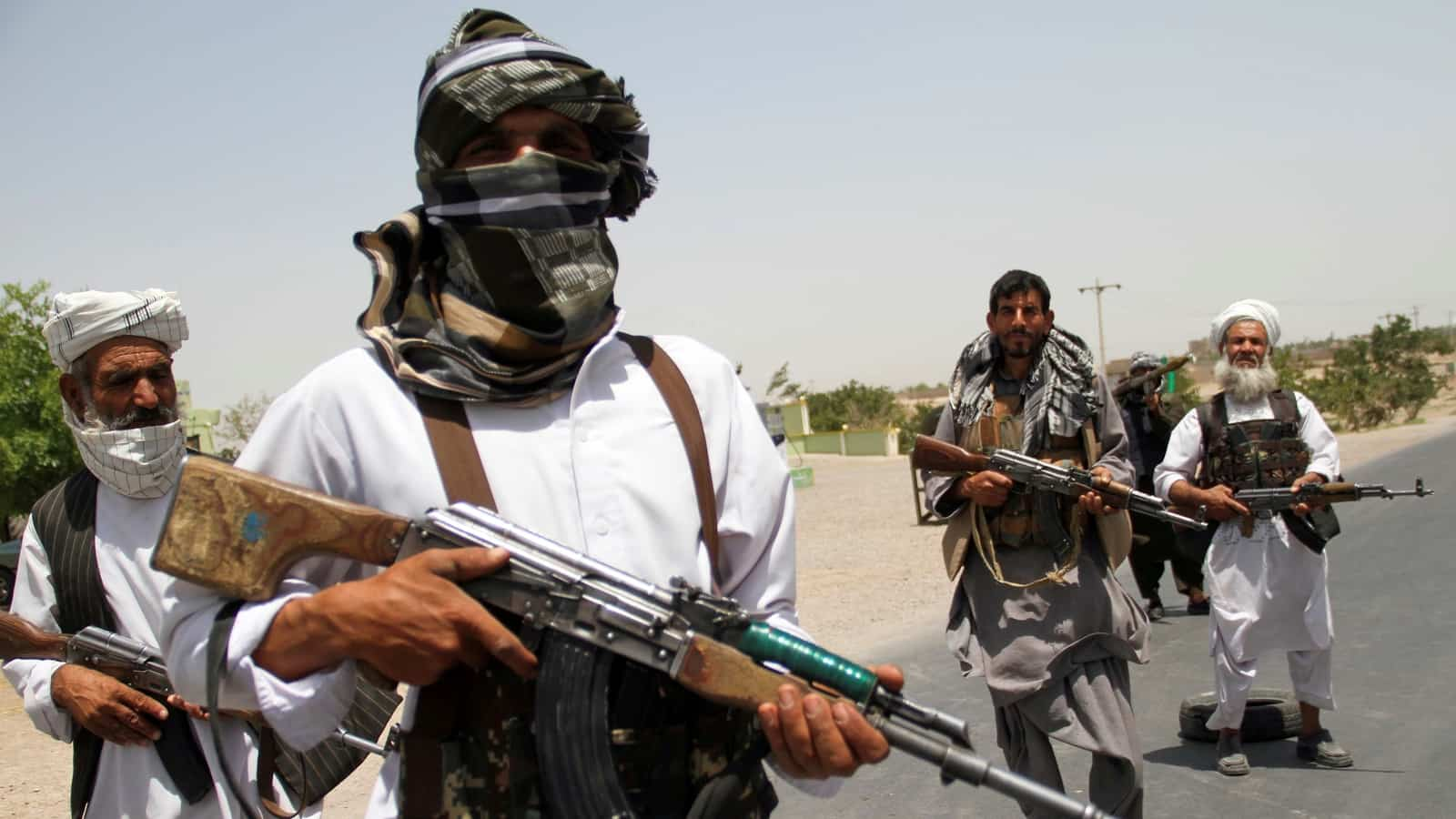
In the early 1990s, Hafiz Muhammad Saeed and Abdullah Azzam, two of Osama bin Laden’s mentors, the leader of the Al-Qaeda terrorist group, created another terrorist group called Lashkar-e-Taiba, and Maulana Sufi Muhammad set up the Tehreek Nifaz Shariat-i-Muhammadi group in Pakistan. Members of the extremist group were sent to Afghanistan along with Al-Qaeda members to fight against the then Soviet Union.
After the victory of the Mojahedin-e Afghan in Afghanistan, these groups found the opportunity to create military training bases on both sides of the Durand Line ( forms the Afghanistan–Pakistan border, a 2,670-kilometre international land border between Afghanistan and Pakistan in South Asia) and built dozens of training bases in those areas. The bases of extremist groups such as Lashkar-e-Taiba, Jaish-e-Mohammed and Al-Qaeda were located in the Muridke area of Lahore province, Pakistan, under the supervision of Pakistan’s Inter-Services Intelligence (ISI), which trained paramilitary forces and transferred them into Afghanistan.
All members of these groups were involved in the conquest of Afghanistan, because of the fact that members of these groups had participated in jihad (fight) against the communist government of Afghanistan and had sacrificed for the success of the Taliban Islamic Emirate in the war-torn country. Eventually, in 2007 the foreign conquerors of the Afghan war, who were consisted of 13 Pakistani militant groups, reached a conclusion to unite and found Tehrik-e-Taliban Pakistan (TTP) umbrella organization.
The examination and identification of the Tehrik-i-Taliban Pakistan movement is not possible without referring to the history of the Taliban in Afghanistan. Because on the one hand, these two groups are linked to each other in terms of political structure and beliefs, and on the other hand, their hideouts, human resources, spiritual and military leaders have close ties with each other along the Durand Line.
The term “Taliban” was originally used to describe a political and ideological group that emerged in 1994 in the border town of Spin Boldak, Kandahar province, located in southern Afghanistan, having its roots in a Deobandi Islamic school of thought as well as the Wahhabi belief. They conquered the important city of Kandahar with a fatwa of jihad from their spiritual leader Mullah Mohammad Omar Mujahid and then, they set out for the city of Jalalabad and the capital of Afghanistan, Kabul, in a bid to overthrow the then communist government in the country.
At a time when the Taliban were engaged in jihad to overthrow the communist government in Afghanistan and then, it clashed with the Mujahideen government composed of Tajiks, Hazaras, and Uzbeks, the tribal areas of Pakistan, including North and South Waziristan districts, were their safe route and arms supply line. Following the Taliban’s three years rule over Afghanistan and the terrorist attack in the United States on September 11, 2001, some Western countries led by the US and NATO kicked off invading Afghanistan with Pakistan’s green light. Simultaneously with the attack by the US and NATO forces on Afghanistan in 2001, radical members of the Afghan Taliban, including the Uzbek Taliban, the Islamic Movement of Uzbekistan (IMU), the Chechen immigrants, the East Turkestan Islamic Party, as well as several Arab members of the Al-Qaeda terrorist group took refuge in northern and northwestern Pakistan (North and South Waziristan districts).
Pakistan’s cooperation with the US in attacking Afghanistan, along with former Pakistani Prime Minister Pervez Musharraf’s order to besiege Pakistan’s tribal areas and arrest Al-Qaeda fugitives despite coordination with tribal elders, turn into a headache for the Pakistani army.
The Pakistani army entered South Waziristan District in 2003 after five decades and it continued the military operations to North Waziristan District in order to arrest Al-Qaeda members. The killing of tribal elders and spiritual figures in these areas by the Pakistani army led to the first clash between the Pakistani army and the Afghan Taliban, Al-Qaeda, Lashkar-e-Taiba, Jaish-e-Mohammed, and armed tribesmen from North and South Waziristan districts in 2004. Those clashes led to the withdrawal of the Pakistani army from Waziristan and the tribes took control of these areas.
The failure of the plan to set up an Islamic government in Pakistan as well as the sectarian and ethnic structure, the educational system of religious schools based on Wahhabism sect, the dispatch of Pakistani jihadi forces to Afghanistan, economic and social disorder, especially in North and South Waziristan districts, foreign and domestic support by anonymous individuals and various groups are among the reasons for the formation of the Taliban group in Pakistan.
However, the drone attack by the United States’ Central Intelligence Agency (CIA) on a religious school affiliated to Tehrik-e-Nifaz-e-Shariat-e-Mohammadi in Bajaur Agency (District) in 2206, which caused several casualties, was the main cause of the emergence of the Tehrik-e-Taliban Pakistan. For the reason that it prompted all armed and radical groups in Pakistan to declare jihad against the US and the Pakistani government.
In 2007, numerous militants from 13 groups, including Mullah Nazir’s group in North Waziristan District, Tehrik-e-Nifaz-e-Shariat-e-Mohammadi led by Sufi Muhammad, Jaish-e-Mohammed, Lashkar-e-Taiba, Al-Qaeda, Afghan Taliban fugitives and other groups with different races led by Baitullah Mehsud from North Waziristan District founded the Tehrik-e-Taliban Pakistan. They declared their goal as defending Prophet Muhammad’s religion, fighting against the Pakistani and the US army, and establishing an Islamic emirate with the focus on the Pashtun people in Pakistan.
In 2008, leader of the Afghan Taliban Mullah Mohammad Omar Mujahid dispatched a delegation led by Mullah Abdullah Zakir to Pakistan and asked for financial assistance from the Pakistani Taliban. Mullah Mohammad Omar Mujahid also asked the Pakistani Taliban to put aside their differences and to help him fight the US and NATO by sending troops.
Baitullah Mehsud, Hafiz Gul Bahadur and Mullah Nazir who had a history of fighting in Afghanistan accepted the proposal of the leader of the Afghan Taliban and pledged allegiance to Mullah Mohammad Omar Mujahid; so, they formed a council of mujahideen union. However, this council did not last more than a year and did not have any specific performance.
The clash between Tehrik-e-Taliban Pakistan and the army of the country was not very intense until 2007. But in 2007 to 2009, the volume of clashes intensified sharply. So, all military operations of armed groups against the Pakistani army from 2001 to 2007, which were about 30 operations and the volume of operations reached 269 attacks from 2007 to 2009. These clashes mostly took place in Khyber Pakhtunkhwa tribal areas and other border regions witnessed fewer tensions.
The most important operation of the Pakistani Taliban can be considered the assassination of former prime minister and leader of the Pakistan People’s Party Benazir Bhutto. The assassination was carried out on December 27, 2007 by a suicide bomber named Karamatullah Bilal from Pakistani militants; he also had a history of membership in the Al-Qaeda terrorist group. After firing several bullets at Bhutto, he carried out a suicide operation and took the lives of 22 people, including Benazir Bhutto.
However, Al-Qaeda denied any involvement in the suicide attack and eventually, Baitullah Mehsud, leader of the Pakistani Taliban, was identified as the first suspect in the assassination of Benazir Bhutto. In the following months, he was wanted by the government of Prime Minister Pervez Musharraf due to other terrorist attacks until he was killed in a drone operation by the US Central intelligence Agency (CIA) in North Waziristan in 2009.
However, his death was not confirmed by the spokesman for the Tehrik-e-Taliban Pakistan and the cause of his death was stated as illness. Two days after the death of Baitullah Mehsud, the 42-member council of the Taliban appointed his deputy Hakimullah Mehsud as the leader of the group. He intensified jihadi operations against the army and government of Pakistan as well as the expanded attacks against Shia civilians. Then, he was killed in a drone attack by the US Central Intelligence Agency in North Waziristan District in 2013. After the death of Hakimullah Mehsud, the 42-member council of the Taliban also appointed Maulana Qazi Fazlullah Hayat as the leader of the Tehrik-e-Taliban Pakistan.
The deadliest military operations of the Tehrik-e-Taliban Pakistan movement against the Pakistani army and government took place on December 16, 2014. In the attack, five members of the Pakistani Taliban entered the country’s Defense Ministry’s military university in Peshawar province, while wearing uniforms. As a result of the attack, 149 military students who were children of army soldiers were killed and 122 others were injured.
After these attacks, the Pakistani army tried to enter into talks with the Tehrik-e-Taliban Pakistan movement. Following the first sessions of talks between government representatives and the TTP, Maulana Omar’s sect separated from the Tehrik-e-Taliban Pakistan movement to show their objection. At the end of 2014, Mehsud’s sect also announced its separation from the Tehrik-e-Taliban Pakistan movement and it established a branch of the Tehrik-e-Taliban in South Waziristan District. This separation dealt a heavy blow to the organizational structure of the Tehrik-e-Taliban Pakistan movement and even despite the joining of the Jamaat-ul-Ahrar group led by Omar Khalid Khorasani to the Tehrik-i-Taliban Pakistan movement, their situation did not improve much.
Read more: Tehrik-i-Taliban Pakistan And The Jamaat-ul-Ahrar Group
The most important operations against the Pakistani army positions can be considered as an attack on PNS Mehran Air Station in Karachi and a 15-hour-long clash with the military forces that resulted in the killing of 13 Pakistani soldiers and the destruction of several military aircraft. The second deadliest attack of the decade also took place in 2016. In this suicide attack, which was carried out by a member of Jamaat-ul-Ahrar terrorist group (a subsidiary of the Tehrik-e-Taliban Pakistan) at a ceremony honoring Christmas in an amusement park in eastern Lahore province, more than 70 Pakistani Christians were killed and injured.
After Qazi Fazlullah Hayat was killed by the US forces in Kunar province in eastern Afghanistan and the second leader of the Tehrik-e-Taliban Pakistan movement Khalid Mehsud was killed by the American forces in Paktika province in Afghanistan in 2017, another commander of Tehrik-e-Taliban Pakistan named Noor Wali Mehsud from Mehsud tribe in South Waziristan District was appointed as the new leader of Tehrik-e-Taliban Pakistan movement.
Noor Wali Mehsud was from Miran Shah town of South Waziristan District, who had studied religious lessons in Faisalabad area of Punjab province. He is one of the most radical leaders of Tehrik-e-Taliban Pakistan who participated in the war between the Afghan Taliban and the United Front or Northern Alliance (Ahmad Shah Massoud and …). After Noor Wali Mehsud was appointed as the leader of Tehrik-e-Taliban Pakistan, Mehsud’s sect also rejoined Tehrik-e-Taliban Pakistan movement after three years.
Currently, Tehrik-e-Taliban Pakistan movement cooperates with various sub-branches militant groups throughout this country and foreign groups from the Haqqani Network to the Jaish ul-Adl. The active members of the group are estimated to be between 20k to 25k people, and 6 thousand of whom have been sent to help the Afghan Taliban.
At the same time when the US forces withdrew from the war-stricken country of Afghanistan and the downfall of the Afghan government in Kabul on August 15, 2021, the Tehrik-e-Taliban Pakistan movement, which was under pressure from the Pakistani army, entered into talks with the government in Islamabad with the mediation of Sirajuddin Haqqani, leader of Haqqani Network.
During these negotiations, representatives of the Tehrik-e-Taliban Pakistan movement demanded the implementation of the Islamic laws and traditions in Pakistan’s tribal areas as well as the release of prisoners affiliated to the Taliban sect, who have been arrested by the government forces. The requests were accepted by the Pakistani government and a short-term ceasefire was established following the negotiations. But shortly afterwards, the government in Pakistan did not take any action to implement the demands and then, the Taliban resumed their attacks and as a result of this situation, the attempts for reconciliations doomed to fail.
In general, it seems that achieving a sustainable peace in Pakistan is a difficult path. Because the country’s society is still facing incorrect tribal cultures and the so-called Islamic government has not been able to meet the expectations and values of an “Islamic government” that was pursued by the groups such as the Tehrik-e-Taliban Pakistan movement. On the other hand, the Pakistani army has the first say in the country’s nationwide programs and their anti-terrorism plan has so far caused more than 18,000 casualties on the Tehrik-e-Taliban Pakistan movement and other groups. Given such conditions, talking about sustainable peace in Pakistan is nothing more than a slogan.
Author: Ahmad Alavi, correspondent and analyst of Afghanistan and Central Asia