

It is said this group affiliated with the Syrian government and against foreign aggressors.
Tag: Raqqah
-

Investigating ISIS Activities in West of Asia in the Last Three Months
Syria:
As indicated in heat map, most of ISIS activities took place in east of Euphrates lands and were mainly IED’s and assassinations, also ambushes.Bombing in Raqqah are noteworthy.
In previous reports, it was mentioned that ISIS activities are limited to east of Euphrates River or close to it and there is no significant activities inside Syrian Government controlled lands.In fact, contrary to expectations, insecurity in areas where the US Coalition forces are present are more than the areas that are not in control of the Coalition!

Iraq:
Most of ISIS activities and attacks are taking place in north of Salah Al Din province and south of Kirkuk and Hawijah area. ISIS activities near Baiji are noteworthy.
ISIS members were under siege lastly in Hawijah area and ISIS continuous activities in these areas indicating that Iraqi security forces operations to clearing the area have not been effective much.
ISIS attacks in Mosul are mainly bombing, increasing number of these attacks is worrying.
ISIS has intense activity in north of Diyala province in Khanaqin area and in Anbar province in Fallujah area.
Egypt, Sinai Peninsula:
Sinai Peninsula is still the biggest threat to security of Egypt and ISIS activities in Egypt are limited to this area.
ISIS attacks take place in three regions: Al Arish, Rafah and Sheikh Zuwaid as before.During recent weeks Israeli fighters attacked ISIS positions in the area.

Afghanistan:
Most of ISIS activities in Afghanistan are in eastern part in the form of bombs and assassination in Kabul and near Jalal Abad.
Overall ISIS terrorist group is present in eastern regions specially in Nangarhar province and there were engagements with Taliban. Kabul is constantly under threat of ISIS suicide bomb attacks.
Other regions:
North of Baydha province (north of Rada’) in Yemen, Mogadishu in Somalia, Libya and Borno state in Nigeria and northeastern borders of the country are areas that in the last 30 days, ISIS was active in with bomb, assassination and other forms of attacks.Among these areas, Borno state in Nigeria was attacked the most and as time went on, the number of attacks increased.
Map by Tomasz Rolbiecki
-

Syrian Flag Raise in SDF Controlled Lands
Today most of Manbij inhabitants raised Syrian flag over their roof and city officials holding Syrian flag supported central government.
Inhabitants of Sabkhah area south of Raqqah also rallied in support of Syrian government.During the last few weeks similar rallies took place in east of Euphrates to support Syrian government and most of seniors are persuading people to support central government.

-
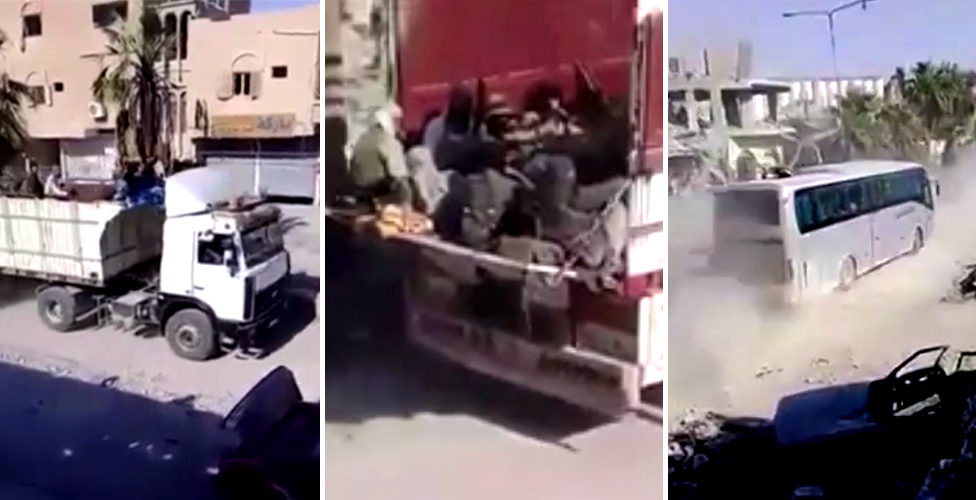
BBC Confirms the US-led Coalition Is Part of the Problem in Syria Rather than any Solution
The revelations carried in a recent BBC report, concerning a deal that was struck between the US-led coalition that has been engaged in the battle to retake the Syrian city of Raqqa in recent months and the Daesh fighters occupying the city – a deal allowing hundreds of said fighters to be evacuated along with their families and weaponry – could not be more scandalous. More than opportunism, it exposes the oft-proclaimed commitment of Washington and its allies to destroying Daesh as hollow.
According to the BBC the deal “enabled many hundreds of IS [Daesh] fighters to escape…At the time, neither the US and British-led coalition, nor the SDF, which it backs, wanted to admit their part.” According to the personal testimony of some of the drivers employed to evacuate the fighters and their families out of Raqqa, “the convoy was six to seven kilometres long. It included almost 50 trucks,13 buses and more than 100 of the Islamic State group’s own vehicles.” We also learn that despite “an agreement to take only personal weapons, IS fighters took everything they could carry. Ten trucks were loaded with weapons and ammunition.”
No one should be in any doubt when it comes to the gravity of seriousness involved in allowing hundreds of Daesh fighters to escape and fan out across Syria with some, according to the BBC, making it across the border into Turkey. The burning question is whether the deal and subsequent evacuation was undertaken with the express purpose of diverting them to parts of Syria controlled by the Syrian Army and its allies?
What is certain is that it brings the US-led coalition into disrepute, confirming that it is part of the problem in Syria and wider region rather than any solution. When we add to this sordid picture the recent sentiments of US Secretary of State Rex Tillerson, asserting that there is no future for Assad in Syria, it is clear that regime change in Damascus remains Washington’s overarching objective.
When it comes to regime change in Syria, exactly who would benefit? Certainly not the Syrian people after the inordinate suffering and sacrifice they have endured in the process of first withstanding then defeating a concerted attempt to destroy the country and its non-sectarian character.
A dirty war has been waged in Syria these past six year not by Daesh, per say, but by the US, UK, and their Persian Gulf allies. Add to this motley crew Israel’s repeated violations of Syrian airspace and you identify an axis which constitutes a threat to human progress and development such as the world hasn’t seen since the Second World War.
As for the Syrian Kurds, fighting under the banner of the SDF (Syrian Democratic Forces), they now have a critical role to play when it comes to the trajectory the conflict takes upon the liberation of Raqqa. Indeed upon their next move will depend whether it will be accurate to describe the removal of Daesh from the city as liberation or whether it will be more akin to a re-occupation.
It has never been more important for the Kurds not to make the mistake of confusing self-determination with treachery. Their part in defeating Daesh has undoubtedly been a courageous one. However with this secret deal to allow hundreds of Daesh militants to leave the city with their weapons and ammunition, it is impossible to avoid pondering if they are now preparing for a post-Daesh confrontation with the Syrian Army, which has just liberated Deir Ezzor 145km southeast of Raqqa.
The point bears repeating: the presence of US military forces in Syria constitutes a clear violation of international law. It bears repeating when we have key US officials, such as Defense Secretary James Matthis, claiming UN sanction for this presence. As Russia Deputy Foreign Minister Gennady Gatilov pointed out in reponse to the US Defense Secretary’s false claim, “Syria is a sovereign independent state,” going on to remind Mr Matthis that “only the Syrian government can invite armed forces of third countries onto its territory. The UN has no such right,” he went on, before emphasizing that “the fight against terrorism does not give any states or coalitions a free hand to establish their presence on Syrian territory.”
There is no doubt, surveying the contours of this struggle in Syria, that driving it has been the ongoing attempt not only to destroy Syria’s sovereignty and independence, but to neuter Iran’s independence also. This is why Trump’s recent unhinged and uninformed bellicose statements, directed at Iran, should come as no surprise. What with the purge unleashed by crown Prince Mohammad bin Salman in the Riyadh recently, along with the detention and forced resignation of Lebanon’s Prime Minister Saad Hariri, though the battle for Syria draws to a close, the wider struggle between the axis of sectarianism and regime change – comprising Washington, Saudi Arabia, and Israel – and the axis of resistance to it – comprising Russia, Iran, Syria and Hezbollah .
-

Latest progress by Syrian army in eastern Syria & possible axis
In recent days, the Syrian army leaded by Soheil Hassan, advancing and defeating ISIS defense lines in southern province of #Raqqah
therefore , a large number of oil and gas wells were freed through the last week.
Also Resistance forces are approaching to Al-Sukhnah in #Tadmur–#DeirezZor axis. It is also possible for them to advance towards T2 station in Hamimah axisRegarding the type of advancements, two points can be considered :
– #SAA can approach to Al-Sukhnah from the top
and bottom in parallel with downstream advancements of the Resistance Forces , and surround the large amount of #ISIS in center of Syria!
Of course, considering the suicide nature of ISIS behavior, this move has its own advantages and disadvantages that are not included in this article.– SAA can continue its advances in southern Raqqah province & reach to Deir ez Zur , meantime resistance forces will advance towards Deir ez Zur along the highway.
Remember these two, in the coming weeks, we will say more about this