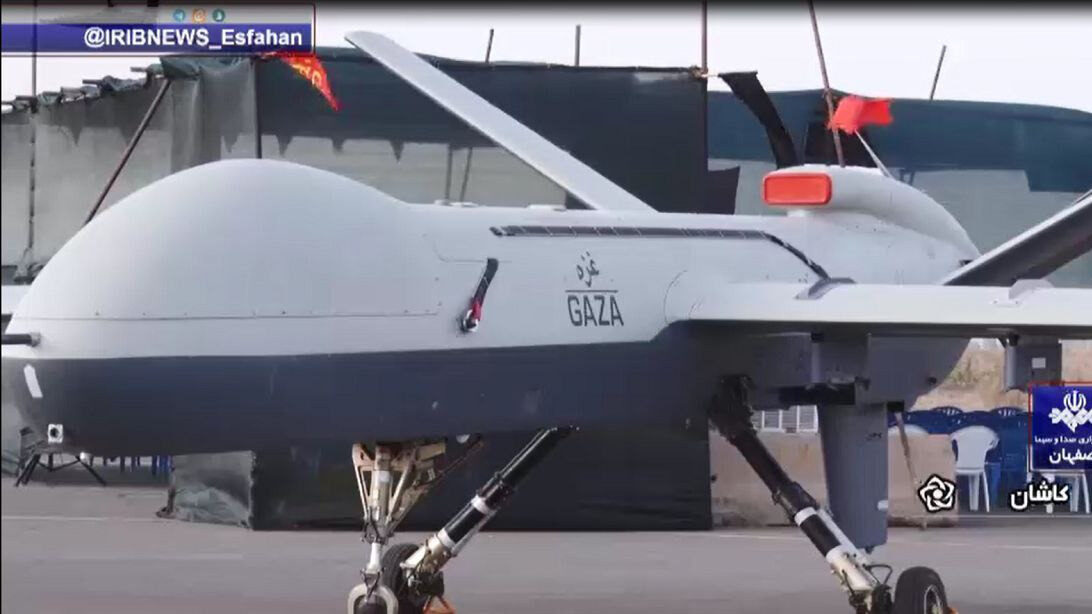
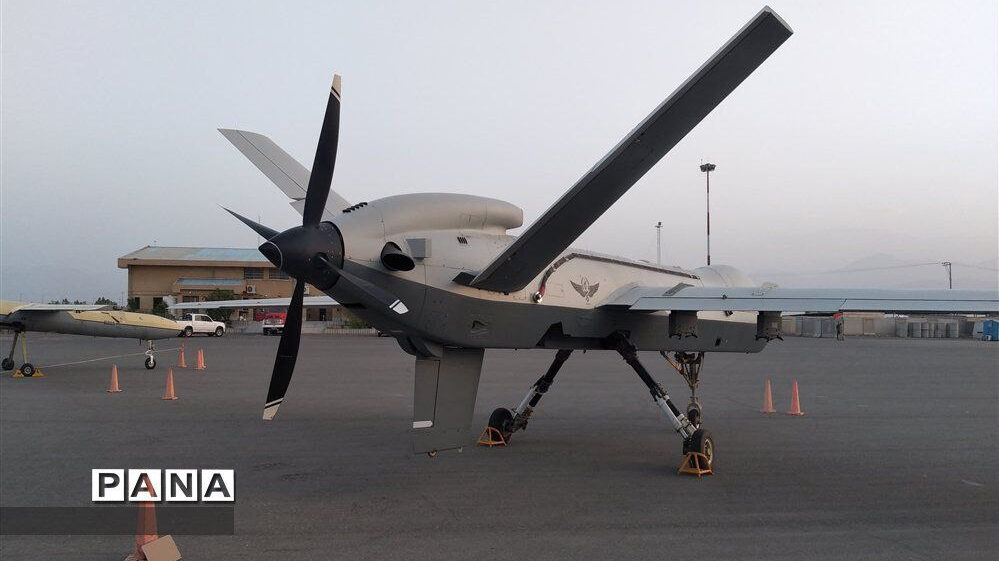
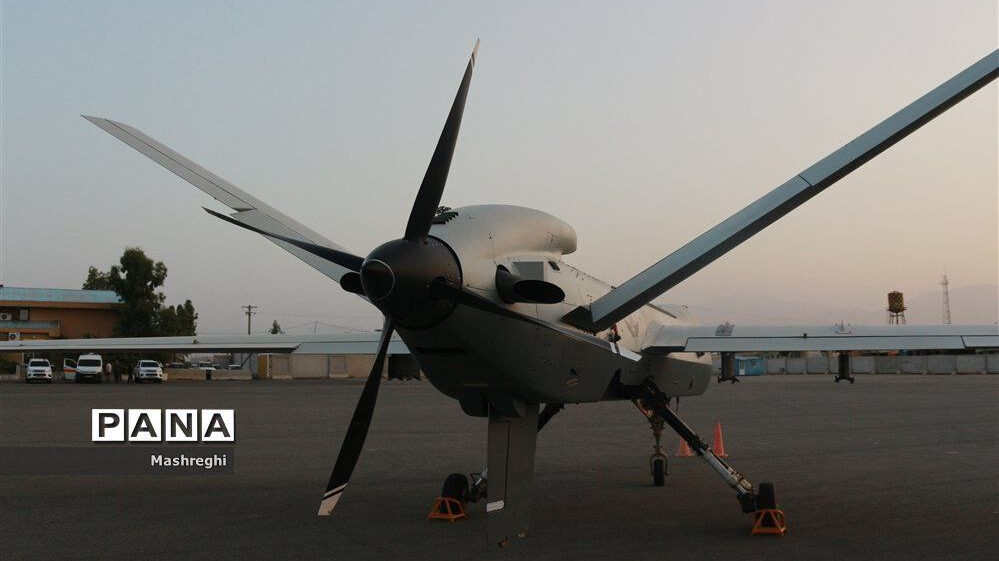
The Shahed-149, which was developed by the Shahed Aviation Industries, is a high-altitude long-endurance combat drone similar in size, shape and role to the American MQ-9 Reaper. The drone was first unveiled and named after the Gaza Strip in honor of the Palestinians’ struggle against Israel amid the May 2021 Palestinian-Israeli crisis.
The upgraded version of the drone, which was unveiled at Martyr Karimi Air Base in the central city of Kashan, is equipped with an improved landing gear system and new hardpoints.
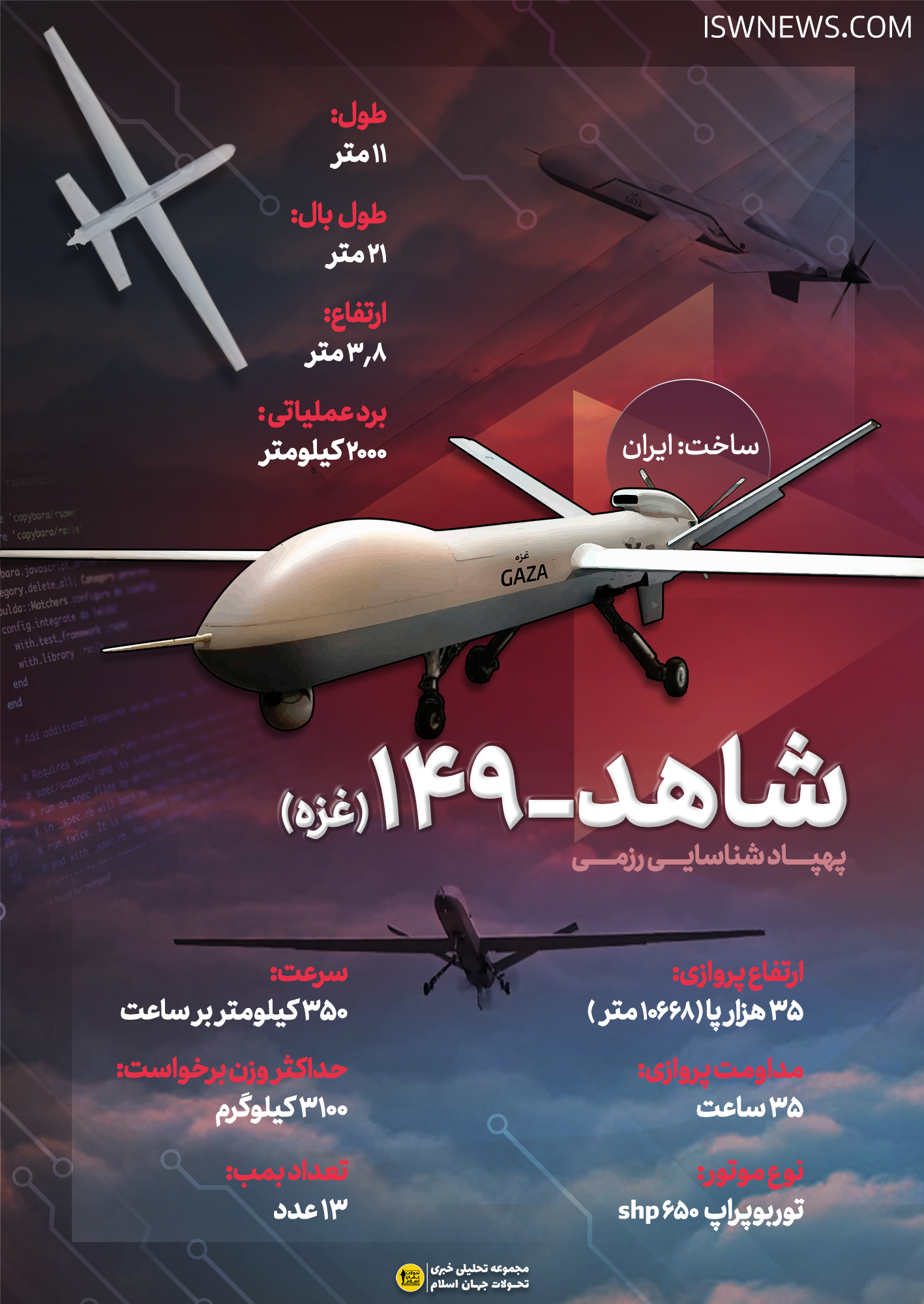
The Shahed-149 has a flight duration of 35 hours, an operational range of 2,000 kilometers and a cruising speed of 350 kilometers per hour. The combat drone is capable of carrying 13 bombs and 500 kg of electronic equipment. It is the first Iranian UAV powered by a turboprop engine.
The long endurance and range of the Shahed-149 should allow it to operate all the way from western Iran to Israel. The drone can also operate over the entire Persian Gulf and the Sea of Oman from Iran’s southern region.
Despite facing sabotage attempts by Israel as well as strict sanctions by the United States and the European Union, Iran managed to expand its drone program in the last few years. Today, the country is one of the world leaders in drone technology.
Shahed-149 or Gaza drone is one of the most advanced and largest Iranian drones ever built by the Iranian Armed Forces, and the specifications and equipment used in it show the significant progress of Iran in increasing the country’s capabilities in the field of UAVs.
The Shahed-149 reconnaissance combat drone, capable of carrying 13 bombs and 500 kilograms of equipment, as well as a 35-hour flight duration up to a radius of 2,000 kilometers, and is capable of conducting a variety of combat and intelligence operations and greatly enhances and promotes Iran’s military capability in the region.
This drone is very similar to the US MQ-9 Reaper drone and is compared to this drone in terms of operational level. According to the published images, it seems that Iranian experts have succeeded in building such a drone by using past experiences and studies on American captured drones.
Shahed-149 (Gaza) drone with a wingspan of 21 meters and a length of 11 meters has a speed of about 350 kilometers per hour and its maximum takeoff weight is 3100 kg and is capable of carrying cargo weighing at least 500 kg and its flight altitude is about 35,000 feet. Therefore, due to the large size and heavy weight of this drone, a turboprop engine has been used. This is the first time that a turboprop engine with this power is used on an Iranian drone. Exact information about the power of this engine has not been published yet; But according to the published images and general information of the drone, it seems that the Shahed-149 drone uses a turboprop engine with a nearly 650 shaft horsepower.
Another noteworthy point in this drone is the use of a more advanced electro-optical system than previous drones. This system, which seems to be one of the most advanced Iranian electro-optical systems, in addition to a day-vision camera with a zoom power of at least 100 to 120 times, also has a infrared sensor system, laser designation and laser illumination capabilities. One of the highlights of this system is the use of a catadioptric lens that increase the magnification ability several times and this is the first time that it has been used in Iranian drones.
Shahed-149 Gaza drone electro-optical system
Amir Ali Hajizadeh, Commander of the IRGC Aerospace Force, regarding the weapons capability of the Gaza drone, stated that this drone is capable of carrying 13 bombs. In the published images, a device similar to the rotating bomb system used in bombers is seen. And given the space under the drone’s fuselage, the Gaza drones appears to be using a Rotary Bomb Launcher under its fuselage that can carry up to five bombs. If this is true, this is the first Iranian drone to use this mechanism. Due to this improvement, 5 bombs will be installed inside the bomb bay and 8 bombs will be installed under the wings, and in total, this drone is capable of carrying 13 bombs.
Possible Rotary Bomb Launcher mechanism in the Shahed-149 Gaza drone
Iranian Sadid “Fire-and-Forget” missiles weighing up to 34 kg, 13 of which weigh up to 442 kg, can be one of the types of missiles that can be used in the Gaza reconnaissance combat drone.
Shahed-149 (Gaza) drone specifications: Length: 11 m Wingspan: 21 m Height: 3.8 m Range: 2,000 km Service ceiling: 35,000 ft (10,668 m) Endurance: 35 hours Powerplant: Turboprop ~ 650 shp Speed: 350 km/h Gross weight: 3,100 kg Armament: Up to 13 missiles Origin: Iran
The commander made the announcement in a televised program of Iran’s national TV network dubbed Saf-e Avval (First Line), informing the details of the state-of-the-art missile and drone weaponries manufactured by the Iranians, including Shahed-149 (Gaza) drone, Paveh cruise missile and hypersonic missile.
Brigadier General Hajizadeh said that “the US officials benefit from making the region insecure, as it can be said given the conflicts in last four decades (Iraq-Iran war, the US’s invasion of Iraq, Saudis’ attack on Yemen, the rise of Takfiri terrorist groups and the strikes on Lebanon’s Hezbollah resistance movement) that our region is facing a security fault, because the root cause of Russia-Ukraine confrontation as well as China-Taiwan quarrel comes from the US. If we are not powerful, the enemy would bring the war into the Iranian territory; so, we should be watchful to maintain security of our country and nation, and if we ignore it, our country may face some challenges.”
He noted that the IRGC Aerospace intends to make the US war machine and capabilities incapable, noting that “the Americans enjoy some components of superiority, but we tried to hit the components and turn them into impracticable. Today, the US’s regional bases are under Iran’s supervision and they are easy targets; so, the bases have turned into the Americans’ weak points, and we can hit the bases whenever it is necessary.”
Touching on the IRGC Aerospace’s missile might, which is an indirect warning to the European countries, he noted that “we are now able to target the US aircraft carriers at a 2,000-kilometer distance. Of course, we kept the limit at the distance to respect the Europeans; so, we hope they respect their esteem.”
On the features of the Iranian hypersonic missile, he said that “the hypersonic missile is capable of maneuvering in outer space and moving in different directions; that means it has an engine, which can start 300, 400 and 500 meters far from a target and kick off maneuvering. The speed of the missile reaches at Mach 12-13 and its main advantage is that the foe’s missile defense system cannot hunt and destroy the hypersonic missile; thus, I’m sure the enemies cannot manufacture a defense system to overcome the Iran-made hypersonic missiles even until tens of years.”
Asked about the timing of unveiling the Iranian hypersonic missile, he replied “given the fact that the projectile travels to outer space, we try to find a way to be able to showcase it; if the Americans do not believe in it, it would be not important, because its capability can be seen on the day of incident.”
The commander also pointed to the upgrade of capabilities of the Iranian ballistic missiles, saying that Iran managed to decrease the weight of the long-range missiles to one-fourth and improved their efficiency; and in terms of precision, all Iran-made missiles are precision-strike projectiles and the time required for their preparation has been reduced to one-sixth.
He further referred to the fact that one of the newest Iranian cruise missiles dubbed Paveh has become operational. The cruise missile with a range of 1,650 kilometers, which can travel 50 meters above earth surface.
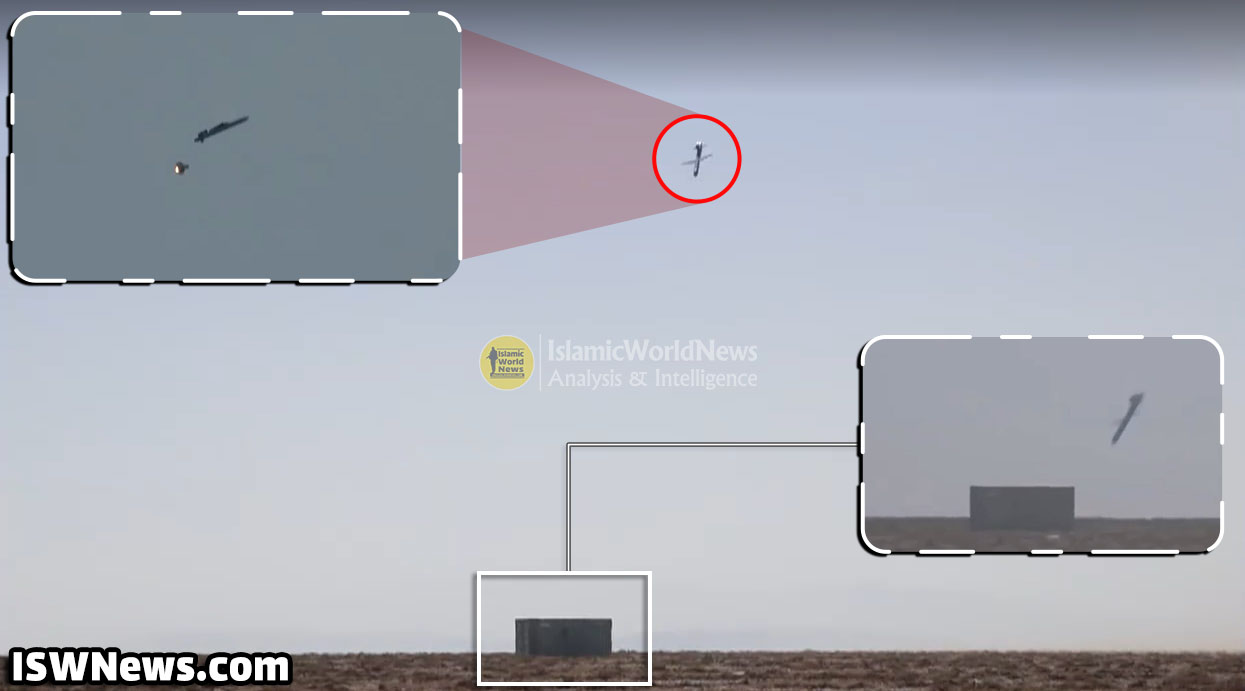
A video published by the IRGC Aerospace shows that the missile was test-fired by the use of solid rocket booster from a launcher; then, the main part was detached from the booster after reaching altitudes, and its wings become open and the main engine starts.
The moment of firing Paveh long-range cruise missile with a range of 1650 km and moving at a flight height of 50 meters from the ground and finally hitting the target
The appearance of Paveh cruise missile is very similar to Quds missile of Yemen’s Ansar Allah movement. It seems that the course of development of Paveh missile has been carried out in recent years using the experiences of Yemen war and Ansar Allah’s operations against Aramco’s oil facilities (officially the Saudi Arabian Oil Group). Paveh missile is an evolved example of Iranian cruise missiles Soumar, Hoveyzeh and Ya-Ali etc.
Video of Yemen’s Ansar Allah Missile Force from the moment of firing Quds 1 cruise missileYemeni Ansar Allah Missile Force’s video of Quds 2 cruise missile
Notable advantages of Paveh cruise missile is that it can be carried and fired by marine and ground vessels as well as fighter jets. The significance of the issue would be highlighted, when Russian Sukhoi 35 fighter jets join the Iranian military equipment, because the Iranians would not need foreign weapons to arm their fighter jets.
Brigadier General Hajizadeh went on to say that “the Shahed-149 or Gaza drone (named after the Gaza Strip in honor of the Palestinians’ struggle against Israel amid their crisis in 2021) is huge drone, which is capable of keeping on flying for a remarkable duration and it can carry nine bombs simultaneously.”
The first video of the takeoff and flight of the Shahed-149 UAV (Gaza)
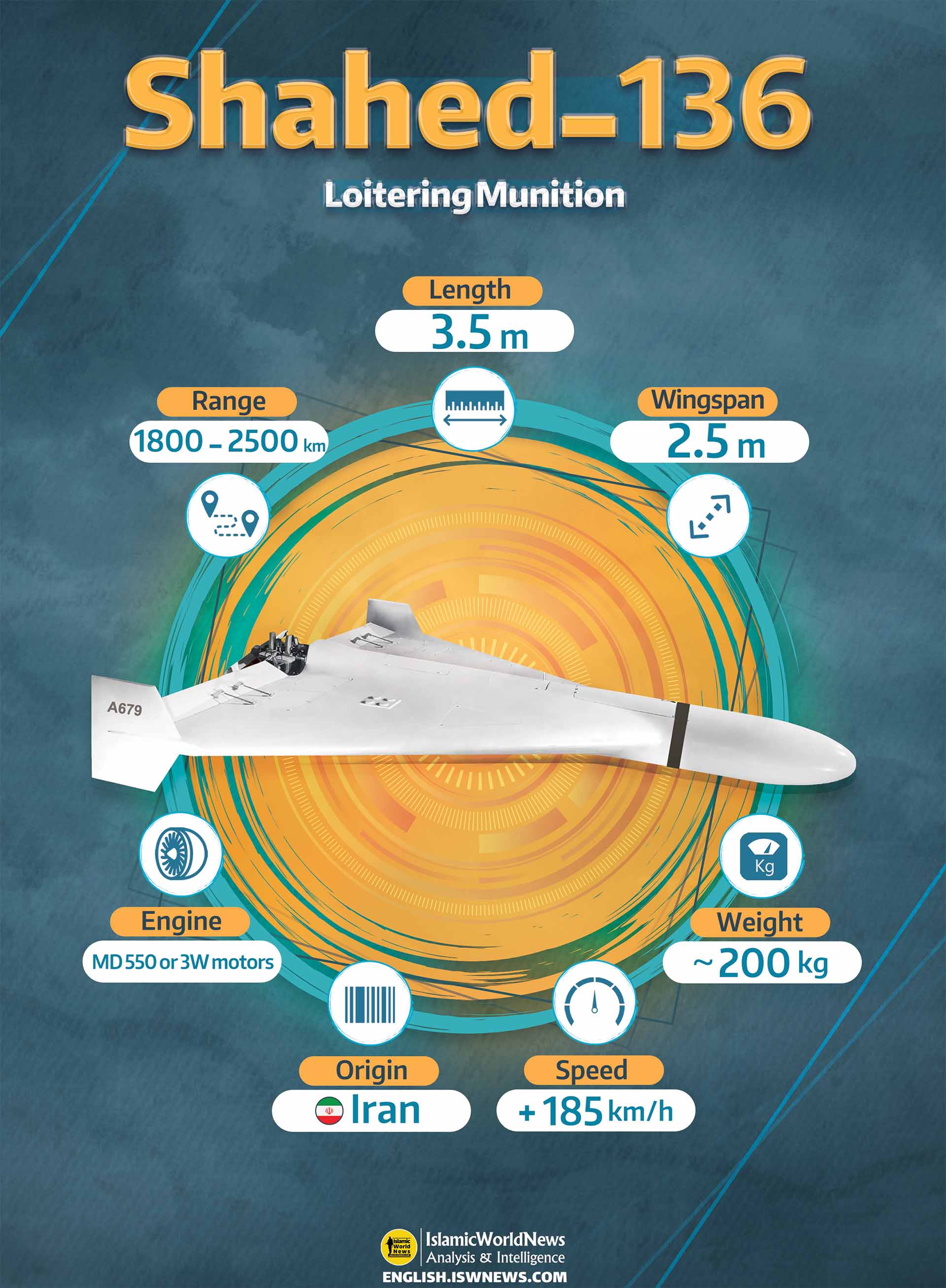
“We have the Shahed-129 and Shahed-139 in our combat drone arsenal, which provide us with good military capabilities, he said, adding that we can utilize the drones for combat, telecommunication and surveillance over border and other areas. The Shahed 129 is equivalent with the US-made MQ-1 and it possesses appropriate abilities, the commander said, noting that the Shahed-136 and Shahed-131 are also unique drones at international level, which have many capabilities.”
Click to view full size
The brigadier general further pointed to Iran’s missile operation on the United States’ airbase in Ayn al Asad (an airbase located in Al Anbar Governorate of western Iraq) in reaction to the Trump administration’s assassination of Lieutenant General Qasem Soleimani at Baghdad Airport on January 3, 2020, saying that “we did not aim to kill the American soldiers in the strike on the Ayn al Asad airbase, but we wanted to break the US’s grandeur; we pursue to avenge former US president Donald Trump and former United States secretary of state Mike Pompeo, who ordered the assassination of General Soleimani.”
Hajizadeh also hinted cooperation among the IRGC Aerospace Force, Iran Space Organization and the Ministry of Defense and Armed Forces Logistics, informing that they try to improve capabilities of satellite carriers to reach higher altitude and increase heavy weights, which will be announced in the future.
The recent operations by the IRGC in the region as well as the resistance movements in Yemen and other countries proved the broaden capabilities of Iran in drone and missile sectors; so that the Western and Eastern politicians as well as military analysts acknowledge the achievements. The understanding of the military superiority of Iran will become more difficult for the Westerners following the massive usage of big drones and hypersonic missiles by the Iranian armed forces.