Tag: Syria

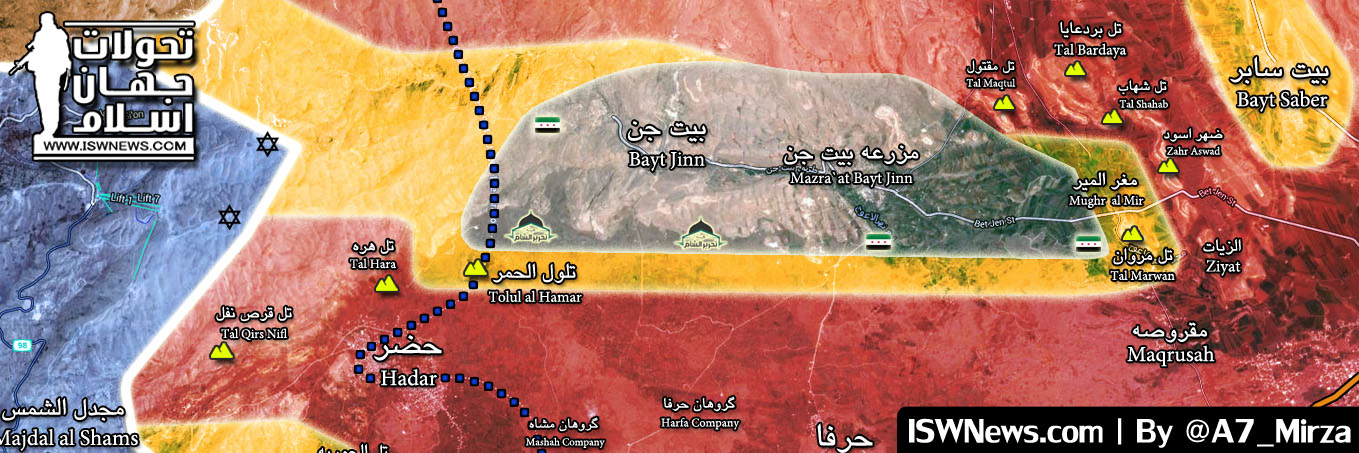
  • Beit Jinn latest updates; Fights still going on Beit Jinn heights.

    Beit Jinn latest updates; Fights still going on Beit Jinn heights.

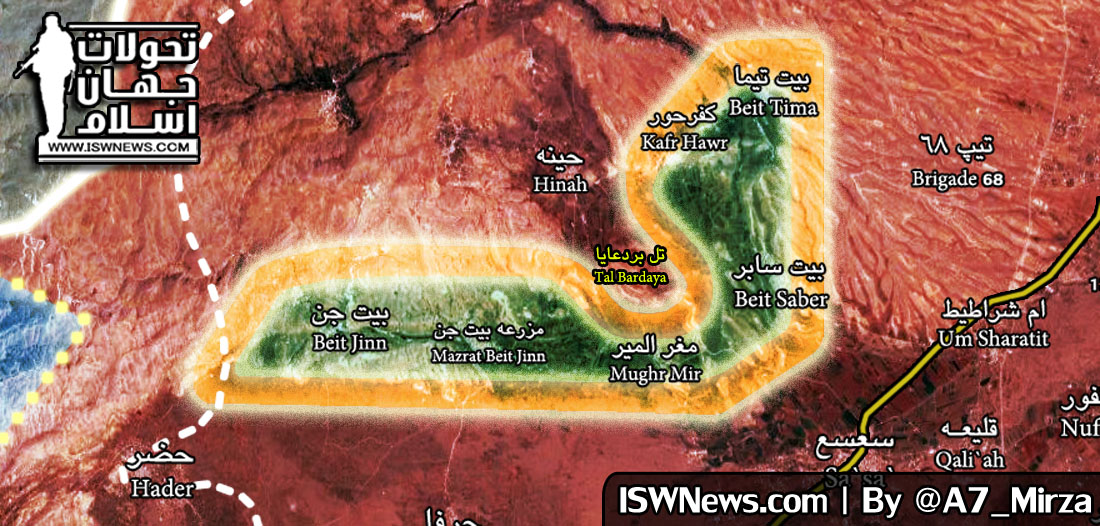
    The importance of these heights is to be dominant over regions in the hands of militia and to defeat them finally. These strategic heights are liberated so far:

    Tal Dhab`, Talal Kafr Hawr, Talal Bardaya, Tal Shihab, Tal Maqtul, Tal Baydha, Khazan, Tal Ahmar, Tal Mantar, Ziyat, Dhahr Aswad.


    With recent advances, the logistic helps of militia in siege are cut and Mughr al Meer falls from military perspective. The only escape axis for militia or help for them are byways of Jabal al Sheikh to Shebaa, Lebanon and Israeli observation posts in Golan occupied heights.


    In the past, terrorists, through Israeli surveillance posts, bypassed the Beit Jin pocket & attacked Hadar..


    Continuing these advances, in near future liberation of the besieged regions of Beit Jinn is expected.


    Download Map

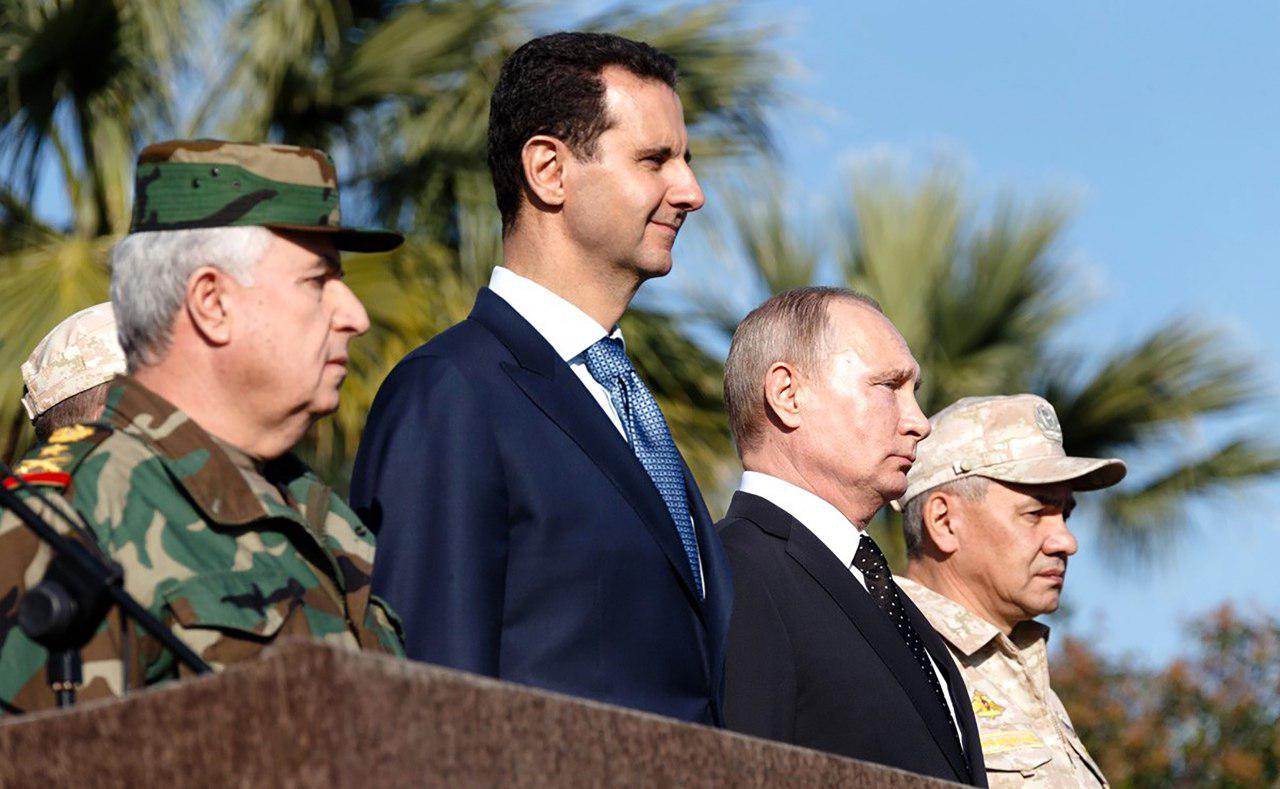
  • Putin ordered the start of preparations for the withdrawal of Russian troops from Syria

    Putin ordered the start of preparations for the withdrawal of Russian troops from Syria

    Putin ordered the start of preparations for the withdrawal of Russian troops from Syria.

    He said:”I ordered the Minister of Defense and the Chief of General Staff to begin withdrawing the Russian forces to their permanent positions,” Putin told the military.

    “In more than two years, the Russian armed forces, together with the Syrian army, have defeated the most powerful international terrorist groups. In view of this, I have decided to return a large part of the Russian military force in the Syrian Arab Republic to Russia. ”

    “If the terrorists raise their heads again, we will strike them,” he said. “We will never forget the victims and the losses we have sustained in fighting terrorism here in Syria and in Russia as well.”


    Putin congratulated the Russian military on the success of the anti-terrorism mission in Syria and thanked them for their service.


    President al-Assad thanked Putin during his meeting with him in Hameimim today for their active participation in the fight against terrorism in Syria, stressing that what the Russian military will do will not be forgotten by the Syrian people after the blood of their martyrs merged with the blood of the martyrs of the Syrian Arab army against the terrorists. Which narrated the soil of Syria that it is stronger than terrorism and mercenaries, and will remain the memory of the martyrs of the heroic armies and their sacrifices beacon for future generations ..

  • Syrian army clearing the deserts in south of the Deir Ezzor province from the ISIS remnants

    Syrian army clearing the deserts in south of the Deir Ezzor province from the ISIS remnants

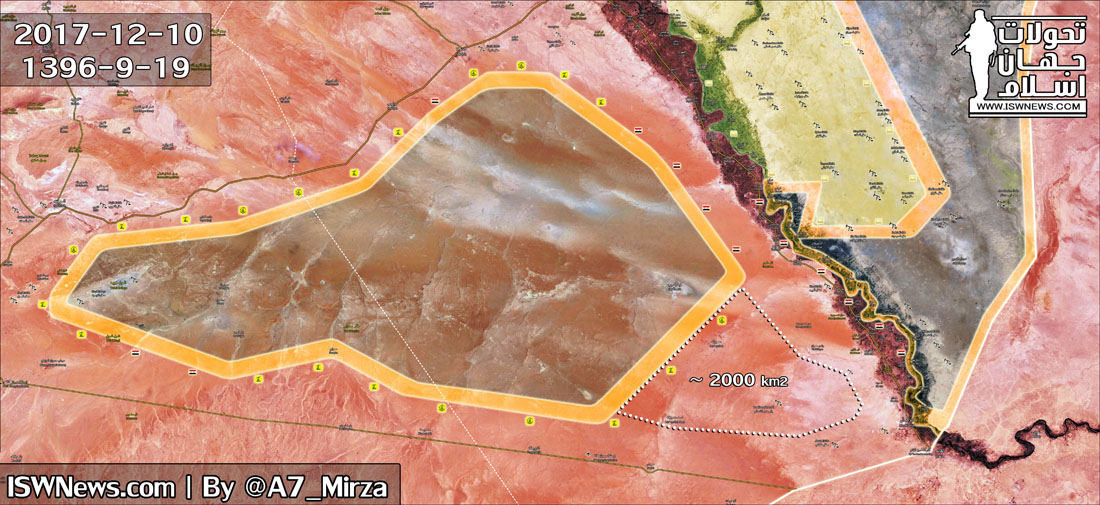
    This success happens after forces in “T2” region advanced to north and Mu`ayzila dam and other forces advanced north to Mu`ayzila and join each other and clear 2,000 square km of besieged lands.


    Considering freedom of Iraq from ISIS, freedom of east of Homs and south of Deir ez Zor is achieved with higher pace.


    High quality map


  • Latest updates about Beit Jinn siege in southern Damascus

    Latest updates about Beit Jinn siege in southern Damascus

    In the last few weeks, Syrian army could advance incremental and Tahrir Al Sham terrorists attacked heavily with help of Israel in Beit Jinn and Hader regions.


    After defending against these attacks, Syrian army recaptured all the lost regions and along with their advances, they took over Tal Bard`aya and Tal Shihab.


    Tal Bard1aya is important since it overhangs the logistic road for terrorists in siege and divides the region into two halves. Having this important point specially after the terrorists in the region denied any reconciliation is necessary, since it forces them to negotiate again but this time with emptier hands..

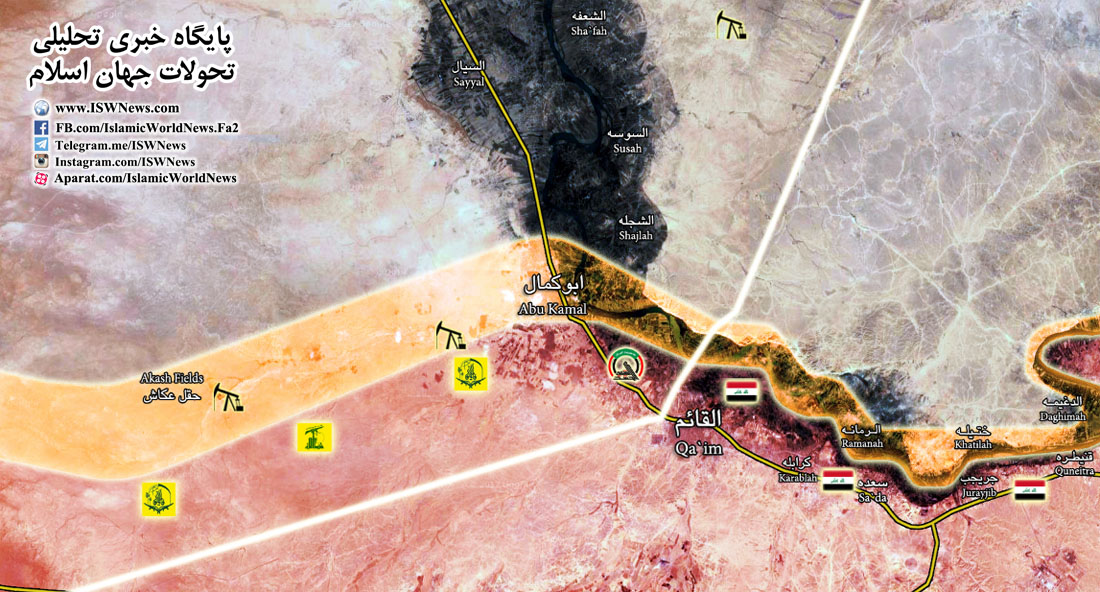
  • Updates on situation of Al Bukamal-Al Mayadin road after recapture and opening

    Updates on situation of Al Bukamal-Al Mayadin road after recapture and opening

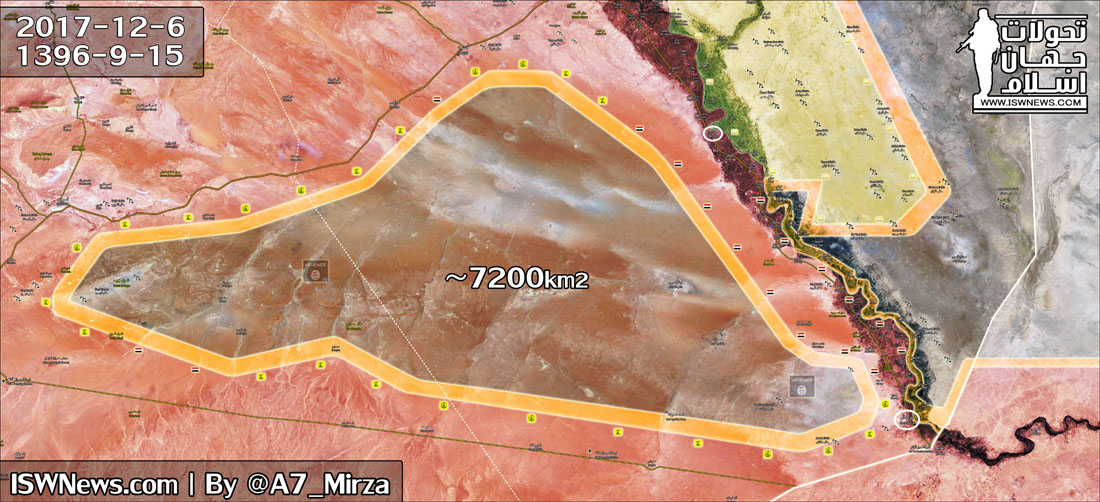
    With new advances, ISIS is besieged in an area of 7,200 square km between east of Homs and south of Deir ez Zur province. But due to their poor condition in terms of logistic and defenses, this big area is expected to be freed completely from ISIS soon.

    In northern Euphrates region, there are still villages between Al Bukamal and Al Mayadin occupied by ISIS, which will be capruted by SDF or will be divided between Syrian Army and SDF until the situation of Kurdish forces be cleared in northern Syria.


    HD MAP


  • Muslims Defeated the “Islamic State”, Israel Is the Big Loser

    Muslims Defeated the “Islamic State”, Israel Is the Big Loser

    Most observers would agree that the United States has directly or indirectly contributed to the creation of most of the international terrorist groups that have been in the news for the past thirty years. The narrative of how Osama bin Laden and what was to become al-Qaeda were initially supported by the U.S., Pakistan and Saudi Arabia to drive the Red Army out of Afghanistan is well known. Washington did so with little regard for broader agendas, including removing the United States out of the Middle East and regime changing the existing secular and religious Arab states in the region.


    When the American supported Holy Warrior Mujahidin were successful beyond their dreams and succeeded in forcing the Soviets to withdraw during 1998-9, a weak Moscow-supported Mohammad Najibullah regime stayed in power, only to be defeated in 1992 by the Taliban, who were one component of the Islamist groups that were being supported by the U.S. and its partners. The Taliban soon demonstrated that they too were not willing to be tools of either Islamabad or Washington and eventually provided al-Qaeda and bin Laden with a home, the casus belli that led to the U.S. attack on Afghanistan after 9/11.


    The U.S. occupation of Iraq followed, based on a similar pretext, i.e. that Saddam Hussein was in league with terrorists and was preparing weapons of mass destruction that threatened the United States. The deliberate dismantling of Iraqi government mechanisms coupled with a collapse in its civil society resulting in extreme sectarianism led many Sunni Iraqis to join the next emerging terrorist group, the Islamic State (IS), also called the Islamic State in Iraq and Syria (ISIS) or Daesh. IS was as surely the product of the American interventionist tactics in Iraq as were al-Qaeda and the Taliban earlier in Afghanistan.


    IS’s appeal was largely due to its recreation of a territorial state, which it dubbed the new Caliphate. It is now facing final defeat at its last remaining enclaves in Iraq and Syria. Soon, it will only be a dark memory in those two countries, a legacy of ruined cities, mass executions, cultural vandalism and torture.


    It is not known if the Islamic State’s leader Abu Bakr al-Baghdadi is still alive, but the group, which proved to be particularly astute in its handling of internet generated propaganda, will certainly live on through radical websites and to an extent through its foreign supporters returning to their home countries to carry out terrorist acts. There were also be places in Africa and Asia where IS will continue to have a physical presence on the ground, to include Sinai and Libya. But, generally speaking, the group will cease to exist, even though one can anticipate that there will be successor organizations that will benefit from the IS example and follow a similar pattern to attract recruits.


    What has changed, however, is the manner in which IS was defeated. The United States helped create al-Qaeda and the Taliban and then played a major role in attempting to destroy them after they ceased to be useful. Washington did indeed play a part in the fighting against IS but it was generally in support of others like the Iraqi Army or Kurdish militias and it did not get seriously engaged due to misgivings about previous interventions and incompatible demands for regime change in Damascus. So IS was defeated by a coalition of Muslim states supported by limited but effective Russian air and sea power, not by some arrangement cobbled together by the United States. Now, the United States, which has lost what little leverage it had to participate at the head table in any discussions to come to a final settlement of the Syrian crisis is desperately seeking to remain relevant by leaving its troops in the area and operating through surrogates.


    But the big loser in the defeat of IS will likely be Israel. The Netanyahu government, whose overall strategy has been to weaken all of its neighbors by bringing about their fragmentation along sectarian and tribal lines, has assisted both IS and al-Qaeda fighters in Syria against that country’s legitimate government and has repeatedly attacked Syrian Army forces. It has been actively supporting Kurdish separatism in Iraq while urging the United States to attack Iran and is now colluding with Saudi Arabia to use both military and economic force to compel the Lebanese government to remove the political arm of Hezbollah from the country’s government and to disarm the group. This has created a crescent of battle-tested governments running from the Caspian Sea to the Mediterranean – Libya, Syria, Iraq and Iran – which now have particularly good reasons to hate the Israelis and their meddling in the region.


    It would be overreach to suggest that the four governments in question will act in unison against Israel because each has particular national interests that will drive its policies, but they certainly will not make any effort to be accommodating to either Israel or to the United States. The four nations are united by the experience of their war against IS, by their largely Shi’a populations, and by their appreciation of the Iranian effort that contributed so greatly to their successes on the battlefield.

    Once again, the United States has intervened in a conflict in the Middle East that was none of its business and, regarding which, no genuine interests were involved. And behind the scenes, Israel was encouraging the unrest for its own reasons. Washington can again walk away from the mess that it has created, but will it? Recent comments from Secretary of Defense James Mattis and from Nikki Haley at the U.N. that the U.S. will keep troops in Syria and will “fight for justice” would suggest that the adults have again left the room. But someday the United States will either have a reality check or run out of manpower and money and will go. Israel will have to stick around and is likely to find itself in a really unfriendly neighborhood.


    Source

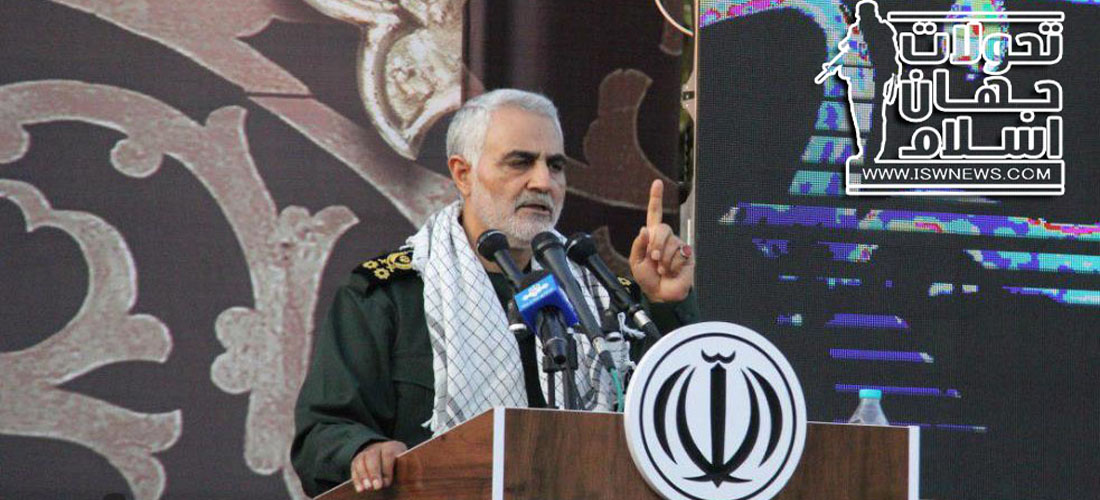
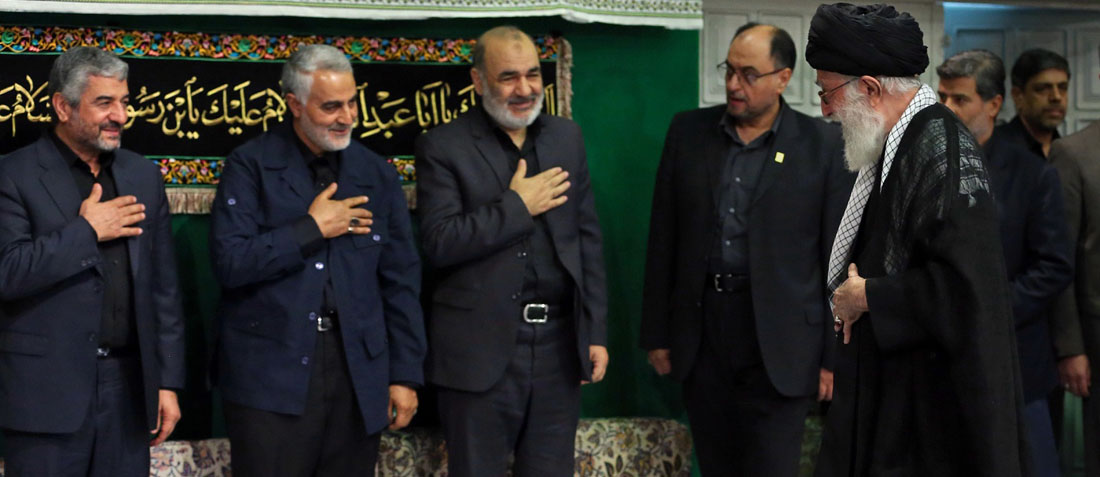
  • Gen. Soleimani congratulates Ayatollah Khamenei and Muslims on ISIS termination

    Gen. Soleimani congratulates Ayatollah Khamenei and Muslims on ISIS termination

    Following the historic victory of Iraq and Syria’s resistance movement over the sedition of Takfiri terrorism and the end of ISIS’s domination, which was manifested by lowering the flag of this American-Zionist group at Abu Kamal–the last key area in the hands of ISIS–General Soleimani issued an important message to Ayatollah Khamenei.

    The following is the full text of Major-General Soleimani’s message to Ayatollah Khamenei:
    In the Name of God, the Most Beneficent, the Most Merciful

    “Indeed, we have opened for you (Prophet Muhammad) a clear opening.” Quran [1: 48]

    To the dear and brave Leader of the Islamic Revolution, Ayatollah Khamenei:

    Salamun Alaikum (peace and greetings upon you),

    Six years ago, a dangerous plot like the ones at the time of Amir al-Mu’minin (as), which prevented Muslims from truly understanding the pure Islam of Muhammad (pbuh), this time, mixed with the poison of Zionism and arrogance, covered the Islamic world like a devastating storm.
    This devastating and poisonous sedition was created by the enemies of Islam with an aim of initiating widespread war within the Islamic world and a fight among Muslims. The evil movement, under the name of the “Islamic State of Iraq and the Levant,” managed, in the early months, to deceive tens of thousands of Muslim youth from both countries, causing a very dangerous crisis for the influential and crucial countries of the Islamic world: Iraq and Syria.
    They occupied hundreds of thousands of square kilometers of land from these countries along with thousands of villages, towns, and provincial centers; they destroyed thousands of factories, manufactures, and major infrastructure of these countries–including roads, bridges, refineries, wells, gas and oil lines, and power plants; they destroyed or burned important cities with valuable historical monuments and national civilizations by bombing them.
    Although it is not possible to calculate all the damage caused yet, the preliminary investigation estimates damages to be around $500 billion.
    In this event, there were extremely horrendous crimes that could not be shown, which included the following: decapitation of children, skinning men alive before their families, taking young girls and women hostage and raping them, burning people alive and group massacres of hundreds of young people.
    The people of these countries, astounded by this poisonous storm, either became victims of the takfiri criminals or left their homes, displaced throughout other cities and countries.
    In this dark sedition, thousands of mosques and sacred centers of Muslims were destroyed or ruined, and sometimes a mosque along with the Imam and all the people in it were blown up.
    More than 6,000 young people, deceived in the name of defending Islam, blew themselves up by way of suicide bombings, using explosive vehicles at city squares, mosques, schools, even hospitals and public places of Muslims; as a result of these criminal acts, tens of thousands of innocent men, women, and children were martyred.
    All these crimes have been designed and implemented by US leaders and organizations, according to the acknowledgement of the highest-ranking US official who is currently president of the United States; moreover, this scheme is still being modified and implemented by current American leaders.
    What, in addition to the favour of God and the special grace of the great Prophet Muhammad and his honorable household (pbut), led to the defeat of this dark and dangerous conspiracy was the wise leadership and guidance of his Excellency, Ayatollah Sistani, who mobilized all facilities to deal with this toxic storm.
    Certainly, the resistance of the Iraqi and Syrian governments and the perseverance of the armies and youths of these two countries, especially the holy Popular Mobilization Forces (PMF), Al-Hashd Al-Sha’abi, and other Muslim youth from other countries with the prominent presence of Hezbollah led by its great leader, Sayyid Hassan Nasrallah, played an important role in overturning this dangerous event.

    Definitely the valuable role of the nation and the government of the Islamic Republic of Iran–the respected president in particular–the parliament, the Defense Ministry, as well as police, military and security organizations of our country, in supporting the above mentioned states and nations, is admirable.
    This humble person, as a soldier called upon by your eminence to serve on this battlefield, announces the termination of the rule of this vicious cursed entity, following the completion of the liberation operation of Abu Kamal as ISIS’ last fort, bringing down the flag of this US-Zionist made terrorist group, raising the flag of Syria. On behalf of all the commanders and anonymous fighters on the battlefield, the thousands of Iranian, Iraqi, Syrian, Lebanese, Afghan and Pakistani martyred and disabled defenders of the holy shrine–who gave their lives to defend the lives and honor of Muslims and their sanctities–I congratulate and felicitate you and the noble nation of Islamic Iran, as well as the nations of Iraq, Syria, and other Muslims of the world. I prostrate before the Almighty God in gratitude for this great victory.

    “And victory comes only from God, the All-mighty, the All-wise.” Quran [3:126]

    Your son and soldier

    Qasem Soleimani

    Source

  • Israel’s Strategic Ambitions Thwarted in Iraqi Kurdistan and Will be in Syria’s Deir ez-Zor

    Israel’s Strategic Ambitions Thwarted in Iraqi Kurdistan and Will be in Syria’s Deir ez-Zor

    We live in extraordinary times. The narrative of the “fight against Islamic State” that holds sway in Western society comes from a fantasy land in which nothing is as it seems; these “certain truths” have as much reality as a rainbow, while reality is distorted or obscured behind it.
    Across the “credibility gulf” we may see everything as it is, but speak a different language; no-one over there in the Western bubble can understand what we say, or even recognise it as language. A declaration that should shock this complacent and self-possessed “civilised world” to the core – that the US is fighting with the Islamic State – simply cannot be understood or accepted, regardless of evidence.

    Since the coordinated operation by Al Qaeda groups in Idlib attempted to kidnap a group of Russian military police on September 17th, it has become evident that the US military really is actively supporting and coordinating with terrorists fighting the Syrian Government. Following further attacks, including particularly the assassination of Lieutenant General Valery Asapov in Deir ez-Zor, Russia now evidently has no remaining doubts about the US “fight against ISIS”; there is no such fight.

    So now we are faced with an intolerable paradox. The US and its coalition partners in Syria are actively engaged in lethal attacks on the Syrian army and its allies within sovereign Syrian territory, both directly and in cooperation with ISIS. At the same time these Western countries’ sole stated pretext for entering Syrian territory without UN authorisation has been to fight ISIS terrorists, while the threat of Wahhabi terrorist attacks at home has been ruthlessly exploited to gain support for these foreign military actions from their domestic audiences.

    Not that this apparent US collaboration with ISIS and Al Qaeda in Syria is anything new, but long-held suspicions – now confirmed – constitute a substantial body of evidence. Events such as the transit of ISIS convoys across the Syrian desert without interference from US coalition planes, or the free pass for the tanker-pipeline taking ISIS Oil out through Turkey can also now be seen as acts of facilitation rather than merely a failure to act.

    But nothing now constitutes clearer proof of collusion than the direct and lethal attack on the Syrian Army outpost protecting Deir ez-Zor airport from ISIS fighters, conducted by both US and Australian planes. This attack of September 17th 2016 has now been revealed as a key part of the US coalition plan, as it is fought out in this same area a year later. What is more, with the strangely coincident events over the border in Iraq, where the plan by the Kurdistan Regional Government to sequester the Kirkuk oilfields out of Baghdad’s control has just been thwarted, another player in the game has come into view – Israel.

    It is almost as if Israel has finally broken, and can no longer contain itself at the sight of its own project for Syria going adrift. And it seems as though the “Kurdistan Project” was a central part of this. Following the Kurdish referendum – which even the US purported to oppose – Israel was the first to voice solidarity with this new “democratic state” in the making, that was presented as sharing its values. Notwithstanding that the ethnically-defined Kurdistan can like Israel only pretend to be democratic.

    Israel’s championing of Kurdistan as the most Western-friendly entity in the region can however be seen chiefly as opportunist, and related to its desire to obstruct Iran’s economic and cultural influence. It also betrays the considerable investment made by Israel into the development of Iraqi Kurdistan, dating back to before the first [Persian] Gulf war. While the original plan to bring oil from Kirkuk via pipeline directly to Israel was thwarted, Israel’s strong presence in Erbil, as well as its close involvement in the handling of Syrian oil stolen by ISIS and exported via Turkey has served the same purpose.

    Allegations that Israel was ‘laundering’ ISIS oil, with the profits being returned as weapons and ammunition for the terrorist Caliphate, were made at the time that Russia bombed the guts out of the IS oil tanker convoys. Natural scepticism that this accusation was just Israel bashing now look too cautious, and instead provide additional evidence of Israel’s criminal involvement and deceptions over the war on Syria.

    But something strange is operating here. So great is Israel’s influence on Western media and perceptions that it is those Western observers who are protesting Israel’s innocence of colluding with terrorist groups in Syria. They fail to notice that neither ISIS nor Al Qaeda never criticise Israel or threaten a campaign to “liberate” Al Quds from its Zionist occupation. Nor do they ever appear upset by Israel’s provision of medical care and sanctuary for terrorists escaping the Syrian Army.

    Even when Israeli leaders proclaim support for these Wahhani mercenaries, including the launching of missile strikes at Syrian army posts that threaten them, Israel is excused. In Western eyes Israel is always the victim.

    Well perhaps this is about to change, as it must. Last month Israeli jets fired missiles at a Syrian factory from Lebanese airspace, which they routinely violate. The vacuous claim that they were targeting a factory producing chemical weapons and missiles for Hezbollah was their justification for this act of war, which took place during major military exercises in Northern Israel. Syria was unable to respond to that provocation, but when Israeli jets flew into Lebanese airspace on the Syrian border on Monday, Syria fired missiles at the planes, forcing them to retreat.

    Proclaiming Israel’s right to self-defence – even when engaged in acts of armed aggression beyond its borders – Israeli jets subsequently bombed the Syrian defensive missile battery. As Netanyahu put it:

    “Today there was an attempt to harm our aircraft — this is unacceptable to us. The air force acted quickly and accurately to destroy what needed to be destroyed,” Netanyahu said.

    The timing is also clear – Russia’s Defence Minister Sergei Shoigu is visiting Israel this week. We would hope that Russia’s patience with Israel is wearing just as thin as it has with the US, and that the next time Israel pushes its luck with Syrian air defences it will be dodging Russia’s feared S400 missiles instead. Not only that of course – Israel’s excuse that it is targeting Iranian infiltration and weapons shipments to Hezbollah can no longer cut any slack with Russia, for whom Iran is now a major military and economic ally.

    The recent “intemperate remarks” about the Iranian Nuclear deal by Donald Trump, echoed immediately by Netanyahu only strengthen these ties; who could not gasp at those delusionary claims from two of the world’s most dangerous nuclear weapons states, whose only real concern is that their stranglehold on global power with the threat of nuclear annihilation might be weakened?

    Well at least Iran is under no misconceptions. As reported by the Guardian – “Ali Akbar Velayati, a senior foreign policy adviser to the Iranian supreme leader, praised the Iraqi army’s move to capture Kirkuk, framing it as a blow to Israel’s strategic ambitions.

    “With the defeat of the Kurds in Kirkuk, Barzani’s conspiracy against the region’s security was foiled. Barzani’s aim and Israel’s covert aim were to seize Kirkuk’s oilfields to serve the Israeli interest. In the Kurdistan region, they raise the flag of Israel and this means if Kurds gain independence in Iraq, we will share a border with Israel,” Velayati said, according to the IRGC-affiliated Tasnim news.

    News that the Iraqi army has retaken control of both Kirkuk and Sinjar and their oil resources, on behalf of all the Iraqi people, is welcome indeed – except in Tel Aviv. We await similar news from Deir ez-Zor.

    Source
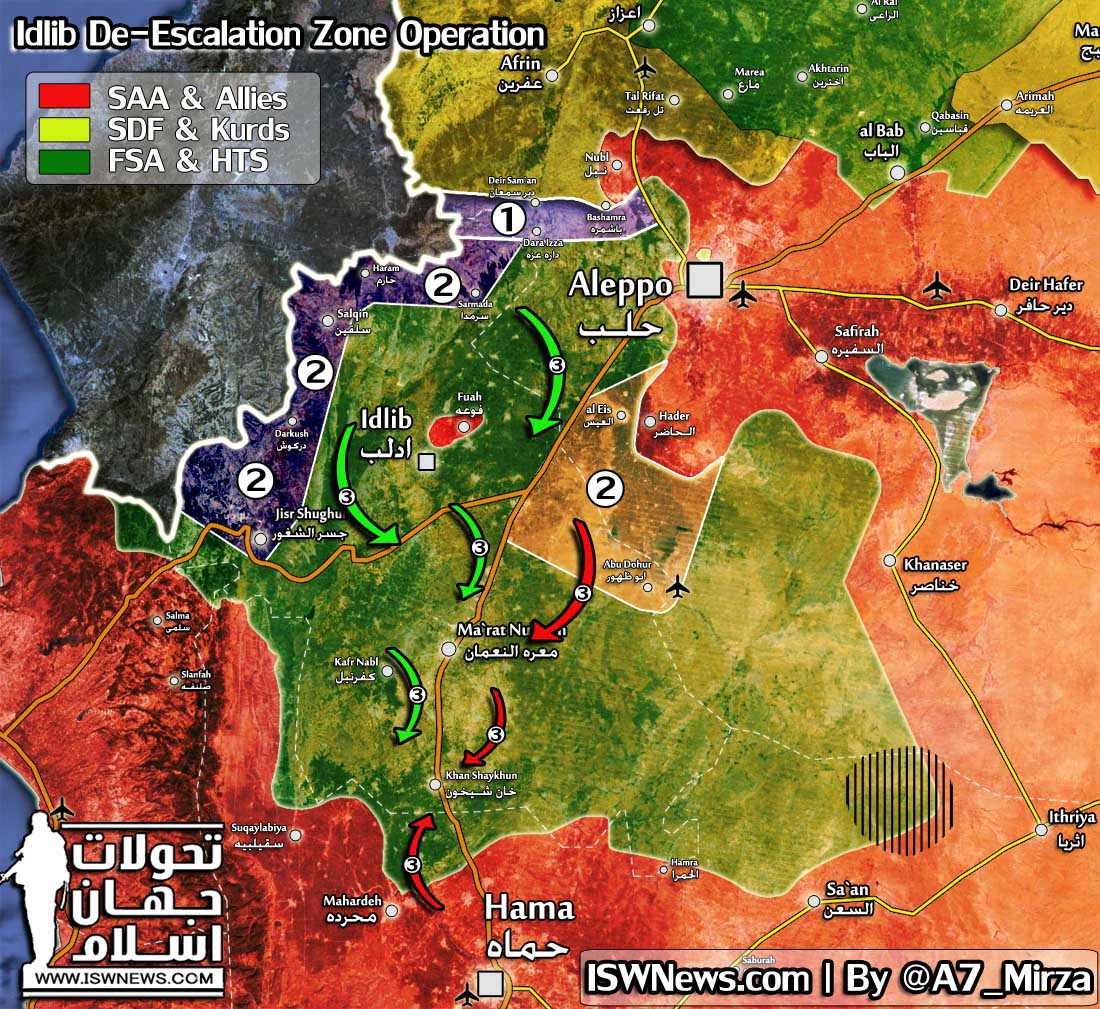
  • Everything you need to know about the future of Turkey’s operations in the Idlib province of Syria + Map

    Everything you need to know about the future of Turkey’s operations in the Idlib province of Syria + Map

    After announcing the start of the operation in Idlib province by Erdogan on October 7th and executing another part of the Astana agreement known as “De-Escalation Zone Deal” , till now about 200 military equipment including military vehicles and personnel along with the Turkish army entered the province of Idlib.

    Turkey’s entry into the province of Idlib within the framework of the Astana peace agreement can be investigated.

    Apart from mentioned objectives of entering the province of Idlib by the Turkey, in the first phase, this event is included of the presence of Turkish troops in western side of Aleppo province along the Darat Izza, Jabal Sheikh Barakat, Dir al-Sam’an and the frontlines between militants(Such as FSA, HTS, etc) and the Kurds(SDF, YPG, etc) throughout the southern front of Afrin, from Bashamrah to Jandris.

    It should be noted that the Turkish troops will not cross the contact line of Afrin and by being in these areas, they will play as a buffer zone.

    In the second phase, Turkish troops will across border between Syria and Turkey. Therefore, Turkish troops will be deployed in areas of Darah Izza, Harim, Sarmada, Darkush, Atmah to Jasr al-Shughur.

    The purpose of this move is to close all militants`s supplying routes (weapons and personnel) from Turkey to Syria and vice versa.

    So far, there will not be any serious tension certainly.

    According to what our field & trusted sources have indicated that the Turkish and their militants (like Euphrates Shield, etc) will move from north and west towards the Aleppo-Hama highway, and on the other hand, the Syrian army and Resistance forces will move from the south of Aleppo and the Abu Dhohour area to the Aleppo-Hama highway.

    The final goal is to open the Aleppo-Hamah highway.

    In the next stage and third phase Turkish troops or Turkish backed forces will be distributed in areas along the highways like Saraqeb, Khan Sheikhun, Ariha, Murek, and they will enter the northern suburbs of Hamah from the north.

    From the southern side, the Syrian Army and Resistance forces as well as the Russian forces on the outskirts of Hama will move along the highway, and ultimately the Aleppo-Hamah highway will be fully liberated and active.


    Therefore, all that mentioned will be carried out in three general stages:

    The first stage is on the western suburbs of Aleppo
    The second stage in the northern and western suburbs of Idlib
    Third stage along the Aleppo-Hamah highway


    According to what is known, the city of Idlib will remain under the control of Tahrir al-Sham (HTS)

    Finally, due to the field changes and political changes, it will decided that the Turkish-backed forces will be distributed in more areas of Idlib and northern Hamah, or that the Turkish forces will be completely excluded from the area by clearing (setting) the situation of the armed forces and the city of Idlib.

    The details of this stage can include many options that domestic (national) reconciliation is one of them.


    It should be noted that the issues mentioned are based on field evidence and the parties’ plans(all sides), and given the dangerous nature of Erdogan and his sudden turns, there is a possible new scenarios.

    There is also no specific talk about the state of Fu`a and Kafraya it is not clear what kind of plans were intended for these settlements.

    Also, the situation of important areas such as al-Rashidin and al-Zahra in west of the city of Aleppo is unclear, and it is likely that these areas will also join the national reconciliations.

    HD MAP

  • Three main reasons which bind all kurds to Iran

    Three main reasons which bind all kurds to Iran

    An important point in the history of the Kurdish struggles is the remarkable difference between the Kurdish riots in Iran compared to the riots in Turkey and Iraq. The Iraqi Kurds had bloody clashes with the Iraq(central government) for a long time. in Anfal operation , which was launched by the Saddam Hussein against the Kurds.especially in 1988 that 180 thousands Kurds lost their lives.

    The war between the PKK and the Turkish government, which has been taking place in the country since 1984, caused nearly 50 thousand dead.

    But the war between the Iranian government and Kurdish armed groups is far less extensive. This is the result of the less friction(struggle) of the Kurdish society with the government compared to the Kurds of Iraq, Turkey and Syria, which makes the Kurdish insurgent groups unable to attract people’s support like the insurgents in three other countries did. This issue has so many reasons that most notable reasons are these:

    1. Differences in the national identity in Iran with other countries with Kurdish population.

    National identity in Iraq and Turkey is defined by ethnicity. Turkey has based its national identity on Turkism, and Turkey’s name comes from the Turkish word. According to the Turkish Constitution, all citizens of this country are considered to be Turkish. Turkey gave the Kurds the title of “Turk of Mountain” and by 1991, the use of words such as Kurdistan and Kurd in this country was prohibited even in personal life.

    In Iraq, the Ba’ath Party was an Arab nationalist party, which established the country’s identity on Arabs.

    In Syria, the same is true about the Arab Ba’ath Party, and its official name is the Syrian Arab Republic. On the contrary, Iran has not defined its identity on ethnicity.

    In Iran, different ethnic groups have lived together for a long time and have formed kind of historical identity, while Turkey, Iraq, and Syria all founded after the First World War and after the fall of Ottoman caliphate, especially Syria and Iraq have a short historical identity as new founded countries . In addition, from the time of Safavids, Iranian identity has been defined based on the religion of Islam and Shiite religion, not ethnicity. That is why in Iran, the Shiite Kurds have not shown any ethnocentric tendencies, and almost all Kurdish ethnic struggles have occurred in the Sunni areas. However, it should be noted that the root of the ethnocentric struggles of the Sunni does not return to the differences between the two Shiite and Sunni religions. Basically, in the regions with Sunni population in Kurdistan, political Sunni Islam has little power(influence), and the vast majority of Kurdish armed groups follow a leftist(left wing)or nationalist ideology. The cause of the emergence of ethnic identity in the Sunni Kurdistan of Iran is that the people of these areas are not part of Shiite religion, which is one of the most important elements of the unity of the majority of the people of Iran. Of course, this does not mean ignoring other unifying elements of Islam, the Iranian historical identity, and linguistic and ethnic similarities. As we have seen and will see, these factors have made the Kurdish ethnic conflict less in Iran than the neighboring countries.

    2-The close relation of ethnic and racial identities of the Kurds to the rest of Iranians

    The race of Kurds are among the Aryan tribes. Kurdish is also one of the branches of Persian language in linguistic divisions and is similar to Persian language and local languages ​​in Iran. Like other Iranians, the Kurds celebrate Nowruz and also Kurds & Iranians have many common culture and myths .But there are no similarities between Kurdish language, culture, and myths with the language, culture and myths of Arabs and Turks.

    In Turkey and Syria, Nowruz was a political event and a sign of Kurdish ethnic identity. Because of that, for a long time, severe restrictions were imposed by the governments of these countries on this celebration, and in some cases, Kurds were killed by the security forces. But Nowruz throughout Iran is a national celebration that various ethnic groups of Iran celebrate along with the government. Because of these reasons, the sense of belonging to the Iranian identity among Kurds is far more than their solidarity with Turkish and Arab identities.

    3-The Cultural and Political Approach of the Iranian Government towards the Kurds

    Iran has chosen a more liberal cultural and political approach to its ethnic groups, including the Kurds. Unlike Turkey, the use of Kurdish or the use of words had not been forbidden in Kurdistan in Iran. Kurdish language has long been used in local media, and in recent years, the teaching of ethnic languages ​​in schools has also been provided. Also, the Shiite Kurdish politicians did not have any obstacle to reach the highest political and administrative positions. Such conditions have not existed for a long time in Syria, Turkey and Iraq, or still does not exist. Before the Syrian civil war, the government refused even to issue birth certificate for Kurd residents and to recognize their citizenship. There were also obvious discrimination against Kurdish citizens in Turkey and Iraq.

    Although some of the dissatisfaction and independency tendencies in the Sunni regions of Kurdistan of Iran can not be denied, these reasons, plus the political and security problems, except in the first two decades of the revolution, and especially in the early years, the activities of the Kurdish rebel groups were mainly limited scattered attacks on the border areas from inside of the Iraqi Kurdistan and these attacks were stopped at some points.

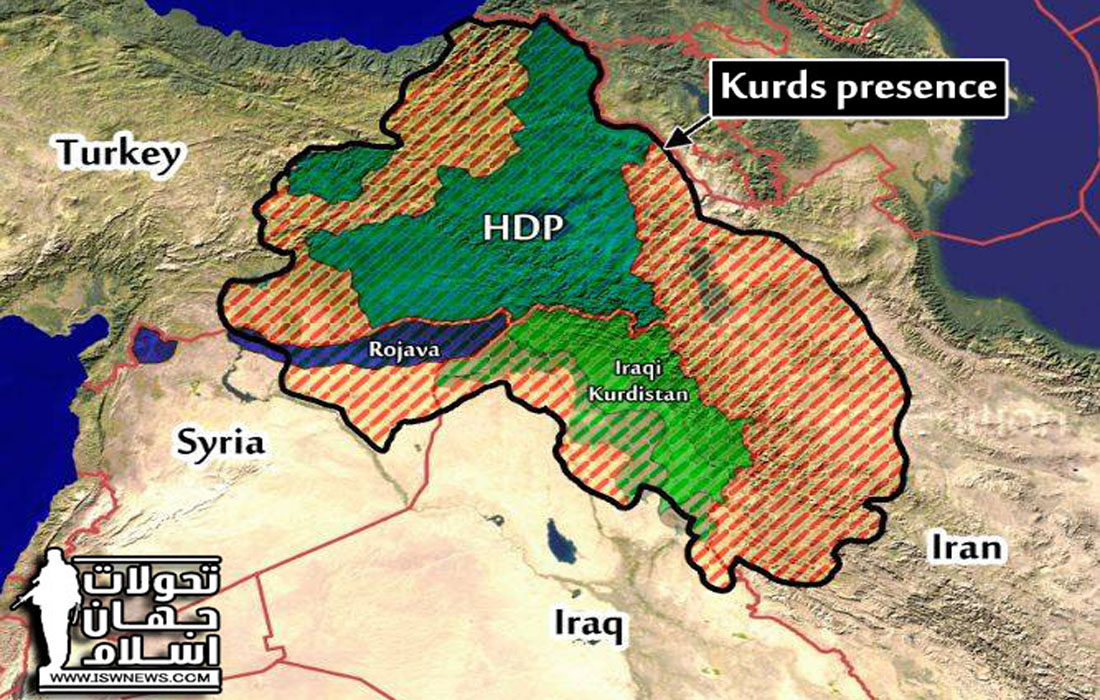
    PS: This map does not represent correct & exact boundaries, and it’s just the hypothetical range of Kurdish presence in region