According to unofficial information, an estimated around 2,000 Yemeni fighters—recruited through Russian companies—are currently taking part in the war in Ukraine alongside Russian forces.
Yemeni participation in the Ukraine war is largely driven by poverty, unemployment, and the futile internal conflict imposed on the country by Arab states.
According to Brigadier General Turki al-Maliki, spokesperson for the coalition, Aidarus al-Zoubaidi and several of his associates escaped via the vessel BAMEDHAF from Aden port to Berbera port in the autonomous region of Somaliland. From there, with the assistance of Major General Awadh Saeed Musleh al-Ahbabi, commander of UAE joint operations, they boarded an Ilyushin-76 (IL-76) aircraft which first landed in Mogadishu before continuing on to Abu Dhabi, the UAE capital.
The coalition spokesperson claims that this aircraft regularly operates in Libya, Somalia, and Ethiopia, and that its registration details (ownership, flag, etc.) match those of the vessel Greenland, which recently transported military vehicles and weapons from Fujairah port to Mukalla port.
No information has been released regarding the possible escape or whereabouts of Ahmed Hamid Lamlas, governor of Aden, and Mohsen al-Wali, commander of the Security Belt forces in Aden. The coalition spokesperson stated that efforts are ongoing to locate or detain them.
As expected, Aidarus al-Zoubaidi fled to the UAE. The narrative of his transfer to al-Zubid village, his birthplace, was a deliberate misinformation tactic aimed at misleading Saudi intelligence and the exiled Yemeni government. The manner of his escape highlights the close ties between the UAE, Somaliland, and the Southern Transitional Council. In fact, the UAE plays a pivotal role in shaping developments in the Horn of Africa and Yemen, and separatist agendas in these regions cannot advance without its support.
After consecutive defeats of the Southern Transitional Council (STC) in Hadhramaut and Al-Mahra — and their withdrawal without fighting from the Balhaf gas facility and the strategic Marra base in Shabwah — the focus of pro-government forces shifted to southern Yemen. In initial negotiations, local authorities in Abyan agreed to hand over their positions to Al-Dara’ Al-Watan forces. Southern militants and allied tribes have not yet surrendered their positions, but they also have not shown resistance.
In Aden, government and service facilities — including the Presidential Palace (Al-Ma’ashiq) and Aden Airport — had already been evacuated by STC fighters and handed over to representatives of the government-in-exile. Early this morning, Al-Dara’ Al-Watan forces entered Aden via the coastal road and Al-Anad base, taking control of military and security sites. Elements of the Giants Brigades also assumed control of parts of Aden at the order of the Saudi-led coalition. Their commander, Abu Zarah Al-Muharrami, officially split from the STC yesterday and pledged allegiance to Saudi Defense Minister Khalid bin Salman.
The Saudi-backed forces captured Aden and Abyan provinces
The disappearance of Aidarus al-Zoubaidi — head of the Southern Transitional Council — at dawn today, and his failure to travel to Riyadh, has angered the Saudis and escalated tensions between the STC and the government-in-exile. Rashad Al-Alimi has revoked his membership in the Presidential Leadership Council. This situation suggests instability will continue in the occupied regions of Yemen — and it is likely that Al-Dhale and Lahij will soon witness Saudi attacks and further Southern capitulations.
According to the Saudi-led coalition, the strikes came after the escape of Aidarus al-Zoubaidi — head of the Southern Transitional Council — from Aden, along with the movement of large numbers of STC forces toward Al-Dhalea with armored vehicles and military convoys. They claim al-Zoubaidi skipped his flight to Riyadh and avoided peace talks with the Yemeni government-in-exile, choosing instead to flee and prepare for renewed unrest.
In response, Rashad al-Alimi revoked al-Zoubaidi’s membership in the Presidential Leadership Council and referred him to the attorney general on charges of forming an armed group and acting against the government.
There’s little doubt al-Zoubaidi knew what awaited him in Riyadh — and that his fate would be no different from figures like Saad Hariri, Abd Rabbuh Mansur Hadi, and others who ended up under house arrest or worse. That’s why he chose to retreat to his hometown, hoping Southern tribal backing might preserve his power. Yet this bet also seems to be failing: Saudi aircraft are reportedly hunting for his whereabouts, and although he may try to flee to the UAE, current conditions in Aden make escape by air or sea nearly impossible.
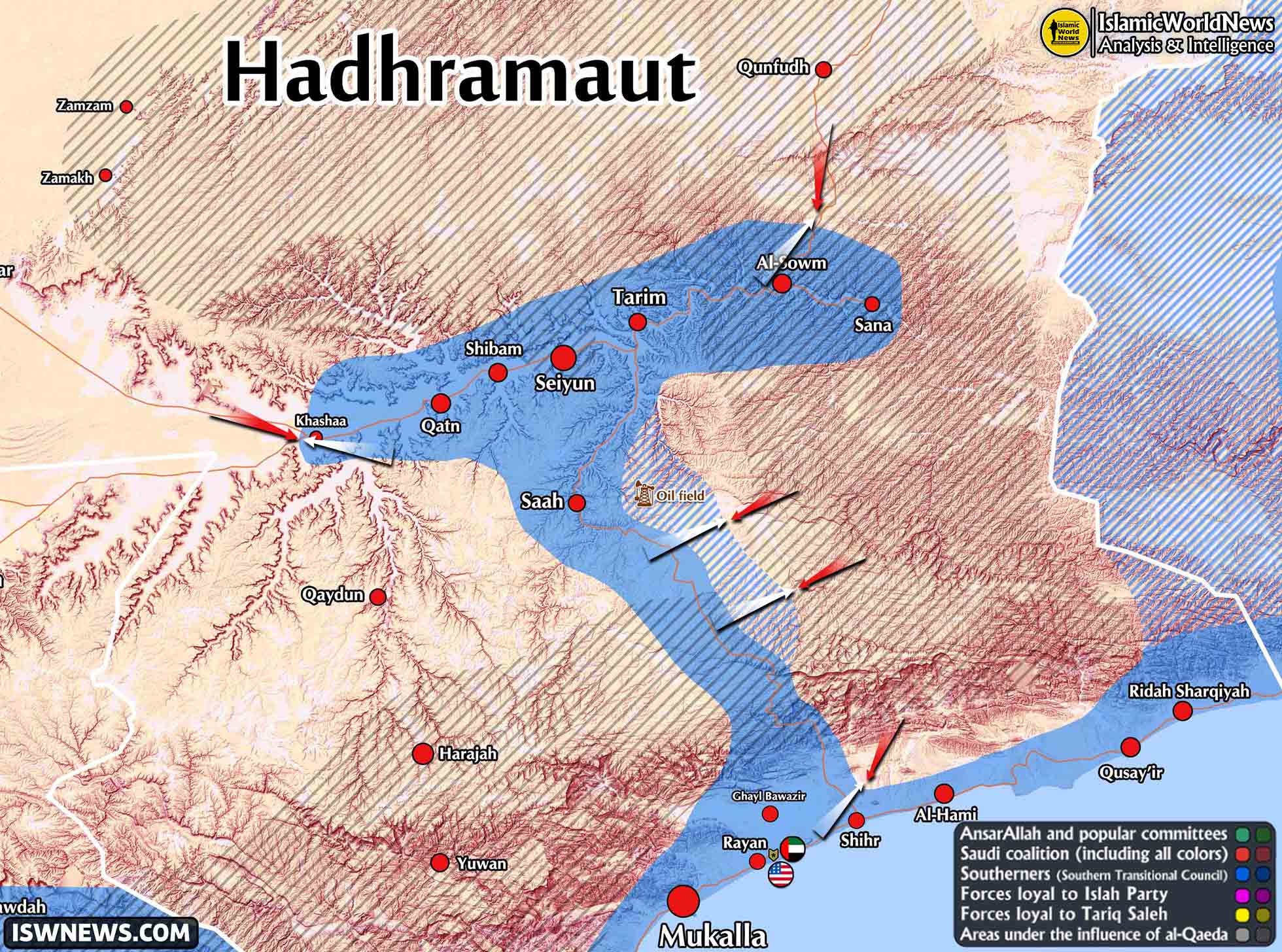
The operation, involving Al-Dara’ Al-Watan forces, armed tribal groups from Hadhramaut, and fighters from the Islah Party, began on Friday, January 3, with Saudi air support. Starting from the Al-Khasha area, they attacked positions of the Southern Transitional Council and advanced toward Al-Qatn in the Hadhramaut valley. By Saturday morning, Al-Qatn and Shibam had fallen to Al-Dara’ Al-Watan, while Southern forces retreated toward the Hadhramaut coast. By Sunday morning, Seiyun and other central districts of Hadhramaut were under government-in-exile control. The forces then moved to Al-Rayyan airbase (previously used by Emirati forces on the Hadhramaut coast) and, after hours of clashes, seized it from the Southern Transitional Council.
During these battles, at least 80 Southern fighters and an unspecified number of Saudi-backed troops were killed, with hundreds more wounded. Both sides have yet to release official casualty figures.
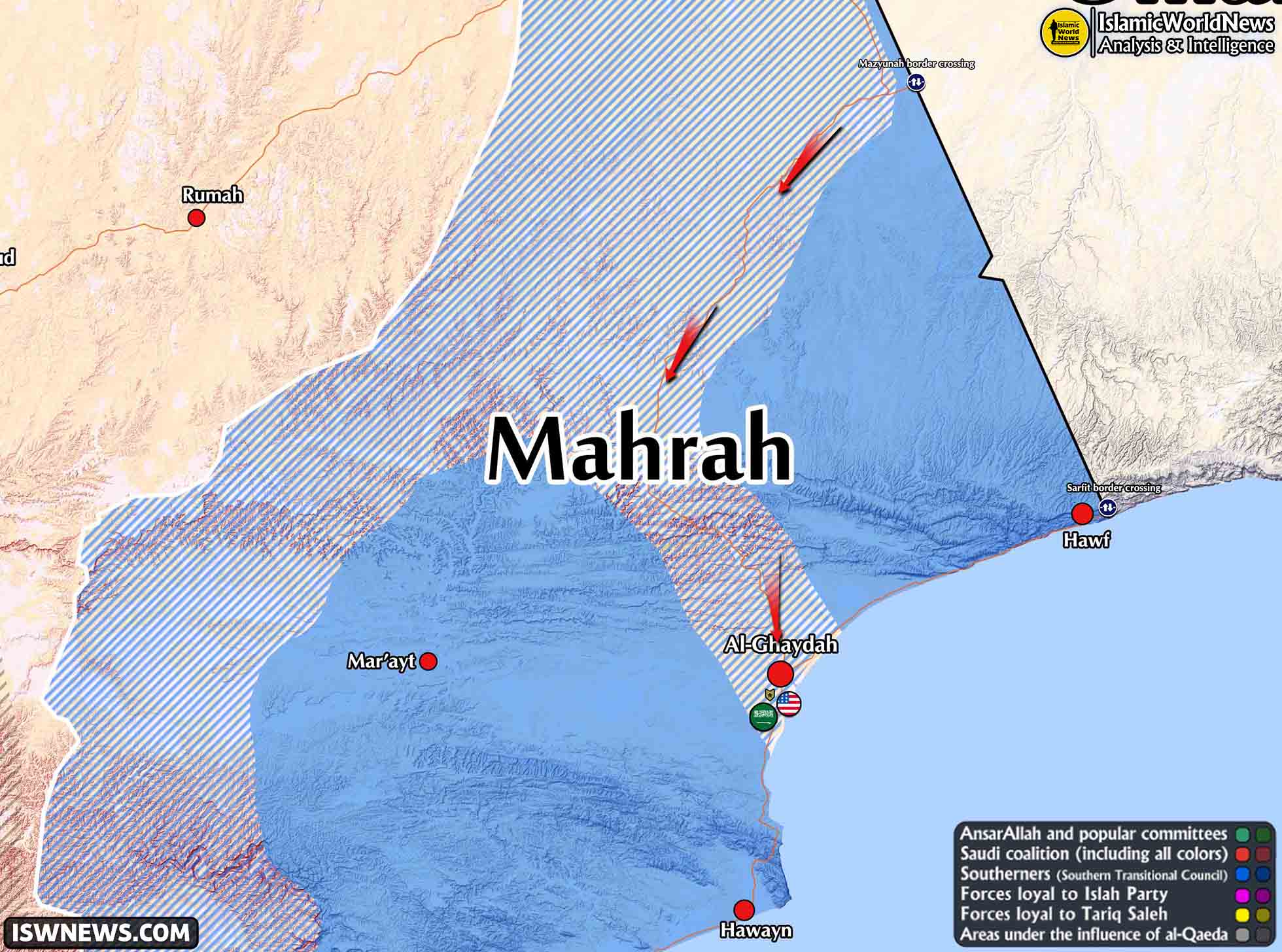
Al-Dera’ Al-Watan forces have since entered Mukalla, the capital of Hadhramaut, without resistance, taking control of all government and military facilities. They also advanced into Al-Mahra province, seizing Al-Ghaydah city and the port of Nishtun. Their objective is to secure Al-Ghaydah’s city and airport, border crossings, and remove Major General Talib Barjash, commander of the Second Military Region (Al-Mahra and Yemen’s southeastern coast), who recently defected to the Southern Transitional Council and rejected the authority of the Presidential Council of the government-in-exile.
Given the heavy defeat of the Southern Transitional Council in Hadhramaut valley and coastal cities, Al-Mahra is also expected to fall under government-in-exile control soon. Awad bin Al-Wazir Al-Awlaki, governor of Shabwa—previously supportive of Southern forces and backed by the UAE—has now announced cooperation with the Saudi-led coalition to deploy forces in oil-rich areas and military bases.
Overall, the Southern Transitional Council’s “Promising Future” operation collapsed with the UAE’s withdrawal and Saudi determination. The plan to partition southern Yemen has been sidelined. However, the Saudis have invited the Southern Transitional Council to participate in Yemen’s internal dialogue conference in Riyadh, and the [Persian] Gulf Cooperation Council’s federal plan for Yemen remains on the table. Still, the re-establishment of a separate South Yemen has failed, leaving Aidarus al-Zoubaidi’s efforts fruitless.
According to the latest reports on Yemen’s fronts — broken down by military zones and provinces — the situation is as follows:
Hadhramaut & Al-Mahra Fronts: In Hadhramaut, the front lines in the north remain unchanged, with Al-Khasha‘a serving as the main contact line. The cities of Al-Qatn, Tarim, and Seiyun in Wadi Hadhramaut are still under southern control. Al-Dara‘ Al-Watani (National Shield) forces have redeployed to Ramah and Thamud in the northeastern desert and taken positions along the Yemen–Saudi border, likely preparing to move toward Al-Sawm on the eastern side of Wadi Hadhramaut.
Hadhramaut map
Fighting continues between the UAE-backed Hadhrami Elite forces and tribal fighters from the Hadhramaut Tribal Council around Ghayl Bin Yamin, as well as in Wadi Khard and Al-Ays on the Hadhramaut coast. Recently, tribal fighters retook the Nohub base and pushed STC forces back from the outskirts of Wadi Khard and Al-Ays.
In Al-Mahra, Major General Barjash — commander of the 2nd Military Region — reaffirmed his support for the STC and declared he will not hand over his positions to National Shield forces backed by Saudi Arabia. He also urged civilians to stay away from military sites and installations.
Al-Mahra situation
Abyan Front: On northern Abyan axes, STC operations against Al-Qaeda elements are progressing slowly and have produced few tangible results. Al-Qaeda cells continue operating covertly. Beyond the integration of rapid-reaction forces from Jishan district, no major shifts have occurred.
Marib & Al-Jawf Fronts: Giants Brigade units have pulled out of Harib and Al-Abdiyah (south of Marib), as well as from the Kitaf and Al-Baqa fronts in northern Saada, redeploying to Hadhramaut and Shabwah. This redeployment has weakened the lines facing Ansar Allah, giving Yemeni resistance fighters an opportunity to resume advances from Harib toward western Shabwah in future clashes.
No significant changes have been recorded on other fronts, and the Yemeni Armed Forces (aligned with Ansar Allah) continue to observe the ceasefire that has been in place since 2023.
The UAE’s departure from Yemen marks a major setback and a turning point in the country’s civil war. Key consequences include fractures within the Saudi-Emirati coalition, a severe weakening of the exiled government, the strengthening of Ansar Allah, a growing power vacuum in the south, and the risk of deeper involvement by another outside actor — potentially the United States. The UAE’s separation from the Yemen file amounts to a failure of the “Arab coalition” project; in recent years, Saudi Arabia has lost two principal partners — Qatar and the UAE — in joint operations. Still, it is too early to draw final conclusions, and much remains unclear.
The UAE’s footprint on strategic Yemeni islands such as Socotra, Abd al-Kuri, Mayun, and others is part of a broader project to control maritime routes through the Gulf of Aden and the Red Sea — reinforced by formal agreements with the exiled government and backed by Western states and Israel.
The ministry confirmed that Emirati forces had been active since 2015 as part of the Arab coalition supporting Yemen’s ousted government. It noted that the UAE formally ended its military presence in 2019 after fulfilling agreed duties, with only limited specialized teams remaining thereafter.
While the statement formally marks the end of the UAE’s military role in Yemen, Abu Dhabi continues to exert influence over developments in the country’s south and east. Leaders of the Southern Transitional Council sharply criticized Rashad al‑Alimi’s decision, calling it illegitimate. Efforts to pave the way for declaring southern Yemen’s secession remain ongoing, with the UAE awaiting broader international backing before re‑engaging more directly in the Yemeni file.
In his morning statement, al‑Alimi also announced a 72‑hour suspension of air, sea, and land activity across all ports and crossings, except with official authorization from the Saudi‑led coalition command.
Administrative powers for Hadramaut and al‑Mahra provinces were handed to their governors, who must coordinate with al‑Dara’ al‑Watan forces to take over camps. All military units are instructed to return to their previous positions under Saudi coalition coordination and hand over sites peacefully.
This declaration signals the end of cooperation between Yemen’s exiled government and the UAE in confronting Ansar Allah, marking a rift within the Saudi‑UAE coalition. The separatist ambitions of the Southern Transitional Council clash with Saudi objectives, as a southern Yemen is seen as a threat to both Saudi and Omani security. With the Beijing agreement between Iran and Saudi Arabia reducing the likelihood of renewed conflict with Ansar Allah, Riyadh appears intent on pursuing its plans in Yemen without the Emiratis, offering no concessions to southern ambitions.
The strikes followed a warning message urging civilians to stay away from the port area. The northern parking lot of Mukalla port was hit, with the main objective being recently imported Emirati military vehicles. These vehicles had arrived aboard two cargo ships from Fujairah port to supply fighters of the Southern Transitional Council (STC).
Saudi Strike Targets Emirati Military Gear in Mukalla
Brigadier General Turki al‑Maliki, spokesperson for the Saudi‑led coalition, stressed that the transfer of Emirati military equipment to Mukalla port constitutes a clear violation of efforts to reduce tensions, pursue a peaceful solution, and breaches UN Security Council Resolution 2216 (2015).
This strike marks the first official and overt Saudi action against the STC and its Emirati backers. By escalating their warnings, the Saudis signaled to southern forces and the UAE that they are capable of fighting them if necessary. However, Riyadh’s primary objective in Yemen remains confronting Ansar Allah, with southerners considered allies in that effort. In reality, the alliance in Yemen has been challenged by Emirati moves, while the Saudis remain reluctant to deepen conflict with their long‑time partner.
Reports indicate at least four members of the Hadrami Elite Forces have been killed in the clashes. (image)
Saudi warplanes continue conducting airstrikes on open, uninhabited areas as a warning to UAE‑aligned forces, aiming to deter further attacks and advances in Hadramaut.
Al‑Houthi stressed that the Islamic Ummah must respond to such actions, warning that negligence would allow Israeli plots to succeed.
He further cautioned that any Israeli presence in Somalia constitutes a threat to Somalia itself, Yemen, and regional security. Accordingly, he declared that Israeli forces in Somaliland or Puntland would be considered legitimate military targets for Yemen’s armed forces.
The message represents a direct and serious warning to both Somaliland authorities and Israel, signaling that in any future conflict, Israeli deployments in the region could become targets of Yemeni missile and drone strikes.
The funeral for Maj. Gen. Zakaria Abdullah Yahya Hajar (Abu Yahya), Brig. Gen. Abdullah Yahya Abdullah Hajar, Brig. Gen. Hussein Yahya Abdullah al‑Hashimi, Brig. Gen. Ahmed Abdullah Yahya Ahmed Hajar, and Mohammed Khaled Yahya Ahmed al‑Haifi will be held at Al‑Shaab Mosque in Sana’a, attended by senior officials of Yemen’s government and military.
Official Yemeni media have not yet released detailed information on their roles or circumstances of martyrdom. However, according to unofficial reports, Maj. Gen. Zakaria Hajar was a specialist in missile and drone systems within Yemen’s Armed Forces and played a role in Yemen’s support operations for Palestine.
He and his men were martyred in a U.S. airstrike in March 2025 targeting the Al‑Jiraf area north of Saada city. Zakaria Hajar’s name, due to his ties with Iran and involvement in Yemen’s missile‑drone program, appears on the alleged terrorist and sanctions lists of Saudi Arabia and the Saudi-backed Yemeni government.