
Military Knowledge: R-37 Air-to-Air Missile

The R-37M missile is a Russian long-range, solid-fuel, supersonic air-to-air missile, regarded as one of the longest-range operational air-to-air weapons in the world. With active radar guidance and a range exceeding 300 km, it is an ideal option for targeting aerial refueling tankers, AWACS aircraft, and other standoff airborne platforms.
The R-37 is also known as izdeliye 610 (Product 610), RVV-BD, and in NATO designation as AA-13 Axehead.
History of the R-37 Design and Development
The concept of the R-37 was intended as a replacement for the R-33 missile. Its design was assigned to the Vympel design bureau, the same company that developed the R-33. The R-33, or AA-9 Amos, was a large missile weighing 490 kg with a range of 160 km (E variant). It entered service in 1981 and remains in use with the Russian Air Force and CIS states. The missile could be deployed on MiG-25 and MiG-31 interceptors, and in testing was reported to have successfully engaged a target at 304 km.
The new missile had to be smaller than the R-33 while offering greater range, enabling it to strike standoff targets such as AWACS and refueling aircraft. It also needed to be compatible with simpler fighter radars beyond the MiG-31.
The R-37 project began in the early 1980s, with the first successful test launch recorded in 1989. Testing continued for about a decade until 1998, but development was halted due to budget constraints and the limited number of launch platforms. Work resumed in 2006, and by 2014 the missile was formally adopted by the Russian Air Force, with serial production initiated.
In 2018, the updated R-37M variant completed its trials. The R-37M is the modernized version of the R-37, also known as RVV-BD. Sources cite its range as over 300 km, with a top speed of Mach 6 (7,400 km/h). It is deployable on the MiG-31BM interceptor, as well as the Su-35S multirole fighter and the Su-57 fifth-generation fighter.
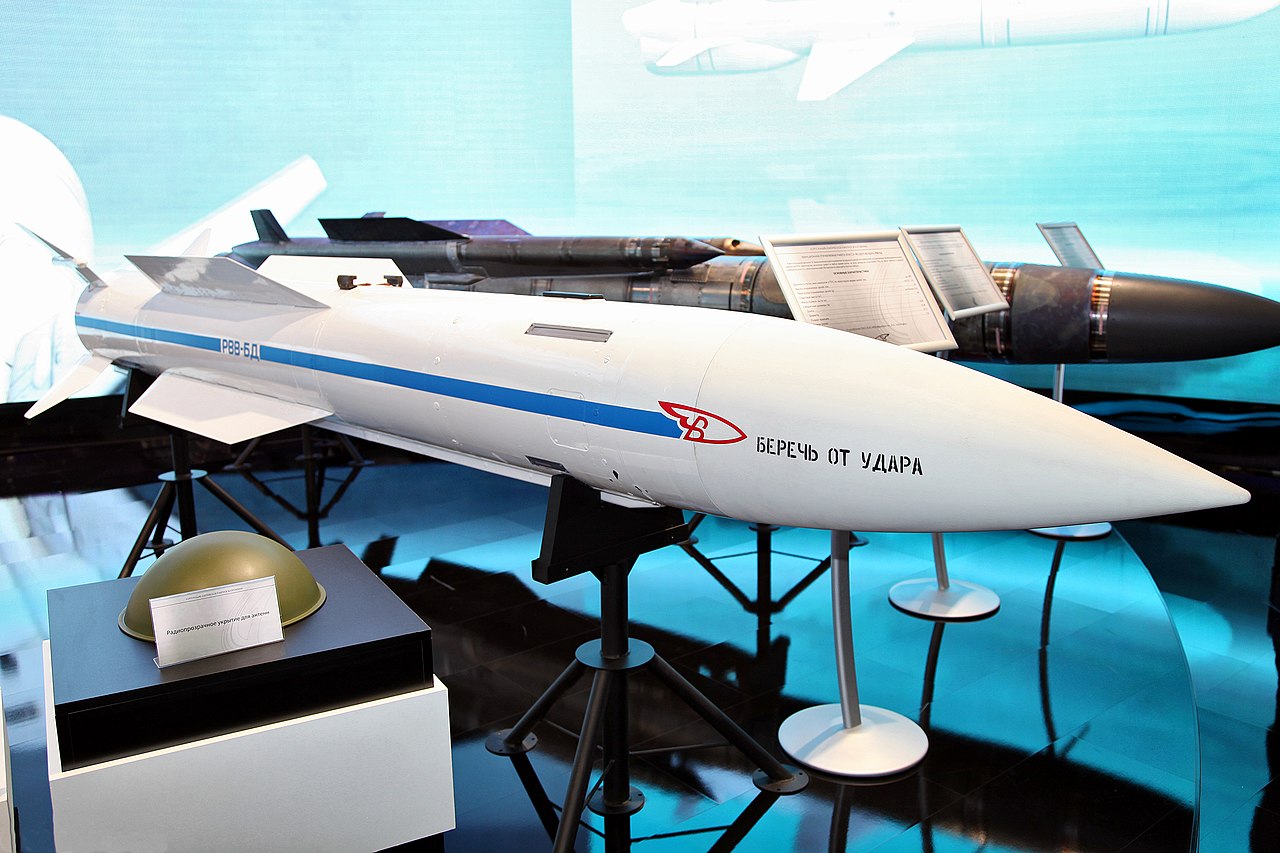
Body and Components of the R-37 Missile
The R-37 air-to-air missile has two sets of fins; the mid-body fins act as stabilizers, while the rear fins are used for guidance and directional control. The rear fins are longer than the mid-body fins and can be folded to reduce the space they occupy.
At the nose section, the missile contains its radar seeker. Behind the seeker is the warhead, followed by the solid-fuel propellant, and finally at the rear is the dual-pulse rocket motor.
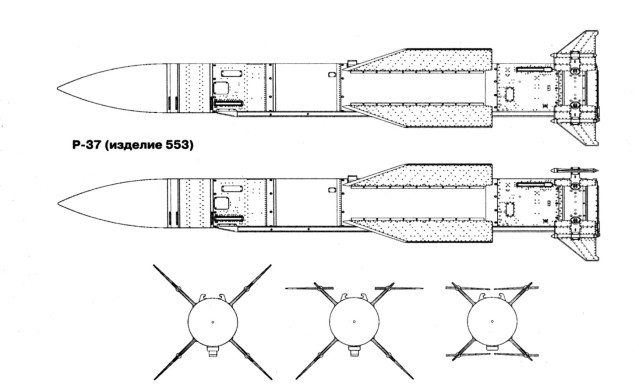
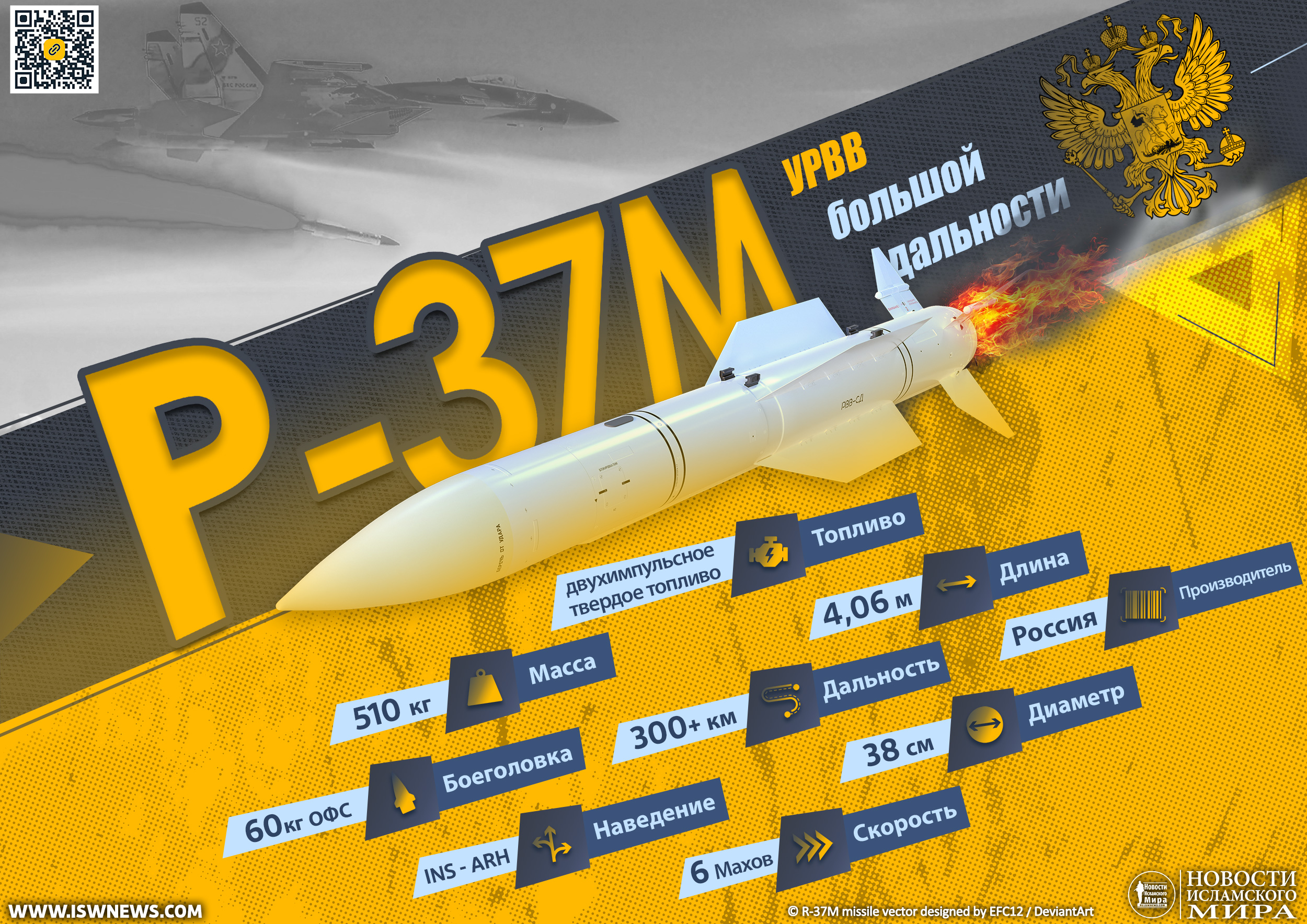
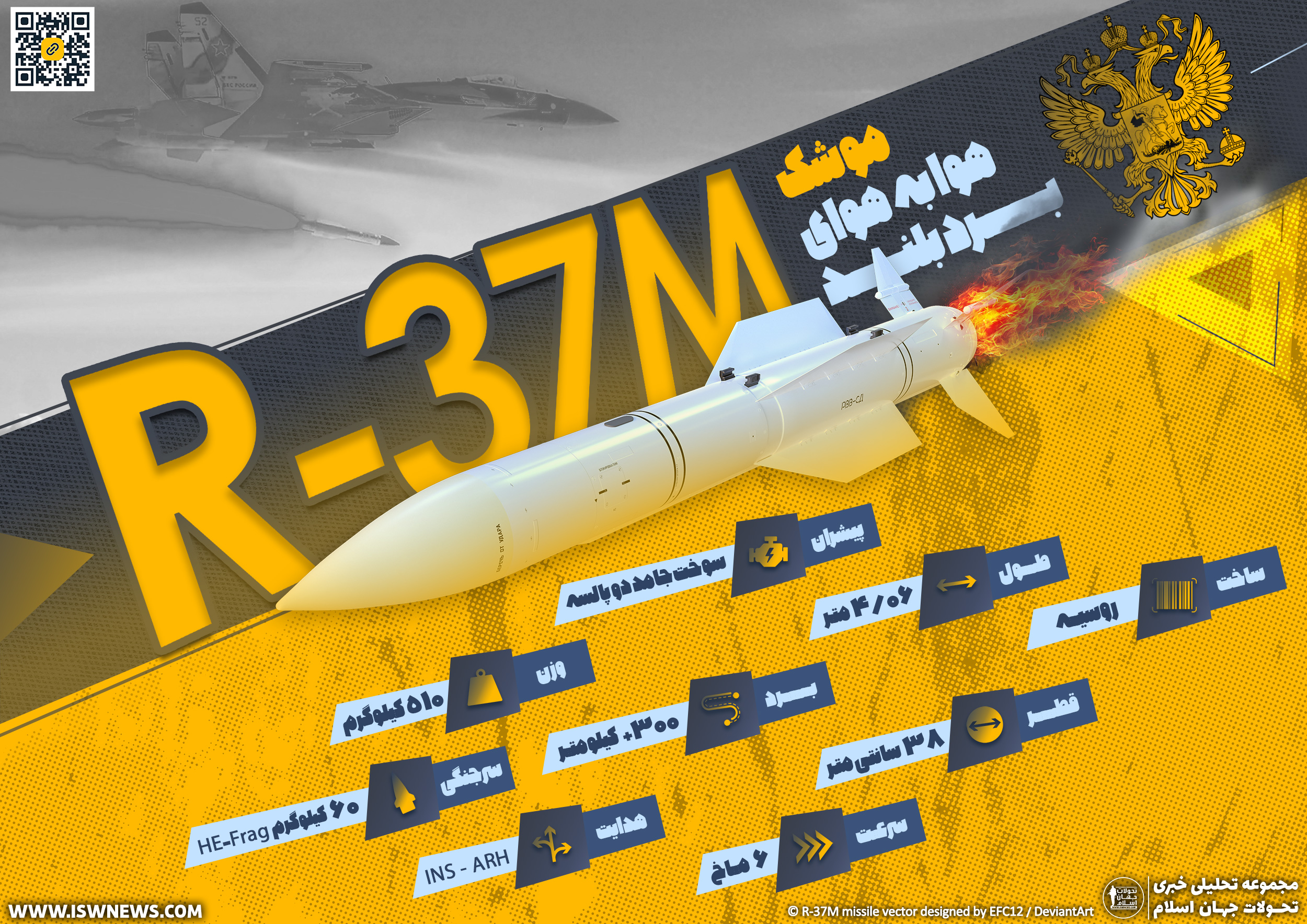
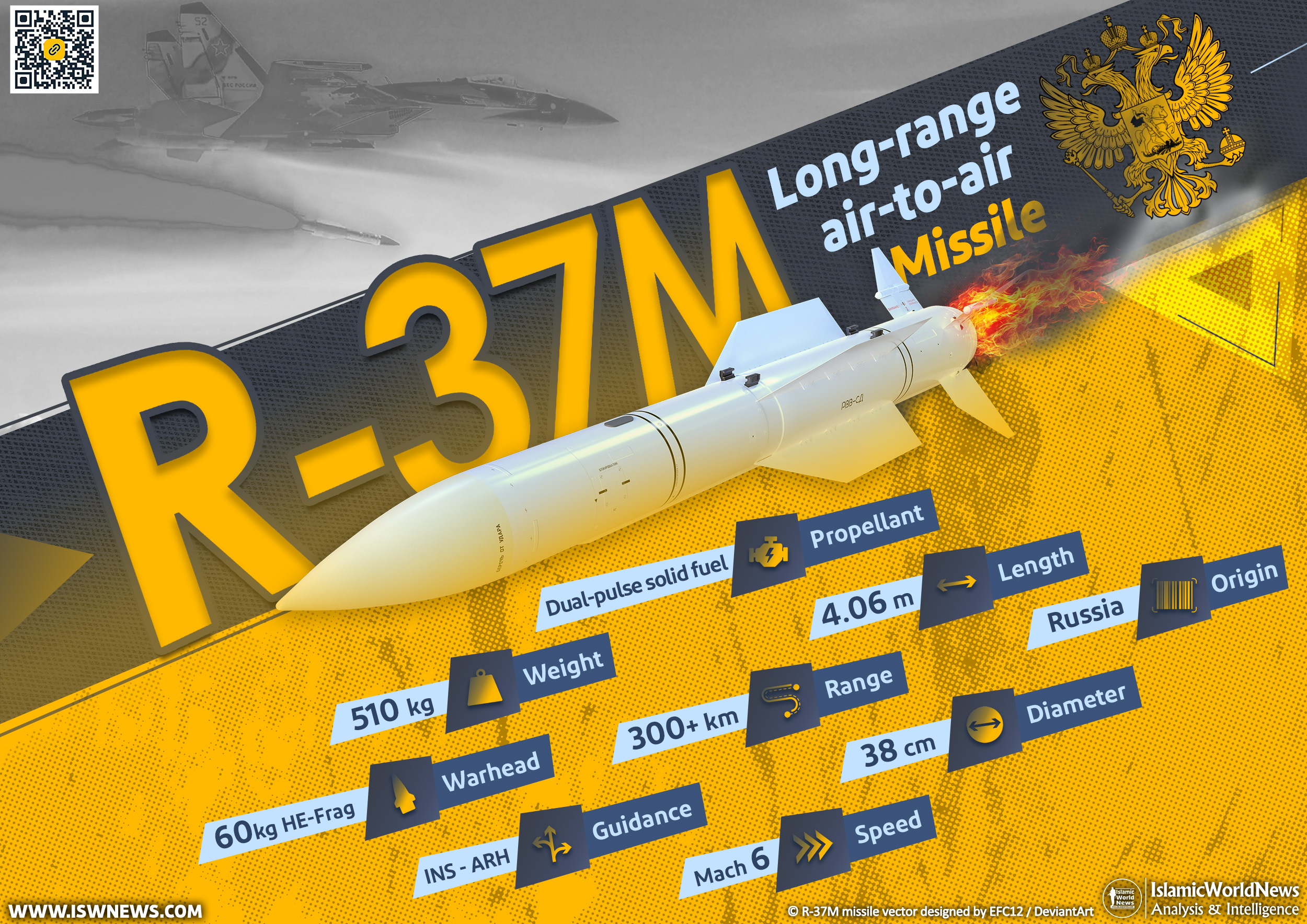
The R-37, with an overall weight of 510 kg and a high-explosive fragmentation warhead weighing 60 kg, is considered a heavy air-to-air missile. This missile has a length of 4.06 m, a diameter of 38 cm, and a wingspan of 72 cm. The range of the R-37M is cited in various sources as between 300 and 400 km.
The dual-pulse solid-fuel rocket motor used on the R-37 was chosen to extend the missile’s range. In a pulsed solid-fuel design, the propellant is divided into separate charges that ignite sequentially with a delay. In the dual-pulse motor, the number of pulses is limited to two, and the chamber is designed accordingly to deliver fuel in separated stages. The purpose of the dual-pulse system is to limit the missile’s maximum speed while increasing its effective range. This powerful motor propels the 510 kg R-37 to a speed of Mach 6.
Guidance and Navigation of the R-37 Missile:
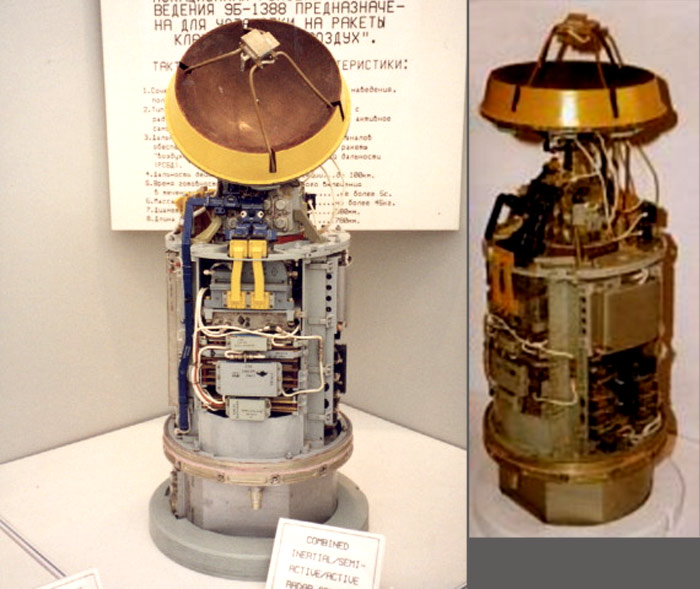
The R-37 uses an active radar seeker called Agat 9B-1388 in its nose, which allows the missile to independently detect and track targets. Given its range of over 300 km, continuous radar seeker guidance throughout the flight is not possible, as with all missiles of this class. Therefore, the missile employs a multi-channel combined guidance system: it is launched in a fire-and-forget mode, but requires mid-course corrections.
The missile is fired with target data and initially flies toward the target using inertial navigation. In the mid-course phase, its trajectory is updated via datalink corrections from the launch aircraft’s radar, ensuring adjustments if the target changes course. In the final phase, the missile closes in and uses its own radar seeker to acquire and engage the target.
Based on limited published data, the 9B-1388 seeker has a diameter of approximately 380 mm, a weight of about 40 kg, the ability to detect a target with a radar cross-section of 5 m² at a distance of around 40 km, and requires about 5 seconds after pre-heating to reach operational readiness. It also supports a radio correction link with an approximate range of 100 km.
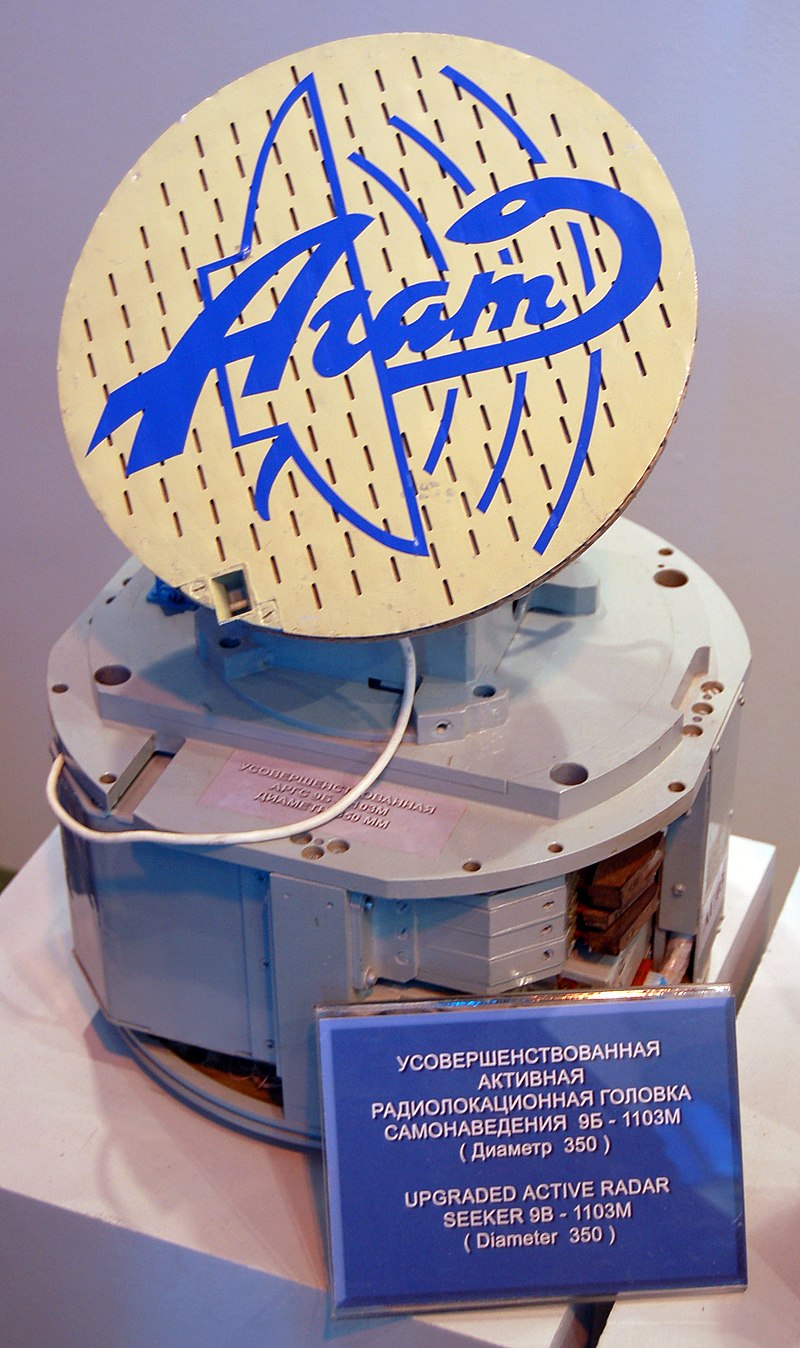
Russia has introduced another radar seeker called 9B-1103M-350, designed for installation on R-37 missiles and other long-range systems such as the KS-172. This seeker incorporates a newly miniaturized digital signal processor with enhanced memory capacity and improved processing speed.
Instead of conventional mechanical gyroscopes, it employs fiber-optic gyroscopes along with fast-activation mechanical gyroscopes, resulting in a shorter missile preparation time before launch.
The radar seeker of this missile is equipped with an antenna measuring 330 mm in length and 350 mm in diameter, with a total weight of 13 kg. Its digital processing system is capable of performing at least 50 million operations per second and can detect a target with a radar cross-section of 5 m² at a minimum distance of 40 km. After two minutes of pre-heating, the seeker reaches full operational readiness within one second.
This new radar seeker offers a high level of standardization and adaptability, making it suitable for use across a wide range of missiles, including both air-defense systems and air-to-air missiles, within the 200 to 400 mm caliber range.
Launch Platforms:
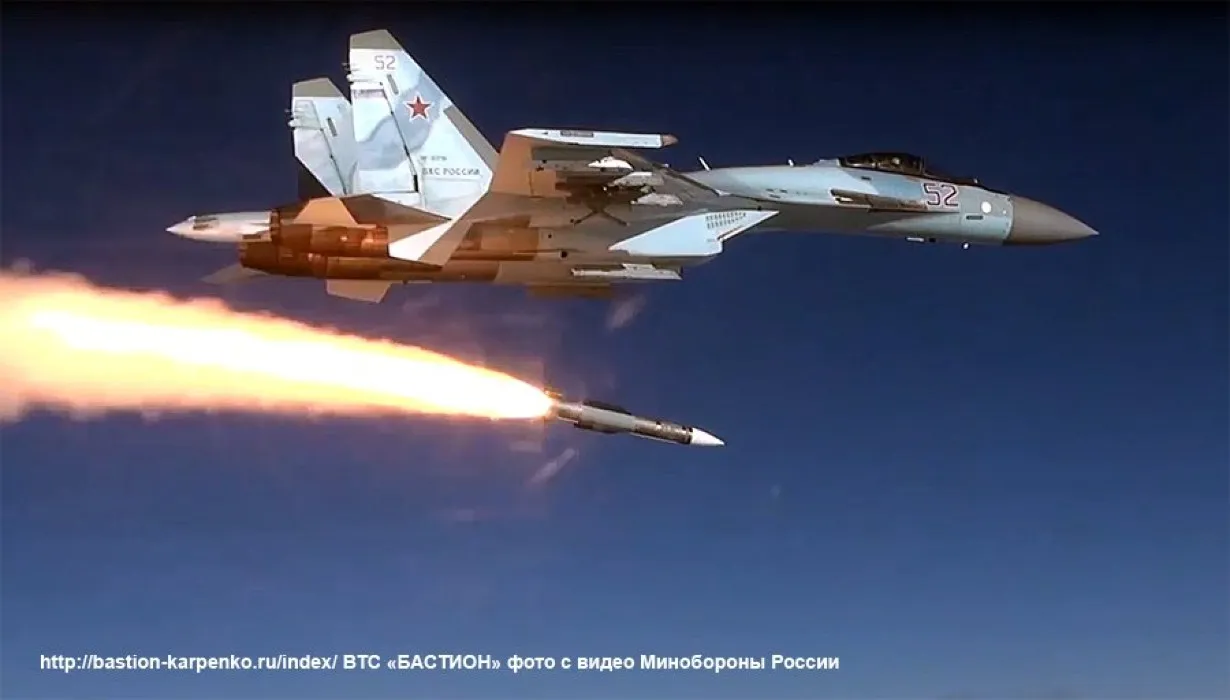
The missile is primarily deployed on the MiG-31BM interceptor as its main operational fighter. It is also integrated on the Su-35S and Su-57 multirole fighters. When loaded onto the Su-35, up to five long-range R-37M air-to-air missiles can be mounted on hardpoints 1, 3, 4, 11, and 12.
Operators of the R-37M Missile
The R-37M is currently in service with the Russian Aerospace Forces, operational on the MiG-31BM, Su-35S, and Su-57 fighters. There have also been reports of the missile being offered to India for use on the Su-30MKI, as well as speculation about a potential order by Iran alongside its acquisition of Su-35 fighters.
If Iranian Su-35s are equipped with the long-range R-37M missiles—with a range of over 300 km and speeds reaching Mach 6—they would pose a serious threat to aerial refueling tankers and AWACS aircraft belonging to Israel and the United States. The combination of the R-37M with the powerful Irbis-E radar on the Su-35 enables targeting from safe standoff distances, meaning that in any potential confrontation, a significant portion of the offensive and surveillance air capabilities of Tel Aviv and Washington could be affected.
Read more: Military Knowledge: Sukhoi Su-35 Multirole Fighter Jet
Specifications of the R-37M Missile:
Type: Long-range air-to-air missile
Origin: Russia
Manufacturer: Vympel NPO
Service Entry: 2014
Length: 4.06 m
Wingspan: 72 cm
Diameter: 38 cm
Propulsion: Dual-pulse solid-fuel rocket motor
Range: 300–400 km
Speed: Mach 6
Weight: 510 kg
Warhead: 60 kg high-explosive fragmentation
Launch Platforms: MiG-31BM, Su-35S, Su-57
Sources:
R-37 (missile) | New Russian long-range AAM | R-37 Long-range air-to-air missile | Homing head 9B-1103M-350 | К-37 / Р-37 / РВВ-БД – AA-13 ARROW | Janes Radar & Electronic Warfare Systems | Agat Research Institute – public brochures | ГСН семейства Агат | Russia Offers to Sell India the R-37M



Comment