
From Socotra to Sudan: Zionist-Emirati Entrenchment in Strategic Regions
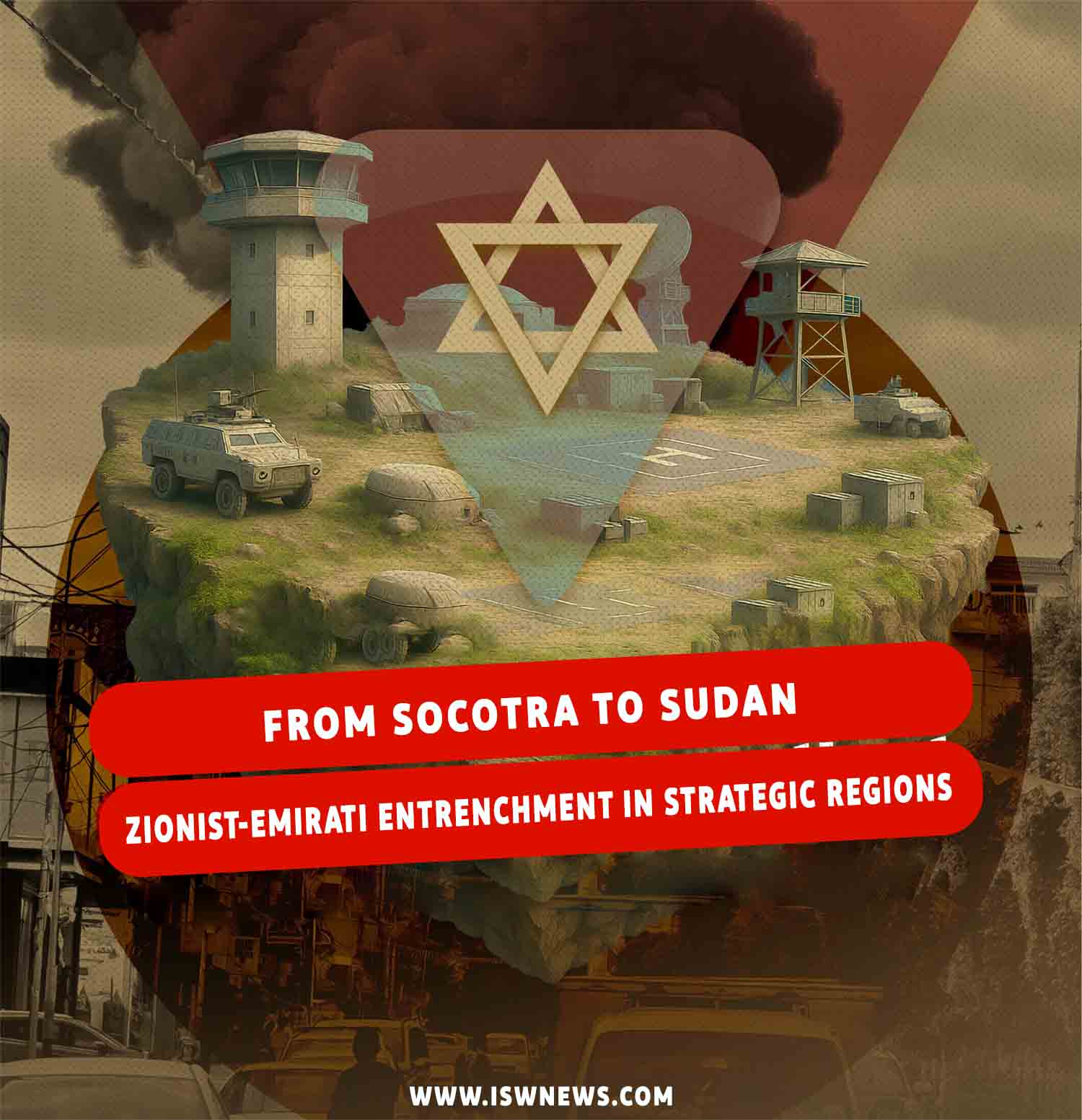
This report exposes a vast network of Emirati military and intelligence bases stretching across strategic routes from the Indian Ocean to the Red Sea—a network functioning as a control ring over the region’s vital shipping arteries. It further examines the direct involvement of the Zionist regime and the United States in shaping this security architecture and its impact on post–Al-Aqsa Storm dynamics and the containment of Ansarallah.
New satellite imagery has revealed a rapidly growing web of military, logistical, and intelligence bases established by the United Arab Emirates along strategic corridors from the Socotra archipelago in the Indian Ocean to the coasts of Somalia and Yemen. This complex military infrastructure effectively serves as Abu Dhabi’s “control ring” over one of the busiest and most sensitive maritime routes in the world—connecting the Arabian Sea, Bab al-Mandeb, and the Red Sea. Since the Al-Aqsa Storm operation against the Zionist regime and the outbreak of the Gaza war, the pace of construction and equipping of these bases has sharply accelerated, making them a cornerstone of the region’s geopolitical reconfiguration.
In this new security structure, the UAE is not the sole actor. Its strategic allies—most notably the Zionist regime and the United States—have played decisive roles in designing, building, and technically supporting the network. Reports confirm the presence of Zionist military officers and technical experts on Socotra islands, where advanced radar systems, electronic surveillance equipment, and maritime control devices manufactured by the regime have been installed. These systems enable the UAE and its allies to monitor Ansarallah’s activities in real time and, if necessary, neutralize missile or naval threats before they reach their targets.
Chain of Military Oversight
On the intelligence front, Abu Dhabi and Tel Aviv have reached an unprecedented level of convergence. Through a joint intelligence platform called Crystal Ball, the two countries share data collected from satellites, drones, and electronic surveillance systems. According to confidential promotional documents prepared for Western partners, the platform was created to “design, deploy, and enhance regional intelligence capabilities in support of energy security and international trade.”
From a geostrategic perspective, this initiative has elevated the UAE from a minor Gulf player to a mid-level power with transregional capabilities. By controlling vital shipping routes through which much of the world’s oil and trade flows, Abu Dhabi positions itself as a “security mediator” in international maritime security. Meanwhile, the Zionist regime’s presence in this chain signals a shift in Tel Aviv’s cooperation field—from the Gulf to the Arabian Sea and Indian Ocean—a development that could alter the naval balance of power against Iran and the resistance axis.
The expansion of such infrastructure has raised regional and international concerns. Many security analysts argue that the network is not limited to countering Yemeni forces but is shaping a “transnational surveillance architecture” that allows the UAE and its allies to control communications, transport, and even the movement of military personnel and equipment across southern Arabia and the Horn of Africa. Ultimately, the militarization of Socotra and adjacent coasts has become a symbol of the new regional power competition in the Red Sea and Indian Ocean—where surveillance technologies, intelligence data, and multilateral security cooperation are replacing direct military occupation.
Abu Dhabi–Tel Aviv Convergence
“Relations between the UAE and the Zionist regime were highly developed even before formal diplomatic ties, but kept silent—not hidden, just silent,” recalls Alon Pinkas, a Zionist diplomat who advised four foreign ministers. The newly built Emirati military and intelligence bases are located in areas not officially under UAE sovereignty. Instead, they are established in territories controlled by Abu Dhabi’s informal allies, including Yemen’s Southern Transitional Council, military commander Tareq Saleh, and the regional governments of Somaliland and Puntland—both technically part of Somalia but in tense relations with Mogadishu and with the UAE.
The Emirati Military Network
The UAE’s military network includes bases, airstrips, and logistical hubs at key maritime points:
- Abd al-Kuri and Samhah islands (part of Socotra), now administered by the Southern Transitional Council
- Bosaso airport in Puntland and Berbera airport in Somaliland
- Mokha port on Yemen’s western coast
- Mayun volcanic island in the middle of the strategic Bab al-Mandeb strait, through which nearly 30% of the world’s oil passes
All these facilities have been newly built or expanded in recent years, forming a coordinated chain of naval and air bases.
According to regime security sources, this complex network was developed through close coordination between Abu Dhabi and Tel Aviv, granting effective control over vast sections of the Red Sea and Gulf of Aden. It constitutes part of a joint UAE–Zionist defense system aimed at creating an integrated regional missile defense, early warning, and intelligence-sharing mechanism.
Regional Security Architecture
The Washington Institute for Near East Policy notes that multilateral air-defense coalitions have become the cornerstone of West Asia’s security architecture after October 7, 2023. Member states have integrated radar, intelligence, and early-warning systems to counter shared threats.
Despite official claims that the network focuses on monitoring global shipping traffic and Yemeni activities, diplomatic and local sources report that Bosaso and Berbera bases now serve broader roles—acting as logistical support hubs for Emirati operations in Sudan’s civil war. In that conflict, Abu Dhabi backs the Rapid Support Forces (RSF) against Sudan’s army. The expansion of Emirati bases around Yemen reflects a wider strategy pursued in recent years, leveraging financial power and diplomatic influence to extend reach across unstable African regions. The UAE has funded or established military bases in southeastern Libya (under General Khalifa Haftar), Chad, the Central African Republic, Uganda, Ethiopia, and Kenya.
Emirati Presence in Sudan
Within Sudan itself, the UAE has maintained two active bases since the war began in April 2023:
- One in Nyala, southern Darfur
- Another in al-Malha, 200 km northeast of al-Fashir, the capital of northern Darfur
The latter area has been under heavy and violent RSF siege for more than 500 days. Thus, what outwardly appears as a surveillance chain against maritime threats has, in practice, evolved into a geostrategic network transforming the UAE into a transregional power with active arms in West Asia, the Horn of Africa, and deep into the African continent.
Comment