
Tag: Socotra

  • The Crossroads of Asia and Africa Under Bin Zayed’s Grip

    The Crossroads of Asia and Africa Under Bin Zayed’s Grip

    Introduction

    In recent decades, under Crown Prince and Abu Dhabi ruler Mohammed bin Zayed, the UAE has pursued an assertive and expansionist strategy aimed at extending its political, economic, and military reach from the Gulf to the Horn of Africa. Bin Zayed, a member of the influential Al Nahyan family, is a staunch opponent of political Islam and a strategic ally of the United States. Washington, in turn, has relied on the UAE in its regional policies, particularly in countering Islamist groups and managing crises.

    The UAE’s population is estimated at around 10 million, of which only one million are citizens; the majority are foreign workers. This demographic reality, combined with oil wealth and vast financial resources, has enabled a foreign policy rooted in economic power and regional networking. Exploiting instability and deep divisions in countries such as Ethiopia, Somalia, Sudan, Yemen, and Libya, the UAE has exerted significant influence over local actors—an influence that would have been impossible in the presence of strong, centralized governments.

    Abu Dhabi’s Role in the Horn of Africa Balance

    The UAE’s military interventions in Libya and Sudan exemplify this approach. In these cases, Abu Dhabi backed forces and groups that countered the influence of rivals like Turkey and Qatar. Over the past decade, Emirati foreign policy has relied on exploiting weak state structures, proxy military networks, and financial capacity—a strategy built on “transactional diplomacy” and “targeted interventionism.”

    Internationally, this policy emerged as the U.S. retreated from its role as global liberal hegemon and scaled back military interventions. Between 2009 and 2011, Bin Zayed recognized that the resulting power vacuum in West Asia and the Horn of Africa offered an unprecedented opportunity for his country to assert itself. Aware of the UAE’s demographic and military limitations but financial and logistical strength, he sought to elevate its geopolitical standing through proactive engagement in surrounding regions.

    The outcome was the launch of a hegemonic and expansionist project spanning both sides of the Red Sea—from the Gulf of Aden to the coasts of Sudan and Eritrea. Through massive investments in ports, infrastructure, and logistics networks across Africa, the UAE became one of the continent’s largest port investors. This economic strategy, combined with military and intelligence activities, enabled Abu Dhabi to build a “transnational empire” blending hard and soft power. Additionally, through informal gold trade networks, the UAE has extracted enormous financial gains from Africa, including the smuggling of roughly 400 tons of gold annually. These economic interests are closely tied to Emirati‑linked companies and institutions active in Africa’s port, security, and financial sectors.

    Socotra: UAE’s Expanding Maritime Influence

    Gradual Entrenchment in Socotra

    The UAE’s approach in Socotra illustrates its strategy of incremental influence and consolidation of geostrategic presence. Following the devastation caused by Cyclone Chapala in 2015, Abu Dhabi deployed relief and engineering teams, establishing itself as a humanitarian actor. This foothold soon evolved into the construction of strategic infrastructure, port facilities, and a limited military presence. Over time, Socotra—ecologically and geostrategically significant—became integrated into the UAE’s maritime influence network stretching across the Persian Gulf, the Arabian Sea, and the Red Sea.

    Overall, Emirati foreign policy over the past two decades has combined geopolitical ambition, targeted economic investment, and exploitation of regional instability. Backed by financial resources and international legitimacy, the UAE has achieved influence far beyond its demographic and military weight, extending from the Gulf to the Horn of Africa and reshaping the security architecture around the Red Sea.

    Abd al‑Kuri: A Strategic Outpost

    Located west of Socotra, Abd al‑Kuri island—home to about 500 residents—sits at the mouth of the Gulf of Aden and the Indian Ocean shipping lanes. Its position makes it a vital observation point for vessels entering the Gulf of Aden, and in recent years it has been transformed into a military and logistical hub.

    In November of that year, U.S. Central Command conducted a Red Sea naval exercise with Bahrain, the UAE, and Israel—the first joint drill among Abraham Accords signatories. This marked the beginning of overt military cooperation between Abu Dhabi and Tel Aviv. Defense ties accelerated: Israel’s Elbit Systems signed contracts to supply defense systems to the UAE Air Force, deployed early‑warning radar in Emirati territory, and in February 2023 unveiled a joint unmanned vessel capable of mine detection. By October 2023, construction began on a 2.4‑km runway in Abd al‑Kuri, later expanded into a full military airfield.

    Satellite imagery in March 2024 revealed the phrase “I love the UAE” etched into nearby sand dunes—a symbolic marker of entrenched Emirati presence. By March 2025, the runway was completed, capable of hosting medium and heavy military cargo aircraft such as U.S. C‑130 Hercules, Russian Il‑76 transports, and advanced drones like Israel’s Hermes‑900. Concurrently, the UAE’s state defense conglomerate EDGE Group entered talks with Elbit Systems to expand its drone fleet, underscoring growing synergy between Emirati investment and Israeli technology. Abd al‑Kuri thus emerged not merely as a small island but as a pivotal node in Abu Dhabi’s geostrategic plan to control maritime routes across Bab al‑Mandeb, in coordination with both Washington and Tel Aviv.

    Storm Gathering at Bab al‑Mandeb

    Parallel to developments in Abd al‑Kuri, extensive activity began on Samhah, the smallest inhabited island of the Socotra archipelago. From 2024 to mid‑2025, the UAE built a runway, paved roads, and support facilities. Given the island’s rugged terrain, the airstrip is suited for surveillance missions and limited reconnaissance flights rather than heavy transport. It is optimized for advanced drones like the Hermes‑900, enabling electronic monitoring and maritime patrols. Samhah’s location between the Gulf of Aden and the Arabian Sea makes it ideal for overseeing a chokepoint through which roughly 12% of global trade passes.

    Satellite images from March–April 2025 showed a temporary sand barrier on the island’s western side, likely for drainage and construction support—typical of isolated military projects. During this period, the Yang Star, a Comoros‑flagged landing craft, anchored off Samhah, ferrying engineering equipment and materials between Socotra, Abd al‑Kuri, and Yemeni ports. Other vessels, including Takreem and Mabrouka‑2, regularly connected Socotra, Yemeni coasts, Abd al‑Kuri, and Bosaso in northern Somalia, forming the logistical backbone of the UAE’s maritime influence network in the southern Arabian Sea and Bab al‑Mandeb.

    Mayun: The Critical Node

    While Socotra, Abd al‑Kuri, and Samhah are key points in this network, Mayun (historically Perim) is strategically the most vital. This volcanic island lies at the center of Bab al‑Mandeb, a strait notorious for treacherous currents and reefs, earning the name “Gate of Tears.” It separates Yemen from Eritrea and Djibouti—both hosts to U.S. and Western military bases. Mayun’s strategic importance dates back centuries, serving as a control point for maritime trade even before the Suez Canal opened in 1869.

    In early 2021, reports surfaced of a “mysterious airbase” under construction on Mayun, with no state claiming responsibility. Analysts noted that whoever controls it gains leverage over Bab al‑Mandeb, enabling air operations into Yemen and naval missions across the Red Sea, Gulf of Aden, and East African coasts. Satellite imagery from 2023–2025 showed a 1.85‑km runway along the island’s western shore, surfaced for medium aircraft, large drones, and reconnaissance planes. While little changed in 2023–2024, 2025 images revealed resurfacing and leveling—signs of reactivation and preparation for new missions.

    This evolving network—from Socotra to Mayun—illustrates how the UAE, through incremental infrastructure projects, military cooperation, and logistical integration, has built a layered maritime presence across one of the world’s most strategic chokepoints. It reflects Abu Dhabi’s ambition to secure influence over global trade routes and embed itself in the security architecture of the Red Sea and Arabian Sea.

    UAE’s Power Play Amid Crisis

    The series of moves in the islands of Samhah, Abd al‑Kuri, and Mayun reflects the emergence of an integrated military‑maritime chain along Yemen’s vital southern sea lanes. The United Arab Emirates, leveraging investment, military technology, and newly forged security ties with Israel and Western partners, is consolidating this network to exert stronger control over trade and military routes in the Gulf of Aden and the Red Sea.

    In this context, recent satellite imagery analysis of the Bosaso base in northern Somalia shows that the UAE has deployed critical infrastructure for maritime surveillance and control. At the northern end of the base, a phased‑array radar system has been identified, most likely the GM‑403 model by France’s Thales, with an effective range of over 400 km and the ability to track more than a thousand aerial targets simultaneously—including drones, fighter jets, cruise missiles, and artillery shells. However, intelligence reports and local sources also suggest the possible deployment of the EL/M‑2084 radar system by Israel’s IAI/ELTA, the same system used in the “Iron Dome” air defense network.

    Given the informal security cooperation between Abu Dhabi and Tel Aviv after the Abraham Accords, this possibility is far from unlikely. Geopolitically, the installation of such a system in Bosaso enables the UAE to maintain continuous surveillance over maritime and aerial movements across the Gulf of Aden, Bab al‑Mandeb Strait, and the southern entrance to the Red Sea—an area through which a vital share of global energy and trade flows from East Asia to Europe.

    This development positions Bosaso as a key link in the UAE’s chain of bases in the Horn of Africa and Yemeni islands—including Socotra, Abd al‑Kuri, Samhah, and Mayun. The Bosaso radar thus functions not only as part of a multilayered regional monitoring system but also as the intelligence backbone of Abu Dhabi’s broader plan to control maritime routes across southern Arabia and eastern Africa. This strategy carries a dual nature: on one hand serving “counter‑terrorism and maritime security,” and on the other consolidating Abu Dhabi’s geostrategic dominance in competition with Iran, Turkey, and Qatar in the security landscape of the Arabian Sea and Red Sea.
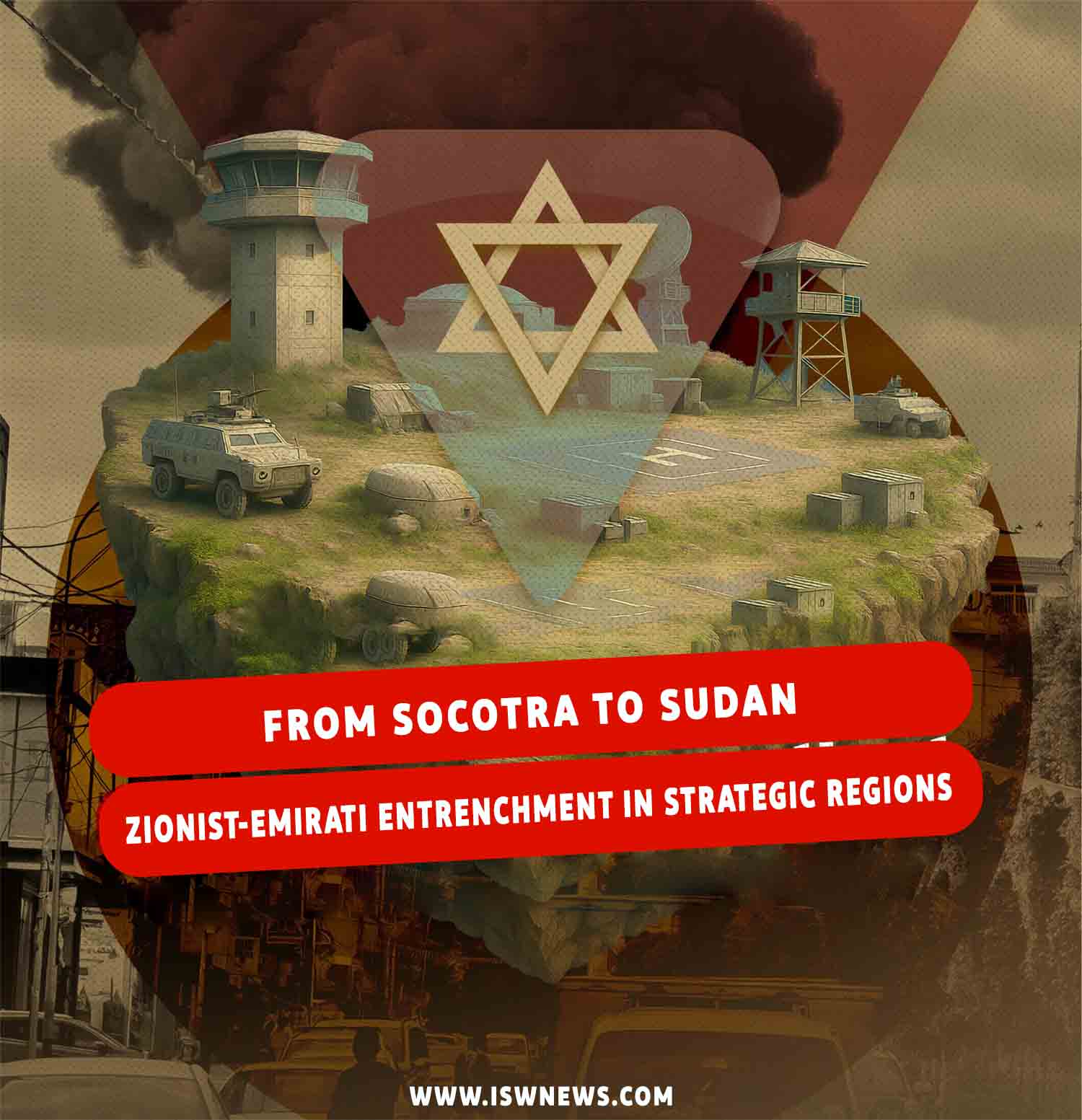
  • From Socotra to Sudan: Zionist-Emirati Entrenchment in Strategic Regions

    From Socotra to Sudan: Zionist-Emirati Entrenchment in Strategic Regions

    New satellite imagery has revealed a rapidly growing web of military, logistical, and intelligence bases established by the United Arab Emirates along strategic corridors from the Socotra archipelago in the Indian Ocean to the coasts of Somalia and Yemen. This complex military infrastructure effectively serves as Abu Dhabi’s “control ring” over one of the busiest and most sensitive maritime routes in the world—connecting the Arabian Sea, Bab al-Mandeb, and the Red Sea. Since the Al-Aqsa Storm operation against the Zionist regime and the outbreak of the Gaza war, the pace of construction and equipping of these bases has sharply accelerated, making them a cornerstone of the region’s geopolitical reconfiguration.

    In this new security structure, the UAE is not the sole actor. Its strategic allies—most notably the Zionist regime and the United States—have played decisive roles in designing, building, and technically supporting the network. Reports confirm the presence of Zionist military officers and technical experts on Socotra islands, where advanced radar systems, electronic surveillance equipment, and maritime control devices manufactured by the regime have been installed. These systems enable the UAE and its allies to monitor Ansarallah’s activities in real time and, if necessary, neutralize missile or naval threats before they reach their targets.

    Chain of Military Oversight

    On the intelligence front, Abu Dhabi and Tel Aviv have reached an unprecedented level of convergence. Through a joint intelligence platform called Crystal Ball, the two countries share data collected from satellites, drones, and electronic surveillance systems. According to confidential promotional documents prepared for Western partners, the platform was created to “design, deploy, and enhance regional intelligence capabilities in support of energy security and international trade.”

    From a geostrategic perspective, this initiative has elevated the UAE from a minor Gulf player to a mid-level power with transregional capabilities. By controlling vital shipping routes through which much of the world’s oil and trade flows, Abu Dhabi positions itself as a “security mediator” in international maritime security. Meanwhile, the Zionist regime’s presence in this chain signals a shift in Tel Aviv’s cooperation field—from the Gulf to the Arabian Sea and Indian Ocean—a development that could alter the naval balance of power against Iran and the resistance axis.

    The expansion of such infrastructure has raised regional and international concerns. Many security analysts argue that the network is not limited to countering Yemeni forces but is shaping a “transnational surveillance architecture” that allows the UAE and its allies to control communications, transport, and even the movement of military personnel and equipment across southern Arabia and the Horn of Africa. Ultimately, the militarization of Socotra and adjacent coasts has become a symbol of the new regional power competition in the Red Sea and Indian Ocean—where surveillance technologies, intelligence data, and multilateral security cooperation are replacing direct military occupation.

    Abu Dhabi–Tel Aviv Convergence

    “Relations between the UAE and the Zionist regime were highly developed even before formal diplomatic ties, but kept silent—not hidden, just silent,” recalls Alon Pinkas, a Zionist diplomat who advised four foreign ministers. The newly built Emirati military and intelligence bases are located in areas not officially under UAE sovereignty. Instead, they are established in territories controlled by Abu Dhabi’s informal allies, including Yemen’s Southern Transitional Council, military commander Tareq Saleh, and the regional governments of Somaliland and Puntland—both technically part of Somalia but in tense relations with Mogadishu and with the UAE.

    The Emirati Military Network

    The UAE’s military network includes bases, airstrips, and logistical hubs at key maritime points:

    • Abd al-Kuri and Samhah islands (part of Socotra), now administered by the Southern Transitional Council
    • Bosaso airport in Puntland and Berbera airport in Somaliland
    • Mokha port on Yemen’s western coast
    • Mayun volcanic island in the middle of the strategic Bab al-Mandeb strait, through which nearly 30% of the world’s oil passes

    All these facilities have been newly built or expanded in recent years, forming a coordinated chain of naval and air bases.

    According to regime security sources, this complex network was developed through close coordination between Abu Dhabi and Tel Aviv, granting effective control over vast sections of the Red Sea and Gulf of Aden. It constitutes part of a joint UAE–Zionist defense system aimed at creating an integrated regional missile defense, early warning, and intelligence-sharing mechanism.

    Regional Security Architecture

    The Washington Institute for Near East Policy notes that multilateral air-defense coalitions have become the cornerstone of West Asia’s security architecture after October 7, 2023. Member states have integrated radar, intelligence, and early-warning systems to counter shared threats.

    Despite official claims that the network focuses on monitoring global shipping traffic and Yemeni activities, diplomatic and local sources report that Bosaso and Berbera bases now serve broader roles—acting as logistical support hubs for Emirati operations in Sudan’s civil war. In that conflict, Abu Dhabi backs the Rapid Support Forces (RSF) against Sudan’s army. The expansion of Emirati bases around Yemen reflects a wider strategy pursued in recent years, leveraging financial power and diplomatic influence to extend reach across unstable African regions. The UAE has funded or established military bases in southeastern Libya (under General Khalifa Haftar), Chad, the Central African Republic, Uganda, Ethiopia, and Kenya.

    Emirati Presence in Sudan

    Within Sudan itself, the UAE has maintained two active bases since the war began in April 2023:

    • One in Nyala, southern Darfur
    • Another in al-Malha, 200 km northeast of al-Fashir, the capital of northern Darfur

    The latter area has been under heavy and violent RSF siege for more than 500 days. Thus, what outwardly appears as a surveillance chain against maritime threats has, in practice, evolved into a geostrategic network transforming the UAE into a transregional power with active arms in West Asia, the Horn of Africa, and deep into the African continent.

  • The UAE Base on Abdul Kuri Island is Ready for Operation

    The UAE Base on Abdul Kuri Island is Ready for Operation

    Abd al Kuri Island is part of the Socotra archipelago, spanning approximately 133 square kilometers with a population of around 500 people. In recent years, the UAE has occupied the island and forcibly relocated its residents to Socotra Island and other areas of Yemen in February 2023.

    With assistance from the United States and Israel, the UAE is constructing an air base on the island, along with several other military and intelligence facilities.

    Operating military aircraft from this island could significantly enhance the UAE’s control over the Gulf of Aden, the Bab al-Mandab Strait, and maritime traffic from the coast of Yemen to the Guardafui Channel in the Horn of Africa.

  • Ansar Allah Expands Military Operations In Indian Ocean; US, Israel Occupy Yemen’s Islands

    Ansar Allah Expands Military Operations In Indian Ocean; US, Israel Occupy Yemen’s Islands

    One of the main reasons for the lack of success of the US-British coalition’s joint operation against Yemeni army attacks was that the coalition’s military fleet had no equipped land bases for support and relief operations in the vicinity of the Red Sea and the Gulf of Aden region.

    Recently, news stories have emerged about the establishment or entry of American and Israeli forces into the islands of Mayun, Socotra, and Abd al-Kuri. Although there has been no visual evidence to prove this issue, the widespread publication of these news and the negative reaction of the residents of these islands indicate that the plan by the US and the Israeli regime to dominate these islands and establish a military presence and defense network is a serious and real scheme.

    The Socotra archipelago at the entrance of the Gulf of Aden, located in the southeast of Yemen

    The United Arab Emirates (UAE) also has a special participation in implementing this plan and has swiftly taken a series of actions with the help of the US and the Israeli regime. The UAE’s measures in line with this plan include:

    1- The UAE Red Crescent embarked on distributing money among 156 families on Mayun Island. This organization has also offered Mayun residents the opportunity to visit the UAE by obtaining a visa. Furthermore, in past years, some residents of Mayun have vacated their homes in exchange for receiving a piece of land in the Yakhtul village (in the coast of the Taiz Governorate of southwestern Yemen) plus one million Saudi riyals in exchange of handing over their homes to the UAE.

    2- The UAE initiated proposing to the resigned Yemeni government that Mayun Island be separated from the Taiz Governorate and annexed to the Aden Governorate.

    3- The UAE started training hundreds of native young forces under the guise of security companies in Socotra Island.

    4- The UAE began granting citizenship to Socotra residents and providing financial aids for travel, residency, education, healthcare, etc., in the UAE.

    5- The UAE kicked off strengthening the influence of individuals affiliated with the Southern Transitional Council (STC).

    6- The UAE started purchasing important lands in Socotra under the guise of investment.

    7- The UAE also began influencing media outlets and influential individuals to justify the UAE’s suspicious activities in the Yemeni islands.

    Alongside these activities by the UAE, the United States has also expanded some plans to deploy some forces on the Yemeni islands. Through the United States Agency for International Development (USAID) and under the guise of providing humanitarian aid, they recently sent a ship carrying food aid to Socotra! Additionally, reports have been published about the deployment of American and Israeli military personnel to Socotra Island, which has been met with serious reactions from the island’s residents.

    Simultaneously with this colonial plan, prominent political and social figures of Socotra Island have condemned the presence of American soldiers and the establishment of Israeli air defense systems in the archipelago by issuing a statement, demanding the immediate withdrawal of foreign military personnel from the Yemeni archipelago.

    In total, the opinion of the residents of the southern Yemeni islands does not have much impact on the implementation of the US and Israeli plan to control these areas, as everything on these islands is under the control of the UAE and Saudi Arabia as well as their figureheads in the resigned Yemeni government.

    Undoubtedly, the United States aims to prevent the spread of the Ansar Allah movement’s operations in the Indian Ocean as well as the success of these attacks in the Gulf of Aden and the Red Sea by using the southern Yemeni islands and establishing defense systems and military ships in these areas. However, this move could lead to failure with the acceleration of Yemeni army attacks and the support of Iranian armed forces present in the Indian Ocean and the Gulf of Aden.

    Locations of US forces deployment in Yemen – click to view in full size
  • Israeli Military Advisors Arrive In Socotra Island On UAE Plane

    Israeli Military Advisors Arrive In Socotra Island On UAE Plane

    The Emirati plane carried a group of Israeli military advisors and Emirati intelligence officers. After landing, the Israeli and Emirati advisors went to the new Emirati military base on the Socotra Island.

    This move follows the publication of reports by some Israeli media outlets about the entry and deployment of the Sa’ar 6-class corvette on the Socotra Island. The Sa’ar 6-class corvette was recently deployed to the Red Sea for the first time.

    No information has been released about the mission of this small warship and the Israeli advisors in Socotra Island, but given the defensive nature of the Sa’ar 6-class corvette, it is likely that the Israeli regime intends to establish a naval base on this island with the help of the UAE and its other allies, and Sa’ar 6-class corvette is tasked with protecting the base.

    Socotra is the most important and largest island in Yemen’s territorial waters in the Gulf of Aden, which plays a crucial role in controlling the waters of southern Yemen. This island had been previously used as a naval and military base by Britain and Portugal and has recently been handed back and forth between Emirati and Saudi mercenaries.

  • Yemen: Saudi Coup To Regain Control Of Socotra

    Yemen: Saudi Coup To Regain Control Of Socotra

    Following the deployment of forces affiliated to Saudi Arabia in a new base in the Mori area, located on the outskirts of Hadibu Airport, dozens of the UAE-backed forces and the Southern Transitional Council militants were put on alert and stationed on the outskirts the airport. The UAE forces and the STC have established a new checkpoint in the streets leading to the airport and control the passage of cars.

    The activities of the Saudis on Socotra began after the senior Saudi military held a meeting with Ramzi Mahrous, the former governor of Socotra, and transferred him to Socotra for unspecified measures. Southern media believe that Saudi Arabia is planning a coup against the UAE to control the island of Socotra, and in this regard, it has transferred Ramzi Mahrous and a number of Islah Party militants to this island.

    Ramzi Mahrous is a member of the Islah party and the former governor of the Socotra, who was defeated in the tensions of June 2020 with the militants of the Southern Transitional Council and left this island.

    It should be noted that the Socotra archipelago is currently under the control of the UAE and the American and Israeli advisers, and its center is the Socotra island. The important role of Socotra Island to control the sea route and its natural resources is one of the reasons for Saudi Arabia’s attempt to control this island.

    Read more: UAE Forces Yemeni Residents To Leave Abd al Kuri Island

  • UAE Forces Yemeni Residents To Leave Abd al Kuri Island

    UAE Forces Yemeni Residents To Leave Abd al Kuri Island

    According to local sources in the island, the UAE forces expelled all residents of Abd al Kuri Island and relocated the Yemeni people in the Socotra Archipelago over the last two days. The UAE had earlier constructed some towns in Socotra and suggested the relocation of the residents of Abd al Kuri Island in the archipelago, but most residents ruled out the proposal.

    The relocation occurred simultaneous with the set-up of a joint military base of the UAE, the US and Israel in Abd al Kuri Island. The UAE resorts to the assistance of ultra-regional players such as the US and the Zionist regime in order to pursue a broaden plan to militarize islands and coasts of Yemen in a bid to control maritime transportation in the Gulf of Aden and the Red Sea.

    The Socotra Archipelago consists of the coral islands of Socotra, Abd al Kuri, Samaha, Darsa and numerous smaller islands, encompassing a total area of 3,625 square kilometers. The islands are 340 km far from the coasts of Yemen and 250km away from Somalia’s coasts. The islands of Samaha and Darsa are also recognized as brother islands.

    The Socotra Archipelago with more than 50,000 populations plays a key role in controlling the Gulf of Aden, and it had been applied by colonial powers (British and Portuguese colonialists) as a military and maritime base. Thus, the UAE spends a great amount of money to dominate the islands especially Socotra and Abd al Kuri.

    The Ministry of Fisheries in the National Salvation Government of Yemen issued a statement, condemned the forced displacement of fishers and residents of Abd al Kuri Island, and described the attempt to turn the island into a military base by the UAE as a plot in line with the Zionists’ demands.

    The ministry noted that the Abd al Kuri Island, which is located 120 kilometers far from Socotra Island, is of geostrategic importance, because it is located near six oil-rich areas as well as the Horn of Africa. It also held accountable the UN Security Council for the escalation of tension in the island, calling for withdrawal of the Saudi-led forces from all lands, islands and coasts of Yemen.

    The UAE’s occupation, change of use and the destruction of natural resources of the Socotra Archipelago is real violation of Yemen’s territorial integrity. If peace negotiations with the mediation of Oman and the UN fail, the Ansar Allah movement can target the UAE positions in the islands and coasts of Yemen.

    Read more: Where is the Yemen war heading? Part 2

  • Latest Updates on Yemen, 25 September 2022

    Latest Updates on Yemen, 25 September 2022

    1- Hudaydah:
    The Saudi-led coalition forces violated the ceasefire 166 times in the last 48 hours in this province.

    2- Taiz:
    On September 22, the UAE transport plane carrying military and communication equipment landed at Mocha Airport (under the control of Tariq Saleh’s forces).

    3- Lahij:
    As a result of a bomb explosion on the way of the vehicle carrying Ali Rashid, the commander of the second battalion in the 1st brigade of Amaliqa forces in Al-Fiyush area in Taban administration, three members of Amaliqa forces were injured.

    4- Socotra:
    – On September 22, a cargo ship belonging to Saudi Arabia unloaded a new cargo of weapons and various military equipment in the port of Socotra Island. These actions have been carried out in line with the efforts of Saudi Arabia and the UAE to militarize Socotra Island.
    – According to local sources, the Saudi military together with the American and Israeli advisers removed the STC forces from the Socotra airport and took control of it.

    5- Reaction of Mohammad Abdussalam, the spokesman of Ansar Allah and the person in charge of the negotiations of the government of salvation of Yemen, to the parade of the Yemeni army in Sana’a on the occasion of the anniversary of the September 21 revolution: “What we witnessed in the magnificent military parade in Sana’a is a part of what the enemy claimed to destroy at the beginning of the invasion eight years ago. Those who made a mistake in understanding our revolution at that time should not repeat their mistake again. This is our message and our advice to the coalition that is fighting against us.”

  • Israel establishes spy base in Yemen!

    Israel establishes spy base in Yemen!

    Israel’s “main goal” would be to establish a base in Socotra to control the Bab al-Mandeb Strait and what they call Iran’s covert aid to Ansar Allah.

    According to the latest information obtained by ISWNews, the UAE does not have a special military presence on the island due to the domination of Saudi-backed Hadi government on the island, and only a few small bases controlled by the Southern Transitional Council forces. These small bases will probably be used if the Israelis enter Socotra.

    The 3,650km2 island, located south of the Yemeni mainland in the Indian Ocean, overlooks the Bab al-Mandab Strait. The straight is a sea route chokepoint between the Horn of Africa and the Middle East, connecting the Red Sea to the Gulf of Aden and Arabian Sea. Most exports of oil and natural gas from the Persian Gulf that transit the Suez Canal or the SUMED Pipeline pass through both the Bab el-Mandeb and the Strait of Hormuz.

    It should also be noted that, according to Eritrean sources, the Israeli regime in 2016 had started to build its largest intelligence-gathering base at the top of Emba Soira mountain, 135 km south of the Eritrean capital Asmara. Emba Soira mountain is the highest mountain in Eritrea with a height of 3018 meters.
    The purpose of building this base is to monitor and control the Bab al-Mandeb Strait and the sea traffic and intelligence aristocracy on the coast of Yemen.

    Strategic location of the Emba Soira Mountain south of the Red Sea
  • Latest Updates on Yemen, 22 June 2020

    Latest Updates on Yemen, 22 June 2020

    1. Ceasefire between Mansour Hadi resigned government and Southern Transitional Council:
    – The Southern Transitional Council (STC) agreed with Saudi Arabia proposed ceasefire.
    – Saudi forces took position in Abyan province to monitor ceasefire.
    – Socotra governor: Fall of Socotra areas was an intrigue by Saudis and Southerners to pressure Mansour Hadi to accept ceasefire.
    – Conflict between Mansour Hadi forces and Southerners outskirt of Zanjibar.

    2. Al Hudaydah:
    – Rescue administration health ministry: Due to enemies attacks to Durayhimi district so far 284 martyred and injured, from whom 69 are children.
    The only hospital in the town was bombed and destroyed two years ago by enemy warplanes.
    – Saudi coalition forces violated ceasefire in the province 80 times in the last 24 hrs.

    3. Marib
    – Conflict between Saudi coalition and Ansar Allah in south of Madghal.
    – Saudi coalition warplanes bombed Majzar district 36 times in the last 24 hrs.

  • Yemen: Southerners on the verge of capturing the Socotra island

    Yemen: Southerners on the verge of capturing the Socotra island

    Following the clashes between Hadi’s forces and the Southern Transitional Council (STC) forces and the withdrawal of Saudi forces from Socotra island yesterday, pro-Southern forces have seized various parts of the island.

    According to the latest news, southern forces have now taken control of a special forces base east of the city of Hadibu (the capital of Socotra province), and only a number of government buildings, the airport and the port of Socotra are under Mansour Hadi’s control.

    Given the recent developments and the lack of support from the Saudis for the resigned government of Mansour Hadi, the complete withdrawal of Mansour Hadi’s forces from the island is possible.

  • Supporters of STC attacked Socotra governorate

    Supporters of STC attacked Socotra governorate

    Socotra province was in recent years always the battlefield between Southerners and Mansoor Hadi’s resigned government.

    Archipelago of Socotra includes coral islands Abd al Kuri, Samhah, Darsah and some smaller ones add up to 3,625 km2. They locate 340 km from Yemen coast and 250 km from Somalia. Two islands Samhah and Darsah are also famous as brother islands.

    Socotra with a population of roughly 50 thousand is a strategic points in Gulf of Aden and was colonized by British and Portuguese before as military base. Therefore UAE tries a lot to take over them.