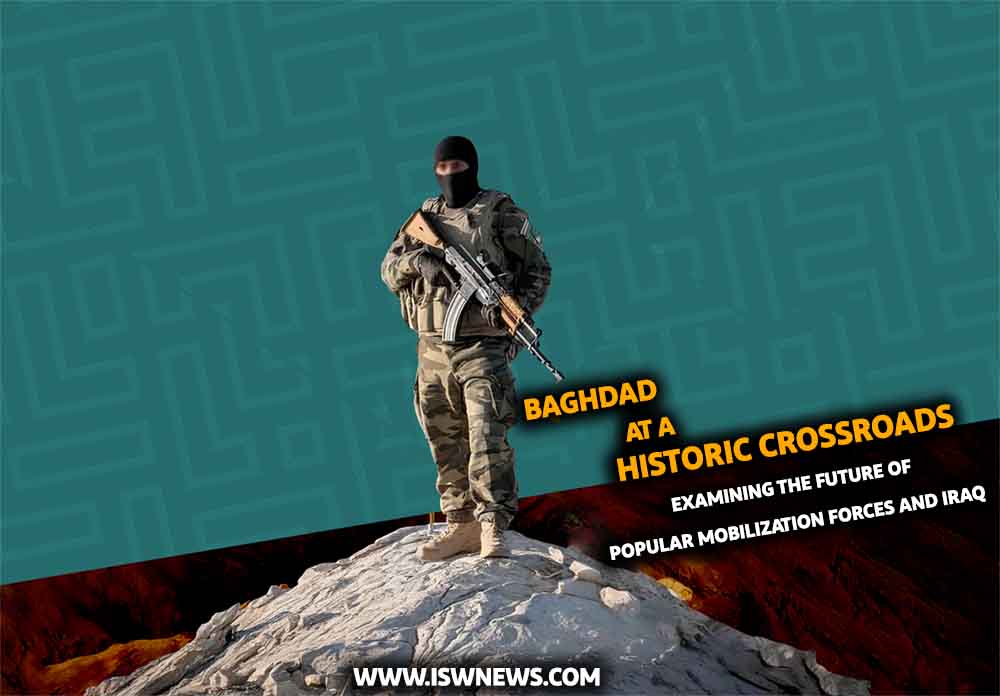
Baghdad at a Historical Crossroads: Examining the Future of the Popular Mobilization Forces and Iraq
Iraq is at a defining stage in its political evolution where the convergence of external pressures—namely Iranian influence and Turkish military presence—with the central government’s financial crisis and the complex internal power structure, particularly the multifaceted role of the Popular Mobilization Forces (PMF), has seriously undermined the country’s prospects for political and security stability. The PMF now functions as a semi-institutional force that, while possessing defensive capabilities and social legitimacy, also operates through political, economic, and transnational networks that influence the behavior of some of its units. This increases the likelihood of autonomous actions, local clashes, or demonstrations of force.
The future of this situation can be envisioned through three scenarios. First, gradual integration and institutionalization within the state framework, provided there is political will and financial transparency. Second, the continuation of its semi-institutional status with sporadic conflicts, which appears to be the most likely path. Third, a deterioration into greater instability triggered by regional developments or a deepening financial crisis.
A risk-reduction strategy should be built on three pillars. Auditing and restructuring the PMF’s personnel system. Gradual reform of legal and political frameworks to enable structured integration. Activation of regional diplomacy to reinforce security boundaries. What remains vital is preserving the PMF’s social legitimacy and operational capacity during the integration process so it can continue to serve as a stabilizing and deterrent force within Iraq’s security architecture during times of crisis.
Iraq’s Current Position in Relation to the PMF
In the second half of 2025, Iraq’s domestic politics depend more than ever on how the government engages with paramilitary actors while managing regional and economic pressures. The experience of the past few years shows that the PMF is no longer a temporary partisan force. It has embedded itself into Iraq’s political, social, and economic fabric and has become a key player in Baghdad’s power dynamics.
From the perspective of local governments and many domestic observers, acknowledging this reality is the first step toward any pragmatic solution. Attempts to rapidly dismantle or marginalize the PMF are not only unfeasible but risk undermining stability and deepening social divides.
Understanding the PMF’s current status requires a composite view of three elements. Its military and security role during the fight against ISIS, which earned it local legitimacy. The political and economic structures surrounding it, which have turned some brigades into influential actors in local institutions and markets. Its regional ties, which shape and sometimes direct its behavior.
For example, in the summer of 2014, when ISIS rapidly captured parts of Iraq and threatened the collapse of the local government and sacred sites, Iran’s Quds Force intervened directly. Intelligence support, military advising, weapons shipments, and field presence were mobilized to organize and strengthen local resistance groups. These efforts, officially framed as protecting holy sites and preventing security collapse, forged deep operational links between certain PMF brigades and Iranian security institutions.
Baghdad’s Balancing Act in Domestic Politics
From the perspective of internal political dynamics, Prime Minister Mohammed Shia’ Al-Sudani’s government operates cautiously in a middle-ground position. On one hand, it must assert sovereignty and demonstrate legal control over national affairs. On the other, it faces pressure from Shiite coalitions and local leaders with divergent interests and expectations. The Coordination Framework of Shiite factions exemplifies this complexity. Some groups maintain close ties with the Islamic Republic of Iran, while others pursue more nationalist or conservative agendas. These differences have created friction in strategic decision-making and pushed the government toward a policy of “patience and passivity.” This cautious approach, especially when compounded by financial strain, reduces the likelihood of gradual compromise and instead opens space for symbolic gestures and localized bargaining.
What Shapes Iraq’s Political Future?
Iraq’s political future is shaped by its engagement with regional actors, particularly Tehran and Ankara. Structurally, Iran maintains deep and networked influence over segments of the Popular Mobilization Forces (PMF), and its preference has often been to preserve communication channels and pursue gradual influence rather than direct confrontation. In critical moments, Tehran has opted for a “keep the channels open” tactic to safeguard its long-term interests in Iraq. Meanwhile, Turkey’s military presence and operations in the north and Kurdish regions exert additional pressure on Baghdad’s ability to assert control, narrowing the government’s strategic options. From Baghdad’s standpoint, managing simultaneous pressure from Iran and Turkey requires active diplomacy and balanced policies. It must also secure guarantees for territorial integrity and decision-making independence without undermining local deterrent mechanisms.
Three Scenarios for the PMF’s Political Trajectory
Given current conditions, three plausible scenarios can be outlined for the future of the PMF and its political role. These scenarios are shaped not by ideological goals or idealistic plans, but by the actual behavior and patterns of current actors.
In the realistic scenario, the PMF remains in a “semi-institutional” state. This means that some units and leadership structures gradually integrate into official military and security institutions, while others retain local influence and continue to play political and economic roles at regional and national levels. This model allows the central government to maintain a degree of control over the national security framework, while delegating some operational authority to paramilitary forces at lower levels. The likely outcome is continued local competition, increased political bargaining on the margins of government, and the emergence of a multi-layered field where Iraq becomes a battleground for regional influence.
In the second scenario, which becomes more likely with rising regional tensions or a financial collapse of the government, certain units may break away from the political process and intensify independent military actions or symbolic operations. This could provoke reactions from foreign actors and rapidly push Iraq into a level of instability from which recovery would be difficult. Field reports of such behavior and attacks on infrastructure suggest that this scenario is not far-fetched.
The third scenario involves structural institutionalization and the transformation of the PMF into a “national asset,” achievable under three conditions. First, Baghdad must demonstrate political will and draft clear legislation. Second, transparent financial mechanisms must be established. Third, regional dialogue must prevent Iraq from becoming a theater of foreign confrontation. Lessons from other regional countries and analytical recommendations suggest that a phased plan—including financial audits, formal personnel registration, revised appointment protocols, and reasonable incentive packages for moderate commanders—could enable a smooth integration into Iraq’s political and legal system. This path requires time, patience, and overlapping political guarantees, but from Baghdad’s perspective, it is both rational and achievable.
The Role of the United States in Iraq’s Future
From a strategic standpoint, U.S. policy toward Iraq in recent years has shifted from a model of direct, large-scale military presence to a more flexible, multi-layered approach. This new framework emphasizes reducing field deployments, maintaining deterrence capabilities, and combining targeted pressure with conditional support. Two key factors have driven this shift: first, Washington’s desire to reduce the political, financial, and human costs of prolonged engagement in the Middle East; and second, its increasing reliance on diplomatic, economic, and security tools as indirect yet effective instruments of influence. As a result, this evolving strategy carries several important implications for Iraq’s political and security architecture—understanding these is essential for grasping the balance of power in Baghdad and the interplay of domestic and regional forces.
The first dimension of these implications relates to the mechanism of “conditional aid” and its role in shaping reform incentives. The United States typically ties its economic and military assistance to progress in governance reforms, financial transparency, and the containment of irregular paramilitary forces. In theory, such conditionality can accelerate the registration, regulation, and integration of armed groups, paving the way for a more cohesive institutional structure. However, Iraq’s field experience shows that imposing conditions without offering credible and sustainable alternatives—especially for moderate local commanders—often backfires. It intensifies political resistance and deepens internal divisions, polarizing the decision-making environment.
The second dimension involves “strategic ambiguity.” The reduction of direct foreign military presence creates deterrence gaps that local actors may exploit to expand their operational autonomy. In this context, U.S. threats of military action or sanctions may serve as crisis deterrents, but repeated or unilateral use—especially without regional coordination or viable economic alternatives—can provoke domestic backlash and erode the legitimacy of Baghdad’s reform efforts.
The third dimension highlights the constructive potential of U.S. assistance. When conditional pressure is paired with investment in institutional capacity—such as technical support for personnel registration systems, strengthening financial institutions, and managerial training—the likelihood of successful reforms increases. This model of pressure combined with structural support can lower the political cost of implementing reforms in Baghdad and facilitate gradual integration of armed groups, provided these programs are designed in coordination with regional stakeholders and domestic beneficiaries.
Assessing the Risk of Early Conflict in Iraq
In recent months, a convergence of political, security, and economic developments in and around Iraq has signaled a shift toward a more fragile phase compared to the relative stability of the past. The overlap of internal pressures with regional movements has significantly increased the risk of scattered tensions escalating into a broader crisis. Domestically, the central government’s chronic financial crisis, unresolved disputes over the PMF legislation, and the lack of transparency in resource allocation and payments have eroded Baghdad’s decision-making structure. This erosion has not only weakened the state’s capacity for rapid response to security incidents but also fostered institutional instability in the relationships between the government, political factions, and paramilitary forces—a reality confirmed by multiple field reports and analytical assessments.
At the same time, several concrete incidents suggest that Iraq’s previously stable security landscape is becoming increasingly fragile. Drone attacks on oil fields in Duhok Province and damage to companies operating in the Kurdistan Region—such as Hunt Oil, which was recently forced to suspend and then conditionally resume operations—are examples of economic-security pressure points that could swiftly alter the local balance of power.
In terms of foreign relations, transnational actors play a critical role. Official and unofficial statements from Iraqi officials have pointed to overt and covert pressure from the United States and Israel regarding the passage of the PMF law, along with warnings about the economic and political consequences of opposing their interests. These developments indicate that Iraq’s internal political actions are rapidly becoming entangled in regional rivalries. Mahmoud al-Mashhadani, Speaker of Parliament, recently spoke publicly about threats and pressure, signaling that disputes over the PMF law are not merely domestic matters—they could become pretexts for external leverage with long-term economic and political consequences for Baghdad.
The Risk of Escalation in Iraq: A Strategic Assessment
In a recent interview, Iraqi parliamentarian Mahmoud al-Mashhadani emphasized that the wave of reports and claims circulating in outlets like Al-Akhbar—regarding the possibility of Iraq being targeted by Tel Aviv-led operations—while alarmist in tone, may in practice serve a deterrent and regulatory function in regional security dynamics. Even when not grounded in verified intelligence, such narratives tend to heighten caution, surveillance, and coordination among actors, prompting them to reassess power balances and operational readiness. In this sense, these discourses, beyond their media role, indirectly activate components of regional deterrence.
The PMF’s Role in Iraq’s Complex Security Equation
The Popular Mobilization Forces (PMF), rooted in social legitimacy and its history of fighting ISIS, has evolved into a network of brigades and political-economic structures. In the absence of transparency and clear legislation, it retains the capacity to act based on local, economic, or ideological motives. Operational and logistical ties between certain brigades and regional actors—as seen in 2014—can justify responses that the central government may view as “outside official channels.” While this structural reality alone does not constitute a war trigger, when combined with financial shocks, external pressure, and attacks on critical infrastructure, it creates conditions for local reactions to escalate beyond the government’s control.
Pathways to Crisis Escalation
Several plausible pathways exist for crisis escalation, though they do not follow a simple cause-and-effect chain. These include:
- A significant blow to the national economy, such as sanctions or widespread shutdowns in the oil sector, which would raise public dissatisfaction and strain both military and civilian budgets
- Coordinated attacks on energy infrastructure or foreign bases, potentially provoking retaliatory military responses
- Breakdown of diplomatic channels between Baghdad and key regional players (Tehran, Ankara, Washington), which would hinder regional crisis management and mediation
The activation of any of these triggers—especially in combination—could substantially increase the likelihood of localized tensions evolving into a broader conflict. Recent developments suggest that some of these triggers are already active or on the verge of activation, including drone strikes in northern Iraq, political pressure surrounding the PMF legislation, and psychological-media tensions linked to allegations of foreign influence and threats.
Strategic Summary and Outlook
The report concludes that while a full-scale war in Iraq is not imminent, the country is exposed to a set of compounding triggers that, if not managed promptly and coherently, could push the situation toward widespread conflict within weeks or months. In other words, the risk of war is a real possibility—dependent on immediate domestic decisions and regional guarantees, not an inevitable outcome.
Therefore, Baghdad’s current priorities must focus on rebuilding financial and personnel transparency within the PMF, passing clear legal frameworks, strengthening protection of energy infrastructure, and activating diplomatic channels with Tehran, Ankara, and Washington. Only through this integrated management approach—and not through unilateral solutions or external pressure—can Iraq avoid becoming a theater of regional confrontation.
Conclusion
In a broader evaluation, the prospect of a full-scale war in Iraq in the medium term is neither unavoidable nor implausible. What determines the outcome is a combination of internal and external triggers and the government’s ability to respond swiftly. If liquidity crises deepen, if the PMF’s semi-institutional structure persists without oversight, and if a strong regional trigger—such as direct attacks on bases or the collapse of diplomatic guarantees—emerges, localized clashes could rapidly escalate into a national conflict.
Conversely, passing legislation, conducting financial audits, registering personnel, offering reasonable incentives to moderate commanders, and securing diplomatic guarantees from regional actors could pave the way for gradual integration and de-escalation. In short, the threat of war is real but entirely contingent on Baghdad’s immediate policies and the nature of regional and international engagement. Transparency, institution-building, and regional guarantees significantly reduce the risk of conflict—while neglecting these measures raises the likelihood of escalation.


Comments