
ISIS Narrative on Julani’s Trip to the U.S.: “Atatürk in Washington”
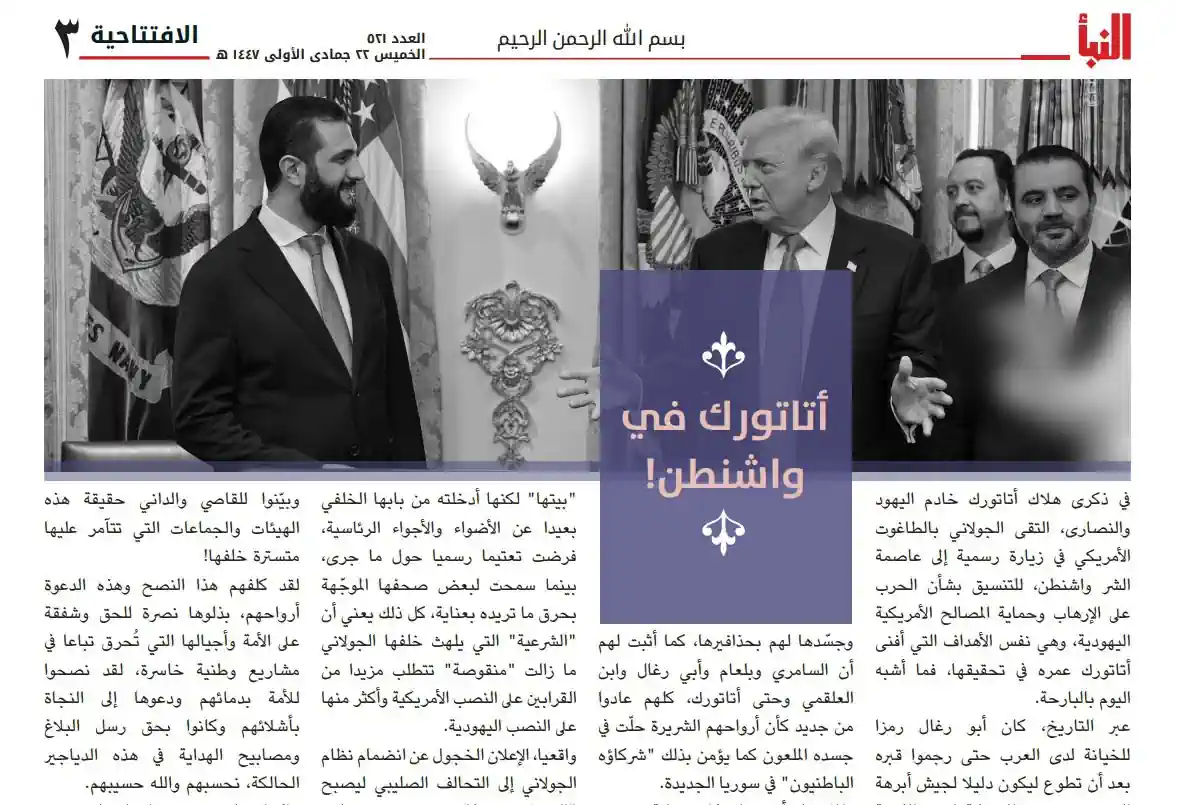
On the anniversary of Atatürk’s death—whom ISIS portrays as a symbol of serving Western powers—history is, in their view, replaying a similar scene.
ISIS in the latest editorial of its al-Naba weekly describes Jolani’s recent trip to Washington as a repeat of the same “betrayal show.” They frame the visit as a direct link between him and the “capital of evil.” In this narrative, Jolani is not seen as a political actor but as a figure resurrected from a history of treachery—an extension of all those whom ISIS associates with a dark past.
Beginning of the Narrative: Betrayal Returns in a New Form
ISIS does not view Jolani’s trip to the U.S. as a simple event. For them, it is a continuation of Atatürk’s path—someone who, in their perception, lived and fought to advance Western goals. Thus, Jolani’s visit is symbolically placed alongside Atatürk’s legacy: an act aimed at weakening the Muslim community and serving the interests of America and its allies.
The comparison is not limited to Atatürk. Jolani is depicted as a new link in a long chain of historical traitors—figures who, in ISIS’s view, paved the way for enemies and served foreign powers. The purpose of these comparisons is to cement Jolani’s image as a “symbol of betrayal” in the minds of their audience.
Prelude to the Trip: A Path Built Behind the Scenes
ISIS claims Jolani’s journey was the result of months of consultations and contacts with U.S. officials, portraying him as someone who had to “prove himself” step by step to gain Washington’s trust. Each meeting with American officials is described as offering “new concessions,” ultimately leading to the main encounter with the U.S. president. The narrative paints Jolani as a man who must pay the price of political advancement through security and political actions against others.
Media Displays: Signs of “New Loyalty”
ISIS interprets Jolani’s promotional videos—especially those showing him engaged in sports—as staged symbols of “victory displays.” These images are seen as part of a performance to show that each new collaboration with the U.S. translates into fresh political gains. A photo of him alongside American commanders is presented as further evidence that Jolani has now secured a place within Western military and political structures.
Political Dimensions: From Containing Iran to Rebuilding Syria
ISIS situates Jolani’s trip within broader regional dynamics. They argue that the U.S. seeks to diminish Iran’s influence in Syria, while Turkey supports Jolani as a more pragmatic alternative for Syria’s future—an actor capable of playing a role in the country’s new political framework. In this context, the lifting of U.S. sanctions on Jolani is interpreted as granting him “semi-legitimacy,” though ISIS insists it is incomplete and will demand further concessions.
From Hidden Cooperation to Open Partnership
ISIS asserts that Jolani’s formal alignment with the international anti-terror coalition is merely the public declaration of a partnership that has existed covertly for years. They cite recent security operations by Jolani’s forces—arrests and pursuits of individuals linked to jihadist groups, coinciding with Israeli strikes in southern Syria—as proof. His silence in the face of Israeli attacks is portrayed as evidence that “his weapons are aimed in only one direction.”
Propaganda Use: Invoking the Legacy of ISIS Leaders
To reinforce its narrative, ISIS references the words and guidance of its slain leaders, aiming to restore moral and ideological legitimacy. The account honors those who “gave their lives on this path” and calls for the return of former ISIS fighters.
Final Message: “The End of Jolani’s Path”
In conclusion, ISIS presents Jolani’s trip as the ultimate symbol of his “complete transformation”—a man who abandoned jihad and entered the service of global powers. For ISIS, this serves as a cautionary tale: an example of how someone once listed as a “terrorist” can become a “partner of the West.”

Comments