Tag: ISIS

  • Joint Syrian–U.S. Coalition Operation: 15 ISIS Hideouts Destroyed

    Joint Syrian–U.S. Coalition Operation: 15 ISIS Hideouts Destroyed

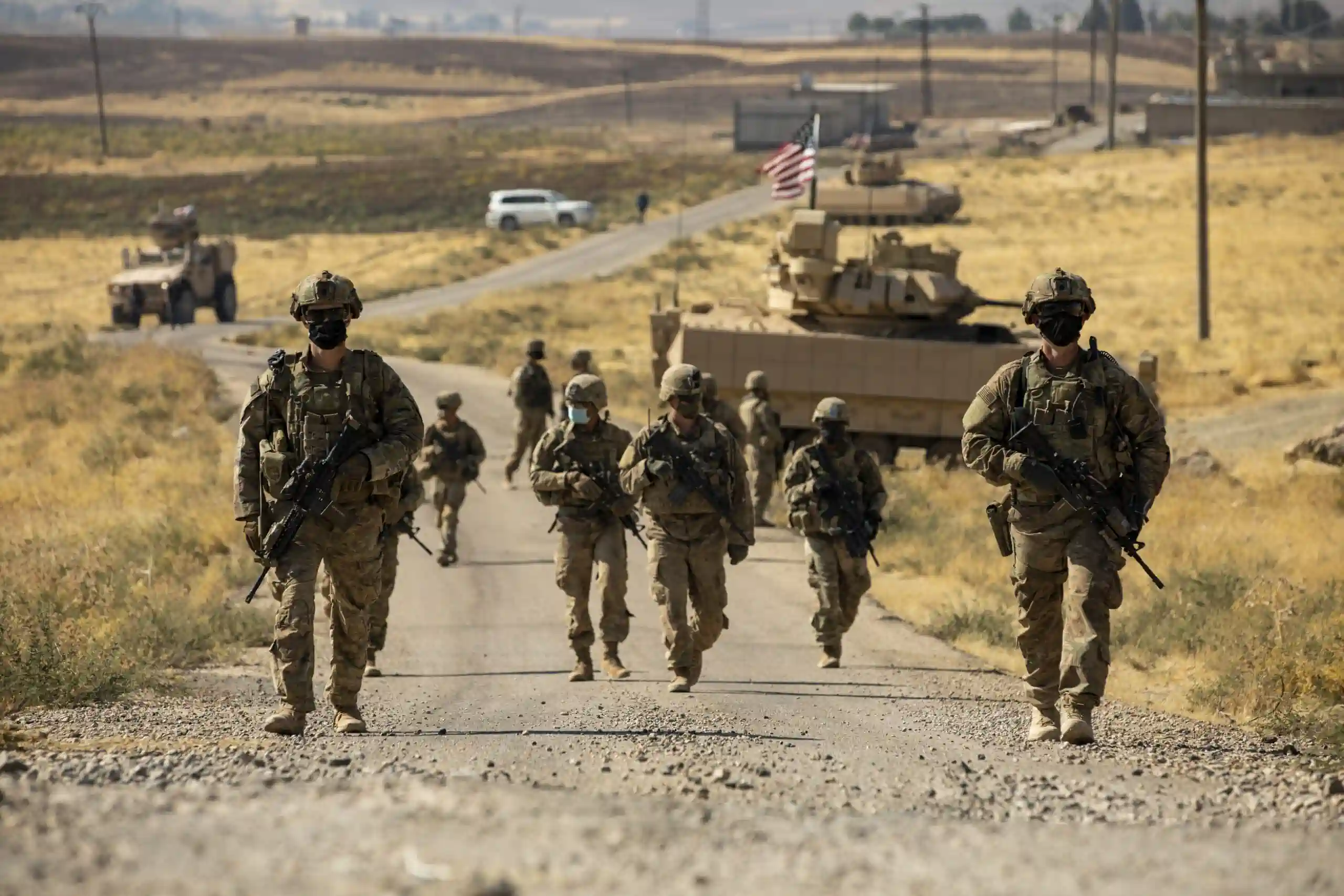
    According to CENTCOM, the operation involved a series of airstrikes and controlled ground demolitions. Among the destroyed stockpiles were more than 130 mortars and rockets, several small arms and machine guns, anti‑armor mines, and materials used for improvised explosive devices.

    The elimination of these ISIS ammunition depots by CENTCOM and Syrian authorities comes only weeks after the al‑Joulani government joined the U.S. coalition, carrying a clear political message. Washington seeks to demonstrate that this alignment is not merely symbolic but has already led to joint field operations—aimed at consolidating Syria’s new security framework and reinforcing the legitimacy of the transitional government in partnership with the United States.

  • Failed Attempt of Mass Escape by ISIS Prisoners from al-Sina’a Prison in Hasakah

    Failed Attempt of Mass Escape by ISIS Prisoners from al-Sina’a Prison in Hasakah

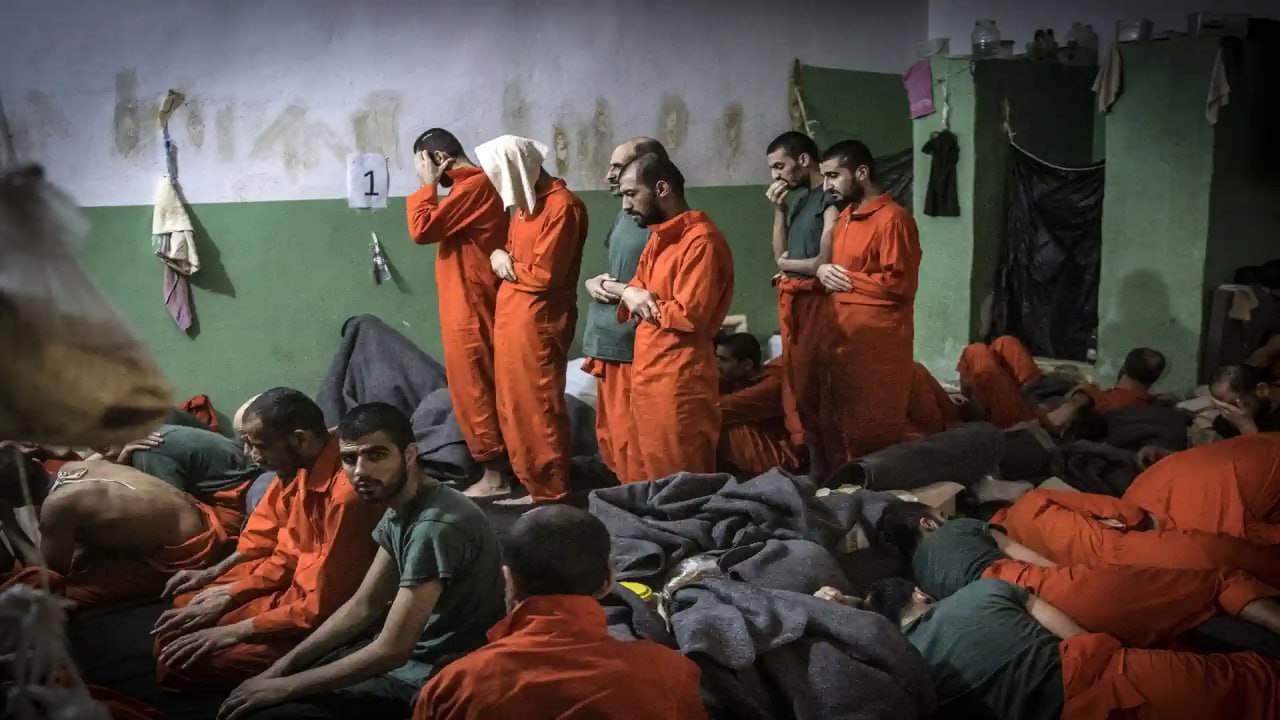
    The plan for the escape was reportedly coordinated between some prisoners and a number of SDF members assigned to guard the wing holding foreign ISIS detainees. After identifying their involvement, coalition forces arrested three SDF personnel, including one of the prison’s internal officials.

    Additionally, SDF forces detained five civilians from the neighborhoods of Ghuweiran and Aziziyah on suspicion of assisting in facilitating the operation. Following the incident, strict security measures were imposed around the prison, with coalition helicopters and aircraft patrolling the skies over the area for several hours.

    It is worth noting that in 2022, al-Sina’a Prison was the site of the largest organized ISIS jailbreak, during which more than 250 prisoners escaped, sparking heavy clashes inside and around the facility. At that time, allegations also surfaced regarding corruption and collaboration by some SDF members in enabling the escape of ISIS detainees.

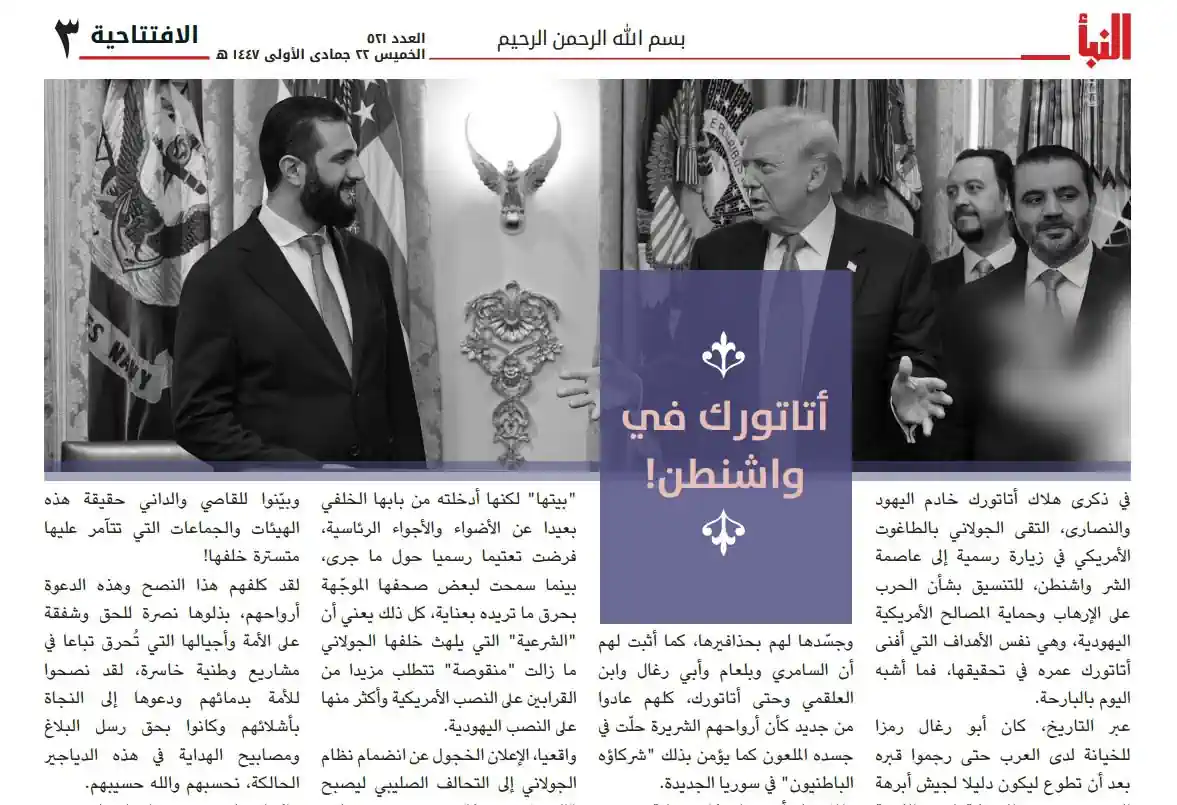
  • ISIS Narrative on Julani’s Trip to the U.S.: “Atatürk in Washington”

    ISIS Narrative on Julani’s Trip to the U.S.: “Atatürk in Washington”

    ISIS in the latest editorial of its al-Naba weekly describes Jolani’s recent trip to Washington as a repeat of the same “betrayal show.” They frame the visit as a direct link between him and the “capital of evil.” In this narrative, Jolani is not seen as a political actor but as a figure resurrected from a history of treachery—an extension of all those whom ISIS associates with a dark past.

    Beginning of the Narrative: Betrayal Returns in a New Form
    ISIS does not view Jolani’s trip to the U.S. as a simple event. For them, it is a continuation of Atatürk’s path—someone who, in their perception, lived and fought to advance Western goals. Thus, Jolani’s visit is symbolically placed alongside Atatürk’s legacy: an act aimed at weakening the Muslim community and serving the interests of America and its allies.

    The comparison is not limited to Atatürk. Jolani is depicted as a new link in a long chain of historical traitors—figures who, in ISIS’s view, paved the way for enemies and served foreign powers. The purpose of these comparisons is to cement Jolani’s image as a “symbol of betrayal” in the minds of their audience.

    Prelude to the Trip: A Path Built Behind the Scenes
    ISIS claims Jolani’s journey was the result of months of consultations and contacts with U.S. officials, portraying him as someone who had to “prove himself” step by step to gain Washington’s trust. Each meeting with American officials is described as offering “new concessions,” ultimately leading to the main encounter with the U.S. president. The narrative paints Jolani as a man who must pay the price of political advancement through security and political actions against others.

    Media Displays: Signs of “New Loyalty”
    ISIS interprets Jolani’s promotional videos—especially those showing him engaged in sports—as staged symbols of “victory displays.” These images are seen as part of a performance to show that each new collaboration with the U.S. translates into fresh political gains. A photo of him alongside American commanders is presented as further evidence that Jolani has now secured a place within Western military and political structures.

    Political Dimensions: From Containing Iran to Rebuilding Syria
    ISIS situates Jolani’s trip within broader regional dynamics. They argue that the U.S. seeks to diminish Iran’s influence in Syria, while Turkey supports Jolani as a more pragmatic alternative for Syria’s future—an actor capable of playing a role in the country’s new political framework. In this context, the lifting of U.S. sanctions on Jolani is interpreted as granting him “semi-legitimacy,” though ISIS insists it is incomplete and will demand further concessions.

    From Hidden Cooperation to Open Partnership
    ISIS asserts that Jolani’s formal alignment with the international anti-terror coalition is merely the public declaration of a partnership that has existed covertly for years. They cite recent security operations by Jolani’s forces—arrests and pursuits of individuals linked to jihadist groups, coinciding with Israeli strikes in southern Syria—as proof. His silence in the face of Israeli attacks is portrayed as evidence that “his weapons are aimed in only one direction.”

    Propaganda Use: Invoking the Legacy of ISIS Leaders
    To reinforce its narrative, ISIS references the words and guidance of its slain leaders, aiming to restore moral and ideological legitimacy. The account honors those who “gave their lives on this path” and calls for the return of former ISIS fighters.

    Final Message: “The End of Jolani’s Path”
    In conclusion, ISIS presents Jolani’s trip as the ultimate symbol of his “complete transformation”—a man who abandoned jihad and entered the service of global powers. For ISIS, this serves as a cautionary tale: an example of how someone once listed as a “terrorist” can become a “partner of the West.”
  • Wall Street Journal: ISIS Resurging in Syria

    Wall Street Journal: ISIS Resurging in Syria

    The report also pointed to the withdrawal of U.S. troops and the transfer of parts of Deir ez-Zor province to SDF control as contributing factors to the rise in ISIS activity. In an interview with one SDF commander, the paper emphasized that the U.S. exit from Syria has emboldened ISIS fighters, giving them greater freedom of movement and operational confidence.

    More than reflecting an on-the-ground reality, the Wall Street Journal report appears to align with a broader media narrative aimed at legitimizing continued U.S. military presence in Syria. By repeatedly highlighting the spike in ISIS attacks following the American drawdown, the report conveys a message that any U.S. retreat from Syria equates to the return of terrorism!

    By emphasizing the inefficiency of the SDF in countering ISIS, the report subtly reinforces the notion that stability in northeastern Syria is only achievable through U.S. support and presence.

    Overall, reports like this—alongside field data and statistics—form part of the broader narrative warfare unfolding in Syria. Western media outlets aim to portray the withdrawal of their forces not as a political decision, but as a security threat. This framing seeks to convince domestic audiences and regional allies that a prolonged U.S. military presence in Syria remains both necessary and justified.

  • ISIS Releases Infographic Detailing Recent Operations in Eastern Syria

    ISIS Releases Infographic Detailing Recent Operations in Eastern Syria

    According to the group, it carried out 38 operations—including direct assaults, assassinations, IED attacks, and ambushes—between August 7 and October 16, 2025, targeting Syrian Democratic Forces (SDF) in Deir ez-Zor, Hasakah, and Raqqa provinces.

    The data suggests an average of one attack every two days, highlighting the group’s continued insurgent presence in the region despite territorial losses.

    While these claims remain unverified, they reflect ISIS’s ongoing efforts to project strength and maintain relevance through its media apparatus.

  • Assassination of Former ISIS Commander in Northern Daraa Countryside

    Assassination of Former ISIS Commander in Northern Daraa Countryside

    Kanhosh who was known by the title “Emir al-Hisbah”, disappeared suddenly after ISIS’s defeat in southern Syria, and little information has been available about his whereabouts or activities since.

    It’s worth noting that Jaysh Khalid ibn al-Walid, during its control of the Yarmouk Basin in western Daraa, was considered one of ISIS’s branches in southern Syria.

    The group played a key role in enforcing strict religious rulings and internal regulations. As head of Hisbah (the body responsible for implementing ISIS’s religious laws), Kanhosh oversaw the group’s repressive policies in the region.

  • ISIS Terrorists Attack Syrian Army Positions In Homs, Deir Ez-Zor

    ISIS Terrorists Attack Syrian Army Positions In Homs, Deir Ez-Zor

    ISIS militants took advantage of adverse weather conditions and limited visibility caused by a dust storm to launch assaults on three Syrian army bases in the governorates of Deir ez-Zor and Homs, located in eastern and western Syria respectively.

    In the first and second rounds of attacks, ISIS terrorists targeted two Syrian army bases in the town of Al-Tabni and Al-Kobajjep desert area located in Deir ez-Zor, confronting with Syrian soldiers. During these clashes, at least two Syrian soldiers were martyred. It is reported that after the Syrian troops retreated, ISIS members managed to enter the military posts of the Syrian army in the aforementioned areas.

    In the third attack, ISIS elements assaulted a Syrian army base and its allied forces in the Al-Sukhnah desert town, resulting in the martyrdom of one Syrian soldier and injuries to several others.

    In recent years, the Syrian desert and various areas of Deir ez-Zor and Homs governorates have witnessed daily operations by ISIS terrorists against civilians, facilities, and military bases, despite ongoing operations by the Syrian army.

    Furthermore, hundreds of Syrian army personnel and their allies have been martyred during cleanup operations in the Syrian desert, yet ISIS’s hidden groups continue to operate in these areas, resorting to terrorist activities to affect the security of some regions in Syria.

    Click to view full size
  • ISIS Attack On Homs Leaves 12 Syrian Forces Martyred

    ISIS Attack On Homs Leaves 12 Syrian Forces Martyred

    A bus carrying 17 members of the 18th Armored Division of the Syrian army stopped due to a technical malfunction in the village of Al-Bayda in eastern Homs.

    ISIS terrorists misused the adverse weather conditions and limited visibility caused by a dust storm in order to target the bus transporting the Syrian soldiers.

    In the terrorist attack, 12 members of the Syrian army were martyred, while five soldiers left the site of the confrontation and retreated.

    In recent years, the desert areas in Syria as well as various districts of Homs Governorate witnessed daily operations by ISIS terrorists against civilians, facilities, and military posts, despite ongoing operations by the Syrian army.

    Additionally, hundreds of Syrian army personnel and their allies have been martyred during those clearing operations in the Syrian desert, yet hidden elements of the ISIS terrorist group continue to be present in these areas, threatening the security of certain regions in Syria with their terrorist actions.

  • ISIS Raids Wound, Killed SAA Servicemen In Syria’s Deir Ezzor

    ISIS Raids Wound, Killed SAA Servicemen In Syria’s Deir Ezzor

    Early in the morning of September 11, ISIS terrorist group raided Syrian Arab Army’s (SAA) chekpoints between the city of Al-Mayadin and the village of Quriyah.

    According to local sources, ISIS terrorists employed light and medium machine guns in attacks.

    As result of clashes, an SAA serviceman was killed and three others were wounded. ISIS militants subsequently retreated to the desert areas in the western outskirts of Al-Mayadin.

    ISIS has not yet claimed responsibility for the attack. However, the main terrorist group active in the Syrian desert is ISIS and these attacks are clearly carried out by ISIS.

    In recent months, ISIS stepped up its attacks in central Syria.

    Two individuals riding a motorcycle attacked oil tankers near the town of al-Dahla on September 10. The attack caused material damages

    Seven SAA soldiers were killed in two separate attacks close to the town of Ithriyah in the eastern Homs countryside on September 5. On the same day, a shepherd was killed and two others were wounded as a result of an attack in the area of al-Buhamad in the southern Raqqa countryside. Both attacks were blamed on ISIS.

    The Syrian military has already reinforced its positions in the central region and resumed strikes against ISIS cells and their hideouts there in cooperation with Russian forces.

    On September 6, warplanes of the Russian Aerospace Forces carried out a series of airstrikes against hideouts used by the terrorist group close to the town of Madan in the eastern Raqqa countryside and the town of Rasafa in the southern countryside of the governorate.

    In recent years, despite the continuous efforts by the Syrian army and Russian Aerospace Forces, the Syrian desert have witnessed the daily operations by ISIS elements against civilians, and military installations. Hundreds of Syrian army forces and allies were killled and wounded, but the terrorist group’s insurgency will not likely end any time soon.

    It seems the terrorist group’s cells receive support from their comrades in the northeastern region which is held by the U.S. and its proxy, the Kurdish-led Syrian Democratic Forces. Also, the Syrian and Russian officials repeatedly accused U.S. forces in the southeastern area of al-Tanf of training and even arming militants, including members of ISIS.

    Posted on SF

  • ISIS Suicide Attack Targets Syrian Democratic Forces in Deir ez-Zor

    ISIS Suicide Attack Targets Syrian Democratic Forces in Deir ez-Zor

    According to the Amaq News Agency’s report, a suicide bomber belonging to ISIS group managed to pass through the gate of an SDF training camp located in the village of Al-Atala in the Al-Baghuz town of northern Deir ez-Zor Governorate on Monday (June 3). The bomber then detonated his booby-trapped vehicle during the forces’ training session, resulting in the killing and wounding of 15 SDF members.

    ISIS has claimed that this attack was carried out in retaliation for the events unfolding in the al-Hawl refugee camp situated in the Al-Hasakah Governorate.

    Corroborating the incident, local news sources had also reported an explosion at the SDF training camp in the same day. However, the SDF forces denied any attack on their camp, attributing the explosion sound to the routine training of their personnel.

    Notably, this suicide attack marks the second such incident in recent days, following the attack on Al-Shuhail city that had occurred a few weeks ago, which had resulted in 23 casualties.

    The continued targeting of the SDF by ISIS elements underscores the persistent threat posed by the terrorist group, even as it has lost the majority of the territory it once controlled in Syria.

  • Deadly ISIS Attack Targets African Forces In Northeastern Nigeria

    Deadly ISIS Attack Targets African Forces In Northeastern Nigeria

    The Islamic State’s West Africa Province (ISWAP) has launched a deadly assault on the headquarters of African Union forces in northeastern Nigeria. The attack, which occurred on Sunday, May 26, left dozens of casualties in its wake.

    According to reports, ISWAP terrorists stormed the encampment near the village of Toumboma in the Borno state, with one of the group’s members, identified as Abu Fatima al-Ansari, detonating a suicide vehicle-borne explosive device among the African forces.

    The ISIS news sources claim that the attack resulted in the deaths and injuries of dozens of African soldiers, while also destroying or disabling four military vehicles. This latest strike comes amid a surge in ISWAP operations against the Nigerian army and its allies in the Borno state over the past 20 days.

    Just days before the Toumboma assault, ISIS terrorists had targeted the headquarters of the African Union’s anti-ISIS forces in the town of Doronária on May 18. After fierce clashes and a suicide attack, the group claimed to have killed or wounded more than 40 African forces in that earlier incident.

    The recent attacks highlight the challenges faced by the African Union and Nigerian forces in their efforts to maintain security and stability in the conflict-torn area.

  • Deputy Of Abu Bakr Al-Baghdadi Arrested In Iraqi Kurdistan Region

    Deputy Of Abu Bakr Al-Baghdadi Arrested In Iraqi Kurdistan Region

    The Kurdistan Region Security Council on May 17 issued a statement announcing the arrest of Soqrat Khalil, the main aide to Abu Bakr al-Baghdadi, the former leader of the ISIS terrorist group.

    The statement said that Khaled returned to the Kurdistan Region from Turkiye with a fake passport after five years and was quickly arrested.

    Khaled played an important role in making bombs for the ISIS terrorist group, and al-Baghdadi had assigned him to carry out many major operations.

    He also played an effective role in the control of Mosul by this terrorist group in 2014 and participated in many battles against Iraqi forces and the Kurdish Peshmerga militias.