Author: Mirza

  • Why The Israeli Regime Withdrew From The Areas in Gaza City?

    Why The Israeli Regime Withdrew From The Areas in Gaza City?

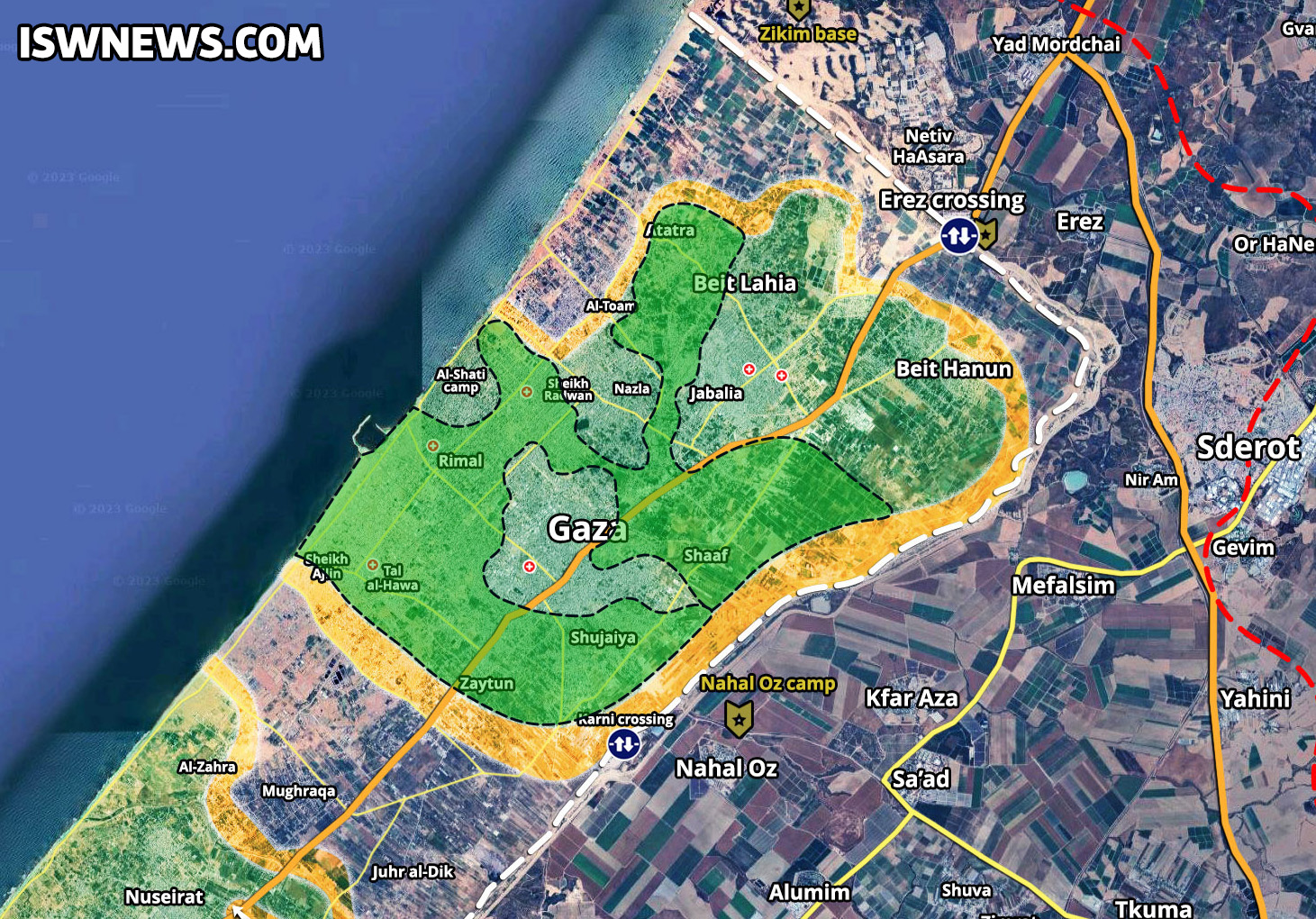
    In recent days, conflicting maps have been published regarding the situation on the ground in the northern Gaza Strip.

    Some believe that the Israeli regime’s forces have completely withdrawn, while others do not accept the Israeli army’s withdrawal and they highlight Israel’s presence in the Gaza city based on the United States think tanks’ maps or pro-Israeli viewpoints. Some consider the Palestinian resistance movement Hamas to be completely victorious, while others consider the Israeli regime to be triumphant.

    However, all these differences of opinion, preferences, oppositions, and biased gestures have no effect on the reality of what is actually happening in the northern Gaza Strip.

    For instance, when there are dozens of videos and reports confirming that Israeli forces have left Beit Hanoun city and taken positions on the outskirts of the city, what difference does it make if some pro-Israeli cartographers or the US think tank show Beit Hanoun as completely under Israeli control? Well, they can do that, but the reality does not change; time will show everything…

    Some question why the Israeli regime withdrew from the occupied areas in Gaza City?
    The answer to this question is that although the Israeli regime has withdrawn from many areas in northern Gaza, it has not withdrawn from northern Gaza and has even achieved some of its objectives. The main goal of Israel’s attack on Gaza was to destroy the Palestinian resistance Hamas. However, the destruction and elimination of Gaza and its infrastructure is another ambition of the regime, or according to some experts, the main goal of the regime’s attack on Gaza, because they themselves know well that Hamas and the Palestinian resistance, which is actually a fundamental ideology, will not be eliminated by military operations in this way.

    Therefore,
    Firstly, due to the very dense urban population and the presence of a vast network of undiscovered tunnels, establishing stable control over the city or, in other words, gaining complete military control over northern Gaza is not possible, and Israeli forces will be trapped in daily skirmishes with Palestinian fighters; so, they will suffer casualties.
    Secondly, the cost of war in Gaza is staggering, and Israelis prefer to avoid war costs as much as possible in their current economic situation.
    Thirdly, the Israeli regime’s army prefers to withdraw from this area, recover, and send forces to other active fronts in the middle and south of the Gaza Strip, rather than engaging in endless urban warfare in Gaza City and the northern Gaza Strip.

    Therefore, considering all the above issue, the Israeli regime has concluded that the best course of action is to withdraw from the urban areas of northern Gaza. This also applies to the middle and southern parts of the Gaza Strip, and the Israelis will eventually withdraw after the destruction and massacre.

    Now the question is that, has the Israeli regime destroyed the Palestinian resistance groups in Gaza City, or will it destroy them throughout the Gaza Strip? No, it cannot. But it has succeeded in maximum destruction of infrastructure and complete devastation of the Gaza Strip. Whether you perceive this reality as a victory or a defeat depends on your perspective and way of thinking!
  • British And American Military Aggression On Yemen’s Ansar Allah (Video)

    British And American Military Aggression On Yemen’s Ansar Allah (Video)

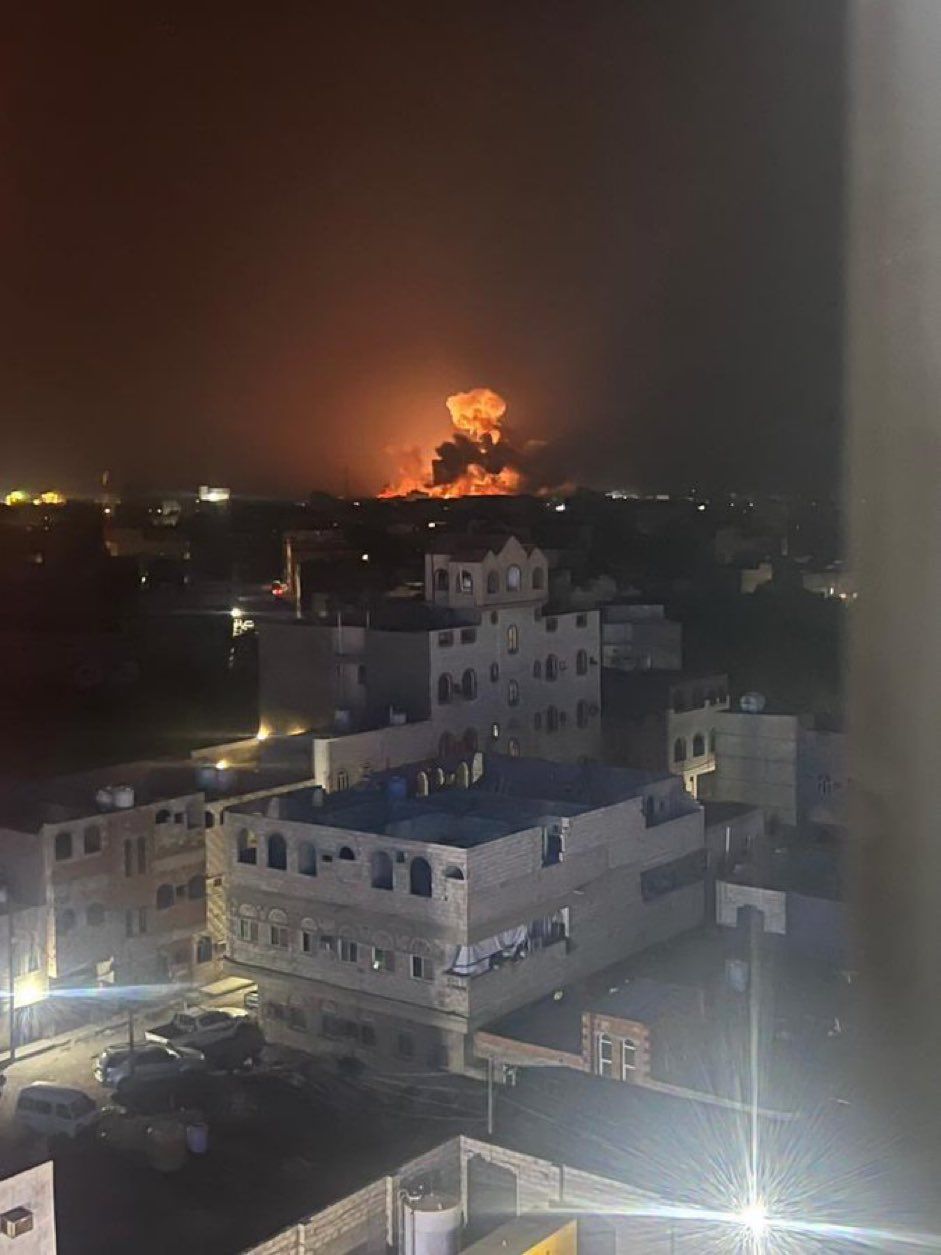
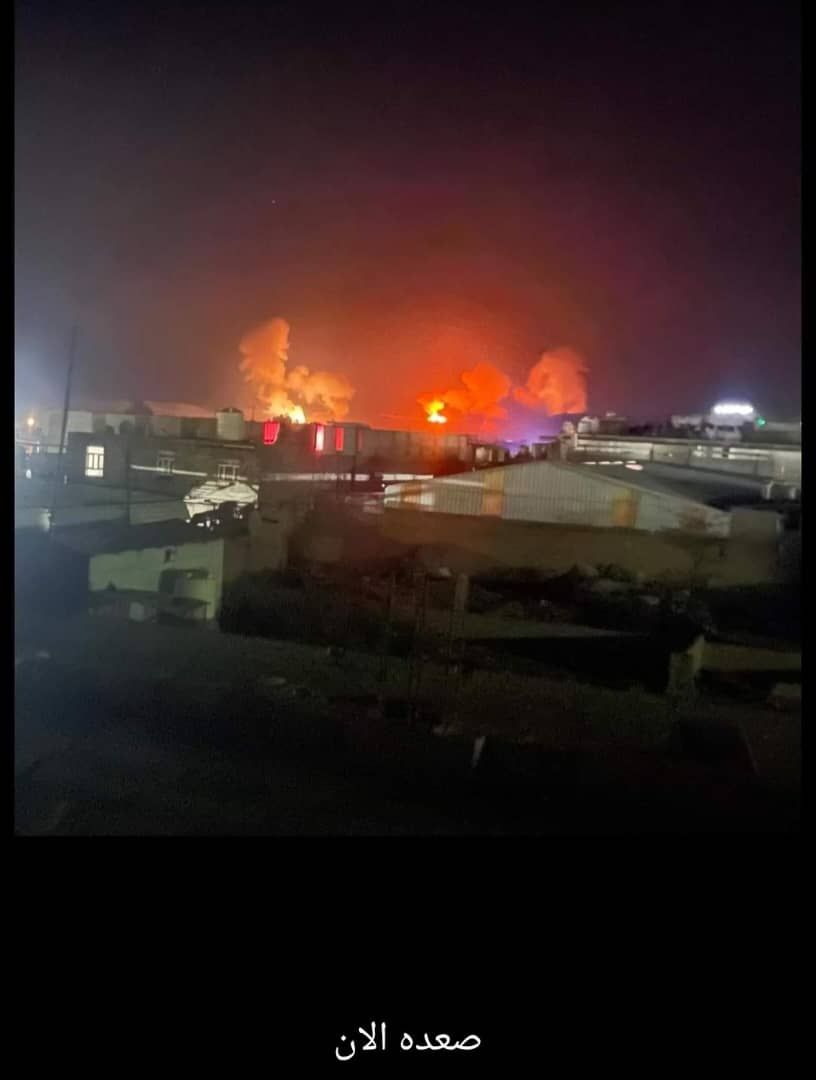
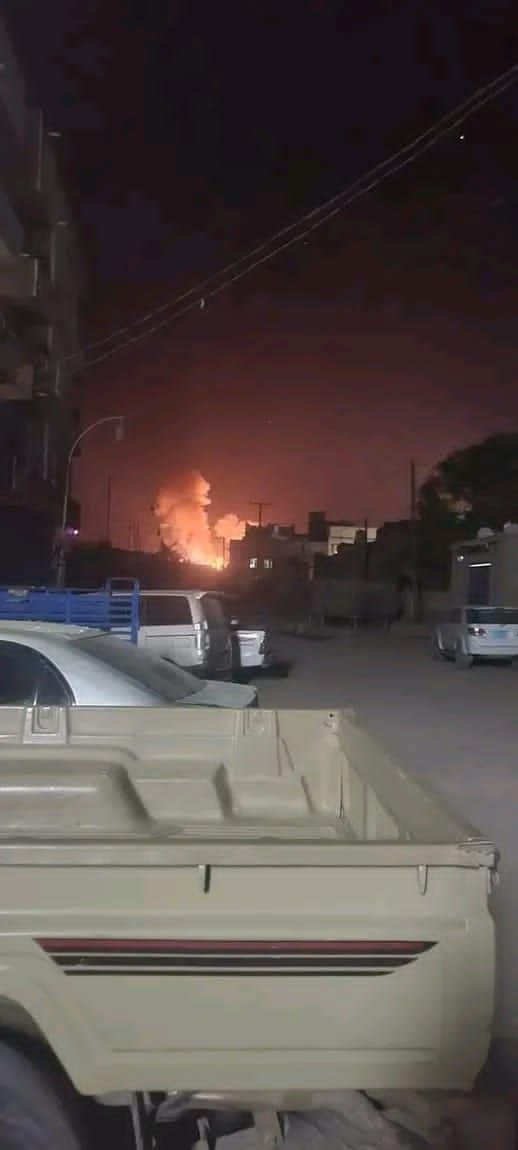
    According to the US Department of Defense, this operation was carried out with the aim of limiting Ansar Allah’s capability to carry out alleged attacks against international shipping in the Red Sea and to prevent further tensions in the region.

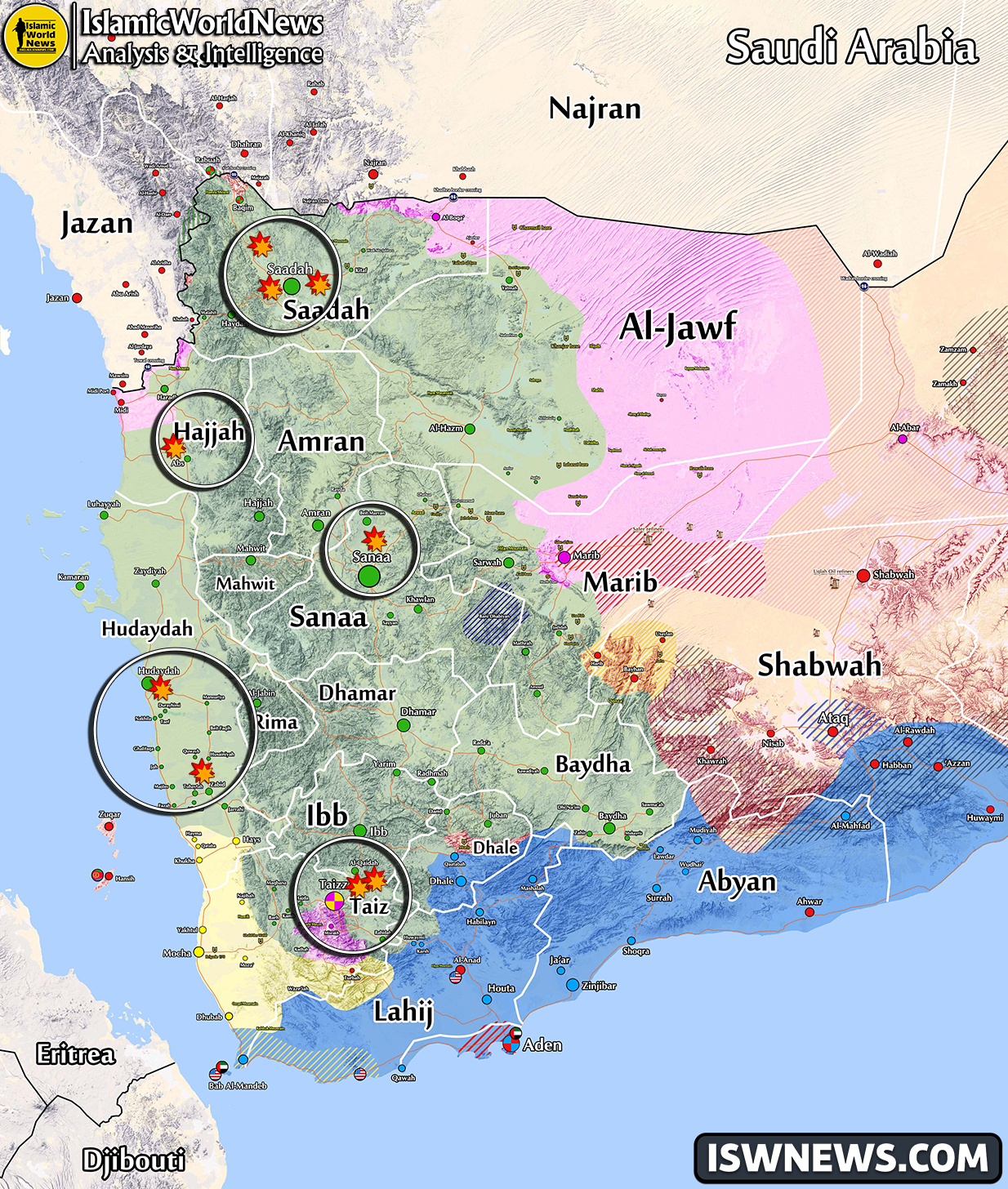
    According to Yemeni media, the US-British airstrikes targeted the following areas:
    – Sana’a: Al-Dailami airbase (in Sanaa airport).
    – Hudaydah: Near Hudaydah airport and areas in the Zabid district.
    – Saada: Kahlan base in the east of Saada, Jabal al-Sama’ in the west of Saada city, and Takhiya area in the Majz district.
    – Hajjah: Abs airport in Hajjah province.
    – Taiz: Taiz airport and 22nd brigade base in Ta’aziyah district.

    The areas that were targeted by the US-British airstrikes on January 12

    American officials stated that this air operation was carried out with the cooperation of UK and with the support of Australia, Bahrain, Canada and the Netherlands. The US Military said that more than 100 missiles were fired at 60 targets in 16 centers affiliated to the Houthis (Ansar Allah movement), including command centers, ammunition depots and UAVs and missile systems.

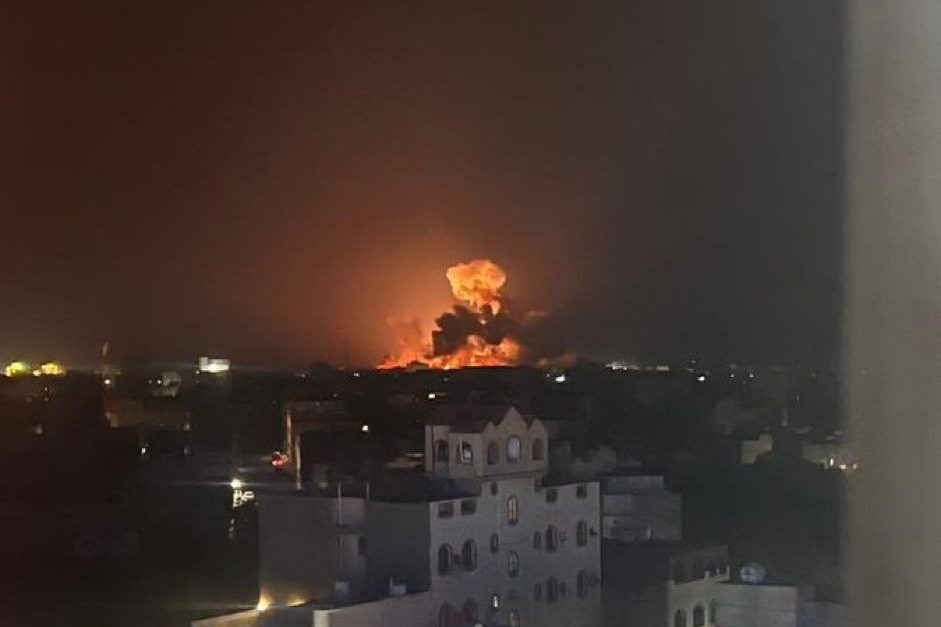
    Video: The moment the attack on Yemen began.

    How was British participation in the operation against Yemen?
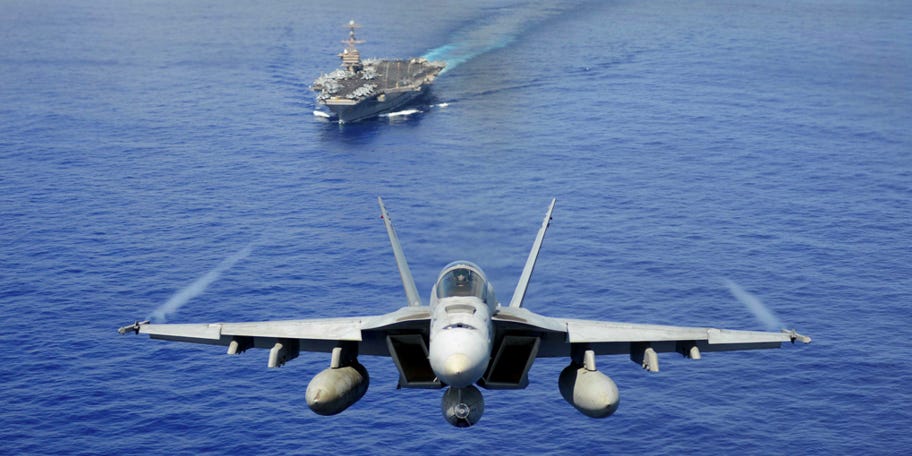
    The British Air Force has participated in joint operations with the United States against Yemen with four Eurofighter Typhoons. These fighter jets flew from the British base in Cyprus to Yemen and refueled in the sky of the Red Sea.

    The British Ministry of Defense stated that this attack was carried out in response to Ansar Allah’s attack on the British destroyer HMS Diamond and the US warships. It is also said that in this attack, British fighter jets bombed two targets in northwestern Yemen, including the Abs airport in Hajjah province, and other targets were bombed by the US fighter jets.

    Video: The flight of four Eurofighter Typhoon fighters from Cyprus to Yemen
    Video: The first moments of the airstrikes
    Video: The first moments of the airstrikes

    After the American and British airstrikes against Yemen this morning, news about Ansar Allah’s missile attack on a British warship and an American warship was published, which cannot be confirmed until now.

    The reaction of Yemen and different countries to the US and British attack on Yemen:

    In a short message, Mohammad Abdul-Salam, spokesperson and chief negotiator of the Yemeni salvation government, in a short message emphasizing the continuation of the operations of the Yemeni armed forces against Israeli vessels and ships that move towards the ports of occupied Palestine, he said: “We emphasize that aggression against Yemen has no justification, because there is no danger to international shipping in the Red and Arabian Seas.”

    Mohammad Al-Bakhiti, the governor of Dhamar and a member of Ansar Allah’s political office, also said in response to this attack:

    “The United States and England made a mistake in the war with Yemen because they did not use their previous experiences. If it wasn’t for Bush’s stupidity in pushing Affash (Ali Abdullah Saleh) to attack us in 2004, the Yemeni people would not have started the 2014 revolution that ended the US ambassador’s rule in Sana’a and expelled their marines from Yemen. If it wasn’t for the stupidity of the United States and England in pressuring Saudi Arabia and the UAE to declare war against us in 2015, today Yemen would not be able to fulfill its religious, moral and humanitarian duty to support Palestine. There is no doubt that today the Americans and the British regret their previous follies and will soon realize that the “direct aggression against Yemen” was also the biggest folly in their history.

    The Ministry of Foreign Affairs of Iran, Hezbollah of Lebanon, Hamas and Islamic Jihad of Palestine issued statements strongly condemning the US and British attacks on Yemen.

    The US and British air campaign against Yemen is their second direct attack on Ansar Allah’s positions and could be the starting point for a widespread war in the Red Sea and the Bab al-Mandeb Strait. In their initial statements, the Yemeni authorities have considered this action as another stupidity of the United States and England, which will have severe consequences for them. Therefore, in the coming days, there is a possibility that the Yemeni armed forces will respond again to the naval fleet of the US coalition in the Red Sea and the Arabian Sea.

    Ansar Allah’s naval operations against Israel’s interests have had intolerable results for the United States and England, and according to Rishi Sunak, the UK Prime Minister, it had led to a major disruption in maritime trade and an increase in the price of basic goods in Israel and Europe.

    Despite the Western pressures, major shipping companies refused to sail through the Red Sea and openly and secretly declared that they were not willing to bear the losses caused by Ansar Allah’s missile and drone attacks. The US and British attack on Yemen and the developments before it once again emphasized the important role of Yemen in the regional developments and showed that if the American and Israeli war mongering is not stopped in Palestine, there is a possibility of their crimes spreading throughout the region.

  • Latest Updates On The Gaza Strip; 97th Day Of Fighting

    Latest Updates On The Gaza Strip; 97th Day Of Fighting

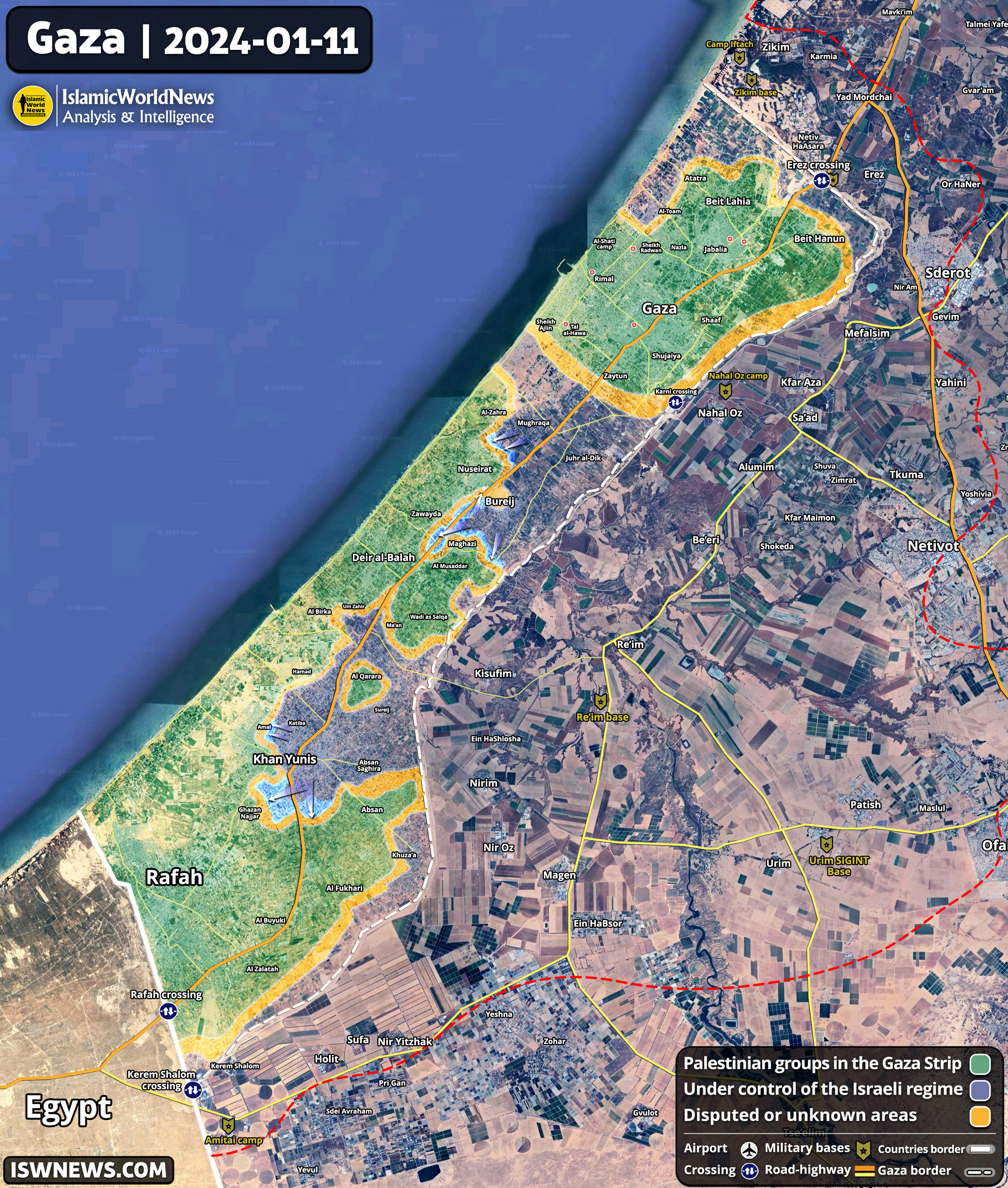
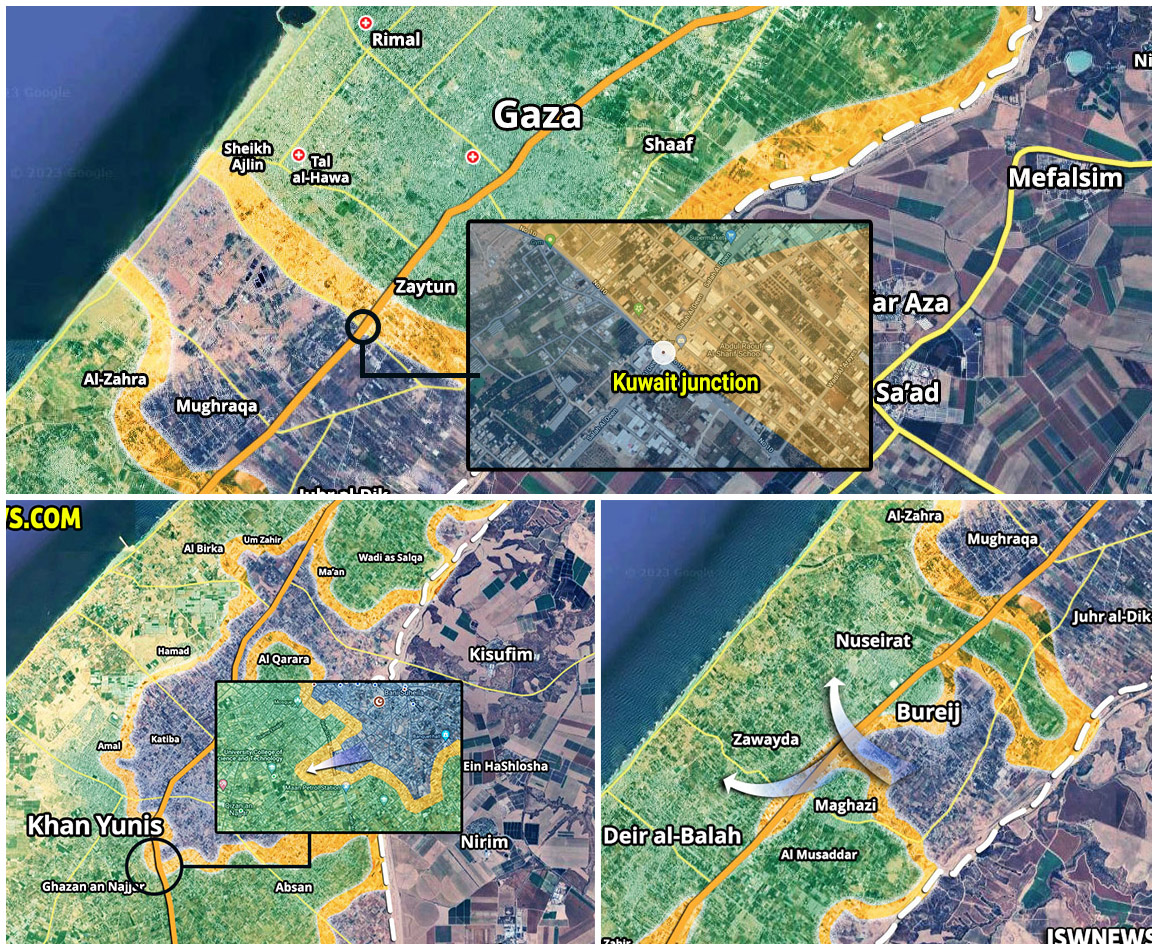
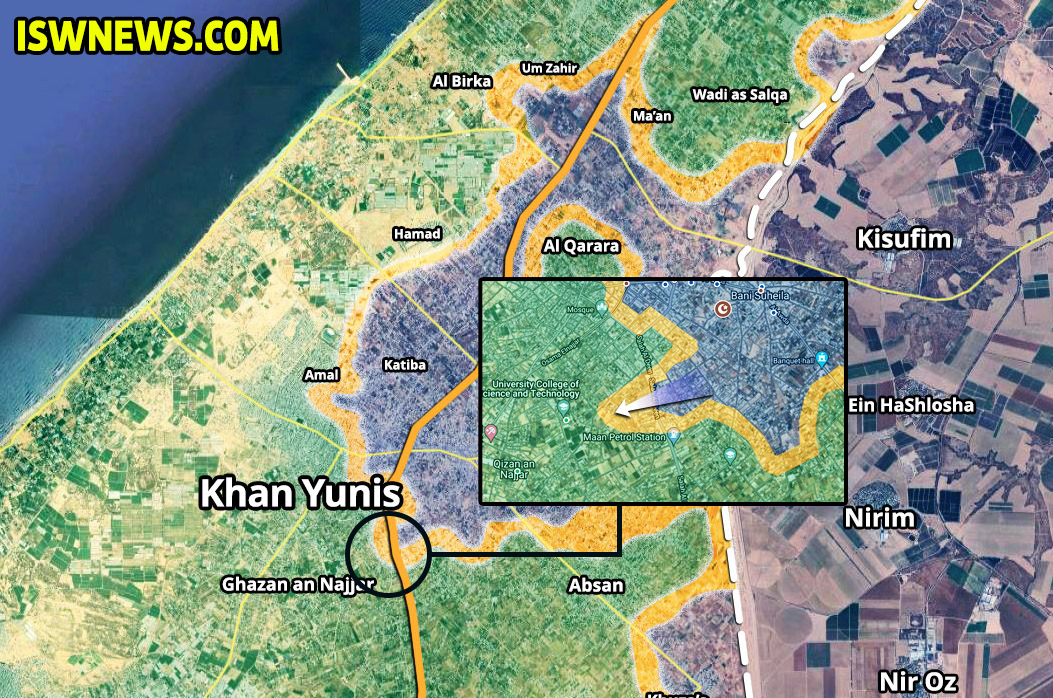
    In the south of the Gaza Strip, during the last four days, Israeli forces increased the extent of their advances in the south and southwest of the city of Khan Yunis. In this axis, Israeli forces have reached Ghazan al-Najjar and clashes continue around this village. By advancing on this axis, the Israeli army plans to encircle the city of Khan Yunis from the south and cut off the roads leading to Rafah.
    Clashes continue in the north of Khan Yunis. The Israeli forces have made advances in this direction in the last few days, but due to the urban context and the fierce resistance by the Palestinian fighters, the amount of advances is limited.

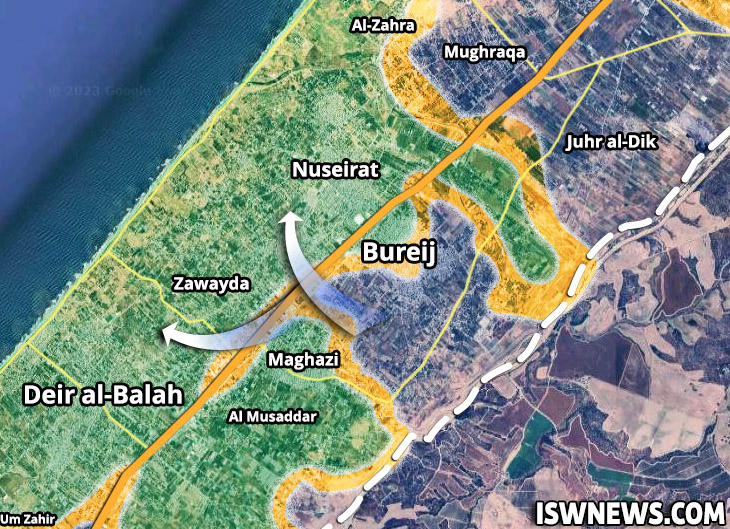
    In the middle of the Gaza Strip, Israeli forces are advancing slowly but steadily. On the Nuseirat front, Israeli forces slightly advanced in west of al-Maghraqa. On the al-Bureij front, Israeli forces have almost surrounded the al-Bureij camp and the fall of al-Bureij seems certain. On the al-Maghazi front, Israeli forces have advanced in the north and south of al-Maghazi and have bypassed this camp and are advancing on Salah al-Din road and its surrounding areas. The Juhr al-Dik front has obviously come under the control of the Israeli army after the recent advances of the Israeli army around al-Bureij and Nuseirat.

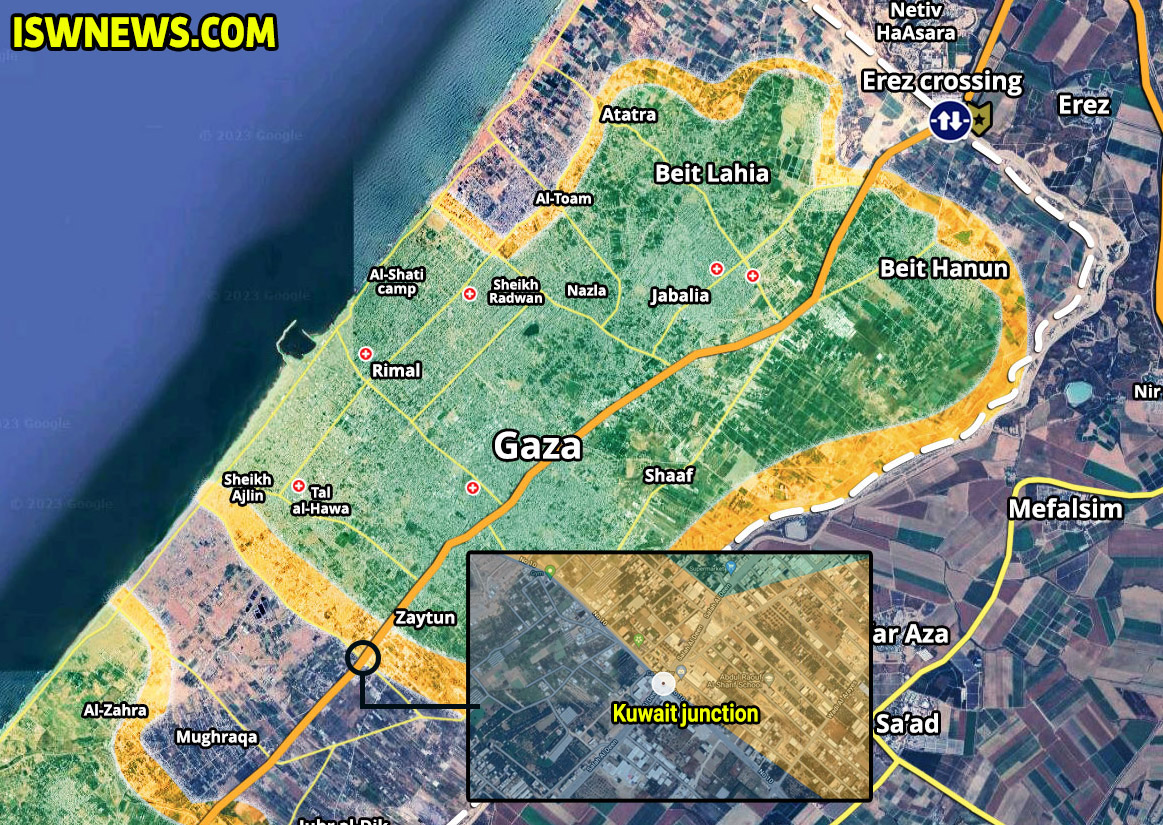
    In the north of the Gaza Strip, after the withdrawal of Israeli forces from inside the Gaza City to the outskirts of the city, there is no specific clashes in the north of the Gaza Strip. Only some sporadic clashes were reported in the outskirts of the city.

    Read more: Latest Updates On The Gaza Strip; 94th Day Of Fighting

    Interactive map of the Gaza Strip

    The latest military situation in the Gaza Strip – click to view in full size
  • Riyadh To Normalize Ties With Israel After Gaza War: Saudi Envoy

    Riyadh To Normalize Ties With Israel After Gaza War: Saudi Envoy

    Prince Khalid bin Bandar Al Sultan made the remarks in an interview with the BBC, claiming that the two countries were on the verge of an agreement before the seventh of October war; and despite the Undesirable Number of casualties in Gaza, Saudi Arabia still believes in establishing relations with Israel, but this should not be at the expense of the people of Palestine and needs to think about integrating Hamas into the future government of Palestine; so, one of these two (Palestine and Israel) will not be without the other. The order and method of managing it is what needs to be negotiated.

    It should be noted that the so-called normalization talks between Saudi Arabia and the Israeli regime were suspended by the Saudis seven days after the onset of the Gaza war on October 14, 2023.

    The so-called normalization talks between the Israeli regime and Arab countries began after the Abraham Accords were proposed by the then US President Donald Trump’s administration in 2020. These agreements led to the normalization of relations between the United Arab Emirates (UAE) and Bahrain with the Israeli regime after several months of negotiations, and then Morocco and Sudan joined this process. However, Saudi Arabia avoided announcing a normalization agreement with Israel for various reasons. Antony Blinken, the US Secretary of State, traveled to Riyadh yesterday to resume these talks, but Mohammed bin Salman’s response to this media request has not been announced.

    Saudi officials have previously stated that they are seeking peace and the formation of a country for the Palestinians in these negotiations. They initially said that normalizing relations with the Israeli regime was impossible without the formation of a Palestinian state, but Khalid bin Bandar speaks of reducing this condition to determining a roadmap and practical strategy for its formation and solving Hamas in Palestine or in other words, removing Hamas. Overall, the Saudis are trying to squeeze concession from the Israeli reimage by using the Palestinian card, and it remains to be seen how far their pressure against the United States and the regime will continue and what the Saudis will trade for the Palestinian cause!

  • Iranian Navy: The Offending US Oil Tanker Was Seized

    Iranian Navy: The Offending US Oil Tanker Was Seized

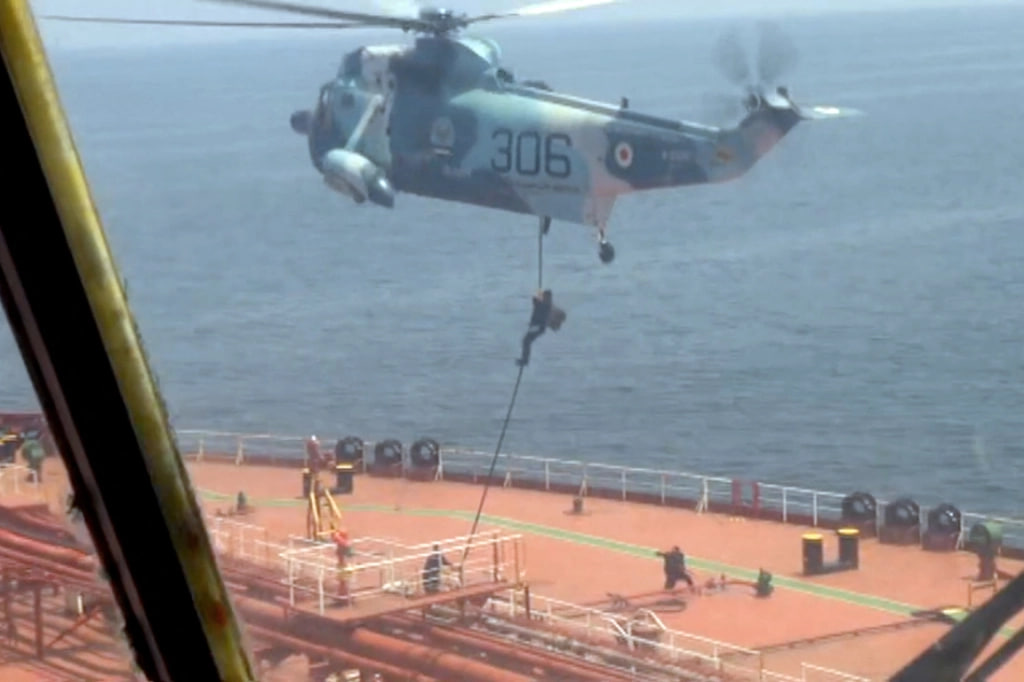
    On January 11, the Public Relations Department of the Navy for the Islamic Republic of Iran’s Army has officially declared the seizure of an American oil tanker in the waters off the Sea of Oman, citing a court order as the basis for the action.

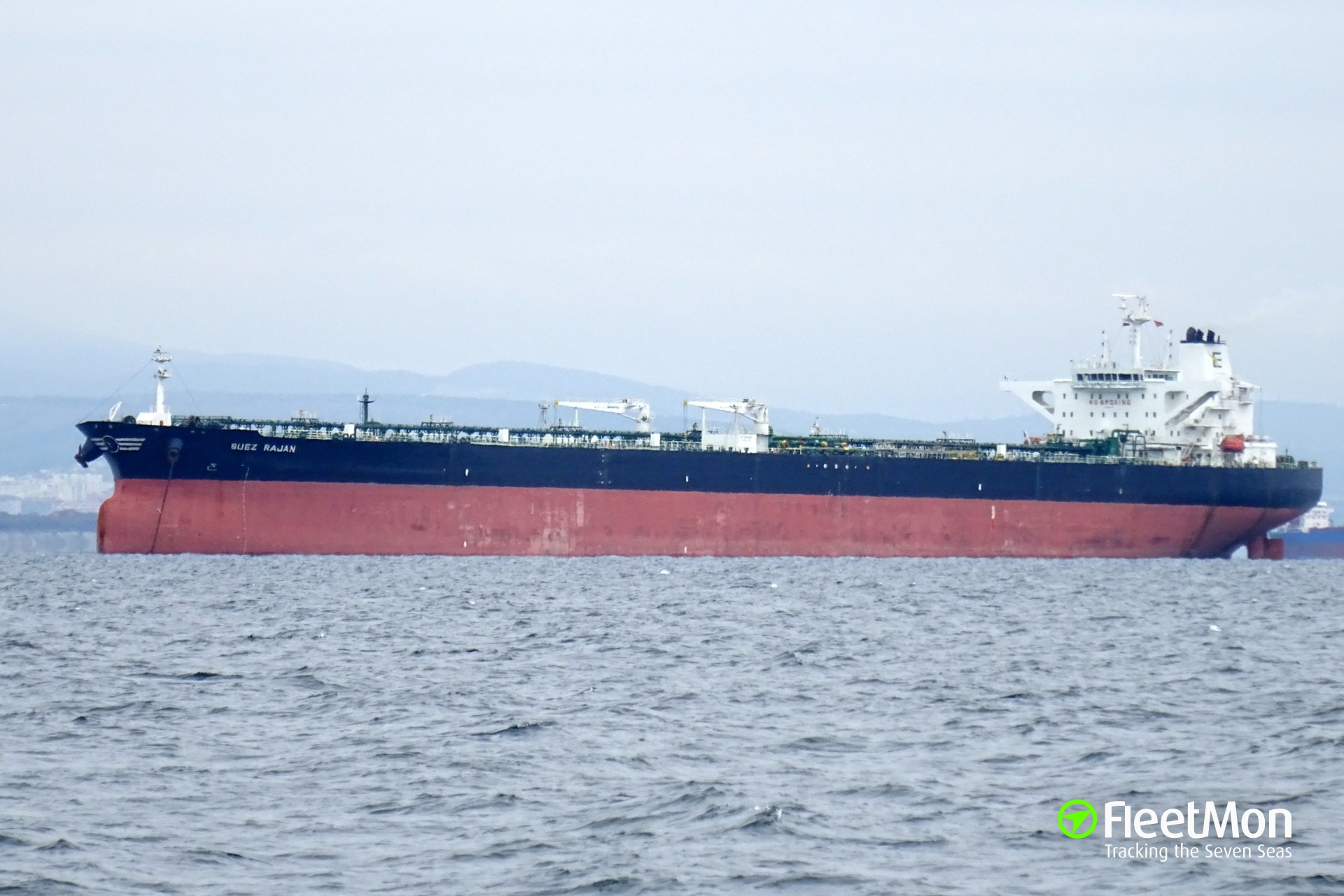
    Public Relations of the Islamic Republic of Iran Navy wrote in this statement: “Following the violation of the “Suez Rajan” ship last year and the theft of Iranian oil by the United States, the aforementioned oil tanker with the new name ST NIKOLAS was seized this morning. Last year, this oil tanker had stolen the cargo of oil belonging to the Islamic Republic of Iran under the guidance of the United States and transferred it to the ports of that country and provided it to the United States.
    This oil tanker that renamed to ST NIKOLAS, was carrying oil in the Oman Sea, which was seized this morning by a court order by the Navy of the Islamic Republic of Iran, in retaliation for oil theft by the American regime, and is being transferred to the ports of the Islamic Republic to be handed over to the authorities.”

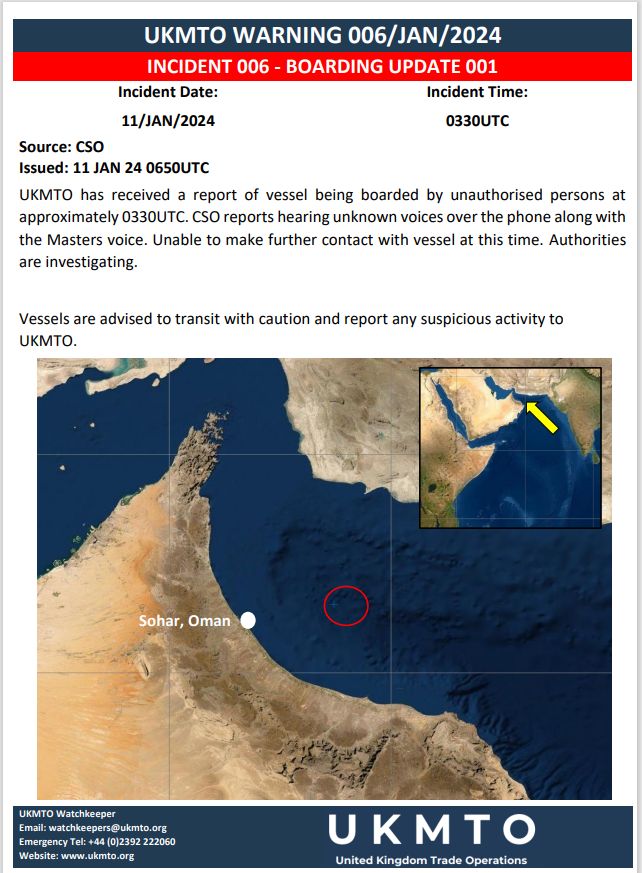
    It should be noted that the United Kingdom Maritime Trade Operations (UKMTO) reported the seizure of a ship off the eastern coast of Oman by six unknown persons this morning.

    Read more: Iran Seizes Oil Tanker; US-Stolen Crude Oil To Be Win Back!

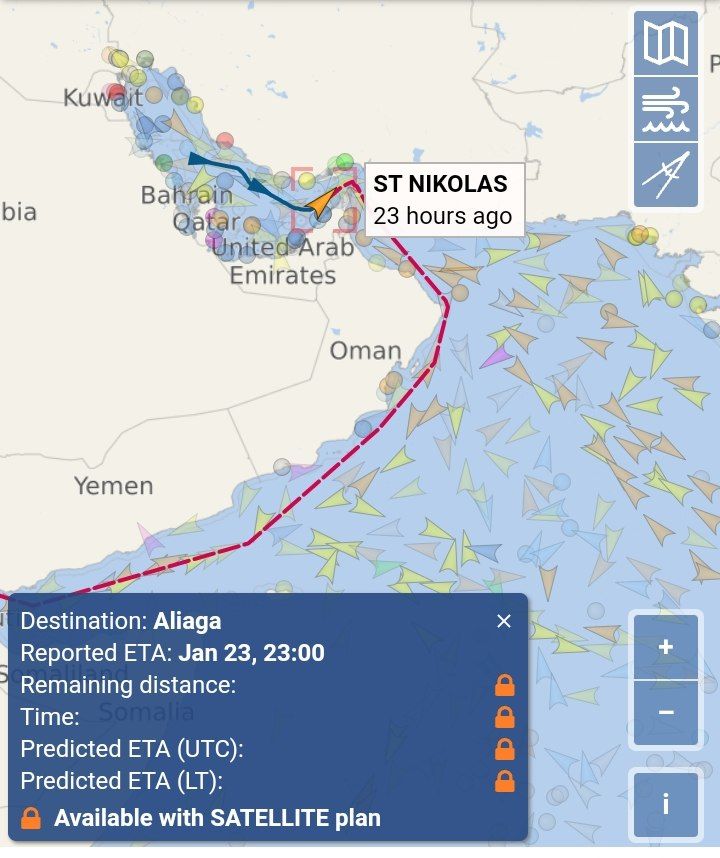
    As mentioned in the army’s statement, this ship is called ST NIKOLAS or formerly Suez Rajan, and was moving from the Iraqi port of Basra to Aliaga port on the western coast of Turkey. This tanker was seized by the United States on the coast of Singapore in an unknown date after February 2022 and its one million barrels of crude oil were sold; so, it was confiscated by the United States. Now, after a few months, the Iranian army trapped the same oil tanker and responded to the American organized piracy with a naval operation and returned the property of the Iranian nation.

    Image: Archive

  • Iran Seizes Oil Tanker; US-Stolen Crude Oil To Be Win Back!

    Iran Seizes Oil Tanker; US-Stolen Crude Oil To Be Win Back!

    The United Kingdom Maritime Trade Operations (UKMTO) reported that a security incident happened in the eastern Oman Sea, 50 miles east of Oman, on Thursday morning, and announced that unidentified individuals boarded a tanker and seized the vessel, and that this center cannot contact the crew of the ship.

    The most recent information shows that the name of the seized ship in the Oman Sea is ST NIKOLAS.

    According to the studies of the IWN, this oil tanker was moving from the Iraqi port of Basra to Aliaga port on the western coast of Turkey. This tanker was previously operating under the name of SUEZ RAJAN affiliated to the Marshall Islands flag and belonged to the Greek company Empire Navigation. This tanker was seized by the United States on the coast of Singapore in an unknown date after February 2022 and its one million barrels of crude oil were sold; so, it was confiscated by the United States. The US fined the Greek company $2.4 million for smuggling oil to Iran and put the tanker back into operation under the new name St Nikolas.

    It should be noted that after this incident, Iran had previously seized two oil tankers, Niovi and Advantage Sweet, in the Oman Sea. The seizure of the St Nikolas tanker, or Suez Rajan (if the news story is correct), can be interpreted as an operation to recover Iran’s property from the United States. Iran has recuperated its oil again!

  • Jaish Ul-Adl’s Terrorist Attack On Police Outpost in Rask County Repelled

    Jaish Ul-Adl’s Terrorist Attack On Police Outpost in Rask County Repelled

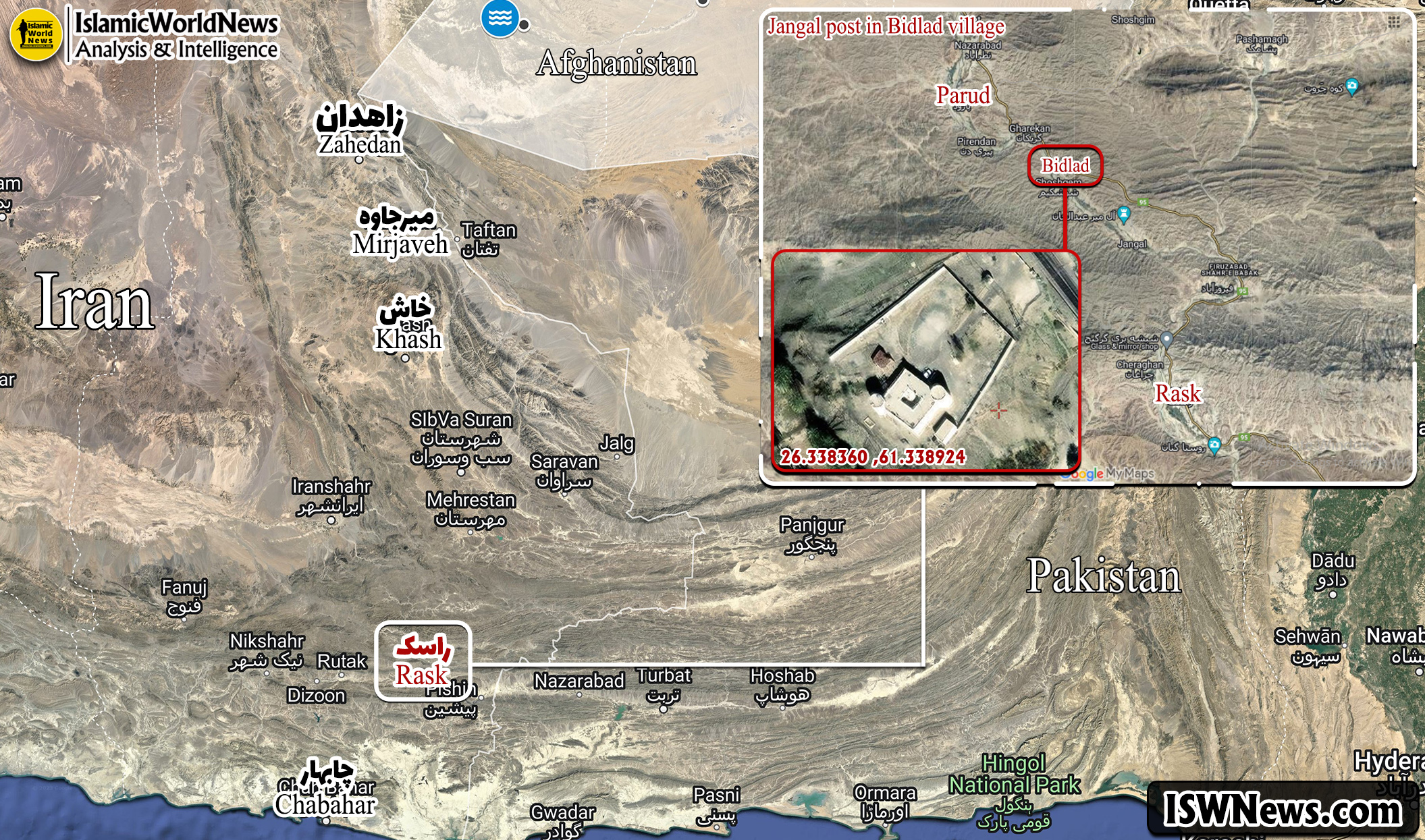
    Early this morning (on January 10), the Jaish al-Adl terrorist group attacked the Jangal outpost in the village of Bidlad in the Rask County, located in the south of Sistan and Baluchestan province. During the confrontation, Sergeant Amir-Hossein Hosseini, a law enforcement officer, was martyred.

    The terrorist group Jaish ul-Adl has officially claimed responsibility for this attack. According to Salim Kadkhoda, the governor of Rask, the confrontation began at 1 a.m. local time and lasted for three hours, ultimately ending with the terrorists’ retreat and the cessation of the confrontation. The police announced that their forces continue efforts to arrest the gunmen who perpetrated the terrorist attack.

    Martyr Sergeant Amir-Hossein Hosseini

    Prior to this attack, in recent days, one of the armed criminals and a key supporter of terrorist groups in southeastern Iran named Akram Naroui was identified and killed by security and intelligence forces in the Bampur County of Sistan and Baluchestan province, when he was attempting to flee. The fugitive was involved in a recent attack on the police headquarters in Rask city, as well as the assassination of two law enforcement personnel in February of last year.

    The recent activities and movements of the terrorist group Jaish ul-Adl in Sistan and Baluchestan province, as well as the terrorist attacks by ISIS in Kerman city, have coincided with the confrontations of resistance groups against the Israeli regime and the United States. According to several experts, these movements are undoubtedly being carried out with the support of the US and Israeli intelligence and security organizations, with the aim of exerting pressure on the Islamic Republic of Iran.

    Read more: Terrorist Attack On Police Station In Southeast Iran Left 19 Martyrs Or Injured

    Jangal outpost in the village of Bidlad in the Rask County, located in the south of Sistan and Baluchestan province
  • Military Knowledge: Sa’ar 6-Class Corvette

    Military Knowledge: Sa’ar 6-Class Corvette

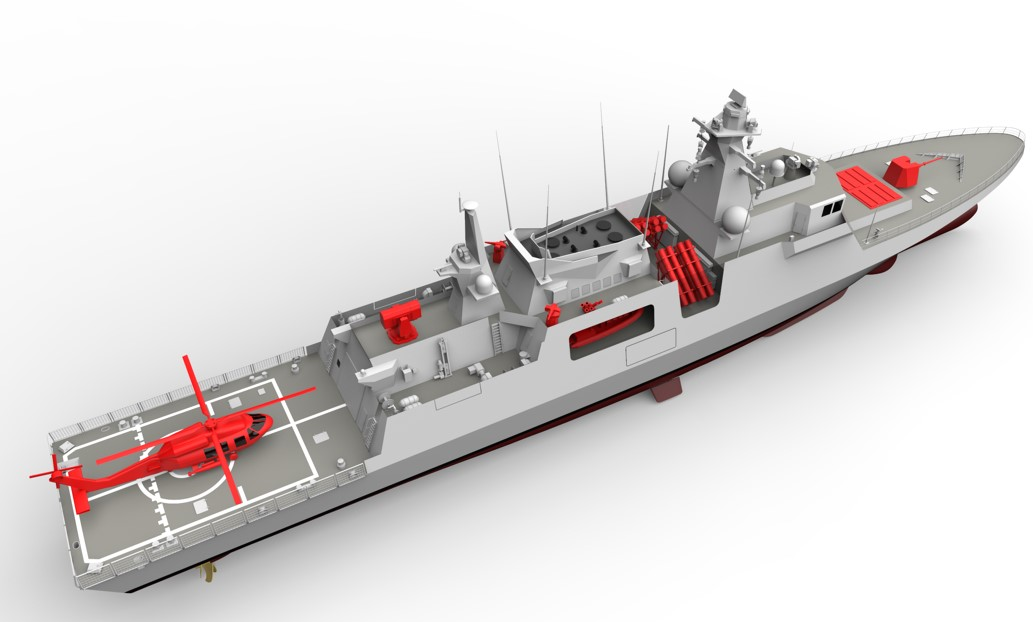
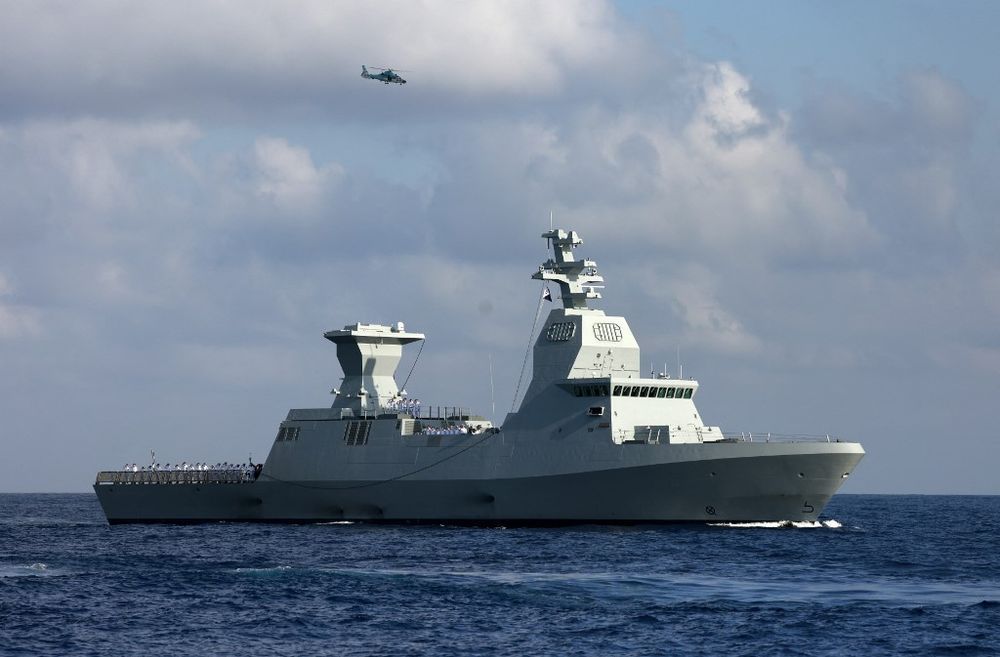
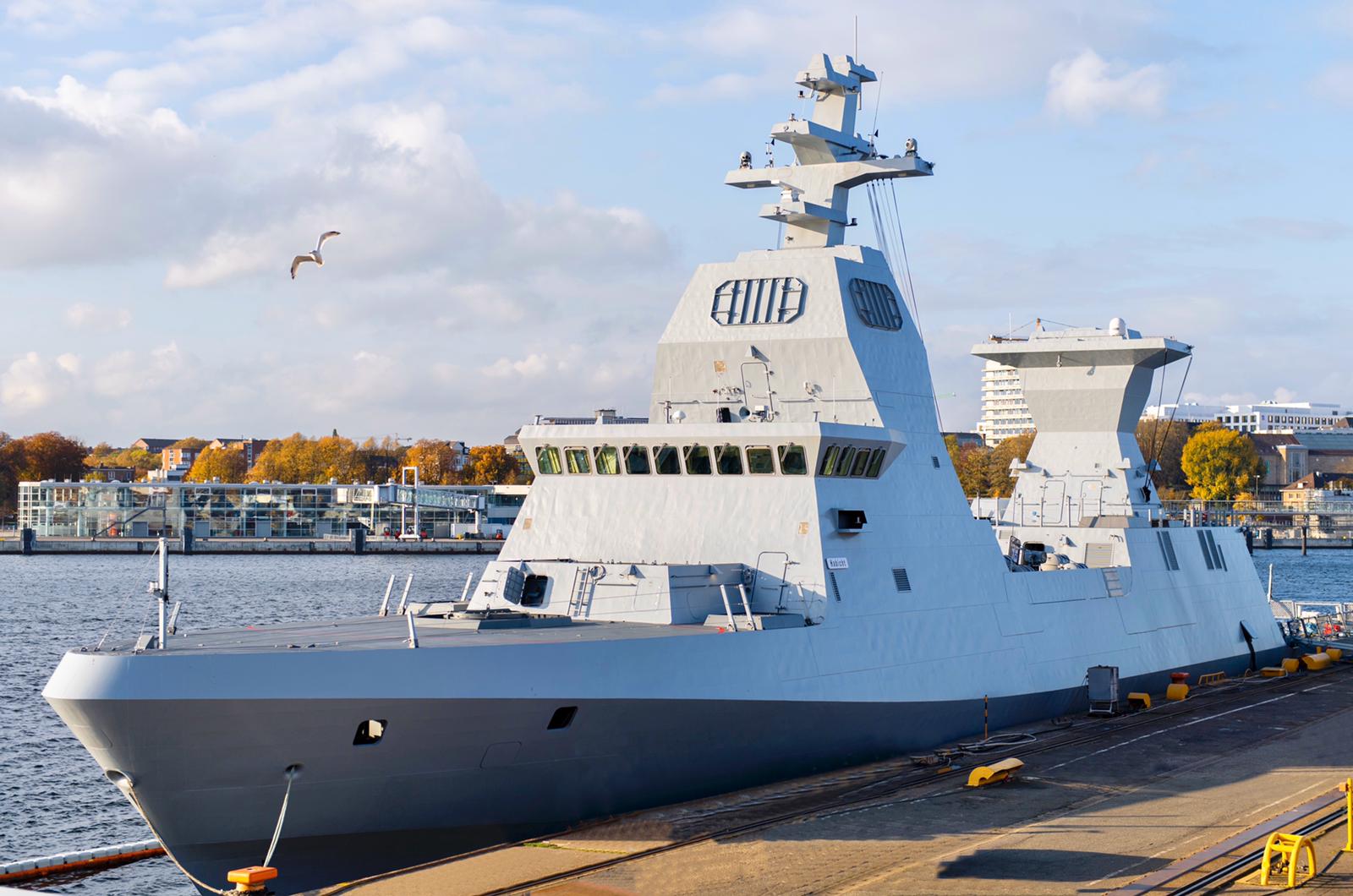
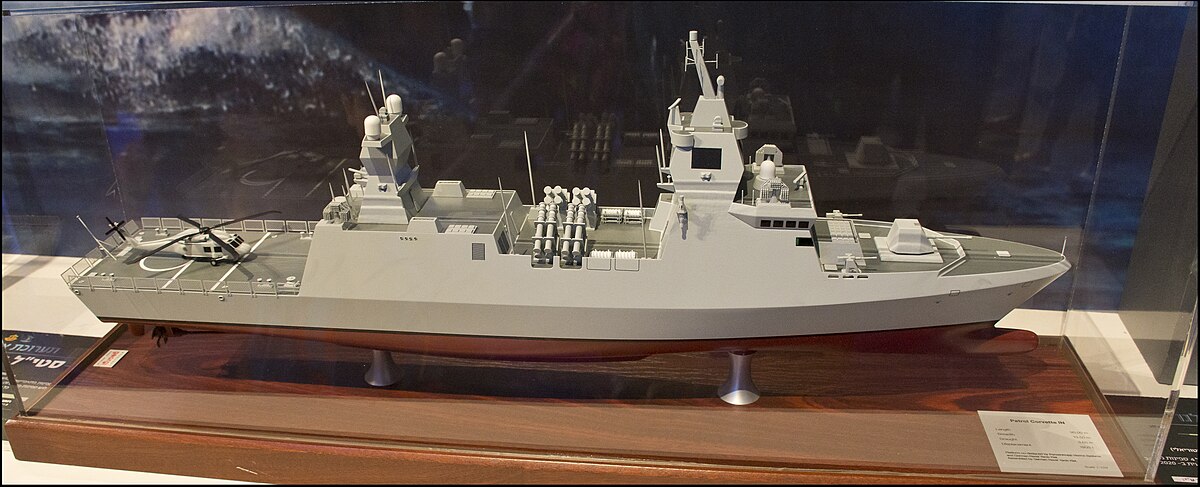
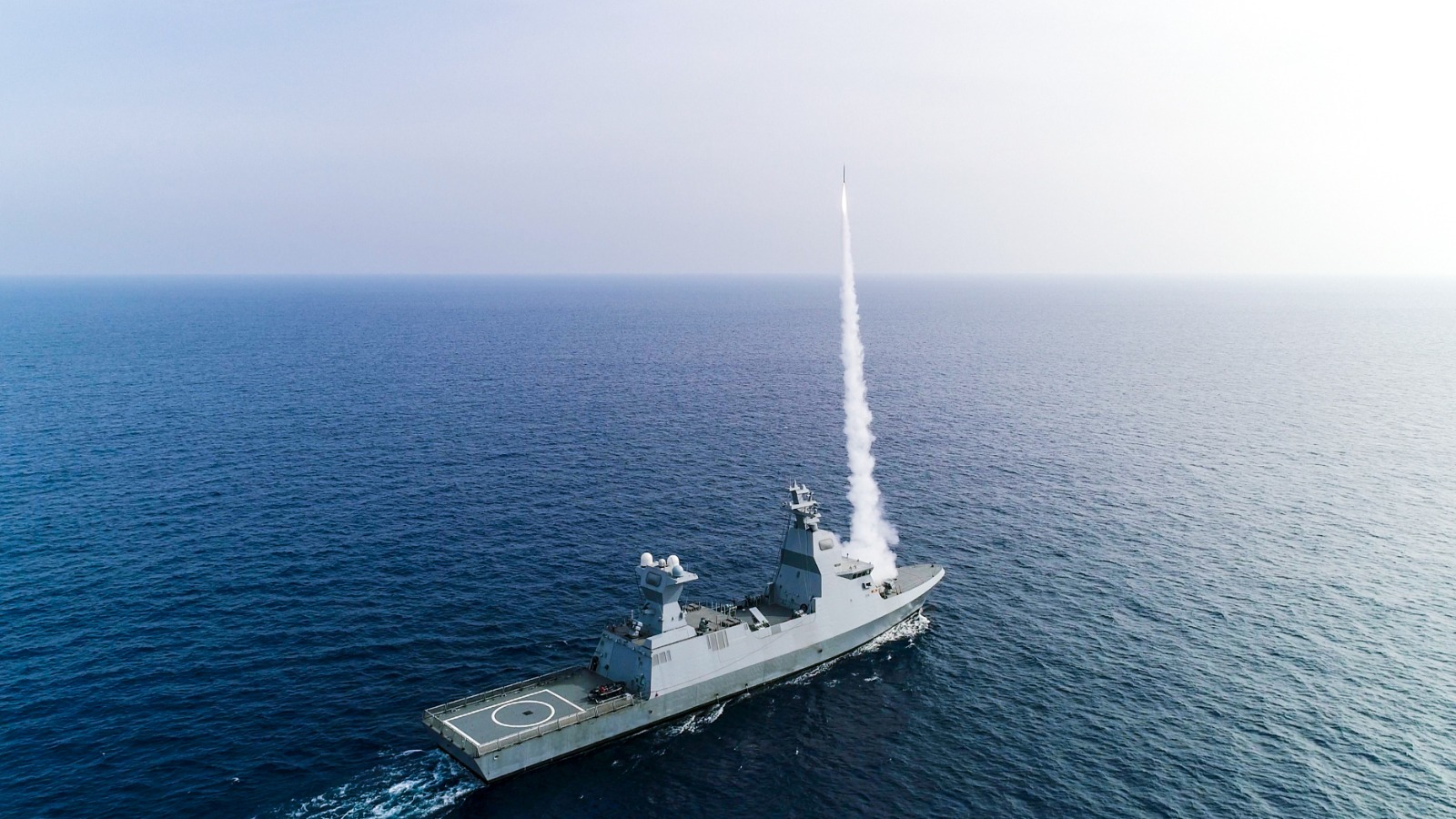
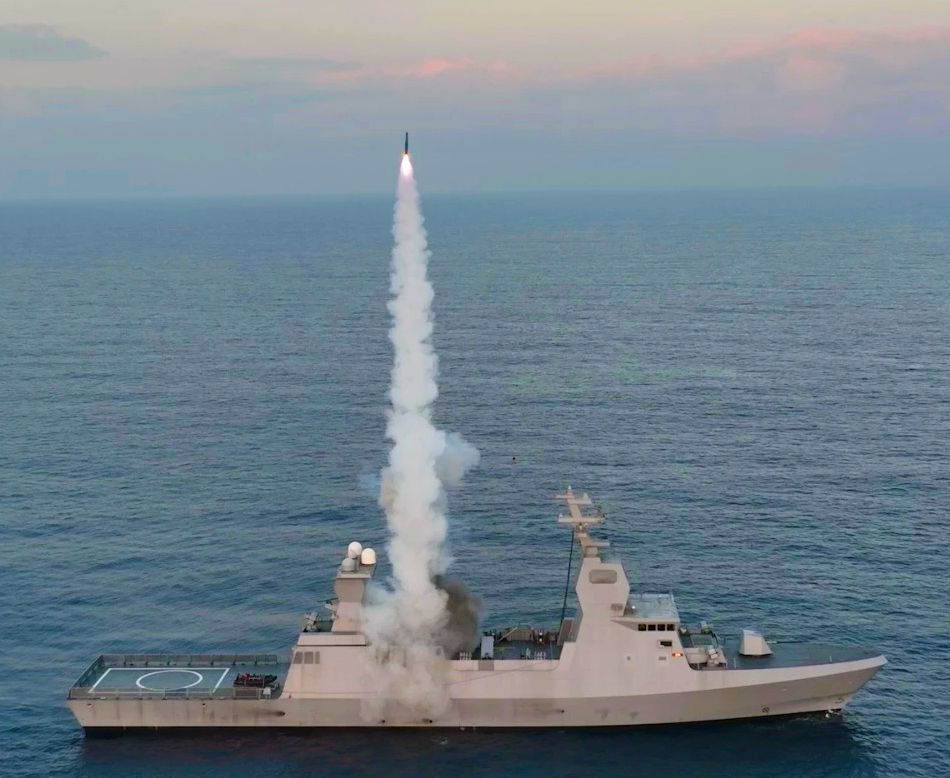
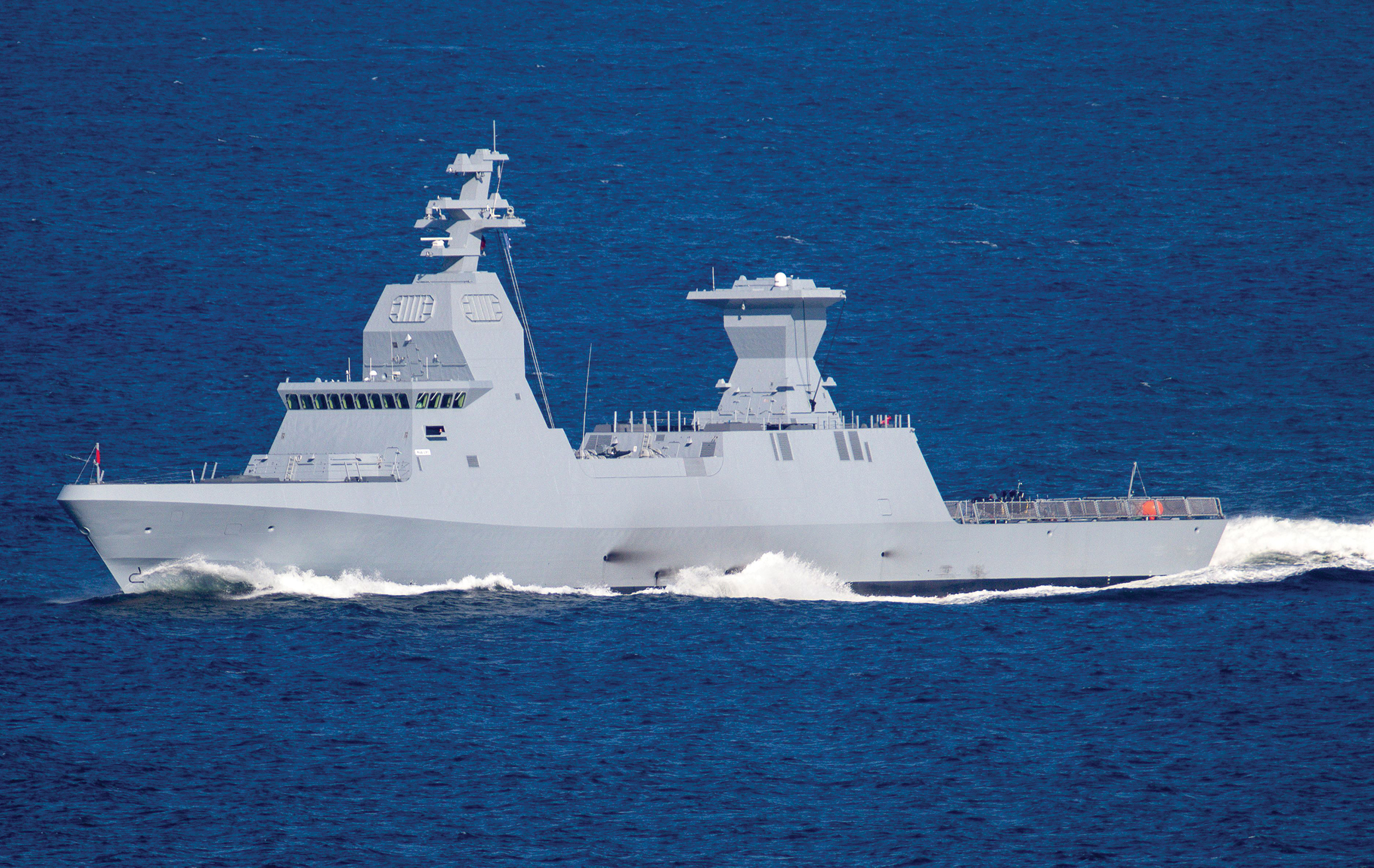
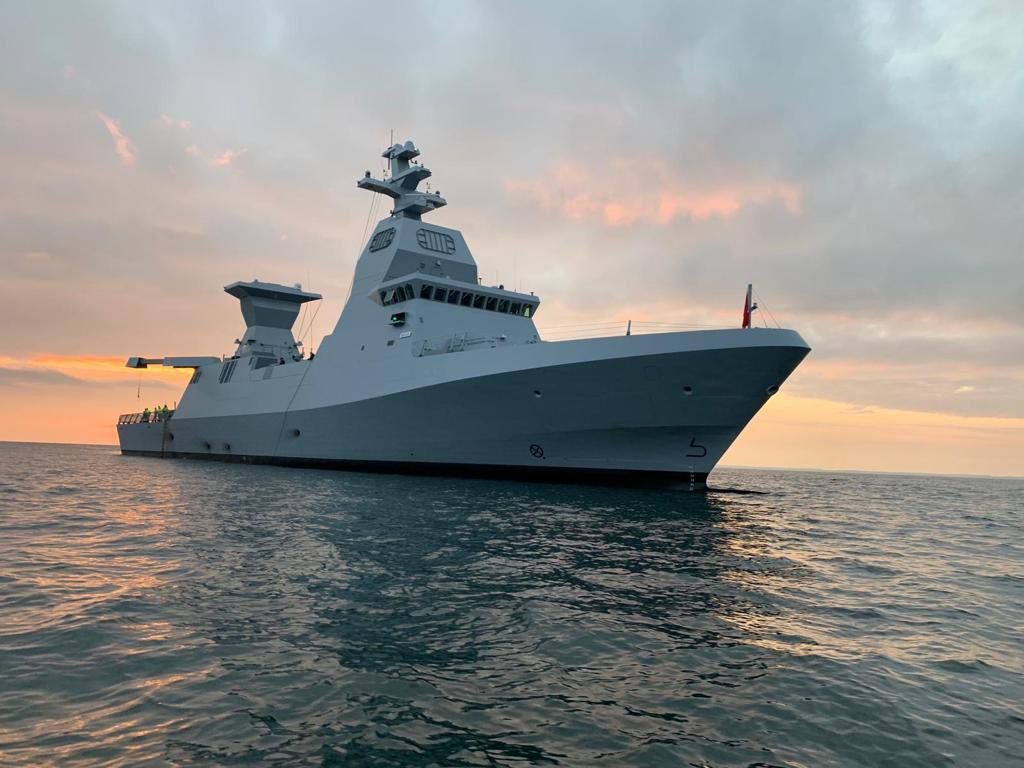
    In 2015, the Israeli army ordered four Sa’ar-6 warships to Germany. Although this ship is generally known in the world as an Israeli warship, the Saar-6 class was built in Germany by the German company ThyssenKrupp Marine Systems based on the design of the German Braunschweig class warship. However, to adapt Israeli systems and missiles such as Barak-8 and the Iron Dome defense system (marine version), changes have been made on this corvette, and this part was done by Israel. It is said that the Israeli company Elbit Systems has been awarded the contract to design and build the electronic warfare suites for the ships.

    In 2020, the first Saar 6 class warship named Magen was delivered to the Israeli Navy. Three more corvettes, OZ, Atzmaut and Nitzachon, were delivered during 2021 but were not operational. These four warships entered the service of the Israeli navy until 2023 and after the completion of various parts. Currently, these corvettes are the largest and most equipped warships in the service of the Israeli navy.

    It should be noted that the Sa’ar 6 corvettes will complement the old Sa’ar 5-class corvettes. Sa’ar 5 corvettes have also been built in the United States of America in the past years on the order of the Israeli regime. Sa’ar 6 corvettes are larger than Sa’ar 5 corvettes and carry more missiles. Also, the radar cross section of Sa’ar 6 has been reduced.

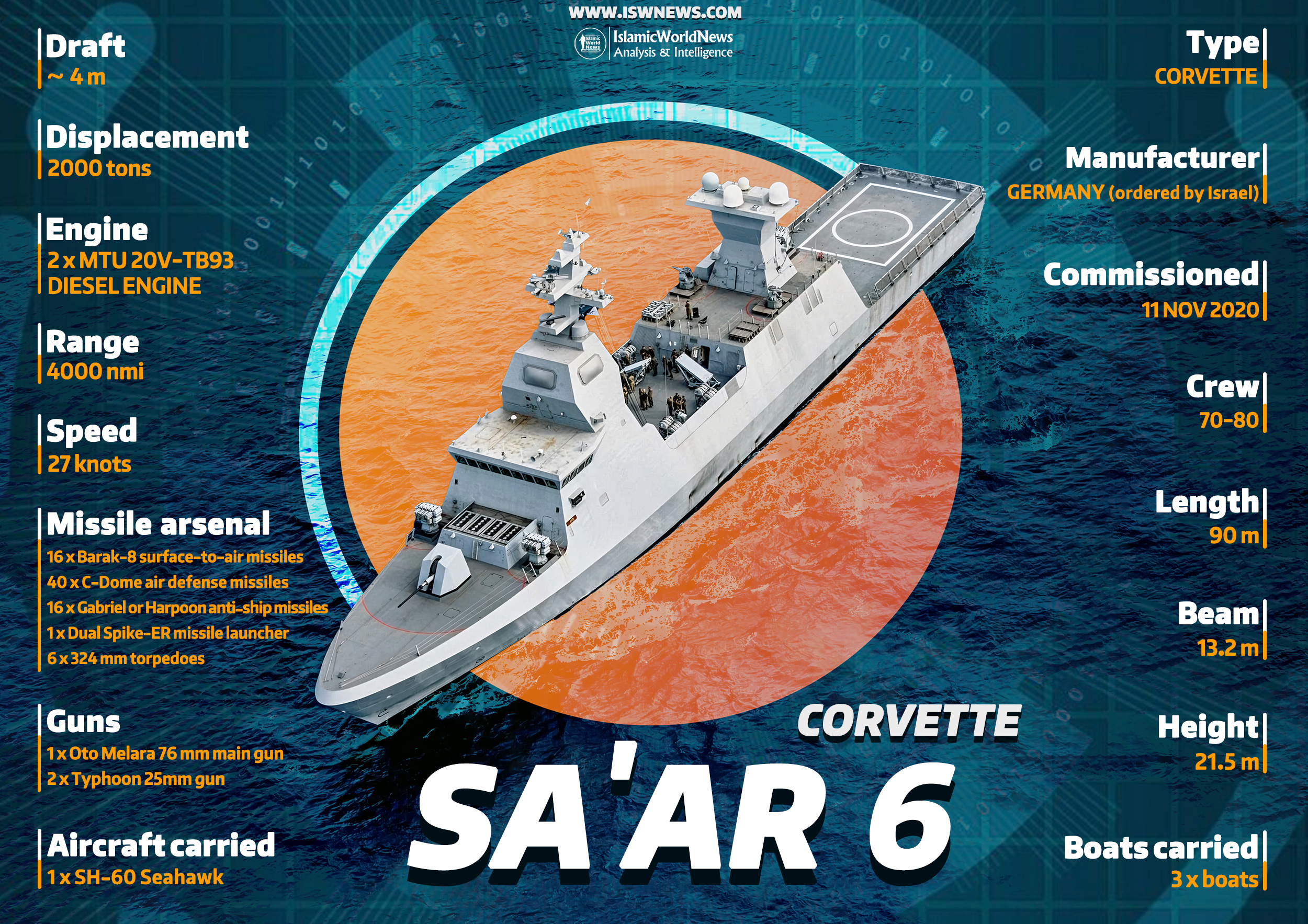
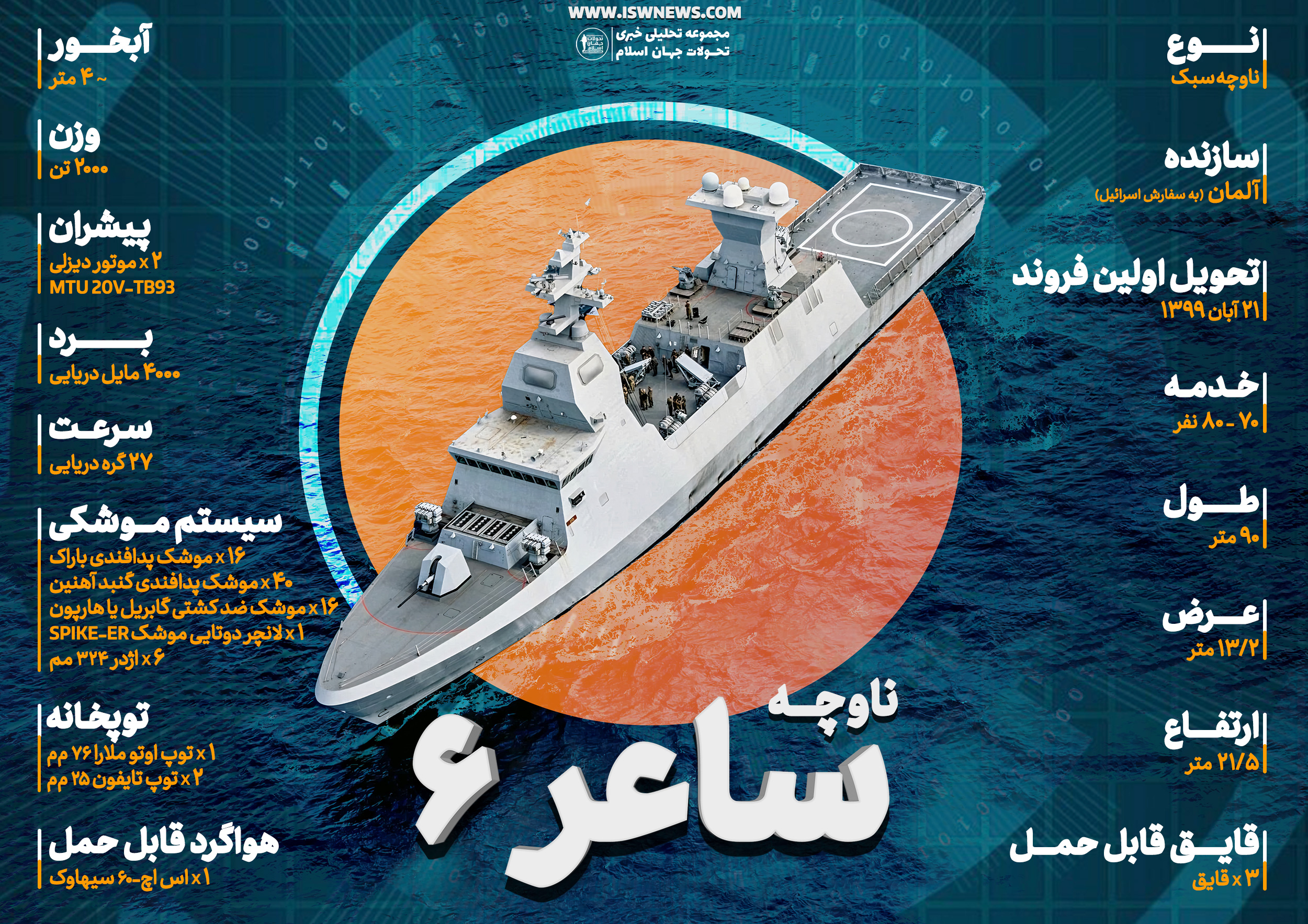
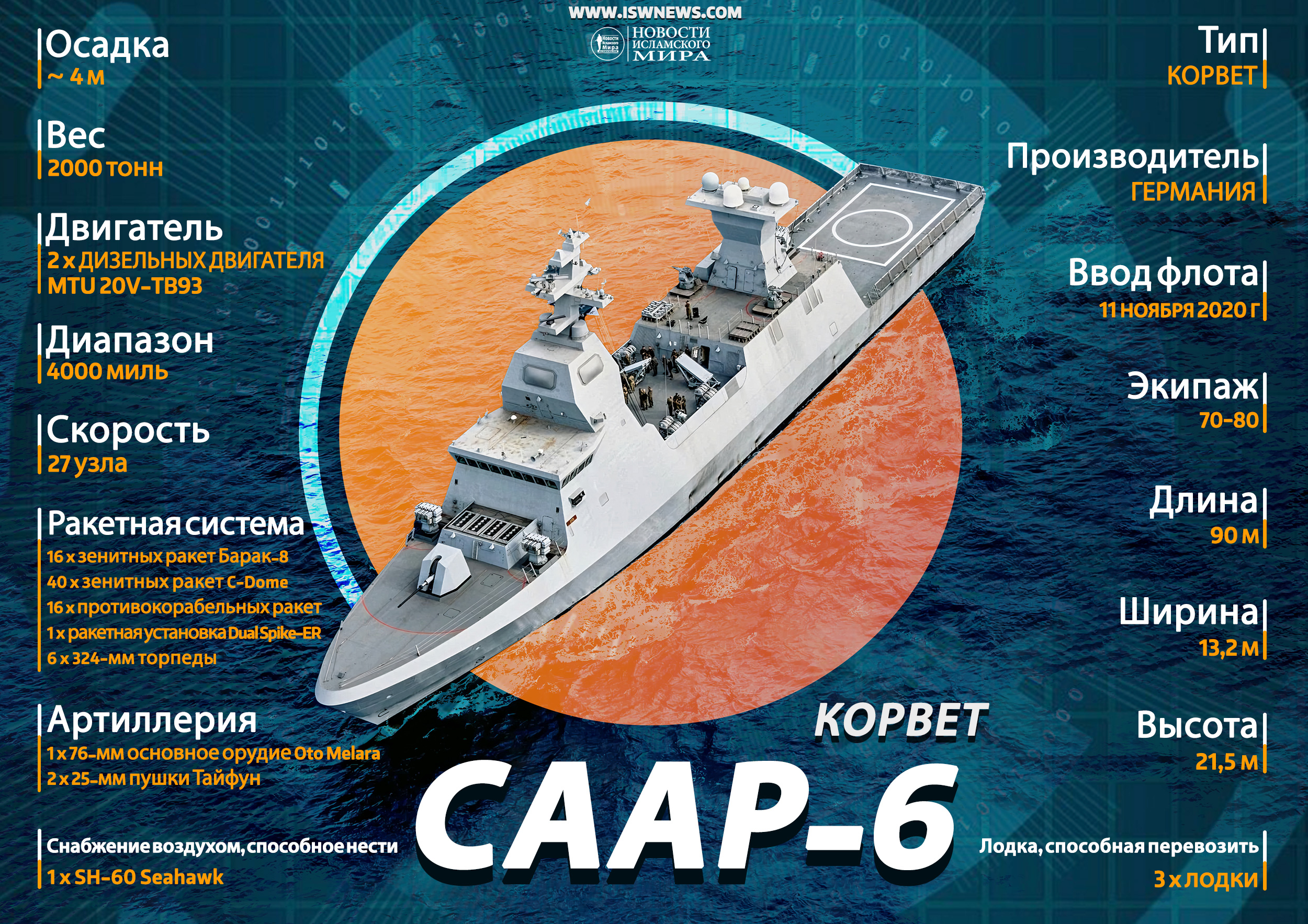
    Saar-6 corvette is 90 meters long, 13.2 meters wide (beam) and 21.5 meters high. Also, the displacement of this corvette is about 2000 tons and it has between 70 and 80 crew members.

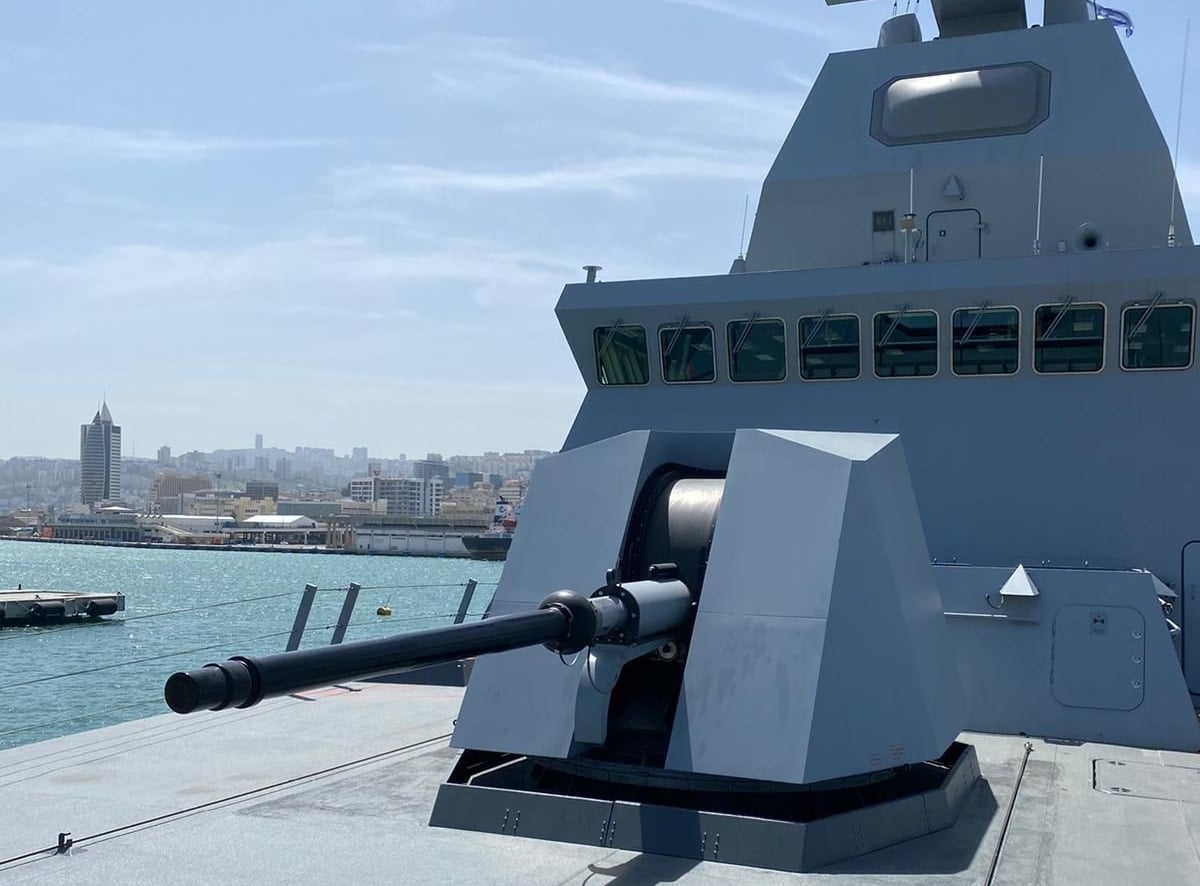
    Sa’ar 6 corvettes are armed with one Italian Oto Melara 76 mm cannon and two Typhoon 25 mm remote-controlled cannons. The Oto Melara cannon can engage surface targets, warships, air targets, and even missiles approaching the ship.

    76 mm Oto Melara cannon

    Sa’ar 6 is equipped with 16 Barak-8 air defense missiles LRAD version with a range of 70 km, 40 Iron Dome air defense missiles (C-Dome), 16 Israeli Gabriel Mark 6 anti-ship missiles with a range of 400 km or American Harpoon Block 2 with a range of 124 km. Also, a dual Spike-ER missile launcher and two 324 mm torpedo launchers are available in this vessel.

    According to the missile systems installed in this warship, it can be seen that Sa’ar 6 is a defensive warship and is mostly used to protect other naval platforms or land installations against missile and air threats. Therefore, this warship will be used to perform maritime patrol duties to protect gas platforms, shipping lines and other strategic assets of the Israeli regime in the Mediterranean Sea and the Red Sea.

    The hangar and helicopter deck at the stern can be used to accommodate a medium multi-mission maritime helicopter such as SH-60 Seahawk.

    In terms of propulsion, Saar 6 light frigates use two MTU 20V 1163 TB93 diesel engines with a power of 9924 horsepower and a total of 19848 horsepower. With the help of these engines, Sa’ar 6 reaches a speed of 27 knots (50 km/h) and can travel up to 4,000 nautical miles (7,400 km).

    In terms of radar, the ELM-2248 Multi-Function Surveillance, Track And Guidance Radar (MF-STAR) multi-function active electronically scanned array (AESA) radar on board the Saar-6-class corvettes will track enemy targets under severe environmental / jamming conditions with a 360° coverage. The maximum range of this radar is up to 450 km.

    Multi-Function Surveillance, Track And Guidance Radar

    Sa’ar 6-class corvette specifications:
    Type: Corvette
    Manufacturer: Germany (ordered by Israel)
    Commissioned: 11 November 2020
    Crew: 70-80
    Length: 90 meters
    Beam: 13.2 meters
    Height: 21.5 meters
    Draft: ~ 4 meters
    Displacement: 2000 tons
    Engine: 2 x MTU 20V 1163 TB93 diesel engine with a power of 9924 hp (total 19848 hp)
    Range: 4000 nautical miles (7400 km)
    Speed: 27 knots (50 km/h)
    Missile arsenal:
    16 x Barak-8 surface-to-air missiles
    40 x C-Dome air defense missiles
    16 x Gabriel or Harpoon anti-ship missiles
    1 x Dual Spike-ER missile launcher
    6 x 324 mm torpedoes
    Guns:
    1 x Oto Melara 76 mm main gun
    2 x Typhoon 25mm gun
    Aircraft carried: 1 x SH-60 Seahawk
    Boats carried: 3 x speedboats or drone boats

    Sa’ar 6 corvette – click to view full size

    Infographics of Sa’ar 6-class corvette in Russian and Farsi:

    Sources:
    Sa’ar 6-class corvette
    Sa’ar 6 class
    EL/M-2248 MF-STAR
    Sa’ar 6 corvette of Israeli Navy
    Sa’ar 6 Class Corvettes

    MTU 20V-1163-TB93 9924 HP

  • US Military Claims Combat Against Ansar Allah’s Complex Attack In Red Sea

    US Military Claims Combat Against Ansar Allah’s Complex Attack In Red Sea

    According to the CENTCOM, the Ansar Allah movement attacked heavily and intricately with the use of several suicide drones and 18 cruise and anti-ship missiles on US and British ships in the southern Red Sea on Tuesday night, January 9.

    Based on statistics announced by the US Army, this is the 26th attack of its kind by Yemeni armed forces on shipping lines in the Red Sea.

    In this regard, the United States has presented a draft resolution to the United Nations Security Council condemning Yemen’s attacks on Israeli shipping and the Israel-bound vessels. The resolution calls on the Ansar Allah movement to stop its attacks against what the United States calls obstruction of global trade and international shipping as soon as possible. The draft resolution also emphasizes the prevention of further tensions in the Red Sea.

    Yemeni officials had previously announced that the naval operations of the Yemeni armed forces in the Arabian Sea and the Red Sea are to support the people and resistance groups of Palestine, and as long as the war against the Israeli regime continues, they will attack the interests of the Israeli regime and the Israel-bound vessels.

    The escalation of tensions between the Yemeni armed forces and the US-led coalition (Operation Prosperity Guardian) occurred after US helicopters attacked Yemeni navy boats in an operation to prevent the movement of the Maersk Hangzhou ship, killing 10 Yemeni soldiers. Yemeni government officials and the Ansar Allah movement have emphasized responding to this criminal attack.

    An hour ago, the Yemeni Armed Forces issued a statement and took responsibility for the attacks. In the statement of Brigadier General Yahya Saree, the spokesman of the Yemeni armed forces, it is stated:

    “The naval, missile and drone forces of the Yemeni armed forces conducted a joint military operation with a large number of ballistic missiles, naval missiles and suicide drones against an American ship that supported the interests of the Zionist regime. This operation was carried out in response to the attack of American enemy forces on our navy. The Yemeni armed forces emphasize that they will not hesitate to properly deal with all hostile threats within the framework of the legitimate defense of the country and the people of Yemen. The Yemeni armed forces will continue to prevent the passage of Israeli ships and ships bound for occupied Palestinian ports in the Arab and Red Sea until the end of the aggression and the lifting of the blockade of our brothers in the Gaza Strip. The Yemeni Armed Forces declares its full protection of the continued traffic of foreign ships in the Red and Arabian seas to all destinations, except the occupied Palestinian ports.”

  • Latest Updates On The Gaza Strip; 94th Day Of Fighting

    Latest Updates On The Gaza Strip; 94th Day Of Fighting

    Currently, the central and southern areas of the Gaza Strip are the most active fronts in the Gaza Strip.

    In the south of the Gaza Strip, clashes continued in the center and south of the city of Khan Yunis. According to field information, the Zionist occupying forces have destroyed the agricultural lands and the houses of the citizens in front of the Khan Younis Faculty of Science and Technology. This shows that the Israeli forces are advancing in the southwest of Khan Yunis city.

    The military situation in the south of the Gaza Strip and Khan Yunis

    In the middle of the Gaza Strip, clashes continued in Al-Bureij and Al-Maghazi and around Nuseirat as well as at the entrance of Al-Zawayda. Israeli artillery and fighter jets are severely targeting Al-Zawayda area. By putting pressure on Al-Zawayda and advancing on this axis, the Israeli regime plans to surround Nuseirat and approach Deir al-Balah.

    The military situation in the center of the Gaza Strip

    In the north of the Gaza Strip, after the withdrawal of Israeli forces from the inner areas of the city, there is no specific ground conflict in Gaza City and the Israeli regime has turned to airstrikes again. However, today clashes were reported near Kuwait junction in the southern suburbs of Al-Zaytoun neighborhood. Kuwait junction is located on the 10th street in the contact line between the Israeli and Palestinian forces. Earlier we announced that the Israeli forces have retreated to behind the 10th street in south of Gaza City. In fact, clashes around Kuwait junction once again confirms the correctness of the IWN map regarding the withdrawal of Israeli forces from the north of the Gaza Strip.

    It is also said that the Israeli regime has completed its withdrawal from the northern areas of the Gaza Strip. If this claim is true, the few remaining areas in the north of Gaza should also be cleared of the Zionists.

    Read more: Latest Military Situation In Gaza Strip; 93rd Day Of Fighting – Israeli Forces Retreats From Northern Gaza

    The military situation in the north of the Gaza Strip

    Interactive map of the Gaza Strip

  • Jordan Carries Out Airstrike On Southern Syria For 2nd Consecutive Time In Past Week!

    Jordan Carries Out Airstrike On Southern Syria For 2nd Consecutive Time In Past Week!

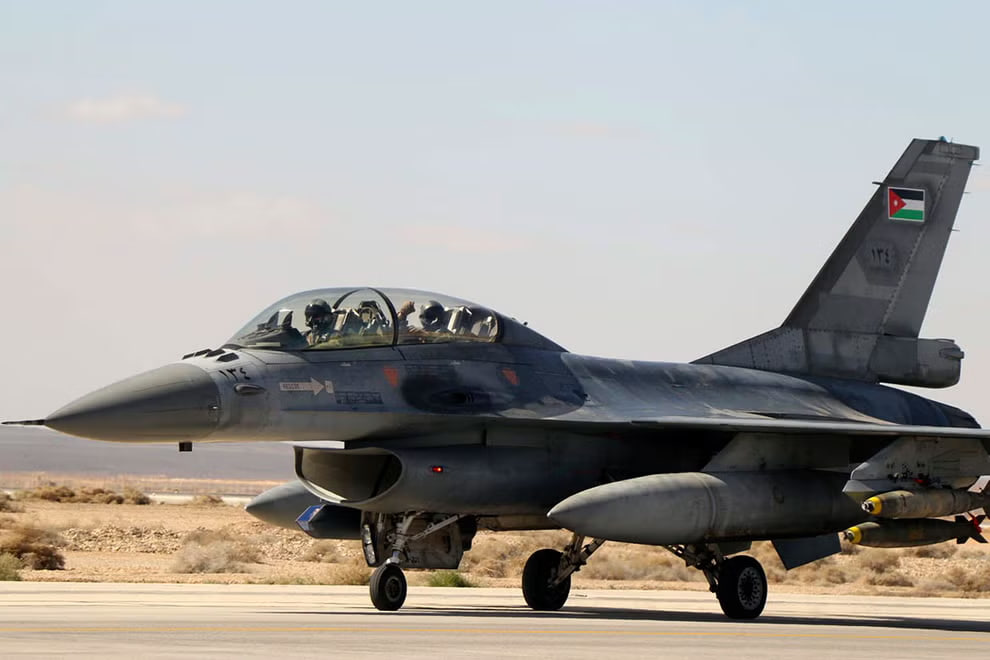
    It is reported that as a result of this attack, three individuals, including a drug smuggler, were killed. Further details have not been disclosed regarding this matter. This is the second airstrike by the Jordanian army in southern Syria in the past week. Before the airstrike, positions in southern Syria were targeted by the Jordanian fighter jets on January 5.

    Prior to this attack, a military source in the Central Command of the Jordanian Armed Forces (JAF) had announced that the army of this Arab country has been engaged in armed clashes with large groups of smugglers on the northern borders since early Saturday morning.

    Under the pretext of fighting drug smugglers, the Jordanian army carried out attacks on positions in southern Syria over the course of recent months, resulting in the loss of several civilians and injuries to dozens of others.

    Media outlets, which are involved in advocating terrorist groups and supported by the Western states, present these groups as connected to the Syrian government and the Resistance, but so far, they have not provided credible evidence to prove their claims concerning the existence of any connection between these groups and the Syrian government.

  • ISIS Attack On Syrian Military Bus Leaves 23 Martyrs Or Wounded In Homs Desert

    ISIS Attack On Syrian Military Bus Leaves 23 Martyrs Or Wounded In Homs Desert

    This attack took place three days after the Syrian army’s operation against ISIS hideouts in the Syrian desert. This is the second attack by ISIS terrorists on the Syrian army in the past 10 days.

    On January 1, attacks against Syrian troops by ISIS terrorists resulted in the martyrdom of 9 soldiers of the Syrian army and its allied forces.

    Following the failure of the US regime’s airstrikes against the Resistance to stop missile and rocket attacks on its bases, the activities of ISIS terrorist groups in the region have recently intensified. The study of the trend of ISIS attacks and movements indicates that the terrorist group’s assassination machine may have been activated at the request of its employers, namely the US and Israeli intelligence services. The main objective of these attacks is to distract the Resistance and undermine its focus on the battle against the Israeli regime.