According to a Syrian military source, “at around 23:05 (local time) on Monday, the Zionist enemy attacked targets in the suburbs of Damascus with several missiles from the occupied Golan; Air defense systems shot down some of the missiles. This attack resulted in the wounding of a Syrian soldier and material damage.”
It is worth mentioning that on August 7, the Israeli regime’s army fighter jets fired several missiles at targets on the outskirts of Damascus, which left four Syrian soldiers killed and four others wounded.
At least one Israeli settler was killed and four others were injured in the incident. The shooting took place in southern Hebron from inside a car, and the attackers fled the scene.
Following the attack, Palestinian resistance movement Hamas spokesman Hazem Qassem congratulated the operation’s success and emphasized that Palestinian resistance succeeded in dealing a strong blow to the enemy once again.
It should be mentioned that two days earlier, two Palestinian youths targeted an Israeli car wash in the Huwara town in the northern West Bank on August 19, killing two other Zionists.
Attack on Israeli car wash in Huwara
In recent weeks, anti-Israeli operations have intensified in the West Bank, a development that has left Israeli leaders more confused than ever, coinciding with widespread internal protests and unrest, which rattled the Israeli regime. As some Israeli experts acknowledged, the regime is on the verge of complete collapse.
At the beginning of the delegation’s work, wreaths and flowers were laid at the Tomb of the Unknown Soldier in Alexander Garden.
The official part of the bilateral talks took place at the Command of Land Forces, where the Iranian military delegation met with Oleg Salyukov, the commander-in-chief of the Russian ground forces. Sides discussed issues of military cooperation and interaction aimed at implementing projects, the goals of which were improvement of the combat readiness of the armed forces of both countries.
“Iran is considered by the Russian Federation as one of the key states in the Middle East and Iran is Russia’s strategic partner, and constant intensive political dialogue is a characteristic feature of the current stage of our partnership,”‘ stressed Commander-in-Chief of the Russian Armed Forces Land Forces General Oleg Salyukov.
The parties reached agreements on further enhancing cooperation between the land forces in various fields. Also, during this trip, the Iranian delegation is going to visit the military training institutes of the Russian Ground Force and defense industry companies.
During the visit, the delegation is to visit military educational institutions of Russian Land Forces and defence industry enterprises.
History: In the Advanced Attack Helicopter (AAH) program, the United States Department of Defense wanted a helicopter with more firepower, performance and range than the AH1-Cobra, and the new helicopter should also be able to fly at a very low altitude (nap-of-the-earth). -NoE) as well. So the Apache helicopter was developed to replace the AH-1 Cobra helicopter.
Proposals were submitted by Bell, Boeing Vertol/Grumman team, Hughes, Lockheed, and Sikorsky. In July 1973, the U.S. Department of Defense selected finalists Bell and Hughes Aircraft’s Toolco Aircraft Division (later Hughes Helicopters).
Each company built prototype helicopters and went through a flight test program. Hughes’ Model 77/YAH-64A prototype first flew on 30 September 1975, while Bell’s Model 409/YAH-63A prototype first flew on 1 October 1975. After evaluating the test results, the Army selected Hughes’ YAH-64A over Bell’s YAH-63A in 1976. Reasons for selecting the YAH-64A included its more damage tolerant four-blade main rotor and the instability of the YAH-63’s tricycle landing gear arrangement.
YAH-63YAH-64A
The AH-64A then entered phase 2 of the AAH program under which three pre-production AH-64s would be built, additionally, the two YAH-64A flight prototypes and the ground test unit were upgraded to the same standard. Weapons and sensor systems were integrated and tested during this time, including the laser-guided AGM-114 Hellfire missile. Development of the Hellfire missile had begun in 1974, originally known by the name of Helicopter Launched, Fire and Forget Missile (‘Hellfire’ being a shortened acronym), for the purpose of arming helicopter platforms with an effective anti-tank missile.
In 1981, three pre-production AH-64As were handed over to the U.S. Army for Operational Test II. The Army testing was successful, but afterward it was decided to upgrade to the more powerful T700-GE-701 version of engine, rated at 1,690 shp (1,260 kW). The AH-64 was named the Apache in late 1981, following the tradition of naming Army helicopters after Native American tribes. It was approved for full-scale production in 1982. In 1983, the first production helicopter was rolled out at Hughes Helicopter’s facility at Mesa, Arizona.
YAH-64A equipped with a Hellfire missile
Hughes Helicopters was purchased by McDonnell Douglas for $470 million in 1984. The helicopter unit later became part of The Boeing Company with the merger of Boeing and McDonnell Douglas in August 1997. Today, MD Helicopters, a subsidiary of Boeing, is responsible for the production of AH-64 Apache helicopters.
Since 1984, some aerospace companies such as AgustaWestland have produced a number of parts for the Apache. Teledyne Ryan Aeronautical was the manufacturer of the Apache fuselage, which was handed over to Korea Aerospace Industries in 2004. This change in fuselage manufacturer led to a long legal dispute between Teledyne Ryan and Boeing.
Design: The AH-64 Apache has a four-blade main rotor and a four-blade tail rotor. The crew sits in tandem, with the pilot sitting behind and above the co-pilot/gunner. Both crew members are capable of flying the aircraft and performing methods of weapon engagements independently.
The AH-64 is powered by two General Electric T700 turboshaft engines with high-mounted exhausts on either side of the fuselage. Various models of engines have been used on the Apache; those in British service use engines from Rolls-Royce. In 2004, General Electric Aviation began producing more powerful T700-GE-701D engines, rated at 2,000 shp (1,500 kW) for AH-64Ds.
The crew compartment and rotor blades are designed to sustain a hit from 23 mm (0.91 in) rounds. The airframe includes some 2,500 lb (1,100 kg) of protection and has a self-sealing fuel system to protect against ballistic projectiles. This compartment also incorporates a transparent blast shield between the pilot and gunner seats so that at least one crew member can survive in the event of a direct hit, but the canopy and windows are otherwise unrated against ballistic threats.
The aircraft was designed to meet the crashworthiness requirements of MIL-STD-1290, which specifies minimum requirement for crash impact energy attenuation to minimize crew injuries and fatalities. This was achieved through incorporation of increased structural strength, crashworthy landing gear, seats and fuel system.
On a standard day, when temperatures are 59 °F (15 °C), the AH-64 has a vertical rate of climb of 1,775 feet per minute (541 m/min), and a service ceiling of 21,000 feet (6,400 m). However, on a hot day, when temperatures are 70 °F (21 °C), its vertical rate of climb is reduced to 1,595 fpm (486 m/min), and service ceiling is reduced to 19,400 feet (5,900 m) due to less dense air.
One of the revolutionary features of the Apache was its helmet mounted display, the Integrated Helmet and Display Sighting System (IHADSS); among its capabilities, either the pilot or gunner can slave the helicopter’s 30 mm automatic M230 Chain Gun to their helmet, making the gun track head movements to point where they look.
The M230E1 can be alternatively fixed to a locked forward firing position, or controlled via the Target Acquisition and Designation System (TADS). On more modern AH-64s, the TADS/PNVS has been replaced by Lockheed Martin’s Arrowhead (MTADS) targeting system.
British Apache pilot with IHADSS
U.S. Army engagement training is performed under the Aerial Weapons Scoring System Integration with Longbow Apache Tactical Engagement Simulation System (AWSS-LBA TESS), using live 30 mm and rocket ammunition as well as simulated Hellfire missiles. The Smart Onboard Data Interface Module (SMODIM) transmits Apache data to an AWSS ground station for gunnery evaluation.
The gunner’s position in the AH-64D Longbow Apache.
The AH-64’s standard of performance for aerial gunnery is to achieve at least 1 hit for every 30 shots fired at a wheeled vehicle at a range of 800–1,200 m (870–1,310 yd). British Apache pilot with IHADSS The AH-64 was designed to perform in front-line environments, and to operate at night or day and during adverse weather conditions.
Various sensors and onboard avionics allows the Apache to perform in these conditions; such systems include the Target Acquisition and Designation System, Pilot Night Vision System (TADS/PNVS), passive infrared countermeasures, GPS, and the IHADSS.
Additional avionics and sensor improvements includes an extended-range radar capable of detecting small ships in littoral environments, software adaptions to handle maritime targets, and adding Link 16 data-links for better communications with friendly assets.
Variants:
AH-64A: The AH-64A is the original production attack helicopter. The crew sit in tandem in an armored compartment. It is powered by two GE T700 turboshaft engines. The A-model was equipped with the −701 engine version until 1990 when the engines were switched to the more powerful −701C version. U.S. Army AH-64As are being converted to AH-64Ds. The service’s last AH-64A was taken out of service in July 2012 before conversion at Boeing’s facility in Mesa, Arizona. On 25 September 2012, Boeing received a $136.8M contract to remanufacture the last 16 AH-64As into the AH-64D Block II version and this was planned to be completed by December 2013.
AH-64B: In 1991, after Operation Desert Storm, the AH-64B was a proposed upgrade to 254 AH-64As. The upgrade would have included new rotor blades, a Global Positioning System (GPS), improved navigation systems and new radios. U.S. Congress approved $82M to begin the Apache B upgrade. The B program was canceled in 1992. The radio, navigation, and GPS modifications were later installed on most AH-64As via other upgrades.
AH-64C: Additional funding from Congress in late 1991 resulted in a program to upgrade AH-64As to an AH-64B+ version. More funding changed the plan to upgrade to AH-64C, which would include all of the changes to be included in the AH-64D except for mast-mounted radar and newer −700C engine versions. However, the C designation was dropped after 1993. With AH-64As receiving the newer engine from 1990, the only difference between the AH-64C and the AH-64D was the radar, which could be moved from one aircraft to another; thus the decision was made to simply designate both versions as AH-64D.
AH-64D Apache Longbow: The AH-64D Apache Longbow is equipped with a glass cockpit and advanced sensors, the most noticeable of which being the AN/APG-78 Longbow millimeter-wave fire-control radar (FCR) target acquisition system and the Radar Frequency Interferometer (RFI), housed in a dome located above the main rotor.
AN/APG-78 fire control radar mounted on the main rotor of an Apache helicopter
The radome’s raised position enables target detection while the helicopter is behind obstacles (e.g. terrain, trees or buildings). The AN/APG-78 is capable of simultaneously tracking up to 128 targets and engaging up to 16 at once; an attack can be initiated within 30 seconds. A radio modem integrated with the sensor suite allows data to be shared with ground units and other Apaches, allowing them to fire on targets detected by a single helicopter.
The aircraft is powered by a pair of uprated T700-GE-701C engines. The forward fuselage was expanded to accommodate new systems to improve survivability, navigation, and ‘tactical internet’ communications capabilities. In February 2003, the first Block II Apache was delivered to the U.S. Army, featuring digital communications upgrades. The Japanese Apache AH-64DJP variant is based on the AH-64D; it can be equipped with the AIM-92 Stinger air-to-air missiles for self-defense.
Interior view of the AH-64D Apache Longbow helicopter and its radar screen
AH-64E: Formerly known as AH-64D Block III, in 2012, it was redesignated as AH-64E Guardian. It has improved digital connectivity, the Joint Tactical Information Distribution System, more powerful T700-GE-701D engines with upgraded face gear transmission to handle more power, capability to control unmanned aerial vehicles (UAVs), full IFR capability, and improved landing gear. New composite rotor blades, which completed testing in 2004, increase cruise speed, climb rate, and payload capacity. Deliveries began in November 2011. Full-rate production was approved on 24 October 2012, 634 AH-64Ds will be upgraded into AH-64Es.
Changes in production lots 4 through 6 include a cognitive decision aiding system and new self-diagnostic abilities. The updated Longbow radar has an oversea capacity, potentially enabling naval strikes; an AESA radar is under consideration. It will have a L-3 Communications MUMT-X datalink in place of two older counterparts, communicating on C, D, L, and Ku frequency bands to transmit and receive data and video with all Army UAVs. Lots 5 and 6 will have Link 16 data-links.The AH-64E is to be fit for maritime use. The U.S. Army expressed interest in extended-range fuel tanks for greater endurance. As of April 2020, 500 AH-64Es have been delivered.
AH-64F: In 2014, Boeing conceptualized an Apache upgrade prior to the introduction of the U.S. Army’s anticipated attack version of the Future Vertical Lift (FVL) aircraft, forecast to replace the Apache by 2040. The conceptual AH-64F would have greater speed via a new 3,000 shp turboshaft engine from the Improved Turbine Engine Program, retractable landing gear, stub wings to offload lift from the main rotor during cruise, and a tail rotor that can articulate 90 degrees to provide forward thrust. In October 2016, the Army revealed they would not pursue another Apache upgrade to focus on funding FVL; the Army will continue buying the Apache through the 2020s until Boeing’s production line ends in 2026, then FVL is slated to come online in 2030. In 2014, Boeing conceptualized an Apache upgrade prior to the introduction of the U.S. Army’s anticipated attack version of the Future Vertical Lift (FVL) aircraft, forecast to replace the Apache by 2040. The conceptual AH-64F would have greater speed via a new 3,000 shp turboshaft engine from the Improved Turbine Engine Program, retractable landing gear, stub wings to offload lift from the main rotor during cruise, and a tail rotor that can articulate 90 degrees to provide forward thrust. In October 2016, the Army revealed they would not pursue another Apache upgrade to focus on funding FVL; the Army will continue buying the Apache through the 2020s until Boeing’s production line ends in 2026, then FVL is slated to come online in 2030.
Compound Apache: In October 2018, Boeing began testing the AH-64E Block 2 Compound, a compound helicopter design which added a larger fixed wing and a pusher propeller to the Apache airframe to provide additional lift and thrust, respectively. In addition, the engine exhaust was redirected downwards. Collectively, the modifications were anticipated to improve speed to 185 kn (343 km/h; 213 mph), range to 460 nmi (850 km; 530 mi), payload to 5,900 lb (2,700 kg), and fuel economy. A 30% scale model completed wind tunnel testing in January 2019. The Compound Apache has been pitched as an interim replacement for the Apache before its replacement under the Future Vertical Lift program.
Sea Apache: During the 1980s naval versions of the AH-64A for the United States Marine Corps and Navy were examined. Multiple concepts were studied with altered landing gear arrangements, improved avionics and weapons. The USMC conducted a two-week evaluation of the Apache in September 1981, including shipboard operation tests. Funding for a naval version was not provided; the USMC continued to use the AH-1.
The Canadian Forces Maritime Command also examined naval Apaches. In 2004, British Army AgustaWestland Apaches were deployed upon the Royal Navy’s HMS Ocean, a Landing Platform Helicopter, for suitability testing; there was U.S. interest in the trials. During the 2011 military intervention in Libya, the British Army extensively used Apaches from HMS Ocean. In 2013, US AH-64Ds were tested on several U.S. Navy ships.
Deployment and flight of the AH-64D helicopter from the helicopter carrier HMS Ocean
Export Apaches: Several models have been derived from the AH-64A, AH-64D and AH-64E for export. The British-built AgustaWestland Apache (assembled from kits purchased from Boeing) is based on the AH-64D Block I with several different systems, including more powerful engines, folding rotor blades, and other modifications for operation from Royal Navy vessels.
A picture of an AgustaWestland Apache on the landing pad of the helicopter carrier HMS Ocean
Specifications of AH-64E Guardian helicopter: Role: Attack helicopter In service: since 1986 Origin: USA Manufacturer: Boeing Defense, Space & Security Crew: 2 Length: 14.68 meters Height: 4.72 meters Rotor diameter: 14.63 meters Engine: 2 General Electric T700-GE-701 Speed: 279 km/h Ascent rate: 853 meters per minute Weight: 6838 kg Maximum take-off weight: 10432 kg Combat range: 480 km Maximum range: 1896 km Flight ceiling: 6096 meters Armament: 1× 30mm M230 Chain Gun with 1,200 rounds 4× hardpoints under the wings
AH-64 Apache helicopter – click to view full size
More pictures of the Apache attack helicopter:
click to view full size
Infographics of Apache AH-64 attack helicopter in Arabic, Russian, Persian, Azeri and Kurdish:
As a result of clashes between Taliban militants and Ahmad Massoud’s forces in the border area of Shiva in the Shaghnan district and the highlands of Shahda district in Badakhshan province, four members of Ahmad Massoud’s forces, including one of their field commanders named Mohammad Tahir, were killed and two others were wounded and three others were captured by the Taliban.
Also, according to media affiliated with Ahmad Massoud, 18 Taliban militants were killed in these clashes, including Qari Rahmatullah Yaftali, the field commander of the Taliban’s Badri Brigade, and 27 others were wounded.
The intensity of clashes were so high that the Taliban had to ask Omari and Badri brigades in Kunduz province to send reinforcements.
History: The Islamic Republic of Iran, as the first purchaser of the BGM-71 TOW missile in 1971, launched a repair and assembly line for BGM-71TOW and FGM-77A Dragon missiles in cooperation with Emerson Energy Systems and Hughes Missile Systems at the Iran Electronics Industries (IEI). In May 1975, the project of joint production of BGM-71TOW and AGM-65 Maverick missiles were stalled due to disagreements over pricing issue. Following the victory of the Islamic Revolution in 1979, negotiations were completely halted and the United States did not allow technology transfer to the Islamic Republic of Iran.
During the Holy Defense (Iran-Iraq War of 1980 to 1988), the Islamic Republic had a great need for anti-tank missiles to counter the massive armor of the Ba’athist Iraqi army. Iran’s initial inventory of anti-armor missiles was TOW missiles, which was added to by purchasing Malyutka (9M14 Malyutka) missiles from the black market. The Iranian fighters were very satisfied with TOW missiles and they stated a success rate of 95%. Therefore, Iran proceeded to reverse engineer TOW missiles.
The Toophan missile and the experiences gained from this missile were used in the Sadid-1 missile and afterward, this success continued in the Sadid and Ghaem precision-guided bomb families.
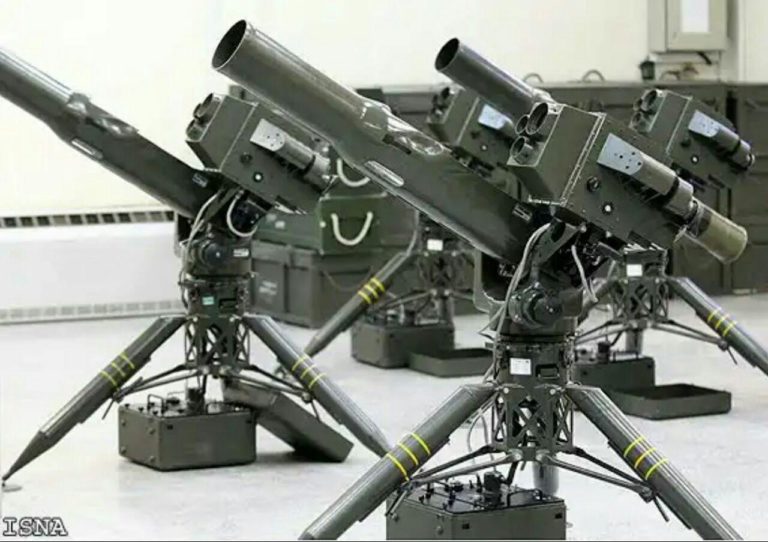
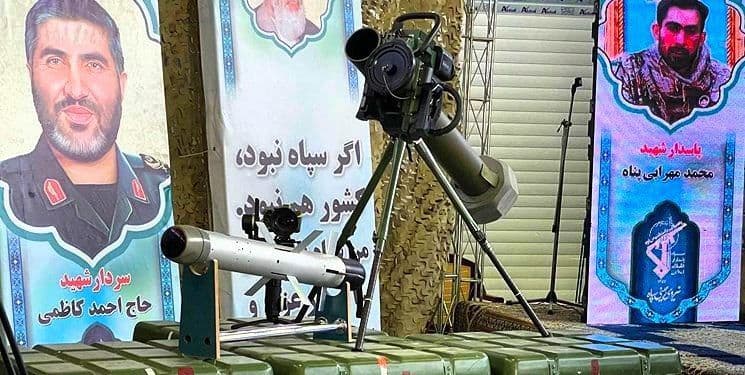
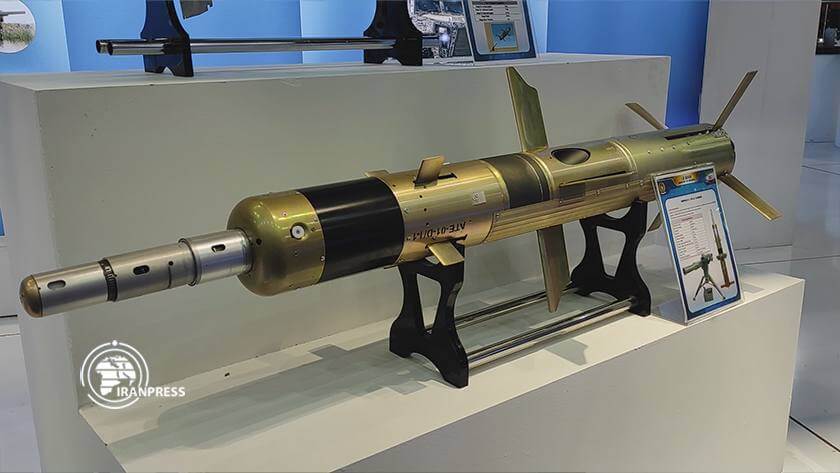
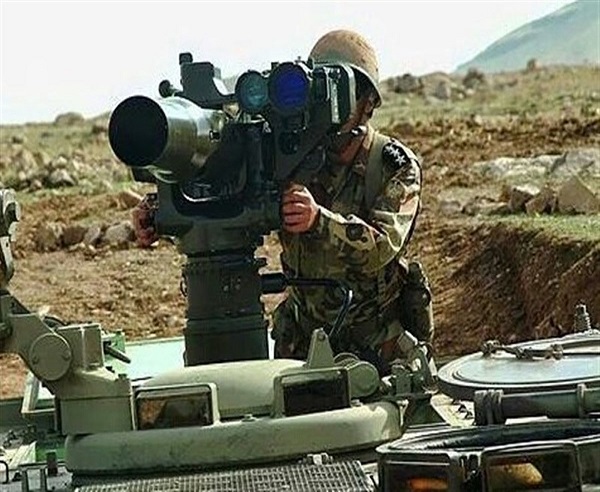
Design: As stated, the Toophan missile is designed and manufactured based on the US-made BGM-71 TOW anti-armor missile. The Toophan anti-armor missile is packaged inside a disposable tube and this tube is loaded onto the launcher at the time of firing. Toophan can be fired from two types of ground-based and air-based missile launchers.
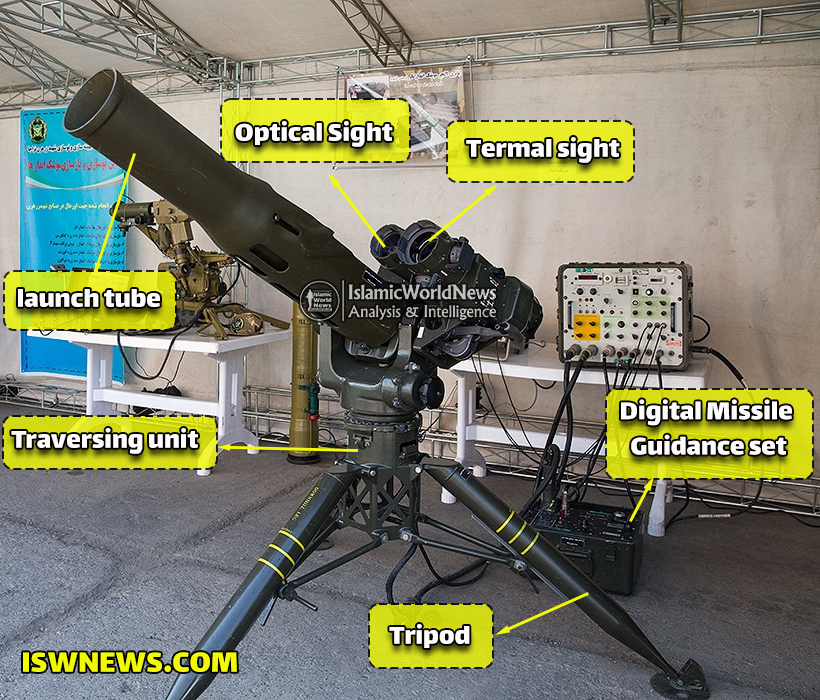
The ground-based missile launcher is installed on various vehicles, armored personnel carriers, tanks and vessels and it consists of a tripod, electro-optic sight, missile-containing tube, and command center. The electro-optic sight consists of two lenses; one for the daytime camera to detect targets during the day and the other for thermal vision to track the xenon lamp at the end of the Toofan missile. The daytime camera can be replaced with a night vision or another thermal camera to detect targets at night as well.
The Toophan anti-armor missile family uses semi-automatic command to line of sight (SACLOS) guidance. In this type of guidance, the operator must keep the camera on the target until the missile hits the target. The presence of a xenon lamp is for determining the position of the missile and in this way, the thermal lens determines the position of the missile and the main camera determines the position of the target and both pieces of information are sent to the control center (Digital Missile Guidance Set-DMGS); then, this center processes the received information. It sends the necessary commands for path correction via wire to the missile and the missile also corrects its path based on those commands.
Click to view full size
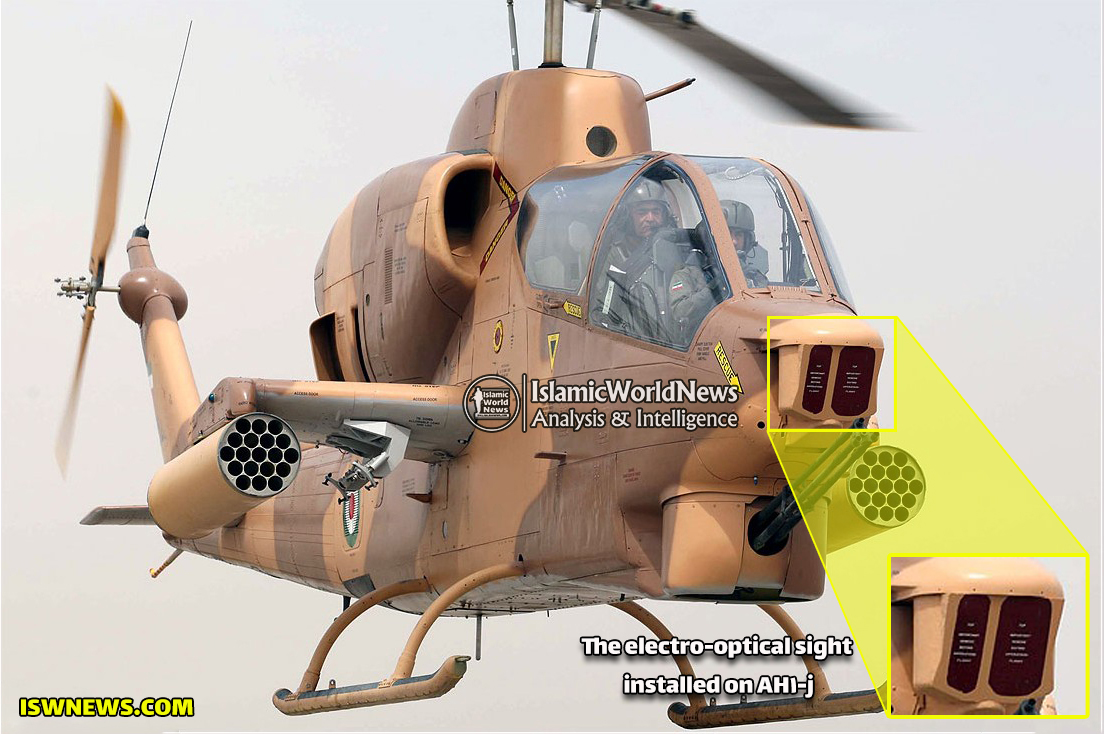
As mentioned, the Toophan missile has an air-based launcher platform. Some AH-1J International helicopters of the Islamic Republic of Iran Air Force have the ability to carry and launch TOW missiles, which are known as Tow-Cobra. This helicopter needs an electro-optic sight called M65 or Telescopic Sight Unit for firing TOW missiles, which has a 13x zoom capacity and is installed in the nose of the helicopter. This sight actually has the same application as an electro-optic sight mounted on a ground tripod. The helicopter’s electro-optic sight first targets and then aims, and also sends information needed for path correction via wire to TOW by tracking missiles. In Iranian Toophan variant, exactly these steps are observed.
Electro-optical site installed on AH1-J helicopter
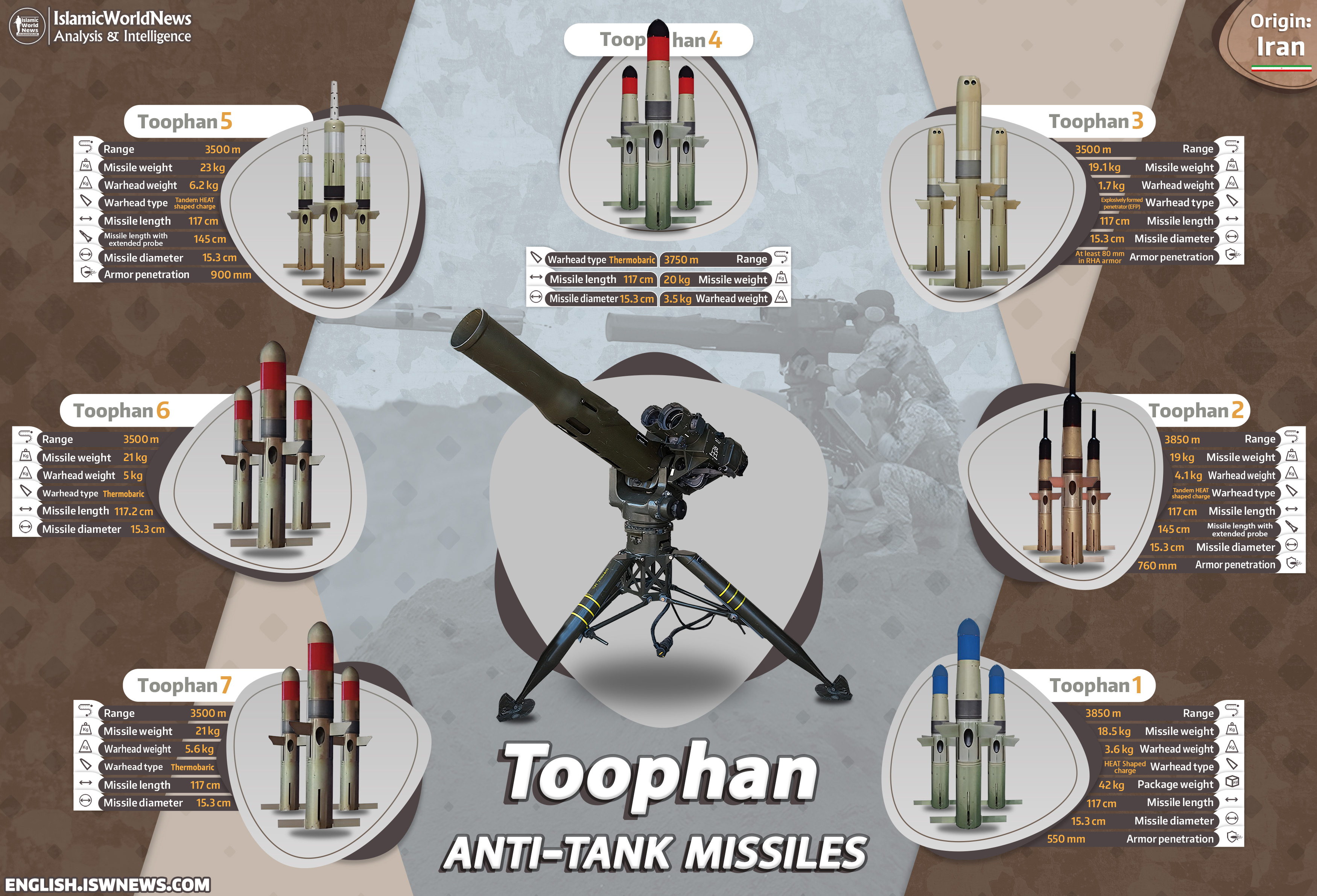
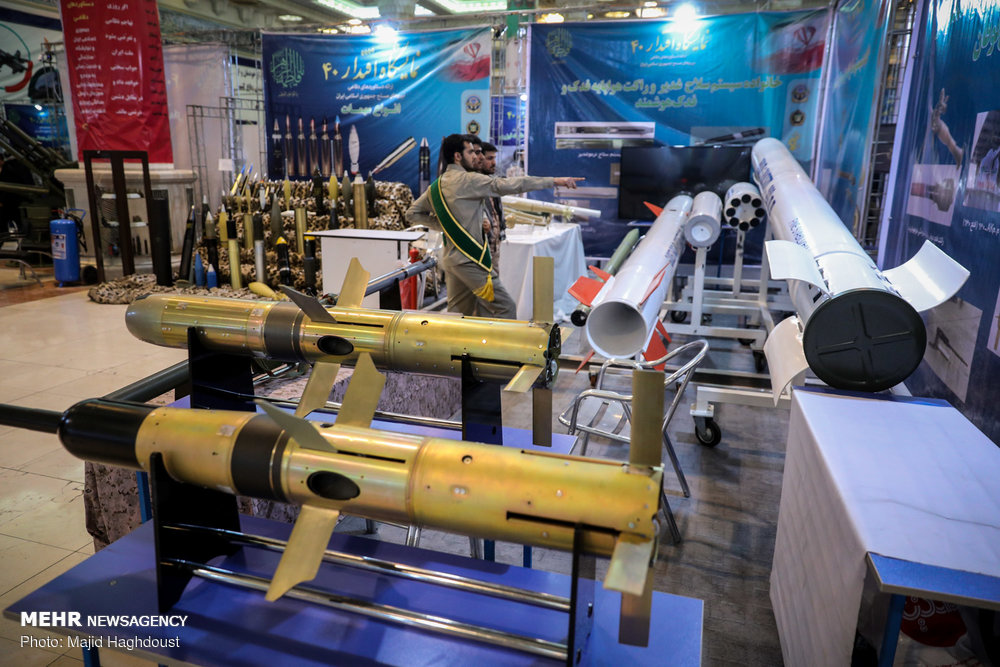
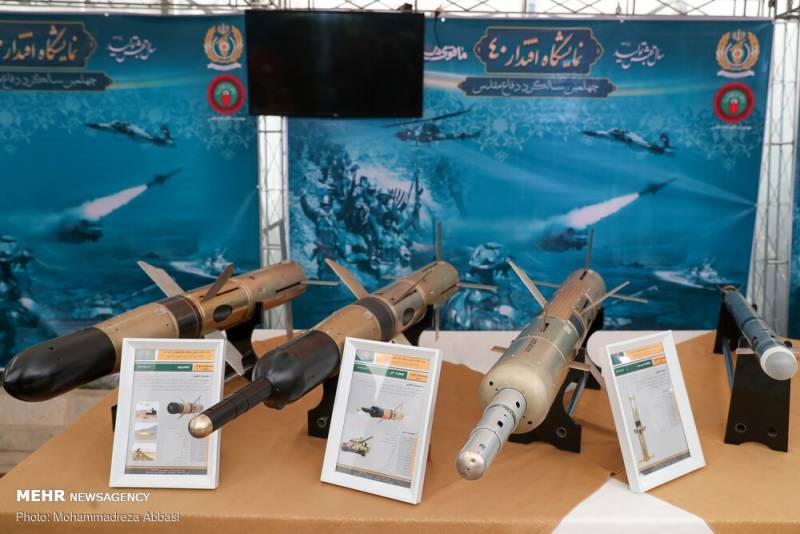
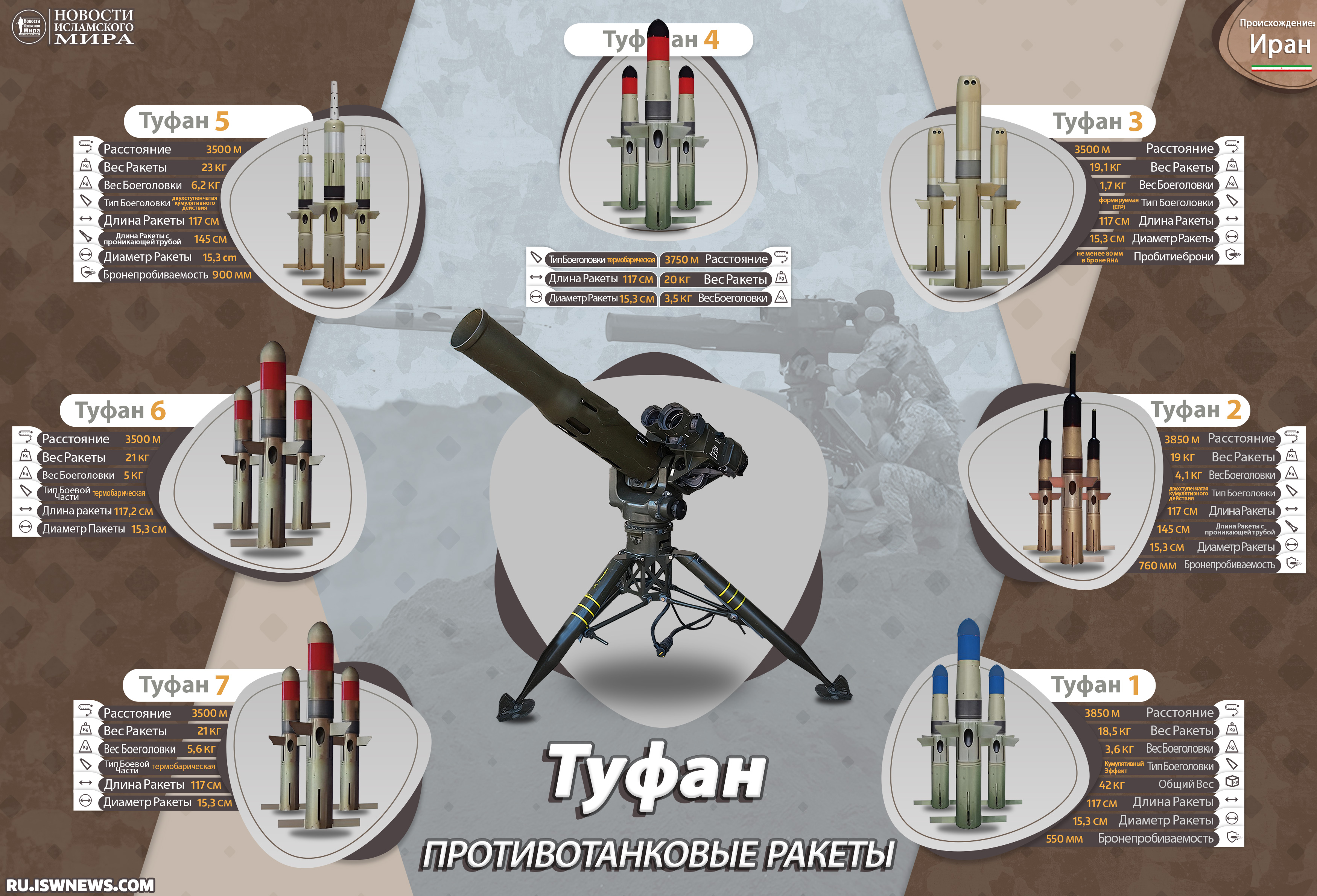
Types of Toophan missiles: As it has been mentioned above, the Toophan missile family was planned to produce 11 types of missiles in the industries of the Ministry of Defense of the Islamic Republic of Iran, and we managed to find 10 specifications of the missiles, which are being explained underneath. Regarding the eleventh type of Toophan missile, we think it was a heavy upgrade based on the Spike model and the missile was renamed, which we will deal with at the end.
Toophan Anti-Tank Missiles – click to view full size
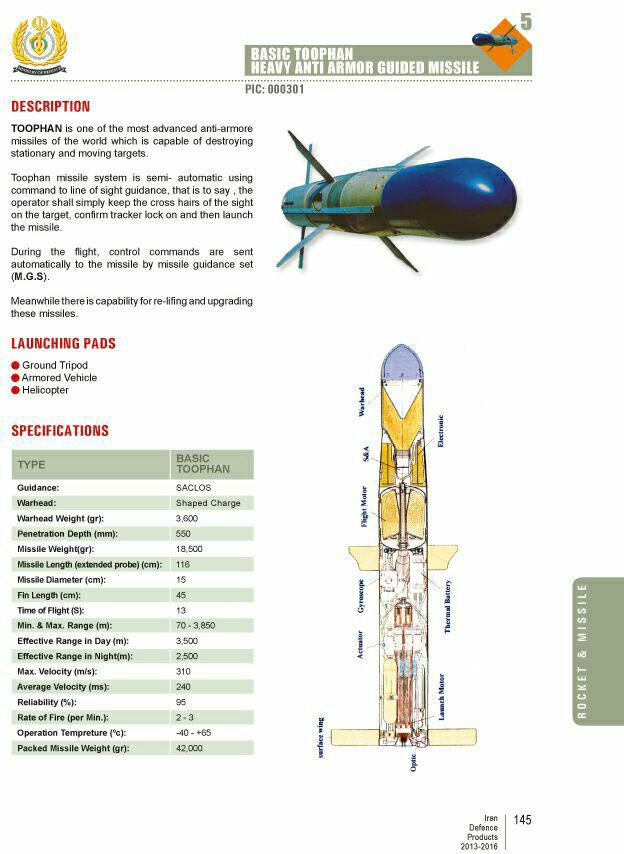
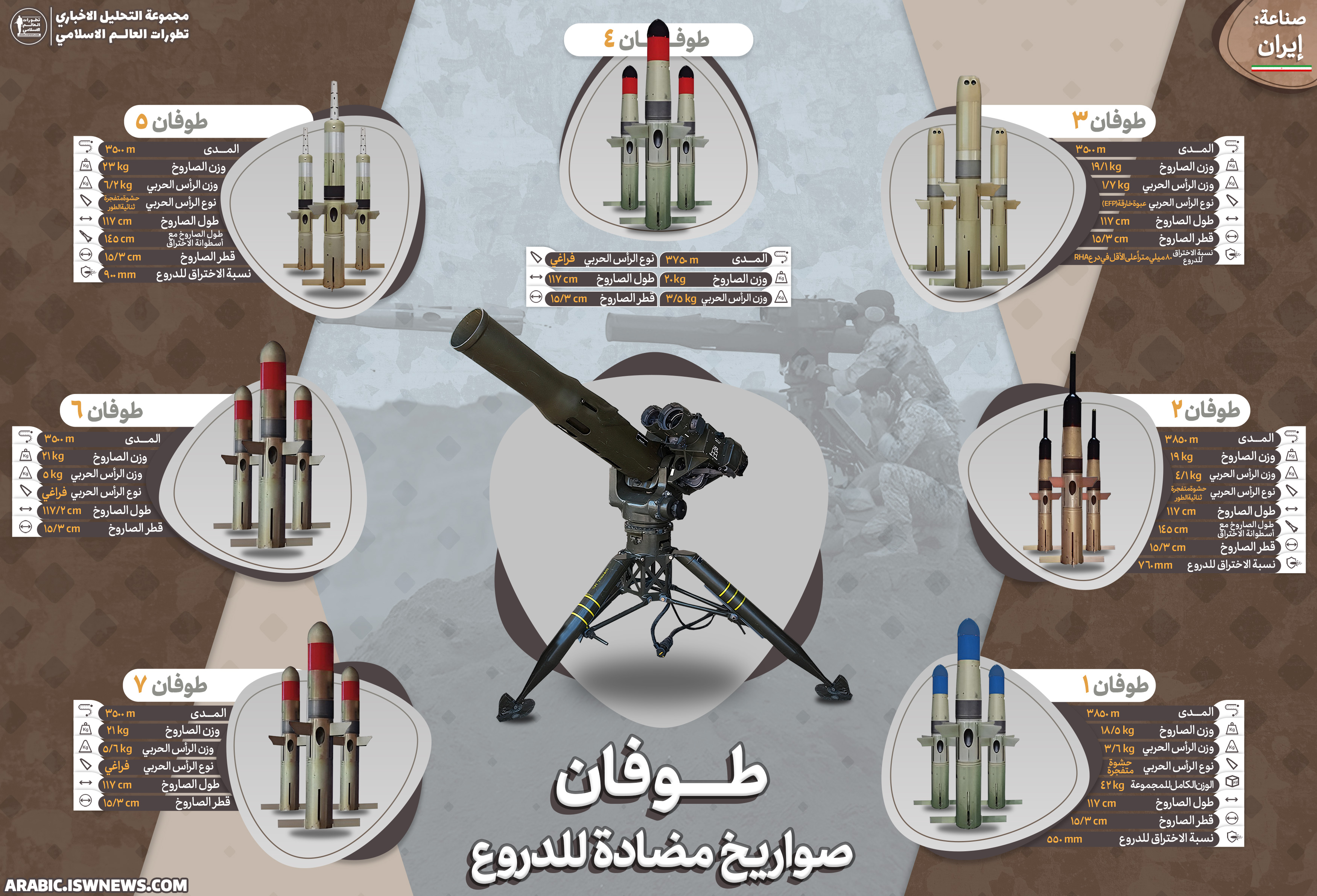
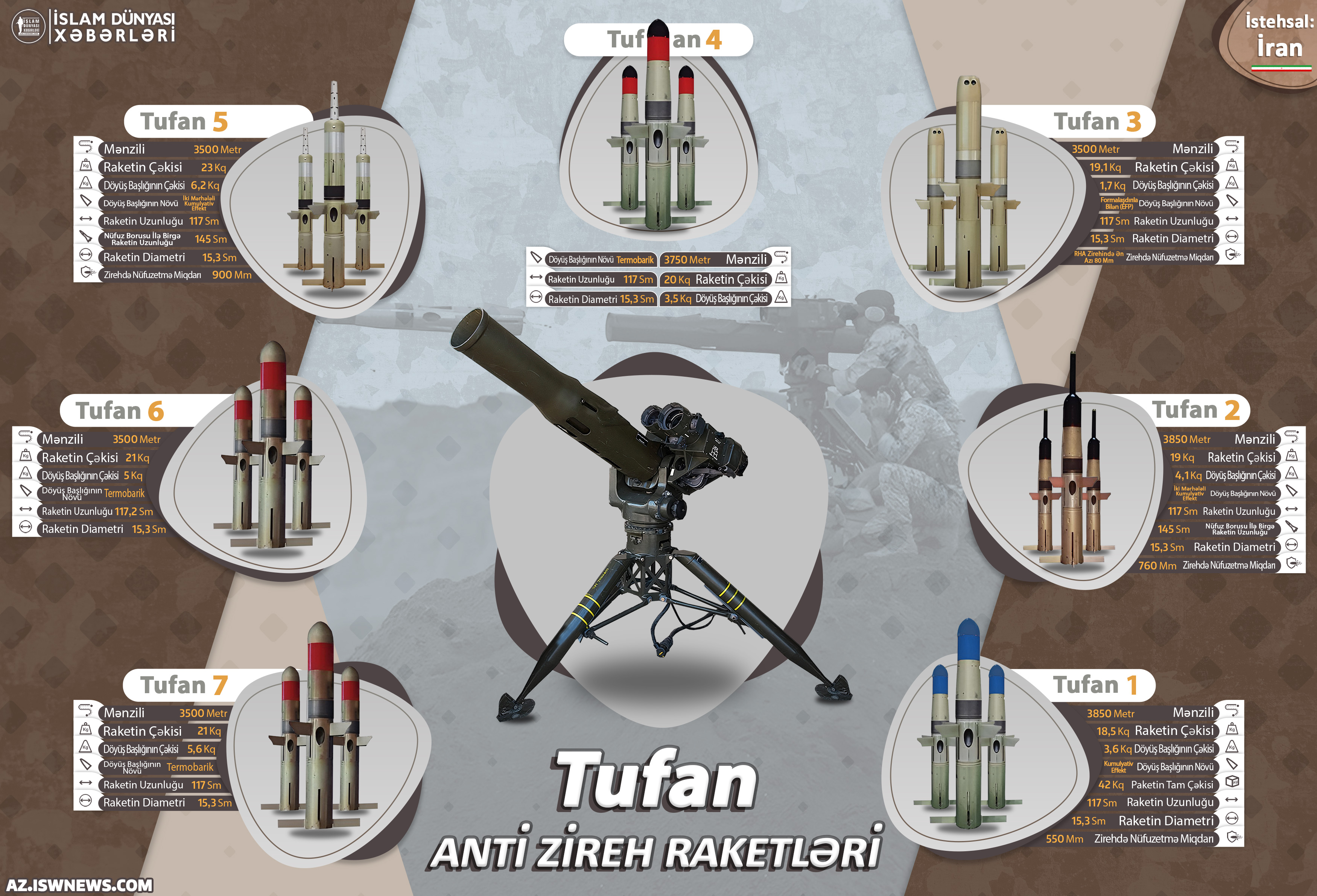
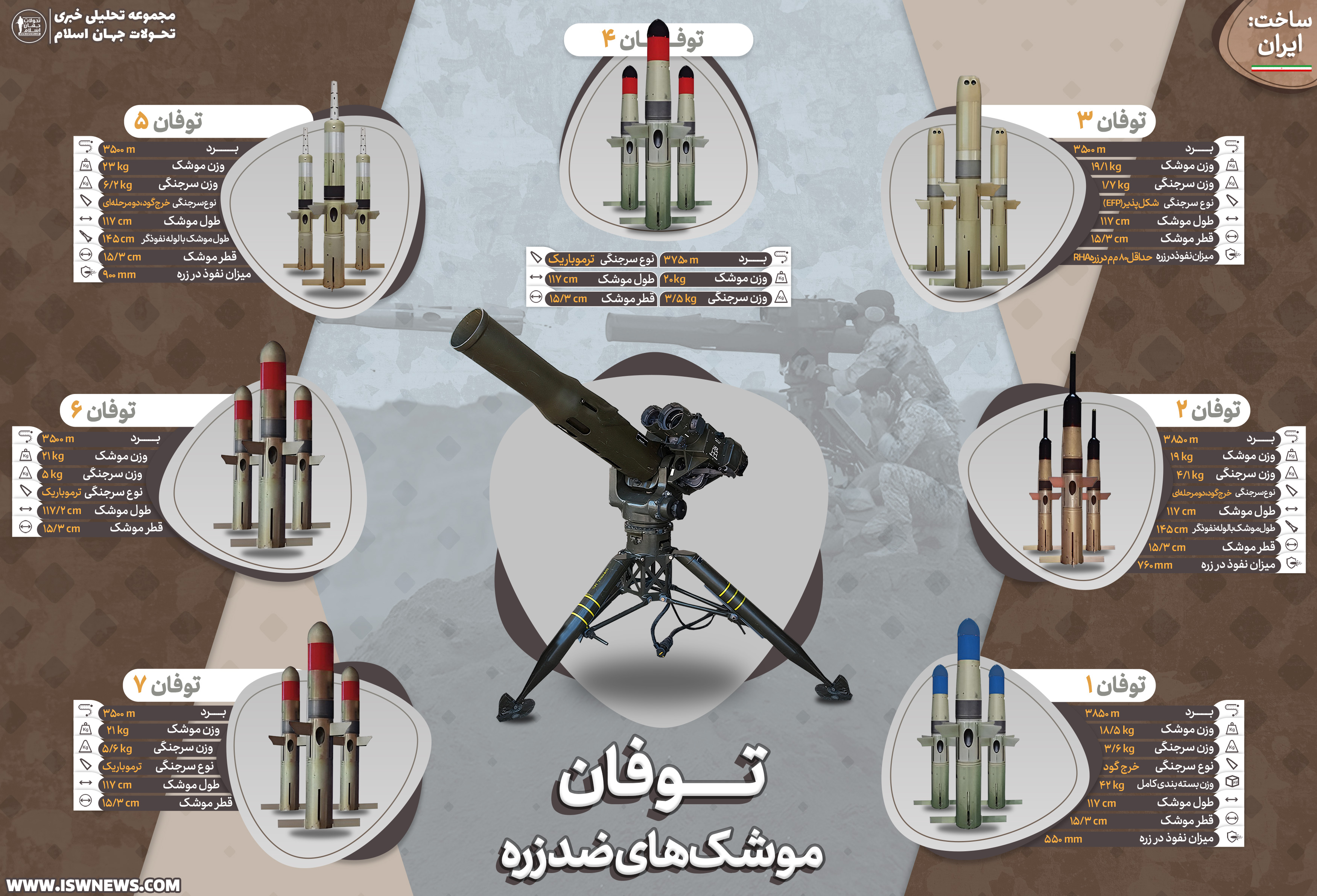
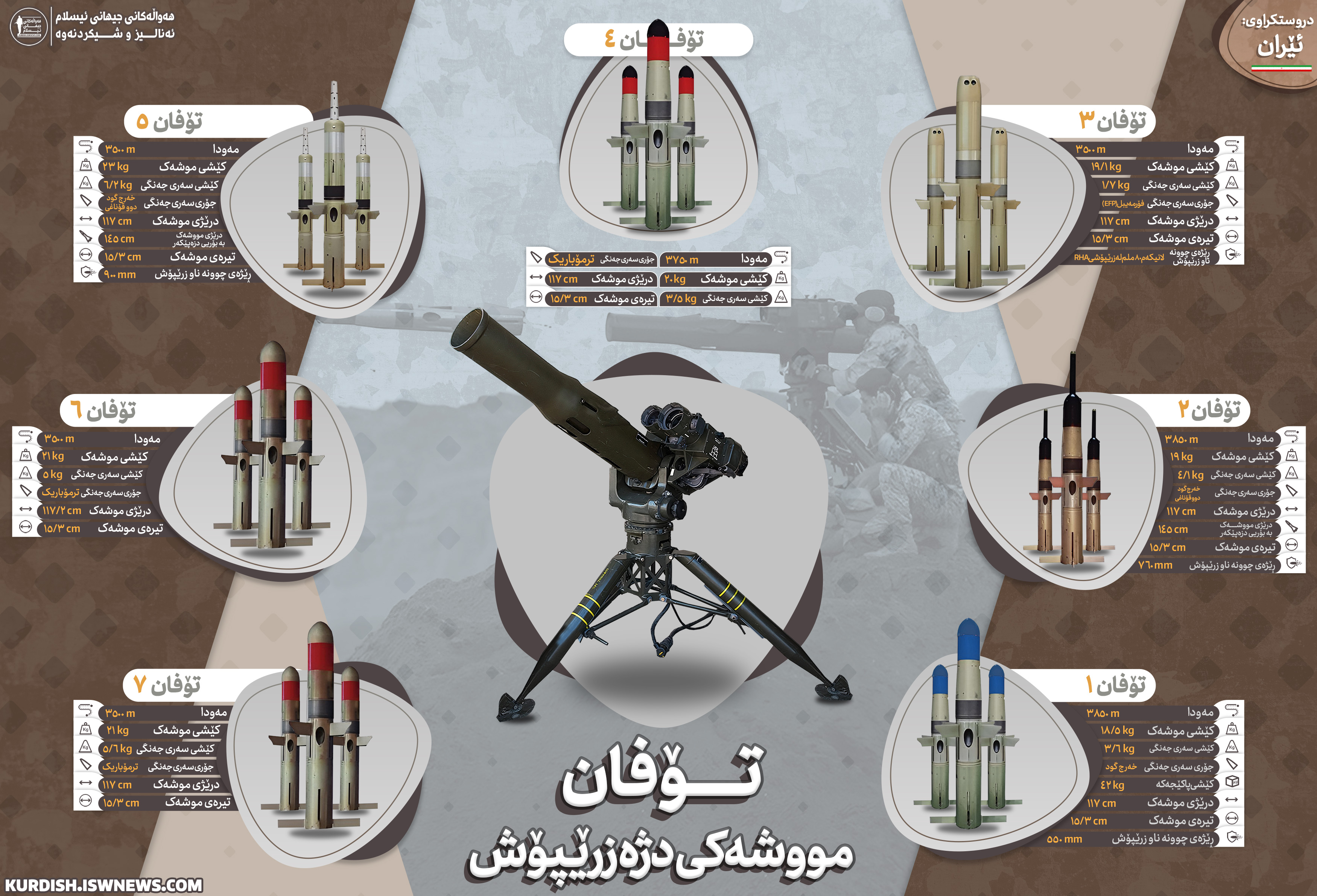
1- Toophan-1 missile: It is a reverse-engineered BGM-71 TOW version B missile. The US variant has a range of 3,750 km and a penetration rate of 430 mm, while the Iranian Toophan-1 missile has a range of 3,850 km and a penetration rate of 550 mm.
Published specifications of Toophan-1
Specifications of Toophan-1 missile: Maximum range: 3850 meters Minimum range: 70 meters Effective range: 3.5 km Effective range at night: 2.5 km Missile weight: 18.5 kg Warhead weight: 3.6 kg Type of warhead: HEAT shaped-charge Package weight: 42 kg Missile length: 117 cm missile diameter: 15.3 cm Armor penetration rate: 550 mm
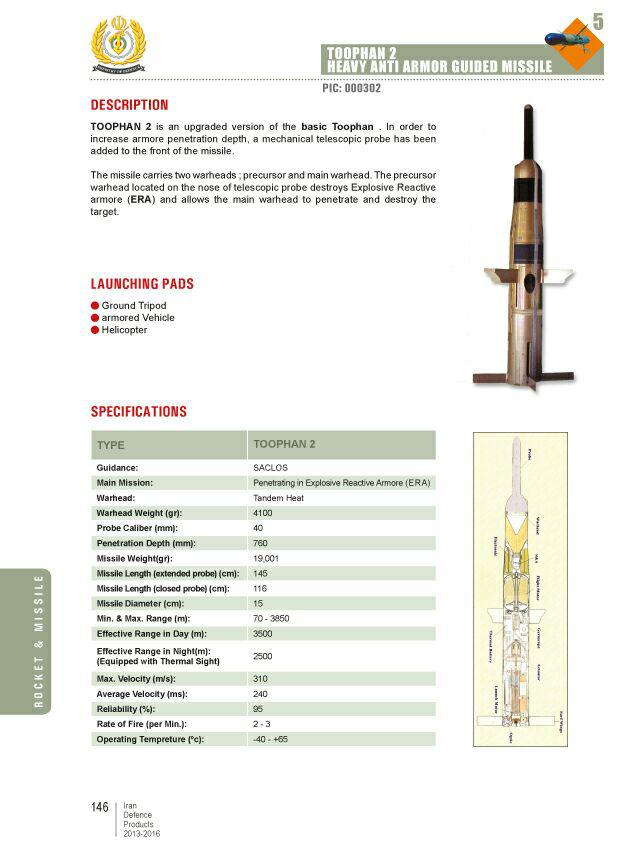
2- Toophan-2 missile: Toophan-2 was developed with the aim of increasing penetration rate, And by adding a penetrating extended probe and a heavier two-stage warhead, it not only gained the power to penetrate 760 mm rolled armor, but also has the ability to pass through all types of reactive armor. The extended probe in Toophan 2 missile has a small warhead to destroy the reactive armor so that the main warhead engages with the main armor. The extended probe is inside the missile, after firing it comes out of the tube, opens and is placed in its place as the missile head.
Published specifications of Toophan-2
Specifications of Toophan-2 missile: Maximum range: 3850 meters Minimum range: 70 meters Effective range: 3.5 km Effective range at night: 2.5 km Missile weight: 19 kg Warhead weight: 4.1 kg Type of warhead: Tandem HEAT shaped-charge Missile length: 117 cm Length of missile with the extended probe: 145 cm Missile diameter: 15.3 cm Armor penetration rate: 760 mm
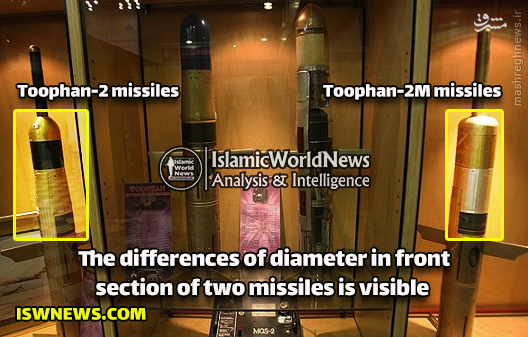
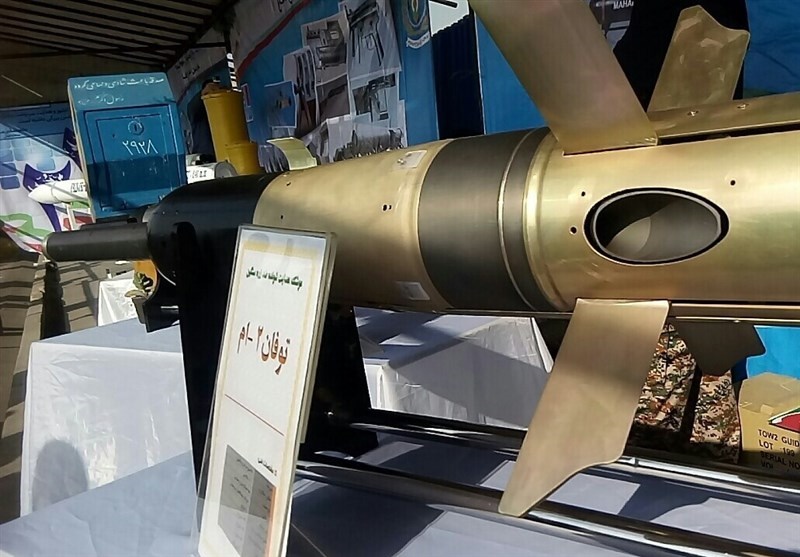
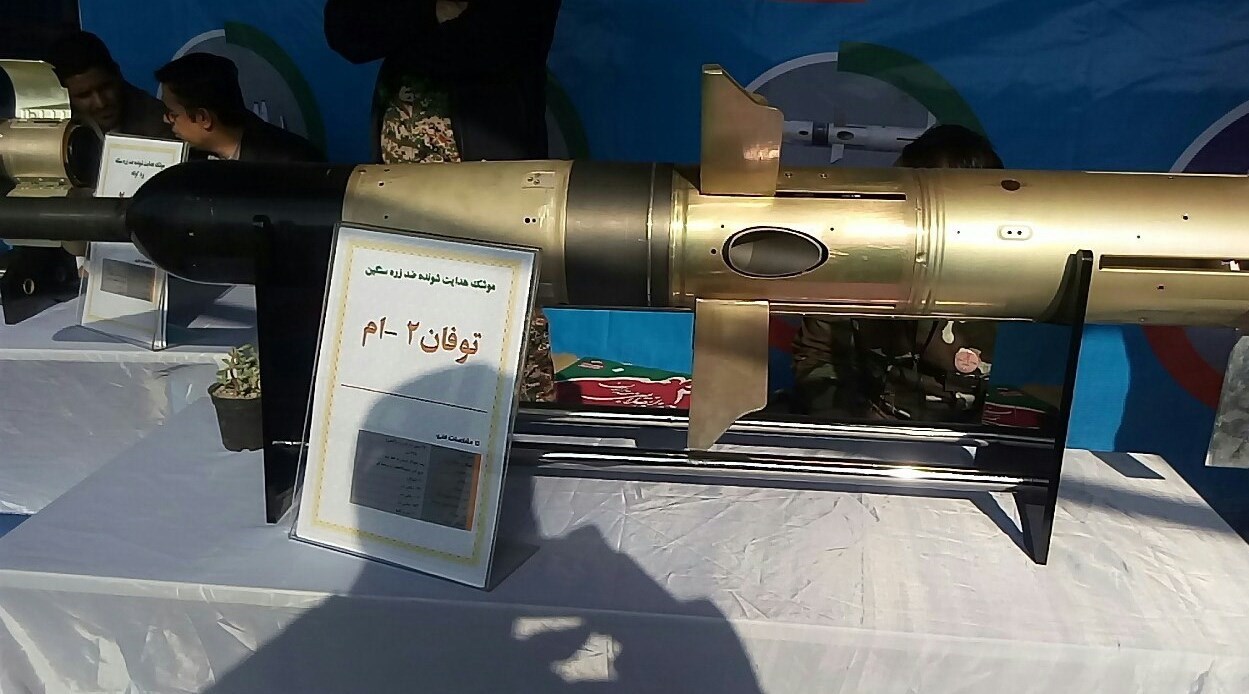
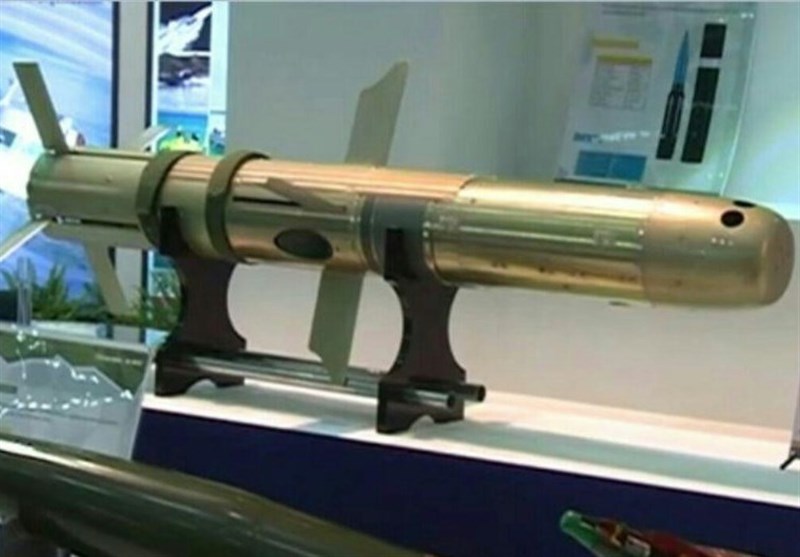
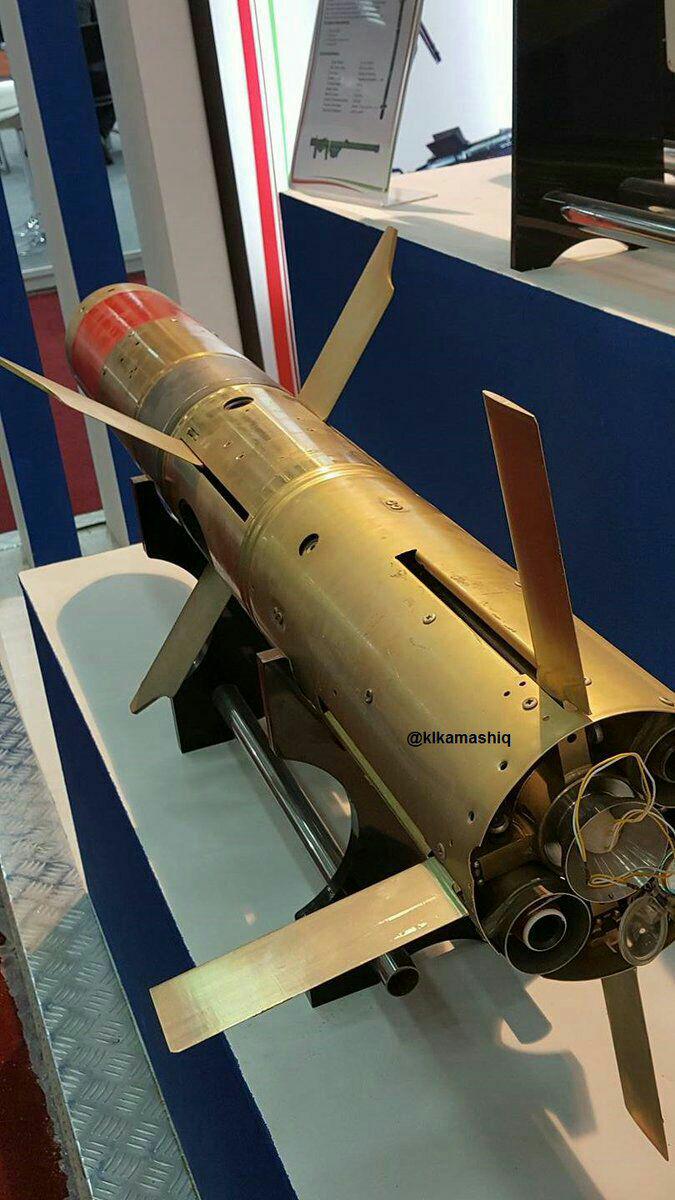
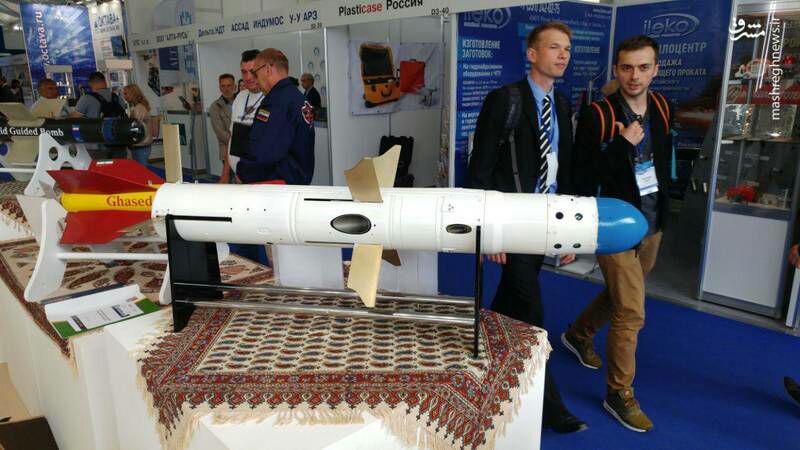
3- Toophan-2M missile: Iran’s defense industry sought to upgrade and develop the Toophan-2 missile, this led to the production of the Toophan-2M variant. This upgraded missile had the ability to penetrate 900 mm of armor. In the overall design of the Toophan-2 missile, the existence of an extended probe and a two-stage warhead has been preserved. The new missile has a larger nose diameter than its previous model due to carrying more explosives. The specifications of Toophan-2M have not been published in full, but due to its similarity with the Toophan-2 variant, its specifications can be guessed to some extent.
The diameter difference between Toophan-2 and Toophan-2M missiles
Specifications of Toophan-2M missile: Maximum range: 3850 meters Minimum range: 70 meters Effective range: 3.5 km Effective range at night: 2.5 km Missile weight: 21 kg Warhead weight: 6.1 kg Type of warhead: Tandem HEAT shaped-charge Missile length: 117 cm Length of missile with the extended probe: 145 cm Missile diameter: 15.3 cm Armor penetration rate: 900 mm
4- Toophan-3 top attack missile: Toophan-3 is a special member of the Toophan anti-armor missile family. This missile attacks armored targets from above and attacks the weakest point of tanks. Top Attack anti-armor missiles have two mechanisms, the first type is diving on the target and the second type explodes on top of the target, which Toophan-3 is of the second type.
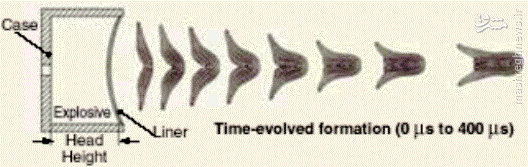
The Toophan-3 missile flies at a height of 2 to 3 meters above the ground and when it passes over the target, the missile’s sensors detect the target and give the command to detonate the Explosively Formed Penetrator (EFP) warhead. The EFP is a special type of shaped charge that deform a metal plate into a slug or rod shape and accelerate it toward the target.
The advantage of using top attack missiles like Toophan-3 is that they can attack targets behind hills or obstacles.
Toophan-3, like other members of the Toophan anti-armor family, uses line-of-sight guidance (SACLOS) and uses wires to transmit course correction information.
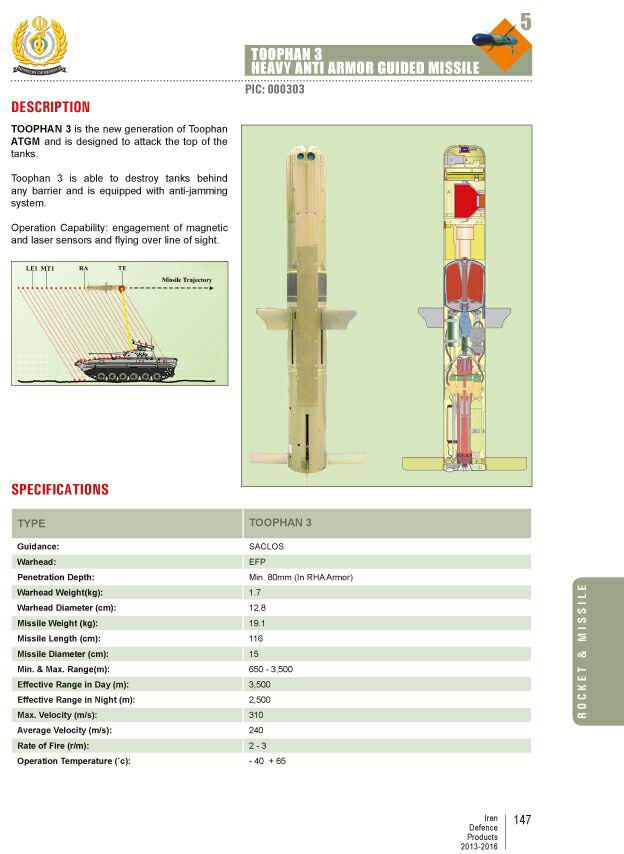
Published specifications of Toophan-3. The picture also shows how Toophan-3 works.
Specifications of Toophan-3 missile: Maximum range: 3500 meters Minimum range: 650 meters Effective range: 3.5 km Effective range at night: 2.5 km Missile weight: 19.1 kg Warhead weight: 1.7 kg Warhead type: EFP Missile length: 117 cm Missile diameter: 15.3 cm Armor penetration rate: at least 80 mm in armor
5- Toophan-3M top attack missile: Like the Toophan-3 missile, this missile is a top attack missile and uses the EFP warhead and SACLOS guidance. The range of this variant has increased to 3,750 meters and the minimum penetration power has increased from 80 mm to 150 mm.
Specifications of Toophan-3M missile: Maximum range: 3750 meters Minimum range: 100 meters Effective range: 3.5 km Effective range at night: 2.5 km Missile weight: 21.5 kg Warhead weight: 4 kg Warhead type: EFP Missile length: 117 cm Missile diameter: 15.3 cm Armor penetration rate : at least 150 mm in armor
6- Toophan-4 missile: Toophan-4 is the first member of the Toophan anti-armor family that is equipped with a thermobaric warhead. This variant also uses SACLOS method for guidance. Toophan 4 missile was displayed for the first time at the Baghdad Defense Exhibition in 2017.
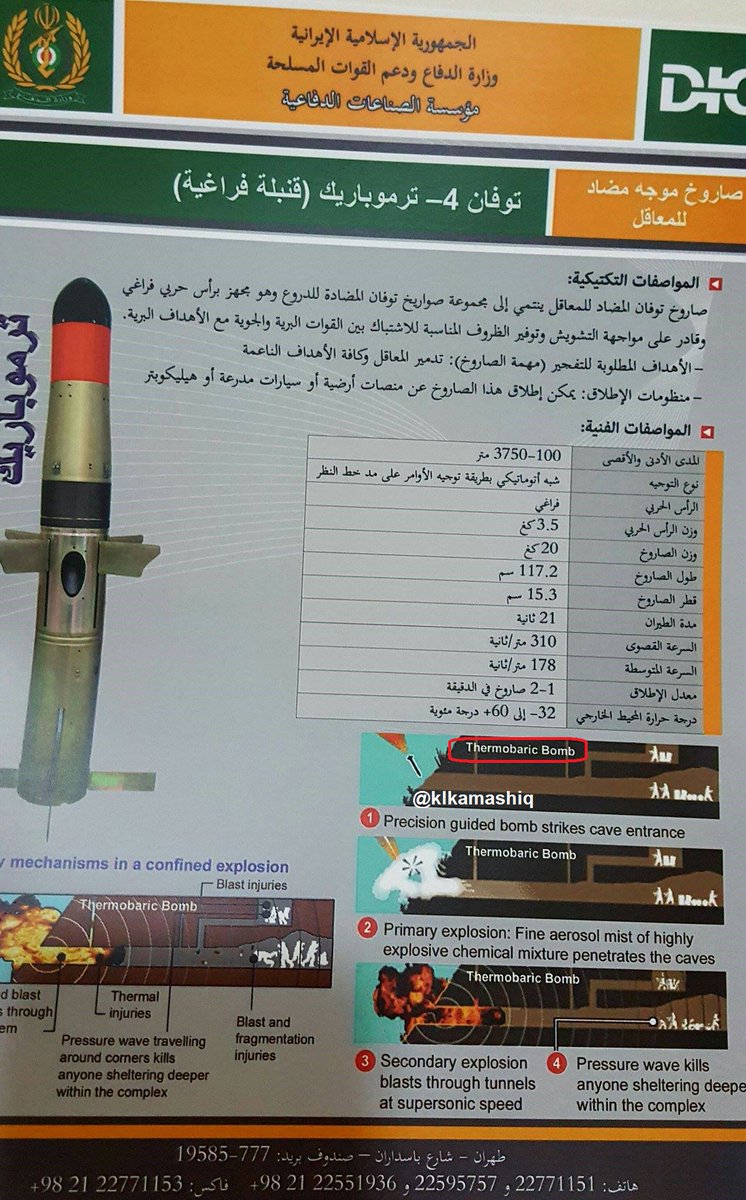
Published specifications of Toophan-4 and how it works
Specifications of Toophan-4 missile: Maximum range: 3750 meters Minimum range: 100 meters Effective range: 3.5 km Effective range at night: 2.5 km Missile weight: 20 kg Warhead weight: 3.5 kg Warhead type: Thermobaric Missile length: 117 cm Missile diameter: 15.3 cm
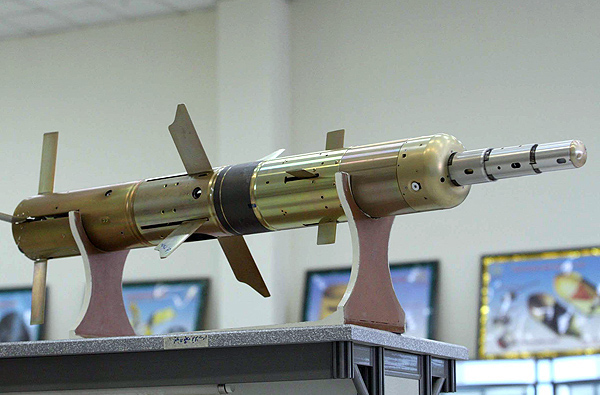
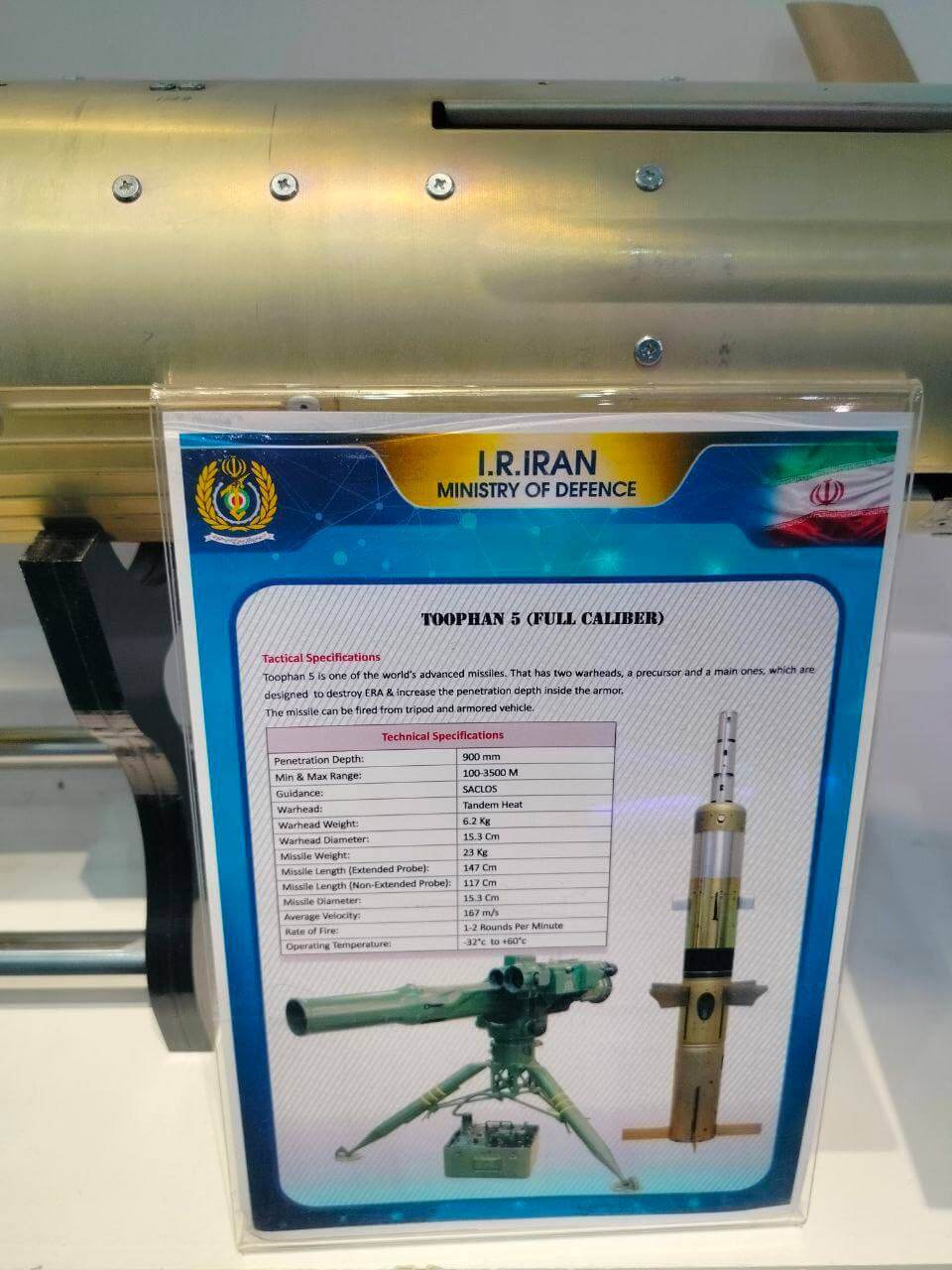
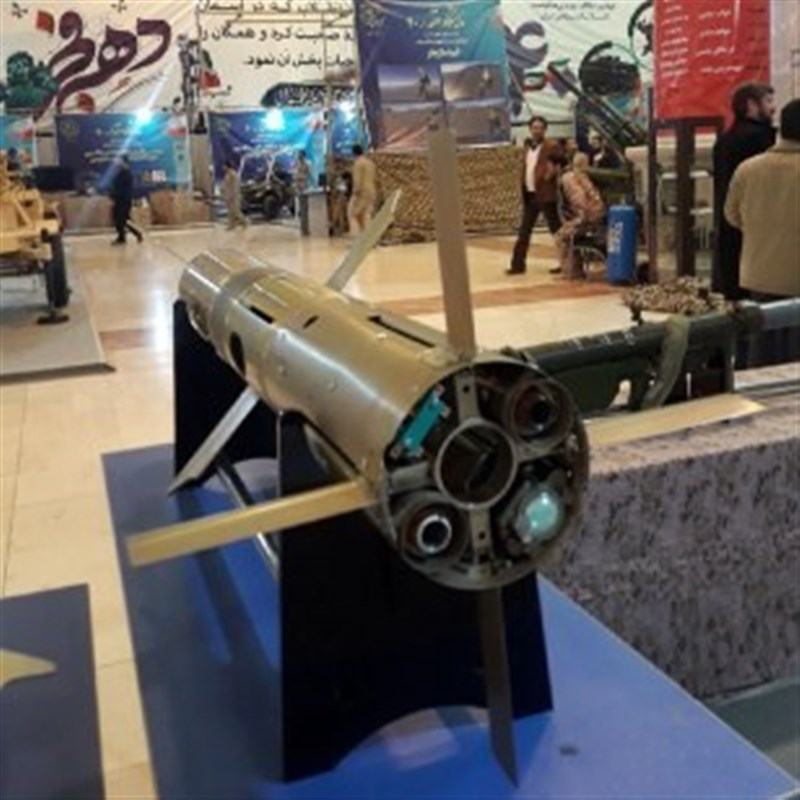
7- Toophan-5 missile: Like the Toophan-2 missile, Toophan-5 is designed to penetrate explosive reactive armor (ERA). This missile also has an extended probe containing explosives and a larger warhead to be able to penetrate reactive armor and pass through the main armor. But Toophan-5 uses a type of laser beam riding for guidance. Another difference between Toophan-5 and previous missiles is that it has three rows of fins, one row is located in the beginning of the missile and near its tip, and the other two rows are placed in the middle and end of the missile like other types of Toophan. The presence of this type of fins makes the missile react faster and make it more stable during flight. It seems that the main reason for using three fin rows is for its type of guidance.
An image of the Toophan-5 missile, which clearly shows three rows of fins.
Due to the type of guidance in Toophan-5 missile, a different launcher is used to fire and guide this missile. This launcher uses three types of lenses. One is for the day vision camera, which is used to find targets during the day. The second lens is for the thermal vision camera, which is used for targeting at night or for targeting after a smoke screen. The third lens is intended to shine the laser beam to the end of the missile during flight and guide it towards the target; This beam is irradiated to the center of the target selected by the operator.
Special launcher for launching Toophan-5 missile
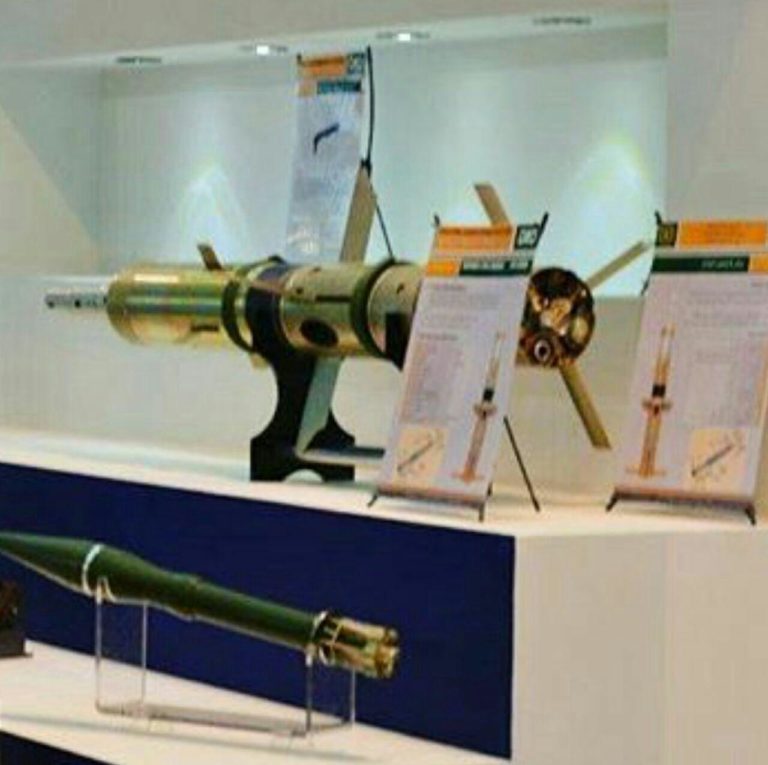
It is worth mentioning that the wire guidance type of Toophan-5 missile was also displayed at the Baghdad International Exhibition in 2017, which indicates that the cheaper version the missile is also in production line.
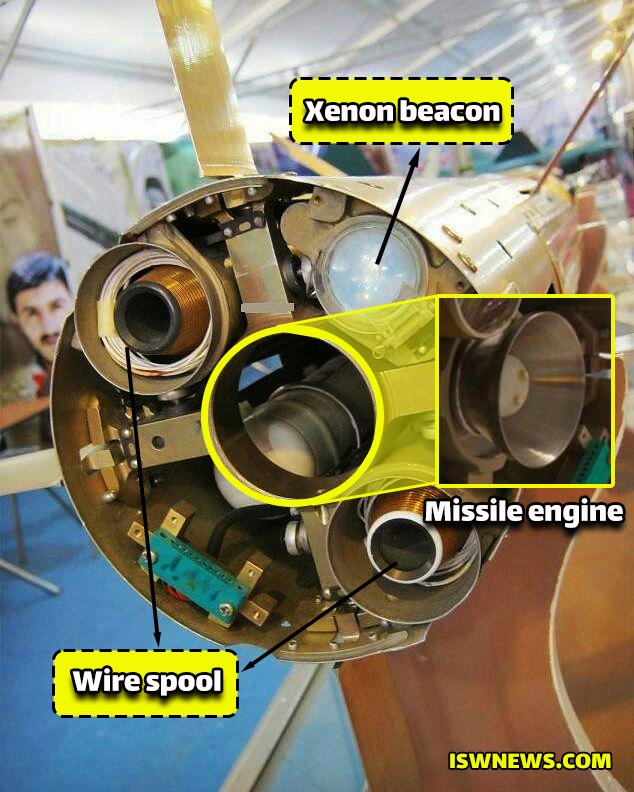
A picture of the Toophan-5 missile in the Baghdad exhibition, where the wire spindle and xenon lamp can be seenPublished specifications of Toophan-5Click to view full size image
Specifications of Toophan-5 missile: Maximum range: 3500 meters Minimum range: 100 meters Effective range: 3.5 km Effective range at night: 2.5 km Missile weight: 23 kg Warhead weight: 6.2 kg Type of warhead: Tandem HEAT shaped-charge Missile length: 117 cm Length of the missile with the extended probe: 145 cm Missile diameter: 15.3 cm Armor penetration: 900 mm
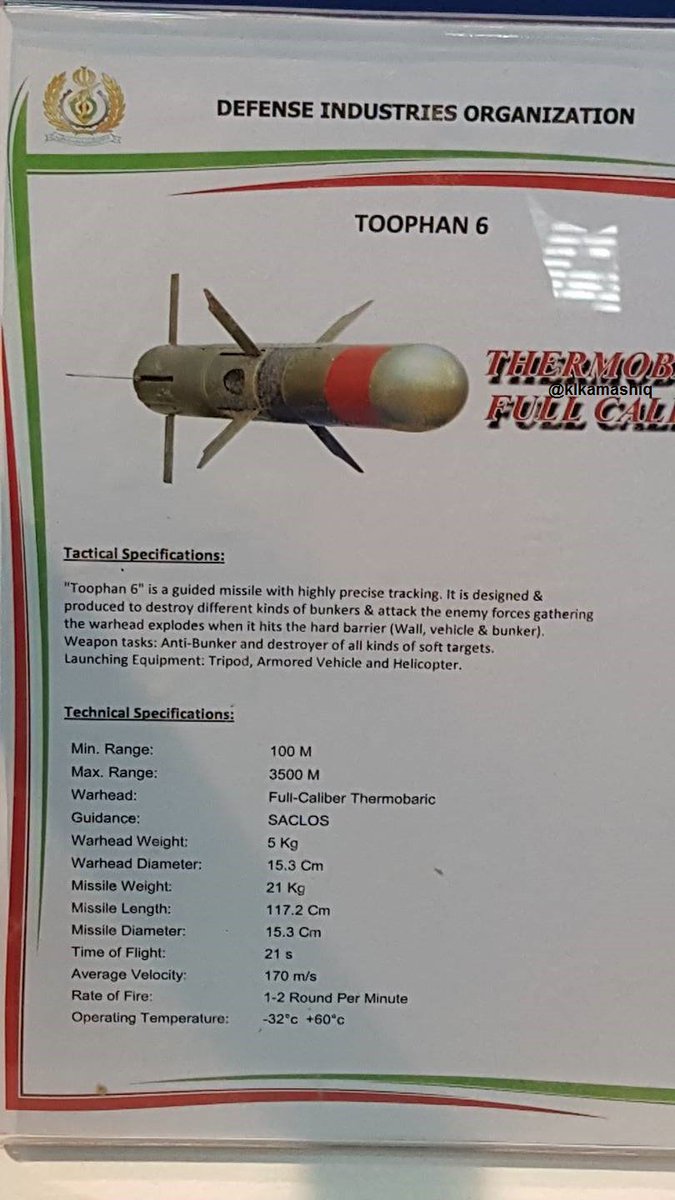
8- Toophan-6 missile: Toophan-6 was first unveiled at the 2017 Baghdad International Exhibition. Like Toophan-4, this missile uses a thermobaric warhead and wire guidance. Toophan-6 uses a 5 kg warhead, but Toophan-4 uses a 3.5 kg warhead. This missile can be fired from the conventional tripods, all types of vehicles and helicopters.
Specifications published about the Toophan-6 missile
Specifications of Toophan-6 missile: Maximum range: 3500 meters Minimum range: 100 meters Effective range: 3.5 km Effective range at night: 2.5 km Missile weight: 21 kg Warhead weight: 5 kg Warhead type: Thermobaric Missile length: 117.2 cm Missile diameter: 15.3 cm
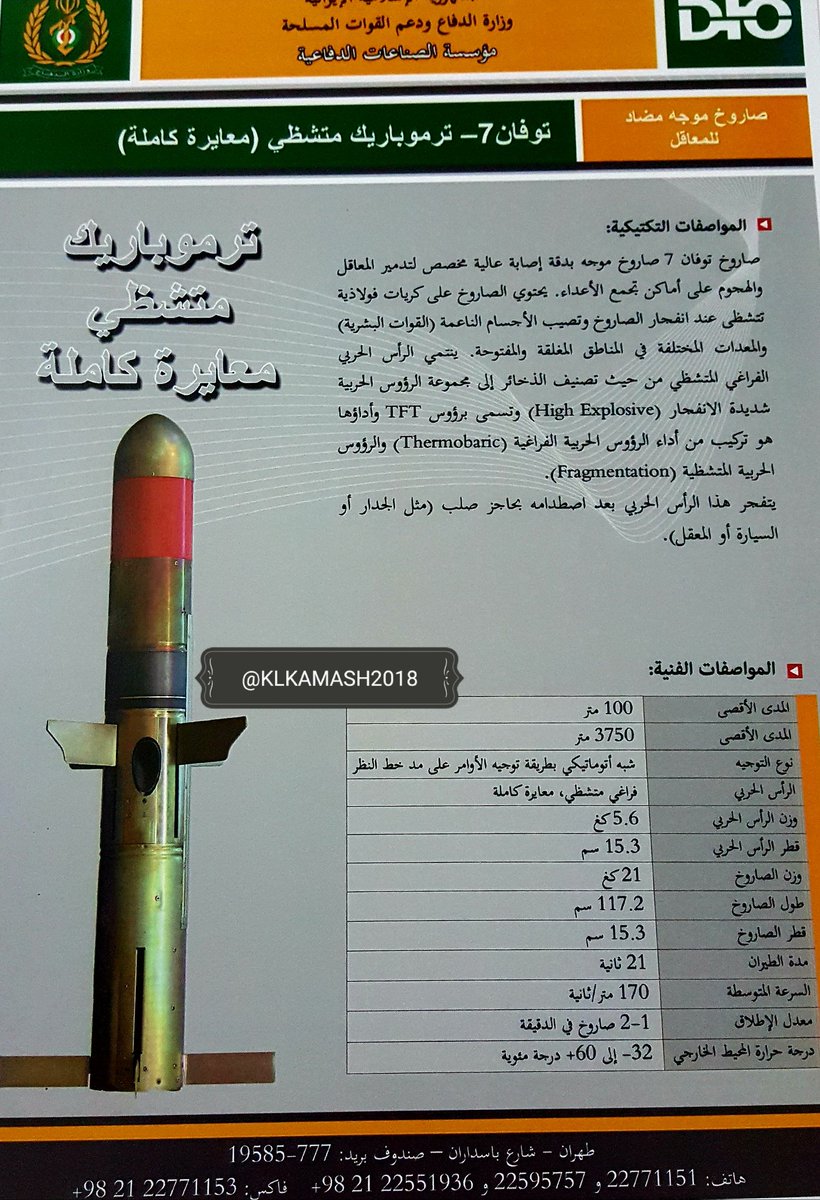
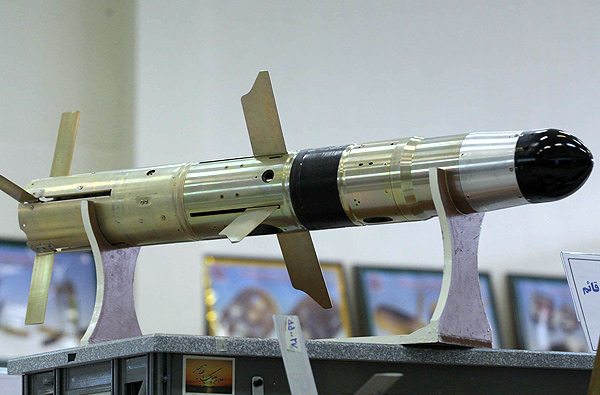
9- Toophan-7 missile: Toophan-7 is the third thermobaric member of the Toophan family, which was introduced after Toophan-4 with 3.5 kg and Toophan-6 with 5 kg of explosives. Toophan-7 with a thermobaric warhead and shrapnel fragment capability has 5.6 kg of explosives. The missile uses semi-automatic command-to-line-of-sight (SACLOS) guidance by wire.
Specifications published about the Toophan-7 missile
Specifications of Toophan-7 missile: Maximum range: 3500 meters Minimum range: 100 meters Effective range: 3.5 km Effective range at night: 2.5 km Missile weight: 21 kg Warhead weight: 5.6 kg Warhead type: thermobaric Missile length: 117 cm Missile diameter: 15.3 cm
10- Ghaem anti-helicoptermissile: Ghaem or Qaem anti-helicopter missile is a semi-heavy guided missile that is intended for use against UAVs and low flying or stationary helicopters. This missile looks very similar to the Toophan-1 missile and it is difficult to distinguish it. The exact specifications of this missile have not been revealed, but it is said that it’s a laser-guided missile and is resistant to electronic warfare.
Ghaem anti-helicopter missile
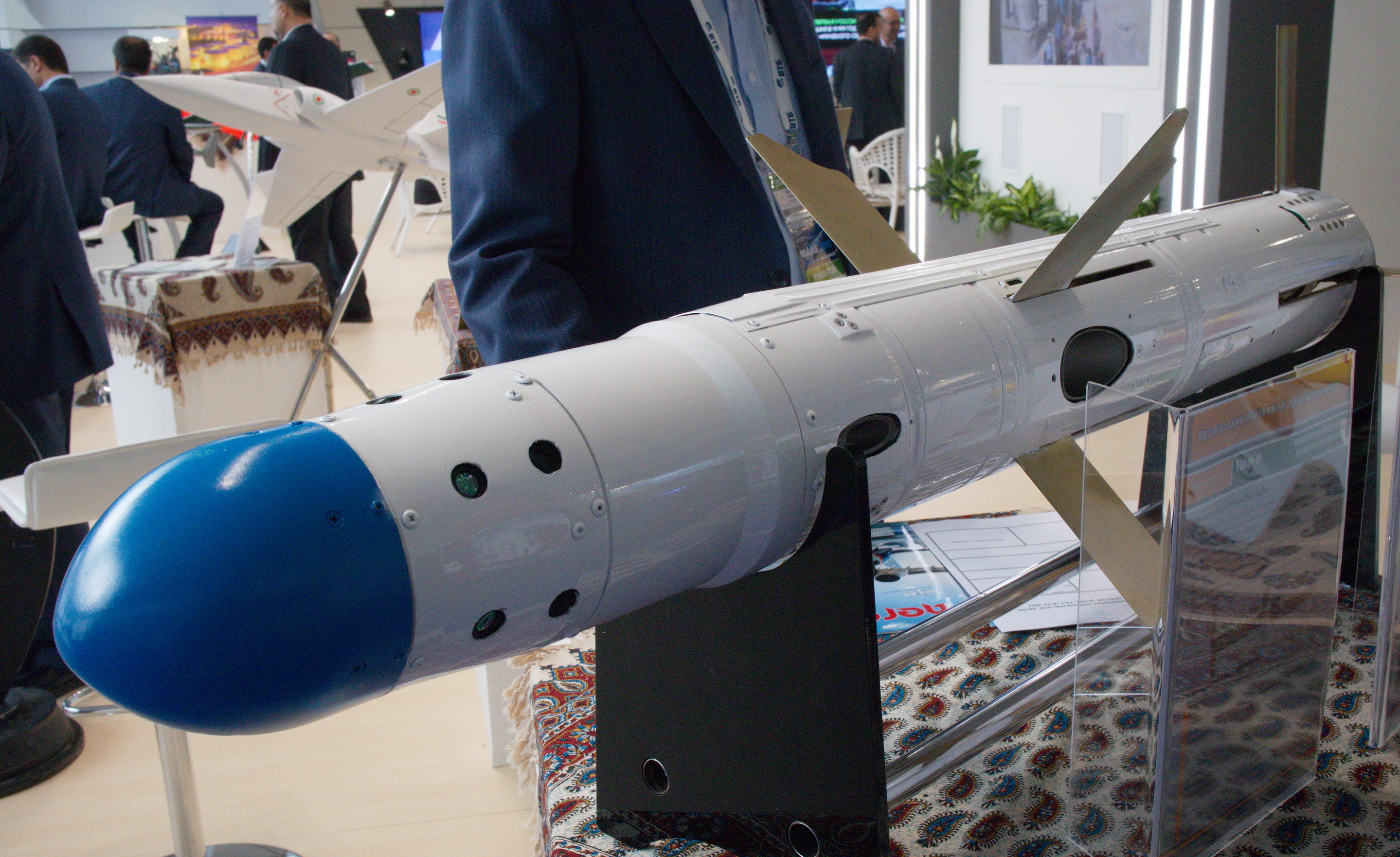
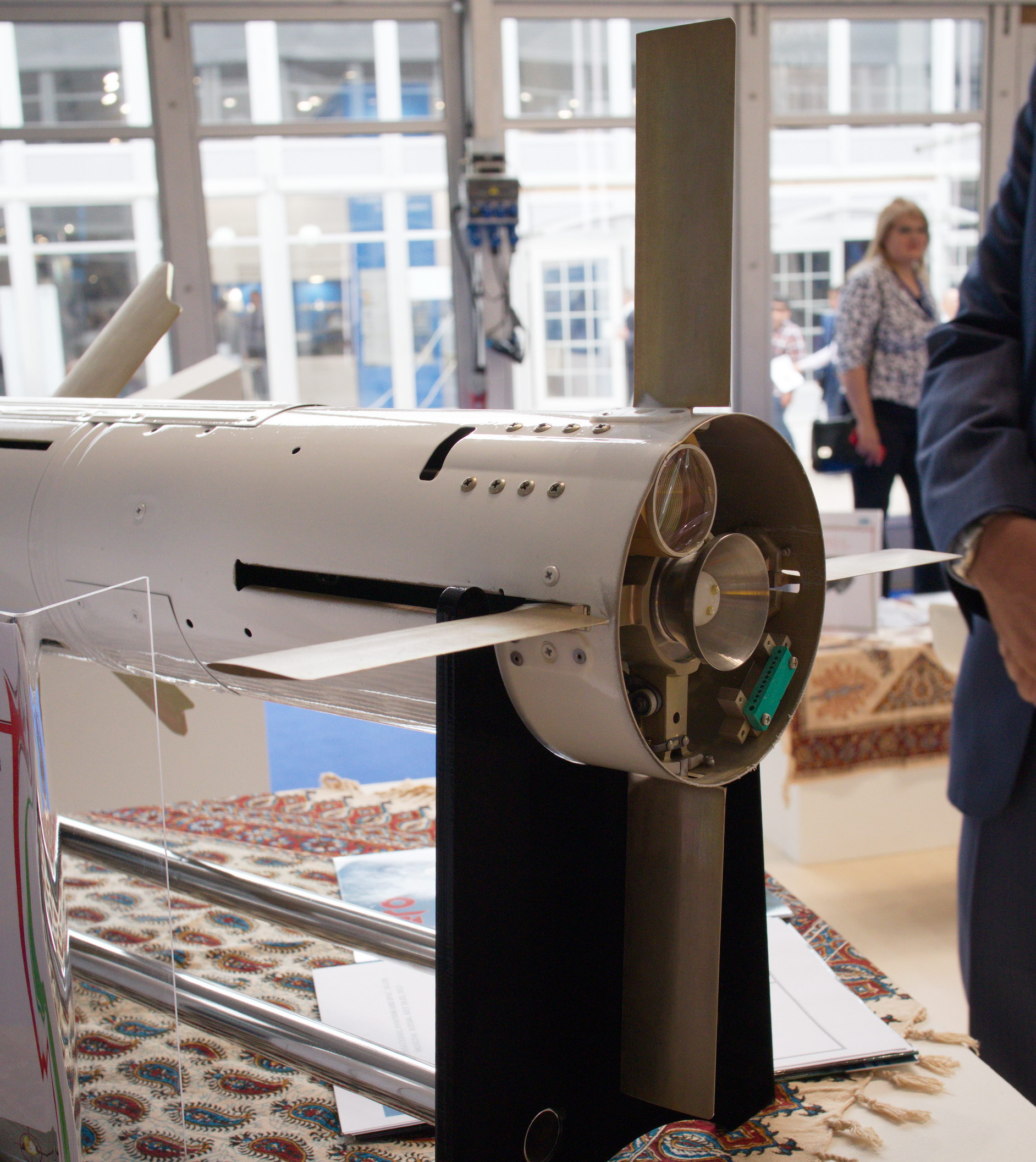
Ghaem-M missile: This missile, like the Ghaem missile, is an anti-helicopter missile and has the ability to destroy air targets with low speed and low altitude, especially attack helicopters. with the difference that this missile uses several proximity fuses that improve its performance. Also, in this variant, a fragmentation warhead with 500 shrapnels and a weight of 1.7 kg was used. These two changes have been made in order to cause more damage if the missile does not hit the target directly. In the published images, it seems that the engine gas output in the middle part of the missile has become larger, which indicates the possibility of using a larger engine to reach a range of 6 km. Also, there is a laser beam receiver at the end of the missile, which confirms the laser beam guidance method like Tofan-5 missile. Unfortunately, the altitude of fire is not mentioned in the published information about this missile. But if the altitude of fire is 5 km, it will be able to deal with most drones and helicopters.
The front part of the Ghaem-M missile, whose sensors are clearly visible.The end part of the Ghaem-M missile, which has a laser receiving lensClick to view full size
Specifications of Ghaem-M missile: Maximum range: 6000 meters Minimum range: 500 meters Missile weight: 19.5 kg Warhead weight: 1.7 kg Type of warhead: Fragmentation (500 shrapnels) Missile length: 116 cm Missile diameter: 15.3 cm Maximum speed: 310 meters per second Average speed: 240 meters per second
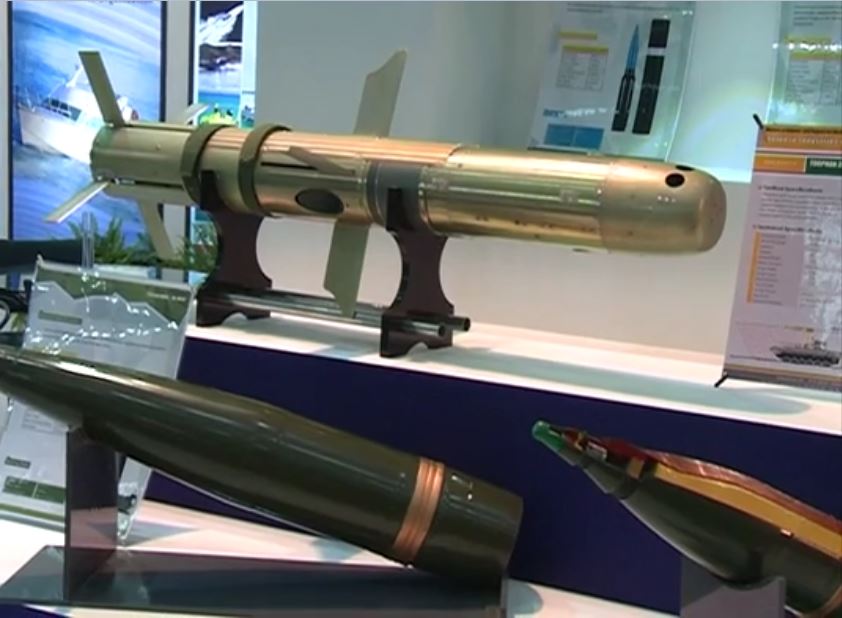
11- Almas anti-tank missile: Almas missile is an anti-armor missile that has always been considered as an independent category. However, when it comes to looking at the configuration of the Almas anti-tank missile, we will realize the great similarity in the essence of the Almas missile and the Toofan missile. Both Toophan and Almas missiles have two rows of wings and an engine in the middle section, with hot gas from the engine coming out next to the middle wings.
In Almas missile, the middle wings are closed forward while in Toophan missiles these wings are closed backward. In Almas missile, the middle wings have a simple shape, but in Toophan missile, the shape of the middle wings is special.
Almas anti-tank missile is a top-attack missile with fire and forget capability. The guidance method of Almas missile is similar to the first type, using a camera on a tripod, tracking and targeting are accomplished and then the missile is fired towards a target and the missile independently goes towards the target and attacks it from above.
It seems that with the addition of this generation and its very significant changes compared to the base model of Toophan, it was necessary to change its name and end the Toophan missile project.
Almas fire-and-forget top attack missile
More images of Toophan ATGMs:
Click to view full size image
Infographics of Toophan anti-armor missiles in Arabic (صواريخ طوفان المضادة للدروع), Russian (Противотанковые ракеты Туфан), Kurdish, Azeri (Tufan Anti Zireh Raketləri), Persian (موشک ضد زره توفان) and Hebrew (טופאן טילים נגד טנקים):
The convoy of the US occupation forces, consisting of four armored vehicles and covered by two attack helicopters, was about to pass near Tal al-Dhahab in the northern suburbs of al-Hasakah, but was stopped by the Syrian army checkpoint and forced to retreat.
It is worth mentioning that most of Hasakah province is under the US control and its proxies, ie the Syrian Democratic Forces. Nevertheless, the Syrian army is still present in a part of the center of Hasakah city (security square), as well as parts of Qamishli city and the south of this city, and in a network of posts and checkpoints in the northern suburbs of Hasakah province.
This is not the first time that the Syrian army prevents American convoys from passing around Qamishli; However, this incident took place, while the northeastern region of Syria is in the most tense situation due to the recent events.
In recent weeks, reports have been published showing that the US terrorist army plans to launch an operation against the SAA and its allies in the region with the aim of cutting off the border areas of Syria and Iraq. Although the Pentagon has denied the existence of such a plan earlier this week, the US military activities and the transfer of troops and equipment in Iraq and Syria say something else.
IRGC Navy Chief Rear Admiral Ali Reza Tangsiri said U.S. helicopters were forced to land on the back deck of the ship shortly after taking off, following the arrival of speed boats deployed by the Zolfaqar flotilla present near the scene.
In the footage, Iranian speed boats can be seen monitoring and chasing the American ship, which was identified as USS Bataan.
This was the first time U.S. naval forces infiltrated into the Gulf waters in around two years, Tangsiri pointed out, adding that the standoff took place on August 17.
Tangsiri stressed that security in the Gulf can be maintained by neighboring countries without the presence of any foreign forces.
The standoff came amid rising tensions between Iran and the U.S. Navy in the Persian Gulf. In July, the Pentagon deployed F-35 and F-16 fighter jets, along with several warships and additional marines to the Middle East, in order to deter Iranian naval forces who seized two tankers in the gulf earlier this year. The IRGC responded by holding a series of naval drills earlier this month.
In recent weeks, the Ukrainian military has had the upper hand in southern Ukraine battles in the southern axes of Donetsk and Zaporizhzhia.
Although the amount of armored and human casualties of the Ukrainian army is very high, the AFU continues to send troops and equipment to these fronts with the support of the West and the supplies that it had predicted for the past months.
Most of the Ukrainian attacks are focused on the two axes of Velyka Novosilka and Orikhiv.
To the south of Velyka Novosilka, in the south of Donetsk Oblast, Ukrainian forces have concentrated their attacks on Zavitne Bazhannya after stabilizing Staromaiorske and Urozhine. The purpose of the advance in this area is to reach Staromlynivka and split the right and left flanks of the Mokri Yaly River. With this tactic, Russia’s defense lines between Pryyutne and Novodonets’ke, which has been resisting for months, will be crushed.
Military situation in Velyka Novosilka axis – click to view full size
In the south of Orikhiv in the south of Zaporizhzhia Oblast, heavy fighting continues along the Robotyne-Verbove line. During the last four days, Ukrainian forces managed to reach the vicinity of Robotyne, and this village is on the verge of falling. In this axis, the Ukrainian army has also set the agenda to advance in depth, and the final goal of the operation in this axis is Tokmak.
Military situation in Orikhiv axis – click to view in full size
In general, although the Ukrainian forces has the upper hand, but the Russians multi-layered defense lines, which have been planned and built in recent months and with the knowledge of the Ukrainians’ major operations in this axis, have made it difficult for the Ukrainian forces to advance; The progress is very slow and the amount of damage caused to the Ukrainian army is very high. Hence, time is against Ukraine and in favor of Russia. It seems that the Russian army tolerates the Ukrainian attacks in some way and waits for the weakening of the Ukrainian forces. It remains to be seen when Russia will come out of defensive mode.
The British forces have entered the area with the support of the United Arab Emirates (UAE) forces and they intended to establish a military base in the Al-Sheen farms, but they faced opposition from the owners of the farms.
Since the beginning of the Yemen war, no accurate information or details have been released about the presence of British troops in the war-torn country.
It seems that Britain does not have a permanent and transparent military presence in Yemen; so, most of the British forces’ movements in Yemen have been temporary or concentrated in the form of Combined Task Force 153 in Yemen’s territorial waters.
British security and intelligence forces are also present at their temporary embassy in the city of Aden and they play an important role in security issues in southern regions of the Arab country.
ISWNews Analysis Group – During the meeting, the Saudi foreign minister expressed Saudi Arabia’s serious intention to pave the way for signing an agreement between the two nations and follow up previous agreements in the fields of security and economy.
Given the development of bilateral relations and the strengthening of regional stability, the representatives of the two countries have begun their work, and the start of the ambassadors’ work will be towards establishing new relations between the two countries, bin Farhan argued.
Amirabdollahian, for his part, announced Iran’s intention to execute existing agreements between the two states in the economic, commercial and security fields. The top Iranian diplomat also said that Tehran has established important relationships with Saudi Arabia and other Arab countries in the West Asia region, including Iraq, Kuwait, Qatar and the United Arab Emirates, and that the Islamic Republic believes regional security and development are in the interest of all regional nations.
Meeting between Amir Abdullahian and Ben Farhan in Riyadh
The Iranian FM further referred to the fact that Saudi King Salman bin Abdulaziz Al Saud has officially invited Iranian President Ebrahim Raisi to visit the kingdom, and that Raisi’s trip to Saudi Arabia will take place at an appropriate time.
Preparations for negotiations aimed at reconstructing relations between Iran and Saudi Arabia kicked off last year and the talks were finalized with an agreement between representatives of the two countries in Beijing, China, on March 6, 2023, and a trilateral statement was also signed to restore relationship between the two neighboring nations. As a result of the resumption of diplomatic relations between Iran and Saudi Arabia, peace negotiations in Yemen also resumed and negotiations between the Ansar Allah movement and the Saudis continued with Oman’s mediation.
However, Yemen is one of the regional disputes between Iran and Saudi Arabia, and the two countries have also differences over other issues such as Iran’s nuclear capability, the dispute over the three Iranian islands (Abu Musa, Greater and Lesser Tunbs), joint gas fields in the Persian Gulf, regional security issues, Saudi support for opposition media outlets, Arab countries’ relations with the Zionist regime, as well as the United States’ military presence in the West Asia region. It seems that the two countries are determined to solve these problems!