Matthew Toller, the US ambassador to Iraq, attended a ceremony to hand over $250 million-worth military aid to Peshmerga forces in Erbil, the capital of the Iraqi Kurdistan region.
According to Iraqi Kurdistan sources, the aid delivered includes armored vehicles and a large quantity of weapons and other military equipment valued at $250 million.
US military assistance will also continue in the future, and a number of US troops will assist the Peshmerga in training and using some weapons.
It is worth mentioning that Matthew Toller, the US Ambassador to Iraq, met separately with Massoud, Masroor and Nechirvan Barzani during his visit to the Iraqi Kurdistan region.
US military aid was delivered directly to the Iraqi Kurdistan region, this is while under Iraqi law any military assistance to Kurdistan Region must be approved by the central government first.
Author: Mirza
-

US military aid to Iraqi Kurdistan region + Images
-

Military Knowledge: Sukhoi Su-33 Multirole Fighter Jet
Specifications:
– Carrier-based air superiority fighter and multirole fighter
– Origin: Soviet Union / Russia
– Design group: Sukhoi
– Built by Sukhoi, Komsomolsk-on-Amur Aircraft Production Association
– First flight: 17 August 1987
– Produced: 1987–1999
– Status: In service
– Number built: Approx. 35
– Crew: 2-seat, 1-seat
– Length: 22 meters
– Wingspan: 14.7 meters
– Height: 5.93 meters
– Empty weight: 18400 kg
– Max takeoff weight: 33000 kg
– Powerplant: 2 × Saturn AL-31F3 afterburning turbofan engines
Performance:
– Maximum speed: 2300 km/h
– Range: 3000 km
– Service ceiling: 17000 m
– Rate of climb: 246 m/s
Armament:
– Hardpoints: 12 external pylons with a capacity of up to 6500 kg
– Cannon: 1 × 30 mm Gryazev-Shipunov GSh-30-1 autocannon with 150 rounds
– Missiles:
Air-to-air missiles: R-27R/ER/T/ET and R-73E
Anti-ship missiles: Kh-31A and Kh-41
Anti-radiation missiles: Kh-25MP and Kh-31P
– Rockets:
S-8KOM/BM/OM
S-13T/OF
S-25OFM-PU
– Bombs:
RBK-500 cluster bombClick to see the full size image
The Sukhoi Su-33, NATO reporting name: Flanker-D is an all-weather carrier-based twin-engine air superiority fighter designed by Sukhoi and manufactured by Komsomolsk-on-Amur Aircraft Production Association, derived from the Su-27 and initially known as the Su-27K. The aircraft has been principally designed and developed to meet the requirements of the Russian Navy.
Compared with the Su-27, the Su-33 has a strengthened undercarriage and structure, folding wings and stabilators, all for carrier operations. The Su-33 has canards and its wings are larger than the Su-27 for increased lift. The Su-33 has upgraded engines and a twin nose wheel, and is air refuelable.
Su-33 aircraft design
The aircraft was designed by Russia’s Sukhoi Design Bureau. The design phase began in 1984 and was finalised in 1985. The aircraft is equipped with sports canards to reduce the take-off distance and enhance manoeuvrability, and has power-aided folding wings. The aircraft is also fitted with an air-refuelling probe to increase its range. The wings are fitted with a two-piece, single-slotted flap, an aileron and a larger leading-edge flap to decrease speed when landing.
Variants
– Su-27K: Carrier-based version of the Su-27 designed for Project 11435 and Project 1160 aircraft carriers (heavy aircraft cruisers in Soviet classification).
– Su-27KI: Project of a carrier-based version of the Su-27 designed for Project 11435 and Project 1153 aircraft carriers (heavy aircraft cruisers in Soviet classification).
– Su-27KPP: Project of a two-seat carrier-based electronic-warfare aircraft. – – Su-27KRS: Project of a two-seat carrier-based reconnaissance and target designation aircraft.
– Su-27KT/Su-27KTZ: Project of a carrier-based tanker aircraft.
– Su-27KU: Project of a two-seat carrier-based trainer.
– Su-27KSH: Project of a carrier-based attack aircraft.
– Su-28K: Project of a two-seat carrier-based attack aircraft.
– Su-28KRS: Project of a carrier-based reconnaissance and target designation aircraft based on the Su-28K.
– Su-29K: Project of a carrier-based interceptor aircraft with a possibility to carry the long-range R-33 air-to-air missiles.
– Su-33: Designation for the Su-27K after its introduction into service with the Russian Naval Aviation on 31 August 1998.
– Su-27KUB/Su-33UB: Two-seat training-and-combat version based on the Su-27K and Su-27KU with side-by-side seating for crew of two. One prototype built. -

Killing two terrorists with ninja missiles!
In this attack, similar to previous attacks, Hellfire R9X missiles known as Ninja missiles were used. The R9X is a non-explosive kinetic projectile that does not carry a warhead and opens when it hits a target with razor blades like it to penetrate the vehicle or destroy the target. Known as the US Secret Missile until years ago, it is used to carry out precision strikes and reduce the risk of civilian casualties in crowded places, despite its inhumane performance, which leads to the fragmentation of the target.
-

Latest Updates on Iraq, 15 September 2020
1. Hashad Sha’abi command launched operation Operation Fath ol-Mobin in Anabr:
The operation is in eight axes by five brigades of Hashad Sha’abi forces started after information about ISIS cores in the province gathered.
2. Group Saraya al-Muntaqim announced itself as fighting with American terrorists by attacking bases and caravans of USA in Iraq.
This group launched its first operation against a logistical caravan of American terrorists in Babil province.
3. Ayatollah Sistani in meeting with UN envoy emphasized on early election on time, collecting firearms without permit, protecting national sovereignty and convicting those who shot at peaceful protests.
4. Nouri al-Maliki, head of State of Law Coalition, visiting Iran and meeting with Ali Shamkhani, secretary of high council of national security.
Some sources claimed Maliki visits Iran to meet some officials and taking some medical tests.
5. Counter terrorism forces drilled in night in Baghdad airport.
6. Repelling ISIS attack in south of Samarra.
Hashad Sha’abi forces repelled ISIS attacks in south of Samarra in the last 48 hrs.
7. International coalition planes with some of Iraqi counter terrorism forces after being air assaulted, killed financial provider of ISIS and arrested a commander of ISIS in Rutbah area, Anbar province, chief of staff commanded.
8. Qasim al-Araji, national security councilor, met with Abdulaziz Shamri, Saudi ambassador, emphasizing on expanding relations with Riyadh and other Arab neighbors.
9. Mustafa al Kadhimi, Iraqi PM, launched reforms in economic and financial parts. In these reforms many officials are dismissed including the head of Iraq central bank.
10. Security operation in south of Mosul by Hashad Sha’abi and army.
11. Four Katyusha rockets fired toward US terrorist ambassador in Baghdad security zone.
According to the information all of them were intercepted by C-RAM defensive systems. -
IED attacks on CIA near Camp Victory in Baghdad
The Saraya al-Muntaqim group said that members of the group entered the area despite heavy security measures around Victory Base, planted explosives and left the area without being monitored by security forces. The group also claimed that three Americans were killed in the attack.
It is noteworthy that this is the third attack by the Saraya al-Muntaqim group against foreign forces in Iraq in two days after its formation, which two of the attacks were carried out directly against American and British forces. -
Roadside bombing targets British convoy in Iraq
Some Iraqi media reported that a British security personnel was killed in the attack, however the British embassy in Iraq has issued a statement confirming the attack on a convoy of British diplomats and denying that a security personnel was killed.
According to Iraqi sources, the Saraya al-Muntaqim resistance group claimed responsibility for the attack. The group had previously stated its intention to attack US military bases and convoys.
It is noteworthy that the attack took place in the area between the airport and the heavily fortified Green Zone which often used by diplomatic missions and with this incident, the security of foreign forces in the mentioned area is in a state of ambiguity. -
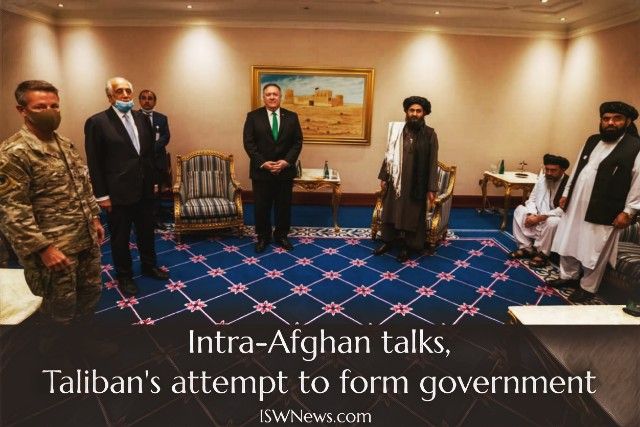
Intra-Afghan talks, Taliban’s attempt to form government
According to the US-Taliban peace agreement, intra-Afghan talks were to begin ten days after the signing of the Taliban-US peace agreement on February 29, 2020; But the process of releasing Taliban prisoners, a precondition for the Taliban to begin negotiations, has been delayed for more than seven months. Following the delay, representatives of the two sides finally met in Qatar last Sunday and officially resumed initial talks.
In the meantime, foreign countries have each had an impact on these negotiations, among which the United States has a greater influence and is directly involved in the negotiation process.
And according to the framework designed in these negotiations, it can be said that the Afghan government is not able to move forward without the approval and coordination of the United States.
“We agree with the Taliban that no foreign parties should be present in the negotiating room, but they may be needed at some point in the negotiations,” Abdullah Abdullah said in an interview before the initial talks with the Taliban.
Other important issues raised by the parties in the negotiations include the following:
1- Ceasefire: which Abdullah Abdullah has mentioned as the first issue in the negotiations with the Taliban and despite the reduction of violence agreed between the US and the Taliban, the clashes continue and the Afghan government strongly condemns this issue. Sustainable casefire is one of the main demands of the Afghan government.
2- Islamic system: which “Mullah Abdul Ghani Baradar” has mentioned as one of the main goals of the Taliban. Of course, most political currents in Afghanistan emphasize the implementation of the “Islamic system” in this country, but their definitions are different from this statement, and perhaps this is the most important reason for the continuing war in Afghanistan so far.
3- Provisional government: which is mostly mentioned by the Afghan media and has not been seriously discussed in the negotiation process so far. But it could become the Taliban’s newest and most important negotiating tool in the peace talks.
4 – Reduction of foreign forces: This issue is also one of the US commitments in the peace agreement with the Taliban, which according to the latest statements of US officials, the US is reducing the number of its troops from 8,000 to 4,500.
The US military withdrawal from Afghanistan, in addition to the triumphant gesture it portrays for the Taliban, will make some influential powers, such as Iran and Russia, more positive about the Afghan peace talks.
In fact, the US withdrawal from Afghanistan will alleviate some of Iran’s concerns about the security of its eastern borders, and with this, the level of hope for a full-fledged peace in Afghanistan will increase.
Another issue highlighted by the media in recent days was the shift of the Taliban negotiator from “Shir Mohammad Abbas Stanekzai” to “Mawlavi Abdul Hakim”, which was attributed to internal Taliban disputes. This change not only does not reflect the internal differences of the Taliban, but also shows the coordination and intelligence of the Taliban during the negotiations. Because Abdul Hakim is a more dominant figure in the field of negotiations with Afghan internal groups and more suitable for resolving disputes with them.
One of the reasons Stanekzai chose to negotiate with the United States was his fluency in English and foreign policy issues, but what matters to the Taliban in negotiating with Afghan groups is the ideology and thinking they have fought for years to differentiate themselves from other Afghan groups. According to Taliban officials, no one but Mawlavi Abdul Hakim is able to defend their positions in the internal negotiations.
In general, both the central government and the Taliban have come to the conclusion that war is not the right solution to the conflict, and that negotiation is the best way to bring peace to Afghanistan.
Based on past statements by Taliban officials and the change in the composition of the Taliban negotiating team, it can be said that the group does not intend to withdraw from its positions in the inter-Afghan talks from “forming a government” and it seems that issues such as “permanent ceasefire” And “severing ties with al-Qaeda” are Taliban’s tools for achieving this important goal.
Therefore, it is very likely that the Taliban will call for elections in Afghanistan in the negotiations, because they consider the majority of Afghanistan as their supporters. Also, the Taliban will definitely never approve of Ashraf Ghani’s government as the organizer of the elections and will demand the formation of an interim government or an independent election committee to hold the elections; Because they believe in fraud and manipulation of votes in the third and fourth presidential elections in Afghanistan and will not enter the predetermined land by the Westernist government of Afghanistan.


