Commander of the Islamic Revolution Guards Corps (IRGC) Aerospace Force Brigadier General Amir Ali Hajizadeh confirmed that the Chamran-1 satellite was launched into the 550-kilometer orbit with the Qaem-100 space launch vehicle and was placed in orbit round the earth with the help of a three-stage launcher at a speed of 7.5 kilometers per second.
The launch moment of Qaem 100 SLVInjection of Chamran-1 hexagonal satellite into 550 km orbit
The Chamran-1 research satellite was designed and manufactured by the space department of the Iran Electronics Industries (SAIran) in collaboration with the Aerospace Research Institute (ARI) of Iran as well as Iranian knowledge-based private companies active in this field.
The home-grown satellite weighs nearly 60 kilograms, and its main mission is to examine hardware and software systems applied to it in order to validate its orbital maneuvering technology at the desired altitude and stage.
Chamran-1 satellite
The solid-fuel Qaem-100 space launch vehicle, which succeeded in placing the Chamran-1 satellite in orbit during its third orbital operation, had four space-related launches to date as follows:
Suborbital launch without a payload (November 5, 2022) Failed orbital launch of the Nahid-1 satellite (March 4, 2023) Successful orbital launch of the Soraya satellite (January 20, 2024) Successful orbital launch of the Chamran-1 satellite (September 14, 2024)
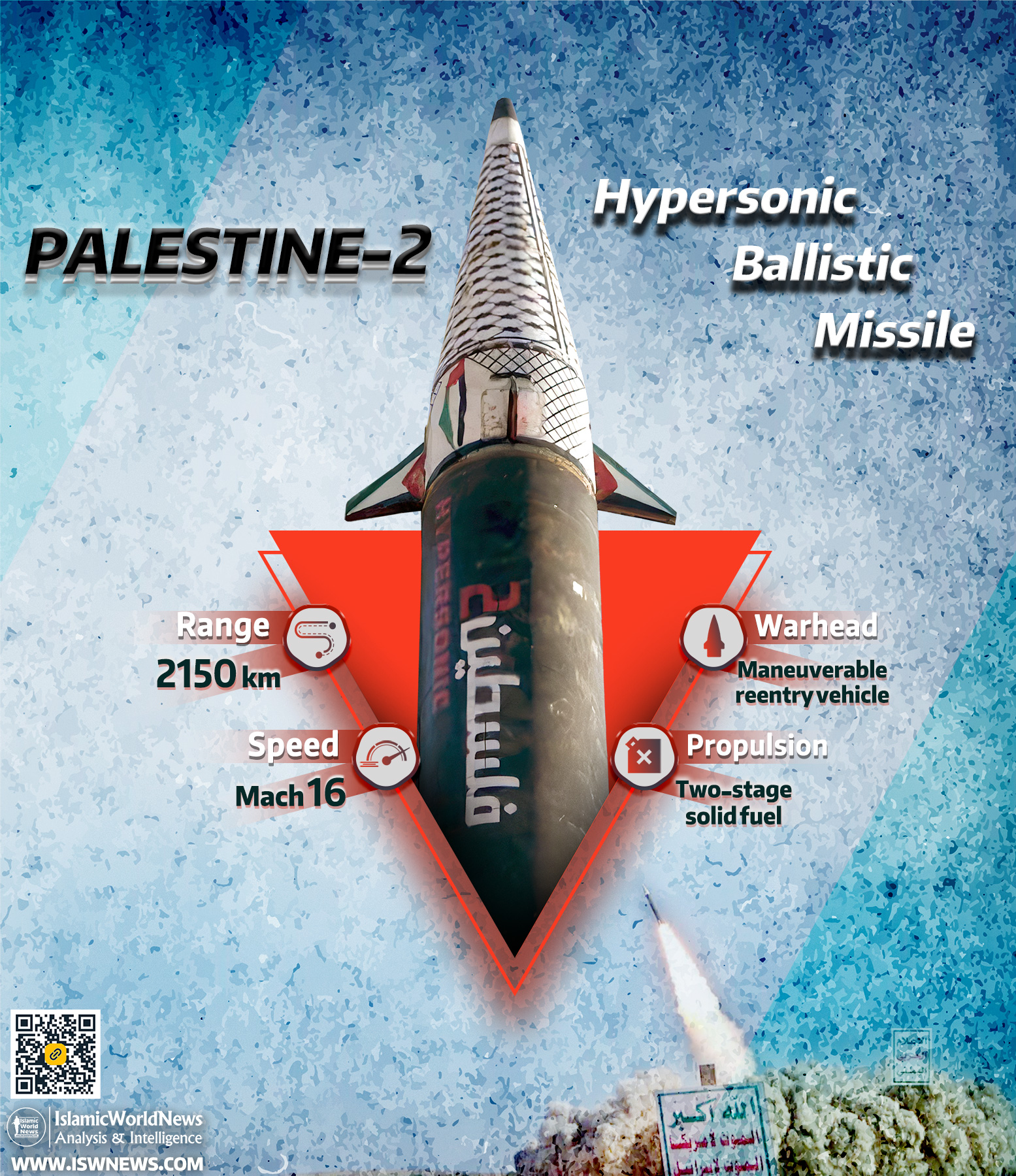
Palestine-2 hypersonic missile, is a two-stage solid-fueled missile with a speed of Mach 16, and its warhead is capable of maneuvering inside atmosphere.
The Palestine 2 missile is Yemen’s adaptation of the Iranian Kheibar Shekan 2 missile. To enhance its capability to strike deeper into Israeli-occupied territories, Yemen has reduced the missile’s warhead weight and extended its range to 2,150 kilometers.
Palestine-2 missilePalestine-2 missile
In general, the Palestine and Hatem class missiles of the Yemeni army are derived from the Iranian Kheibar Shekan 1 and 2 missiles.
The Hatem 1 and 2 missiles have a three-cone warhead similar to the Iranian Kheibar Shekan-1 missile, and the Palestine 1 and 2 missiles have a single-cone warhead derived from the Iranian Kheibar Shekan-2 missile.
The range of the Palestine-1 missile is 1,800 kilometers, like the Iranian Khaybar Shekan-2. However, the range of the Palestine-2 missile has been slightly increased to about 2,150 kilometers.
Khaybar Shekan 1Khaybar Shekan 2Iranian Khaybar Shekan 1 and 2
As to the military operations of the Kataib Sayyid al-Shuhada, Al-Walai said that the first phase of their assaults in support of the Gaza Strip kicked off with strikes on US bases inside the Iraqi territories, which proved to be effective.
“By God’s grace, the resistance fighters managed to disable much of the US’s military bases in Erbil Governorate and al-Harir town. The second phase of these attacks involved pounding positions in occupied territories of Palestine, during which the fighters targeted power plants and ports in the cities of Ashdod and Haifa. The third stage commenced with joint operations alongside the heroic fighters of Yemen, as noted by Leader of the Ansar Allah movement Sayyid Abdul-Malik al-Houthi”, he said.
Al-Walai also emphasized that arrangement is underway for the implementation of the fourth phase of the attacks, which will involve more coordination to pave the way for operating on multiple fronts.
The secretary-general of the Kataib Sayyid al-Shuhada also highlighted the Iraqi resistance’s participation in the Battle of Promised Conquest, noting that they succeeded in coordinating endeavors across various fronts, and launched missiles and drones at their targets at the same time.
Describing the recent developments in the Red Sea and the Mediterranean Sea as astonishing for the world public opinion, he asserted that the foes are struggling to cope with the fiery front in and around Yemen.
Al-Wala’i voiced pride in serving under the Ansar Allah movement leader, adding that Hamas’ Izz ad-Din al-Qassam spokesman Abu Obaida and the Yemeni Armed Forces’ Spokesman Brigadier General Yahya Saree are considered as the role models for youth and children in Iraq.
The Iraqi commander also admired the massive gatherings of the Yemeni people in support of Palestine, and emphasized that the slogans of the Yemeni demonstrators are a source of encouragement for the fighters on the Islamic resistance front.
It is noteworthy that fighters of the Iraqi resistance groups as well as the Yemeni Armed Forces carried out eight joint assaults against the positions of the Israeli regime’s army in occupied Palestine and the Mediterranean Sea only in one month (June 6 to July 8), which exerted remarkable pressure on the ports of occupied Palestine and Israeli-affiliated vessels in the Mediterranean Sea.
According to local Yemeni sources, divisions of the Dar al-Watan forces, who are affiliated with Saudi Arabia, have started entering the desert of Al-Jawf Governorate in northern Yemen to take control of the border military sites between the war-torn country and Saudi Arabia.
The Yemeni sources also confirmed that the process of replacing Al-Dara’ al-Watan forces with armed members of the Al-Islah Party (the Yemeni Congregation for Reform) is part of a security plot, which also comprises the city of Marib that is the headquarters of the Al-Islah Party.
The plan for deploying Al-Dara’ al-Watan forces in Hadhramaut, Al-Jawf, Marib, and Shabwa governorates reflects the Saudi kingdom’s attempt to dominate Yemen’s oil-rich regions prior to achieving any potential political accord.
Al-Dara’ Al-Watan (Nation Shield) forces are militants, who formed in November 2022 with the support of Saudi Arabia to pursue its plans in Yemen.
Four days after the attack, more details about the incident are beginning to emerge.
The Israeli newspaper, Yediot Aharonot, quoted a media close to the Syrian-militants, claiming that during the Israeli army’s airstrike in Masyaf, Israeli special forces carried out a heliborne operation inside Syria.
Israeli special forces allegedly confiscated important files and documents from a building south of Masyaf, and destroyed the scientific research building belonging to the Syrian army, where high-tech military industries are being developed with Iranian assistance.
Israeli media also claim that they nabbed two Islamic Revolutionary Guard Corps (IRGC) members from the area.
The report claimed that the Israeli army targeted the vehicles sent by the Syrian security forces to the incident site using suicide drones. Israeli aircraft targeted several roads in the area and cut off all the routes leading to the Syrian military research center to ensure the operation proceeded without any problems.
Satellite images confirm this claim. According to satellite images, at least four roads leading to the research center were bombed.
The red circles are the roads that were bombed by the Israeli regime on the night of the operation to block the communication routes to the research center.
In addition to bombing the roads leading to the research center, an electric power plant in the north of Masyaf was also bombed. This attack caused widespread power outages in different areas of Masyaf. Communication infrastructures, fiber optic cables, and power transmission lines were also targeted in order to completely cut off communications.
The electric power plant that was attacked in the north of Masyaf. (coordinates)
Also, on the night of the attack, local sources in al-Duraykish area in Tartus province heard the sound of helicopters flying at a low altitude. Speculations indicate that the Israeli special forces entered Syria from the Mediterranean Sea and the south side of Tartus and went to Masyaf.
The alleged video, which is said to have been recorded by local people in al-Duraykish area. The sound of helicopters flying at low altitude can be heard.
Field reports indicate that vehicles near the research center or any activity capable of disrupting the operation were targeted.
All the mentioned cases indicate that this attack was carried out according to a detailed and premeditated plan.
(Images of the targeting of vehicles, motorcycles, communication routes and electricity and internet cables on the night of the attack near the Syrian research center in Masyaf.)
Sources close to the Syrian government described the operation in Masyaf as “a complex military operation”, but strongly denied the Hebrew media claim regarding the kidnapping of Iranian forces, and called it a blatant lie.
A Syrian military source emphasized “Everything that the Hebrew and Western media published about the Masyaf operation came from the opposition Syrian TV, whose credibility rating is below zero. There is no Iranian facility in Masyaf, and there is absolutely no presence of the IRGC forces in the entire region, and the Syrians know this very well.”
“What happened in Masyaf was major and a “complex military operation.” We abide by the Syrian state’s decision not to circulate any details related to the incident,” he added.
Iranian media close to the IRGC also denied the Israeli claim. Iranian media stated “we (IRGC) did not have forces at the targeted site in Masyaf and we deny that we had any casualties or captures.”
The Iranian Foreign Ministry also condemned the airstrikes but denied the presence of any Iran-operated military site in the area.
It is worth noting that Masyaf area has been targeted by Israel many times. This military base, which is identified as an alleged underground facility known as “Research Center 4000”, was also targeted in a series of Israeli airstrikes on March 12, 2023. The previous time, the airstrikes were also launched from Lebanon’s airspace.
Nevertheless, the fact is that all the stories about the airdrop operation in Masyaf are currently just speculations. It is not possible to confirm this issue with certainty until more evidence is presented or reliable documents are published by either side.
If Israel’s claim is true, it is likely that Benjamin Netanyahu, who is now under intense pressure from public opinion and various political factions due to his cabinet’s disastrous performance, will make this story public in the coming days. He and Gallant face accusations of genocide for crimes in Gaza at the International Court of Justice and need to buy time for themselves with this show.
A spokesperson for the US embassy in Iraq confirmed Wednesday that the diplomatic mission in Baghdad was attacked on Tuesday night; however, no casualties have been reported so far.
The spokesperson also noted that the American forces in Iraq are evaluating the damage and the cause of the strike, and that more information will be provided following the end of the evaluations.
It is noteworthy that local Iraqi sources said that an attack on the base of US troops took place in the vicinity of the Baghdad International Airport in the late hours of Tuesday (local time).
Following the attack, Spokesman for the Kata’ib Hezbollah resistance faction in Iraq Jaafar al-Husseini stated that the suspicious attack was carried out on Baghdad airport in a bid to disrupt the upcoming visit of Iranian President Masoud Pezeshkian to Iraq.
As of the moment of publishing this report, no individual or group has claimed responsibility for the suspicious strike.
Major General Tahsin al-Khafaji, spokesman for Iraq’s Joint Operation Command, also declared that the nature, type of explosion, and reasons behind this attack still remain unclear for Iraqi security forces, adding that no party has taken responsibility for it yet.
Early in the morning of September 11, ISIS terrorist group raided Syrian Arab Army’s (SAA) chekpoints between the city of Al-Mayadin and the village of Quriyah.
According to local sources, ISIS terrorists employed light and medium machine guns in attacks.
As result of clashes, an SAA serviceman was killed and three others were wounded. ISIS militants subsequently retreated to the desert areas in the western outskirts of Al-Mayadin.
ISIS has not yet claimed responsibility for the attack. However, the main terrorist group active in the Syrian desert is ISIS and these attacks are clearly carried out by ISIS.
In recent months, ISIS stepped up its attacks in central Syria.
Two individuals riding a motorcycle attacked oil tankers near the town of al-Dahla on September 10. The attack caused material damages
Seven SAA soldiers were killed in two separate attacks close to the town of Ithriyah in the eastern Homs countryside on September 5. On the same day, a shepherd was killed and two others were wounded as a result of an attack in the area of al-Buhamad in the southern Raqqa countryside. Both attacks were blamed on ISIS.
The Syrian military has already reinforced its positions in the central region and resumed strikes against ISIS cells and their hideouts there in cooperation with Russian forces.
On September 6, warplanes of the Russian Aerospace Forces carried out a series of airstrikes against hideouts used by the terrorist group close to the town of Madan in the eastern Raqqa countryside and the town of Rasafa in the southern countryside of the governorate.
In recent years, despite the continuous efforts by the Syrian army and Russian Aerospace Forces, the Syrian desert have witnessed the daily operations by ISIS elements against civilians, and military installations. Hundreds of Syrian army forces and allies were killled and wounded, but the terrorist group’s insurgency will not likely end any time soon.
It seems the terrorist group’s cells receive support from their comrades in the northeastern region which is held by the U.S. and its proxy, the Kurdish-led Syrian Democratic Forces. Also, the Syrian and Russian officials repeatedly accused U.S. forces in the southeastern area of al-Tanf of training and even arming militants, including members of ISIS.
Hayel Issa Abdel Jabbar Dhaifallah, A 58-year-old Palestinian tanker driver from the Rafat town of Ramallah, rammed into the Israeli army outpost in the Giv’at Assaf at high speed and ran over the Israeli troops. As a result of this retaliatory operation, one Israeli trooper was killed and another was injured.
Minutes after the incident, local sources reported the martyrdom of the Palestinian attacker, but the Israeli regime’s Channel 14 TV reported that the executor of the operation was not martyred but was injured and taken to a hospital in al-Quds.
The moment truck rammed into an Israeli army outpost in the Giv’at Assaf at high speed and ran over the Israeli soldiers
The Palestinian resistance movement Hamas congratulated the heroic operation near Ramallah, underlining that today’s operation was a natural response to the atrocities committed by the Israeli enemy in the Gaza Strip and the West Bank.
It is worth noting that three Israeli occupiers were killed as a result of an armed operation by a Jordanian driver at the Al-Karameh border crossing, located in the border between Jordan and Israeli-occupied territories on September 8.
While the ‘Aisha Umm Al Momineen secondary school’ was on the verge of being closed, the United States’ warplanes carried out two air raids on the entrance and surrounding areas of the school, which led to the martyrdom of two students – Hamas Abdullah Abd al-Salam (seventh grade) and Saji Ahmed Dahan (fifth grade) – and the wounding of nine other students.
The shock wave of the explosion also caused 13 other students to faint. At present, the injured students have been taken to a hospital and are being treated.
Two female students were martyred and 9 other students were injured as a result of the air attack by the American-British coalition fighter jets on a school in north of Taiz province.
Mohammed Abdul Salam, spokesman for the Ansar Allah movement and top negotiator of the Yemeni government, issued a statement to condemn the war crime, and emphasized that the US-UK coalition’s assaults on civilian areas will not prompt the Yemeni Armed Forces to halt their military operations in support of the Palestinian oppressed nation.
The ongoing air attacks by US warplanes on civilian sites in Yemen as well as the recent strike by the Israeli regime on the electricity facilities and fuel depot in the port city of al-Hudaydah proved that the Western states and their allies are incapable of confronting the retaliatory actions of the Yemeni Armed Forces and they have no way to challenge the Yemeni army.
Therefore, the aggressors have resorted to carry out terrorist operations, put pressure at domestic level, and try to divert the military confrontation on the Yemeni front.
According to an initial probe by the Israeli air force, a UH-60A Yanshuf from the 123rd Squadron flew to Rafah with a Unit 669 medical team late on September 10 to evacuate a combat engineer seriously wounded in fighting in the area.
During the final landing stage inside an Israeli army encampment in Rafah, the helicopter impacted the ground instead of touching down correctly. The probe alleges that the helicopter was not hit by enemy fire, and the crash occurred moments before it was supposed to land, meaning it did not fall from a significant height.
The helicopter was still heavily damaged in the crash as evident by video footage that was posted to social networks later in the day.
Scene of the accident
As a result of the crash, two soldiers were killed and another eight were taken to hospitals, four of them in serious condition. Among the four seriously injured was the combat engineer who was injured separately.
Israeli forces’ casualties as a result of a helicopter crash in the southern Gaza Strip.
Israeli air force Chief Maj. Gen. Tomer Bar ordered a probe to determine why the helicopter impacted the ground in the encampment instead of landing correctly.
This was the second time Israel has acknowledged losing a helicopter since the start of the war on the Gaza Strip last October. The first helicopter, a S-65C-3 Yas’ur, was destroyed during a battle with fighters from the Hamas Movement in the Israeli settlement of Be’eri near the Palestinian enclave in the very first days of the war.
Hamas and other armed factions have not yet commented on the helicopter crash. More information on the so-called incident could surface in the upcoming few days.
Late hours on September 8, the Israeli military forces targeted the Syrian Armed Forces’ scientific research centers in Masyaf city as well as several other locations around the city.
In addition to the Syrian army’s research centers and a position in the north of the city of Masyaf, the Israelis also targeted a military base in the southwest of the city, which, according to the Israeli regime, was the site of the production of rockets utilized by the Lebanese resistance movement Hezbollah with the help of Iranian and Lebanese military advisers.
This military base, which is identified as an underground facility and the Institute 4000 research center, was also targeted in an airstrike by the occupying regime’s army on March 12, 2023. Since 2018, the mentioned center has been attacked by the Israeli regime’s army at least in four operations.
Satellite images of the underground facilities AKA 4000 center
Images, which have been released so far of the remnants of the regime’s drones and missiles indicate that the Tel Aviv regime utilized a combination of Delilah cruise missiles and suicide drones to pound its envisioned targets in the recent strike.
The Delilah cruise missile is manufactured by Israel Military Industries (IMI) and is used to pound stationary and mobile targets. The missile impact error (Circular Error Probable) of this class of missile is stated to be less than 1 meter.
Delilah cruise missiles
Moreover, the released images of the remnants of the UAVs shot down by the Syrian army’s defense systems also indicated that the Israeli regime used the IAI Harop class of drones in the recent attack.
Remains of missiles and drones of the Zionist army
The IAI Harop suicide drone is a relatively expensive loitering munition manufactured by the Israeli regime’s Aerospace Industries. The main task of this UAV is to overpower their enemy’s air defenses. The kamikaze drone was first displayed to the public in 2009 at the 7th edition of Aero India, which was a biennial air show and aviation exhibition held in Bangalore, India.
According to the evidence on the ground, it is now obvious that the sound of an explosion in Tartus port city was related to the activation of the Syrian army’s defense systems to intercept the missiles and suicide drones fired by the Israeli regime’s army.
Interception of Israeli missiles by the Syrian air defense missiles near Tartus
It seems that the regime is using suicide drones to engage or suppress the defense systems of the Syrian Armed Forces in order to pave the ground for launching cruise missiles.
Even though a number of Israeli drones and missiles were successfully intercepted and demolished by the Syrian army’s defense systems, a few number of them hit the predetermined targets of the Israeli regime.
The Israeli forces launched a new operation in the Tulkarm city of the West Bank on September 10.
Following the military raid on the Palestinian city, resistance fighters started reacting to the aggression by the occupying forces; thus, armed clashes took place in this region.
The Al-Aqsa Martyrs Brigades (AMB), a coalition of Palestinian resistance fighters in the West Bank, announced a direct clash with the Israeli forces in Tulkarm.
The Al-Quds Brigades, the armed wing of the Palestinian Islamic Jihad (PIJ), also issued a statement declaring that its fighters exploded roadside bombs on the way of an Israeli military convoy, and targeted an infantry of the regime’s army.
The Israeli army issued a statement declaring that they kicked off an assault against the resistance groups in Tulkarm as part of a military operation in the occupied West Bank.
According to the Palestinian Red Crescent Society (PRCS), a Palestinian girl has been shot dead by Israeli troops and four others have been wounded so far.
The latest statistics showed that confrontations and exchanges of fire continued in the city, and blasts and shootings can be heard from some areas in Tulkarm.