Author: Mirza
-

Gen. Soleimani congratulates Ayatollah Khamenei and Muslims on ISIS termination
Following the historic victory of Iraq and Syria’s resistance movement over the sedition of Takfiri terrorism and the end of ISIS’s domination, which was manifested by lowering the flag of this American-Zionist group at Abu Kamal–the last key area in the hands of ISIS–General Soleimani issued an important message to Ayatollah Khamenei.
The following is the full text of Major-General Soleimani’s message to Ayatollah Khamenei:
In the Name of God, the Most Beneficent, the Most Merciful“Indeed, we have opened for you (Prophet Muhammad) a clear opening.” Quran [1: 48]
To the dear and brave Leader of the Islamic Revolution, Ayatollah Khamenei:
Salamun Alaikum (peace and greetings upon you),
Six years ago, a dangerous plot like the ones at the time of Amir al-Mu’minin (as), which prevented Muslims from truly understanding the pure Islam of Muhammad (pbuh), this time, mixed with the poison of Zionism and arrogance, covered the Islamic world like a devastating storm.
This devastating and poisonous sedition was created by the enemies of Islam with an aim of initiating widespread war within the Islamic world and a fight among Muslims. The evil movement, under the name of the “Islamic State of Iraq and the Levant,” managed, in the early months, to deceive tens of thousands of Muslim youth from both countries, causing a very dangerous crisis for the influential and crucial countries of the Islamic world: Iraq and Syria.
They occupied hundreds of thousands of square kilometers of land from these countries along with thousands of villages, towns, and provincial centers; they destroyed thousands of factories, manufactures, and major infrastructure of these countries–including roads, bridges, refineries, wells, gas and oil lines, and power plants; they destroyed or burned important cities with valuable historical monuments and national civilizations by bombing them.
Although it is not possible to calculate all the damage caused yet, the preliminary investigation estimates damages to be around $500 billion.
In this event, there were extremely horrendous crimes that could not be shown, which included the following: decapitation of children, skinning men alive before their families, taking young girls and women hostage and raping them, burning people alive and group massacres of hundreds of young people.
The people of these countries, astounded by this poisonous storm, either became victims of the takfiri criminals or left their homes, displaced throughout other cities and countries.
In this dark sedition, thousands of mosques and sacred centers of Muslims were destroyed or ruined, and sometimes a mosque along with the Imam and all the people in it were blown up.
More than 6,000 young people, deceived in the name of defending Islam, blew themselves up by way of suicide bombings, using explosive vehicles at city squares, mosques, schools, even hospitals and public places of Muslims; as a result of these criminal acts, tens of thousands of innocent men, women, and children were martyred.
All these crimes have been designed and implemented by US leaders and organizations, according to the acknowledgement of the highest-ranking US official who is currently president of the United States; moreover, this scheme is still being modified and implemented by current American leaders.
What, in addition to the favour of God and the special grace of the great Prophet Muhammad and his honorable household (pbut), led to the defeat of this dark and dangerous conspiracy was the wise leadership and guidance of his Excellency, Ayatollah Sistani, who mobilized all facilities to deal with this toxic storm.
Certainly, the resistance of the Iraqi and Syrian governments and the perseverance of the armies and youths of these two countries, especially the holy Popular Mobilization Forces (PMF), Al-Hashd Al-Sha’abi, and other Muslim youth from other countries with the prominent presence of Hezbollah led by its great leader, Sayyid Hassan Nasrallah, played an important role in overturning this dangerous event.Definitely the valuable role of the nation and the government of the Islamic Republic of Iran–the respected president in particular–the parliament, the Defense Ministry, as well as police, military and security organizations of our country, in supporting the above mentioned states and nations, is admirable.
This humble person, as a soldier called upon by your eminence to serve on this battlefield, announces the termination of the rule of this vicious cursed entity, following the completion of the liberation operation of Abu Kamal as ISIS’ last fort, bringing down the flag of this US-Zionist made terrorist group, raising the flag of Syria. On behalf of all the commanders and anonymous fighters on the battlefield, the thousands of Iranian, Iraqi, Syrian, Lebanese, Afghan and Pakistani martyred and disabled defenders of the holy shrine–who gave their lives to defend the lives and honor of Muslims and their sanctities–I congratulate and felicitate you and the noble nation of Islamic Iran, as well as the nations of Iraq, Syria, and other Muslims of the world. I prostrate before the Almighty God in gratitude for this great victory.“And victory comes only from God, the All-mighty, the All-wise.” Quran [3:126]
Your son and soldier
Qasem Soleimani
-

SDF Made Large Advance In Southeastern Deir Ezzor. ISIS Massacred Again Refugees
Meanwhile, the SDF announced that its fighters were repelling a wide-scale attack of ISIS on their positions southeast of al-Tanak oil field near the Syrian-Iraqi border. The SDF said that its fighters destroyed a BMP-1 armored vehicle and a VBIED during the clashes around al-Tanak.
The ISIS-linked news agency Amaq announced that ISIS fighters killed 6 fighters of the SDF and destroyed an armored vehicle of the SDF southeast of the Omar oil fields.
In a related development, the Syrian Arab News Agency (SANA) reported that a VBIED of ISIS targeted a gathering of Syrian refugees between the CONICO gas facility and the Jafra oil field north of Deir Ezzor city. According to SANA, over 20 civilians were killed and 30 other injured in the attack.
This is the third ISIS attack agaonst the refugees inside the SDF-held areas with VBIEDs. Back on November 4, a VBIED of ISIS killed over 100 refugees in the same area between the CONICO gas facility and the Jafra oil field. On October 12, an ISIS suicide bomber driving a VBIED targeted a gathering of civilians near the Abu Fas area on the al-Hasakah–Deir Ezzor highway killing over 40 civilians.
The ISIS attacks on the refugees prove that the SDF-held areas are far from being safe, especially that ISIS managed to hit the same position over 30km deep inside the SDF-held areas twice in a single month.
Text by SouthFront
-
BBC Confirms the US-led Coalition Is Part of the Problem in Syria Rather than any Solution
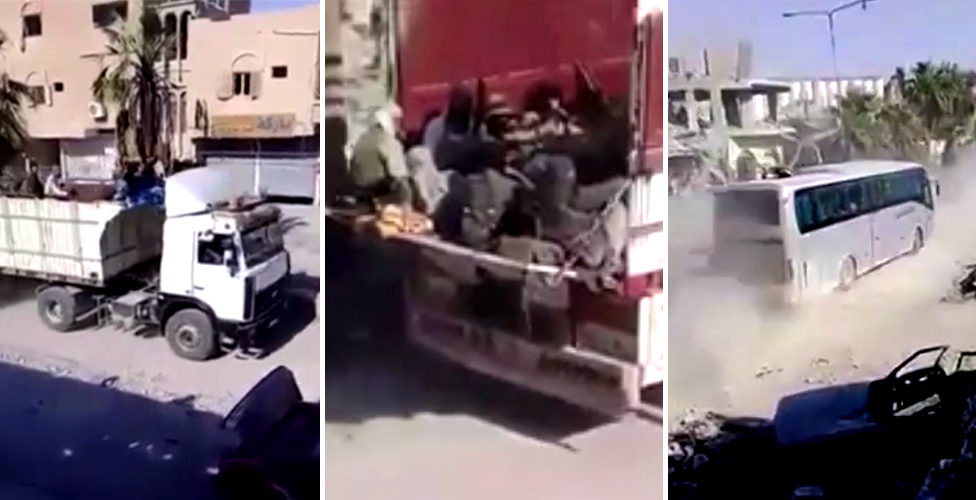
The revelations carried in a recent BBC report, concerning a deal that was struck between the US-led coalition that has been engaged in the battle to retake the Syrian city of Raqqa in recent months and the Daesh fighters occupying the city – a deal allowing hundreds of said fighters to be evacuated along with their families and weaponry – could not be more scandalous. More than opportunism, it exposes the oft-proclaimed commitment of Washington and its allies to destroying Daesh as hollow.
According to the BBC the deal “enabled many hundreds of IS [Daesh] fighters to escape…At the time, neither the US and British-led coalition, nor the SDF, which it backs, wanted to admit their part.” According to the personal testimony of some of the drivers employed to evacuate the fighters and their families out of Raqqa, “the convoy was six to seven kilometres long. It included almost 50 trucks,13 buses and more than 100 of the Islamic State group’s own vehicles.” We also learn that despite “an agreement to take only personal weapons, IS fighters took everything they could carry. Ten trucks were loaded with weapons and ammunition.”
No one should be in any doubt when it comes to the gravity of seriousness involved in allowing hundreds of Daesh fighters to escape and fan out across Syria with some, according to the BBC, making it across the border into Turkey. The burning question is whether the deal and subsequent evacuation was undertaken with the express purpose of diverting them to parts of Syria controlled by the Syrian Army and its allies?
What is certain is that it brings the US-led coalition into disrepute, confirming that it is part of the problem in Syria and wider region rather than any solution. When we add to this sordid picture the recent sentiments of US Secretary of State Rex Tillerson, asserting that there is no future for Assad in Syria, it is clear that regime change in Damascus remains Washington’s overarching objective.
When it comes to regime change in Syria, exactly who would benefit? Certainly not the Syrian people after the inordinate suffering and sacrifice they have endured in the process of first withstanding then defeating a concerted attempt to destroy the country and its non-sectarian character.
A dirty war has been waged in Syria these past six year not by Daesh, per say, but by the US, UK, and their Persian Gulf allies. Add to this motley crew Israel’s repeated violations of Syrian airspace and you identify an axis which constitutes a threat to human progress and development such as the world hasn’t seen since the Second World War.
As for the Syrian Kurds, fighting under the banner of the SDF (Syrian Democratic Forces), they now have a critical role to play when it comes to the trajectory the conflict takes upon the liberation of Raqqa. Indeed upon their next move will depend whether it will be accurate to describe the removal of Daesh from the city as liberation or whether it will be more akin to a re-occupation.
It has never been more important for the Kurds not to make the mistake of confusing self-determination with treachery. Their part in defeating Daesh has undoubtedly been a courageous one. However with this secret deal to allow hundreds of Daesh militants to leave the city with their weapons and ammunition, it is impossible to avoid pondering if they are now preparing for a post-Daesh confrontation with the Syrian Army, which has just liberated Deir Ezzor 145km southeast of Raqqa.
The point bears repeating: the presence of US military forces in Syria constitutes a clear violation of international law. It bears repeating when we have key US officials, such as Defense Secretary James Matthis, claiming UN sanction for this presence. As Russia Deputy Foreign Minister Gennady Gatilov pointed out in reponse to the US Defense Secretary’s false claim, “Syria is a sovereign independent state,” going on to remind Mr Matthis that “only the Syrian government can invite armed forces of third countries onto its territory. The UN has no such right,” he went on, before emphasizing that “the fight against terrorism does not give any states or coalitions a free hand to establish their presence on Syrian territory.”
There is no doubt, surveying the contours of this struggle in Syria, that driving it has been the ongoing attempt not only to destroy Syria’s sovereignty and independence, but to neuter Iran’s independence also. This is why Trump’s recent unhinged and uninformed bellicose statements, directed at Iran, should come as no surprise. What with the purge unleashed by crown Prince Mohammad bin Salman in the Riyadh recently, along with the detention and forced resignation of Lebanon’s Prime Minister Saad Hariri, though the battle for Syria draws to a close, the wider struggle between the axis of sectarianism and regime change – comprising Washington, Saudi Arabia, and Israel – and the axis of resistance to it – comprising Russia, Iran, Syria and Hezbollah .
-

Last Military Situation in Central and Eastern Syria till November 13, 2017
– Liberation of Deir Ezzor city and continuing operation in Hawija Qate
– The arrival of the Syrian Resistance and the Syrian Army at the east of the T-2 station on the Iraqi-Syrian border.
– Moving towards al-Bukamal and the siege of this city and the city’s military fall.
– Continuing advances of the Syrian army and resistance on the north-east front of Hama.
– Progression of the Syrian army ~30 kilometers south east of Al-Mayadin.
– The advances of SDF in north of the Euphrates and the occupation of the oil and gas wells of Omar and Tanak
– The advances of SDF in the southern province of Al-Hassekah and the domination of the important area of “Markadeh”.
-

Saudi Arabia Calls On UN Security Council To Take Action Against Iran
Translate provided by SouthFront
-

World’s Biggest Pilgrimage Now Underway, And Why You’ve Never Heard of it!
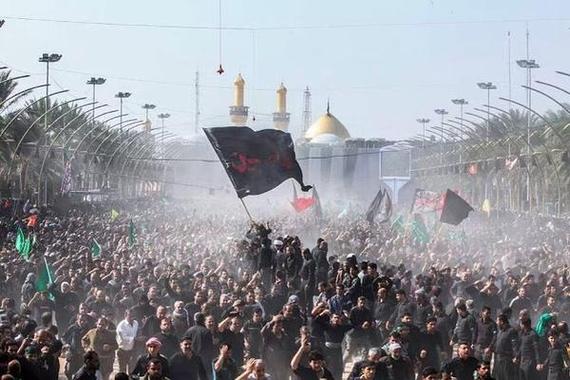
Not only does the congregation exceed the number of visitors to Mecca (by a factor of five, in fact), it is more significant than Kumbh Mela, since the latter is only held every third year. In short, Arbaeen dwarfs every other rally on the planet, reaching twenty million last year. That is a staggering %60 of Iraq’s entire population, and it is growing year after year.

Above all, Arbaeen is unique because it takes place against the backdrop of chaotic and dangerous geopolitical scenes. Daesh (aka ‘Islamic State’) sees the Shia as their mortal enemy, so nothing infuriates the terror group more than the sight of Shia pilgrims gathering for their greatest show of faith.
There’s another peculiar feature of Arbaeen. While it is a distinctively Shia spiritual exercise, Sunnis, even Christians, Yazidis, Zoroastrians, and Sabians partake in both the pilgrimage as well as serving of devotees. This is remarkable given the exclusive nature of religious rituals, and it could only mean one thing: people regardless of color or creed see Hussein as a universal, borderless, and meta-religious symbol of freedom and compassion.
Why you have never heard of it probably has to do with the fact that the press is concerned more with negative, gory, and sensationalized tabloids, than with positive, inspiring narratives, particularly when it comes to Islam. If a few hundred anti-immigration protestors take to the streets in London and they will make headlines.. The same level of airtime is awarded to a pro-democracy march in Hong Kong or an anti-Putin rally in Russia.. But a gathering of twenty million in obstreperous defiance of terror and injustice somehow fails even to make it into the TV news ticker! An unofficial media embargo is imposed on the gargantuan event despite the story having all the critical elements of an eye-catching feature; the staggering numbers, the political significance, the revolutionary message, the tense backdrop, as well as originality.. But when such a story does make it through the editorial axe of major news outlets, it creates shockwaves and touches the most random people.
Among the countless individuals inspired by it, is a young Australian man I met several years ago who had converted to Islam. Evidently, no one takes such a life-altering decision lightly, so upon inquiry he told me it all started in 2003. One evening, as he was watching the news only to be drawn by scenes of millions streaming towards a holy city known as Karbala, chanting the name of a man he had never heard of: “Hussein”. For the first time in decades, in a globally televised event, the world had caught an glimpse into previously suppressed religious fervor in Iraq.
With the Sunni Ba’athist regime toppled, Western viewers were eager to see how Iraqis would respond to a new era free from dictatorship persecution. The ‘Republic of Fear’ had crumbled and the genie had irreversibly escaped from the bottle. “Where is Karbala, and why is everyone heading in its direction?” he recalls asking himself. “Who is this Hussein who motivates people to defy all the odds and come out to mourn his death fourteen centuries after the fact?”
What he witnessed in that 60-second report was especially moving because the imagery was unlike any he had ever seen. A fervent sense of connection turned human pilgrims into iron filings, swarming together other as they drew closer to what could only be described as Hussein’s irresistible magnetic field. “If you want to see a living, breathing, lively religion, come to Karbala” he said.
How could a man who was killed 1396 years ago be so alive and have such a palpable presence today that he makes millions take up his cause, and view his plight as their own? People are unlikely to be drawn into a dispute (much less one that transpired in ancient times) unless they have a personal interest in the matter. On the other hand, if you felt someone was engaged in a fight over your right to freedom, your prerogative to be treated justly, and your entitlement to a life of dignity, you would feel you had a vested interest and would empathize with him to the point where conversion to his beliefs is not a far-fetched possibility.
The Ultimate Tragedy
Hussein, grandson of the Prophet Muhammad, is revered by Muslims as the “Prince of Martyrs”. He was killed in Karbala on a day which became known as Ashura, the tenth day of the Islamic month of Muharram, having refused to pledge allegiance to the corrupt and tyrannical caliph, Yazid.
He and his family and companions were surrounded in the desert by an army of 30,000, starved of food and water, then beheaded in the most macabre manner, a graphic tale recounted from pulpits every year since the day he was slain. Their bodies were mutilated. In the words of the English historian Edward Gibbon: “In a distant age and climate, the tragic scene of the death of Hussein will awaken the sympathy of the coldest reader.”
Shia Muslims have since mourned the death of Hussein, in particular on the days of Ashura, then, forty days later, on Arbaeen. Forty days is the usual length of mourning in many Muslim traditions. This year, Arba’een falls on Friday 12 December.
Long Trek
I travelled to Karbala, my own ancestral home, to find out for myself why the city is so intoxicating. What I witnessed proved to me that even the widest-angle camera lens is too narrow to capture the spirit of this tumultuous, yet peaceful gathering.
An avalanche of men, women and children, but most visibly black-veiled women, fill the eye from one end of the horizon to the other.The crowds were so huge that they caused a blockade for hundreds of miles.
The 425 mile distance between the southern port city of Basra and Karbala is a long journey by car, but it’s unimaginably arduous on foot. It takes pilgrims a full two weeks to complete the walk. People of all age groups trudge in the scorching sun during the day and in bone-chilling cold at night. They travel across rough terrain, down uneven roads, through terrorist strongholds, and dangerous marshlands. Without even the most basic amenities or travel gear, the pilgrims carry little besides their burning love for “The Master” Hussein. Flags and banners remind them, and the world, of the purpose of their journey:
O self, you are worthless after Hussein.My life and death are one and the same,
So be it if they call me insane!
The message recalls an epic recited by Abbas, Hussein’s half-brother and trusted lieutenant, who was also killed in the Battle of Karbala in 680AD while trying to fetch water for his parched nieces and nephews. With security being in the detrimental state that makes Iraq the number one headline in the world, no one doubts that this statement is genuine in every sense.
Free lunch.. And dinner, and breakfast!
One part of the pilgrimage which will leave every visitor perplexed is the sight of thousands of tents with makeshift kitchens set up by local villagers who live around the pilgrims’ path. The tents (called ‘mawkeb’) are places where pilgrims get practically everything they need. From fresh meals to eat and a space to rest, to free international phone calls to assure concerned relatives, to baby diapers, to practically every other amenity, free of charge. In fact, pilgrims do not need to carry anything on the 400 mile journey except the clothes they wear.
More intriguing is how pilgrims are invited for food and drink. Mawkeb organizers intercept the pilgrims’ path to plead with them to accept their offerings, which often includes a full suite of services fit for kings: first you can a foot massage, then you are offered a delicious hot meal, then you are invited to rest while your clothes are washed, ironed, then returned to you after a nap. All complimentary, of course.
For some perspective, consider this: In the aftermath of the Haiti earthquake, and with worldwide sympathy and support, the UN World Food Programme announced delivery of half a million meals at the height of its relief efforts.. The United States military, launched Operation Unified Response, bringing together the massive resources of various federal agencies and announced that within five months of the humanitarian catastrophe, 4.9 million meals had been delivered to Haitians. Now compare that with over 50 million meals per day during Arbaeen, equating to about 700 million meals for the duration of the pilgrimage, all financed not by the United Nations or international charities, but by poor laborers and farmers who starve to feed the pilgrims and save up all year round so that visitors are satisfied. Everything, including security is provided mostly by volunteer fighters who have one eye on Daesh, and another on protecting the pilgrim’s path. “To know what Islam teaches,” says one Mawkeb organizer, “don’t look at the actions of a few hundred barbaric terrorists, but the selfless sacrifices exhibited by millions of Arbaeen pilgrims.”
In fact, Arbaeen should be listed in the Guinness Book of World Records in several categories: biggest annual gathering, longest continuous dining table, largest number of people fed for free, largest group of volunteers serving a single event, all under the imminent threat of suicide bombings.
Unmatched Devotion
Just looking at the multitudes leaves you breathless. What adds to the spectacle is that, as the security conditions worsen, even more people are motivated to challenge the terrorist threats and march in defiance. Thus, the pilgrimage isn’t a mere religious exercise, but a bold statement of resistance. Videos have been posted online showing how a suicide bomber blows himself up in the midst of the pilgrims, only to have the crowds turn out in even greater numbers, chanting in unison:
If they sever our legs and hands,We shall crawl to the Holy Lands!
The horrific bomb blasts which occur year-round, mostly targeting Shia pilgrims and taking countless lives, illustrate the dangers facing Shias living in Iraq, and the insecurity that continues to plague the country. Yet the imminent threat of death doesn’t seem to deter people – young and old, Iraqis and foreigners – from making the dangerous journey to the holy city.
It isn’t easy for an outsider to understand what inspires the pilgrims. You see women carrying children in their arms, old men in wheelchairs, people on crutches, and blind seniors holding walking sticks. I met a father who had travelled all the way from Basra with his disabled boy. The 12-year-old had cerebral palsy and could not walk unassisted. So for a part of the trek the father put the boy’s feet on top of his and held him by the armpits as they walked. It is the kind of story out of which Oscar-winning films are made, but it seems Hollywood is more concerned with comic heroes and with real life heroes whose superpower is their courage and commitment.
Golden Dome of Hussein
Visitors to the shrine of Hussein and his brother Abbas are not driven by emotion alone. They cry be reminded of the atrocious nature of his death, in doing so, they reaffirm their pledge to his ideals.
The first thing that pilgrims do upon reaching his shrine is recite the Ziyara, a sacred text which summarizes the status of Hussein. In it, they begin the address by calling Hussein the “inheritor” of Adam, Noah, Abraham, Moses and Jesus. There is something profound in making this proclamation. It shows that Hussein’s message of truth, justice, and love for the oppressed is viewed as an inseparable extension of all divinely-appointed prophets.
People go to Karbala not to marvel at the city’s landscape – lush with date palms, or to admire the mausoleum’s physical beauty, or to shop, be entertained, or to visit ancient historical sites. They go to cry. To mourn and experience the angelic aura of Hussein. They enter the sacred shrine weeping and lamenting the greatest act of sacrifice ever seen.
It is as though every person has established a personal relationship with the man they have never seen. They talk to him and call out his name; they grip the housing of his tomb; they kiss the floor leading into the shrine; they touch its walls and doors in the same manner one touches the face of a long-lost friend. It is a picturesque vista of epic proportions. What motivates these people is something that requires an understanding of the character and status of Imam Hussein and the spiritual relationship that those who have come to know him have developed with his living legend.
If the world understood Hussein, his message, and his sacrifice, they would begin to understand the ancient roots of Daesh and its credo of death and destruction. It was centuries ago in Karbala that humanity witnessed the genesis of senseless monstrosities, epitomized in the murderers of Hussein. It was pitch black darkness v. Absolute shining light, an exhibition of vice v. a festival of virtue, hence the potent specter of Hussein today. His presence is primordially woven into every facet of their lives. His legend encourages, inspires, and champions change for the better, and no amount of media blackout can extinguish its light.
“Who is this Hussein”? For hundreds of millions of his followers, a question this profound, which can cause people to relinquish their religion for another, can be answered only when you have marched to the shrine of Hussein on foot.
-

Syrian Army, Hezbollah, Fatemiyoun Reach Iraqi Border Near Al-Bukamal
The SAA and Hezbollah are now deployed near Akash fields and de-facto controls the road headign to the Iraqi city of al-Qaim, which was liberated by the Iraqi Army and the Popular Mobilization Units on Friday.
As soon as Syrian forces liberated Akash and secure their flanks, they will push towards al-Bukamal. Some sources say that ISIS members are now withdrawing from their stronghold. If true, al-Bukamal will be liberated within few days.
Text by SouthFront
-
How Barzani regime’s media ridiculed itself during the Kirkuk Crisis: the case of Rudaw and Kurdistan24
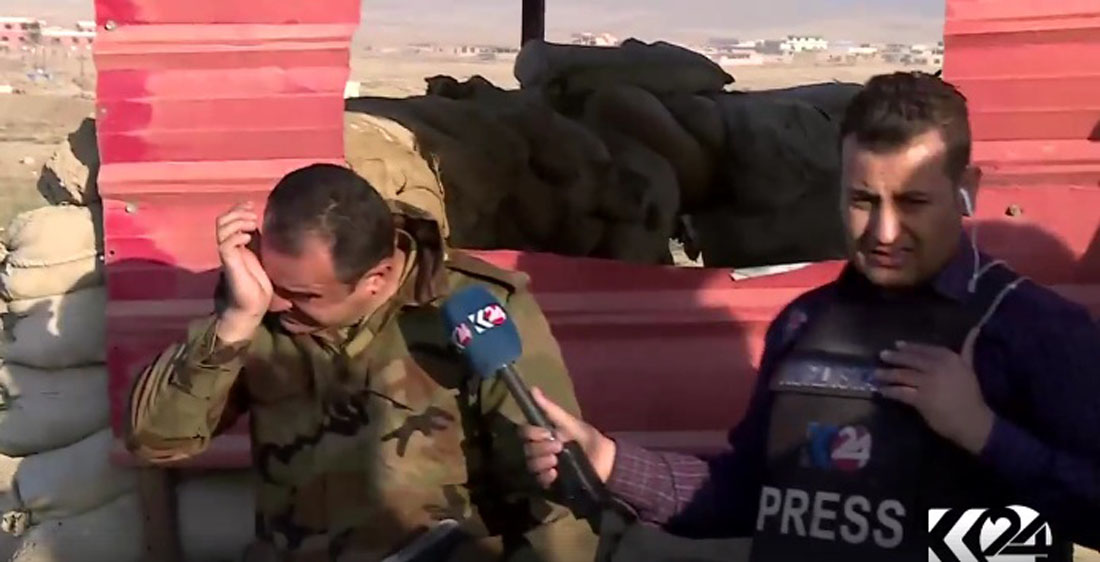
The political circus received relatively wide coverage in the Western media, but many people find it easier to follow the English-language regional media whose teams of professional journalists reported from the field and published articles more frequently. Beside the well established news networks like the Qatar-based Al-Jazeera, the Saudi-owned Al-Arabiya and the Iranian Press TV, several new actors have emerged on various social media platforms, notably Rudaw and Kurdistan24. In this October, the first one has recorded more than 94,000 shares and 480,000 comments on Facebook posts, as well as over 20 million impressions on Twitter, reaching over 90 million people in total. Rudaw has over 3.2 million Facebook followers, compared to Kurdistan24 which has less than half.
Media of tribal enterprise
The ownership background and the differences between two networks are quite astonishing. In the authoritarian countries, the national media presents one-sided view, and in totalitarian systems, all outlets are owned by the ruling party. However, in the tribal enterprise of the Barzani clan, called Iraqi Kurdistan, they have gone even further. Rudaw and Kurdistan24 therefore do not only present a single view and propagate policies that support the Kurdistan Democratic Party (KDP), but they’re also owned by the same family. Rudaw was established in 2008 for the purpose of serving interests of current Kurdish prime minister Nechirvan Barzani, and competitive Kurdistan24 (K24) was launched in 2015 by his cousin Masrour Barzani, a son of president Masoud Barzani. That’s the concept of, as Kurdophiles like to say, a Western-minded flourishing democracy and its free press.
In the mid 2000s, there was a brief period of the independent media in local languages, emerged in political chaos rather than a pluralistic environment. Information monopoly of ruling party was temporary staggered, so regional authorities quickly moved to stifle it. The first step of undermining was establishing a number of allegedly independent outlets, but de facto subservient to the regime. The second step was the severe repression of individuals and organizations. In 2008, journalist Soran Mama Hama was killed by unknown armed men, and later the same fate befell Sardasht Osman and Kawa Garmeyani. All were writing critically on the political situation and corruption in Iraqi Kurdistan. Numerous other independent reporters received death threats for reporting on corruption and discrimination. In 2011, a free satellite TV-station NRT was established, but was set on fire by armed men only three days after its official launch.
Both Rudaw and Kurdistan24 do not enjoy popularity among neighboring countries and their Kurdish groups. Rudaw has been banned in PYD-led Syrian Kurdistan for conducing a ‘smear campaign’ against them, while the Turkey’s Kurdistan Communities Union also called for the boycott and accused the media group as being founded by Turkish Intelligence Organization. Turkey itself has removed both Rudaw and Kurdistan24 from its TurkSat satellite, due to broadcasting violations during the independence referendum. Both channels are also banned in Iran, and even Baghdad issued statements threatening to revoke their television license in Iraq. Neither the US Department of State has any words of praise for Rudaw, describing it as the KDP affiliated outlet rather than objective media. On the other hand, among very few of their foreign admirers is Bernard-Henri Levy who recently spoke against proposed Baghdad’s ban and stated that “every friend of freedom in the world should support Rudaw.” His objectivity is already well known, as we’re speaking about the same person who called Israeli forces as “the most democratic army in the world.”
Referendum coverage
By analyzing coverage during the thirty days following the referendum, it’s easy to conclude that Rudaw’s and Kurdistan24’s strategic and tactical approach was almost identical. The personal rivalries between Nechirvan and Masrour were set aside, as well as various economic issues. There was not a single word about disputed oil exports (illegal over-exploitation against constitution and an OPEC agreement), the KRG’s major customers (Italy and Israel), a few months’ delay in payment of salaries, or the region’s debt which may be upwards of $20 billion. For a region with population comparable to that of Croatia, oil reserves/exports larger than those of Libya, that’s truly an amazing achievement. Still, they happily pointed out and exaggerated Iraqi debts, and all their financial hardships were attributed to Baghdad. Duo published over a thousand articles during a month, subordinating everything to the positive outcome of the referendum and desperately desired international recognition.
Their position regarding the referendum choices can be hardly described as a black-and-white dichotomy, since “no” vote option was not even considered possible. According to their reports, stances among participants could be divided only into “yes” and “not yet” categories. When it comes to specific political actors, the contrast between good and bad was more clear. On one side there’s the light forces, “One Leader, One Party, One Choice, One Country,” and on other side there are the dark forces of the inconvenient Gorran Movement, the traitorous Patriotic Union of Kurdistan (PUK), oppressive Baghdad and the regional bullies Turkey and Iran. In the hundreds of articles, there is not a single statement against separatism, either from an average citizen or some high-ranking politician. Counter-views obviously weren’t worth even of disproportionate treatment.
Opposing arguments given by numerous international leaders were also ignored, and the Kurdish media instead rushed to find and present any publicly available support. The results are invaluable, as they gave us a clear picture of the nature of their apologists. Those ‘freedom lovers,’ in alphabetical order, include Ralph Abraham, Stephane Bergeron, Marsha Blackburn, Richard Blumenthal, John Bolton, Ted Cruz, Trent Franks, Peter Galbraith, Mike Gallagher, Jay Garner, Newt Gingrich, Franklin Graham, Lindsey Graham, Glenn Grothman, Fuad Hussein, Jim Inhofe, Jack Keane, Zalmay Khalilzad, Bernard Kouchner, Bernard-Henri Levy, John McCain, Benjamin Netanyahu, Jared Polis, Vesna Pusić, Marco Rubio, Chuck Schumer, and the Wilson Center. Beside a few energy lobbyists and conspiracy theorists, virtually all of them are Zionist extremists and the neoconservative warmongers. Thus, the alleged Iranian-Turkish ‘accusation’ or a ‘conspiracy theory’ of Zionist role in the referendum, turned out to be a verified fact.
From heroes to victims
Rudaw’s and Kurdistan24’s coverage has reached peak absurdity during the Kirkuk Crisis, when they clumsily balanced between the narratives of heroism and victimhood. Four days prior to the start of military operation, they reported that region’s Security Council is expecting a ‘major attack’ by the Iraqi Security Forces and Popular Mobilization Forces (Hashd Al-Shaabi), and in the following days numerous reports about Kurdish heroism appeared. President Barzani told to Baghdad that referendum won’t be annulled at any price, Peshmerga also rejected all Iraqi warnings and stood prepared to face them, the Kurdish authorities were allegedly united, and thousands of volunteers took up arms. They even published bizarre videos of children and old ladies carrying rifles, claiming “they would rather die than allow occupation.” According to such reports, a decisive battle was supposed to happen, the cataclysmic conflict between the forces of good and evil, between Peshmerga as the finest soldiers ever and the cowardly Iraqi army, with Glorious Leader declaring ‘not a step back’ order, and courageous civilian support. A new Stalingrad battle.
The reality proved to be quite different. On 15 October 2017, the Iraqi military started a major operation and restored full control of Kirkuk City in just about 15 hours, with very little violence since Kurds mostly retreated without fighting. This fact passed unreported as both Rudaw and Kurdistan24 continued to report about minor skirmishes between smaller groups of disobedient soldiers, and phrase ‘fall of Kirkuk’ appeared only three days later. In the meanwhile, the desperate need for heroic scenes resulted in flooding their websites and social media by fake pictures and stories, intentionally posted to increase hatred and escalate tensions. They presented Saudi army vehicles burned in Yemen as ‘Iraqi’ equipment, killed Daesh terrorists in Fallujah as ‘Shia militia’ in Kurdistan, a controlled demolition of the bridge in Kansas as the ‘Peshmerga’s scorched-earth policy’ in Altun Kupri, etc. One rumor said that Abu Azrael, a famous Shia figher against Daesh, had been killed in fighting in northern Iraq, but the lie was refuted by himself who posted a YouTube video to show he was still alive and well. They also published unconfirmed and highly dubious data of ‘180 killed’ Iraqis, ‘400 killed’ Kurdish civilians and ‘200 missing’ in Kirkuk.
A sudden shift in the reporting strategy has rigorously transformed the Peshmerga soldiers and the Kurdish people. On Sunday night, they were ‘fearless warriors’ who never retreat, but it was already Monday morning when they became ‘betrayed and abandoned,’ blubbering incoherently for help. The bitter confession about real outcome required shame and humility, denial that true heroes never fail, and for Rudaw and Kurdistan24 that was out of the question. Instead, they found the main reason for failure in a ‘treacherous elements’ within the rival PUK party, claiming their leaders ordered a retreat, while the second reason was role of merciless foreign powers, notably Iran. During the first day of operation, Kurdistan24 showed several videos of weeping Peshmerga members who allegedly wanted to fight, but commanders ordered to pull back. The Kurdish narrative of victimhood became fashionable once again. First they managed to convince own population that there’s a total war going on, and after many fled from Kirkuk, they showed crowded roads and claimed people are escaping due to persecution.
Non-combatant Kurdish citizens also reportedly suffered ‘tremendous crimes,’ as the Kurdish language was barred from the Iraqi organized press conference in Kirkuk, and someone even put Iranian Khamenei’s photos inside governorate building. Such ‘horrors’ might remind us of Saddam’s al-Anfal campaign and the times when tens of thousands of the Kurds when gassed. It was Iran who helped Peshmerga and gave refugee to over 1.5 million Kurds, and it was the United States who supported Saddam’s regime and continued to aid it after receiving reports of chemical attacks. Still, in the perspective of Barzani ruling thugs, Iran is a major enemy, and the US should intervene in the KRG favor. Beside equalizing Iraqi prime minister Haider al-Abadi to Saddam, the Kurdish media also tried to present Iraqi Shia militias as no different than Daesh. A recently published video by Rudaw shows women with totally covered faces and smiling boys, claiming they have witnessed a beheading of a 12-year-old son and house burning. The footage shows no dead bodies, no destroyed houses, only empty stories. Perhaps Kurdish soldiers are not the bravest in the World, but Kurdish journalists definitely are. Not because they are not afraid of anything, but because they are not ashamed of anything.


