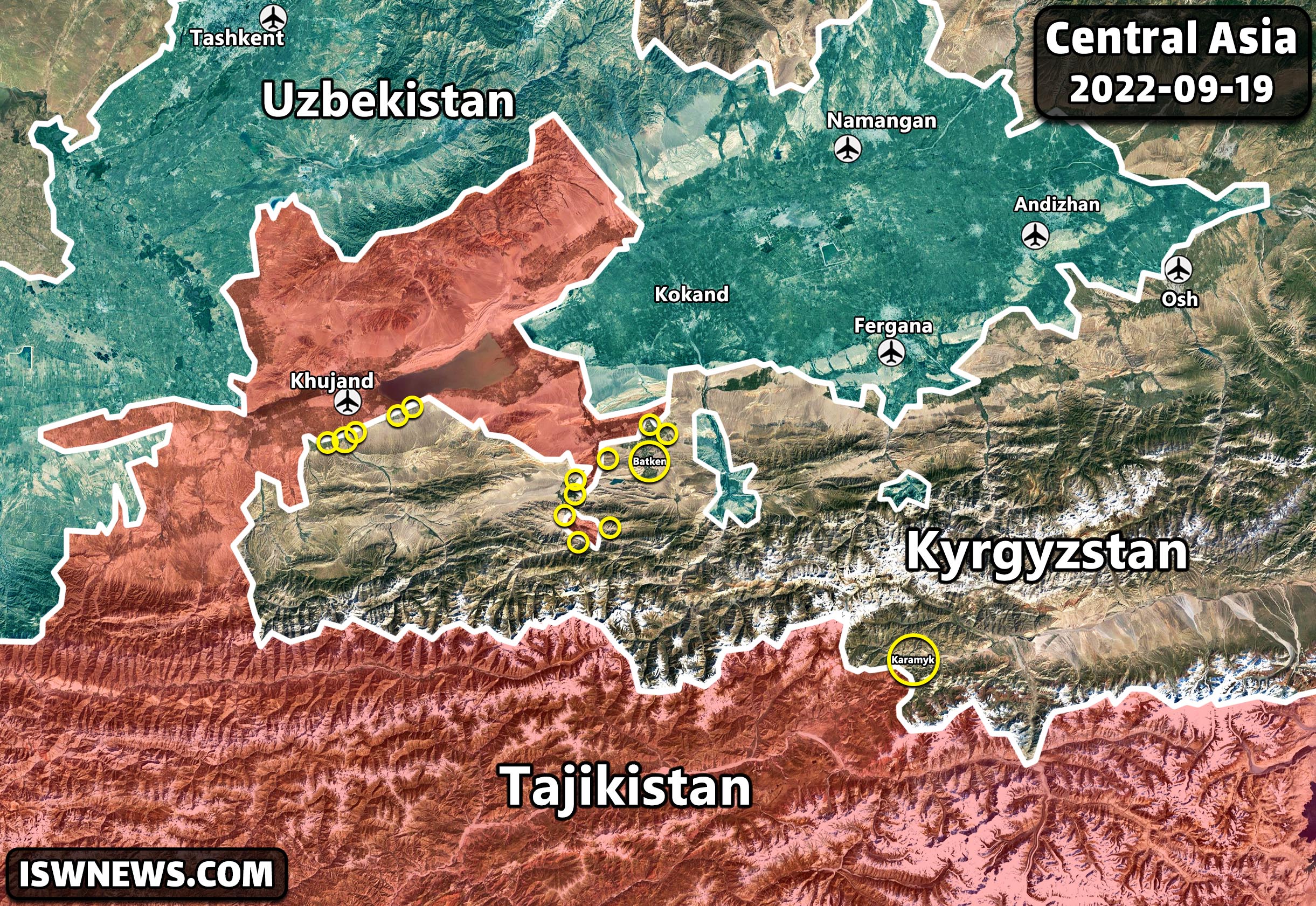
After establishing diplomatic contact between the governments of Tajikistan and Kyrgyzstan on September 16th, the two countries agreed to establish a ceasefire starting at noon of the same day, but this agreement did not last long and the exchange of fire continued. At the same time as the conflict increased, the Tajik army moved BM-21 Grad rocket launchers to the border with Kyrgyzstan and attacked Kyrgyz military positions and Batken Airport several times.
On the other hand, Kyrgyzstan has attacked the equipment and gatherings of the Tajik forces using its unmanned aerial vehicles (Bayraktar TB2). The ground conflict has also led to the destruction of the Ak-Say border bridge and several tanks and armored vehicles from the forces of both sides.
According to the Ministry of Health of Kyrgyzstan, since the beginning of the border conflict with Tajikistan, 59 people have been killed and more than 150 people have been injured. The Kyrgyz government also claims that these conflicts have led to the evacuation and displacement of more than 137,000 civilians. Tajik media also quoted the Ministry of Health of this country as saying that 24 people died and more than 121 people were injured.
Currently, the United Nations, Iran, Russia, US and other foreign countries have called and sent messages to the leaders of the two countries, calling for an end to the conflicts and solving the border disputes through dialogue, but the border conflicts continue regardless of these requests.
Video number 1: Destruction of the Ak-Say bridge by the Tajik armyVideo number 2: The destruction of the T-72 tank of the Kyrgyz army by the forces of the Tajik army
After the collapse of the Soviet Union, diplomatic relations between Tajikistan and the United States began on February 14, 1992, with the opening of the US embassy in Dushanbe. Now the US ambassador to Tajikistan is Manuel P. Micaller Jr. that has replaced the former US ambassador, John Mark Pommersheim, since March 15, 2019. The Embassy of Tajikistan in Washington also started working in 2002 and the ambassador of this country in the US is “Hamralizoda Farrukh Mahmud”.
The basis of two decades of political relations is based on cooperation in the field of fighting terrorism, preventing drug trafficking, commercial and economic agreements, etc., but these relations have taken on a military and security aspect in recent months, and the US has gained a stronger presence in Tajikistan. The root of this can be found in the developments of the last year in the Central Asia region and the world. The withdrawal of the US from Afghanistan and the rise of the Taliban, the war between Russia and Ukraine, the expansion of relations between China and Iran with the countries of Central Asia, etc. are among the reasons that have forced the US to make more efforts to increase its influence in Tajikistan. In this regard, the United States has brought its political, military and cultural advisors and representatives into the field and has put extensive programs on the agenda of Tajikistan.
The main US programs in Tajikistan can be categorized as follows:
1- Political and military: During the last year, the number of visits and meetings of “Thomas West”, the special representative of the United States for Afghanistan, “Donald Low”, the assistant secretary of the United States of America, and General “Michael Kurilla”, the commander of United States Central Command with the authorities of Tajikistan have increased dramatically. According to US officials, these meetings were centered around the security issues of Central Asia, especially Afghanistan, the strengthening and construction of border posts in Tajikistan, and the protests of the autonomous province of Badakhshan. In addition to these, important issues such as handing over weapons transferred from Afghanistan to the Tajik army, US intelligence-security use of Tajik border bases, immigration to US, military training, etc. have been considered.
In an interview with Radio Liberty Tajikistan, Donald Low says about the construction of border posts: “We are waiting for the completion of the new project for the construction of a border post in Chaldovar region. Of course, in the issue of border checkpoints, the US has completed other projects, but the Chaldovar project was the largest project, and the other projects were for handing over and transferring military facilities and equipment to the border guard forces of Tajikistan.” It should be noted that this base is located in the Chaldovar area, located south of the border town of Aiwaj, and its reconstruction operations were entrusted to US military companies by the Tajik government with the financing of the US Drug Enforcement Administration in 2020.
According to General Kurilla’s statements, since the beginning of political relations with Tajikistan, the United States has provided more than 330 million dollars in financial aid to Tajikistan in the field of security, of which the provision of RQ-20 Puma drones worth 20 million dollars was the largest part.
Another issue that has been highlighted in the field of military cooperation between the two countries is the fighter jets and helicopters of the Afghan army, which fled to Tajikistan during the fall of the previous Afghan government. In their meetings with the Tajik authorities, the US officials have promised to hand over these aircraft to the Tajik army, but in return, the US had demands from Tajikistan, the details of which are not clear.
2- Cultural: The US non-governmental organizations (NGOs) have been able to create a special social footholds among the people of Tajikistan in the form of humanitarian aid and through human information intelligence (HUMINT) methods. In addition to recruiting and identifying scientific elites, these organizations have identified Afghan refugees and Russian-affiliated people and expanded their intelligence network by granting immigration visas to America, financial aid, holding educational, artistic programs, etc.
Unlike Tajikistan, Kyrgyzstan and Uzbekistan’s relations with the United States have not changed much after the fall of the Afghan government. Kyrgyzstan is still unhappy with the US military withdrawal from the Manas Air Base in 2014, and due to the US’s secret support for Kyrgyzstan’s unrest, Kyrgyzstan has not welcomed the Americans in military and security issues. To the extent that no Kyrgyz official came to meet General Kurilla’s recent trip to Manas Airbase! Despite receiving military aid from the United States, Uzbekistan has aslo declared its policy to be neutral and has declared that it will not allow the construction of a military base and the deployment of foreign troops on its territory.
In general, the Americans have been able to create a new and strong footholds for themselves by establishing warm relations with the officials of Rahmon’s government and deeply examining the needs of the people of Tajikistan. Despite the fact that US has not succeeded in establishing a military base in Tajikistan, their political-intelligence network has expanded in Tajikistan, and this means they have succeeded in penetrating Tajikistan without sensitizing the Tajiks’ main partner, Russia. Tajikistan shares more than 1,400 kilometers of common border with Afghanistan and has a lot in common with this country in terms of ethnic and religious composition. Therefore, in order to continue to control and play a role in the developments of Afghanistan and Central Asia, the United States firstly needs Tajikistan and secondly Uzbekistan, Kyrgyzstan, Pakistan and Turkmenistan.
During the last year, Central Asia has witnessed different crises, from street protests to military conflicts at different levels. Also, the activities of political movements and the military officials of various countries in the Central Asian region, especially the Americans, have increased the importance of this situation. The crises of this region can be defined as follows:
1- Afghanistan crisis and America’s effort to influence more in Central Asia: After a year passed since the Taliban came to power in Afghanistan and also the withdrawal of the American forces from the country, a big security vacuum was created in the region and most of the Central Asian countries started their relations with the Taliban in limited condition. But in the meantime, Tajikistan publicly supported Ahmad Massoud forces and rejected the general interaction with the Taliban government. This issue arises from a close relationship with America. In general, the goal of the Americans for the warm relationship with Tajikistan is to continue to be present in the Central Asian region so that they can firstly penetrate into the backyard of Russia, China and Iran and also continue to play a role in the Afghanistan developments. America was defeated by Pakistan’s negative response regarding the construction of the base and several other things at the beginning of this matter; But now with the HUMINT policy, support for non-governmental organizations (NGOs) as well as training and military and security assistance, it has increased its influence in Tajikistan. One of the reasons for Putin’s recent visit to Tajikistan was the concern about the increase of American activities. In less than a month, three high-ranking American officials, Donald Lowe, Tom West, and General Michael Kurilla, had traveled to Tajikistan.
Rocket attacks by ISIS and unknown groups from Afghanistan to Tajikistan, Uzbekistan and Turkmenistan were also among the other events that happened in the last few months, and this issue cannot be analyzed until its dimensions are hidden.
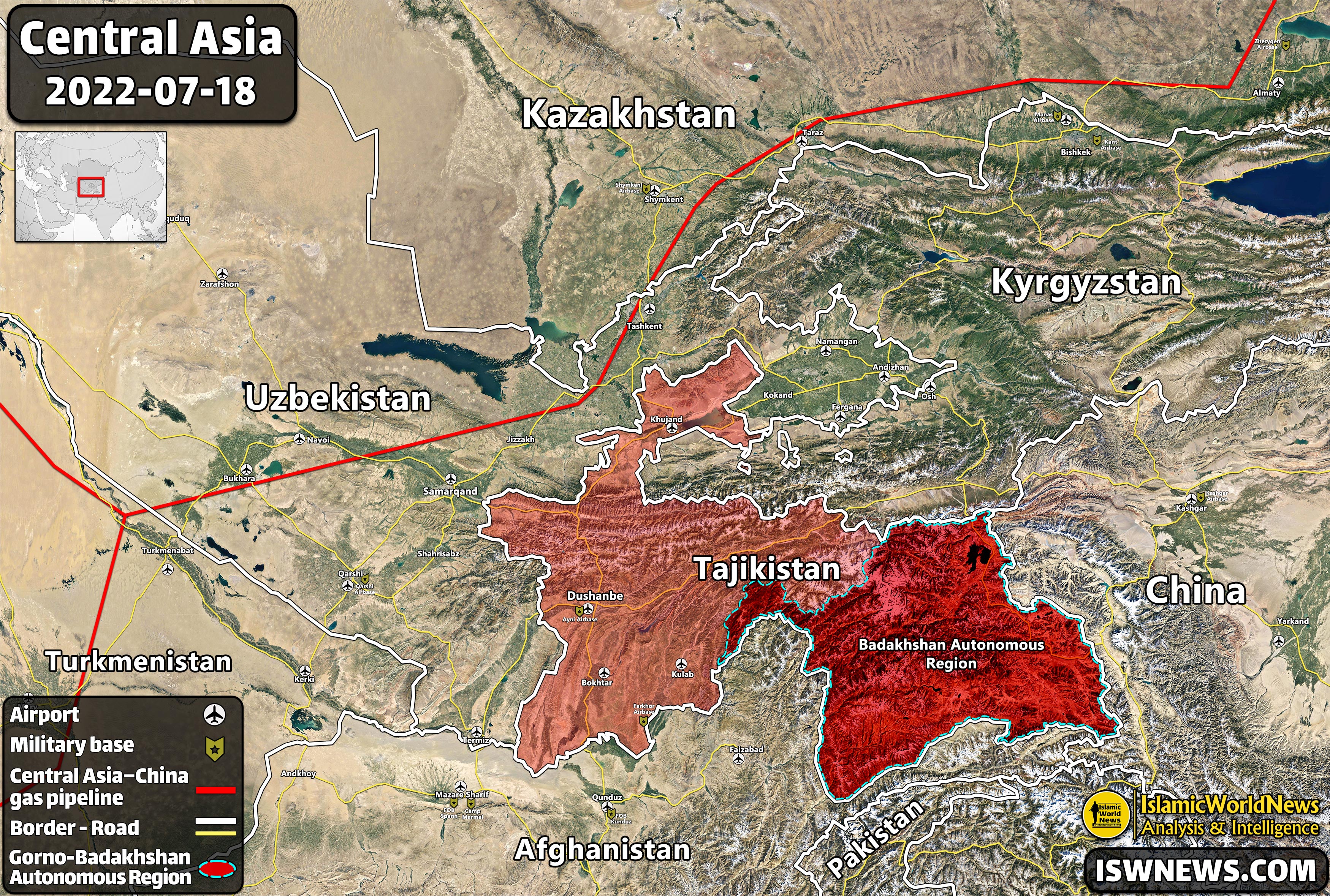
2- Suppression of popular protests in Tajikistan’s Badakhshan: Since 2012, the mountainous Badakhshan Autonomous Region of Tajikistan has been the source of popular protests and severe repressions by the government of Emomali Rahmon. This issue has intensified since November 2021 and its peak can be seen in the assassination of “Martyr Mohammad Baqer MohammadBaqerov”, one of the popular leaders of this region. Also, other local leaders have had a similar fate or have been arrested.
According to the latest field information, the government of Tajikistan seeks to suppress the popular groups in Badakhshan in order to apply its unified and autocratic rule in all of Tajikistan. With the opportunity of Russia’s war with Ukraine and simultaneous regional trips to Iran, Russia and Uzbekistan, “Rahmon” was able to complete his operations for ethnic cleansing in Badakhshan without any pressure. It should be noted that after this tension, the young fighters of Badakhshan either ran away or hid in the mountains, and the atmosphere of suffocation reigned over the city of Kharogh and other cities of Badakhshan province.
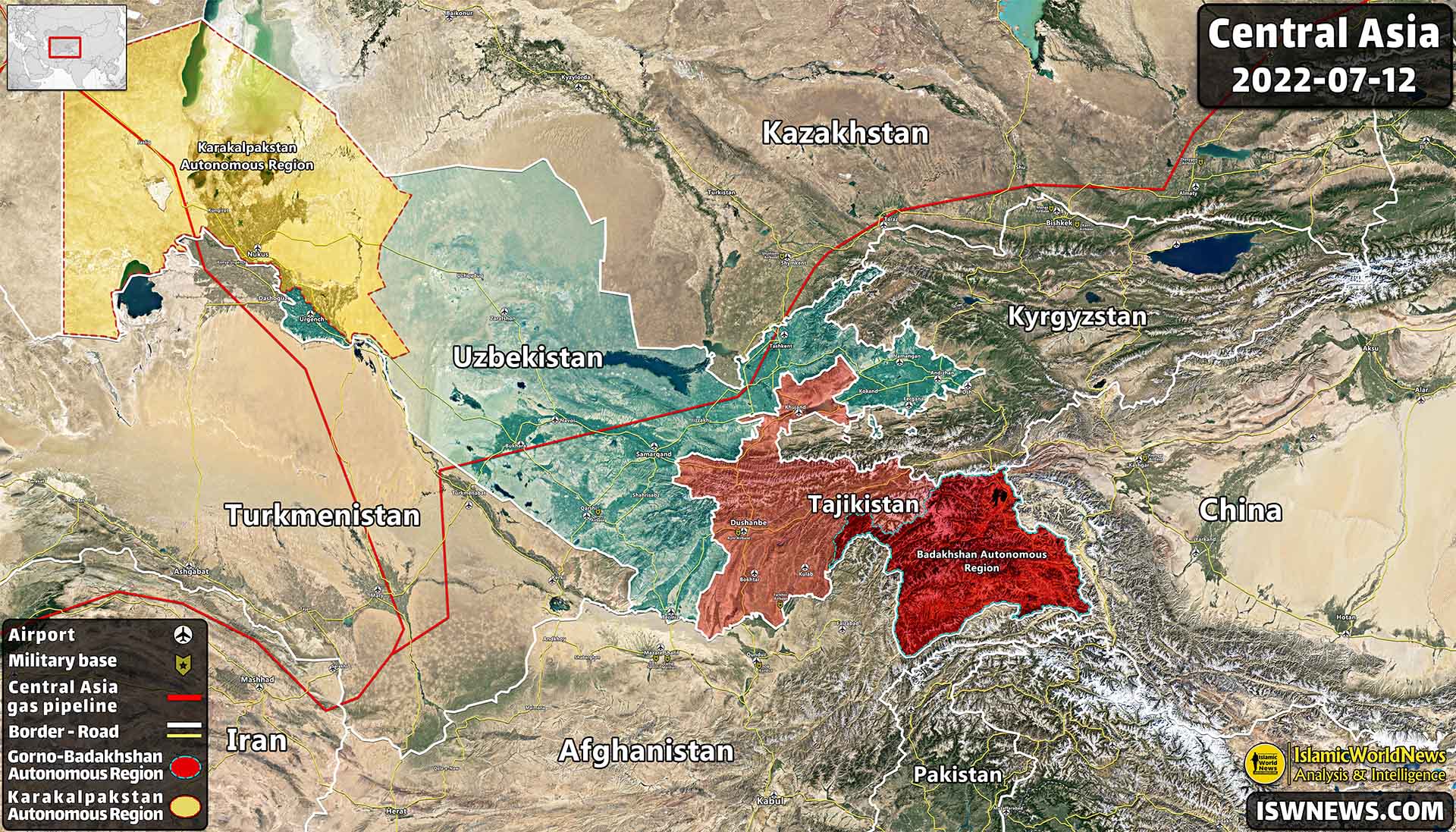
3- Uzbekistan and the Karakalpakstan crisis: During the Soviet Union period, the Karakalpakstan region was first included in Kazakhstan, then in Kyrgyzstan, and later in the status of an autonomous republic, and finally it was handed over to the Soviet Republic of Uzbekistan. In 1990, the sovereignty of Karakalpakstan was approved, and at the beginning of 1993, an intergovernmental agreement was signed, according to which the Republic of Karakalpakstan became part of Uzbekistan for 20 years. Karakalpaks believe that their country is not an autonomous region, but an independent country within Uzbekistan.
Karakalpakstan is a parliamentary republic, which has a national flag, official coat of arms, constitution and national anthem, and covers 37.1% of the territory of Uzbekistan. This region has rich resources and reserves of oil, gas and gold, and its population is about 2 million people, who are in the minority compared to the population of 35.3 million Uzbeks.
The separatist tendencies in this republic intensified when the government of Tashkent announced that it was preparing to approve a constitutional amendment, which will remove the sovereignty of the Karakalpaks over their region. On July 5, “Dauletmurat Tazhimuratov”, the leader of Karakalpaks, planned to hold a peaceful rally on this issue, but the situation became tense after his video call. After this, military equipment and counter-insurgency forces were deployed throughout the city of Nukus, the capital of Karakalpakstan and Tazhimuratov was arrested. Of course, the Uzbek government has backed off from changing the constitution and the situation has calmed down. In the last 10 years, the situation in Karakalpakstan has become the hottest topic in the media about Uzbekistan.
It should be noted that the authorities of Tashkent government have not renewed the autonomy agreement of Karakalpakstan since 2003 without polls and elections from the people of Karakalpakstan, and this led to start of these protests.
4- Protests in Kazakhstan: What ignited the protests in Kazakhstan was the increase of fuel prices, but the demands of the protesters have now changed and they want to address broader issues. Kassym-Jomart Tokayev, the president of Kazakhstan, claims that these protests are organized by “terrorist groups” trained outside of Kazakhstan. The president of Kazakhstan declared a state of emergency following these protests across the country and promised to deal severely with the protesters. In a televised speech in the first hours of the protests, he said that he requested the help of the “Collective Security Treaty Organization” (CSTO) to establish stability in his country. Tokayev is the second leader of Kazakhstan after declaring independence from the Soviet Union in 1991. The election of Tokayev in 2019 was condemned by the Organization for Security and Cooperation in Europe (OSCE) on the pretext of not observing democratic standards in the elections.
The presence of CSTO forces in Kazakhstan to suppress protests was one of the notable points.
5- The military aid of the world powers to the countries of the Central Asian region: During the past few months, significant military aid was provided to the countries of the region, most of which was directed to Tajikistan. The establishment of the Ababil 2 drone production line in Tajikistan with the presence of Major General Bagheri, the Commander of the General Staff of the Iranian Armed Forces, the visit of the head of US CENTCOM to Tajikistan and the announcement of US$60 million military aid to Tajikistan (Puma drone, the construction of border posts in the Chaldovar region in the south of Tajikistan, ranger and mountain warfare training to the Tajik military, as well as providing special border equipment to Tajikistan), equipping the Tajik army with Chinese weapons, Russia’s promise to support and equip the Tajik border guards, and the sale of Turkish drones to Kyrgyzstan have been part of these military deals.
Location of US border bases near Aiwaj in Chaldovar region
Based on these developments, it can be concluded that Central Asia has always been in the spotlight due to its high importance, and due to the attention of the world’s military powers and the sending of military aid to this region, it is susceptible to important developments in the future. As Alexander Lukashenko, the President of Belarus, pointed out at the ceremony of the Independence Day of Belarus, Central Asia, like Eastern Europe, is located between two fronts and is a place where global poles clash. But the main issue today is not Ukraine, Belarus, grain and wheat exports, etc. Rather, the main issue is the emergence of new, powerful players in the international arena who have challenged the unipolar structure of the world. Protests and color revolutions, the greater influence of America and China and in contrast to the decrease of Russian influence in Central Asia, the possible role of Iran, etc. are among the things that we will hear more about in the future.