Category: West Asia

  • Objectives, Consequences Of Possible Israeli Attack On Lebanon

    Objectives, Consequences Of Possible Israeli Attack On Lebanon

    Whenever public opinion in the world is focused on a place, the best conditions are provided for the implementation of grand plans, like a magician who draws the minds and senses of the audience to one side with one hand and executes his magic with the other. We are now at a time in history when the West Asia region is prone to great events. The 2024 Olympics in France have attracted the attention of the world and the media, providing the necessary breathing space for the Israeli regime to launch a military attack on Lebanon. A few days have passed since the visit of the prime minister of the Zionist regime to the United States, and speculation is growing about the goals of this trip. From influencing the US presidential elections to receiving financial and military aid, and most importantly, coordinating with the US to launch a military attack on Lebanon’s soil.

    It should be mentioned that in a military battle, more important than the subject of the war itself is the answer to a few basic questions. Questions that determine the beginning, duration, type, level, and end of a war. What is the purpose of the war? What is the way out of the war? What will be the consequences of war for both sides of the conflict? And… If Israel also starts a war against Hezbollah, it will have no choice but to answer these questions. What we are looking for in this article is to provide a general picture of the possible answers to these questions.

    As for the goals of the Israeli regime in this attack, it is certainly not possible to mention a single goal and suffice with that, because basically the realization of the goals is subject to conditions that make it possible to achieve them with ifs and buts. Inevitably, the initiators of conflicts always try to define a range of goals and seek to achieve the maximum of them, and if – for any reason – the maximum goal is not achieved, the other goals are expected to be achieved.

    The most important and maximum objective of the Israeli regime in the fight against Lebanon is the annihilation of the Lebanese Hezbollah. However, it should be noted that this objective cannot be achieved in any way. First, Hezbollah, beyond its military wing, is considered a deep-rooted intellectual and ideological movement in Lebanon, which even beyond the Shia community, has strong supporters in Lebanon among other religions, tribes, sects, etc. As a result, it is not possible to imagine a future for the destruction of a popular and ideological movement by relying on military means.

    From a military perspective, after 10 months of military warfare with its advanced and regular war machine, the Israeli regime has not yet succeeded in destroying the military and combat capabilities of the Palestinian Hamas movement in the Gaza Strip. It is a very small strip that has been surrounded by 360 degrees for many years and is located in a flat geography. The geography that is the most desirable place for the military operations of a well-organized and well-equipped army.

    Now, taking into account the border geography of Lebanon and the Israeli regime, which is mountainous, it can be assumed that the plan of militarily destructing the Hezbollah movement is nothing more than a dream, and the Israeli army will not be able to destroy a tried and tested guerrilla force with all its might. Israel will fight fighters who have decades of experience in a variety of desert, urban and mountainous confrontations, from urban and mountainous battles and the Lebanese plains to later breathtaking fights in the deserts, cities and mountains of Syria.

    Due to its lack of population and lack of geographical depth, the Israeli regime has focused on armor and air power. Both powerful arms of Israel will not be effective in a military conflict with Hezbollah. The Hezbollah movement is equipped with a variety of modern anti-armor weapons, and Israel’s armor in the plains and mountains of Lebanon will be only easy prey, as in the past 10 months, when every movement of the Israeli army in the Lebanese border line has been targeted. The air force of the usurping regime will also not be able to provide effective air support to the armored columns, because there are basically no visible military targets to destroy and bomb in the confrontation against guerrilla groups. From a military point of view, the destruction of Hezbollah is the maximum and at the same time the most unattainable objective for the Israeli regime.

    Another goal of the Israeli regime is to keep Hezbollah fighters away from Israel’s borders so that Israel can reorganize the ordinary lives of its displaced people in the north in light of the decline of the daily attacks on the north of occupied Palestine. This goal has been repeatedly expressed as the demand of the occupying regime, and international and Lebanese officials have been asked to help withdraw Hezbollah fighters to the back of the Litani River. This is not a maximum goal, but it remains to be seen whether it can be achieved or not. From a military point of view, it should be said that the retreat of Hezbollah’s guerrilla forces, which used a vast network of caves, tunnels, concrete positions, etc. is almost impossible. The experience of the world’s great armies proves this, and where the Red Army of the former Soviet Union in Afghanistan and the advanced and large American army in Korea, Vietnam, Afghanistan, and Iraq have been unable to achieve this objective, the small army of Israel will not be able to do so.

    But from another perspective, it is possible to realize this issue. The Israeli regime army’s main strategy is to rely on the destructive capability of the air force’s heavy and ultra-heavy munitions. In the first stage, the Israeli Air Force will brutally bomb all Lebanese military and infrastructure targets. The purpose of this is to increase pressures on the livelihood and lives of the Lebanese people in order to mount pressure of public and political opinion on Hezbollah and to force the Lebanese resistance movement to accept Israel’s conditions. On the other hand, the destruction of Lebanon’s infrastructure, which means the beginning of a period of post-war reconstruction, and naturally, governments that are engaged in providing infrastructure and development funding will not pose a serious threat to their neighbors. If this stage does not lead to the realization of Israel’s demands, in the second stage, the Zionists will start the equation of mass murder. The regime’s goal in killing people is to force the other side to surrender. But now, this equation is not one-sided, and the resistance is capable of implementing both of these methods.

    Addressing the consequences of the conflict is also an important part of the equation of war. On the one hand, Lebanon will be subjected to a heavy Israeli invasion and will certainly suffer a lot of losses. However, according to military analysts, Hezbollah is armed with highly accurate tactical missiles and a vast drone capability that is capable of accurately destroying any target in the small geography of occupied Palestine. As a result, if the Israeli regime starts a war on infrastructure or a genocide, Hezbollah will also be able to target Israel’s public and service infrastructure. Such a war would also be very deadly for Israel. At the same time, if Hezbollah has been able to acquire effective air defense systems in the past years, which is not unexpected, the Israeli regime’s war machine will also be contained in the sky to some extent, which will mean the complete failure of Israel’s military strategy.

    Hezbollah has made the necessary preparations to destroy the armored power of the Israeli regime, as the strength of the Israeli ground forces, and it has sufficient and effective weapons, but the containment of the air force is an undeniable necessity. Targeting Israeli airports does not seem to stop the air force’s activity, as Israel has designed the highway network in such a way that it can be used as an airport, assuming that it is possible to attack airports in future battles. In fact, Israel is a large military garrison. The most effective way for Hezbollah to change the balance of the confrontation is to stop Israeli attacks and force Israel to accept the terms of resistance, which is to strike at Israel’s public and service infrastructure. Concerning targeting military and commercial fleets at sea – Hezbollah is well capable of doing so – and destroying power plants, refineries, silos, and food warehouses, etc. Israel will be under a real siege and will be completely paralyzed.

    It seems that the Israeli regime is muddled about the initiation of war against Lebanon. The regime’s political and war strategies have not changed over the past decades, but the regional and military conditions of Israel’s enemies have undergone a serious change, and the resistance in the region has become highly equipped and capable. Under these conditions, Israel can start a war, but it does not have any plan to get out of it, and it may not achieve its goals, but it would also be forced to accept numerous demands.

  • The Voice Of Palestine Is Getting Louder In The West

    The Voice Of Palestine Is Getting Louder In The West

    While civil society and party activists in the Arab world have chosen the path of rallies, which, in their opinion, is enough to support Palestine, rapid changes are taking place in Europe.

    Paradoxically, but the fact remains that the Hamas operation “Flood of al-Aqsa” (Al-Aqsa Storm) did not awaken the Arab peoples from a flawed sleep, but civil society activists of various ideologies in the United States and Europe.

    Students in the United States still remain an influential pro-Palestinian force, while in the EU, in addition to the call from major political parties for the need to decolonize Palestine, resistance groups have emerged whose goal is to stop military support for the Zionists.

    Intellectual circles also did not stand aside and there is an example of France, where a local political scientist immediately supported the Palestinians, for which he was subjected to pressure from the Zionist lobby.

    Of course, against the background of powerful pro-Palestinian activity, the forces of evil, led by the Zionist lobby, are making a variety of efforts to prevent the truth from being heard. Moreover, we must not forget about the allies of Zionism in the camp of the European bureaucracy, which still supports the genocide of the Palestinians.

    In general, we see how the Palestinian issue has become the main topic of discussion in European capitals. Personally, I associate what is happening with the recognition of the fact of the collapse of Zionist imperialism and the willingness to rethink the foreign policy vector.

    The collective West, in an attempt to preserve the Zionist colony, got bogged down in the Middle East and had no other choice but to reduce its military presence in the Islamic environment to zero.

    Moreover, against the background of what is happening in Ukraine, the leading EU countries, Britain and the United States, due to ideological, economic and geopolitical reasons, simply cannot allow Kiev to defeat, but there is still a frozen conflict in Transnistria, a “crisis of democracy” in Georgia and the last “Soviet stronghold” in the person of Belarus. In all these countries, the influence of the Kremlin looms, and in the long term – China, respectively, the titans of Atlanticism do not want to fight with all at once, and even more so to endlessly risk in the name of a lame horse (Zionism). Therefore, the leading Think-tank of the West decided to gradually move away from the alliance with the right-wing Zionists and immerse themselves in the internal affairs of Europe.

    In conclusion, I would like to point out that unfortunately, at the moment there is no partisan activity from the majority of EU Muslims by analogy with British left-wing groups, but there is at least political activity (again, only in Britain and partly in France). Over time, Muslims will show more efforts and even get a chance to enter the European Parliament, so it’s worth thinking about the future now, for example, about developing a common ideology and a mechanism for persecuting Zionists around the globe.

  • Iraqi Officer: Graduates Of Iran AJA University Better Than Nato Alumnae

    Iraqi Officer: Graduates Of Iran AJA University Better Than Nato Alumnae

    Lieutenant General Hamed Mohammad Kamar, Deputy Chief of Education for the Iraqi Army, during a visit to the AJA University of Command and Staff of the Islamic Republic of Iran Army, stated that senior Iraqi officers who graduated from of the Iranian Army are much more efficient than those who have completed the military courses in NATO and are more competent in all the responsibilities assigned to them.

    He went on to say that for this reason, the Iraqi officials want to ask Iran to increase the quota for Iraqi officers at this university, and that Baghdad found out that Iraqi trained officers in Pakistan are also good, and after more scrutiny, it was found that most of the professors of military courses in Pakistan are also graduates from AJA University of Command and Staff of the Islamic Republic of Iran Army.

    For his part, Brigadier General Hossein Valivand Zamani, Commander of the Iranian Army’s War University, said: Iraq is important to us from two aspects, first because of the existence of the holy shrines and second due to its proximity, so we are ready to meet all the training needed by the Iraqi army in the field of command and headquarters and other arenas.

  • Syrian, Turkish Presidents To Meet In Near Future

    Syrian, Turkish Presidents To Meet In Near Future

    Turkish President Recep Tayyip Erdogan and Syrian President Bashar al-Assad will meet at the end of August in a Syrian-Turkish border area.

    The Turkish newspaper Daily Sabah reported that the officials of the two countries have held three rounds of meetings on the normalization of bilateral relations over the past month, and they discussed the timing and place of the first meeting of the presidents of the two countries since 2011.

    According to the newspaper, Iraq was first discussed as a meeting venue between Erdogan and Assad, and now Ankara is considering a new option for the meeting, namely the Kasab checkpoint on the Syrian-Turkish border.

    On July 11, Erdogan announced that he had assigned his Foreign Minister Hakan Fidan to arrange a meeting with President Assad, even in a third country.

  • Hezbollah Denies Responsibility For Suspicious Attack On Majdal Shams

    Hezbollah Denies Responsibility For Suspicious Attack On Majdal Shams

    After Hezbollah’s rocket attacks on the headquarters of the Hermon Brigade in the Ma’aleh Golani barracks and the Za’oura area in the northern occupied Golan, the Zionist regime’s media outlets reported that a rocket hit the soccer field of the town of Majdal Shams.

    As a result of the explosion, 11 people have been killed and 34 injured so far. Some media outlets have also reported that the death toll has risen to 14, which cannot be confirmed at this time.

    Explosion in Majdal Shams

    Senior Israeli officials told the regime’s media outlets that the Lebanese resistance movement had crossed red lines with the attack and that Lebanon would soon receive a response.

    In contrast to this scenario, some media outlets have reported on the mistaken performance of the Israeli regime army’s defense systems in confronting Hezbollah’s rocket attack on the Ma’aleh Golani barracks and the fall of one of the defensive missiles on the Majdal Shams soccer field, which needs further investigation. Therefore, in order to investigate the dimensions and truth of this attack, we must wait for more evidence and citations.

    In a statement, Lebanese Hezbollah movement officially denied responsibility for the attack, writing, “The Lebanese Islamic Resistance categorically denies the allegations published by some of the enemy’s media outlets and various tribunes regarding the targeting of Majdal Shams, and categorically rejects the Islamic Resistance’s connection to this incident.”

    Aftermath of explosion in Majdal Shams

    The Zionist website Walla news also reported that the residents of Majdal Shams were not warned before the attack, and wrote that they had not been ordered to go to the shelters. In response to the incident, the Israel Hayom newspaper’s website reported that initial investigations indicated that the air defense systems had difficulty intercepting the Majdal Shams missiles.

    The incident area in Majdal Shams

    Finance Minister and hardline Zionist politician Bezalel Smotrich called on Israeli Prime Minister Benjamin Netanyahu to return immediately. He claimed that the time has come to take action and that all of Lebanon must pay the price. Smotrich also called for the assassination of Secretary General of Hezbollah Sayyed Hassan Nasrallah in response to the Majdal Shams attack.

    The Zionist regime’s Minister of Internal Security Itamar Ben-Gvir said: “Since October 7, I have said that we are in a state of war in the north and that the enemy must be defeated, and for 10 months the decision-making bodies have been refraining from admitting that we are in a battle with Hezbollah. Today, no one, in any assembly, including the Minister of War, who only sought to contain Hezbollah, can avoid the bloody reality. ‘We are at war.’ I will immediately call the prime minister to a cabinet meeting with an encrypted phone to make a decision that I have been calling for a long time. Now the war is in the north!”

    At a press conference, IDF Spokesperson Rear Admiral Daniel Hagari called the explosion the most serious since the Oct. 7 attack, saying that the minister of war, the chief of the general staff of the armed forces and the head of the Mossad were assessing the situation of Majdal Shams. Hagari went on to blame Hezbollah for the killing of innocent children and said the army would respond to the attack in accordance with the declared framework.

    In another statement, Hagari claimed that the rocket that hit the Majdal Shams football field was Iran-made and carried a 50-kilogram explosive warhead. He also blamed a Hezbollah field commander named Ali Muhammad Yahya for firing the rocket at Majdal Shams.

    In another message, the Israeli regime’s army claimed that an analysis of the army’s operational systems showed that the rocket was fired at Majdal Shams, from an area north of the village of Shebaa in southern Lebanon.

    Image published by the Israeli army about Majdal Shams incident

    The Israeli regime’s Channel 13 TV also reported that the United States has asked Israel not to respond to the Majdal Shams attack because of fears of war in Lebanon. Former US President Donald Trump took a stance that indicated his propaganda campaign in an election contest with the Democratic administration, calling the missile attack on the Golan Heights horrific and claimed that it would not have happened if he had been president. Trump went on to say: We cannot allow these attacks to continue.

    According to the videos and pictures available from the moment the rocket hit the soccer field of the town of Majdal Shams, the incident occurred at the same time as Hezbollah carried out rocket attacks on the Ma’aleh Golani barracks in the northern occupied Golan, but the cause and type of the missile are not related to Hezbollah, and it is most likely that one of the Israeli army’s Iron Dome defensive missiles had a wrong function and fell down towards the city.

    Initial citations of low volumes of smoke, surface destruction of the ground, and the trajectory of other Israeli defense missiles also indicate the same issue. The Israeli regime and its army are taking advantage of this issue to justify their attacks on southern Lebanon and to pave the way for further actions in eastern and northern Lebanon. The expansion of the war on the northern front of occupied Palestine will benefit the Netanyahu cabinet in the short term, but in the long run, it will lead to the collapse of the regime. Netanyahu is waiting for the outcome of the US presidential election and his preferred choice in order to provoke more warmongering policies in the region.

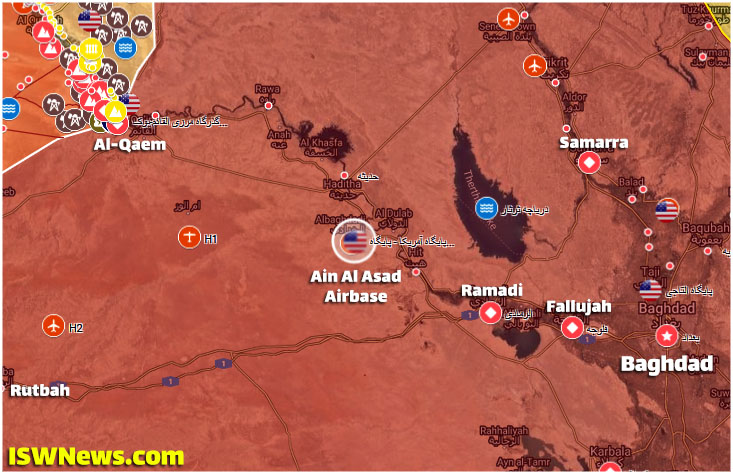
  • US Positions Pounded At Conoco, Ain Al-Asad In Syria

    US Positions Pounded At Conoco, Ain Al-Asad In Syria

    In the first attack, the position of the US terrorist forces in the Ain al-Asad Airbase was targeted in rocket attacks by the Islamic resistance groups on July 25.

    The attack is said to have been carried out using six Arash-4 rockets. No further details have been released, and no group has claimed responsibility for the attack so far.

    This is the 40th attack on the US military positions at the Ain al-Asad base since the start of the war in Gaza.

    Ain al-Asad Airbase

    The second attack took place on Saturday (July 27), when fighters of the Islamic Resistance in Iraq conducted a rocket attack on the Conoco gas plant in the past 24 hours.

    In response to the rocket attack on the Conoco gas facility, the US terrorist army targeted the positions of the resistance groups in Marat, Khasham, Ayyash and Al-Jawza in Deir ez-Zur Governorate.

    This is the 27th attack on American positions at the Conoco gas plant since the start of the war in Gaza.

    Conoco gas facility

    In the third strike, the positions of the US coalition in the Conoco gas facilities were targeted by rocket attacks of Islamic resistance groups on July 26.

    Local sources claimed that the rocket attack was carried out on the positions of the American occupiers in the Conoco gas facility in Deir Ezzor province using five rockets. Three of the rockets hit the United States’ Patriot defense system and caused an explosion.

    This is the 26th attack by the Islamic Resistance in Iraq on US positions at the Conoco gas plant.

    The Iraqi resistance forces have carried out military operations against the United States and the Israeli regime in response to the genocidal war and siege on Gaza. The Islamic Resistance in Iraq, an umbrella group of various resistance factions, emphasized that they will continue these attacks to force the Israeli regime and its staunch ally (the US), which supplies the regime with arms and ammunition, to stop killing innocent people in the besieged strip.

  • Ministry Of Defense Of Armenia Denies Arms Purchase From Iran

    Ministry Of Defense Of Armenia Denies Arms Purchase From Iran

    The pro-Zionist TV network Iran International recently claimed in a report that Iran and Armenia have signed a secret arms contract worth $500 million, according to which a variety of suicide, reconnaissance, and combat drones such as the Shahed-136, Shahed-129, Mohajer-6, as well as the defense systems such as the Khordad-3, Majid, Khordad-15, and so on, will be exported to Armenia.

    To elaborate this news, it should be noted that the figure of $500 million for the purchase of weapons by Armenia is a large figure and is not small in the size and economic capacity of this country.

    Moreover, Armenia’s geographical location and conditions are not suitable for the mentioned weapons, especially defense systems, and from this phony information, it can be understood that agents of the Iran International TV network in conjunction with the Pan-Turkism media outlets in Turkiye and Azerbaijan Republic have propagated false or incomplete reporting mission.

  • PKK Drone Attacks On Turkish Troops Ankara’s New Challenge In Northern Iraq (Video)

    PKK Drone Attacks On Turkish Troops Ankara’s New Challenge In Northern Iraq (Video)

    The Kurdistan Workers’ Party (PKK) forces have carried out several drone attacks against Turkish army positions in northern Iraq in recent weeks.

    A review of the released footages shows that the PKK forces used Mugin-3 commercial drones made by the Chinese company Mugin, which have a length of 2,488 mm, a wingspan of 3,600 mm, and a take-off weight of about 28 kilograms.

    The minimum speed of this drone is 45 kilometers per hour with a flight duration of up to 3 hours and is capable of carrying a payload between 5 and 8 kilograms. The price of this UAV is recorded on some international websites as about $3,600, and with the short runway (between 50 and 70 meters), it is considered a suitable option to be used by armed groups in the West Asia region.

    The video released by the PKK of the attack on the Turkish forces

    The PKK forces have also used ArduPilot open-source autopilot systems and software in this field to guide the drone, so that they can easily create a flight line by drawing a path or creating a waypoint towards the target, therefore, they can have the least human intervention in the operation.

    It should be noted that the low price of such drones, along with the fact that certain Western states try to arm some terrorist groups around Iran’s borders, can be considered a serious alarm for the Iranian armed forces, because terrorist groups can create new troubles and numerous problems against border posts and bases, and even military positions and densely populated areas inside the country. Preventing these incidents requires vigilance and preventive measures by the Iranian armed forces.

  • Russian, Syrian Presidents Meet At Kremlin

    Russian, Syrian Presidents Meet At Kremlin

    Syrian President Al-Assad held talks with his Russian counterpart Putin at the Kremlin in a surprise visit on July 25.

    In the meeting with his Syrian counterpart, Putin pointed out that he had the opportunity to talk about the entire interactions between the two countries, saying: I would be very interested to ask your opinion on the situation in the region in general, which is unfortunately deteriorating, as well as on Syria, which is directly affected.

    Putin expressed hope that the two sides could discuss trade and economic relations and promising trends and approaches in this regard.

    President Al-Assad, for his part, underscored that his visit to Moscow today coincides with the 80th anniversary of the establishment of relationship between the two nations, which have undergone very difficult tests over the past decades, and that the relations between our two countries are based on mutual trust and maintaining this trust shows the maturity of both the Syrian and Russian nations.

    In light of the events that are taking place around the world and in the Eurasian region, our meeting today is very important to discuss the situation and the details of developments, prospects and possible scenarios, Assad stressed.

  • Hezbollah Drone Infiltrates Deep Inside Israel, Takes Footage Of Strategic Airbase! (Video)

    Hezbollah Drone Infiltrates Deep Inside Israel, Takes Footage Of Strategic Airbase! (Video)

    Hezbollah had released in June 18 a video showing sensitive military and economic sites of the Israeli regime in the city of Haifa and published another video earlier this month captured over the occupied Golan Heights.

    The new video was published on July 24. As Hezbollah says in the video “What the Hoopoe (Hodhod) brought back from the last night Tuesday”, Hezbollah claims the video was taken on July 23rd.

    The video published by Hezbollah media wing about Ramat David airbase

    The Ramat David airbase is one of the main air bases of the Israeli Air Force, which is located about 50 kilometers from the Lebanese border.

    The release of this high-quality video from the Ramat David air base at the same time as Benjamin Netanyahu, the Prime Minister of the Zionist regime, is visiting the United States is undoubtedly a big shock to him and the heads of the Israeli army.

    The most interesting point of the story is that the Hodhod drone returned safely to Lebanon after the reconnaissance operation.

    The clashes between Hezbollah and Israeli forces first broke out after the start of the war in Gaza last October, with Hezbollah and its allies carrying out regular attacks in support of the Palestinian people and movements in the Gaza Strip.

    The first drone surveillance video from the city of Haifa, which was published by Hezbollah on June 18
    The second drone surveillance video of the occupied Golan was released by Hezbollah on July 9
  • Yemen, Saudi Arabia Strike New Deal To De-Escalate

    Yemen, Saudi Arabia Strike New Deal To De-Escalate

    The officials of Saudi Arabia and the National Salvation Government of Yemen have reached consensus to cancel the recent decisions and measures against each other’s banks and similar moves in the future.

    The two sides also agreed to resume Yemen Airlines flights three flights a day from Sana’a International Airport to the Jordanian capital Amman, as well as from Sana’a to the Egyptian capital Cairo, and India as needed.

    In addition, meetings will be held to resolve the administrative, technical and financial disputes of Yemen Airlines, and to review all economic and humanitarian issues based on a special roadmap.

    Officials from Egypt, Oman and the resigned Yemeni government (affiliated with the Saudi-led coalition) have welcomed the agreement. According to Saudi journalists, the agreement was signed in Saudi Arabia, and Omani officials played an important role in the diplomatic consultations on the agreement.

    It should be noted that in recent months, under pressure from the United States, Saudi Arabia had imposed sanctions and ratified punitive laws against the Central Bank of Yemen, which had caused tension and the cancellation of some political agreements by the National Salvation Government.

    The Saudis also unilaterally rejected the Ansar Allah movement’s proposed deal to exchange prisoners and send humanitarian aid, irritating Yemeni officials. This tension was eventually entered new phase after serious threats from Sayyid Abdul-Malik Badr al-Din al-Houthi, the leader of the Ansar Allah movement and the Yemeni revolution, which led to the recent consensus and reaching the aforementioned agreement.

  • Hezbollah Boasting Its Capabilities In Attacking Israeli Merkavas (Video)

    Hezbollah Boasting Its Capabilities In Attacking Israeli Merkavas (Video)

    The video showcases the 9M113M Concourse-M anti-armor missiles, the Tharallah anti-armor system, the 9M133-1 Kornet-E/Dehlavieh anti-armor missiles, the Almas class anti-armor missiles (Hezbollah has Almas-1, Almas-2, Almas-3 and Almas-4 missiles), the Toofan anti-armor missiles (Iranian TOW) and the Ghadir Tandem rocket (an Iranian version of RPG-29 rocket).

    Read more:
    Military Knowledge: Dehlavieh Dual Missile Launcher
    Lebanon’s Hezbollah Unveils Tharallah Anti-Tank System (Video)
    Dehlavieh 3 anti-tank guided missile, the longest-range Iranian anti-tank missile
    Military Knowledge: Almas Missile

    In this video, the Lebanese Hezbollah threatens the Zionists by stating that “you will not have any more tanks.” Hezbollah has a very large and up-to-date stockpile of anti-armor weapons, and naturally, the Israeli army’s Merkava tank series will not have an easy task in a possible invasion of Lebanese territory.

    The promotional video published by Hezbollah

    Hezbollah’s Military Media Unit has recently released a video showcasing their anti-armor capabilities and operations targeting Israeli Merkava tanks and fighters.

    The video serves as a direct warning to Israeli authorities and occupation forces.

    It features multiple anti-tank guided missile systems and a shoulder-fired anti-tank shell, highlighting Hezbollah’s advanced arsenal.

    The footage demonstrates the effectiveness of their anti-armor forces in scoring destructive hits against Israeli tanks.