The World Health Organization (WHO) reported that the number of affected people in the recent confrontations in Sudan reached 83 killed and 1126 wounded, while the local media quoted the Central Committee of Sudan Doctors (CCSD) as saying that 97 people were killed and 365 others were injured.
Airport in Khartoum in fire
The Rapid Support Forces claimed that they could take control of the presidential palace, the headquarters of the ground forces and a building of the Defense Ministry in Khartoum as well as the Hattab military base in northern areas of Khartoum Bahri city. Furthermore, the RSF took control of the house of General Abdul Fattah al-Barhan, commander of Sudan’s Army, in Khartoum.
An official with the Sudanese Army claimed in an interview with Al Jazeera TV network that the report on General Barhan’s house is not correct and the videos published on the house are old ones! Despite the explanation, videos are authenticated and the general’s house has been seized by the Rapid Support Forces.
Clashes around the Khartoum International Airport continue fiercely and the military forces backed by the Army’s fighter jets and helicopters is attempting to repel attacks by the Rapid Support Forces. The latest satellite images prove that the number of damaged or destroyed aircraft in the Khartoum International Airport is much more than what was reported earlier. According to the images, five aircraft including two Ilyushin Il-76, one Boeing 737, one Airbus A330 and one Turboprop aircraft were totally destroyed. It is said that two aircraft (Boeing and Airbus) belonged to Saudi Arabia.
Merowe City:
Following today’s attacks by the Rapid Support Forces on Merowe, the Merowe international Airport was fully captured by the RSF. Moreover, local sources reported that an aircraft belonging to Egypt was burned down. The type and the usage of the airplane is not clear yet.
The Merowe international Airport is one of the largest airports in Sudan, which plays key role in maintaining security of the Merowe Dam, because it is located near the dam.
Video of Sudan’s Rapid Support Forces from Merowe Air Base
On Sunday, which is the second day of confrontations between the RSF and military forces, the war battle expanded to the western areas of Sudan in addition to Khartoum, al-Fashir, Merowe and so on. Despite the spread of conflicts and both warring sides’ claims on advancing and taking control of cities, the status quo has not been changed drastically, and most of the cities and military bases are still the scene of confrontation and exchange of fire.
The Sudanese Army pounds headquarters and positions of the Rapid Support Forces with the support of its fighter jets and helicopters, and the RSF also resorts to urban warfare with the aim of taking control of cities in the African country.
The situation in Sudan’s capital Khartoum
On April 16, the clashes in the capital city were focused on Khartoum Refinery, Al-Riyadiya neighborhood as well as an industrial-military center in al-Jili area in northern Khartoum. Moreover, the RSF militants declared that they succeeded in shooting down an Apache helicopter belonging to Sudan’s Army in the sky of Khartoum Bahri in northern district of the capital city, but given the condition of the helicopter fuselage in a newly released video footage, it seems that the claim is unfounded, and the RSF militants could only discover one of the helicopters of the Army.
The circumstances in Merowe
In the city of Merowe, the RSF militants carried out artillery attacks on the city’s airport and suburb following their failure during the second round of raid on Merowe. As a result of the strikes, a number of buildings of the nearby neighborhoods as well as one of the air traffic control tower got fire and several districts of the city experienced power outage.
The city and Merowe Airport are under the Sudanese Army’s control and the second attack by the Rapid Support Forces on the region doomed to failure.
Merowe city
The condition of other cities
Clashes between the Rapid Support Forces and the Sudanese Army keep on in Kabkabiya, Al Fashir, Al-Junaynah, Nyala and Port Sudan. The Sudanese military forces released images, claimed the arrest of a number of the RSF militants and ruled out the RSF control on Port Sudan.
In another news story, the Rapid Support Forces claimed that they shoot down Sudan’s Air Force Sukhoi fighter jet, but they have not yet provided any data of the location and time of the alleged incident.
The latest situation in eastern Sudan; Who does have the upper hand?
In one of the newly released video footages, the Sudanese Army forces are being seen in the entrance of the headquarters of the Rapid Support Forces in Al Qadarif city some 410 kilometers far from capital Khartoum, which rules out claims made by the RSF on taking full control of the eastern Sudan. Furthermore, another video footage shows that the Sudanese armed forces enter Kassala city some 480 kilometers away from Khartoum and in vicinity of Eritrea’s border area.
In accordance with the latest news stories on the clashes in Sudan, none of the warring sides could gain momentum and upper hand in recent confrontation in general. But the Rapid Support Forces made all-out efforts to take control of the strategic points in Sudan, including airports and military bases, on Saturday and Sunday; although, they have not been successful in achieving their objectives so far. Sudan’s Army also is attempting to push back and exhaust the Rapid Support Forces and maintain strategic positions in order to gain momentum and be able to disrupt their military power and cross the barrier of the adversary.
The arrival of Sudanese army forces in the city of Kassala in eastern SudanThe control of the Sudanese army forces over the headquarters of the RSF in the city of al-Qadarif in eastern Sudan
More than 14,000 Israelis held protest rallies in Tel Aviv and some other cities of the occupied lands, including Haifa and Jerusalem al-Quds, to show their opposition to the so-called judicial reforms of Premier Netanyahu on April 15.
The protestors chanted slogans against Netanyahu and his cabinet’s bill for judicial reforms, and called for his resignation. Amid the protest rallies, at least seven Zionists were arrested by Israeli police forces.
Although, Netanyahu informed of cessation of his controversial bill on the judicial system on March 27, the protest rallies keep on in every Saturday of every week in different cities of the occupied Palestine territories. The gatherings, which were formed to show the Israelis’ opposition to the reform bill of the Netanyahu’s cabinet, has entered the fifteenth week in a row now.
On April 14, the opening ceremony of the 2023 European Weightlifting Championship was held in Armenian capital city. In a part of the ceremony, famous Armenian designer Aram Nikolyan set fire to Azerbaijan’s flag on stage! The move was lauded by a group of the Armenian people… Following the incident, security forces arrested the designer, and Prime Minister of Armenia Nikol Pashinyan, who was present in the event, ordered Nikolyan’s dismissal.
The flag of the Republic of Azerbaijan was set on fire at the opening ceremony of the European Weightlifting Championship in Yerevan
Azerbaijani team’s return and prosecution
Azerbaijan Republic took part in the 2023 European Weightlifting Championship with 12 weightlifters, but after the incident, Azerbaijani authorities called on the athletes to leave Yerevan to Baku. The interesting point is that the weightlifting team of Azerbaijan did not participate in the opening ceremony due to security issues. The Ministry of Foreign Affairs of Azerbaijan condemned the flag burning incident in Armenia, and the attorney general of Azerbaijan ordered filing a lawsuit at the international court. Some nationalist citizens gathered in capital Baku, hoisted their flag and chanted anti-Armenia slogans.
Turkiye’s implicit support
Among other events related to the issue, the support by a Turkish athlete from Azerbaijan Republic was interesting. Cansu Bektash dedicated his medal of this round of competitions to Azerbaijan’s team.
Tension in borderline of Kalbajar-Gegharkunik
Concurrent with tension in Yerevan, tension escalated in border areas between Armenia and Azerbaijan, and Azerbaijani forces fired at the Sotk gold mine in Gegharkunik, Armenia. The Sotk gold mine is located in the borderline between the two countries. Rosanna Grigoryan, representative of the GeoProMining Gold, said that the armed forces of Azerbaijan fired at the mine from 19 to 23 local time on Friday to Saturday morning. The mining company stopped its activity and staff were pulled out from the mine.
Sotk gold mine in the borderline between the two countries
The incidents happen in circumstances that the tension over arrest of Azerbaijan’s military forces in Armenian soil has not subsided; so, it seems that we should wait for more escalations. It can be said that the public opinion is being prepared for a war between the two nations.
As the civil war continues in Sudan, the Rapid Support Forces claimed taking control of an airport and several military sites in Al Fashir located in southwestern Sudan. The RSF also released a video of Al-Junaynah (Al-Subira) Airport, claiming the seizure of the city. Al-Junaynah city is the capital city of the West Darfur State near the borderline of Chad. Moreover, they warring sides have initiated clashes in vicinity of the Nyala Airport; however, the Sudanese army claimed the full control of Nyala city and the escape of the Rapid Support Forces from the city.
In the capital city of the country, severe conflicts between the Sudanese Army and the Rapid Support Forces have been reported near the presidential palace and the headquarters of the armed forces in the downtown Khartoum. Furthermore, clashes in vicinity of Khartoum refinery, Al-Riyadiya neighborhood as well as an industrial-military center in al-Jili area in northern Khartoum is in progress.
The Rapid Support Forces are preparing to carry out new attacks on Meroë in order to take control of the city. However, the Sudanese Army succeeded in retaking the airport of the city on Saturday afternoon.
The clashes between RSF and Sudan’s Army continues in Kabkabiya, Al Fashir, Al-Junaynah, Nyala and Port Sudan.
According to a report by the independent Sudanese Doctors’ Central Committee, the death toll of Sudan’s clashes has reached 56 dead and 595 injured, which may increase as a result of constant conflicts in the country.
Sudan’s media outlets quoted officials of the Army as saying that the command of the armed forces of the country will issue a decree to order dissolution of the Rapid Support Forces and the end of mission of all officers and personnel under supervision of General Hemetti (Hemedti).
The first generation of the Germans’ Main Battle Tank (MBT) was the M48 Patton tank made by the United States, and the second generation was the Leopard-1 tank, which is still in service with modifications for other NATO users. The Leopard 1 tank was designed and produced in West Germany in the 1960s. This tank was first produced in 1963 by Krauss-Maffei for the Ministry of Defense of West Germany, and more than 6,000 units of it were produced for 9 NATO member countries, including Germany, the Netherlands, Belgium, Greece, Turkey, Italy, Canada, Norway, as well as Made in Australia.
To develop and improve the Leopard-1 tank, Germany started developing the MBT-70 project in 1963 with the cooperation of the United States of America. However, in 1967, the German government ordered Porsche to research the facilities needed to upgrade the Leopard-1 tank. It is interesting to know that the Leopard-1 tank was in the service of Germany from 1965 to 1995, and the need for the MBT-70 project was announced before the Leopard-1 tank entered service. Leopard-1 was designed by Porsche and manufactured by Krauss-Maffei. This issue becomes more interesting when you know that Porsche named this new project Vergoldeter Leopard or Gilded Leopard and focused on updating with advanced technologies. Adding an automatic loader, an automatic and coaxial cannon with a machine gun, an independent periscope for the commander, the possibility of using an anti-aircraft machine gun from inside the cabin, the presence of a television surveillance camera on the mast with the possibility of increasing the height, changing the shape of the turret, improving the suspension system, the gearbox and engine exhaust valves, were considered as new project items.
Development and production:
In 1967, the West German government decided to produce a prototype of the Gilded Leopard project, as well as an experimental development based on the Leopard 1 tank. But due to the lack of sufficient funds, it was not possible to develop two projects at the same time, finally a trial development contract was concluded with Krauss-Maffei, but this company committed to work with Porsche to develop the chassis and with Wegmann to develop the turret. In this regard, two prototypes with different components were built with the aim of improving the Leopard 1 tank to match the firepower requirements of the MBT-70. The purpose of these optimizations was to increase the probability of hitting the first shot at a range of more than 2000 meters. Also, increasing the ability to accurately engage with moving targets using a computerized fire control system was another main goal of the experimental development. The tanks built were nicknamed Keiler. Two prototypes (ET01 and ET02) were built by Keiler in 1969 and 1970, both powered by the MB872 engine.
After many ups and downs in 1971, the name of the MBT-70 project was changed to Leopard-2. In the same year, 17 prototypes were ordered, but only 16 hulls were built because production of the PT12 hull was cancelled. The turrets were named from T1 to T17 and the hull from PT1 to PT17. These prototypes were produced to perform numerous tests, from the required and different components and concepts for the development of the tank, and each sample had components that were not found in other samples. Ten of these turrets were equipped with 105 mm cannons and seven prototypes were equipped with a 120 mm cannon. The welded turret used spaced armor formed by two steel plates. Prototypes were equipped with the EMES-12 optical range finder and fire control system, which was later used in the Leopard 1A4. The T14 turret was modified to install new anti-armor modules and was equipped with an all-electric turret drive and stabilization system. The turret was jointly developed by General Electric and AEG Telefunken.
The PT15 model with a 105 mm cannon
In July 1973, an agreement was signed between the defense ministries of Germany and the United States to standardize the Main Battle Tanks (MBT) in favor of NATO. Due to the previous joint cooperation on the MBT-70 design, it was decided to use the parts that were completely manufactured by German companies for the Leopard 2 in the Abrams tank prototype, which reduced the cost of the XM1 Abrams design. According to the US laws, it was not possible to interfere in the production of the XM1 Abrams tank by the German company. As a result, modification of the Leopard-2 prototypes to meet US Army requirements was considered. On December 11, 1974, a memorandum of understanding was signed between Germany and the United States that required the United States to test a modified version of the Leopard-2 against the XM1 prototypes. Also, this memorandum obliges the Federal Republic of West Germany to send a sample suitable to the needs of the United States for examination.
A tougher version of the Leopard 2 tank, the Leopard 2AV, was developed to meet both US requirements and the latest protection requirements of the German Ministry of Defence. The T14 turret was used as the main turret of the Leopard 2AV, but achieving the required level of protection for the hull required further research, until final ballistic tests were carried out in June 1976. The United States preferred to use a US-made laser range finder; For this purpose, the US Hughes company’s laser range finder was used on the turret. This turret was installed on the PT19 prototype. Compared to the Leopard 2 prototypes, the AV prototype had a fire control system, along with the EMES-12 optical range finder. In this example, the crosswind sensor was removed and air pressure and temperature sensors were added. Modifications such as the addition of a PERI R12 commander’s sight with infrared illuminator, short-range anti-infantry grenade launcher, retractable searchlight, fixed searchlight, retractable night vision camera, APU and mechanical loading assistant were among the additions to the AV prototype.
Due to the longer-than-expected design and production of the Leopard 2AV, it was not possible to send the Leopard 2AV to the United States and conduct tests in the United States before September 1, 1976. Despite German efforts to evaluate the Leopard 2AV and XM1 prototypes at the same time, the US Army decided not to wait for the Leopard 2AV and tested XM1 prototypes built by Chrysler and General Motors.
The Germans sent two prototypes of the hull and three turrets to the United States: the PT20 using a 105 mm L7 gun with a Hughes fire control system, and the second PT19 with the same Hughes fire control system but with the 120 mm Rheinmetall cannon. The third prototype was called the PT21, which was equipped with a Krupp Atlas Elektronik EMES-13 fire control system and a 120 mm Rheinmetall cannon. A study conducted by the US company FMC showed that manufacturing the Leopard 2AV under license in the US would not exceed the cost limits set by the US military. Thus the Leopard 2AV design fully met the US requirements. But after obtaining the license to manufacture the Leopard 2AV, FMC decided not to submit a technical proposal because they saw little chance of acceptance for a vehicle that had not been developed in the United States. For this reason, the focus was on common features and components between the two tanks.
A US military evaluation found that the XM1 had more special armor than the Leopard 2AV. In tests, the Leopard 2AV was found to have the same performance as the XM1 prototypes, but the AGT-1500 turbine engine used about 50% more fuel. The wheel chains on the Leopard 2AV tank had good endurance, while the wheel chains used on the XM1 prototypes failed to meet the Army’s requirements. The thermal reflection of the MTU diesel engine used in the Leopard 2AV was much lower than the AGT-1500 turbine engine used in the XM1 Abrams. The fire control system in Leopard-2 performed better and the 120 mm gun showed its superiority. The projected production costs for one XM1 tank were $728,000 in 1976, and the costs for one Leopard 2AV were $56,000 higher.
Contradictory statements about the reasons for rejecting the Leopard 2AV tank were given by America; Such as lower loading speed for firing and lower tank weight as well as better stabilization system of the XM1 Abrams tank. This decision was criticized by many German experts at that time.
The Ministry of Defense of the West German Federal Government ordered 1,800 Leopard 2 tanks in September 1977, to be produced in five batches. The main contractor was Krauss-Maffei Wegmann (KMW), but Maschinenbau Kiel (MaK) was also contracted to produce 45% of the tanks. The first batch consisted of 380 tanks, with delivery of six tanks scheduled for 1979, 114 tanks for 1980, 180 tanks for 1981, and 300 tanks each year thereafter. This tank entered service from 1979 and Germany received more than 2000 Leopard 2 tanks by 1991. During the Cold War, KMW Company was able to produce 16 units per month and MaK Company was able to produce 9 units per month of this tank. But after the end of the cold war, this production decreased, but KMW company has still maintained its production capacity.
Leopard 2 variants:
Leopard 2: The base and early version of the Leopard 2, sometimes informally called “A0” to distinguish it from later versions. This version was the first version produced in the Leopard tank series. From October 1979 to March 1982, a total of 380 tanks of this version were produced.
Leopard 2A1: In this version, a number of minor modifications were made, including the installation of a thermal sight for the gunner and new ammunition racks on the Leopard-2 tank. This variant of Leopard-2 tank has been used in the Netherlands and Canada.
Leopard 2A2: This version uses a new thermal sight. This modernisation gradually replaced the original PZB 200 sights in the first batch with thermal sights for the EMES 15 as they became available. The upgrade included the fitting of filler openings and caps to the forward hull fuel tanks to allow separate refuelling. There was an addition of a deflector plate for the periscope and a large coverplate to protect the existing NBC protection system. The tank was given new five metre towing cables with a different position.
Leopard 2A3: The main change was the addition of the SEM80/90 digital radio sets (also being fitted to the Leopard 1 at the same time), and the ammunition reloading hatches being welded shut. Even with these minor changes the new batch was known as the 2A3.
An old ammunition hatch of a Leopard 2AV tank with a crew member loading anti-armor rounds into it.
Leopard 2A4: This version is equipped with a 120mm caliber L44 smoothbore gun along with a high-performance stabilizer, which gives it better combat capabilities than the previous generation. In addition, it has received several upgrades and renovations since its introduction in 1985. The addition of a digital ballistic computer along with an improved fire suppression system plus optimization of the front turret and cannon protection, a new electronic turret and a new automatic cannon arming mechanism, a commander’s periscope equipped with an infrared camera and thermal imaging device, a modern navigation system and etc, are just a few of the upgrades that have been made since then. In general, all models of the Leopard-2 tank have armor consisting of a combination of steel plates of different hardness, elastic materials, and other non-metallic materials to repel various types of anti-armor ammunition, in which changes have been made in this model so that the armor of the Leopard-2 tank model A4 It has a maximum physical thickness of 800 mm.
The Leopard 2A4 tank was the most produced of the Leopard 2 tanks. Between 1985 and 1992, 2,570 Leopard 2A4 tanks were built for Germany and the Netherlands. After the end of the Cold War, many A4s were sold to other NATO countries including Canada, Denmark, Finland, Greece, Norway, Poland, Portugal, Spain, Sweden and Turkey have also used this tank.
The latest A4 model is the Leopard 2A4M. The Leopard 2A4M add an additional mine protection plate for the belly, which increases protection against mines and IEDs. Adaptive suspension systems with a combination of thermal imager and low light amplifier, driver’s night vision system for front and rear vision are also among other optimizations of the 2A4M model. Also, to increase operational capabilities, the A4M is equipped with an engineering interface and additional mounts for attaching a bulldozer blade, plow, or roller for dealing with mines.
During the war between Russia and Ukraine, the Leopard 2A4 tank was the most important option sent by the countries supporting Ukraine. Meanwhile, the Czech Republic was an exception as it sent T-72 MBT tanks to Ukraine and received Leopard 2 in return. On June 5, 2022, Spain announced the delivery of 40 Leopard 2A4 tanks to Ukraine. On January 26, 2023, Canada announced that it had delivered four Leopard 2A4 tanks to Ukraine from their military inventory. On February 3, 2023, Spain announced a plan to supply up to 6 Leopard 2A4 tanks to Ukraine. The first four Leopard 2A4 tanks donated by Poland arrived in Ukraine on February 24, 2023. On March 4, 2023, citing information published by the German news magazine “Der Spiegel”, it was stated that the German company Rheinmetall is ready to supply 50 Leopard 2A4 tanks to Ukraine. Also, on March 7, 2023, Poland announced the delivery of 10 more Leopard 2A4 tanks to Ukraine.
An image of the Leopard 2A4 KMW tank
Specifications of the Leopard 2A4 tank: Length (turret forward): 9.67 meters Width: 3.7 meters Height: 2.79 meters Weight: 52 tons Combat weight: 55 tons Engine power: 1500 horsepower (1100 kW) Maximum speed: 70 km/h on road and more than 30 km/h off road Operational range: 450 km Weapons: 120 mm smoothbore gun L/44 – 7.62 mm machine gun
Various components of the Leopard 2 tank
Leopard 2A5: The development of this version of the Leopard 2 tank began in 1995 and its production continued until 2002. In the A5 model, armor with a high slope is placed in the front part of the turret and in the sides, and the thickness of the armor has been increased to 1200 mm by these sloped modules. Improvements have also been made to the main armor composition, making it resistant to 125mm APFSDS rounds fired from 1,500 meters away. The inner part of the tank has a spall liner. These liners are used to eliminate the damage caused by projectiles and the fragmentation of armor parts inward if the armor is penetrated. The front third of the tank’s side skirts armour, which protect the tanks against projectiles and rocket-propelled grenades (RPGs), have been replaced with a new, stronger type.
Arrowhead-shaped armour module of the Leopard 2A5Parts of the Leopard 2A5 tank equipped with additional sloped armor
In addition to the armor changes mentioned earlier, there have also been changes in the command and control section. This tank uses the same gun as the A4 model, i.e. the Rheinmetall 120 mm smoothbore gun L/44 along with two 7.62 mm machine guns, one of which is located on the left side of the gun coaxially with it and the other on the turret and requires an operator outside the tank turret. Two groups of four 76 mm smoke grenades are installed on each side of the turret. The Leopard 2A5 turret is equipped with fully electronic gun control equipment as a replacement for the previous Leopard 2A4’s hydraulic system. This model of tank has been used by Germany, Sweden, Spain and 16 other countries. There is also the possibility of delivering this variant to Ukraine.
Image of emes 15 thermal imaging system installed on Leopard 2A5 tank
Leopard 2A6: The A6 version has a Rheinmetall 120 mm smoothbore gun L/55, which is one meter longer than the L/44 model used in the A5, making it easy to distinguish the A6 from the A5. This modern gun has more power due to the use of longer length and high caliber bullets. With the new ammunition, the L/55 also gains greater penetration power at greater distances. With the improved DM53 kinetic energy ammunition, the L/55 gun can fire up to a range of 5,000 meters. DM53 ammo is a new type of ammo that has a melting shell, this increases the volume of explosives in the pumice, which improves muzzle velocity. The DM53 ammunition was developed for both the L/44 and L/55 cannons.
Shooting 5 dm53 bullets within 20 seconds. As it is clear, the bullets have no pumice and only a small part of the bullet remains.
On both sides of the turret, two places with four smoke grenades are installed. The gunner is equipped with a stabilized dual-magnification EMES-15 sight with a 9,900-meter range laser rangefinder and a thermal imaging unit (WBG) connected to the fire control computer. The fire control computer sequentially calculates the sight angle and side angle for the main weapons. The production of this version started in 2001 and continued until 2005.
In general, the Leopard 2A6 tank with the changes it received reached a weight of about 61.7 tons. This tank was equipped with a MTU MB 873 diesel engine, with a power of 1500 hp, and a Renk HSWL 354 gear and brake system, so that it could carry out its missions despite its greater weight. A6 has a maximum road speed of 70 km/h and a maximum range of 450 km.
Leopard 2A6 tank in the service of the German army
Leopard 2 also has an A6M model. In the A6M version, for more protection of the crew against mines, toothed plates are used under the chassis, which makes the crew more survivable on the battlefield. Also, the Leopard 2A6EX model has been made with private investment for the export market. The Leopard 2A6 EX tank has an auxiliary power unit, air conditioning unit and improved armor protection over the base model A6.
Periscope system PERI R17 assigned to various Leopard 2 tanks
Leopard 2A7: This version of the tank is known with two models A7 and A7+. The A7 tank was not optimized for urban warfare and was fundamentally different from the variants developed by KMW. Therefore, another example named A7+ has been developed by KMW (Kraus-Maffei Wegmann), which has better urban warfare capabilities added to this tank. The Leopard 2A7+ tank has been in service since 2014 and was first publicly displayed at the Eurosatory exhibition in 2010 by the German Ministry of Defense.
Leopard 2A7+ tank at the Eurosatory exhibition in 2010
The upgrade of this version of the Leopard 2 tank began in 2012. The Leopard 2A7+ is designed to operate both in low-intensity and high-intensity conflicts. The tank’s protection has been increased by modular armour. The frontal protection has been improved with a dual kit on the turret and hull front, while 360° protection against RPGs and mine protection increase the survivability of the tank in urban operations The asymmetric threats of terrorist groups, improvised explosive devices, complex and dangerous urban environments led Krauss-Maffei Wegmann to offer the Leopard 2A7+ a suitable solution for armored forces, so that they can carry out their missions more effectively and safely. Like the A6 version, the Leopard 2A7+ tank is equipped with the Rheinmetall 120 mm smoothbore gun L/55, replacing the L/44 cannon. Increasing the length of the barrel from 44 caliber to 55 caliber (139 cm) allows more of the energy in the barrel to be converted into projectile velocity. The new programmable 120mm HE gun capability enables the crew to engage targets behind cover and inside buildings. The turret-mounted MG3 has been replaced with a stabilised FLW 200 remotely controlled weapon station. Mobility, sustainability, and situational awareness have also been improved. The optimizations made in version 2A7+ are available as an upgrade kit for all versions of Leopard 2 and include a complete set of all components.
7.62 mm machine gun installed on the remote control weapon station KMW FLW 200 on the turret of the Leopard 2A7+ tank
The Leopard 2A7 + tank is divided into two versions, which we will briefly introduce below: Leopard 2A7+ Duel Operations: Developed by KMW and based on a Dutch Leopard 2A6, this model has been optimized for anti-armor operations on the modern battlefield. Leopard 2A7+ Urban Ops: The Leopard 2A6 upgrade is equipped with new armor and special equipment for urban combat operations. In fact, this example is considered an upgrade kit.
How the Leopard tank works on the battlefield
In all types of Leopard 2 tanks, different thicknesses of armor are used throughout its body. The side and back of the tank are resistant to heavy machine guns, medium caliber bullets and old types of anti-tank ammunition. The side of the body is also covered by armor in the new types to protect against shrapnel and light anti-armor such as RPG and roadside bombs to save the tank crew. On both sides of the body, rubber plates reinforced with steel are used to cover the tank chains. To increase mine protection, a 45-degree slope is used in the front and back, and the floor is reinforced with corrugations.
Reviewing the armor of Leopard 2, especially the A5 variant, from the way it is arranged to the way the anti-armor bullet penetrates
Leopard 2 tanks can carry 42 bullets, 15 ready-to-fire bullets are stored in the turret and the rest are stored in front of the body and next to the driver. This ammunition tank is equipped with NBC protection system and automatic fire extinguishing systems.
This tank uses two types of APFSDS-T anti-armor bullets and HEAT-MP-T multipurpose bullets. The APFSDS-T bullet has the ability to penetrate 450 mm of rolled homogeneous armor at a range of 2000 meters. Since its introduction, several generations of APFSDS-T rounds have been developed and used by the German military. The Germans claim that the Leopard-2 tank bullet can penetrate the front armor of the Russian T-72 tank at a range of 2000 meters and the front armor of the T-62 tank at a range of more than 4000 meters.
All variants of the Leopard 2 tank have four crew members, including the commander, gunner, loader and driver, and in addition to the 120 mm cannon, it has two 7.62 mm machine guns. One is guided by the gunner and moves along with the main gun, and the other is mounted on the turret, which in the prototypes is fired by one of the crew, and in the A7+ is controlled by remote control from inside.
The engine used in the A4 and later models is a MTU MB 873 Ka-501 12-cylinder twin-turbocharged diesel engine that provides 1479 horsepower. Providing a torque of 4,700 newton meters at 1,600 to 1,700 rpm gives the tank a very good performance.
MTU MB 873 Ka-501 12-cylinder twin-turbocharged diesel engine
The existence of a very good suspension system and gun stabilizer has provided the possibility of accurate shooting and specific movement conditions for this tank. Leopard 2 has tanks with a capacity of 1160 liters of fuel and can travel up to 450 km on the road and up to 300 km on rough terrain.
Future development of Leopard-2 tank titled “Panther KF51”:
The Panther KF51 tank is being developed by Rheinmetall based on the Leopard 2A4 chassis and has not yet reached mass production. This tank uses a new turret that is equipped with a 130 mm automatic cannon, which gives this tank more fire power.
130 mm Rheinmetall gun
The development of this tank started in 2016 and the first example was produced and tested in 2018. Its full development is expected to take until 2026, but it is already possible to produce a prototype. One of the features of this tank is coordination with the HERO 120 suicide drone. Using active protection instead of passive protection, using artificial intelligence in the fire control system to enable automatic target detection and identification, using a more powerful engine, using a body with less weight and greater ability to adapt to the environment for longer survivability in the fields are some of the salient features of this model. It is also possible to create an unmanned version of the Panther KF51, which has not yet reached the stage of production and testing.
The current model of the Panther KF51 tank uses the same MTU MB 873 Ka-501 engine used in the previous models of the Leopard 2 tank. Due to the weight reduction of Panther to 59 tons, its navigation capacity has increased up to 500 km. The KF51 Panther is stated to have three layers of protection: passive, reactive and active. The innermost layer consists of all-welded steel armour covered by passive armour modules. The second layer comprises sensor-based reactive armour, while the final layer consists of Rheinmetall’s Active Defence System (ADS) Active Protection System (APS) that Rheinmetall claims is capable of protecting against kinetic energy (KE) projectiles and Anti-Tank Guided Missiles (ATGMs). It is possible to mount the ADS on both the hull and the turret. The Panther is fitted with eight Rheinmetall Rapid Obscuring System (ROSY) smoke grenade launchers mounted in staggered rows of two behind the central camera housing on each side of the turret. It is possible to integrate sensors into the Panther that can detect the launch signature of ATGMs and unguided anti-tank rockets before cueing the vehicle’s crew towards the threat or launching appropriate countermeasures. The Panther can be fitted with Rheinmetall’s Top Attack Protection System (TAPS). This comprises a hard-kill element in which the coverage of the ADS is extended to the roof of the platform to protect against both ATGMs and unguided anti-tank rockets launched at high elevations, as well as a soft-kill element that aims to protect against threats such as loitering munitions..
A video of the introduction of Panther KF51
Leopard 2 export and contracts:
In 2011, it was announced that Saudi Arabia plans to purchase 270 Leopard 2A7+ tanks from Germany, but this was not confirmed by Germany. According to reports, in 2013, Qatar ordered 62 Leopard 2A7+ tanks, 24 PzH-2000 155mm self-propelled howitzers (SPH) and several light armored vehicles in a contract worth $2.21 billion. The first batch of these weapons was delivered to Qatar in 2015 and the second batch in 2016 by the German company KMW. On December 19, 2018, Hungary signed a contract with the German defense company Krauss-Maffei Wegmann (KMW) for the purchase of 44 Leopard 2 A7+ main battle tanks as part of its military modernization process. KMW received an order for the delivery of 44 Leopard 2A7+ tanks to the Hungarian Defense Forces in December 2018, scheduled for delivery between 2021 and 2025. According to information published in May 2022 by the Reuters news agency, the Czech Republic is negotiating with Germany to purchase 50 machines.
Leopard-2 specifications: Crew: 4 Length Turret forward: 9.67 meters (2A4 and 2A5 models) – 10.97 meters (2A6 and 2A7+ models) Width: 3.7 meters (2A4 model) – 3.76 meters (2A5 and 2A6) – 4 meters (2A7+ model) Height: 2.79 m (2A4 model) – 3.03 m (2A5 and 2A6) – 2.64 m (2A7+ model) Ground clearance: 0.54 meters Wading depth without preparation: 1.2 meters Wading depth with snorkel: 4 meters Engine: MTU MB 873 Ka-501 12-cylinder twin-turbocharged diesel engine with 1500 horsepower Fuel capacity: 1160 liters Speed: 72 km/h – backwards 31 km/h Range: 450 km Empty weight: 52 tons (2A4 model) – 57.3 tons (2A5 model) – 57.6 tons (2A6 model) Combat weight: 55.15 tons (2A4 model) – 59.5 tons (2A5 model) – 61.7 tons (2A6 model) – 67.5 tons (2A7+ model) Rotation time (360°): in 10 seconds Armament: – Rh-120 L/44 120 mm smoothbore gun and 7.62 mm machine gun (2A4 and 2A5 models) – Rh-120 L/55 120 mm smoothbore gun and 7.62mm machine gun (2A6 model) – Rh-120 L/55 120 mm or Rh-120 L/44 120 mm smoothbore gun, FLW 200 system with 40mm automatic grenade launcher and 7.62mm machine gun or 0.50 MG machine gun (2A7+)
Click to view full size
More images of Leopard 2 tank:
SONY DSCClick to view full size
Collection of “Leopard Tank 2” posters in Russian, Arabic, Farsi, Kurdish and Azeri languages:
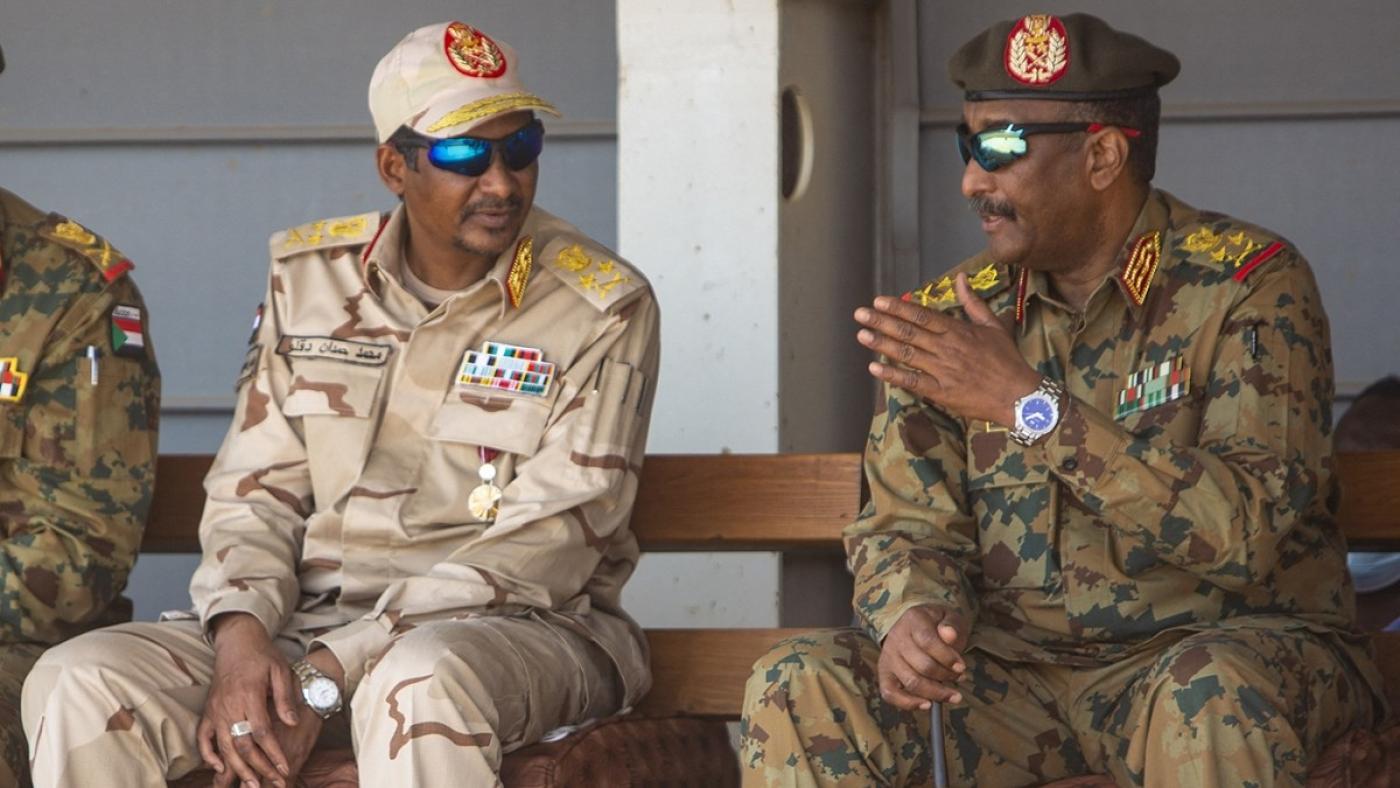
Sudan’s today confrontations erupted between Chairperson of the Sovereign Council and Commander-in-Chief of the Sudanese Army General Abdel Fattah al-Burhan and Deputy Head of Sudan’s ruling Sovereign Council and commander of Sudan’s Rapid Support Forces (RSF) General Mohamed Hamdan Dagalo, generally referred to as Hemetti.
What is the reason behind the clashes?
The power struggle and disputes between Hemetti and al-Burhan are the main causes of the conflicts. According to an accord between civil groups and the ruling Sovereign Council in order to resolve the existing political crisis, which was achieved on December 5, 2022, all armed groups especially the Rapid Support Forces should be integrated into armed forces of Sudan in a determined period, and no militia is allowed to be formed in the country.
Who is ruling Sudan’s government?
At present, the government of Sudan is under the control of General Abdel Fattah al-Burhan, and the transitional government of Sudan has not had any sort of special might since the second coup by the country’s army.
What is the root cause of the crisis in Sudan?
In 2019 coup d’état by Sudan’s Army against the then government of the African country, the then President of Sudan Omar al-Bashir was toppled and Abdalla Hamdok was appointed as the prime minister of the transitional government to take the helm for three years. Furthermore, Sudan’s Transitional Sovereignty Council was formed, consisting of 11 members including military officials and politicians (in cooperation with the Army); of course one of its seats has been empty because of their failure in electing a representative from the eastern Sudan.
Hamdok’s transitional government, which was formed in 2019 in cooperation with the Army and the Forces of Freedom and Change (FFC) coalition, faced a second coup by the Sudanese Army in October 2021. The second coup d’état was faced with protests by the Sudanese people and pro-government groups; so, the coup doomed to fail; and then on December 5, 2022, political and military groups influenced by top commanders of the army reached a consensus to form a 24-month transitional period, which was accepted to be started from the election of a transitional prime minister. However, the process faced power struggle and clashes between Hemetti and al-Burhan; therefore, the fate of Sudan will still wait for other transformations.
The Yemenis from capital Sanaa and 14 other governorates embraced Leader of the Ansar Allah movement Abdul-Malik Badruldeen al-Houthi’s call for taking part in the last Friday of the holy month of Ramadan to commemorate the International Quds Day, and they turned up in masses to show support for Palestine.
The Yemeni people hoisted the flag of Palestine and chanted slogans against the Zionist regime in order to show support for the Palestinian people and resistance movement.
The nation of Yemen issued a statement in the end of the demonstration.
According to the statement, the issue of Palestine is a pivotal matter of the Arab and Islamic Ummah as well as the frontline of its humane and religious priorities, and Palestine is a correct compass that the Ummah turns to it, and any effort by the enemy to turn away its compass direction is doomed to failure. The Yemeni nation will not abandon Palestine and they are ready to have an active presence in any conflict against the temporary Israeli regime. Moreover, we underline once more the Yemenis’ stance on the United States’ hegemony and its hostile policies in the face of the Arab and Islamic Ummah. The International Quds Day maintains the issue of Palestine alive in the soul and sentiments of the people, and helps them constantly keep vigilant in the face of the Zionist foe, because this day is the day of mobilizing the Islamic Ummah and making them well aware of the menace of the enemy and the way to fight back it until they can achieve victory.
Among their slogans, the Yemeni people also called for imposing sanctions on the commodities produced by the United States and the Israeli regime as a practical act in confronting the criminal regimes.
The International Quds Day was designated by Imam Khomeini in 1979 to show support for the Palestinian nation. Following the formation of resistance movement in Yemen as well as the victory of the popular revolution against the then president of Yemen Ali Abdullah Saleh, people of the Arab country hold massive and marvelous demonstrations in the Ansar Allah movement-controlled cities to commemorate the International Quds Day every year in the last Friday of the fasting month of Ramadan.
People from all walks of life from different cities and villages of the Islamic country take part passionately in the important occasion in line with their annual tradition on the last Friday of the fasting month of Ramadan to commemorate the International Quds Day. The occasion has its root in Imam Khomeini’s decision, shortly after leading an Islamic Revolution which toppled the US-backed Shah of Iran in 1979, to designate the last Friday of the fasting month of Ramadan as the International Quds Day.
Video of the presence of millions of Iranian people in the International Quds Day march in different cities of Iran
The Iranian nation participated in the International Quds Day rallies to showcase their solidarity and unity with the Palestinian people, and underlined the need for defending the oppressed nation as well as showing the real power of Islam. They also manifested that the International Quds Day is an Intifada (uprising) of the Islamic world.
The people, who participated in the glorious demonstrations, also emphasized that Muslims’ convergence as well as the unity among the Islamic Ummah are the prelude to strengthening the intifada of the Palestinian people and consolidating their victory in the face of the Zionist regime.
Imam Khomeini’s speech on Int’l Quds Day
During this year’s International Quds Day rallies in Iran, different military and non-military officials pointed out to the unstable and chaotic circumstances of these days of the Zionist regime, and informed of the imminent collapse of the temporary regime. The motto of this year’s International Quds Day was declared “Quds Day Pivot of Islamic Ummah Unity, Quds in Threshold of Liberation.”
It is noteworthy to mention that plus Iran, the International Quds Day rallies were commemorated in different Islamic and Arab countries, including Syria, Malaysia, Bahrain, Lebanon, Jordan and Pakistan, where Muslim nations displayed their resentment towards brutal crimes committed by the Zionist regime against the Palestinian people and the occupation of the Palestinian territories.
Images of the Quds Day march in different cities of Iran
According to local sources, Taliban could have access to information on the exact location of the headquarters of the NLFA forces in Salang district, when they arrested a member of the liberation front and tortured him; then, the Aftab Unit of the 313th Central Army under the supervision of the Taliban’s caretaker government raided the position of the group.
It is worth mentioning that the militants of the National Liberation Front of Afghanistan under the command of Akmal Amir succeeded in resisting in the face of heavy attacks by the Taliban forces until 2 a.m. on April 11, when the militants were killed after suffering from heavy damages and losses; then, they lost their ammunition.
Taliban-affiliated media sources released images of Akmal Amir and Basir Ahmad Andarabi, confirming the death of the two commanders of the National Liberation Front of Afghanistan in Parwan province. However, the NLFA issued a statement denouncing the death of the military commander of the group, underlining that Akmal Amir was injured in the fight against Taliban’s militias, and that the commander has been moved to a safe place.
Akmal Amir and Basir Ahmad Andarabi were known as two members of the special forces of the Afghanistan army during the tenure of the former government of the war-torn country, who had fought along with military forces of the United States and NATO against Taliban militants in Helmand, Kandahar, Uruzgan, Zabul and Kunduz for around 10 years.
Following the collapse of the previous Afghanistan government on June 14, 2021, the commanders moved to Panjshir province and continued their fight against the Taliban under the name of the National Liberation Front of Afghanistan.
The National Liberation Front of Afghanistan consists of anti-Taliban groups, which was formed on February 4, 2022 under the supervision of the former Chief of staff of the Afghan National Army in the previous Afghanistan government Yasin Zia. The groups have active presence in Kunduz, Takhar, Badakhshan, Parwan and Baghlan provinces, pursuing armed confrontation against Taliban.
Following the recent tensions and power struggle among fractions affiliated to the Saudi-led coalition in the occupied territories of Yemen, Saudi Arabia ordered the deployment of the Ataq Military Axis and Al-Dara’ Al-Watan militants in Jardan district, located in northern areas of Ataq city, on April 11.
The forces embarked on setting up a field military base in the mentioned regions, and they also prepared and accumulated military equipment to start advances to Ataq city.
The move comes simultaneous with dispatching some battalions of the Al-Dara’ Al-Watan militants to the port city of Balhaf in a bid to take control of the gas facilities in the city as well as to force the military units of the United Arab Emirates (UAE) to retreat from Shabwah Governorate.
It is noteworthy that in early March, Saudi Arabia recruited certain commanders of the Yemeni Congregation for Reform ie. Islah Party, such as Abd Rabbah Laqab in order to strengthen Al-Dara’ Al-Watan militants.
They are expected to take part in the potential operation by Al-Dara’ Al-Watan militants in Shabwah Governorate.