On December 3, US terrorist army aircraft targeted a site belonging to Iraqi resistance groups in the Dibs area of Kirkuk province, resulting in the martyrdom of five fighters of the Islamic Resistance in Iraq, an umbrella group representing several Iraqi armed factions.
In this regard, a US official claimed that these individuals were preparing to attack US forces in northern Iraq.
A US military commander also told Al Jazeera TV network in an interview: We took defensive action in Iraq, during which a drone site was targeted.
The Islamic Resistance in Iraq, in a statement confirming the martyrdom of five Iraqi fighters, warned US forces to expect more gruesome attacks until they are ultimately expelled from the Arab country.
Given the ongoing events in the Gaza Strip, it does not seem that attacks on US military bases in the region will cease until a complete cessation of war in the besieged area of Palestine.
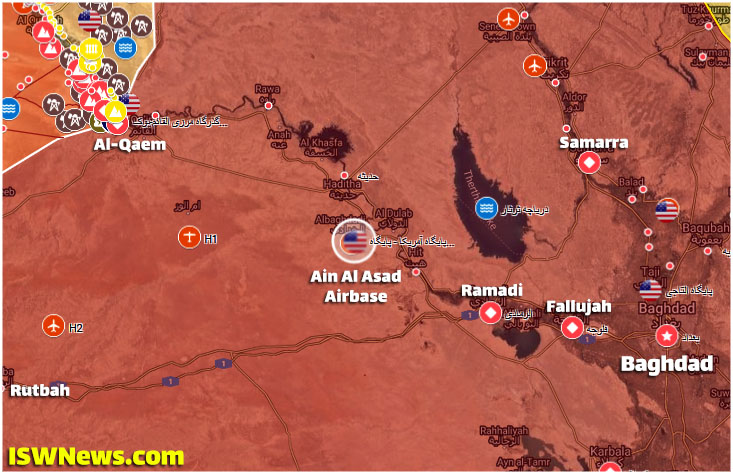
ISWNews Analysis Group – The Islamic Resistance in Iraq declared in a statement on December 3 that its resistance fighters had carried out a drone attack on the positions of the US occupiers in the Green Village at the Al-Omar oil field in Deir ez-Zor Governorate of Syria, as well as the Ain al-Asad Airbase in Al-Anbar province of Iraq.
According to the analysis made by the ISWnews, this is the twenty-first attack on positions of the United States’ forces at the Ain al-Asad Airbase and the fifteenth attack on American positions at the Al-Omar oil field over the course of recent weeks.
Major General Mohammad Bagheri, the Chief of Staff of the Iranian Armed Forces, arrived in the capital of Iraq on December 2 in an official trip to the neighboring country.
During this trip, Bagheri met with Iraqi Defense Minister Jaber al-Jaberi. According to the Iraqi Ministry of Defense, the two sides discussed a number of important issues between Iraq and Iran, particularly the development of military relations between the two countries.
The Chief of Staff of the Armed Forces continued his presence in Baghdad and met with Iraq’s Minister of Interior Abdul Amir al-Shammari. The two sides discussed the promotion of joint security and intelligence efforts.
Bagheri also met with the Chief of the General Staff of the Iraqi Armed Forces Abdel Emir Rashid Yarallah. He expressed appreciation for the efforts and seriousness of the Iraqi government and security forces in organizing the Arbaeen pilgrimage, which brings millions of Shia Muslims to Iraqi city of Karbala. He also said that the Iranian Armed Forces are ready to respond to any threats to Iraq’s territorial integrity and national sovereignty.
The chief of staff of the Iraqi Army also expressed gratitude to the Islamic Republic of Iran for its sincere cooperation in the fight against ISIS terrorist group and commemorated the Iranian commander martyr Qassem Soleimani, who was assassinated by the United States’ drone at the Baghdad International Airport on January 3, 2020.
Abdel Emir Rashid Yarallah announced the full readiness of the Iraqi Armed Forces to develop military, defense, training, joint drills, and experience exchanges.
On December 3, the positions of American occupiers at the Erbil International Airport (EIA), which is located in northern Iraq, were targeted by the Iraqi Islamic Resistance’s drone strikes.
According to investigations made by the ISWnews, this is the nineteenth attack by Iraqi resistance groups on US military positions in the Erbil province during recent weeks.
A few days ago, the Secretary-General of the Iraqi Kataib Hezbollah group Abu Hussein al-Hamidawi declared in a statement that resistance forces’ attacks against American bases during the ceasefire in the Gaza Strip had decreased.
It seems that one of the reasons that the Israeli regime accepted the ceasefire in the Gaza Strip was the increase in pressures and attacks by resistance groups against the United States’ military bases in the West Asia region.
The cessation of strike and the joining of resistance groups in Iraq and Syria to the ceasefire shows that the increase or decrease in attacks against the United States’ military forces in the region is directly related to the actions of the Israeli regime against the Palestinian people in the Gaza Strip.
According to investigations made by the IWN, the Islamic resistance groups have targeted American occupying forces’ positions at least 46 times in Syria and 39 times in Iraq since the onset of the current conflict until two days ago (temporary cessation), as well as four direct attacks on Israeli-occupied territories.
An American official said in a conversation with Al Jazeera: Our forces were attacked by a missile yesterday at the Ain al-Asad base in Iraq, during which 10 soldiers were injured.
Yesterday, the positions of American terrorists in the Ain al-Asad base located in Anbar province of Iraq were targeted by a missile attack by the Iraqi Islamic Resistance. According to the video published by the resistance media, two short-range ballistic missiles were used in this attack. The use of missiles to target American bases in the region has raised the level of military actions against the American invaders to a higher level. Missile attacks will certainly increase American casualties.
During this period, the resistance factions have targeted the US bases in Iraq and Syria at least 68 times. In addition, the Islamic Resistance Groups in Iraq have targeted Israeli regime’s positions in the occupied territories of Palestine four times.
The Islamic resistance groups in Iraq and Syria have launched a series of attacks against the forces supporting the Israeli army in the region (such as the United States Central Command or CENTCOM) and in the Zionist-occupied territories in response to the regime’s brutal attacks on the Gaza Strip.
In the course of these attacks, the resistance groups have targeted US occupiers’ military bases in the West Asia region, as well as the positions of the Israeli army in occupied Palestine, by the use of rockets, drones, and various types of missiles.
Based on analyses of ISWNEWS, the Islamic resistance groups have targeted the following military bases in Syria: three attacks against the Tell Beydar base in Al-Hasakah Governorate, six attacks against the Al-Shaddadi base in southern Al-Hasakah Governorate, six attacks against the CONOCO base in the northeastern Deir Ezzor Governorate, 12 attacks against the Al-Omar base in east of Deir ez-Zor Governorate, six attacks against the Al-Tanf base in Homs Governorate, four attacks against the Al-Rumaylan base (Kharab Al-Jir) in northern Al-Hasakah Governorate, one attack against the Al-Qosrak base in Homs Governorate, and one attack against the Al-Malikiyah base in Al-Hasakah Governorate.
In Iraq, the Camp Victory at the Baghdad International Airport as well as US positions at the Erbil International Airport (EIA) were targeted each on one occasion, while the Al-Harir Air Base in Erbil Governorate was attacked 11 times, and the US army positions at the Ain al-Assad base in al-Anbar Governorate were targeted 17 times with rocket and drone attacks by the Islamic resistance groups.
Furthermore, the Iraqi resistance groups have targeted Israeli-occupied territories, particularly the city of Um al-Rashrash “Eilat”, four times with their missile and drone attacks.
The point that is noteworthy in recent strikes by the resistance groups, is the unveiling of new weapons by these groups during their raids on the conflict zones and the utilization of their updated arms in attacks against the US occupiers’ positions in the region.
The Islamic Front for the Iraqi Resistance, an umbrella group of anti-terror fighters, has recently unveiled two new missiles named Al-Quds 1 and Sarem. The simultaneous unveiling of these missiles along with the recent amplified actions taken by the resistance axis against the United States indicates the beginning of a new phase in their confrontation with the enemies.
Attacks on US bases in the region since October 7 – click to view fulls size
The Islamic resistance of Iraq took responsibility for the attacks by publishing statements.
The operation against the American base in Tal Baydar area of Syria has been carried out using two suicide drones. The operation against Ain al-Assad was also carried out with two suicide drones, and the attack on Harir was also carried out with one suicide drone.
ISWNews Analysis Group – On November 13, media outlets close to the Islamic Resistance of Iraq released a new video of Elizabeth Tsurkov who had disappeared in Iraq some time ago.
In this video footage, Tsurkov said that I am an Israeli citizen and 37 years old. I left Israel and went to the United States. I was working for the Mossad and CIA. I was active in establishing relations between Israel and the Syrian Democratic Forces in northeastern Syria, and I had traveled there in 2022.
She concluded by saying that I came to Iraq to serve the Mossad and CIA, and I have been in captivity for about 7 months now. I served Israel and I don’t think anything has been done for my freedom.
Before her arrest, Tsurkov has been active on Twitter for over 15 years and openly supported wars and interventions against countries that the US and Israel consider their enemies, especially Syria. Despite the crimes of terrorist groups and opponents of the Syrian government, she helped to whitewash in favor of Syrian militants.
According to her close friends, she was a former member of the Israeli army intelligence forces who participated in Israel’s 2006 war against Lebanon’s Hezbollah (33-day war). Tsurkov is also simultaneously a member of several Israeli think tanks and US institutions, including New Lines Institute.
On November 14, the Islamic Resistance of Iraq issued a statement and released an image of the new ballistic missile dubbed Sarem.
The Islamic Resistance of Iraq emphasized in the statement that the missile was unveiled as part of the response to the Israeli regime’s war crimes during the invasion of the Gaza Strip, which occurred under the guidance and management of the United States.
The images of the Sarem ballistic missile show that it is similar in size and shape to the Al-Aqsa 1 missile, both of which appear to be based on the same warhead design. Both unveiled missiles possess a combination of fins and a similar shape to the Fateh missile family.
Sarem missileAl-Aqsa 1 missile
Given the fact that the Islamic Resistance of Iraq has not yet announced the specifications of the two missiles officially, it seems to be difficult to determine their exact type. But, with a diameter of 368 mm, neither of the two examples can be the Fateh 360.
However, we can consider three possibilities for the two missiles Al-Aqsa 1 and Sarem.
In the first possibility, Al-Aqsa 1 could be a BM45 missile, and with the possibility of the existence of Al-Aqsa 2, another option must also be sought among the Fateh missile family. In this case, Sarem missile must be a BM250 missile.
But in the second possibility, Al-Aqsa 1 would be a Fateh-110 missile, and Sarem missile must be a Fateh-313 missile. However, the shape of the wings of the Sarem missile is similar to the Zolfaghar missile as well.
The third possibility is the production of exclusive missiles for the Islamic Resistance of Iraq, which may have been named and unveiled according to the needs of the time. In this case, the missiles only resemble Iranian models in appearance and may have significant changes to reduce costs while using the same engine.
It should be noted that the Islamic Resistance of Iraq had previously published an image on November 6 and unveiled another missile called Al-Aqsa 1.
The Islamic Resistance of Iraq released a statement on November 12, 2023. The group stated that in support of the people of Gaza and in response to the war crimes committed by the occupying Israeli regime against Palestinian civilians, including women, children, and the elderly, the fighters of the Islamic resistance of Iraq targeted positions in the Umm al-Rashrash area i.e. Eilat.
According to the analysis of IWN, this is the third recent attack by the Iraqi resistance group on Israeli positions. Earlier, on November 3, the Islamic Resistance of Iraq had also targeted the city of Eilat.