Tag: Muslim Brotherhood

  • Egypt’s Final Court Ruling Effectively Ends Muslim Brotherhood’s Prospects of Political Return

    Egypt’s Final Court Ruling Effectively Ends Muslim Brotherhood’s Prospects of Political Return

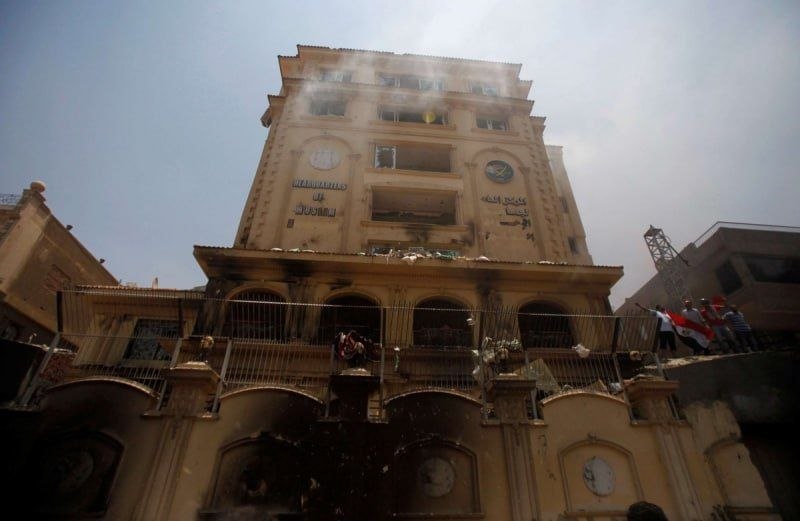
    The process of banning the Muslim Brotherhood began following the ouster of former Egyptian President Mohamed Morsi in 2013. Now, with the judicial ruling becoming final, broader restrictions will be imposed on the group.

    Under the ruling, assets and properties belonging to the Muslim Brotherhood will be transferred to the state, while members of the group will face restrictions on political activities, participation in elections, and holding government positions. The Egyptian government also intends to use the ruling to pursue Brotherhood members abroad and identify and freeze their assets.

    The report also points to internal divisions within the Muslim Brotherhood between factions based in London and Istanbul, arguing that the new ruling could further weaken the group’s financial resources and organizational structure. Meanwhile, the Brotherhood’s branches abroad have described the move as politically motivated, arguing that the Egyptian government has closed off any possibility of reconciliation or the group’s return to political life.

  • Will we see an alliance of the Muslim Brotherhood of Jordan and Iran?

    Will we see an alliance of the Muslim Brotherhood of Jordan and Iran?

    Here, it is worth paying attention to Jordan, which the spokesman for the al-Qassam Brigades, Abu Ubaida, has repeatedly noted as an important strategic pillar of the Palestinians.

    It all started with a statement by Abu Ali al-Askari (spokesman for Kataeb Hezbollah – Iraq), in which the Iraqi resistance expressed its willingness to train 12,000 Jordanians to participate in the resistance to the Zionists. Earlier, the authorities of the Hashemite autocracy arrested three local residents on charges of smuggling weapons to the West Bank, after which Hamas demanded the release of the detainees. Some authors and journalists were quick to point out the presence of local Ikhwan cells that oversee their actions with Hamas and Iran, but no one provided concrete evidence.

    After these incidents, propaganda was organized in the pro-government media of the kingdom against local Ikhwans and Iran, both sides were attacked and accused of trying to “destabilize the country.” In an attempt to defuse tensions, the leader of the Islamic Action Front (the political wing of the Muslim Brotherhood of Jordan), Murad al-Adaylah, pointed out that Jordan’s Ikhwans allegedly had no relations with Iran after 2011. In connection with the disagreements on Syria.

    In my opinion, the head of the Ikhwans proceeded from two points. 1 – at the moment, his main task is to prevent a confrontation with the regime of Abdullah II, so as not to return to a situation in which the Brotherhood of Jordan will be banned. 2 – due to the small number of seats that the “hawks” of the movement gained in the recent internal vote of the Muslim Brotherhood, the party’s agenda remained moderate, which means that one should adhere to relative conformity and voice narratives convenient for the regime.

    In any case, all the justifications for the weak position of the Jordanian Brotherhood against the background of the genocide of the Gaza Strip look inappropriate, especially after Abu Ubaida’s calls to intensify resistance from Jordan to help occupied Palestine.

    The most important question in this whole situation is, will the members of the Muslim Brotherhood of Jordan respond to Kataeb Hezbollah’s proposal to organize a common resistance to Zionism? Time will tell, but the fact that a younger generation has grown up among the Ikhwans dissatisfied with the dominance of the old conformists is a fact. As well as the fact that among all the branches of the brotherhood there is a strong pro-Hamas line that sees the allies of the Palestinian resistance as like-minded people.

  • Scholar council of Saudi Arabia: Muslim Brotherhood is terrorist!

    Scholar council of Saudi Arabia: Muslim Brotherhood is terrorist!

    Scholar council of Saudi Arabia: “Muslim Brotherhood organization is a terrorist group which is not delegate of Islamic theology. They follow their political mission which contradicts our religion. They are imposing hypocrisy, dividing, intriguing, violence and terrorism upon Islam.
    Muslim Brotherhood is a pervert group based on defying the ruler and opposing the government, intriguing in countries, weakening the unity and bringing the societies into ignorance.
    Since the foundation, this group, does not have any attention to believes, Islamic books and traditions but their mission is to reach power.
    The history of this group is full of evil and intrigues, from which terrorist groups came out which corrupted people and countries which can be seen from violent crimes and terrorism in the whole world.”

    Scholar council of Egypt called Muslim Brotherhood heretic before and permitted to take over their wealth to compensate for their damage to Egypt.

    It is noteworthy that Saudi Arabia scholar council statement divided Mansoor Hadi army commanders in Yemen and their internal conflict is not unlikely. It is said Saudi coalition intents to remove Muhammad al-Mqadashi defense minister and Saghrir bin Aziz chief of staff of resigned government of Mansour Hadi, respectively.

  • Opinion: What is Turkey seeking in Libya?

    Opinion: What is Turkey seeking in Libya?

    After the Col. Muammar Gaddafi overthrow in 2011 in Libya, that ended his more than 40-years governing, this country entered to a new stage of political and military actions. The actions that continue so far and have turned Libya into regional and trans-regional powers presence square. These clashes still continue, despite the numerous changing of governments. Among the most important reasons of this conflict continuation, can mention the factors like severe disagreements between the national congress early members and their supporting of Gen. Haftar, that announced the coup against national congress in a tv-speech, governments disability in disarming of armed groups and disability in forming a national army.

    In the current situation, Gen. Haftar (LNA) has the control of more parts of Libya, with the support of some Libyan political groups, foreign countries like Saudi Arabia, UAE and some European countries; and also in other parts, the government stationed in Tripoli (GNA) is supported by Turkey and Qatar. Among the countries that involved in the Libyan conflict, the Turkey activities are more greater. This presence has many reasons including political, ideological and economic reasons.

    The political and ideological dimensions of Turkey’s presence in Libya

    The Government of National Accord (GNA) has the Muslim Brotherhood idealogy, that this issue is one of the main reasons of Turkey’s supports from the Tripoli based government in Libya. The AKP that is the ruling party in Turkey, supported of Muslim Brotherhood all over the Arab world in the Arab spring. The clear example of this issue, was supporting of Morsi in Egypt. Also, one of the reasons for Turkey and Qatar good relations, is the Muslim Brotherhood thoughts of Qatar. The thinking that one of its main rivals in the Sunnah world, is Wahhabism thinking by the Saudi Arabia leadership.

    Erdogan, as the number one figure in Turkey in recent decade, is very interested in Muslim Brotherhood idealogy. Erdogan has studied at the Imam Khatib school, that is a religious school and promotes some of the Muslim Brotherhood ideas and has had activities in Turkey, and he is so interested in these ideas, regardless of political tendencies. Also, spreading of this ideology is a tool for the reviving the Ottoman geographical borders and ideas named Ottomanism by Erdogan, that include the Syria to Egypt and now the Libya.
    Of course, the Libya has been the Mediterranean gateway for the Ottomans, since Ottoman empire. Therefore, the political reason for Turkey presence in Libya is an effort for the Brotherhood government domination in Libya in order to turning to a base for Turkey in the North Africa. In fact, the Turks believe that after the coup in Egypt and the Muhammad Morsi overthrow in Egypt as one of the Erdogan allies in north of Africa, Libya can fill this gap for Turkey.

    The economic dimension of Turkey presence in Libya

    But the other issue, is Turkey’s economic role. At the Muammar Gaddafi time, Turkey had many contractors in Libya, so with the Gaddafi overthrow, Turkey was from the countries that suffered economically in this country. Turkey’s economic activities in Libya were in the extent that this country had been turned to one of the major economic partners of Turkey. Turkey’s investments in Libya are estimated more than 28 billion dollars. Turkey wanted to follow this process after the Gaddafi overthrow, that Libyan economic negotiations with Turkey were postponed due to the Khalife Haftar confliction with the Government of National Accord.

    On the other hand, access to the oil and gas as the cheap fuel and industrial motive is very important for Turkey. The issue that Turkey for reaching it, did drilling in Cyprus and even confronted with Europe. Libya is also from the countries that has a lot of natural resources. The sources that can release the Turkey from dependence on Russia and Iran.

    Therefore, when the Government of National Accord asked Turkey to send the forces, the Turkish parliament allowed immediately Erdogan to dispatch military forces to Libya. After the Turkey policies failure in Syria and the hopelessness, or it’s better that say Erdogan’s fear of confronting with Syria and its supporters such as Iran and Russia, this country’s forces almost lost their efficiency in the Syria, and now for supplying the Turkey’s economic and political interests in Libya, should fight with Gen. Haftar that is backed by Saudi and UAE.

  • Mohamed Morsi dies in court!

    Mohamed Morsi dies in court!

    He was the fifth president of Egypt and leader of Freedom and Justice Party (close to Muslim Brotherhood) who was in office from 30 June 2012 to 3 July 2013.
    Morsi was removed from office by the Army’s coup under El-Sisi(current president of Egypt) and arrested.

  • The Situation of Political Currents in Yemen’s Political Sphere

    The Situation of Political Currents in Yemen’s Political Sphere

    1. Zaidi ( including three groups, one is close to Iran, one to Saudi Arabia & Zaidi intellectuals )
    2. Republican ( with Arabic ethnical tendencies towards Egypt & United Arab Emirates )
    3. Muslim Brotherhood – Salafi ( close to Saudi Arabia, Qatar and Turkey )
    4. Southerners ( with unification, Seperatist, Sufi & Salafi tendencies )


    Until 1962, the unipolar (political) system of Zaidi(1) was ruling in Sana’a.

    From 1962 to 2000, the bipolar system of Saleh-Al-Ahmar(2&3) was ruling in Sana’a and with oppressing the two Zaidi(1) & Southern(4) current, Yemen seemed to be stable.


    From 2000, Ali Abdullah Saleh, with the help of Zaidi(1) current, tried keep Muslim Brotherhood-Salafi(3) current away from power in order to make preparation for presidency of his son.

    Ahmed Ali Abdullah Saleh. but the 2011 revolution led to his downfall.

    The GCC’s, (Persian Gulf Cooperation Council) plan was an attempt to keep “Bipolar” system(2&3) in power and keep Zaidi & Southern current away from center of power.

    However, with regards to downfall of Ali Abdullah Saleh, their efforts led to dominance of Salafi-Muslim Brotherhood current over Sana’a.


    The dictatorship of Salafi-Muslim Brotherhood current in Sana’a, led to convergence of Houthi(1) & Saleh(2), and finally in 2014, Ansarallah entered Sana’a and the Salafi-Muslim Brotherhood current was ousted from Sana’a.


    With Saleh’s death in 2017, the Zaidi(1) “Unipolar” system came into power once again in Sana’a, and the system put itself against these three other groups which despite their ideological & historical differences, are converged now.


    Regarding to failure of all these four currents to rule over yemen alone, the chances for Ansarallah’s survival in Sana’a is very low. Although the repetition of past is not certain, but it is probable.


    United Arab Emirates, which are in fact representing Britain, managed to make majority of southerners(4) & leftovers of Saleh’s system(2) dependant to itself. However, The Salafi-Muslim Brotherhood current(3) which is the main force in Hadi’s organization, is supported by Saudi Arabia and has issues with UAE.

    But how the UAE managed to contain “Bin Salman” so that the initiative don’t fall into the hands of Salafi-Muslim Brotherhood current?

    About this matter, it has been said that attacking non-military targets in Yemen and making it public in medias is one of the tactics of UAE. Even in the popular incident of “October 2016 Sana’a funeral airstrike” (مجزرة الصالة الکبری) in Kholan tribe which was held for father of former interior minister Jalal al-Rowaishan, around 17 commanders of Hadi’s army were killed. in similar cases, serious cases are ongoing against “Bin Salman” in international community, and UAE is using it as an instrument to control “Bin Salman”.


    UAE’s scenario to continue the war, is to gain control over Yemen’s coasts & ports and to make Ahmed Abdullah Saleh, Ali’s son, ruler of Yemen. If this scenario happens, the Zaidi(1) current will be restricted to “Azal” region, the Salafi-Muslim Brotherhood(3) to “Saba” region.

    The Britain which was ousted out of “Aden” in 1967, is coming back to this region, which is one of the strategic regions in the world. However, this time they are pursuing another goal and thats weakening “Shia Political Islam (Zaidi)” & Sunni Political Islam (Muslim Brotherhood)”. Britain knows it better that the ruler of “Sana’a”, will have control over “Aden” too, so Britain can’t leave Sana’a alone and give it to Zaidis or Muslim Brotherhood.


    M.Pirbodaghi