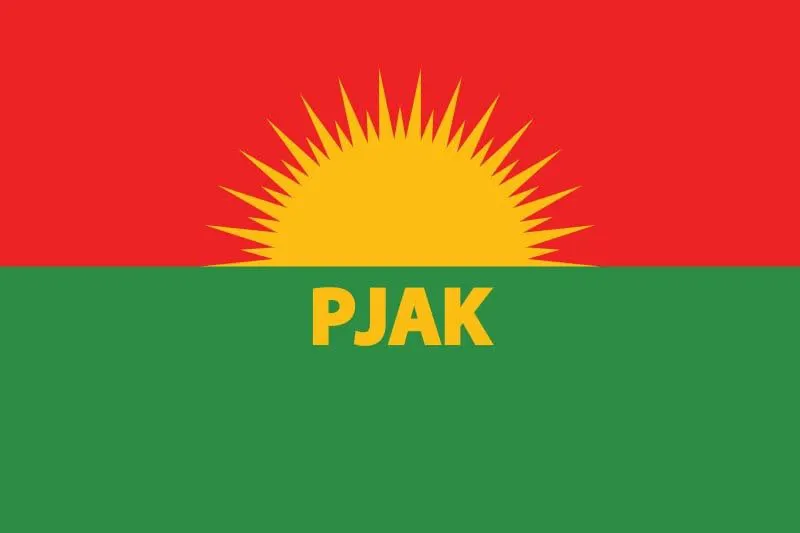
PJAK was established in 2004 by Iranian members of the Kurdistan Workers’ Party (PKK). Its military branch, the “Eastern Kurdistan Units,” operates across Iranian Kurdistan and Qandil in Iraq. Due to its origins, PJAK is influenced by the Turkish PKK, and the United States also regards it as an affiliate of the PKK.
Over the past two decades, multiple clashes have occurred between Iranian forces and PJAK. One of the most significant confrontations took place in the summer of 2011, when the Iranian army launched a large-scale operation against PJAK positions in Qandil, which ended with a ceasefire declared on September 29 of that year. Nevertheless, sporadic skirmishes continued in the following years.
PJAK is led jointly by Amir Karimi and Peyman Wiyan. The group is part of the Kurdistan Communities Union (KCK) and regards Abdullah Öcalan as its ideological leader. After the collapse of the peace process between Turkey and the PKK in 2015, a significant number of Iranian Kurds joined the KCK’s ranks, now making up roughly 35% of its military forces. This has strengthened PJAK’s role in both regional and international contexts.
With the resumption of talks between Turkey and Öcalan in 2024, along with the PKK’s announcement of its withdrawal from armed struggle, the future of the PJAK remains uncertain. Some believe that the PKK’s military and guerrilla capabilities may shift to the PJAK, which could create significant security challenges for Iran.
Maybe it’s worth revisiting Öcalan’s earlier statements; since 2008, he has expressed concerns regarding Iran’s interference in the peace process and in 2013, recommended boosting PJAK forces to 40,000 to confront Iranian dangers.
Global developments—from the war in Ukraine and the Syrian crisis to Iran-Turkey rivalry, the role of Israel, and NATO tensions—have influenced Turkey’s strategic calculations regarding Iran. Turkey’s experiences in Syria and Iraq have shown that the Kurds act as a balance of power. Ankara now seeks engagement and coordination with PJAK instead of direct confrontation.
In this context, Netanyahu’s focus on destabilizing Iran has pushed Turkey to develop a more calculated approach toward Iranian affairs. It seems Ankara has concluded that it cannot play an effective role in Iran’s future developments without considering PJAK’s influence. All these factors are compelling Turkey to seriously revise and prepare its strategic agenda concerning Iran. One indication of this may be the Turkish leadership’s intention to align the PKK’s congress with its own interests in renegotiation and potential rearmament.
The Necessity of PJAK in Turkey’s New Strategy
In 2015, the Democratic Party of Iranian Kurdistan (PDKI), along with several other Kurdish parties, attempted to reclaim their former position in Iranian Kurdistan’s political and social scene through a campaign called “Rasan,” aiming to curb PJAK’s growing influence. Clashes occurred in the mountainous region of Kileh Shin, allegedly part of an operation orchestrated by the Turkish government. Media outlets close to the PDKI and to some extent Komala subtly confirmed Turkey’s role in these events.
However, these efforts failed, and the Iranian Kurdish parties were unsuccessful in achieving their objectives. Following this setback, Turkey began looking for a more effective alternative force in the region—and that force was PJAK. Simultaneously, Israel unofficially conveyed a message to these Kurdish parties suggesting that significant developments were approaching in Iran and that Kurds could play a key role in shaping them.
PJAK in Turkey’s Strategic Calculations
PJAK has yet to hold a congress to formally disarm or dissolve, and this process has stalled, with Qandil attributing the deadlock to Öcalan’s absence from the process. Even if a decision to end armed struggle is made, the guerrilla forces would not immediately lay down their arms. Integrating them into formal politics would require a transitional structure—something PJAK could provide, but only if a comprehensive agreement is reached between Turkey and Öcalan, and anti-Turkish elements within PJAK shift their stance.
Turkey aims to use PJAK as a tool to manage potential developments in Iran and prevent the Kurds from aligning with Israeli interests, thereby avoiding a repeat of the Syrian scenario. For this reason, Ankara seeks to incorporate PJAK into any future peace agreements. According to a Kurdish journalist, Turkey envisions PJAK playing a role in Iran similar to that of the Syrian National Army (SNA) in Syria.
Iran’s Position in the Turkey-PJAK Equation
Since 2013, when PKK guerrillas withdrew toward Iran’s borders, Tehran has grown increasingly concerned about the implications of the Turkey-PKK peace process. In meetings with the PKK and Kurdish parties in Iraq, Iran explicitly warned about the expanded presence of these forces near its borders, questioning who would control PJAK in the event of a Turkey-Öcalan agreement. This concern led to a widening rift between Iran and Qandil.
This concern was not solely security-related; it also stemmed from a deeper geopolitical rivalry between Iran and Turkey. From Tehran’s perspective, PJAK could become a tool of Turkish influence if the group aligns itself with Ankara. As a regional actor, Iran must maintain ties with Qandil and use political tools to prevent the balance from tipping solely in Turkey’s favor.
The future role of PJAK depends on the PKK’s orientation toward Iran. If relations between Qandil and Tehran deteriorate, it would signal a full alignment of the PKK with Turkey—a scenario that seems unlikely for now without concrete assurances. For the sake of regional stability, both Iran and Qandil will likely be forced to maintain engagement.


