Tag: United Arab Emirates

  • Emirates; The Pirates’ Shore!

    Emirates; The Pirates’ Shore!

    On 2nd December 1971, British under William Luce as head conducted negotiations with administration of Iran and established a country in Persian Gulf which was famous as home of pirates before.
    Immigrant Wahhabis who settled in southern shores of Persian Gulf under due to weakness of central administrations of Iran (Zand, Qajar and Pahlavi dynasties) are now called United Arab Emirates which consists of seven Emirates of Abu Dhabi, Dubai, Sharjah, Ras Al Khaimah, Ajman, Fujairah and Umm Al Quwain.


    Emirates Sheikhs (chiefs) are proclaiming to rule over the three islands Greater and Lesser Tunbs and Abu Musa from the incipient and accusing Iran to be occupier and sometimes have supports from the region or around the globe.
    But this proclaim considering Iran’s ruling over the aforementioned islands from old maps and documents, its mention in colonizers contracts with Qajar kings and etc., is not true which was rejected in UN Security Council as well.


    Authoritarianism and Corruption:
    Emirates under support of Britain not only proclaiming of right to rule over the three islands but also supports Iran’s sanctions, assaulting Yemen, condemning Syria and Hezbollah, supporter of Saddam during Iran-Iraq war (Emirates, Saudi Arabia, Kuwait, Bahrain and Qatar donating 50 billion dollars, 1,500 missiles to Saddam and supporting US Navy in confronting Iran), supporter of ISIS financially and military, supporter of Taliban, supporter of General Haftar in Libya’s civil war (sending fighter aircrafts and military equipment), military presence in Afghanistan among others.


    Confronting Iran:
    The reason behind having such a proclaim is not only limited to the rich oil resources of the islands but also to confront Iran’s rule over south of Persian Gulf and Strait of Hormuz, and since the only maritime route for tankers and large vessels is between Abu Musa and Tunbs islands due to depth of water.
    To retaliate Iran’s threat over shutting Strait of Hormuz, Emirates started building a 370 km pipeline to transport Arabic countries’ oil from Abu Dhabi to east of Emirates in Fujairah area. This pipeline can transport up to three quarter of Emirates oil export.
    They are building the world’s largest underground oil reservoir in Fujairah(eastern shore of Emirates on Gulf of Oman) with capacity of 42 million barrels of oil with help of South Korea.
    Emirates also bought or rented oil reservoirs in India and Japan so if Iran’s threat takes place nothing happens to western masters’ oil import.

    These plans need huge amounts of time and money which are happening under western countries’ long negotiations with Iran and imposing sanction on it.
    Thus, everytime Emirates repeats the proclaim over the islands, western countries’ from Obama’s to Trump’s administration to France’s Foreign Ministry and Arab rulers become excited and support the nonsense proclaims…
  • Monthly Report on Yemen’s developments 28 June 2018; Situation of Fronts + Maps

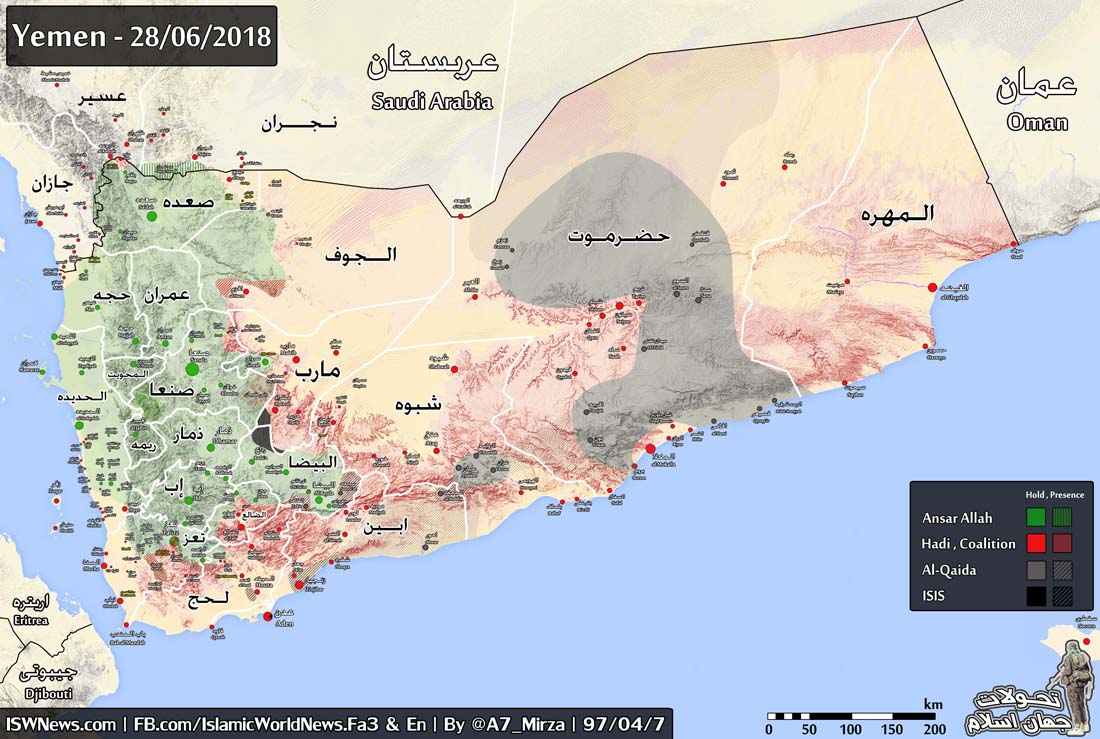
    Monthly Report on Yemen’s developments 28 June 2018; Situation of Fronts + Maps

    In the past month three pivot, out of ten pivot, had more change and clashes.
    – Northern Al-Hajjah pivot
    – Southern Al-Hudaydah pivot
    – Al-Bayda pivot


    Al-Hajjah pivot:
    In Yemen’s northern pivot, the coalition forces —after that Ansarallah left the Saudi Arabia soil and heavy bombardments against villages & border towns, like Khobah— invaded border crossings and cities across the main roads, which resulted the fall of “Midi” port (northern Al-Hajjah) and Al-Nar & Al-Shabaka heights (east side of Tawwal crossing) all the way up to northern Harad, into the hands of coalition. Right now Al-Nar & Al-Shabaka are retaken by Ansarallah, and once again the coalition forces have retreated from eastern Tawwal to Saudi Arabia’s soil, However, Midi is still under control of coalition.


    Southern Al-Hudaydah pivot:

    As we mentioned in our previous report, the aim of their operation in west coast of Yemen is to cut Ansarallah’s access to the sea. For achieving this goal, from the beginning of Yemen war, southern Al-Hudaydah have faced heaviest attacks from Saudi-led coalition, with pivotal role of United Arab Emirates.

    (According to the latest news & field informations, the situation of southern Al-Hudaydah is explained in this Link: Latest Updates on Al-Hudaydah and Western Coast Fronts; Map)


    Al-Bayda pivot:

    In this pivot, the attacks by Saudi-led coalition, ISIL and Al-Qaeda are still going on in pivots which were described in previous report.
    In Na’man district, Ansarallah retreated from its positions and now Malajim, Nati` and Qaniya are the contact lines between Saudi-led coalition and Ansarallah.
    In Rada’a district, the enticed elements of Al-Qaeda & ISIL were killed by Ansarallah in its recent operations, and some of them are captured. ( For more information about this news, go to: Latest Updates on Yemen 25 June 2018; News of Fronts )
    In other pivots, there is no report about notable clashes.


    And about negotiations and the fate of the war:

    The fate of the war in Yemen is dependant on Al-Hudaydah Operation.
    Overall it can be said that Saudi-led coalition sword is double edged. The blunt side is the negotiations, and the sharp side is their military operation. So in light of this the negotiations are still going on with the mediation of UN’s Envoy, in one hand, and the military operation in Al-Hudaydah continues, on the other hand.


    Previously, Ansarallah’s leader said that they are ready to give UN the control over the payments of government employees & revenues from Al-Hudaydah port, and he also said that if coalition stop its military operation in Al-Hudaydah coasts, they will stop their attacks in sea and secure the sea.


    For completing the military victories, Ansarallah needs to achieve a political victory, which they have alot of troubles in the way of getting it.
    One of these troubles is the International Consensus that has been created by lots of Saudi and UAE money & mercenary states of the region.
    Ansarallah officials need to break this consensus and get themselves out of international limitations. (maybe this solution is the only channel right now that Iranians can help Ansarallah with it)
    Ansarallah, in terms of military power, social support, security of cities, etc… is not in a bad position, but in Diplomacy War, sometimes they need the support of countries like Iran and sometimes creating an agreement with other fronts and even an election on a national scale.


    Despite the things that are being said, Ansarallah has enough power to defend western coasts, and what led the UAE to Al-Hudaydah airfield is Ansarallah plan to swamp Emirates in order to drain their power.


    The battle of Al-Hudaydah will determine the next stage of war in Yemen, and in future we shall see that Ansarallah can make Al-Hudaydah for Emirates sheikhs & Saudi crown prince, another Stalingrad, or that the fall of Al-Hudaydah will be the key to secession & colonization of Yemen.


    HD map
    Interactive map


    Monthly Report on Yemen’s developments 29 May 2018; Situation of Fronts + Maps

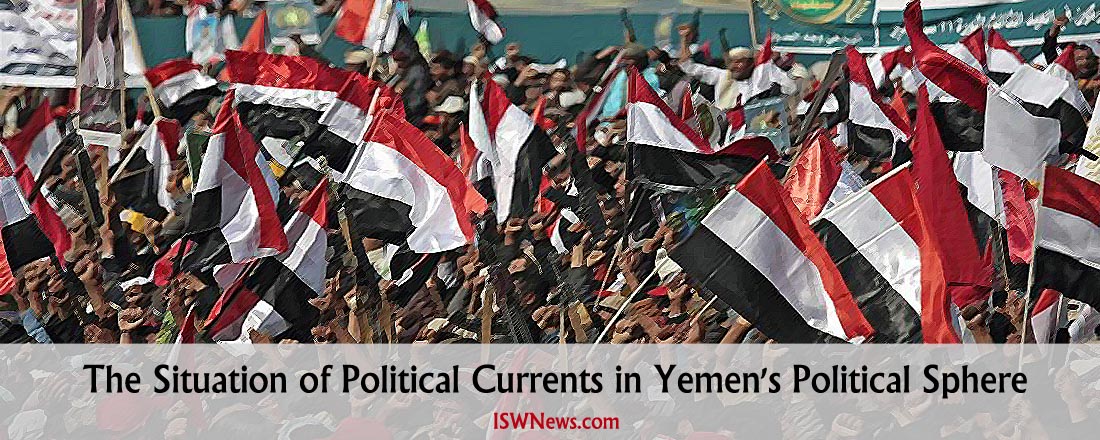
  • The Situation of Political Currents in Yemen’s Political Sphere

    The Situation of Political Currents in Yemen’s Political Sphere

    1. Zaidi ( including three groups, one is close to Iran, one to Saudi Arabia & Zaidi intellectuals )
    2. Republican ( with Arabic ethnical tendencies towards Egypt & United Arab Emirates )
    3. Muslim Brotherhood – Salafi ( close to Saudi Arabia, Qatar and Turkey )
    4. Southerners ( with unification, Seperatist, Sufi & Salafi tendencies )


    Until 1962, the unipolar (political) system of Zaidi(1) was ruling in Sana’a.

    From 1962 to 2000, the bipolar system of Saleh-Al-Ahmar(2&3) was ruling in Sana’a and with oppressing the two Zaidi(1) & Southern(4) current, Yemen seemed to be stable.


    From 2000, Ali Abdullah Saleh, with the help of Zaidi(1) current, tried keep Muslim Brotherhood-Salafi(3) current away from power in order to make preparation for presidency of his son.

    Ahmed Ali Abdullah Saleh. but the 2011 revolution led to his downfall.

    The GCC’s, (Persian Gulf Cooperation Council) plan was an attempt to keep “Bipolar” system(2&3) in power and keep Zaidi & Southern current away from center of power.

    However, with regards to downfall of Ali Abdullah Saleh, their efforts led to dominance of Salafi-Muslim Brotherhood current over Sana’a.


    The dictatorship of Salafi-Muslim Brotherhood current in Sana’a, led to convergence of Houthi(1) & Saleh(2), and finally in 2014, Ansarallah entered Sana’a and the Salafi-Muslim Brotherhood current was ousted from Sana’a.


    With Saleh’s death in 2017, the Zaidi(1) “Unipolar” system came into power once again in Sana’a, and the system put itself against these three other groups which despite their ideological & historical differences, are converged now.


    Regarding to failure of all these four currents to rule over yemen alone, the chances for Ansarallah’s survival in Sana’a is very low. Although the repetition of past is not certain, but it is probable.


    United Arab Emirates, which are in fact representing Britain, managed to make majority of southerners(4) & leftovers of Saleh’s system(2) dependant to itself. However, The Salafi-Muslim Brotherhood current(3) which is the main force in Hadi’s organization, is supported by Saudi Arabia and has issues with UAE.

    But how the UAE managed to contain “Bin Salman” so that the initiative don’t fall into the hands of Salafi-Muslim Brotherhood current?

    About this matter, it has been said that attacking non-military targets in Yemen and making it public in medias is one of the tactics of UAE. Even in the popular incident of “October 2016 Sana’a funeral airstrike” (مجزرة الصالة الکبری) in Kholan tribe which was held for father of former interior minister Jalal al-Rowaishan, around 17 commanders of Hadi’s army were killed. in similar cases, serious cases are ongoing against “Bin Salman” in international community, and UAE is using it as an instrument to control “Bin Salman”.


    UAE’s scenario to continue the war, is to gain control over Yemen’s coasts & ports and to make Ahmed Abdullah Saleh, Ali’s son, ruler of Yemen. If this scenario happens, the Zaidi(1) current will be restricted to “Azal” region, the Salafi-Muslim Brotherhood(3) to “Saba” region.

    The Britain which was ousted out of “Aden” in 1967, is coming back to this region, which is one of the strategic regions in the world. However, this time they are pursuing another goal and thats weakening “Shia Political Islam (Zaidi)” & Sunni Political Islam (Muslim Brotherhood)”. Britain knows it better that the ruler of “Sana’a”, will have control over “Aden” too, so Britain can’t leave Sana’a alone and give it to Zaidis or Muslim Brotherhood.


    M.Pirbodaghi


  • Latest Updates On Yemen 3 May 2018; The Intensification of Conflicts in Ta’iz and the Yemeni Western Coast

    Latest Updates On Yemen 3 May 2018; The Intensification of Conflicts in Ta’iz and the Yemeni Western Coast

    1- Continuation of conflict on the western coast and the positions of the UAE-backed forces up to Mafraq al-Mukhah, came under the AnsarAllah and Army’s fire.


    2- Clashes around the presidential palace and al-Tashrifat garrison in the east of Taiz.

    According to Saudi sources, the AnsarAllah attack repelled.


    3. Major General Ali Mohammad Salem, Defense Minister of Sudan:

    “We are examining the various dimensions and angles of the continuation of the Sudanese army presence in Yemen and what has achieved in this war so far; We will announce the results soon.”


    4. The reaction of Mohammed Ali al-Houthi, President of the Revolutionary Committee, to Saudi Arabia’s threats against Iran:

    “If Saudi Arabia could fight Iran, it would do so in Syria, As Iran did, and fought with its allies in Syria against terrorist groups.

    Saudi generals must stop provoking the media tensions which they are trying to show that they are able to defeat Iran.

    The fighting in Syria continues and the Iranian generals run from Suleimani to the youngest Iranian soldier and we see them in the media, but where are you in Syria? Where are your generals?

    The Saudis do not dare to confront Iran and its allies in Syria.

    The UAE publicly threatens Iran, but it is secretly trying to hold Iranian companies in Dubai.”


    5- Yemeni popular committees and the Army attacked the position of the Saudi-led coalition forces in the al-Abdeyah area of the Nateq district. (Al-Bayda province).


    6. Mansoor Hadi’s operation to occupy Taiz province.

    The controversy between the southern forces (supported by United Arab Emirates) and the Mansour Hadi forces (supported by Saudi Arabia), the geographical conditions and AnsarAllah’s resistance can be one of the factors that would make this operation fail.