Following the historic victory of Iraq and Syria’s resistance movement over the sedition of Takfiri terrorism and the end of ISIS’s domination, which was manifested by lowering the flag of this American-Zionist group at Abu Kamal–the last key area in the hands of ISIS–General Soleimani issued an important message to Ayatollah Khamenei.
The following is the full text of Major-General Soleimani’s message to Ayatollah Khamenei: In the Name of God, the Most Beneficent, the Most Merciful
“Indeed, we have opened for you (Prophet Muhammad) a clear opening.” Quran [1: 48]
To the dear and brave Leader of the Islamic Revolution, Ayatollah Khamenei:
Salamun Alaikum (peace and greetings upon you),
Six years ago, a dangerous plot like the ones at the time of Amir al-Mu’minin (as), which prevented Muslims from truly understanding the pure Islam of Muhammad (pbuh), this time, mixed with the poison of Zionism and arrogance, covered the Islamic world like a devastating storm.
This devastating and poisonous sedition was created by the enemies of Islam with an aim of initiating widespread war within the Islamic world and a fight among Muslims. The evil movement, under the name of the “Islamic State of Iraq and the Levant,” managed, in the early months, to deceive tens of thousands of Muslim youth from both countries, causing a very dangerous crisis for the influential and crucial countries of the Islamic world: Iraq and Syria.
They occupied hundreds of thousands of square kilometers of land from these countries along with thousands of villages, towns, and provincial centers; they destroyed thousands of factories, manufactures, and major infrastructure of these countries–including roads, bridges, refineries, wells, gas and oil lines, and power plants; they destroyed or burned important cities with valuable historical monuments and national civilizations by bombing them.
Although it is not possible to calculate all the damage caused yet, the preliminary investigation estimates damages to be around $500 billion.
In this event, there were extremely horrendous crimes that could not be shown, which included the following: decapitation of children, skinning men alive before their families, taking young girls and women hostage and raping them, burning people alive and group massacres of hundreds of young people.
The people of these countries, astounded by this poisonous storm, either became victims of the takfiri criminals or left their homes, displaced throughout other cities and countries.
In this dark sedition, thousands of mosques and sacred centers of Muslims were destroyed or ruined, and sometimes a mosque along with the Imam and all the people in it were blown up.
More than 6,000 young people, deceived in the name of defending Islam, blew themselves up by way of suicide bombings, using explosive vehicles at city squares, mosques, schools, even hospitals and public places of Muslims; as a result of these criminal acts, tens of thousands of innocent men, women, and children were martyred.
All these crimes have been designed and implemented by US leaders and organizations, according to the acknowledgement of the highest-ranking US official who is currently president of the United States; moreover, this scheme is still being modified and implemented by current American leaders.
What, in addition to the favour of God and the special grace of the great Prophet Muhammad and his honorable household (pbut), led to the defeat of this dark and dangerous conspiracy was the wise leadership and guidance of his Excellency, Ayatollah Sistani, who mobilized all facilities to deal with this toxic storm.
Certainly, the resistance of the Iraqi and Syrian governments and the perseverance of the armies and youths of these two countries, especially the holy Popular Mobilization Forces (PMF), Al-Hashd Al-Sha’abi, and other Muslim youth from other countries with the prominent presence of Hezbollah led by its great leader, Sayyid Hassan Nasrallah, played an important role in overturning this dangerous event.
Definitely the valuable role of the nation and the government of the Islamic Republic of Iran–the respected president in particular–the parliament, the Defense Ministry, as well as police, military and security organizations of our country, in supporting the above mentioned states and nations, is admirable.
This humble person, as a soldier called upon by your eminence to serve on this battlefield, announces the termination of the rule of this vicious cursed entity, following the completion of the liberation operation of Abu Kamal as ISIS’ last fort, bringing down the flag of this US-Zionist made terrorist group, raising the flag of Syria. On behalf of all the commanders and anonymous fighters on the battlefield, the thousands of Iranian, Iraqi, Syrian, Lebanese, Afghan and Pakistani martyred and disabled defenders of the holy shrine–who gave their lives to defend the lives and honor of Muslims and their sanctities–I congratulate and felicitate you and the noble nation of Islamic Iran, as well as the nations of Iraq, Syria, and other Muslims of the world. I prostrate before the Almighty God in gratitude for this great victory.
“And victory comes only from God, the All-mighty, the All-wise.” Quran [3:126]
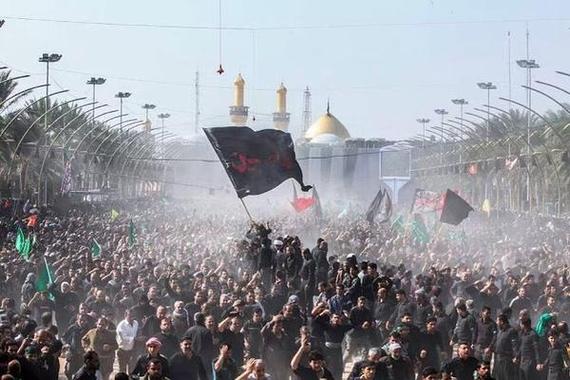
Not only does the congregation exceed the number of visitors to Mecca (by a factor of five, in fact), it is more significant than Kumbh Mela, since the latter is only held every third year. In short, Arbaeen dwarfs every other rally on the planet, reaching twenty million last year. That is a staggering %60 of Iraq’s entire population, and it is growing year after year.
Above all, Arbaeen is unique because it takes place against the backdrop of chaotic and dangerous geopolitical scenes. Daesh (aka ‘Islamic State’) sees the Shia as their mortal enemy, so nothing infuriates the terror group more than the sight of Shia pilgrims gathering for their greatest show of faith.
There’s another peculiar feature of Arbaeen. While it is a distinctively Shia spiritual exercise, Sunnis, even Christians, Yazidis, Zoroastrians, and Sabians partake in both the pilgrimage as well as serving of devotees. This is remarkable given the exclusive nature of religious rituals, and it could only mean one thing: people regardless of color or creed see Hussein as a universal, borderless, and meta-religious symbol of freedom and compassion.
Why you have never heard of it probably has to do with the fact that the press is concerned more with negative, gory, and sensationalized tabloids, than with positive, inspiring narratives, particularly when it comes to Islam. If a few hundred anti-immigration protestors take to the streets in London and they will make headlines.. The same level of airtime is awarded to a pro-democracy march in Hong Kong or an anti-Putin rally in Russia.. But a gathering of twenty million in obstreperous defiance of terror and injustice somehow fails even to make it into the TV news ticker! An unofficial media embargo is imposed on the gargantuan event despite the story having all the critical elements of an eye-catching feature; the staggering numbers, the political significance, the revolutionary message, the tense backdrop, as well as originality.. But when such a story does make it through the editorial axe of major news outlets, it creates shockwaves and touches the most random people.
Among the countless individuals inspired by it, is a young Australian man I met several years ago who had converted to Islam. Evidently, no one takes such a life-altering decision lightly, so upon inquiry he told me it all started in 2003. One evening, as he was watching the news only to be drawn by scenes of millions streaming towards a holy city known as Karbala, chanting the name of a man he had never heard of: “Hussein”. For the first time in decades, in a globally televised event, the world had caught an glimpse into previously suppressed religious fervor in Iraq.
With the Sunni Ba’athist regime toppled, Western viewers were eager to see how Iraqis would respond to a new era free from dictatorship persecution. The ‘Republic of Fear’ had crumbled and the genie had irreversibly escaped from the bottle. “Where is Karbala, and why is everyone heading in its direction?” he recalls asking himself. “Who is this Hussein who motivates people to defy all the odds and come out to mourn his death fourteen centuries after the fact?”
What he witnessed in that 60-second report was especially moving because the imagery was unlike any he had ever seen. A fervent sense of connection turned human pilgrims into iron filings, swarming together other as they drew closer to what could only be described as Hussein’s irresistible magnetic field. “If you want to see a living, breathing, lively religion, come to Karbala” he said.
How could a man who was killed 1396 years ago be so alive and have such a palpable presence today that he makes millions take up his cause, and view his plight as their own? People are unlikely to be drawn into a dispute (much less one that transpired in ancient times) unless they have a personal interest in the matter. On the other hand, if you felt someone was engaged in a fight over your right to freedom, your prerogative to be treated justly, and your entitlement to a life of dignity, you would feel you had a vested interest and would empathize with him to the point where conversion to his beliefs is not a far-fetched possibility.
The Ultimate Tragedy
Hussein, grandson of the Prophet Muhammad, is revered by Muslims as the “Prince of Martyrs”. He was killed in Karbala on a day which became known as Ashura, the tenth day of the Islamic month of Muharram, having refused to pledge allegiance to the corrupt and tyrannical caliph, Yazid.
Shia Muslims have since mourned the death of Hussein, in particular on the days of Ashura, then, forty days later, on Arbaeen. Forty days is the usual length of mourning in many Muslim traditions. This year, Arba’een falls on Friday 12 December.
Long Trek
I travelled to Karbala, my own ancestral home, to find out for myself why the city is so intoxicating. What I witnessed proved to me that even the widest-angle camera lens is too narrow to capture the spirit of this tumultuous, yet peaceful gathering.
An avalanche of men, women and children, but most visibly black-veiled women, fill the eye from one end of the horizon to the other.The crowds were so huge that they caused a blockade for hundreds of miles.
The 425 mile distance between the southern port city of Basra and Karbala is a long journey by car, but it’s unimaginably arduous on foot. It takes pilgrims a full two weeks to complete the walk. People of all age groups trudge in the scorching sun during the day and in bone-chilling cold at night. They travel across rough terrain, down uneven roads, through terrorist strongholds, and dangerous marshlands. Without even the most basic amenities or travel gear, the pilgrims carry little besides their burning love for “The Master” Hussein. Flags and banners remind them, and the world, of the purpose of their journey:
O self, you are worthless after Hussein.My life and death are one and the same,
So be it if they call me insane!
The message recalls an epic recited by Abbas, Hussein’s half-brother and trusted lieutenant, who was also killed in the Battle of Karbala in 680AD while trying to fetch water for his parched nieces and nephews. With security being in the detrimental state that makes Iraq the number one headline in the world, no one doubts that this statement is genuine in every sense.
Free lunch.. And dinner, and breakfast!
One part of the pilgrimage which will leave every visitor perplexed is the sight of thousands of tents with makeshift kitchens set up by local villagers who live around the pilgrims’ path. The tents (called ‘mawkeb’) are places where pilgrims get practically everything they need. From fresh meals to eat and a space to rest, to free international phone calls to assure concerned relatives, to baby diapers, to practically every other amenity, free of charge. In fact, pilgrims do not need to carry anything on the 400 mile journey except the clothes they wear.
More intriguing is how pilgrims are invited for food and drink. Mawkeb organizers intercept the pilgrims’ path to plead with them to accept their offerings, which often includes a full suite of services fit for kings: first you can a foot massage, then you are offered a delicious hot meal, then you are invited to rest while your clothes are washed, ironed, then returned to you after a nap. All complimentary, of course.
For some perspective, consider this: In the aftermath of the Haiti earthquake, and with worldwide sympathy and support, the UN World Food Programme announced delivery of half a million meals at the height of its relief efforts.. The United States military, launched Operation Unified Response, bringing together the massive resources of various federal agencies and announced that within five months of the humanitarian catastrophe, 4.9 million meals had been delivered to Haitians. Now compare that with over 50 million meals per day during Arbaeen, equating to about 700 million meals for the duration of the pilgrimage, all financed not by the United Nations or international charities, but by poor laborers and farmers who starve to feed the pilgrims and save up all year round so that visitors are satisfied. Everything, including security is provided mostly by volunteer fighters who have one eye on Daesh, and another on protecting the pilgrim’s path. “To know what Islam teaches,” says one Mawkeb organizer, “don’t look at the actions of a few hundred barbaric terrorists, but the selfless sacrifices exhibited by millions of Arbaeen pilgrims.”
In fact, Arbaeen should be listed in the Guinness Book of World Records in several categories: biggest annual gathering, longest continuous dining table, largest number of people fed for free, largest group of volunteers serving a single event, all under the imminent threat of suicide bombings.
Unmatched Devotion
Just looking at the multitudes leaves you breathless. What adds to the spectacle is that, as the security conditions worsen, even more people are motivated to challenge the terrorist threats and march in defiance. Thus, the pilgrimage isn’t a mere religious exercise, but a bold statement of resistance. Videos have been posted online showing how a suicide bomber blows himself up in the midst of the pilgrims, only to have the crowds turn out in even greater numbers, chanting in unison:
If they sever our legs and hands,We shall crawl to the Holy Lands!
The horrific bomb blasts which occur year-round, mostly targeting Shia pilgrims and taking countless lives, illustrate the dangers facing Shias living in Iraq, and the insecurity that continues to plague the country. Yet the imminent threat of death doesn’t seem to deter people – young and old, Iraqis and foreigners – from making the dangerous journey to the holy city.
It isn’t easy for an outsider to understand what inspires the pilgrims. You see women carrying children in their arms, old men in wheelchairs, people on crutches, and blind seniors holding walking sticks. I met a father who had travelled all the way from Basra with his disabled boy. The 12-year-old had cerebral palsy and could not walk unassisted. So for a part of the trek the father put the boy’s feet on top of his and held him by the armpits as they walked. It is the kind of story out of which Oscar-winning films are made, but it seems Hollywood is more concerned with comic heroes and with real life heroes whose superpower is their courage and commitment.
Golden Dome of Hussein
Visitors to the shrine of Hussein and his brother Abbas are not driven by emotion alone. They cry be reminded of the atrocious nature of his death, in doing so, they reaffirm their pledge to his ideals.
The first thing that pilgrims do upon reaching his shrine is recite the Ziyara, a sacred text which summarizes the status of Hussein. In it, they begin the address by calling Hussein the “inheritor” of Adam, Noah, Abraham, Moses and Jesus. There is something profound in making this proclamation. It shows that Hussein’s message of truth, justice, and love for the oppressed is viewed as an inseparable extension of all divinely-appointed prophets.
People go to Karbala not to marvel at the city’s landscape – lush with date palms, or to admire the mausoleum’s physical beauty, or to shop, be entertained, or to visit ancient historical sites. They go to cry. To mourn and experience the angelic aura of Hussein. They enter the sacred shrine weeping and lamenting the greatest act of sacrifice ever seen.
It is as though every person has established a personal relationship with the man they have never seen. They talk to him and call out his name; they grip the housing of his tomb; they kiss the floor leading into the shrine; they touch its walls and doors in the same manner one touches the face of a long-lost friend. It is a picturesque vista of epic proportions. What motivates these people is something that requires an understanding of the character and status of Imam Hussein and the spiritual relationship that those who have come to know him have developed with his living legend.
If the world understood Hussein, his message, and his sacrifice, they would begin to understand the ancient roots of Daesh and its credo of death and destruction. It was centuries ago in Karbala that humanity witnessed the genesis of senseless monstrosities, epitomized in the murderers of Hussein. It was pitch black darkness v. Absolute shining light, an exhibition of vice v. a festival of virtue, hence the potent specter of Hussein today. His presence is primordially woven into every facet of their lives. His legend encourages, inspires, and champions change for the better, and no amount of media blackout can extinguish its light.
“Who is this Hussein”? For hundreds of millions of his followers, a question this profound, which can cause people to relinquish their religion for another, can be answered only when you have marched to the shrine of Hussein on foot.
After announcing the start of the operation in Idlib province by Erdogan on October 7th and executing another part of the Astana agreement known as “De-Escalation Zone Deal” , till now about 200 military equipment including military vehicles and personnel along with the Turkish army entered the province of Idlib.
Turkey’s entry into the province of Idlib within the framework of the Astana peace agreement can be investigated.
Apart from mentioned objectives of entering the province of Idlib by the Turkey, in the first phase, this event is included of the presence of Turkish troops in western side of Aleppo province along the Darat Izza, Jabal Sheikh Barakat, Dir al-Sam’an and the frontlines between militants(Such as FSA, HTS, etc) and the Kurds(SDF, YPG, etc) throughout the southern front of Afrin, from Bashamrah to Jandris.
It should be noted that the Turkish troops will not cross the contact line of Afrin and by being in these areas, they will play as a buffer zone.
In the second phase, Turkish troops will across border between Syria and Turkey. Therefore, Turkish troops will be deployed in areas of Darah Izza, Harim, Sarmada, Darkush, Atmah to Jasr al-Shughur.
The purpose of this move is to close all militants`s supplying routes (weapons and personnel) from Turkey to Syria and vice versa.
So far, there will not be any serious tension certainly.
According to what our field & trusted sources have indicated that the Turkish and their militants (like Euphrates Shield, etc) will move from north and west towards the Aleppo-Hama highway, and on the other hand, the Syrian army and Resistance forces will move from the south of Aleppo and the Abu Dhohour area to the Aleppo-Hama highway.
The final goal is to open the Aleppo-Hamah highway.
In the next stage and third phase Turkish troops or Turkish backed forces will be distributed in areas along the highways like Saraqeb, Khan Sheikhun, Ariha, Murek, and they will enter the northern suburbs of Hamah from the north.
From the southern side, the Syrian Army and Resistance forces as well as the Russian forces on the outskirts of Hama will move along the highway, and ultimately the Aleppo-Hamah highway will be fully liberated and active.
Therefore, all that mentioned will be carried out in three general stages:
The first stage is on the western suburbs of Aleppo
The second stage in the northern and western suburbs of Idlib
Third stage along the Aleppo-Hamah highway
According to what is known, the city of Idlib will remain under the control of Tahrir al-Sham (HTS)
Finally, due to the field changes and political changes, it will decided that the Turkish-backed forces will be distributed in more areas of Idlib and northern Hamah, or that the Turkish forces will be completely excluded from the area by clearing (setting) the situation of the armed forces and the city of Idlib.
The details of this stage can include many options that domestic (national) reconciliation is one of them.
It should be noted that the issues mentioned are based on field evidence and the parties’ plans(all sides), and given the dangerous nature of Erdogan and his sudden turns, there is a possible new scenarios.
There is also no specific talk about the state of Fu`a and Kafraya it is not clear what kind of plans were intended for these settlements.
Also, the situation of important areas such as al-Rashidin and al-Zahra in west of the city of Aleppo is unclear, and it is likely that these areas will also join the national reconciliations.
The most important news of the military situation in these days of Syria and perhaps the whole region is the breaking of the three-year-old siege of the most strategic city of Deir Ezzor in the eastern desert of Syria , the diamond of Euphrates and the oil-richest province of Syria.
Perhaps in the first place this is not new or important news, and this massive coverage of the news and the happiness of the Syrian people looks weird. But with a deeper look at the developments in Syria, and especially over the past two years, we will take note of the importance of the issue. The series of events that led to break the siege of Deir Ezzor began with a similar incident in the northwest of the country; the 2-year-old blockade of the Kuwayris military airport in the east of the strategic city of Aleppo, and breaking the siege of Aleppo.
The reader may ask what is the connection between Aleppo in the northwest of Syria, with the east of this country and the breakdown of the Deir Ezzor siege ?! Let’s go back five years and seven months to clarify.
After the first sparks of civil protest in early 2011, the protests turned into armed rebellions with the direct engagement, provocation and arming of Western countries, including the United States, France and Britain, as well as regional allies including Saudi Arabia, Turkey, Jordan And Qatar, as well as the Zionist regime, has entered an unprecedented crisis in the political history of the world. During the continuing fall of the Syria’s various cities and regions, it was the turn of emergence of the most dangerous and powerful group, ISIS, the Islamic state of Iraq and Syria.
ISIL, which transferred its belief from the deserts between Iraq and Syria! and its non-indigenous human resources (more than half its troops) from Turkey into Syria, saw Deir Ezzor as the point of his life. So, after failing to fully control it, ISIL quickly had chosen the Raqqah, the closest city to the strategic location of Deir Ezzor, as its capital. The forces of ISIL which called themselves the forces of “Khalafah” captured with incredible speed small and large cities one after the other and soon over 50% of Syria’s 185,000-kilometer area was lost from the army and other terrorist groups, especially The Free Syrian Army (FSA) has and even they penetrated into some of the southern districts of Damascus, and reached to the hundred meters distance to the holly shrine of Zainab.
In the meantime, several areas were surrounded by takfiri groups(radicals), including the Kuwayris Military Airport, Deir-Ezzor City, Nubl and Al-Zahra towns, and then the villages of Fua and Kafraya.
In the most critical days of Syria, when politicians and military men heard the sound of the war in the presidential palace and actually saw the fall of the government probable, it was the axis of resistance and the thoughtful act of Imam Khamenei and the courage of the commanders and militants, such as Shahid Sardar Hamedani, come to help Syria that was the most important ally in Iraq-Iran war. In the first step, the training of volunteers (National Defense Force, NDF) and the formation of resistance groups to defend neighborhoods and villages, and then the urban warfare training, were put on the agenda of the army.
The end of 2014 was the first turning point in the developments in the Syrian crisis, which the resistance forces were able to defend first what they had and prevent the collapse of the Assad government, and in a major development in September 2015 convinced Russia to enter with air support, the Syrian army started the offensive phase and cleared the lost areas.
With a slow and erosive but positive development, the forces of resistance strike the most powerful terrorist group in the world those who imagined to rule Iraq and Syria and then to other parts of the region. Finally, on November 11, 2015, the two-year siege of the Kuwires Airport broke down.
But the most important victory of the resistance axis was in the city of Aleppo, a city where all the supporters of the terrorists were insisting on expulse Syrian government and led the battles in this city directly by its intelligence officers and managed to occupy more than 40% of this strategic city. The battle of Aleppo was known for its importance for both sides as the “Mother of Wars” or “Stalingrad of Syria.” But after the breaking of the Kuwayris airport blockade and the advance of the united forces towards this city, and after months of heavy clashes and so many martyrs of resistance forces & Syrian army, this was again the will of the resistance, which overcome the international and regional powers and their related terrorists, the city of Aleppo was completely liberated on December 14, December 23rd.
Aleppo’s liberation had many effects on both the psychological and military dimensions.
?In the psychological aspect, it actually meant the end of the dream of the supporters of terrorism in Syria to remove Bashar al-Assad government , as the American senator Lindsay Graham called the victory of Assad in Aleppo as a nightmare for the U.S . This marvelous victory was the second turning point in the Syrian crisis, which led to a fundamental change in the political and military equations of the two sides of the conflict, absolutely after that we had never heard and we will never hear about the theme that Assad must go…
?In the military dimension, the withdrawal of armed support from Turkey (in the operation to remove the siege of the cities of Nubl and Al-Zahra), the military groups and the change of the battle lines have caused that hundreds or even thousands of Syrian army forces be free, including the elite forces of Soheil Hasan, commander of the Tiger forces By consolidating its position in the northwest and gradually moving towards the south and east, he has made his decision to liberate the eastern regions, in particular the city of Deir-Ezzor, and in this way, cities and important areas such as the Tadmur (Palmyra), Al-Sukhnah, Eastern Badia, and by liberating whole Homs and Hama provinces they provided a major victory near the Euphrates River.
? Deir Ezzor, the strategic bridge of the Euphrates, and the important point of the Syrian desert, is so critical that the United States began to bombed the positions of the Syrian army during several air strikes to take the Deir Ezzor from the central government.
? The broken siege of Deir Ezzor and the imminent liberation of the city, such as the liberation of Aleppo, will be the beginning of the total liberation of the Deir Ezzor province, the richest province of Syria in terms of oil resources, and then the ultimate victory of the resistance axis against ISIL terrorists, which is expected Over the next few months – as military experts say, about four months – as a result the illegitimate ISIL caliphate(government) in Syria, will completely be vanished and all the occupied areas of this group will back.
? Finally, we can say the first indication of the importance of breaking the Deir Ezzor siege appeared only two days later, with the announcement of expulsion of military groups(terrorists) from the deserts of Damascus and Homs (about 14,000 square kilometers).
According to the report obtained by Reuters, “attacks carried out by air caused over half of all child casualties, with at least 349 killed and 333 injured”. The report says that the deaths were “unacceptably high”.
The report insists that 51% of all child deaths and injuries in Yemen last year were the result of military actions of the Saudi-led coalition.
The Saudi-led coalition destroyed more than 28 schools in Yemen, the report added.
The obtained text was reportedly drafted by UN Secretary-General Antonio Guterres’ special envoy for children and armed conflict, Virginia Gamba, acting on a request from the UN Security Council.
However, Guterres still has to approve the report. If this is done, the report will be released this month.
The report will be a serious problem for the UN secretary-general because if he releases the report, he will damage the UN’s relations with Saudi Arabia and its allies. If he does not release the report, he will be accused of undermining the UN’s commitment to human rights.
In February, Gutierrez suggested to his senior advisors to postpone the release of the report for three to six month in hope that it may motivate Saudi-led coalition to improve its human right performance in Yemen and particularly the rights of children in war.
Gutierrez will allegedly receive the final report this week.
The signing of the de-escalation agreement in Avril 2016 reportedly reduced the civilian casualties. However, the actual death toll can be higher than the provided in the report because of a lack of access to documents that can provide accurate info on the civilian casualties.
According to reports, there is still no final decision on the countries that would be added to the final list of countries that violate the human rights.
The recent release of a tranche of declassified CIA documents, including memos covering this particular period, are a timely reminder not only of the staggering mendacity and perfidy of both countries in asserting the right to lecture the rest of world about democracy and human rights, but the extent to which they have wrought so much damage and devastation across the world since the Second World War.
Operation Ajax, the name by which the plan to undermine and topple Mossadegh’s government is known, was undertaken in response to the Iranian leader’s decision to nationalize the country’s oil industry with a view to husbanding the revenue for the benefit of the Iranian people, rather than allow it to continue to be sucked out of the country by the then British state-owned Anglo-Iranian Oil Company (AIOC) – forerunner of today’s global oil conglomerate BP.
Britain had been in control of Iran’s oil since 1908, when the country was still known as Persia. London set up APOC with the development and exploitation of this energy bonanza in mind, the UK government taking over a controlling-share of the concession that had been granted to English mining entrepreneur William Knox D’Arcy by Persia’s [Iran’s] monarch in 1901. It came at point when Britain’s navy was shifting from coal to oil-powered engines, thus making a secure oil supply of critical strategic and military importance for a country’s whose empire at the time covered almost a quarter of the planet’s land surface.
None other than Britain’s future Prime Minister Winston Churchill affirmed the importance of control over Iran’s oil, when he wrote, “Fortune brought us a prize from fairyland beyond our wildest dreams. Mastery itself was the prize of the venture.” Note the colonial grandeur of Churchill’s sentiments – a turgid celebration of the opportunity for enrichment that was so unabashed it would make a low-rent mafia hood blush. Meanwhile, the record shows that throughout the AIOC’s presence and operations in Iran, Tehran received a derisory percentage of the huge revenue garnered from the oil that was extracted from its territory.
Mohammad Mossadegh became the country’s prime minister in 1951 on the back of a rise in national consciousness vis-à-vis the colonial and imperialist powers. Soon after coming to power he nationalized Iran’s oil and confiscated the assets of the AIOC. In a speech explaining his motives, he said,
Our long years of negotiations with foreign countries have yielded no results thus far. With the oil revenues we could meet our entire budget and combat poverty, disease, and backwardness among our people. Another important consideration is that by the elimination of the power of the British company, we would also eliminate corruption and intrigue, by means of which the internal affairs of our country have been influenced. Once this tutelage has ceased, Iran will have achieved its economic and political independence.
Britain responded by making it impossible for Iran to sell its newly nationalized oil on the world market. However, this wasn’t enough, and having persuaded the Americans that Iran was ‘in danger’ of turning communist, a plan to remove Mossadegh was hatched with the CIA playing the lead role.
In one of the recently declassified US State Department memos covering this sordid episode, the insouciance with which the possibility of a coup to topple Iran’s government is first mooted is simply staggering. Under the subheading ‘Problem’, a section of the memo reads,
The British Foreign Office has informed us that it would be disposed to attempt to bring about a coup d’etat in Iran, replacing the Mosadeq (sic) Government with one which would be more “reliable”, if the American Government agreed to cooperate. British and American intelligence agencies have had very tentative and preliminary discussions regarding the practability of such a move but cannot go further unless the State Department is prepared seriously to consider it as a matter of policy. The intelligence representative have requested a definite statement on this point.
In London the plan was signed off by the aforesaid Winston Churchill, at the time Britain’s prime minister, while in Washington Dwight D Eisenhower, as US president, authorized its implementation.
When Mossadegh got wind of the plan he closed the British Embassy in Tehran and expelled its staff. Discovering that the country’s then monarch, the Shah, was also in cahoots with the plan, he forced him to flee the country. However by now the CIA had succeeded in bribing various Iranian army and police officers, along with key journalists and members of the Iranian parliament. Together they helped to whip up an anti-Mossadegh atmosphere in the country, accusing him of being a communist, thus playing to the religiosity of a section of the population.
On August 191, 1953, Mossadegh was arrested along with thousands of his supporters. Upon his arrest, the Shah returned from exile to become Washington’s placeman, ruling the country with uncommon brutality and corruption until he was ousted in the Iranian Revolution of 1979.
Ultimately, no region has suffered more at the hands of US imperialism than the Middle East. It is, indeed, still suffering at its hands as these words are being written, with Iran in Washington’s crosshairs for daring to assert its independence, dignity, and resistance to hegemony.
As for Mohammad Mossadegh, he goes down in history as a leader with the courage to defy US and Western imperialism. It is a legacy which lives on in the obdurate refusal of the Iranian people to submit to Washington’s writ today, over half a century later
There’s been much talk recently of the motives behind the terrorist attacks that targeted Iran’s parliament and the shrine of Ayatollah Khomeini in Tehran, and there will be much talk in media outlets on those responsible. Despite the fact that ISIS claimed responsibility for this attack, certain ambiguities still exist regarding the operators behind them.
Looking into the previous instances of ISIS’s terrorist attacks around the world, one would conclude that this is not the work of ISIS. Taking the videos that were circulated of the attackers that had been recorded in the days prior to the attacks into question, none of these were circulated in the name of ISIS, nor did they show its banner. Moreover, on the day of the attack, there were no indicators pointing towards ISIS or its black banner.
Saudi Arabia’s Al-Arabiya TV was the first media outlet to broadcast the video sent by the attackers, and after that, ISIS’s Aamaq broadcast that same video, announcing that ISIS claims responsibility for the attack. In reality, the fact that the attackers spoke Arabic in the video would have one think that they are affiliated with ISIS, and it’s easier to believe that ISIS would be behind it.
The question that comes to mind is, if ISIS was not behind these attacks, then why did it claim responsibility for them? In answering this question it must be said that one of ISIS’s goals has always been to showcase itself, and show its capabilities on the international level, performing terrorist attacks around the world to show that it has the ability to perform such actions all over the world, such as its attacks in European countries and elsewhere. Furthermore, ISIS sees Iran as one of its most important enemies, and had threatened to perform terrorist attacks against it time and time again, always failing to perform any attacks on Iranian soil. It so follows that these latest attacks are the best chance for it to make some political gains without putting up any of the costs.
Another question that comes to mind is: who are the true perpetrators of the Tehran attacks then? The “Ansar al-Islam” organization is a radical Sunni organization, active in Iranian and Iraqi Kurdistan, is anti-Iranian, and has deep religious and ethnic differences with the Shia system ruling Iran. It has arranged a number of operations against the Iranian state in the past, and some informed sources have cited them as being behind the Tehran attacks. We will discuss this group’s role in the management and the execution of the attacks as we go along.
Mullah Krekar is one of the well-known Salafi figures of Halabja in Iraqi Kurdistan. He had been a follower of Osama bin Laden in Afghanistan for a number of years and fought alongside him. Upon his return to Halabja he began spreading Salafi Jihadism in Iraqi Kurdistan, founding Ansar al-Islam, which simultaneously fought against Saddam Hussein and the Taliban and Barzani movements. After 9/11, he added fighting the U.S to his agenda.
Abu Musab al-Zarqawi left Afghanistan, settling in Iranian and Iraqi Kurdistan. The members of Ansar al-Islam, who were mostly Sunni Kurds from Iraq and Iran, were placed under his ideological and intellectual tutelage. This is why this organization considers Al-Zarqawi to be its spiritual leader.
During Zarqawi’s stay in Iraq, especially in August 2003, three months after the fall of Saddam Hussein in Iraq, he planned and led the Najaf attacks which resulted in the assassination of Sayyid Mohammad Baqer al-Hakim, the head of the Shia Supreme Council of Iraq on August 29th, in the shrine of Imam Ali, the first Imam of Twelver Shia Muslims. After the incident, he established “Tanzim al-Jihad fi Bilad al-Rafidayn”, Al-Qaeda’s Iraq branch, which eventually came to form ISIS.
Throughout their period of activity, Ansar al-Islam managed to gain great ideological and intellectual influence among Iranian Kurds, leading to the formation of the “Tawhid and Jihad” group. This group, through its commencement of operations since 2011, managed to impose itself as a serious player among Jihadi groups. Furthermore, being the earliest of Salafi Jihadist groups in Iran, it began to spread the ideas of ISIS when the latter revealed itself, and a number of them have gone to fight in Syria and Iraq with ISIS. The group was active in Western Iran and its neighbor Iraq, and enjoyed financial support from some of the region’s wealthier countries whose politics run counter to Iran’s.
Another matter is that anti-Iran groups, apart from their relations with anti-Iran countries, also possess relations with other anti-Iran groups, and cooperate with one another. One of the oldest of these groups is the MEK, which in the post-revolutionary period had many differences with Ayatollah Khomeini, Iran’s then supreme leader, and began fighting the new rule. This organization, in its efforts to combat the Iranian administration, has relations with all anti-Iranian groups, including Ansar al-Islam, and cooperates with them. The MEK enjoys political and social support from the U.S, as well as financial support from Saudi Arabia.
Some informed sources have said almost 50 members of Ansar al-Islam, all of whom are Iranian, Kurdish Sunni Muslims, operate from a base linked to the MOC operations room in Jordan, under the military and operational tutelage of the MEK, and are now ready to launch wide attacks inside Iranian soil.
These sources have also added that the MEK handled the planning of these latest operations, and that Ansar al-Islam executed them on the anniversary of al-Zarqawi’s death. However, because of Iran’s security forces’ grip on Iranian and Iraqi Kurdistan, and their fears of backlash from Iran, Ansar al-Islam decided it was better to conceal their responsibility for these operations, remaining silent, and letting ISIS claim responsibility for them.
It is noticeable that Saudi Arabia’s king, Iran’s traditional opponent in the region, has supported all radical anti-Iran groups, and even political opposition outside of Iran, such as the MEK, both financially and morally. So much so that Prince Turki al-Faysal, the former head of Saudi Intelligence, in his speech before the MEK’s yearly conference in 2016 in Paris, announced Saudi Arabia’s full support of the organization, as well as all anti-Iran groups.
Saudi Arabia will continue to support these groups in the possibility that Iran, a Shia Islamist country, might be weakened or its system of government changed. Saudi Arabia has accused Iran, on a number of occasions, of supporting terrorism and exporting its revolution to other countries, and interfering in the internal affairs of Arab countries. Mohammad bin Salman, the Saudi Minister of Defense and Deputy Crown Prince, has very recently accused Iran of trying to control the entire region, and threatened to create instability and take the war to within Iranian soil. Meanwhile, refuting Saudi claims, Iran’s minister of defense said that if Saudi Arabia should start a war with Iran, nowhere will remain safe in Saudi Arabia but for Mecca and Medina, which are sacred ground. Taking all these factors into question, are the Tehran attacks also a message that the Middle East will be the arena of a military bout between Iran and Saudi Arabia?
On July 3, 1988, Iran Air Flight 655 (IR655) was shot down by USS Vincennes which led to the loss of life of 290 innocent civilian from six nations including 66 children. There were 38 non-Iranians aboard.
Flight 655, as a commercial flight, operated by Iran Air that flew on a Tehran-Bandar Abbas-Dubai route. While flying in Iranian airspace over Iran’s territorial waters in the Persian Gulf on its usual flight path, it was destroyed by the guided missile cruiser USS Vincennes.
This attack ranks tenth among the deadliest disasters in aviation history, the incident retains the highest death toll of any aviation incident in the Persian Gulf and the highest death toll of any incident involving an Airbus aircraft anywhere in the world.
According to the United States Government, the crew mistakenly identified the Iranian Airbus A300 as an attacking F-14 Tomcat fighter. Contributing to the error was the fact that the aircraft did not respond to several inquiries to change course and did not identify itself clearly as civilian. The Iranian government maintains that Vincennes neglectfully shot down the civilian aircraft. The event produced a great deal of dispute and criticism of the United States. Several analysts have blamed U.S. military commanders and the captain of Vincennes for irresponsible and aggressive behavior in a tense and dangerous environment. The airliner was transmitting an identification friend or foe code for a civilian aircraft, but Captain William C. Rogers III in an interview insisted that he believed the code alone did not mean the aircraft was non-hostile. Captain Rogers described the attack as a self-defense measure to save his ship and the lives of the crew.
While issuing notes of regret over the loss of human life, the U.S. government has, thus far, neither admitted any wrongdoing or responsibility in this disaster, nor apologized, but continues to blame Iranian hostile actions for the event. The crew of the Vincennes were all awarded combat-action.
More than two decades later, the attack continues to pervade Iranian social psychology and fuel the strategic thinking of its military leadership. Many Iranians remember the event with a bitter sense of vulnerability. A foreign government, the United States, which was not in war with them, used brutal and lethal force against Iranian civilians.
For those with a longer memory span, it’s hard to dismiss some of these concerns especially when you recall that the irresponsible behavior of the USS Vincennes commanding officer earned him the Legion of Merits, “a military decoration of the United States armed forces that is awarded for exceptionally meritorious conduct in the performance of outstanding services and achievements.” For many Iranians, this is utterly incomprehensible.
US President Donald Trump has ordered increased military operations in Syria and delegated more authority to his generals despite lacking a comprehensive strategy, an approach that may spark a confrontation with Syria, Iran and Russia, according to US officials and analysts.
The United States has taken a series of military actions over the past three months against Syrian government forces and its allies, including the shoot-down of a Syrian jet on Sunday.
In April, Trump ordered cruise missile strikes against a Syrian airfield from which Washington said a deadly chemical weapons attack was launched.
Analysts say these incidents are tactical and not part of any military strategy in Syria.
“There isn’t an over-arching US strategy driving this,” said Charles Lister of the Middle East Institute.
“This is just the result of tactical decisions by a commander on the ground whose only focus is a specific theater in Syria. He is acting to protect his assets … This is purely a series of tactical decisions that are creating a series of very serious strategic consequences.”
Russia and Iran are both assisting Syrian President Bashar al-Assad to fight Daesh (ISIL) and other terrorist groups wreaking havoc in Syria.
The larger problem, the officials and analysts said, is that Trump and his national security team have not prepared a long-term political strategy for dealing with Syria.
“We have never had a coherent Syrian strategy,” said one US official, speaking on condition of anonymity. “We oppose Assad, but our main enemy is ISIS, which also opposes Assad. Our most capable allies are the (Kurdish) peshmerga, but Turkey, who is a NATO ally and host to an airbase that is central to our efforts, considers the Kurds enemies.”
US General Joseph Dunford, the chairman of the Joint Chiefs of Staff, said Monday the US is working to restore a communications line with Russia intended to avoid mid-air collisions over Syria, after Moscow cut it off following the US downing of the Syrian military jet on Sunday.
The deconfliction arrangement was first established with Russia in 2015 to avoid unnecessary conflict and miscommunication in the military movements of US-led coalition and Russian forces in Syria.
The Russian military involvement in Syria began in September 2015 after an official request by the Syrian government for military assistance against terrorist groups.
Different foreign-backed terrorist groups have been wreaking havoc in Syria since 2011. Over the past few months, Syrian forces have made sweeping gains against Takfiri elements, who have lately increased their acts of violence across the country following a series of defeats on the ground.