The eighth meeting of the state commission on the delimitation of the borders of the Republic of Azerbaijan and the Republic of Armenia was held on April 19 with the participation of Deputy Prime Minister of the Republic of Azerbaijan Shahin Mustafayev and Deputy Prime Minister of Armenia Mher Grigoryan.
According to the agreements reached at this meeting, the four border villages of Baghanis Ayrum, Ashagi Askipara, Kheyrimli and Gizilhajili, which had been occupied by the Republic of Armenia since the early 1990s, were returned to the Republic of Azerbaijan.
Also, as a result of the agreements reached at this meeting, the two countries agreed on the process of adjusting the border coordinates based on geodetic measurements.
It should be noted that due to the remaining problems in the borders of the Soviet era in this region, some villages were located on the border between the two Soviet Socialist Republics of Azerbaijan and Armenia, and after the collapse of the Soviet Union and the independence of the Republic of Azerbaijan and the Republic of Armenia, this issue became a source of the constant tensions between the two countries.
During the First Karabakh War and the invasion of parts of the region by Armenian forces, some of these villages also came under Armenian occupation. Now, after the liberation of the Karabakh region by the Republic of Azerbaijan, the situation of these villages and the borders of the two countries will be addressed and resolved by the border demarcation commissions.
On the other hand, after this agreement, various groups of people in the Republic of Armenia took to the streets in the border areas, including Tavush, to protest against this issue by blocking roads. The protesters believe that Armenian Prime Minister Nikol Pashinyan is handing over Armenian territory to the Baku government.
Four border villages of Baghanis Ayrum, Ashagi Askipara, Kheyrimli and Gizilhajili (yellow color) on the border of the Republic of Azerbaijan and Armenia – click to view in full size
ISWNews Analysis Group – According to Armenian media outlets, the military base belonging to the Russian peacekeeping forces in the north of Khankendi (de facto capital of Stepanakert) was attacked by the Azerbaijani army.
This attack was carried out by artillery or a combat drone of the Republic of Azerbaijan’s army; however, the details of possible casualties and damages of the strike have not been determined yet.
Meanwhile, Azerbaijani media outlets reported that the target of this attack was an ammunition depot belonging to the Nagorno-Karabakh forces, and the location of the Russian peacekeeping forces was next to this depot.
According to the reviews made by ISWNEWS, this attack took place on September 19, and Armenian media outlets published a video related to the strike on September 23.
The moment of the air attack by the Azerbaijani army near the Russian peacekeepers in the north of KhankendiLocation of Russian peacekeepers in the north of Khankendi – click to view in full size
From 13:00 local time on September 20, a temporary ceasefire was established as a result of Russian mediation between the Republic of Azerbaijan and the forces of the Republic of Artsakh or the Nagorno-Karabakh Republic. However, this ceasefire has been established at the repeated request of the Armenians of Nagorno-Karabakh, while the Azerbaijani army forces did not have much desire for it.
After the Azerbaijani army launched a widespread operation from land and air against Nagorno-Karabakh on Tuesday, the so-called Artsakh forces came under severe pressure and many of their military and defensive positions were destroyed. Also, the ground units of the Azerbaijani army easily captured new areas of Nagorno-Karabakh.
In the second Karabakh war, despite the air superiority of the Republic of Azerbaijan, the Azerbaijani army suffered very high casualties of about 2,700 people and on the other side about 3,700 people were killed. Azerbaijan learned from this.
In fact, after the second Karabakh war and due to the delivery of vast areas of western Nagorno-Karabakh and also Lachin corridor to Baku government, all logistical routes from Armenian soil to Nagorno-Karabakh region were cut off and Artsakh forces were completely besieged and became very weak in terms of logistics and forces. Therefore, it was predicted that in the future war, Nagorno-Karabakh would have no chance against a new onslaught and Azerbaijani army casualties would also be negligible.
This issue was clearly seen on the ground and during 24 hours of military operations of Azerbaijani army in Nagorno-Karabakh, significant areas came under Baku government control. In western Nagorno-Karabakh and on Kalbajar district, Azerbaijani army easily took control of Charektar and Getavan areas and advanced near Heyvali in central northern areas. In eastern Nagorno-Karabakh and on Agdam axis, Kashen mine came under control of Azerbaijani forces. On Fuzuli axis, the Amaras and its monastery came under control of Azerbaijani forces as well.
The latest military situation in Nagorno-Karabakh after the advance of the Azerbaijani army in the western, eastern and southern axis of Nagorno-Karabakh – click to view in full size
Therefore, before losing all areas in the Nagorno-Karabakh region with high casualties, Artsakh forces requested a ceasefire.
Now government in Baku has upper hand in negotiations. In these negotiations, Armenian government of Nagorno-Karabakh must be dissolved, its military forces must be disarmed and move to the Armenian mainland and deliver all their positions to Russian peacekeeping forces. And ultimately in continuation of this process, all Nagorno-Karabakh region must be annexed to mainland of Republic of Azerbaijan.
It is noteworthy that Iran and Russia also consider Nagorno-Karabakh region as part of Republic of Azerbaijan and support its annexation to Azerbaijani soil while respecting citizenship rights of Armenians in Nagorno-Karabakh.
At noon today, the Azerbaijani Ministry of Defense, by publishing a statement, officially announced the beginning of a “local anti-terrorist operation” against the Nagorno-Karabakh government. The government of Baku stated that the purpose of this operation is to disarm and drive out the Armenian armed forces present in Nagorno-Karabakh and restore security to the region. In this statement, it is stated that the operation was carried out with the coordination and information of Russia and Turkey.
The operation follows weeks of clashes and after three years of tension between Azerbaijan and Armenia over the Nagorno-Karabakh, also known as Artsakh. Azerbaijan has announced a new offensive in the breakaway region of Nagorno-Karabakh, a major escalation which could turn the simmering dispute into all-out war.
In the field and based on the available visual information, the artillery of the Republic of Azerbaijan Army targeted the Nagorno-Karabakh (Artsakh) air defense systems in Stepanakert (Khankendi) the center of Nagorno-Karabakh with several Israeli LORA missiles.
The targeting of Artsakh air defense systems in Stepanakert with the Lora missileThe launch of the Lora missile by the Republic of Azerbaijan towards Karabakh
At the same time as this attack, the drones of the Republic of Azerbaijan were also seen over the region; According to the sound of drones, it seems that the Azerbaijani army has carried out another attack against the Armenian positions using Israeli Harop suicide drones.
Suicide drones over Nagorno-Karabakh
Also, scattered clashes continue on the contact lines between the parties. There are also reports that some civilians were wounded in the exchange of fire near the contact lines.
Actually, a new war and the battles in the Karabakh region were a clear and expected event. After the Second Nagorno-Karabakh War, which was left with a chaotic situation and a vague ceasefire agreement and somehow became a bone within a wound, it was clear that the situation in the region would move towards a new war. During the past three years, Armenia has been involved in various internal chaos and wrong decisions, and on the other hand, the government of Baku was preparing for another war by strengthening its military and political ties with others and planning coherently.
Considering the current situation of Russia and the war in Ukraine and the differences that exist on the Armenian front, undoubtedly the Armenians of Nagorno-Karabakh will have nothing to say against the Azerbaijan threats, And its is clear that after the occupation of Nagorno-Karabakh by Azerbaijan, the so-called Zangezur corridor and the ambitious plans for the occupation of the southern regions of Armenia will be more on the agenda of the Baku government.
Military situation in Karabakh – click to view full size
The Russian-language service of the BBC paid heed to the issue in a report titled prisoners of war in Azerbaijan; terrorists or negotiation tools.
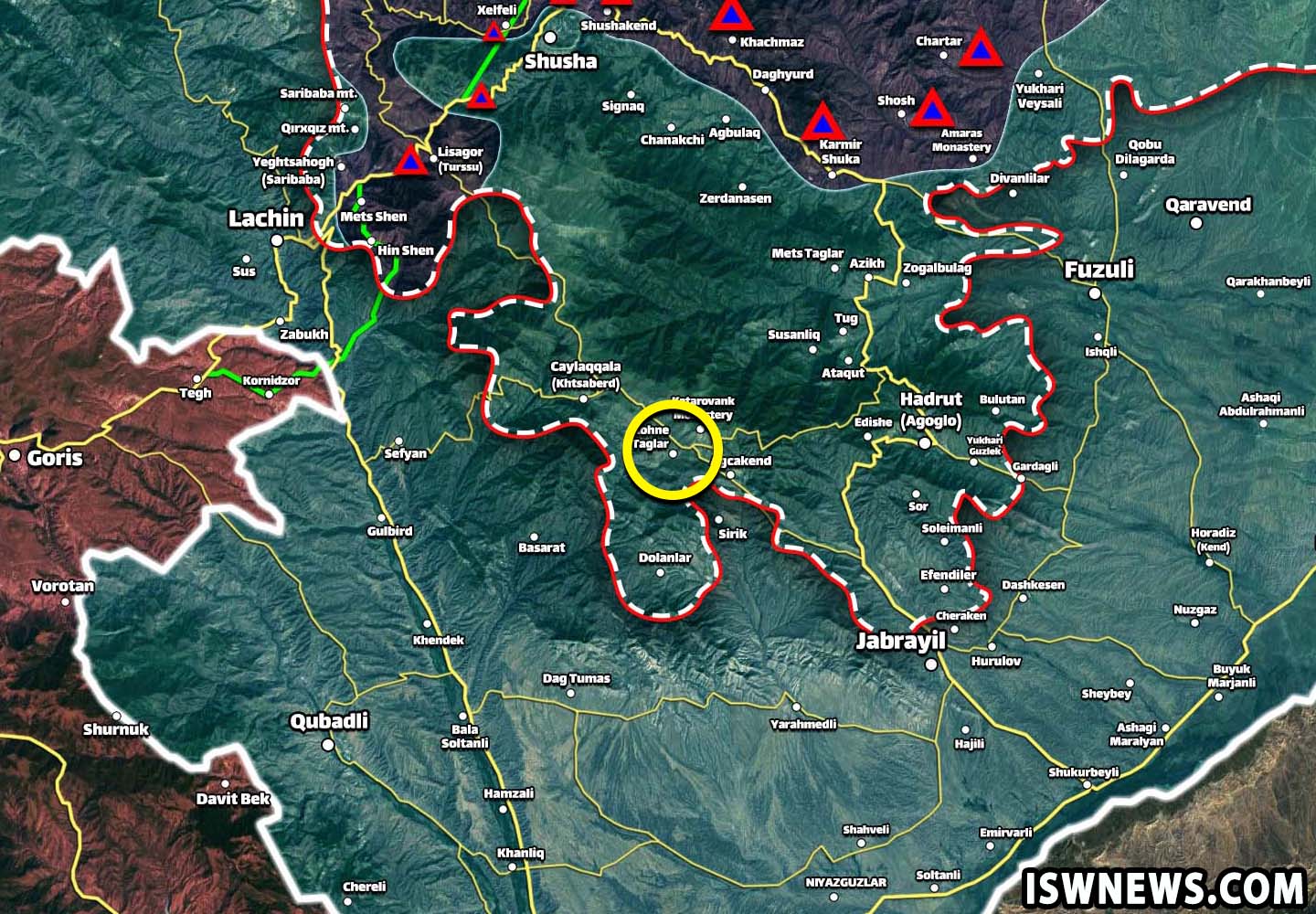
Following the signing ceremony of a tripartite statement among Russia, Republic of Azerbaijan and Armenia on November 9, 2020 and the official conclusion the Second Nagorno-Karabakh War, Azerbaijan’s army besieged and arrested Armenian soldiers, who were stationed in Hin Tagher village in the disputed region of Nagorno-Karabakh. The village is called Kohne Taghlar in Azerbaijani language and in accordance with Azerbaijan’s administrative division is part of the Khojavend County. At the time, when the Armenian soldiers were arrested, the areas controlled by any warring side were not clearly identified; so, the Armenian forces were besieged and then arrested.
In summer 2011, the Azerbaijan Republic sentenced 13 Armenian prisoners of war to six years behind bar on charges of terrorism, keeping and transporting of illegal arms as well as forming unlawful armed organization.
The government in Baku announced that only 33 prisoners of war are in custody. Siranush Sahakian, lawyer representing Armenian POWs in the European Court of Human Rights, believes that in addition to the mentioned number, there are also 90 other Armenian prisoners of war in Azerbaijan.
Arman Tatoyan, human rights defender in Armenia, said that the trial of the Armenian prisoners of war in Azerbaijan was held in contradiction to the international regulations.
Arif Yunusov, human rights activist in Azerbaijan, is of the opinion that the trial was held hastily and without paying heed to the prisoners’ cases. All knew that the people will turn into a case for exchanging and bargaining with Armenia, the United States, Syria and Lebanon. There are two Armenian nationals of Syria among the 13 trialed prisoners of war. Azerbaijan needs the prisoners of war in order to take advantage for different political postures. Earlier, Azerbaijan released 15 Armenian prisoners of war, when an American official visited Baku.
The BBC went on to say that the signing of peace deal between Azerbaijan and Armenia has been tied to the issue of supporting the rights of Armenians in the mountainous region of Nagorno-Karabakh. The Armenian nationals of the Nagorno-Karabakh region are worried about their security, because the Azerbaijani authorities foment hate speeches against the Armenians of the country.
According to the ISWnews, some Armenian sources said that Head of Communication and Prevention Programs at the Armenian Office of the International Committee of the Red Cross Zara Amatuni has released other news stories on the conditions of the Armenian prisoners of war with the of military and paramilitary background, who were active in the Hin Tagher village. The Azerbaijani government allowed Amatuni to meet Vigen Oljakchian, a Lebanese Armenian national, who was imprisoned in Baku. Oljakchian could have a phone conversation with his family members for the first time since the time when he was arrested by Azerbaijan. The Armenian national paramilitary force refused to give any information to the representative of the Red Cross.
The volunteer Armenian national paramilitary forces that came from different countries cooperated with the Armenian armed forces as well as other paramilitary forces during the Second Nagorno-Karabakh War against Azerbaijan’s army. The foreign Armenian national paramilitary forces are those, whose ancestors were massacred or displaced by the Ottoman Empire during the World War I.
In the afternoon of April 11, local sources in the Tegh Municipality of the Syunik Province in southern Armenia reported a clash between the Azerbaijani and Armenian military forces.
According to the Ministry of Defence of the Republic of Azerbaijan, the struggle left three Azerbaijani soldiers dead and a few others injured. The Ministry of Defence of Armenia also declared that the confrontation left four Armenian soldiers dead and six others wounded.
Azerbaijan claims that the clash erupted following a shooting by Armenian forces towards positions of the Azerbaijani soldiers on the way to Lachin Corridor. Then, the Azerbaijani army responded to the attack, which led to some casualties among the Armenian ranks.
Now, the two sides have reached a consensus to halt the confrontation; so, there is not any more details of the battle ground in Tegh-Zabukh borderline. Zabukh is a village located in the Lachin District of Azerbaijan Republic.
A weird and unrelated issue regarding to the incident is that some media outlets in Azerbaijan’s capital Baku claimed that Armenia utilized Iran-made drones in the mentioned confrontation, but Yerevan ruled out the fake news story, attributing the propaganda to media outlets affiliated to Azerbaijan’s President Ilham Aliyev. The unfounded accusation has been leveled in line with Baku’s Iranophobic policy and its strategy to pave the ground for potential clashes with Iran.
It should be mentioned that Azerbaijan’s army held joint military drills along with the allies of the country in its border areas with Armenia.
Baku resorted to anti-Tehran accusations in recent months, while the Islamic Republic has called on Azerbaijan and Armenia to abide by international borders and stop escalating tensions.
A number of so-called environmental activists, who support Azerbaijan’s President Ilham Aliyev, stopped transit of Armenians in Shusha city towards the center of Nagorno-Karabakh (Artsakh) region. Azerbaijan’s armed forces, from March 25, have started advancing in some parts of northern corridor of Lachin and seized control of heights overlooking side roads from Lisagor (Turssu) village to Stepanakert (Khankendi) city, the center of Nagorno-Karabakh region. Therefore, residents of six villages of Lisagor (Turssu), Yeghtsahogh (Saribaba), Mets Shen (Buyuk Galadarasi), Hen Shen (Kichik Galadarasi), Kanach Tala (Goytala) and Tasy Verst that are Armenian settlements have been besieged, and the side roads, which are their last chance to maintain their connection with the center of the Nagorno-Karabakh have been blocked.
Challenge of living in Line of Contact
Radio Liberty of Armenia has prepared a report on regions that are near the Line of Contact and witnessing a hard situation following the closure of transportation ways. Lisagor in this region is the only residential area, where the Armenians have been resided in following the end of First Nagorno-Karabakh War from February 1988 to May 1994.
Qajik Nasibyan, head of Lisagor council, told a reporter of the radio that the village with 73 Armenian people has been situated in vicinity of the Line of Contact after the end of the Second Nagorno-Karabakh War (September 27, 2020 – November 10, 2020). Their presence zone on the road is 8 to 10 kilometers near Shusha. Now, the village comes under the fire of the observation post of the Azerbaijan Republic’s army. The Azerbaijan armed forces plan to control the only remained road for their connection to Stepanakert; so, they took it.
Artak Hakobyan, head of Saribaba council, explained the hardships of living under this condition, saying that aside from healthcare issues, other problems have happened. Students cannot commute to Stepanakert. The Azerbaijan army personnel have been deployed 500 meters away from the Saribaba village. The residents of the village can farm only near their houses. In August 2022, Azerbaijan Republic retook Lachin District, and the Azeri Army controlled heights around the village. Azerbaijanis have stolen 17 cows so far; so, if we neglect for only five minutes, our cattle would be stolen.
Azerbaijan does not intend to retreat
Siran Ayraptian, representative of the Armenian separatists of Artsakh, in an interview with Radio Liberty pointed to the inconclusive negotiations by Russian peacekeepers to urge Azerbaijan Republic to retreat from the heights overlooking Lisagor village, saying that Azerbaijan resorted to blocking the only transportation road in a bid to force the Armenian community there to stop their demand for independence. On one hand, the Azeri authorities speak of peace, and on the other hand, they resort to enforcing pressure in order to force us to do something else, but the performance would not bring positive result.
Pro-Aliyev environmental activists present in Shusha sit-in accuse Armenian people of illegal excavation of mines in Karabakh and pollution in that mountainous region; therefore, they resort to the excuse to block the road even for routine traffic. The authorities in Azerbaijan Republic say that the side roads are being applied for delivery of arms and military equipment. Thus, all roads should be closed for residents of central parts of the mountainous Karabakh region!
From checkpoint to border police station
Azerbaijan Republic is saying that they should build a border police station in Lachin Corridor. The Azeri officials first announced that an checkpoint should be erected in Shusha city, but now they say the post should be constructed in the borderline between Azerbaijan and Armenia.
It is worth mentioning that the Azerbaijan Army trespassed on Armenian soil, when they attempted to cut the old route of Tegh to Lachin Corridor, and they occupied hundreds of hectares of Armenian territories in east and northeast of Tegh. (Map below)
Checkpoint is contrary to Moscow statement
Russian foreign ministry spokesperson Maria Zakharova underlined the need for implementing provisions of the Nagorno-Karabakh ceasefire agreement, which is a tripartite statement signed by Russia, Azerbaijan and Armenia on November 9, 2020, saying that the establishment of a checkpoint is not among the provisions of the statement, but Moscow will observe the option.
Challenges of new path of Lachin Corridor
The Lachin Corridor links Armenians living in the Nagorno-Karabakh region to Armenia; so, the residents of the region can only meet their needs through this path.
The developments of the Lachin Corridor are also of importance. According to the Nagorno-Karabakh ceasefire agreement, the old route from Tegh village should be closed from April 1, 2023 and a new path towards the south should be used, which has a boundary of five kilometers. Azerbaijan constructed parts of the road, which is under its control prior to the end of last year (2022), and it has blocked the old route totally.
The substitute route, which passes across Kornidzor village in southern Tegh village, has not been completed yet by Armenia. 200 meters of the road near Kornidzor village is under construction; so, transport through the piece of road is hard. Armenia’s hesitance to construct the route seems to be a weird gesture!
Detailed map of the new and old routes of the southern part of Lachine Corridor
On March 24, the Ministry of Defense of Azerbaijan published a statement announcing the illegal transfer of military equipment of Russian peacekeepers and Armenian forces in Nagorno-Karabakh on the Khankendi (Stepanakert)-Xelfeli-Turssu (Lisagor) route. The Republic of Azerbaijan called this a violation of the agreements by the Russian peacekeeping forces and their inability to perform their duties in relation to the implementation of the provisions of the tripartite declaration.
According to the information provided by the Ministry of Defense of Azerbaijan, the Armenian engineering forces are building a new road in north of the Khankendi (Stepanakert)-Xelfeli-Turssu (Lisagor) road (the northern section of Lachin Corridor), which passes through the Khankendi-Kosalar-Mirzeler-Turssu route.
Construction of new road in north of the northern road of Lachin Corridor by the Armenians of Karabakh
Following these tensions, on March 25, Baku government forces violated the 2020 ceasefire agreement in Nagorno-Karabakh by crossing the contact lines of Nagorno-Karabakh in northern Lachin. Following this progress, the Ministry of Defense of the Republic of Azerbaijan published another statement and announced that it has taken the necessary measures to prevent the smuggling of weapons and ammunition to the Nagorno-Karabakh Autonomous Region through the northern road of the Lachin Corridor.
According to the information obtained by the Islamic World News, after the blocking of the Khankendi road by the so-called environmental activists of Ilham Aliev near Shusha, the Armenian forces, with the support of Russia, began the construction of a new and alternative route in the north of the Khankendi-Xelfeli-Turssu road. The government of Baku knows very well that if this road is built and completed, practically all the efforts and achievements of the so-called environmental activists will be wasted; therefore, in order to take the initiative of the Nagorno-Karabakh entering/exiting route, they violated the ceasefire agreement and advanced in this direction.
After these events, the Ministry of Defense of Russia published a statement accusing Azerbaijan of violating clause 1 of the Nagorno-Karabakh ceasefire agreement. It is stated in this statement that the forces of the Republic of Azerbaijan have deployed engineering equipment in the Shusha region at an altitude of 2054.0 (2.9 km northeast of Saribaba mountain) after crossing the contact line. The statement emphasized the Azerbaijani side was informed about the necessity of complying with the provisions of the tripartite agreements of the heads of states, stopping the engineering and technical operations and withdrawing from the occupied positions.
It seems that the purpose of the advances made and the occupation of this point by the government of Baku is to establish military points and increase fire control over the newly established Armenian route or routes in the Khankendi-Kosalar-Mirzeler-Trussu line.
According to the ISWNews field information from the Republic of Azerbaijan, the government and the army of this country are preparing to launch a large-scale military offensive against Armenia and occupy the areas of Syunik, Vayots Dzor and Gegharkunik provinces in the south of Armenia after September 27, i.e. after the anniversary of the start of the second Karabakh war. The main goal of Azerbaijan is to occupy the historical region of Zangezur, which now geographically corresponds to Syunik province of Armenia.
According to the received information, it is very likely that the Azerbaijani army will start its military attacks after September 27 (the end of September or the beginning of October) with the focus on occupying the Zangezur region and connecting the main territory of the Republic of Azerbaijan to the Nakhchivan region.
The historical area of Zangezur is marked in red
During the last two weeks, the Azerbaijani army has sent troops and heavy military equipment to the borders of Armenia and these activities are still ongoing. In one of these cases, about 60 Azerbaijani military trucks have transferred and deployed a significant number of Azerbaijani military forces to Fuzuli area.
The deployment of S300 air defense systems in Baku and its surroundings and the increase of air defense measures are observed in this region more than before.
Also, the people who have just finished their military service have been re-called to the army, and soon a general call will be announced for a certain age range to introduce themselves to the army.
On Turkey’s side, several thousands of troops have been prepared for a possible attack on Armenia from the west, and they will enter the war if necessary.
All these cases and a series of other events show Azerbaijan’s serious intention for a large-scale military attack, and if nothing special happens, this attack will be carried out.
Simultaneously with these activities, the US, British, and French embassies in Armenia have issued statements and maps asking their nationals not to travel to the mentioned areas. In the map published by the French Embassy, the possible areas of Azerbaijan’s operations in Armenia are clearly marked.
Click to view full size
On September 24, Azerbaijan’s Defense Minister, Zakir Hasanov, officially announced in a statement that the country’s army may carry out further military operations against Armenia as they did between 12 and 14 September. Also, the military posts that were recently occupied by Azerbaijan in Armenia will receive supplies and equipment.
In another move, Baku is hosting NATO’s OCC E&F training course from September 26. The Operational Capability Concept Evaluation and Feedback Programme (OCC E&F) is a multipurpose military mechanism designed to develop and establish closer operational relationships between NATO and potential contributor (here Azerbaijan) that are fully interoperable and capable of operating with NATO standards and procedures.
During the border clashes, the Azerbaijani army managed to penetrate deep into defense positions of Armenia by capturing 7 military positions. Edvard Asryan, Chief of the General Staff of the Armenian Armed Forces, during a visit to the Jermuk region, admits that Azerbaijan has advanced and several positions have fallen: “The Azerbaijani army, due to superiority in personnel and firepower, have advanced in an area with a width of 8.5 km and a depth of 7.5 km near Jermuk, which have been stopped by defensive measures.”
Also, the people of Sotk town have quickly evacuated their houses due to the advance of the Azerbaijani army. Residents of Kut and Norabak villages near Sotk have also been displaced.
In the map below you can see the progress of the Azerbaijani army and the occupied areas of Armenian territory in the Jermuk area.
Click to view full size
Allegation of war crimes by Azerbaijan
The head of the Joint Chiefs of Staff of Armenia accuses Azerbaijan of war crimes and states: “The heads, arms and legs of Armenian soldiers were separated from the bodies.” However, Azerbaijani media say: “The military court examined the bodies of 32 Armenians and found no signs of torture.” The bodies of 95 other soldiers were also handed over on September 20 through the mediation of Russia.
Armenian sources report the death of 141 soldiers, but the Azerbaijani side has estimated 400 Armenian casualties. Azerbaijan’s state television has also announced the presence of five Armenian soldiers who were captured and will be released soon through the mediation of Russia.
The Azerbaijani army has published a statement and accused Armenia of violating the ceasefire in the Kalbajar and Lachin axes and has again used this issue as a pretext for artillery and airstrikes on Armenian positions. The Armenian Ministry of Defense also confirmed the attacks of Azerbaijan and announced that the Azerbaijani army has again used drones to target Armenia in Jermuk region.
Tensions continue in Karabakh and the borders of the two countries while Russia announced the beginning of a ceasefire between Azerbaijan and Armenia yesterday. However, it seems that Russia’s measures to reduce tensions are useless and the parties involved, especially Azerbaijan, do not adhere to the ceasefire.
Therefore, Russian President Vladimir Putin has announced to the CSTO (Collective Security Treaty Organization) that Russia will take further steps to reduce tensions on the borders of Azerbaijan and Armenia. The special envoy of Russia, Igor Khovaev, will also travel to Baku and Yerevan to meet the officials of the two countries.
The government of Baku is still seeking for the creation of a corridor known as the Zangezur Corridor to connect the main land of the Republic of Azerbaijan to Nakhchivan, and in the meantime, any tension in the Karabakh region and the borders of the two countries is used as a pretext for launching attacks and intensifying tensions and conflicts in this region, so that if the situation becomes acute, it can use this issue to carry out a final and big operation to achieve its goal.
According to the available information, from last night until this morning, the artillery of the Azerbaijani army has bombarded the areas of Sotk, Jermuk, Vardenis and Goris. It is also said that the Azerbaijani army attacked a target in the city of Martuni inside the territory of Armenia using a suicide drone.
There are also news about the entry of the Azerbaijani army into the territory of Armenia, which is not true and cannot be confirmed.
Last night, the Azerbaijani media reported the violation of ceasefire by Armenia on the border lines between the two countries and the Karabakh region. Following this news, some Azerbaijani social networks announced the implementation of the construction of the new Zangzor corridor from Nakhchivan and the sending of 12 military cargo planes full of equipment from Turkey to the Azerbaijani armed forces.
In a statement, the Ministry of Defense of the Republic of Azerbaijan announced the destruction of an Armenian military unit, a radar station and two S300 anti-aircraft missile systems.
On the other hand, Armenia accuses the Azerbaijani army of violating the ceasefire. Armenia has announced that the drones of the Azerbaijani army attacked the Zangzor military unit in Armenia. Armenian Prime Minister Nikol Pashinyan said that at least 49 Armenians were killed in the conflict with Azerbaijan.
Azerbaijan fired Katyusha rockets against Armenia
Armenian media reports the evacuation of a number of villages in Kapan and Goris regions. According to the information of the media of both sides, the Azerbaijani army and the Armenian army have mobilized their forces on the border lines and there is a possibility of more battles.
In this regard, the Armenian government has announced that Nikol Pashinyan, the Prime Minister of this country, has announced the details of last night’s clashes with the Republic of Azerbaijan to Russian President Vladimir Putin over the phone.
Although the Ministry of Defense of Russia announced the beginning of the ceasefire between Armenia and Azerbaijan at 9:00 am today, tensions in Karabakh are still high. France has asked the UN Security Council for an urgent meeting regarding the tension on the border between Azerbaijan and Armenia.