Category: Iran

  • IRGC Commander Says Operation Al-Aqsa Storm Not Revenge For Martyr Soleimani; Iran to Take Revenge For His Assassination

    IRGC Commander Says Operation Al-Aqsa Storm Not Revenge For Martyr Soleimani; Iran to Take Revenge For His Assassination

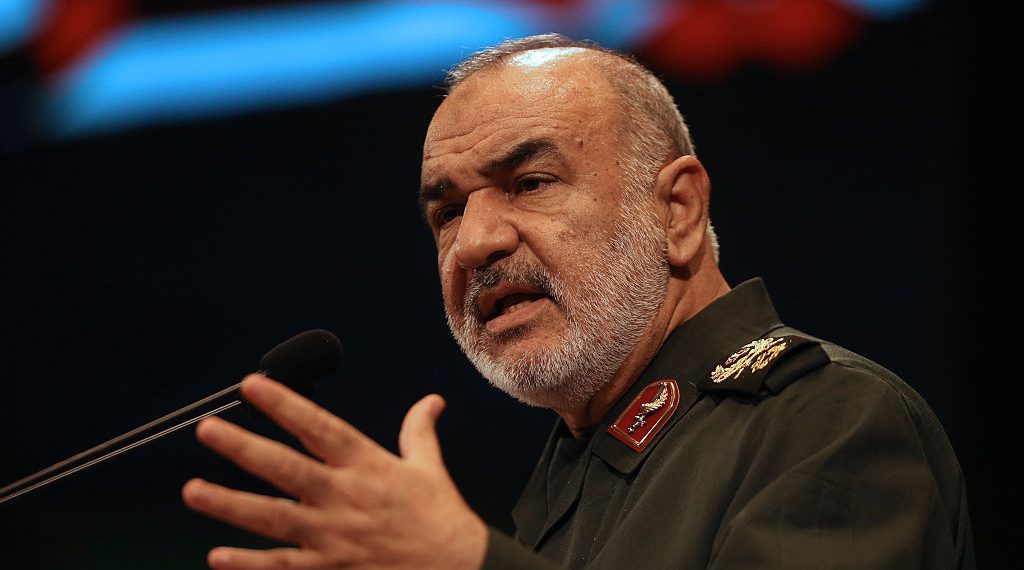
    Commander of the Islamic Revolution Guards Corps (IRGC) Brigadier General Hossein Salami has made a speech at the funeral procession of Martyr Seyed Razi Mousavi: Seyed Razi Mousavi was one of the most experienced and effective commanders of the IRGC in the resistance front. Martyr Mousavi stood for the security of the Islamic Ummah over three decades in the most difficult circumstances. He was a companion of the immortal legend, the martyr Lieutenant General Qasem Soleimani. Interestingly, it should be noted that during his 33 years of service, Martyr Mousavi had not visited the holy shrines of Imam Hussein (A.S) in Karbala and Imam Ali (AS) in Najaf until yesterday (on Wednesday), when he (his corpse) visited and paid his respects to them, just like the companions of Imam Hussein (A.S) who pilgrimed Him whit their dismembered bodies.

    The Commander of the IRGC differentiated between the Palestinian’s Operation Al-Aqsa Storm against Israel and taking revenge for Martyr Qasem Soleimani, adding: The Operation Al-Aqsa Storm was a purely Palestinian operation, designed and executed by the Palestinians themselves. This operation was carried out without any foreign support and is a response to the 75 years of oppression and occupation by the Israeli regime. The Operation Al-Aqsa Storm was not a revenge for the assassination of Martyr Soleimani; we will take our revenge on the perpetrators and planners of the martyrdom of this great man and deputy head of Iraq’s Popular Mobilization Forces (PMF) Abu Mahdi al-Muhandis and their comrades. We will not remain silent in the face of the assassination of our children and we will take revenge on the perpetrators. The revenge of our children will be nothing but the end of the Israeli regime’s existence.

    The recent statements made by the Supreme Leader Ayatollah Seyyed Ali Khamenei and the Commander of the IRGC Hossein Salami regarding Operation Al-Aqsa Storm and the recent Palestinian war with the Israeli regime indicate that although the Islamic resistance front has coordination and strong unity in many issues, including goals, ideals, and values, each pillar of the resistance front acts based on its own national identity and circumstances. The Hezbollah movement operates based on tactics and Time requirements to limit Israel’s military might, the Ansar Allah movement also operates based on its Yemeni identity and targets the maritime shipping and economic interests of the Israeli regime, and other pillars of the resistance in Palestine, Iraq, and Syria also operate in different ways against the Israeli regime and its Western allies.

  • Terrorist Attack On Police Station In Southeast Iran Left 19 Martyrs Or Injured

    Terrorist Attack On Police Station In Southeast Iran Left 19 Martyrs Or Injured

    Armed terrorists carried out attacks against the headquarters of the FARAJA command in Rask city, located in Sistan and Baluchestan province, in the early hours of December 15, resulting in the martyrdom of at least 11 security forces and the injury of 8 others.

    Some of the injured people are reported to be in critical condition, and there is a possibility of an increase in the number of martyrs.

    A police spokesperson said that in this attack, some of the terrorists were injured and killed, and some police forces were martyred and injured.

    Concurrent with the clashes in Rask, the terrorist group known as the Jaish al-Adl claimed responsibility for this attack by issuing a statement.

    Currently, helicopters of the Iranian armed forces have taken flight over the cities of Sarbaz and Iranshahr to identify and hunt the elements of the terrorist group.

    It is said that Brigadier General Qasem Rezaei, deputy commander of the Iranian police, will travel to Sistan and Baluchestan province to evaluate the situation on the ground.

  • Iran Chief Of Staff Bagheri Meets Iraqi Officials

    Iran Chief Of Staff Bagheri Meets Iraqi Officials

    Major General Mohammad Bagheri, the Chief of Staff of the Iranian Armed Forces, arrived in the capital of Iraq on December 2 in an official trip to the neighboring country.

    During this trip, Bagheri met with Iraqi Defense Minister Jaber al-Jaberi. According to the Iraqi Ministry of Defense, the two sides discussed a number of important issues between Iraq and Iran, particularly the development of military relations between the two countries.

    The Chief of Staff of the Armed Forces continued his presence in Baghdad and met with Iraq’s Minister of Interior Abdul Amir al-Shammari. The two sides discussed the promotion of joint security and intelligence efforts.

    Bagheri also met with the Chief of the General Staff of the Iraqi Armed Forces Abdel Emir Rashid Yarallah. He expressed appreciation for the efforts and seriousness of the Iraqi government and security forces in organizing the Arbaeen pilgrimage, which brings millions of Shia Muslims to Iraqi city of Karbala. He also said that the Iranian Armed Forces are ready to respond to any threats to Iraq’s territorial integrity and national sovereignty.

    The chief of staff of the Iraqi Army also expressed gratitude to the Islamic Republic of Iran for its sincere cooperation in the fight against ISIS terrorist group and commemorated the Iranian commander martyr Qassem Soleimani, who was assassinated by the United States’ drone at the Baghdad International Airport on January 3, 2020.

    Abdel Emir Rashid Yarallah announced the full readiness of the Iraqi Armed Forces to develop military, defense, training, joint drills, and experience exchanges.

  • Iran’s IRGC Lost Two Of Its Servicemen In Syria

    Iran’s IRGC Lost Two Of Its Servicemen In Syria

    The names of the deceased IRGC members are “Mohammad Ali Ataei (Shoorche)” and “Panah Taghizadeh”.

    This statement does not mention how these two servicemen were martyred; But last night, the fighter jets of the Israeli regime attacked targets in the suburbs of Damascus. It seems that these two servicemen lost their lives in this attack.

    Read more: Israel Carries Out Airstrike On Syrian Capital

  • Iran Finalizes Deal To Buy Russian Su-35 Fighter Jets, Mi-28 Attack Helicopters

    Iran Finalizes Deal To Buy Russian Su-35 Fighter Jets, Mi-28 Attack Helicopters

    “Plans have been finalized for Sukhoi Su-35 fighter jets, Mil Mi-28 attack helicopters and Yak-130 jet trainers to join the combat units of Iran’s Army,” Brigadier General Mehdi Farahi said.

    Brig. Gen. Farahi added that three advanced aircraft will be definitely at Iran’s disposal and the processes are currently underway.

    The Islamic Republic of Iran Air Force (IRIAF) has only a few dozen strike aircraft, including Soviet-era fighter jets as well as aging United States-made models acquired before the 1979 Islamic Revolution.

    In April, Iran announced that it had finalized a deal to buy Su-35 fighter jets from Russia. Under the deal, the IRIAF is supposed to receive a total of 24 Su-35s which were originally built for Egypt as a part of a contract that was thwarted by the U.S.

    Sukhoi designed the Su-35 to engage all types of aerial targets in long and close ranged air battles as well as to attack ground and sea-surface targets including those covered by air defenses and located far behind the frontline.

    Read more: Military Knowledge: Sukhoi Su-35 Multirole Fighter Jet

    Later in September, Iran received a first batch of Yak-130 training and light combat jets from Russia. The delivery marked the first time new jets entered service with the IRIAF since the 1990s, when Iran received a few MiG-29s from Russia.

    The Yak-130 was originally designed by Yakovlev for training missions. As an advanced trainer, the jet is able to replicate the characteristics of several fourth-generation and fifth-generation fighters, including the Su-35. The jet can also perform light-attack and reconnaissance duties.

    Read more: Military Knowledge: Yak-130 Fighter Trainer

    Unlike the Su-35 and Yak-130, there were no reports about Iran purchasing Mi-28 attack helicopters before Brig. Gen. Farahi announcement.

    The Mi-28, designed by Mil, is an all-weather, day-night, military tandem, two-seat anti-armor attack helicopter. It carries a single gun in an under-nose barbette, plus external loads carried on pylons beneath stub wings.

    Russian-Iranian military cooperation grew significantly in the last few years. Washington claims that Tehran supplied Moscow with hundreds of suicide and combat drones in the last few months for use in the ongoing special military operation in Ukraine.

    Originally posted on SouthFront

  • Qaani To Deif: We Will Not Let The Enemy To Achieve Its Dirty Goals In Gaza And Palestine

    Qaani To Deif: We Will Not Let The Enemy To Achieve Its Dirty Goals In Gaza And Palestine

    Summary of Qaani’s message to Deif:

    ▪️Qaani: You wrote a great epic entitled the Al-Aqsa Storm, which God granted at the hands of the Mujahideen in the Al-Qassam Brigades and the Resistance in Gaza.

    ▪️Qaani: You clearly demonstrated the weakness and fragility of the usurping Zionist entity and demonstrated in a practical and decisive manner that it is weaker than a spider’s web.

    ▪️Qaani: It is sufficient to describe the Al-Aqsa Storm operation, that Palestine and the region will not be what it was before it after this great event.

    ▪️Qaani: The strikes directed by the resistance against the enemy forces and armored vehicles proved to everyone that the resistance in Gaza is capable of initiative and innovation.

    ▪️Qaani: Trust that your brothers who are united with you in the axis of Al-Quds and the resistance will not allow the enemy and those behind him to isolate Gaza and its people.

    ▪️Qaani: Your brothers in the Al-Quds axis and the resistance will not let the enemy to achieve its dirty goals in Gaza and Palestine.

    ▪️Qaani: We affirm the covenant, the charter, and the faith and fraternal commitment that unites us, and we reassure you that, as part of our continued effective protection and support for the resistance, we will do everything we must in this historic battle.

    Qaani’s message to Mohammed Deif
  • Iranian President: Islamic Countries Should Arm The Palestinian People

    Iranian President: Islamic Countries Should Arm The Palestinian People

    Iranian President, Seyyed Ebrahim Raisi at the joint Islamic summit in Riyadh:

    ▪️Today is a historic day for the defense of Al-Aqsa Mosque. We want to make a historic and decisive decision about what is happening in the Palestinian territories.

    ▪️The US is complicit in Israel’s crimes. Americans prefer the Zionist regime to the lives of thousands of oppressed people and encourage them to commit crimes against the oppressed.

    ▪️Today everyone has to decide which side to stand on.

    ▪️The worst role in the Gaza war is the role of America. America has practically entered the war in favor of Israel and sends many weapons shipments to Israel daily.

    ▪️I hope our meeting today will lead to the issuance of a resolution in favor of the Palestinian nation. We must immediately demand the withdrawal of the Zionist regime from Gaza. We must demand a cease-fire and complete lifting of the blockade of the Gaza Strip and the reopening of the Rafah crossing without restrictions or conditions.

    ▪️All countries, including Islamic countries, must ensure the security of Palestinians in the occupied territories.

    ▪️Trade and cooperation with the Zionist regime and the import of Israeli goods should be banned.

    ▪️We demand the formation of an international court for the Zionists and Americans involved in killing Gaza.

    ▪️Islamic countries should arm the Palestinian people.

    ▪️The sustainable solution to this crisis is to create a Palestinian state from the sea to the river. The passage of time is not beneficial and Israel must be confronted and the only solution is resistance.

    ▪️We send greetings to the resistant nation of Palestine and kiss the hands of the resistance.

    ▪️Muslims consider what is happening to be shameful for them, and if our meeting today does not have a result, it will cause the Islamic Ummah to despair.

  • Iran Supreme Leader Receives Iraqi PM

    Iran Supreme Leader Receives Iraqi PM

    During the meeting, the Supreme Leader of the Islamic Revolution emphasized the need for increased political pressure from the Islamic world on the United States and the Israeli regime to stop the massacre of the people of Gaza. He stated that Iraq, as an important country in the region, can play a special role in this regard and create a new line in the Arab and Islamic world.

    Referring to the dire situation in Gaza and the wounded hearts of all free people from these crimes and cruelties, the Supreme Leader stated that from the early days of the Zionist regime’s attacks, all evidence indicates direct US involvement in leading this war, and as time goes on, the reasons for the United States’ direct role in the regime’s crimes become stronger and more pronounced.

    The Supreme Leader went on to say that if it weren’t for US military and political aid, the Israeli regime would not be able to continue its actions. The Americans are truly and justly accomplices in the crimes of the Zionists in Gaza, Ayatollah Khamenei stated, adding that despite all the massacres that have taken place in Gaza, the regime has suffered a real defeat because it has not been able to restore its lost honor and will not be able to do so in the future.

    The Supreme Leader also underlined the need for comprehensive efforts to increase political pressure on the United States and the Israeli regime to stop bombings in the Gaza Strip, noting that the Islamic Republic of Iran and Iraq can play a role and have an impact in this regard via keeping on coordination with each other.

    In this meeting, which was also attended by Iranian President Ebrahim Raisi, the Iraqi prime minister expressed his great satisfaction with meeting the Supreme Leader of the Islamic Revolution and described the Operation Al-Aqsa Storm as a heroic operation that brought joy to all free people in the world.

    He went on to say that alongside this joy, the Iraqis are deeply saddened by the brutal massacre in Gaza, which is a collective revenge of the people of this tiny region.

    The prime minister also emphasized that the government and people of Iraq as well as Iraqi political movements are at the forefront of supporting the oppressed people of this region when it comes to the Gaza issue, and that the Iraqi government has made extensive political efforts to stop the crimes in the Gaza Strip.

    Moreover, Al-Sudani criticized the silence of international organizations and human rights claimants in the face of these war crimes and stated that the Iraqis are mainly focused their efforts on halting the Gaza bombings and then delivering food and medicine to the people of the besieged region; so, necessary coordination has been made during today negotiations with the president of the Islamic Republic of Iran in this regard.

  • The head of Hamas’ Political Bureau has met and held talks with the Supreme Leader of the Islamic Revolution

    The head of Hamas’ Political Bureau has met and held talks with the Supreme Leader of the Islamic Revolution

    During the meeting, the head of Hamas’ Political Bureau provided a report on the latest developments in the Gaza Strip and the war crimes committed by the Israeli regime in the besieged area, as well as the situation in the West Bank.

    The Supreme Leader of the Islamic Revolution expressed his appreciation for the steadfastness and resilience of the people of Gaza and expressed deep regret over the crimes committed by the Israeli regime with direct support from the United States and certain Western states.

    Ayatollah Khamenei also emphasized Iran’s longstanding policy of supporting Palestinian resistance forces that fight Israeli occupiers.

    The Leader stressed the need for serious actions by Islamic countries and international organizations, as well as Islamic governments’ comprehensive and practical support for the people of Gaza.

  • Iran Intelligence Ministry, Afghanistan’s Taliban Arrested Mossad Agents On Afghan Border!

    Iran Intelligence Ministry, Afghanistan’s Taliban Arrested Mossad Agents On Afghan Border!

    These individuals were Iranian nationals and intended to carry out attacks using suicide drones on Iranian soil and try to create discord between Iran and the Taliban.

    It is also said that the Taliban caretaker government will soon transfer the detainees to Iran for interrogation.

    The preparation and implementation of such terrorist plots are expected in the current crisis situation that the Israeli regime is facing. It is worth mentioning that Iranian nuclear facilities, military sites, and border areas can be targeted.

    Furthermore, since the onset of the Gaza war, Persian-language media outlets in the Israeli occupied territories have repeatedly attempted to provoke terrorist acts in Iranian border provinces such as Sistan and Baluchistan, Kurdistan, as well as trigger political and social disputes, but they have been unsuccessful for various reasons.

  • Armenia-Azerbaijan Peace Process Talks In Tehran After 31 Years!

    Armenia-Azerbaijan Peace Process Talks In Tehran After 31 Years!

    The Caucasus region was known as an area under the influence of Iran and the Ottoman Empire centuries ago, to them the Russian Empire was added about two centuries ago; so, it can be claimed that the developments in the Caucasus region over the past two centuries have been a function of the developments of the Iran, Ottoman, and Russian triangle. However, the establishment of Soviet reign heavily enhanced Russia’s foothold in the Caucasus region, and the policies of this state paved the way for separating the Caucasus region from Iran and Turkiye.

    But the collapse of the Soviet Union in the 1990s once again added importance to regional players such as Iran and Turkiye and forced these two countries to play a role in resolving conflicts that led to the First Nagorno-Karabakh War that took place from February 1988 to May 1994. The Islamic Republic of Iran turned into the first player in terms of resolving disputes between the two republics (Armenia and Azerbaijan) due to its strong communication channels with the two fledgling republics, and in this process, several ceasefire agreements were reached and prisoner swaps were carried out.

    But the most important achievement of the Iranian diplomatic mission was the issuance of the Tehran Communiqué also known as the Joint statement of the heads of state in Tehran, which is the joint communiqué mediated by then Iranian President Akbar Hashemi Rafsanjani and signed by the acting President of Azerbaijan Yagub Mammadov and President of Armenia Levon Ter-Petrossian on May 7, 1992. The communiqué gained the consent of the leaders of the two warring countries to begin negotiations in order to resolve disputes between Baku and Yerevan. A process that failed with the intervention of forces affiliated with extra-regional powers such as the United States and ultimately with the end of the First Nagorno-Karabakh War and the establishment of a ceasefire; thus, the Azerbaijan-Armenia disputes were entrusted to a group of representatives from Belarus, Germany, Italy, Sweden, Finland, and Turkiye, known as the Minsk Group. However, this group has not achieved any tangible result in its three decades of activity.

    The formation of a establishment known as the Republic of Artsakh or the Republic of Nagorno-Karabakh over the past three decades prevented officials of the two countries of Azerbaijan and Armenia from ignoring the issue of Nagorno-Karabakh region and focusing on resolving issues and disputes between the two nations; so, many of these issues were forgotten during this time. But with the outbreak of the Second Nagorno-Karabakh War and the return of this region to the territory of Azerbaijan, existing issues between the two countries, such as determination of border lines and the fate of transportation routes, as well as legal, judicial, and diplomatic systems, have become more serious, which paved the way for the direct negotiations between Baku and Yerevan in a more appropriate ground.

    However, the geopolitical situation in the Caucasus region makes it impossible to advance such actions without considering the interests and goals of traditional regional powers (Russia, Turkiye, and Iran); therefore, deciding on the framework and format of future talks will largely determine how negotiations will proceed and how will be their level of success. Russia, as the most influential state in the Caucasus region, was involved in the developments following the 2020 war, but recent political developments in Armenia show that there are signs of a rapid distance between Yerevan and Moscow. On the other hand, Russia’s policies in recent years have been strongly protested by Armenians to the point where Armenian officials announced their dissatisfaction with the progress of negotiations under the heavy influence of Russia and proposed a return to the European Union. However, Azerbaijan, which experienced bitter experiences with the intervention of extra-regional powers and remembers the neutral performance of the Minsk Group, did not agree with the proposal from Armenia, especially since EU officials have largely supported the Armenian side during recent developments and their role in such a framework could have increased Armenian bargaining power. The intervention of extra-regional powers could have turned the dispute into a new crisis, in addition to slowing down the process of resolving disputes; thus, both sides agreed to resolve issues within a regional framework and expressed their readiness to participate in the 3+3 format.

    A look at the field developments and political atmosphere of the region shows that the current conditions should be considered in continuing to the Tehran Communiqué in 1992, when both warring parties were in the most balanced point. The First Nagorno-Karabakh War had not yet begun in 1992 and its financial and human losses had not been incurred by both sides. Tens of thousands of Azerbaijani refugees (for 30 years) and Armenians (who left Nagorno-Karabakh in recent months) were still stationed in their homes. But now, after 31 years of these harmful events, Nagorno-Karabakh is empty of population and its fate is once again linked to the negotiations in Tehran!

    Image: The front page of Iran’s Ettela’at newspaper 31 years ago, which discussed the topic of those days’ negotiations in Tehran and resolving the dispute between Azerbaijan and Armenia in Tehran.
  • Iran’s Foreign Minister Warned: Stop the Genocide In Gaza! (Video)

    Iran’s Foreign Minister Warned: Stop the Genocide In Gaza! (Video)

    Hossein Amir-Abdollahian said in parts of his speech about the war of the Zionist regime and the Palestinian resistance at the meeting of the United Nations General Assembly:

    • The genocide of the Palestinian people in Gaza by the Zionist regime must be stopped immediately. The US and European countries see and support the killing of 7,000 civilians in Gaza by Israel.
    • This is our home and West Asia is our region. We will not deal with any party or country that endangers the security of our region.
    • We do not welcome the expansion of the war in the region, but if the war in Gaza continues, we cannot stop the fire. If this war continues, the US will not be spared from the fire.
    • The Islamic Republic of Iran has proposed holding a referendum among all the residents of Palestine.
    • Hamas is ready to release civilian prisoners and the world should support the release of 6,000 Palestinian prisoners too.