On December 3, the positions of American occupiers at the Erbil International Airport (EIA), which is located in northern Iraq, were targeted by the Iraqi Islamic Resistance’s drone strikes.
According to investigations made by the ISWnews, this is the nineteenth attack by Iraqi resistance groups on US military positions in the Erbil province during recent weeks.
Blog
-

Islamic Resistance Of Iraq Carries Out Drone Strike On US Occupiers In Erbil
-

Yemen’s Army Attacked Two Ships In The Waters Of The Red Sea
The Yemeni armed forces released a statement about today’s attacks.
Brigadier General Yahya Saree, Spokesman of the Yemeni Armed Forces:
“This morning, with the help of God Almighty, the Yemeni Navy attacked two Israeli ships named Unity Explorer and NUMBER 9 in Bab al-Mandab. The first ship was targeted by a missile and the second ship was targeted by a drone (suicide drone). The operation was carried out after two ships rejected warning messages from the Yemeni navy.
The Yemeni Armed Forces will continue to prevent the movement of Israeli ships in the Red and Arab seas until Israel’s aggression against our brothers in the Gaza Strip is stopped. The Yemeni Armed Forces had warned all Israeli ships or Israeli-affiliated ships that they would become a legal target if they violates what was issued in this statement and previous statements.”
NUMBER 9 
UNITY EXPLORER The US Army claims that its naval fleet moved towards the position of Israeli ships at 10:00 am today, and during a five-hour conflict, they confronted Ansar Allah’s missiles and drones. But it seems their actions have not been very effective in saving Israeli ships.
In this regard, some Zionist media claimed that one of the ships that was hit by the drone was slightly damaged, but the other ship, part of which is also owned by the British, was hit by a cruise missile and severely damaged. This ship is currently stopped near the Bab al-Mandab Strait and reportedly will sink if immediate help does not reach it.
The Yemeni Army and Ansar Allah control a large part of Yemen and maintain a large arsenal of missiles and drones. After the Israeli invasion of Gaza, the Yemeni Army launched several missile and drone attacks at targets in Israel. The Yemeni Army also seized Galaxy Leader, an Israeli-owned ship that was sailing towards the Bab al-Mandab Strait and allegedly attacked another ship with a suicide drone in the Indian Ocean.
The Yemeni Army had halted operations against Israeli after a temporary ceasefire in Gaza entered into effect on November 24. A week later, they warned Israel that they will renew missile and drone attacks if the crimes against the people of Gaza were not stopped. With the resumption of war by Israel, now the Yemenis have resumed their attacks against Israel.
-
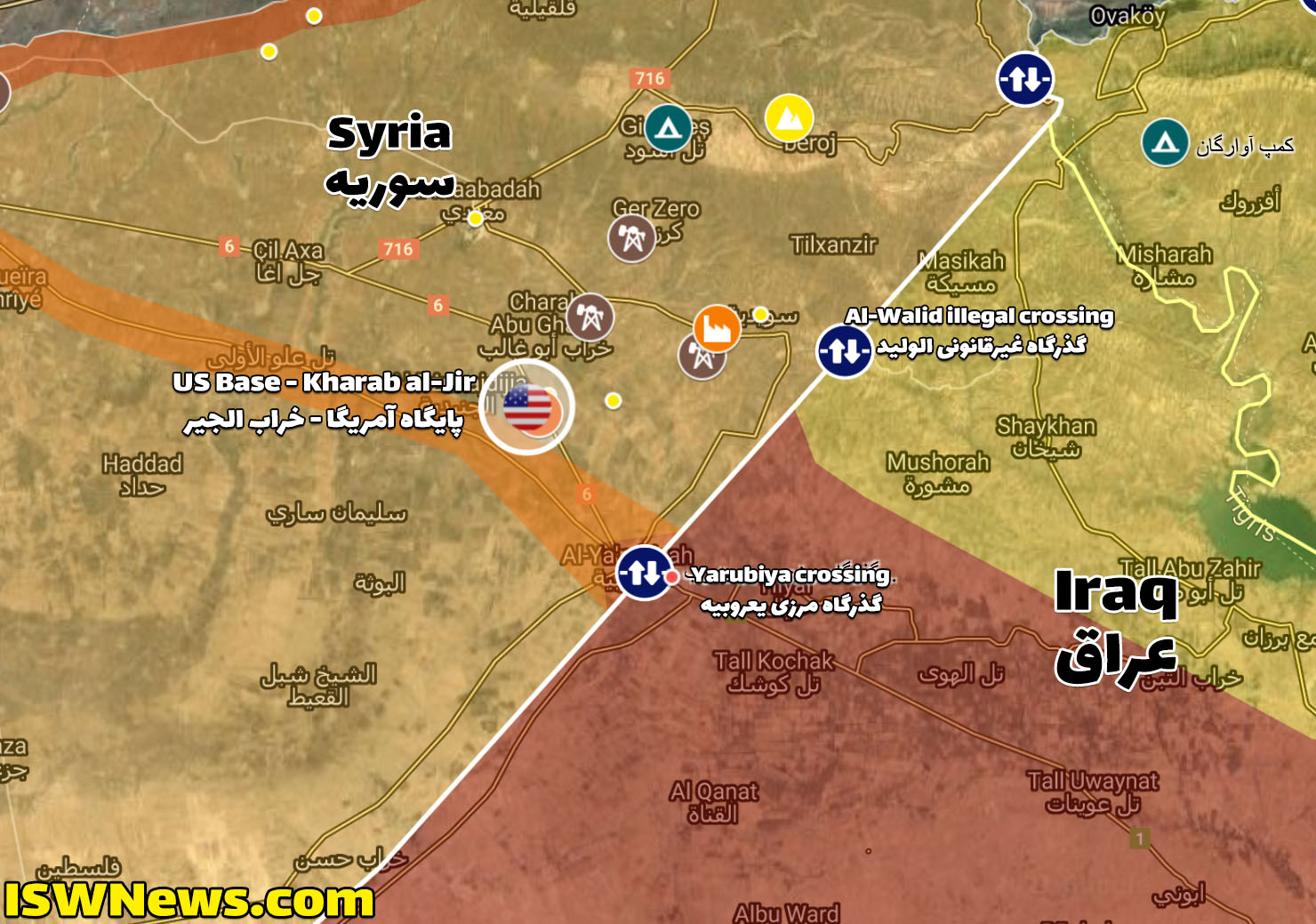
Islamic Resistance of Iraq Conducts Rocket Attack On US Terrorists In Syria
The Islamic Resistance of Iraq targeted the US military base in the village of ‘Kharab al-Jir, located five kilometers from the Al-Ya’aroubiyah border crossing in the northeastern Syrian governorate of Hasakah.
Following the attack, the Islamic Front for the Iraqi Resistance issued a statement to take responsibility for the rocket attack on the US military base in Kharab Al-Jir.
According to investigations made by the ISWnews, this is the fourth attack on US military positions in Kharab Al-Jir over the course of recent weeks.
-

Two More Israeli Servicemen Killed In Gaza
With the death of these two servicemen, according to the official announcement, the death toll of the Israeli army since the beginning of the ground attack on Gaza has increased to 70 servicemen.
Thus, the total number of “military” deaths of this regime since the beginning of the conflict has reached 398 servicemen.
-

Latest News From Northern Palestine, Southern Lebanon fronts, 2 December 2023
Israeli airstrikes on southern Lebanon:
Warplanes attack:
Fighter jets bombed the areas of Kfar Shuba and Kfar Hamam, as well as Al-Naqoura and Beit Lif.Rocket attacks:
Three rockets were fired at the outskirts of Al-Qouzah.Artillery attacks:
The Israeli regime army’s artillery unit attacked Aitaroun, Al-Rawisat (near Al-Naqoura), Maroun el-Ras, Yaroun, Blida, Tayr Harfa, Al-Naqoura, Aalma ech Chaab, Raba’ Al-Tebn, and Shanooh (south of Kfar Shuba), Ramieh, Ayta ash Shab, Al-Khiam, Tell el-Hammam, Kafar Kila, Tel Al-Awaida, and Tel Al-Nahhas.Hezbollah attacks on Israeli army positions in occupied Palestine:
Rocket attacks:
– An attack on the Israeli army’s missile base in the town of Dishon with Grad rockets
– An attack on the Khirbet Maer areaATGM missile attacks, artillery attacks, and shootings:
– An attack on the Rahib base (Shtula)
– An attack on the Biranit base and the command center of the Israeli army’s 91st Brigade
– An attack on the Al-Ruwaysat Al-Alam base
– An attack on the Jal Al-Alam base
– An attack on the Jal Al-Alam base
– An attack on an Israeli army gathering near the Birka Risha base
– An attack on two Israeli soldiers in a building in the town of Dovev (in two stages)
– An attack on the Al-Marj base
– An attack on the Mutela baseIt should be noted that in addition to the aforementioned clashes, Israeli forces and Hezbollah fighters engaged in ground combat at the Kafar Kila border area. The exchange of fire in this front continues and details of any advances, losses, and potential casualties have not been released yet.
-
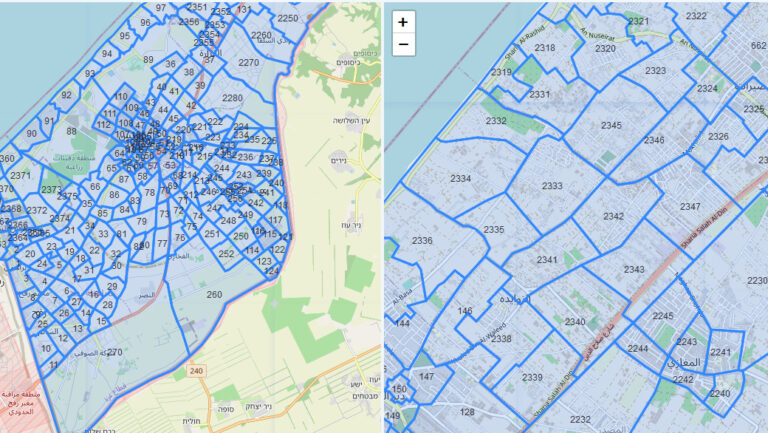
Israeli Army Attempts To Justify Its War Crimes By Publishing Interactive Map!
On December 1, the Israeli army announced that it would use this interactive map to inform and evacuate Palestinian civilians from various areas in the Gaza Strip. In this map, different parts of the Gaza Strip are divided into smaller numbered areas.
The Israeli army claims that this interactive map was designed to help distinguish between civilians and militants.
In a message to the residents of Gaza, the Israeli army stated: “The Israeli army is fighting against terrorist organizations and at the same time making great efforts to distinguish between civilians and terrorists. The people of Gaza are not our enemies. Therefore, since this morning, the Israeli army has been conducting controlled evacuation operations and identifying residents of Gaza in order to get them out of war zones as much as possible.”
It should be noted that this map was released after the temporary ceasefire in Gaza, which was mediated by the United States, Egypt, and Qatar. The Israeli army’s interactive map shows that this regime is planning to evacuate more than two million Palestinians from Gaza. The Israeli army has not yet specified whether the civilians who have been displaced due to the ground attack on the Gaza Strip will be allowed to return home after the war or not.
The Israeli army also dropped leaflets over southern Gaza on Friday. In these propaganda leaflets, people in the southern Gaza were threatened: “Palestinian civilians in Rafah area on the border with Egypt should leave; this city is known as a dangerous war zone.”
On December 2, the Israeli army ordered Palestinians to evacuate several areas in the north and south of the Gaza Strip. Although efforts to extend the ceasefire in Gaza and release some Israeli prisoners continue, recent movements by the Israeli army indicate that this regime is not actually interested in peace and ceasefire.
-

Iran’s IRGC Lost Two Of Its Servicemen In Syria
The names of the deceased IRGC members are “Mohammad Ali Ataei (Shoorche)” and “Panah Taghizadeh”.
This statement does not mention how these two servicemen were martyred; But last night, the fighter jets of the Israeli regime attacked targets in the suburbs of Damascus. It seems that these two servicemen lost their lives in this attack.
Read more: Israel Carries Out Airstrike On Syrian Capital

Mohammad Ali Ataei (Shoorche) 
Panah Taghizadeh -

Yemeni People In The 9th March For Palestine: The U.S. And Israel Leaders Are War Criminals
In the final statement of this march, the people of Yemen emphasized their readiness to face all options and support the people and resistance groups of Palestine.
They also considered the recent statements of Mahdi Al-Mashat, the head of the Supreme Political Council of Yemen, as strong and clear positions that express the positions of the Yemeni people, and they demanded a quick trial of the American and Israeli leaders as war criminals.


-
Israel Carries Out Airstrike On Syrian Capital
According to Syrian military sources, around 01:35 local time on Saturday, the Israeli enemy attacked targets in the outskirts of Damascus with several missiles from the occupied Golan Heights, and the Syrian air defense shot down most of the missiles. This attack resulted in material damage.
While the Ministry of Defense of the Syrian Arab Republic has only referred to the damage caused by this attack as material, local sources have reported targeting of sites around the neighborhood of Sayyidah Zaynab, commonly known as Sitt Zaynab, in Damascus and the killing of two civilians.
More details have not been released on this matter so far.
It is worth mentioning that the Israeli regime’s warplanes also attacked targets in the outskirts of Damascus with missile fire on November 26.
-

Resumption Of Clashes Between Palestinian And Israeli Army In The Gaza Strip
Since the morning of December 1, clashes between the resistance fighters and the Israeli regime forces resumed in different areas of the Gaza Strip and are now intensifying.
In the northern axis of Gaza, there is a fierce conflict between Palestinian fighters and Israeli forces in the area of al-Tawam and Sheikh Radwan. It is said that the resistance forces have succeeded in destroying an Israeli armored vehicle in Sheikh Radwan area during this conflict.
A video of the conflict between resistance forces and Israeli army in Al-Tawam axis In the southwestern axis of Gaza City, the Palestinian resistance forces are exchanging fire with the Zionist forces around Tel Al-Hawa area.
In addition to these areas, the Juhar al-Dik area, located in the south of Gaza City, is witnessing clashes between Palestinian fighters and Israeli soldiers.
Since this morning, Israeli fighter jets have started bombing different areas of the Gaza Strip. So far, various areas in Rafah and Khan Yunis in the south of the Gaza Strip have been targeted several times by Israeli fighter jets. According to the latest information, 54 civilians have been killed in these bombings.
In response to Israel’s attacks, the resistance forces attacked the towns of Ashkelon, Sderot, Mefalsim, Kafrazza, Saad, Nirim, Nir Oz, Kissufim around the Gaza Strip with rockets.
Gaza map – click to view full size map -

The World’s First Major Shipping Line Stopped Shipping In The Red Sea!
Also, the Zionist shipping company “ZIM” announced in an official statement that some of its ships have been diverted from the Red Sea and the Arabian Sea because of existing threats.
According to this decision, Israeli ships will pass through the Strait of Gibraltar instead of the Suez Canal and the Red Sea, and will have to bypass the African continent.
The decision of shipping companies to stop traffic from the Red Sea significantly lengthens the journey time of ships and increases its cost. This increase in costs will be added to the cost of transportation as well as the price of imported goods.
In the long run, this problem increases the costs of the Israeli regime’s partner companies to a great extent and increases the economic pressure on Israel. A problem that seems to continue at least until the end of the Gaza war.
-

Military Knowledge: Zulfiqar Main Battle Tank
History:
The first prototype of the Zulfiqar tank is known as Zulfiqar-1. This tank was first introduced in 1994. According to studies, the design and construction of the tank were carried out by Brigadier General Mir-Younes Masoumzadeh, the first head of the Research and Self-Sufficient Jihad organizations of the Ground Forces of the Islamic Republic of Iran Army. It is likely that the design and construction of this tank took place from 1988 to 1994. Brigadier General Masoumzadeh maintained the position of presiding the Research and Self-Sufficient Jihad organizations until his retirement in 1999.The Shahid Kolahdooz Industrial Complex was inaugurated in 1988. This military industrial unit was affiliated with the Ministry of Defence and Armed Forces Logistics and its main goal was to produce armored equipment, especially the Zulfiqar tank. Despite its main goal, this complex also produces various types of railway wagons and heavy equipment due to its high industrial capacity. However, despite the main goal of creating this industrial center for the production of the Zulfiqar tank, the number of Zulfiqar tanks seen in service is not high at all. Some sources claim that 100 units of Zulfiqar-1 tanks have been produced; however, because the military industry is not being publicized, it is not easy to verify this number outright.
The information about the timing of the introduction of the Zulfiqar-2 tank is not complete and the available data is unclear. However, based on the existing research, it is likely that the Zulfiqar-2 tank was introduced between 1999 and 2004. High-quality images of the Zulfiqar-2 tank are not available. The turret of the Zulfiqar-2 has undergone significant changes and is longer in comparison to the initial version. At least one wheel has been added to the chassis of the Zulfiqar-2 compared to the initial version. It is likely that significant changes were made to the turret and crew size during the purchase, production, and deployment of T-72 tanks in the mid-1970s. The Zulfiqar-2 tank likely uses a similar automatic loader to the T-72 tank and the crew size has been reduced to 3 personnel.
The Zulfiqar-3 tank was first seen during the military parade in April 2011. This tank also uses the chassis of the Zulfiqar-2 and its turret has a strong resemblance to that of the Zulfiqar-2. In 2016, changes were made to the Zulfiqar-3, mainly related to the design of the front part of the turret. The version unveiled in 2016 is also referred to as Zulfiqar-3E.
Design:
As mentioned in the history section, the Zulfiqar-1 has fewer wheels in comparison to later versions. Despite claims that the chassis of the Zulfiqar-1 is similar to the M60 or M48, a closer examination of the chassis reveals that it enjoys an independent designation.
A graphic image of three Zulfiqar tank models, in the new models, the chassis is longer and a wheel has been added to it. The Zulfiqar-1 chassis uses a more modern design than the M48, and the only similarity between the Zulfiqar chassis and the M48 is the number of wheels, which is 7. The chassis of M48 is made by casting method and at a glance, the difference between Zulfiqar and M48 chassis is obvious.

The difference between the two chassis is quite evident Regarding the similarity of the Zulfiqar-1 tank with the M60 tank, it can be said that the most similarity can be seen in the chassis of these two tanks. Both have the same number of wheels and the same shape in front of the chassis. However, the chassis height of the Zulfiqar tank is less. For this reason, five wheels have been used instead of three supporting wheels above, so that the reduction of the chassis height does not interfere with the performance of the wheels and chains on rough roads. The reduction in height and the applied changes can also indicate a change in the suspension system. According to the mentioned points, the Zulfiqar-1 chassis, despite its similarity with the M60, has used an independent design.
Due to the similarities between Zulfiqar-1 and M60 designs, many experts believe that the AVDS-1790 engine with 1000 horsepower belonging to the M60 tank was used in Zulfiqar.

The difference in the height of the tank chassis and the number of tank tread wheels in the M60 and Zulfiqar-1 tanks The designers of the Zulfiqar-1 tank have paid attention to reducing the height of the chassis to achieve greater stealth. For this purpose, small wheels are used more in the top of the tank tread. The reason for this is to prevent the interference of the wheels and chains on the roads with high unevenness and also reduce the damage of the wheels or chains during the movement.
The design of the Zulfiqar 2 and 3 chassis is very similar to the American Abrams chassis at first glance. It seems that in the process of designing the Zulfiqar 2 and 3 chassis, an attempt has been made to present a modern design based on the Abrams chassis.

Comparison of Zulfiqar-3 and Abrams tanks, which are similar in appearance. Review of Zulfiqar-3 tank:
Zulfiqar-3 tank is an Iranian main battle tank. This tank is the result of eight years of holy defense experience and the construction of Zulfiqar-1 tank in 1993.Zulfiqar-3 tank uses 125mm 2A46 gun. According to the image documents, this gun was also present on Zulfiqar-1 from the very beginning. Most likely, at first, Iran tried to buy western types of guns, because the combat organization of the Iranian army is based on western tools, But due to Western sanctions against Iran, the Russian 2A46 125 mm gun was used. This gun was available on the captured tanks of the Iraq war, and considering the economic conditions of Russia after the collapse of the Soviet Union, it was possible to buy it from Russia.
In the mid-1990s, Iran succeeded in buying and producing the T-72 tank from Russia. This tank was imported into the country as a kit and assembly operations were carried out in Iran. This caused Iran to use the automatic loading system of the T-72 tank in addition to the 125 mm gun in the next samples of Zulfiqar. Today, Iran itself is the producer of 125mm 2A46 gun under Russian license.

The effective range of the gun used in the Zulfiqar-3 tank is about 3000 km. To increase the accuracy of this gun, the KAT-72 fire control system made in Iran has been used. This fire control system is the result of technology transfer and production of Slovenian EFCS-3-55 system. This system enables the Zulfiqar tank to shoot at a moving target at a distance of 2000 km while the Zulfiqar tank itself is moving. Also, the KAT-72 fire control system allows the Zulfiqar-3 tank to hit the first shot at a distance of 2,200 meters in a stationary state.
This tank uses a laser range finder produced by SAIRAN company, which can measure the distance up to 10,000 meters with high accuracy. The fire control system also uses wind sensor, temperature sensor and gun deviation sensor.
The Zulfiqar-3 tank uses a 360-degree periscope for the commander, a day and night vision site for the gunner, and a periscope for the gunner. Also, the tank includes 12 smoke grenade launchers (6 on each side).

Different parts of Zulfiqar-3 tank In the prototypes, in addition to the main 125 mm gun, a 12.7 mm Dshk machine gun for the commander and a 7.62 MG3 machine gun for the gunner are installed as secondary weapons on the tank. The machine guns have no remote control and the tank crew must get out of the tank to use them. But in more advanced models of Zulfiqar 3, a Dshk machine gun with remote control capability has also been added to this section.
The point that attracts attention in this section is the use of three machine guns on the tank. In general, using this number of machine guns on today’s modern tanks is not customary and is considered excessive. Also, remote controlled machine guns are used in modern tanks today. Having a remote controlled machine gun for the gunner and commander in urban warfare can be much more practical than the current arrangement. Because it keeps the crew away from the enemy’s direct fire and provides a large volume of fire without rotating the turret in several directions.
 The machine guns used on the Zulfiqar-3 tank
In some published images of the Zulfiqar-3 tank, thermal camouflage nets have been used for greater concealment and to increase the degree of protection.
The driver in the Zulfiqar-3 tank is located in the middle and almost below the junction of the gun and the turret. This location is similar to the location of eastern tanks. Regarding the periscope or surveillance camera for the driver, there is no item on the tank, but it is possible to install and use these items, similar to the Karrar tank.
Read more: Military Knowledge: Karrar Main Battle Tank

Thermal camouflage nets and the location of the Zulfiqar-3 tank driver The exact specifications of the engine used on the Zulfiqar-3 tank are not available. But speculation predicts the existence of an engine with a minimum power of 1000 horsepower. Based on the power of 1000 hp, the M60 tank engine named AVDS-1790 and the Ukrainian 6TD engine with a maximum power of 1200 hp and the Russian V92 engine with a power of 1000 hp (used in the T-90A) are available for the Zulfiqar-3 tank.
Zulfiqar-3 engine with 1000 horsepower and 52 tons of weight gives this tank a thrust to weight ratio of 20 horsepower per ton, which is a desirable number.
Specifications of the Zulfiqar 3 tank:
Type: Main Battle Tank
Country of Origin: Iran
Producer: Jihad self-sufficiency of the ground forces of the Islamic Republic of Iran Army
Unveiled: 2012
Crew: 3 (driver, commander and gunner)
Length: 9.2 to 9.7 meters (including the gun barrel)
Width: 3.6 meters
Height: 2.5 meters
Engine: 1000 horsepower
Operational range: 450 km
Speed: maximum 60 to 70 km/h on the road
Mass: 52 tons
Main weapon: 125mm 2A46M gun with stabilizer
Secondary weapon: one 7.62 mm MG3 machine gun – one 12.7 mm Dshk machine gun – one 12.7 mm Dshk machine gun with remote control capabilityZulfiqar-3 Tank – click to view full size More images of Zulfiqar-3 tank:


Click to view full size Infographics of Zulfiqar-3 tank in Russian, Arabic, Hebrew, Kurdish, Azeri and Farsi:


Click to view full size Sources:
ویژگی های نسل جدید تانک ذوالفقار+عکس
Zulfiqar (1993)
بدانیم که … (سایت دستاوردهای ارتش)
تانک ذوالفقار