On July 30, after a woman complained to the police station in Al-Ma’ala district over being harassed by son of one of Aden’s security commanders, the Al-Hizam Amni security forces backed by the Southern Transitional Council (STC) went to this person’s house.
This move led to violence and clashes between the two sides, and one of the Al-Hizam Amni security forces was wounded by a bullet from the security commander, who later succumbed to injury after being transferred to the hospital.
Following the fatal incident, the Al-Hizam security forces went to the residence of the security commander to arrest and punish him, but this time the security commander was killed by the Al-Hizam Amni forces.
This incident has led to continued chaos in the city of Aden, and up to now an arms depot belonging to the Al-Hizam security forces has been exploded in the Al-Sha’ab neighborhood and a restaurant in the Crater district of the Aden Governorate has caught fire.
The city of Aden has witnessed violent clashes since Friday evening, which indicates that security chaos in occupied areas of Yemen has its roots in economic pressures and the inability of Yemen’s resigned government to resolve political and security woes.
Explosion of the weapons and ammunition warehouse of Hizam al-Amni forces in Sha’ab area
ISWNews Analysis Group – According to Syrian military sources, the Zionist enemy fired several missiles from the northeast direction of Lebanese capital city Beirut towards targets on the outskirts of the city of Homs around 00:20 a.m. (local time) on Sunday, and the Syrian air defense shot down most of the missiles.
The military sources also confirmed that air strike resulted in material damage.
No further details have been released so far, but it is said that one of the Syrian army’s positions in the village of Al-Najma, located in north of the city of Homs, was targeted by the Israeli fighter jets.
During the air raid, the Syrian army’s air defense systems fired an anti-aircraft missile at the Israeli fighter jets, which fell in the Rahat area in the occupied territories of Palestine.
The Israeli army also confirmed in a statement that a Syrian air defense missile had entered the occupied Palestinian airspace
A Syrian anti-aircraft missile was fired towards occupied territories and apparently exploded in the sky, the statement mentioned.
According to the statement, the Israelis have initiated investigations on the Syrian missile.
Some Hebrew-language media outlets reported that a missile was able to travel more than 400 kilometers from the Homs region of Syria (the region where Israeli fighter jets attacked) to Rahat district and it fell in the occupied lands after passing through the Israeli regime’s air defense system.
The distance traveled by the Syrian missile according to the Israeli claim
On the other hand, some Israeli sources claimed that the Patriot air defense system located in the north of occupied Palestine intercepted a Syrian anti-aircraft missile that was fired at the Israeli regime fighter jet and the remains of the missile fell in Rahat area.
Remnants of a Syrian missile in the Rahat area
It is worth mentioning that on June 14, the Zionist regime’s fighter jets attacked targets in the suburbs of Damascus by firing several missiles from the occupied Golan. This attack caused material damage.
The Challenger 2 is the third vehicle of this name, the first being the A30 Challenger, a World War II design using the Cromwell tank chassis with a 17-pounder gun. The second was the Persian Gulf War era Challenger 1, which was the British army’s main battle tank (MBT) from the early 1980s to the mid-1990s. The design process of the Challenger 2 tank was carried out between 1989 to 1994 by the British company “Vickers Defence Systems”, which also designed the Challenger 1 tank. Today, Challenger 2 is produced by BAE Systems Platforms & Services.
The Challenger 2 tank was developed on the basis of the Challenger 1, however despite outward similarities to the Challenger 1, only about 3% of components are interchangeable with the earlier vehicle.
The main armament is a L30A1 120-millimetre rifled tank gun, an improved derivative of the L11 gun used on the Chieftain and Challenger 1. Fifty rounds of ammunition are carried for the main armament, alongside 4,200 rounds of 7.62 mm ammunition for the tank’s secondary weapons: A L94A1 EX-34 chain gun mounted coaxially, and a L37A2 (GPMG) machine gun. The turret and hull are protected with second generation Chobham armour, also known as Dorchester. Powered by a Perkins CV12-6A V12 diesel engine, the tank has a range of 550 kilometres and maximum road speed of 59 kilometres per hour.
Two 7.62 mm machine guns on the Challenger 2
Challenger 2 benefits from a L30A1 120-millimetre rifled gun, firing both long rod penetrator and High Explosive Squash Head (HESH) ammunition natures. The rifled barrels increase stability and shooting accuracy. The “rifling” is for the purpose of exerting torque and thus imparting a spin to a projectile around its longitudinal axis during shooting to stabilize the projectile longitudinally by conservation of angular momentum, improving its aerodynamic stability and accuracy over smoothbore designs.
L30A1 rifled gun on Challenger 2
The commander has a panoramic SAGEM VS 580-10 gyrostabilised sight with laser rangefinder. The commander’s station is equipped with eight periscopes for 360° vision. The Thermal Observation and Gunnery Sight II (TOGS II), from Thales, provides night vision. The thermal image is displayed on both the gunner’s and commander’s sights and monitors. The gunner has a stabilised primary sight using a laser rangefinder, with a range of 200 m to 10 km. The driver’s position is equipped with a Thales Optronics image-intensifying Passive Driving Periscope (PDP) for night driving and a rear view thermal camera.
The fire control system of Challenger 2 is the same as the US M1A1 Abrams and the French Leclerc MBT. Also, Challenger 2 and Abrams tanks use the same battlefield management system, which allows easy exchange of information between British and American tanks.
Electro-optical systems used in the Challenger 2
The turret and hull are protected with second generation Chobham armour, also known as Dorchester. The Dorchester armor, although lighter than the Chobham, provides better protection for the Challenger-2 tank.
Challenger 2 is also equipped with an automatic fire extinguishing system in addition to the Nuclear, Biological and Chemical (NBC) protection system and Visual and Infrared Screening Smoke (VIRSS) systems.
The Challenger 2 tank is designed in such a way that its detection and tracking by enemy detection radars is as low as possible. Therefore, the FV4034 Challenger 2 tank can be considered one of the most stealth tanks in the world.
One of the most confidential information about main battle tanks is the amount of armor in different parts of it, which is usually published in an exaggerated form. An image of the actual amount of armor used in Challenger 2 has been published by a website that claims to have information about Challenger 2. The images below show the armor’s resistance against high-explosive anti-tank (HEAT) projectiles and kinetic energy (KE) projectiles.
An image of the thickness of the armor of the Challenger 2 in frontAn image of the thickness of the armor of the Challenger 2 on sidesClick to view full size
The Challenger 2 Powered by a Perkins CV12-6a turbocharged diesel engine. Using this engine, the Challenger 2 tank can reach a maximum range of 550 km and a maximum speed of 59 km/h.
Challenger 2’s Perkins CV12-6a engine
Challenger 2 uses Horstman Defence Systems second-generation hydrogas suspension units, which is an improved suspension system, along with improved gearbox and a Hydraulic Track Tensioner provide platform stability covering flat road surfaces through to rough cross-country terrain.
The Challenger-2 is the Royal Army’s only main battle tank (MBT) today. The country of Oman has also recruited 38 units of this British tank.
The Challenger 2 tank has participated in wars such as Bosnia, Kosovo and the Persian Gulf War. In 2003, during the Desert Storm operation in Iraq, a Challenger 2 tank seriously damaged another Challenger 2 tank, and there were no casualties.
Challenger 2 Updates:
CLIP update: The Challenger Lethality Improvement Programme (CLIP) was a programme to replace the current L30A1 rifled gun with the smoothbore Rheinmetall 120 mm gun currently used in the Leopard 2 and M1 Abrams. The use of a smoothbore weapon would have allowed Challenger 2 to use NATO standard ammunition, including tungsten-based kinetic energy penetrators which do not have the same political and environmental objections as depleted uranium rounds. The production lines for rifled 120 mm ammunition in the UK have been closed for some years so existing stocks of ammunition for the L30A1 are finite. Challenger 2 fitted with 120 mm smoothbore gun for trials A single Challenger 2 was fitted with the L55 and underwent trials in January 2006. The smoothbore gun was the same length as the L30A1 and was fitted with the rifled gun’s cradle, thermal sleeve, bore evacuator and muzzle reference system. Early trials apparently revealed that the German tungsten DM53 round was more effective than the depleted uranium CHARM 3. The ammunition storage and handling arrangements had to be changed to cater for the single-piece smoothbore rounds, instead of the separate-loading rifled rounds. Other improvements were also considered, including a regenerative NBC protection system.
Challenger 2 equipped with L30A1 rifled gunChallenger 2 tank equipped with L55 smoothbore gunClick to view full size
HAAIP update: Updates to the automotive components of Challenger 2 are being undertaken as part of the ongoing Heavy Armour Automotive Improvement Programme (HAAIP), which is expected to continue until 2031, and expected to align with the Challenger 3 programme. The HAAIP programme “will be made to existing in-service Challenger 2 tanks to increase their mobility and stability, both of which are critical to providing the foundation for the new turret and systems that will upgrade the vehicle to a Challenger 3.”
The overall scope of HAAIP includes: – Upgraded CV12-9A engines for Challenger 3 and CRARRV – Third Generation Hydrogas Suspension – New Hydraulic Track Tensioners (HTT) with inline accumulators – Improved Electric Cold Start System (Intake Manifold Heater) – Unspecified new components fitted to improve the transmissions – New Main Engine Air Intake Filters – Improved Main Engine/Transmission Cooling; fitting new high efficiency radiators and fans.
TES Megatron update: The Megatron update, or Challenger 2 TES Megatron, was first unveiled in 2013 at the DVD Defense Expo in Millbrook. Another example of Megatron’s update was also unveiled in 2016.
This update includes: – Adding reactive and passive armors to deal with new types of threats on the battlefield, which allows to equip Megatron with additional types of armor depending on the type of threats. – Upgrading the L30A1 gun to be able to fire more of the existing NATO ammunitions. – Installation of a remote control weapons system called Enforcer. – Using of a new armor that is a combination of Dorchester’s standard composite armor, reactive, passive and rod armor and Chobham armor.
Megatron has a maximum weight of 74,840 kg with TES armor and 62,500 kg in standard configuration.
Enforcer Remote Control Weapons System
Black Night update: In 2018, following the update program of the Challenger-2 tank, an update called Black Night was implemented, which practically became a different product. Two examples of this update have been seen to date, differing only in “gun type”. One example uses the same L30A1 gun and another example uses the L55 gun that was previously coordinated with this tank in the CLIP update.
Features announced for the Black Night update by BAE include: – Active Protection System – Systems allow the tank to detect incoming anti-tank missiles or armour penetrating rounds and automatically launches a counter-explosive to neutralise the threat. – Laser Warning System – When targeted by enemy weapon systems, the tank can identify the source of the threat then automatically slew the gun to point at that source, making it quicker for the crew to counter-fire. – Regenerative braking – The tank has been made more energy efficient by using less energy-hungry kit and installing regenerative braking in the turret, which generates power when the gun slows down into position. – Thermal Imaging Technology – Front and rear infrared cameras (similar to those used in television programmes such as Planet Earth II) provide extremely sharp night imagery, helping troops identify potential threats and move undetected in hostile situations, while also shaving valuable seconds off reaction times. – Accelerated fightability – New equipment controlling tank’s weaponry is faster, meaning the crew can identify an enemy, target and engage more quickly.
Challenger 2 Black Night tank equipped with the L30A1 rifled gunChallenger 2 Black Night tank equipped with L55 smoothbore gunTrophy system and Challenger 2 Black Night componentsClick to view full size
CSP / LEP update: In 2005, the British MoD recognised a need for a Capability Sustainment Programme (CSP) to extend the service life of the Challenger 2 into the mid-2030s and upgrade its mobility, lethality and survivability. The CSP was planned to be complete by 2020 and was to combine all the upgrades from CLIP, including the fitting of a 120 mm smoothbore gun. By 2014, the CSP programme had been replaced by the Life Extension Programme (LEP) which shared a similar scope of replacing obsolete components and extending the tank’s service life from 2025 to 2035, however the 120 mm smoothbore gun had seemingly been abandoned.
In 2015, the British Army provided an insight into the scope of the LEP, dividing it into four key areas, namely: – Surveillance and target acquisition: Upgrades to the commander’s primary sight and gunner’s primary sight, as well as the replacement of the thermal observation and gunnery sights (TOGS) with third-generation thermal imaging. – Weapon control system: Upgrades to the fire control computer, fire control panel and gun processing unit. – Mobility: Upgrades including third-generation hydrogas suspension, improved air filtration, CV-12 common rail fuel injection, transmission and cooling. – Electronic architecture: Upgrades to the gunner’s control handles, video distribution architecture, generic vehicle architecture compliant interfaces, increased onboard processing and improved human machine interface.
Challenger 3 update: This update was implemented to consolidate the experience of all the upgrades made on the Challenger-2 tank and was unveiled in 2021. The upgrades that were first done on the Megatron and then on the Black Night continued on the Challenger 3. In order to increase the survivability of tank in the battlefield, two models of active protection systems (APS) have been used on this tank: MUSS (MUltifunctional Self protection System) and Rheinmetall’s ROSY Rapid Obscurant System.
MUltifunctional Self protection System – click to view full size
With the introduction of Megatron in 2016 and Black Knight in 2018, a proposal design was also unveiled by Rheinmetall in 2019. The design included the development of a completely new turret with fully digital electronic architecture, day and night sights for the commander and gunner, and a Rheinmetall L55 120 mm smoothbore gun. Whilst a more substantial upgrade than Black Night, the turret was developed on Rheinmetall’s initiative and was not funded by the UK MoD. In June 2019, BAE Systems and Rheinmetall formed a joint venture company, based in the UK, named Rheinmetall BAE Systems Land (RBSL). Despite the merger, the company was still expected to present two separate proposals for the LEP contract, however, at DSEI 2019, RBSL instead opted to only showcase the Rheinmetall proposal.
This upgrade includes a new turret with a fully digital electronic architecture, a Thales Orion day and night sight for the commander, and a Thales DGNS T3 day and night sights for the gunner, along with the use of a 120mm Rheinmetall L55A1 gun. The turret architecture also allows for an active protection system or an Improvised Explosive Electronic Warfare system to be installed in the future if required by the user.
Click to view full size
In 2020, the UK MoD argued against buying a new main battle tank from overseas instead of pursuing the Challenger 2 LEP, stating that an upgraded Challenger 2 would be “comparable – and in certain areas superior” to a Leopard 2 or Abrams.
In 2021, the UK MoD published its long-awaited command paper, Defence in a Competitive Age, which confirmed the British Army’s plans to upgrade 148 Challenger 2 tanks and designate them Challenger 3. The UK MoD confirmed the contract with RBSL had been signed, valued at £800 million (US$1 billion), on 7 May 2021. Rheinmetall’s more extensive upgrade proposal, including the new 120 mm smoothbore gun, had been accepted. The initial operating capability for the upgraded tanks is expected by 2027, with full operation capability expected to be declared by 2030.
Infographic published by RBSL comparing Challenger 2 and Challenger 3 tanks
Types of tanks and combat vehicles based on Challenger-2 chassis:
Trojan combat engineering armored vehicle: The Trojan Armoured Vehicle Royal Engineers is a combat engineering vehicle designed as a replacement for the Chieftain AVRE (ChAVRE). It uses the Challenger 2 chassis, and carries an articulated excavator arm, a dozer blade, and attachment rails for fascines. Entering service in 2007, 33 were produced.
Trojan combat engineering armored vehicle:
Challenger 2 Driver Training Tank: The Challenger 2 Driver Training Tank (DTT) is based on the Challenger 2 hull. The turret has been replaced with a fixed weighted superstructure to accommodate an instructor and up to 4 trainees. The design is similar to the Challenger 1 derived Challenger Training Tank (CTT). Weighting the superstructure replicates the weight (and therefore also the driving characteristics) of the standard tank in operational service.
Challenger 2 Driver Training Tank
Titan armoured bridge layer: The Titan armoured bridge layer is based on aspects of the Challenger 2 running gear and replaced the Chieftain Armoured Vehicle Launched Bridge (ChAVLB). The Titan came into service in 2006 with the Royal Engineers, with 33 in service. Titan can carry a single 26-metre-long bridge or two 12-metre-long bridges. It can also be fitted with a bulldozer blade.
Titan armoured bridge layer
Challenger 2E: Challenger 2E The Challenger 2E is an export version of the tank. It has a new integrated weapon control and battlefield management system, which includes a gyrostabilised panoramic SAGEM MVS 580-day/thermal sight for the commander and SAGEM SAVAN 15 gyrostabilised day/thermal sight for the gunner, both with eye-safe laser rangefinder. This allows hunter/killer operations with a common engagement sequence. An optional servo-controlled overhead weapons platform can be slaved to the commander’s sight to allow operation independent from the turret. The power pack has been replaced by a new 1,500 hp (1,100 kW) EuroPowerPack with a transversely mounted MTU MT883 diesel engine coupled to Renk HSWL 295TM automatic transmission. The increase in both vehicle performance and durability is significant. The smaller volume but more powerful EuroPowerPack additionally incorporates as standard a cooling system and air intake filtration system proved in desert use. The free space in the hull is available for ammunition stowage or for fuel, increasing the vehicle’s range to 550 km (340 mi). This power pack was previously installed on the French Leclerc tanks delivered to the UAE as well as the recovery tank version of the Leclerc in service with the French Army. Further developed versions of the EuroPowerPack have more recently been installed in the latest serial produced Korean K2 Black Panther tank. BAES announced in 2005 that development and export marketing of 2E would stop. This has been linked by the media to the failure of the 2E to be selected for the Hellenic Army in 2002, a competition won by the Leopard 2.
Challenger Armoured Repair and Recovery Vehicle: The Challenger Armoured Repair and Recovery Vehicle (CRARRV) is an armoured recovery vehicle based on the Challenger 1 hull, designed to repair and recover damaged tanks on the battlefield. Ordered in 1985, and delivered between 1988 and 1993, the CRARRV has subsequently been updated to use a Challenger 2 powertrain consisting of a CV12-5C/6C engine with TN54E transmission. The British Army ordered 80 vehicles. Four CRARRVs were purchased by Oman to complement their acquisition of Challenger 2 tanks. CRARRVs were first deployed in action in the lead up to the First Gulf War, Operation Granby in 1991. They were subsequently deployed during the 2003 invasion of Iraq, Operation Telic in 2003, alongside standard Challenger 2 MBTs.
CRARRV armored vehicle using its craneCRARRV armored vehicle equipped with a bulldozer bladeClick to view full size
Challenger 2 specifications: – Type: Main Battle Tank (MBT) – Manufacturer: BAE Systems – In service: since 1998 – Wars: Iraq war, Kosovo war, Bosnian war, Afghanistan war – Unit cost: £4,217,000 – Mass: 64 tons – Length: 8.3 m – Width: 3.5 m – Height: 2.49 m – Crew: 4 (commander, gunner, loader–operator, driver) – Engine: Perkins CV12-6A V12 diesel, 26.1 L, 1200 bhp (890 kW) – Fuel capacity: 1,592 litres – Operational range: 550 km on-road, 250 km off-road – Speed: 59 km/h on-road, 40 km/h) off-road – Origin: UK
Challenger 2 tank – click to view full sizeClick to view full size
Collection of Challenger 2 posters in Russian, Arabic, Persian, Azeri and Kurdish:
This video is the first documentary about the downing of a Storm Shadow cruise missile during the war between Russia and Ukraine. Earlier, British Defence Secretary Ben Wallace announced on May 11, that the country has started sending Storm Shadow cruise missiles to Ukraine. The Storm Shadow missile is an air-launched MBDA with a range of over 250 km.
ISWNews Analysis Group – A mysterious combat drone pounded the Al-Kharouba (Al-Khadim) air base, which is home to Wagner Group’s forces in eastern Libya on July 29.
The Al-Khrouba air base is located 105 kilometers southwest of Benghazi in the Libyan province of Al-Marj, where is under the control of the Libyan National Army under the command of General Khalifa Belqasim Haftar.
After General Haftar’s request for military assistance from Russia and the deployment of Wagner Group’s forces to Libya, the air base turned into one of the points where members of the Wagner group were stationed.
In addition to its own Russian forces, the private paramilitary company Wagner Group has also employed militants from Chad, Sudan, Niger and Syria, whose failed operations to occupy capital Tripoli and northwestern Libya were among their activities in the African country.
These Wagner forces are said to be active in securing and operating oil fields in eastern and southern Libya.
Al-Khadim (Al-Khoruba) air base in northeastern Libya – click to view full size
ISWNews Analysis Group – Wall Street Journal, quoting diplomatic and intelligence sources, alleged that Moscow had informed Syrian President Bashar al-Assad that Wagner forces would no longer operate independently in the Arab country.
The Wall Street Journal also wrote, quoting its sources that Wagner Group’s personnel, who are stationed in Syria, followed up orders to move to the Russian military base in Latakia Governorate located on the Mediterranean coast.
Moscow has also informed Syrian President Bashar al-Assad that the Wagner forces will no longer perform any independent operation in Syria.
According to the American media, the Kremlin is trying to fully control the operations of the Wagner Group throughout the world after the recent incident inside the Russian soil and the clash that erupted between the Wagner forces and the Russian army.
It is worth mentioning that the Wagner Group has been present in Syria since 2015 and it has participated in various military operations alongside the Syrian army and its allies against terrorist groups such as the ISIS.
Following an increase in clashes between the Syrian armed forces and ISIS elements in the Syrian Desert in 2022, some local sources reported that about 1,200 Wagner forces were deployed in the Homs desert and around the city of Tadmor (Palmyra) to confront the undercover elements of the ISIS terrorist group.
1- Russian army artillery struck positions of Ukrainian forces nearNeveske. 2- Russian army artillery struck positions of Ukrainian forces near Dibrova. 3- Russian army artillery struck positions of Ukrainian forces near Kupyansk. 4- Russian army artillery struck positions of Ukrainian forces near Orikhiv. 5- Russian army artillery struck positions of Ukrainian forces near Velyka Novosilka. 6- Russian army artillery struck an ammunition warehouse belonging to Ukrainian forces in Vyemka area. 7- Russian army artillery struck a fuel depot belonging to Ukrainian forces near Zaporizhzhia. 8- Ukrainian artillery struck a Russian base in the northern neighborhoods of Donetsk city.
9- Clashes between the Russian army Ukrainian forces continue in Pyatikhatki area. 10- Clashes between the Russian army and the Ukrainian forces continue in Robotyne area. 11- Clashes between the Russian army and Ukrainian forces continue in the Makarivka area. 12- Clashes between the Russian army and Ukrainian forces continue in Mariinka town. 13- Clashes between the Russian army and Ukrainian forces continue near the city of Bakhmut. 14- Ukrainian forces repelled the Russian army attack in Mariinka town. 15- Ukrainian forces repelled the Russian army attack in west of Dibrova. 16- Russian army forces repelled Ukrainian army attack to Antonovsky Island.
– According to Ukrainian sources, the artillery of the Ukrainian army destroyed 6 accumulations of weapons and military equipment, 3 ammunition depots and 14 artillery units of the Russian army in the past 24 hours. – According to the Russian Ministry of Defense, the Russian army destroyed 75 Ukrainian servicemen, 3 motor vehicles, 1 howitzer in the Kopyansk region. – According to the Russian Ministry of Defense, the Russian army destroyed 90 Ukrainian servicemen, 1 tank, 2 personnel carriers, 8 motor vehicles, 2 howitzers in the Krasny Liman region. – According to the Russian Ministry of Defense, the Russian army destroyed 265 Ukrainian servicemen, 2 armored vehicles, 2 pickup trucks, 1 Krab artillery system in the Donetsk region. – According to the Russian Ministry of Defense, the Russian army destroyed 140 Ukrainian servicemen, 3 armored vehicles, 7 motor vehicles, and 2 howitzers in the Zaporizhzhia region. – According to the Russian Ministry of Defense, the Russian army destroyed 30 Ukrainian servicemen, 4 motor vehicles, 1 American M777 cannon in the Kherson region.
Somalia is a part of the land and identity of Greater Somalia, where people with Somali ethnicity live and almost geographically includes a large part of the Horn of Africa. The territories that make up Greater Somalia include the present-day country of Somalia, Djibouti, Ogaden (Western Somalia), which is now in Ethiopia’s possession, and the northeastern province of Kenya in southern Somalia today. British and Italian colonial rule over areas of the greater Somaliland eventually led to the separation of parts of this land and its annexation to other lands, including the non-Islamic lands of Ethiopia and Kenya, which can be considered the root of many problems in Somalia today.
An image of the territorial identity of Greater Somalia, which has separated from Somalia, such as Djibouti, Ogaden, and NFD, or is in the process of secession, such as the state of Somaliland.
As mentioned, the British and Italian colonial rule over parts of the greater Somali land eventually caused the separation of parts of this land. In the early years of the 20th century, Somalia was an Italian colony and was called “Italian Somaliland”. Italian Somaliland included the eastern, central and southern regions of Somalia. This land gained independence in 1960, but due to the Somali civil war at the end of the 20th century, it was divided into smaller regions.
Different Areas of Somalia
The territorial identity of Somalia has experienced several ups and downs over the past two decades and it has been divided into different regions during the colonialism. Nowadays, some parts of the territory are located in the current country of Somalia, while other parts have been given to other countries or they have turned into a new entity.
After the declaration of independence in 1960 and the events that led to civil war and other problems, Somalia has been officially divided into six federal states since 2016. These states are Somaliland, Puntland, Galmudug, Southwest, Hirshabelle and Jubaland. Also, the port area that includes the city of Mogadishu is considered as an independent state.
Among the mentioned states, the two states of Puntland and Somaliland have more importance and political-military background than other states, which we will explain below. Also, during the colonial period, the land of Somalia has been divided and fragmented, which we will also discuss.
A picture of the states of the federal country of Somalia
Somaliland State: The region is named Somaliland or British Somaliland, because it was dominated by Britain in the past. The territory is situated in northwest of Somalia and between Ethiopia, Djibouti and the Gulf of Aden. It could get rid of British domination in 1960. Five regions out of the 18 areas of Somalia are located in this part of the country, and its capital city is Hargeisa. Later since 1991, Somaliland was separated from the mainland of Somalia in practice. Somaliland has its own government, parliament, army and even passport from 2000. Separatists of Somaliland held a referendum in 2001 and actually announced separation from the central government in Somalia under the title of Somaliland or the Republic of Somaliland. Berbera is one of the most important cities of this region. The establishment and relative stability as well as the ability of its military forces in disarming different armed groups in Somaliland are the main differences of this part of Somalia in comparison to other parts.
Flag of Somaliland separatists
Puntland State: The territory is located in northeastern part of Somalia and encompasses 33 percent of the country. Its capital city is Bosaso. Puntland is considered as part of federal government of Somalia. Puntland’s parliament declared the autonomy of the region in 1998 and installed former colonel of the Somali National Army Abdullahi Yusuf Ahmed as the head of the Somali Salvation Democratic Front (SSDF). The autonomous state of Puntland possesses its special military and security forces, who are being called as Puntland Security Force (PSF). Puntland unlike the separatists of Somaliland is not seeking to be recognized as an independent country at international level, but it abides by the federal system and the unity among Somalians. It is worth mentioning that Puntland and the separatists of Somaliland are confronting to control two regions of Sanaag and Sool.
Flag of the Autonomous State of Puntland
Ogaden State: The region, which is known as Western Somalia was handed over to Ethiopia during the Italian colonialism prior to the World War II and developments following the war and the British colonialism in 1954; so, it is named as the fifth region or Ogaden state in Ethiopian administrative division. Most of the people in the region are Muslims and have Somalian roots. In 1977 and after the fall of Emperor Haile Selassie in Ethiopia, some armed groups affiliated to general Mohamed Siad Barre’s government in Somalia controlled most areas of the region, but Ethiopia could retake the region by the help of Cuba and the Soviet Union in 1978. At present, the region is part of the administrative division of Ethiopia under the name of a Somalian state, and it is considered as the second and largest state of Ethiopia after Oromia State.
Ogaden region in western Somalia
Southwest region: The region, which is also known as the Northern Frontier District (NFD), is part of Kenya nowadays and its capital city is Garissa. The region was handed over to Kenya in 1963 by the help of Britain, which in fact translates into occupation. Most of the people residing in the region are historically Somalian. During the negotiations for the independence of Kenya, Britain handed over the NFD to Kenyan nationalists despite the fact that an unofficial referendum showed that people of the region were very keen on joining to the newly-formed republic in Somalia. It is noteworthy that Harakat al-Shabaab al-Mujahideen, more commonly known as al-Shabaab, has a say in this region and it conducts military operations sometimes.
Southwest State or the so-called Northern Frontier Region (NFD)
Afar-Issa region: This part is known as French Somaliland, and as it is obvious from its name, it had been under France’s dominance during the French colonialism. Two tribes of Issa and Afar are the main habitats of this region. The area embarked on holding referendum two times in 1957 and 1967 with the aim of joining to the mainland that is Somalia. But the effort was ruled out each time. The Somalians are of the opinion that France by the help of opponents and by resorting to electoral fraud could change the results of the elections in both referendums. The third referendum was held in 1977, which was focused on gaining independence from the French colonialism, ending up in maximum victory of the residents of the region to establish a new country named the Republic of Djibouti.
French Somaliland or Afar-Issa region
The geography of distribution of extremist groups in Somalia
The geography of extremism in Somalia includes a diverse situation of groups, movements and periodic and non-periodic agreements, of course, “Al-Shabaab Al-Mujahideen Movement” has the upper hand among them; In such a way that the activities of other groups are overshadowed by al-Shabaab. In the following, we will examine the extremist Islamist movements based in Somalia:
Harakat al-Shabaab al-Mujahideen in Somalia
Harakat al-Shabaab al-Mujahideen briefly known as al-Shabaab is a Salafist jihadist group, who fights in Somalia on behalf of Al-Qaeda, and some of its forces and allied groups follow ISIS terrorist organization. The groups have their roots in the civil war in Somalia and the Islamic Courts Union, which was a legal and political organization formed to address the lawlessness that had gripped Somalia since the fall of the Siad Barre regime in 1991 during the Somali Civil War. The union had southern Somalia under its influence and later branched into different groups, and with the emergence of ISIS, some of these groups joined their alliance.
Al-Shabaab emerged in 2004, when the military wing of the Islamic Courts Union, which dominated Mogadishu, as well as their militants connected to Al-Qaeda quickly as a result of links between certain commanders of the international wing of the al-Shabaab group and the Al-Qaeda in East Africa. The connection continued until 2009. And in this year, al-Shabaab al-Mujahideen officially joined the Al-Qaeda.
Now, al-Shabaab is the most powerful Salafi-jihadist group in Somalia, whose operations are mostly focused on southern and central areas of the African country. Undeniably, al-Shabaab is active and carries out operations in Puntland in northern Somalia, in Somalian borderlines near Ethiopia as well as in northern Kenya.
First, Ahmed Abdi Godane, also known as Mukhtar Abu Zubair, led al-Shabaab; then, Ahmed Omar Abu Obeidah has been on charge of the leadership of the group since 2014, when Mukhtar Abu Zubair was killed in a drone attack by the United States in southern Somalia.
Islamic State in Somalia (Wilayah Somali)
The Islamic State in Somalia or Abnaa ul-Calipha was established under the leadership of Sheikh Abdulqadir Mumin in some mountainous areas of Puntland particularly in vicinity of Bosaso in 2015 by certain defected militants from al-Shabaab. The number of militants and operations of the Islamic State in Somalia is significantly less than al-Shabaab despite the fact that they conducted some operations against al-Shabaab. The Islamic State in Somalia carries out terrorist attacks in some cities, including Somalian capital city of Mogadishu, along with its operations in mountainous regions of Puntland.
Somalia’s state-owned news agencies have recently reported that the latest ISIS emir Abu al-Baraa al-Amani has been killed in the African country. However, his death has not been confirmed by the ISIS so far. Moreover, the image released by official sources of the Somalian government contradicted a story narrated by the ISIS.
Islamic Courts Union
The Islamic Courts Union was formed in 1991 following the collapse of the central government in Somalia. The union lasted only a few months until the onset of civil war in Somalia in the end of 1991. The group re-emerged in 1994 and its militants could dominate a town between Mogadishu and Bidawa in 2006. The group, whose first leader was Sheikh Sharif Sheikh Ahmed, has no more any activity or presence in Somalia nowadays.
Somali Islamic Party (Hizbul Islam)
The Hizbul Islam or Somali Islamic Party was made up of four Islamist groups, including the Islamic Courts Union (Asmara branch), Mu’askar Ras Kamboni (Ras Kamboni Brigade), Jabhatul Islamiya (Somali Islamic Front) and Muaskar Anole in 2009. This party emphasized the fight against Sheikh Sharif’s government (president from 2009 to 2012) and joined Shabab al-Mujahideen in 2010. Finally, in 2012, Hizubl Islam separated from Al-Shabab and expressed its readiness to talk with the Somali government. In 2013, Hizbul Islam formally renounced violence and announced in June 2014 that it would continue to operate in Somali politics as a political party and changed its name to Istiqlal.
Flag of Hizbul Islam
Ras Kamboni Brigade
Mu’askar Ras Kamboni or the Ras Kamboni Brigades is one of the oldest Islamist militant groups in Somalia, who was named after the coastal region of Ras Kamboni in the most southern area of the country. The group defected from the Somali Islamic Party (Hizbul Isalm) in 2010 and joined al-Shabaab.
It is worth mentioning that following the withdrawal of the group from the Somali Islamic Party and their joining to al-Shabaab, one of the senior commanders of the group named Sheikh Ahmad Muhammad Islam defected from the Ras Kamboni Brigades and created his own group called the Ras Kamboni Movement. Now, he is is the president of Jubaland State, and the Ras Kamboni Movement is allied with the central government and fights al-Shabaab.
Jabhatul Islamiya (Somali Islamic Front)
Jabhatul Islamiya (Somali Islamic Front) is the military wing of the al-Itesam salafist group, who defected from the Islamic Courts Union. The Islamic Front emerged in 2007 and joined the Somali Islamic Party in 2009.
Ahlu Sunna Waljama’a
Ahlu Sunna Waljama’a is an Islamist group, whose ideas have their roots in Sufism, also known as Tasawwuf. The group has been active in Somalia since 1991. The headquarters of the group is located in Dhusamareb city, the capital of Galmudug state, in central part of Somalia. The members of the group are generally moderate Islamists, who are against ideas of Salafi-jihadist groups such as al-Shabaab and other groups like the ISIS. The leaders of the Ahlu Sunna Waljama’a have announced that they aim to prevent indoctrination of Wahhabi sect as well as to maintain traditions of Sufism of the Sunni sect. The group cooperated in overthrowing the socialist-communist regime of Mohamed Siad Bari during the civil war in Somalia. Between 2008 and 2012, they fought extremist groups such as al-Shabaab during the transitional government of Somalia and then, along with the Federal Republic of Somalia.
In 2015, the Ahlu Sunna Waljama’a group and the national army of Somalia involved in bloody clashes in Guriel city following political disagreements in Galmudug state. However, the two sides reached consensus to stop violence after awhile and an agreement of peace was signed between leader of Ahlu Sunna Waljama’a group and defense minister of Somalia. In 2018, the Ahlu Sunna Waljama’a merged their military forces into administrative forces of the Galmudug state. In October 2021, the two sides engaged in a short confrontation, but it came to an end and the situation returned to the previous routine.
Flag of Ahlu Sunna Waljama’a
African Union Mission to Somalia
Following the escalation of tension in Somalia in 2007, the African Union dispatched military forces dubbed the African Union Mission to Somalia (AMISOM), including troops from Ethiopia, Djibouti, Uganda, Kenya, Burundi and Sierra Leone. The forces are still present in Somalia in order to assist the Somalian military forces in their fight against al-Shabaab extremists.
The African Union Mission, which was formed for the first time in 1963 with the initiative of Ethiopia, is fighting in Nigeria, Cameroon, Burkina Faso, Congo and some other countries against the ISIS and other extremist groups, but it is not capable to consolidate its victories and control all regions usurped by terrorists and armed groups. It is noteworthy that due to disagreements between the African Union and the European Union on the activities of AMISOM in Somalia, the EU has decreased its support for the African Union Mission to Somalia. In 2021, a decision was made to replace AMISOM with the African Union Transition Mission in Somalia (ATMIS) gradually.
The form of deployment and number of AMISOM forces in Somalia in 2015 statistics are as following: – Some 960 Djibouti’s forces in Galguduud and Hiran regions in central Somalia – Some 5432 Burundi’s forces in Middle Shabelle in central Somalia and coastal areas of the Indian Ocean – Some 4395 Ethiopian forces in Bakul, Bai and Gedu in southern Somalia and borders with Ethiopia. It is worth mentioning that Ethiopia had 1,000 forces in Kismayo in southern Lower Juba province of Somalia. – Some 6700 Ugandan forces in Mogadishu and Lower Shabelle in southern Somalia and coastal areas of the Indian Ocean – Some 3664 Kenyan forces in Lower Juba and Middle Juba provinces in southern Somalia and in borderlines with Kenya
Conclusion
As we see, Somalia faces diversion and disagreements in different social and political arenas. It seems that the nation-state process has not been formed properly in the historical country as a result of interventions by colonial powers in the contemporary history of the territory. And the issue caused different variables such as local and tribal variables as well as regional and international interactions turn Somalia into an inflammatory state forever; especially due to the reason that Somalia’s position in the Horn of Africa as well as its almost long beaches along with the Indian Ocean and the Red Sea, which are one of the most important waterways in world maritime, paved the way for being focused by regional and international powers openly and secretly. Therefore, Somalia has constantly experienced the scene of different internal confrontations.
Meanwhile, one of the newest clashes happened in almost calm territory of Somaliland. The region has always been more tranquil than Puntland state and the mainland of Somalia. Unrest in Laascaanood some 500 kilometers away from Hargeisa, capital city of Somaliland, initiated in 2022 following murder of a militant in Somaliland and turned into an armed conflict gradually. On February 6, 2023, armed clashes erupted between Somaliland militants and armed forces affiliated to the Somalian central government in the disputed area of Laascaanood, which left tens of people dead and wounded as well as thousands of others homeless.
Al-Shabaab, which has the upper hand among the militants in Somalia, has created numerous challenges for the central government in the African country. The Somalian government has recently invested in supporting tribes in order to mobilize them against the Harakat al-Shabaab al-Mujahideen, but there are conflicting news about the success or failure of these measures. ISIS also conducts operations in Somalia from time to time, which are in no way comparable to the quantity and quality of al-Shabaab’s operations.
The Tehrik-i-Taliban Pakistan (TTP) is a group made up of multiple tribal, geographical, and ideological offshoots, who has a complicated relationship between its central leadership and different factions.
The complexity is not only dependent on the atmosphere in which the Tehrik-i-Taliban Pakistan (TTP) exists, but also on how the group was formed as well as its goals, its relationship with Afghanistan’s Taliban on the one hand and the Pakistani government on the other; moreover, the formation of the Tehrik-i-Taliban Pakistan in 2007 as a result of a gathering of 13 large and small groups, which adds to the complexity of the group’s relationships.
Those groups that make up the Pakistani Taliban today include Lashkar-e-Islam (LeI), Baloch Mazari Group, Jundallah Group, Jamaat ul-Ahrar (JuA), Ghazi Abdul Rashid Shahid Brigade (GARSB), Tehrik-e Taliban Punjab (TT Punjab), Musa Shaheed Karwan group, Amjad Farooqi Group and Hakimullah Mehsud Group.
Among these groups, Jamaat-ul-Ahrar (JuA) has always had a complex and fluid relationship with the central command of the Tehrik-i-Taliban Pakistan as an effective faction within it.
It can be said that following the killing of first leader of the Tehrik-i-Taliban Pakistan (TTP) Baitullah Mehsud in 2009 and also the killing of Hakimullah Mehsud, who was the second leader of the Pakistani Taliban, in 2013, as well as the Mehsud tribe’s failure in keeping on the leadership of the TTP and the next leadership under Fazlullah Khorasani, who did not come from the Mehsud tribe but came from Swat region, doubled the complexity of internal relations of the Tehrik-i-Taliban Pakistan.
One of the consequences of the withdrawal of leadership from the Mehsud region and tribe was the separation of different groups from the Tehrik-i-Taliban Pakistan. Among the main issues was Omar Khalid Khorasani, a leading commander of the Mohmand Agency in the Tehrik-i-Taliban Pakistan and leader of Jamaat ul-Ahrar, who did not tolerate Fazlullah Khorasani’s leadership and separated from the Tehrik-i-Taliban Pakistan in 2014.
Some sources also claim that Fazlullah Khorasani, then leader of the Tehrik-i-Taliban Pakistan, expelled him from the movement due to Omar Khalid Khorasani’s relations with groups, which are more extremist than the TTP.
Prior to the event, Omar Khalid Khorasani, who had more heart for Salafi jihadist groups than other movements, tried to mediate between the ISIS and Jabhat al-Nusra terrorist groups in Syria through Jamaat ul-Ahrar’s exclusive media outlet dubbed “Revival of Caliphate”. In fact, it seems that Omar Khalid Khorasani had warm relations with leaders of the Orakzai Taliban especially Hafiz Saeed Khan [also known as Mullah Saeed Orakzai] who joined the ISIS and became Emir (leader) of ISIS in Khorasan. However, as a result of the killing of Fazlullah Khorasani in 2018, the leadership of Tehrik-i-Taliban Pakistan once again went to Taliban of the Mehsud region and specifically to Mufti Noor Wali Mehsud nicknamed Abu Mansoor Asim.
Following the leadership of the Mehsud tribe over the Tehrik-i-Taliban Pakistan once more, Mufti Noor Wali Mehsud tried to bring the separated groups back to the movement, and among them, the paramilitaries of the Hakimullah Mehsud Group were the first group to return to the Tehrik-i-Taliban Pakistan.
The Amjad Farooqi Group also returned to the Tehrik-i-Taliban Pakistan, as well as the Lashkar-e-Jhangvi’s (LeJ) Usman Saifullah group led by Mullah Khosh Mohammed Sindi, pledged allegiance to Noor Wali Mehsud. Later in 2020, Jamaat ul-Ahrar, led by Omar Khalid Khorasani, along with Hizb al-Ahrar led by Omar Khorasani, pledged allegiance to the Tehrik-i-Taliban Pakistan.
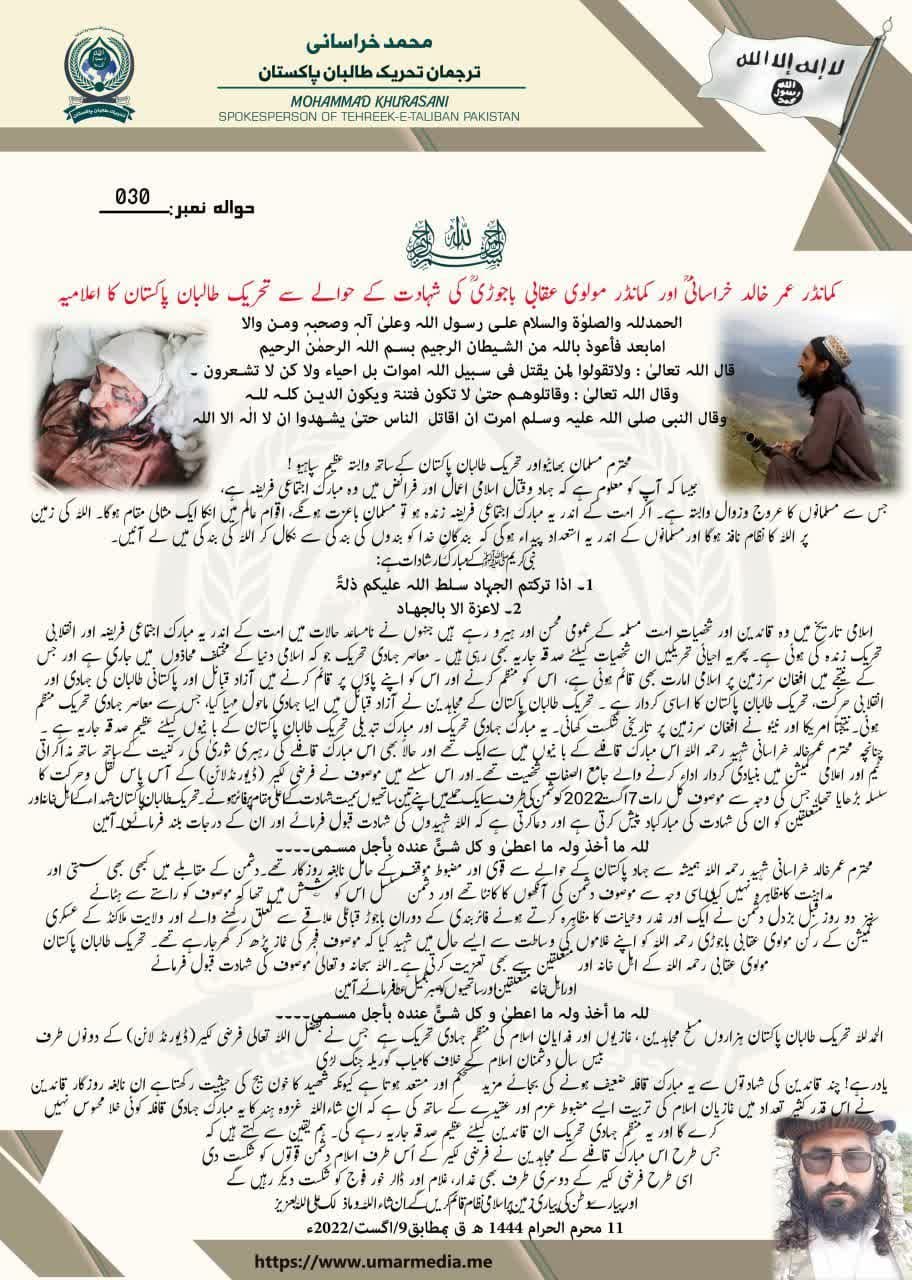
Omar Khalid Khorasani was eventually killed on August 7, 2022 in Paktika province of Afghanistan by the United States’ drones. But his group still continues its existence and apparently under the leadership of Omar Khorasani, Omar Khalid Khorasani’s personal guard who had previously split from the group and formed Hizb al-Ahrar, simultaneously and in on one day rejoined the Tehrik-i-Taliban Pakistan.
Following the killing of Omar Khalid Khorasani, the complicated relationship of Jamaat ul-Ahrar with Tehrik-i-Taliban Pakistan did not come to an end, but it even became more complicated.
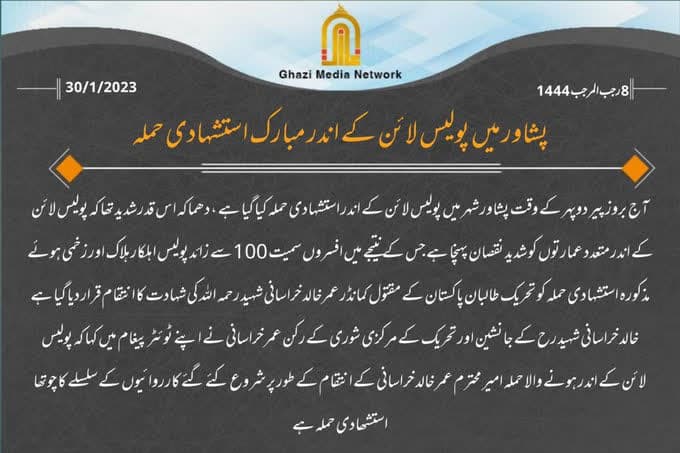
The issue became more obvious after a series of operations by Jamaat ul-Ahrar under the name of taking revenge for Omar Khalid Khorasani’s blood, at the top of the revenge incidents was Police Lines Mosque operation in Peshawar, Pakistan’s Khyber Pakhtunkhwa province, on January 30, 2023.
As a result of the suicide operation in Peshawar, a bomb exploded during prayer and at least 100 people were killed and more than 170 were injured. The Police Lines Mosque was located in the headquarters of the Pakistani security forces and residence of police officers; thus, most of worshipers and casualties of suicide attack were security forces and police staff.
Hours after the terrorist attack, Omar Khalid Khorasani’s branch took responsibility for the bomb blast through issuing a statement and they considered it in revenge for the assassination of Omar Khalid Khorasani. But Mohammad Khorasani, spokesman for the Tehrik-i-Taliban Pakistan, underlined that operations against mosques and public places are wrong.
The statement of Ghazi Media, the media arm of Jamaat-ul-Ahrar, about the operation of Police Lines Mosque in PeshawarThe statement of Mufti Noor Wali Mehsud, the leader of Tehreek-e-Taliban Pakistan, regarding the killing of Omar Khalid KhorasaniOmar Khalid Khorasani next to Shahidullah Shahid, who later becomes the second leader of ISIS Khorasan province
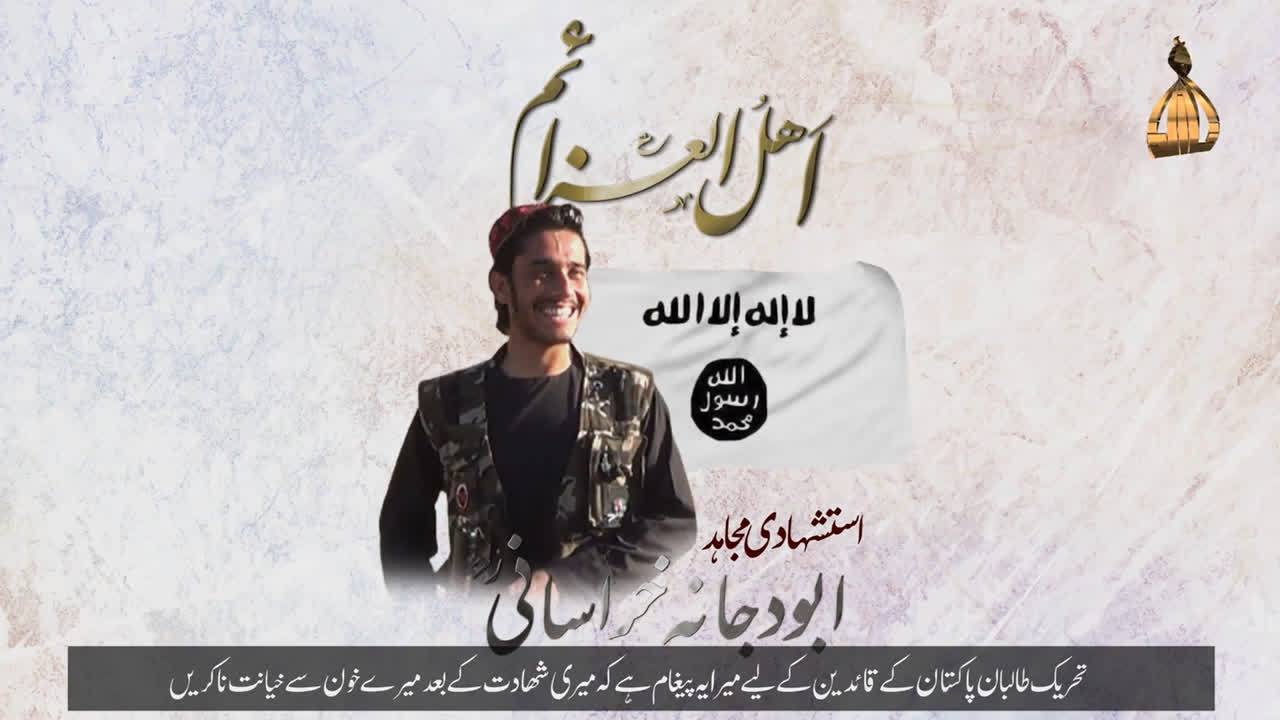
Jamaat ul-Ahrar recently released a video from its new media outlet dubbed Ghazi Media that dealt with several suicide operations and considered all of them in revenge for the assassination of Omar Khalid Khorasani. Interestingly, the Peshawar Police Line Mosque operation was not among the highlighted operations in this video. Remarkably, in the final scenes of the film, one of the suicide elements named Abu Mallal al-Hummam Khalil Muhammad al-Balawi also known as Abu Dujana al-Khorasani, who spoke before his operation in Ghazi Media outlet, sent a message to the leaders of the Tehrik-i-Taliban Pakistan not to betray the blood of martyrs.
In conclusion, it seems that complicated relationship between the Tehrik-i-Taliban Pakistan and Jamaat al-Ahrar would not end up in convergence even after killing of Omar Khalid Khorasani due to challenges facing the Tehrik-i-Taliban Pakistan in relation to Pakistani government in new circumstances on one hand and more extremist approach of Jamaat ul-Ahrar on other hand.
Ahl al-Azaim movie poster showing suicide operations in revenge for the assassination of Omar Khaled Khorasani
Author: Yasser Qazvini Haeri, ISIS and terrorism expert
ISWNews Analysis Group – The chairman of the Southern Transitional Council (STC) and a member of the presidential council of the resigned Yemeni government, said in an interview with the English newspaper The Guardian that the West should accept a new reality in which northern Yemen is run by the Houthis (Ansar Allah Movement) and the south by the Southern Transitional Council.
Al-Zoubaidi said about coming talks on Yemen that the negotiation should have answers for the new reality of Yemen, especially for southern regions. The talks are mostly under Saudi supervision, which wants to find a way out of a war that is estimated to have left more than 250,000 dead.
The STC head assured Western countries that maritime lines, ports and oil fields in southern Yemen, which are strategically important, will be safe under the STC leadership. Al-Zoubaidi went on to say that he would apply all United Nations and international rules in the southern areas. He also warned if we are not there, the Houthis who are supported by Iran, would replace that area and they would be able to control the Bab al-Mandab Strait, which is a vital waterway for international trade.
The head of the Southern Transitional Council also pledged to hold a referendum under the United Nations’ supervision and international law before the independence of the Southern region. He also announced his readiness to prepare voter lists and said he would cooperate with the International Criminal Court (ICC) to investigate war crimes.
The goal of the Southern Transitional Council is to divide current Yemen and return to the borders of southern and northern Yemen, which was in place before the 1990s. Currently, the Southern Transitional Council is competing and fighting with other factions supported by the Saudi-led coalition, especially the Reform Party, the terrorist group al-Qaeda, Vice President of the Yemeni Presidential Leadership Council Brigadier General Tariq Saleh and so on over the control of southern Yemen.
The Southern Transitional Council says they do not accept any political-religious movement, but the forces of Amaliqah, an extremist group of the residents in southern Yemen, are allied with the STC.
As a result of the improvement of Yemen peace talks, the officials of the Southern Transitional Council stepped up their efforts to achieve their demands, and therefore, Aidarus al-Zoubaidi has recently traveled to Britain to negotiate with Western states, and the result of the trip was a Chatham House meeting and interviews with prominent Western media outlets, including The Guardian newspaper.
The main supporter of the Southern Transitional Council in its path is Britain in the first place and the United Arab Emirates (UAE) in the second place. Saudi Arabia is not willing to accept the Southern Transitional Council, because it means that the Saudis imposed eight years of war against Yemen to eventually hand over control of northern and western regions to the Ansar Allah Movement and the southern regions to the Southern Transitional Council.
Thus, Saudi Arabia is trying to form the “Hadhramaut Council” to discourage the Southern Transitional Council from controlling Hadramout Governorate and balance the scene with the power of the Yemeni Congregation for Reform, frequently called al-Islah, as well as Al-Dara Al-Watan in Aden, Marib and Shabwa and in inaccessible areas of Abyan and Shabwa governorates with the use of al-Qaeda leverage.
Some Southern Transitional Council officials expect future Yemen talks may occur between the group and the Ansar Allah Movement, but so far Saudi Arabia has refused to bring any representatives from the Southern Transitional Council into the negotiating cycle, but also the resigned government has not played any role in that process.
ISWNews Analysis Group – As a result of the explosion of the homemade bomb at the location of the militants of the Jamaat-ul-Ahrar group, who are allies of the Pakistani Tehrik-i-Taliban Pakistan (TTP) in the Khogyakhil border area located in Goshta district of Nangarhar province, several militants of the JuA group, including Qari Imran Orakzai and Atif Mohmand were killed or wounded.
According to local sources, Qari Imran Orakzai’s is in critical condition, but Atef Mohmand is reported to be suffering from minor injury.
Jamaat-ul-Ahrar group is an ally and offshoot branch of the Pakistani Tehrik-i-Taliban Pakistan (TTP) that has several bases in Mohmand Dara city and Goshta districts in Nangarhar province as well as parts of Kunar province in eastern Afghanistan.
After the assassination of leader of Jamaat-ul-Ahrar Omar Khalid Khorasani, who was also one of the founding members of the Tehreek-i-Taliban Pakistan, on August 7, 2022 by the United States, another scenario was that the Tehreek-i-Taliban Pakistan might be behind his assassination.
Therefore, the possibility has been raised again for the killing of two senior commanders of Jamaat-ul-Ahrar, and some sources pointed to the Tehreek-i-Taliban Pakistan as responsible for the assassination of Qari Imran Orakzai and Atif Mohmand.
ISWNews Analysis Group – As a result of the border clash between Taliban military personnel and Pakistani border guards on June 25, at the Angur Ada border crossing between the South Waziristan of Pakistan’s Khyber Pakhtunkhwa and Afghanistan’s Paktika Province, six Taliban forces, including intelligence commander of the Taliban’s 203 Mansoori Corps Qari Sibghatullah Takal as well as five Pakistani soldiers were killed and injured.
This is the twelfth border clash between the Taliban and Pakistani border forces since the group came to power in Afghanistan.
The last confrontation between Taliban military staff and Pakistani border guards occurred on February 20, 2023 at the Torkham border crossing located in Mohmand Dara district in Nangarhar province, where a Pakistani soldier was injured; then, trade activities at the crossing were suspended by Pakistan for several days.
Every time following such incidents the Taliban officials pledge to observe international border laws and sack rogue military commanders, but they have not yet been successful in completely preventing such provocations by their border commanders.
Angur Ada crossing and the direction of the border conflict between the Taliban and the Pakistan Border GuardsQari Sibghatullah Takal, intelligence commander of Taliban’s 203 Mansoori Corps