Saudi Arabia started the aggression on Yemen since 2015 under title of “Operation Decisive Storm”. The operation is continuing under “Operation Restoring Hope” with a coalition of Arabic countries.
But the results of the war did not turn out as Saudi Arabia predicted!
Most see!
Download
Blog
-

Video: How Many Saudi coalition aircraft were shot down in Yemen?
-

Opinion: Kuala Lumpur Summit; A New Approach to Islamic World
Mahathir Mohamad, Malaysian PM said regarding this:
– Islamic countries in this summit will form a new platform that can solve issues of Muslims in the world. Organization of Islamic Cooperation has failed to solve Muslims issues.
– This summit will be a strong organization in future and will be more effective than OIC.
Mahathir’s important words made Saudi Arabia and states of Persian Gulf very worried. Warm answer and presence of leaders of Iran, Turkey, Qatar and Pakistan in this summit made Saudi worried so much that Imran Khan cancelled his presence in the summit due to demand of Bin Salman and his FM will go instead.
Mahathir Mohamad’s innovations include bringing up the main issues of Islamic World such as war in Yemen, Uyghur Muslims in Xinjiang, China and Kashmir.
Mahathir Mohamad has already condemned Saudis stances in Yemen war, having friendly relationship with Israel and Jamal Khashoggi murder.
In addition to Saudi Arabia, USA, China and India are not happy with Kuala Lumpur Summit either. USA does not like an Islamic coalition without Saudi’s control and China and India do not tolerate such movements due to severe oppression they do to Muslims of those countries.
It seems Mahathir Mohamad is trying to expand its political power in Islamic World after a relatively stable economy and probably will be successful. This can be a model for other Islamic countries if there is any close relationship though. -

Pervez Musharraf’s death sentence confirmed
On Tuesday, the Islamabad special court sentenced the former prime minister to death on charges of treason against the country.
Pervez Musharraf who had overthrown Nawaz Sharif government, the former Pakistani Prime Minister in a military coup in 1999, is now found guilty in a Pakistani court. The court convicted him and sentenced him to death for suspending the country’s constitution and violating the country law on November 3, 2007.
This is the first time in Pakistan history that a former military ruler faces the charge of “great treason against the country” and sentenced to death. -

The Imminent Withdrawal of US Troops from Afghanistan
US Secretary of Defense Mark Esper at a news conference Monday said that we might reduce the number of US troops without a peace deal to give higher priority to strategic competition with China.
NATO and US forces commander in Afghanistan Austin S. Miller have also made similar remarks.
Apparently, after resuming talks with the Taliban yesterday, the US officials decided to announce the 4000 troops’ withdrawal plan next week.
A US senator has also said that Trump will announce this decision soon. -

Fayez al-Sarraj re-visits Erdogan
According to Libyan sources, the focus of the talks between Sarraj and Erdogan was the deployment of Turkish troops in Libya.
Regarding this, Erdogan said:
– The process that Haftar(LNA commander) started is illegal.
– Turkey is ready to provide any military support needed by the Libyan government and we will do what is necessary if we receive an official invitation.
– A cooperation agreement with Libya certainly comes into action after the Turkish parliament approval.
P.S. Sarraj appears to be on the edge of success in persuading Erdogan to gain Turkish military support against the attacks of General Hafar’s army. Turkish military support depends on financial support from Qatar, and Sarraj met and consulted with Qatari officials in Doha before this trip to Turkey. -

Saudis to partner with Deir ez-Zur oil
According to local sources in Deir ez-Zur, a team of experts from Aramco has visited Al-Omar oil and gas fields in the northern part of Deir ez-Zur province.
It is said that in the coming days the US and Aramco will sign contracts for these oil resources. -

Eventually, Nizam Al-Din Qaysari escaped
The case begins when Qaysari, who is a close friend of General Dostum, entered Mazar-i-Sharif after his abrupt release from the custody of Ashraf Ghani’s government. He gathered Turkmens for a speech and demanded the rights of the Turkmen in Balkh province which is being violated. He also criticized General Dostum and the government.
Ghani’s government, in co-operation with the forces affiliated with Atta Muhammad Nur took action against him and issued a warrant to arrest him. But Qaysari resisted the arrest warrant by distributing weapons to his fellows this time. Last night, after two hours of heavy clashes, four of his men were killed and four others were wounded, and Qaysari himself escaped.
Some news sources quoted from a telephone call to Qaysari as saying he is still in Mazar-i-Sharif, and some others quoted Islamic Movement Party (owned by General Dostum) officials as saying that he had returned to Sheberghan and General Dostum. -
Breaking: ISIS Attacking South of Mosul
Engagements are continuing in the area and 15 ISIS militants are besieged by Hashad forces.
-

Indian Muslims Protesting Against the Government
Indian police attacking protesting students of Jamia Millia Islamic university arrested and wounded some students and desecrated the mosque of the university.
The protests started in other provinces such as Uttar Pradesh, Mumbai and Bengaluru.
Some of actors and directors of Bollywood also showed support for students and protesters and blamed police violence.
Other Indian Muslims also started to condemn police and government and solidarity with students using #WeStandWithAMU hashtag.
The bill proposed by the government, which was passed in both Senate and Parliament, enables non Muslim immigrants of Afghanistan, Bangladesh and Pakistan who came before 2015 to get citizenship.
Narendra Modi administration called the bill correct and should be implemented. -

Iraq: ISIS attacks to PMU bases near Iran’s border
Also ISIS terrorists attacked the Iraqi Army forces in al-Anbar province.
-
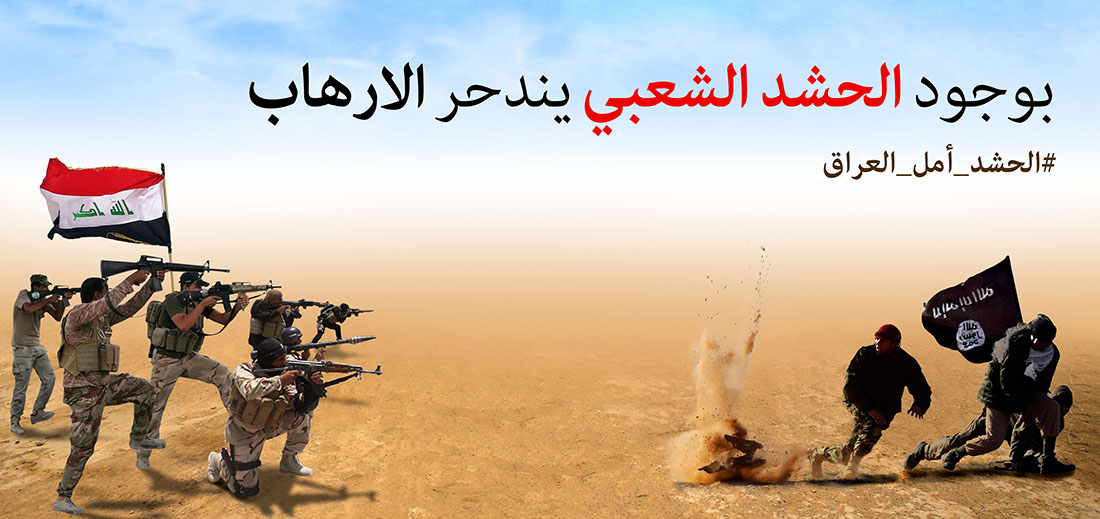
Article: The scenario of the Popular Mobilization Forces (Al-Hashd Ash-Sha’bi) extirpating, Part 1
Why do they want to extirpate the Popular Mobilization Forces?
From the very beginning of the formation of the Popular Mobilization Forces until now, especially after the defeat of the ISIS terrorist forces, there have been numerous overt and covert attempts to dissolve and remove the Popular Mobilization Forces organization in Iraq. These efforts are being pursued by the United States, Saudi Arabia, the Zionist regime, and some political spectrums and groups inside Iraq, that there are numerous cases and varied instances to prove it.
For example, Zionist drone strikes in recent months on Popular Mobilization Forces headquarters or the US condition for extension of Iraq exemption from Iran sanctions in exchange for the Popular Mobilization Forces disarmament can be mentioned. More recently, the U.S. Department of the Treasury imposed sanctions on four Iraqis on the pretext of human rights abuses whom three of them are the Popular Mobilization Forces leaders. [1] This note explains why there are some efforts to extirpate the Popular Mobilization Forces of Iraq.
– Forming out of conventional processes
The Popular Mobilization Forces in Iraq’s first and only military and defense entity that has been formed independent of existing processes such as political spectrums agreements, collusion and economic corruption or targeted US programs in Iraq. Although the militant groups under the Popular Mobilization Forces leadership are attributable to some Iraqi religious and political leaders, the ruling spirit of the Popular Mobilization Forces is completely independent of the conventional divisions in the country. This structure poses a serious threat to the United States, which is the main designer and beneficiary of current systems and structures in Iraq.
– Massive and widespread social support
Almost all provinces and regions of Iraq, including the Sunni areas, have been involved in the formation of the Popular Mobilization Forces. However, the role and contribution of Iraqi Shia have been far more effective than others. However, they can be considered as the only organization in Iraq, which has a pervasive range of members from most of Iraq cities. On the other hand, having representatives and recruitment offices in different areas of Iraq is also a strength of the organization. This has led some political parties, such as the Sadrist Movement, to consider the Popular Mobilization Forces as their serious competitor to draw public support.
– The ideological and uniting foundation
The Popular Mobilization Forces are the only institution that has not been formed under a political, religious, or tribal process. Rather, it is at the heart of the national-religious beliefs that have brought together various groups and provided the basis for the unity and unity of different groups. The multiplicity of religious and political spectrums in Iraq has caused the country to continue to face political and internal strife, so the United States and its favorable countries continuing to take advantage of this characteristic of Iraqi society. By founding the Popular Mobilization Forces, a new trend emerged, unlike previous practices that naturally had many dissenters.
– The reason for confidence in Iraqi society
Following ISIS’s entry into Iraq and the continuous defeats of the Iraqi army, an atmosphere of frustration and lack of self-esteem prevailed in Iraqi society, and the general public sought a way to make up for those failures. Most of the Iraqi youth who were highly motivated to compensate for their defeats voluntarily participated in the formation of various Popular Mobilization Forces groups, with the mandate of the Jihad of the Iraqi Marja’iyyat to confront ISIS. This has made the Popular Mobilization Forces a symbol of the Iraqi national self-confidence. Even in recent protests, the experience of victory over ISIS has given Iraqi youth confidence to fight economic and political problems. Having national self-confidence in Iraqi society means moving towards independence and relying on the power of its youth, which will lead to the formation of a powerful nation. However, a strong and independent Iraq conflicts with the interests of the US and Saudi Arabia. The US is already in the country under the pretext of the lack of security. Saudi Arabia, on the other hand, sees Iraq as its longtime rival in the leadership of the Arab states.
– Affiliation to reputation and position of Marja’iyyat
Given the effective role of the reputation and position of Marja’iyyat in the formation of Popular Mobilization Forces, the power and strength of the Popular Mobilization Forces mean the power and strength of Marja’iyyat in Iraq. It is clear that countries such as the United States and Saudi Arabia will never agree with strengthening the Shia Marja’iyyat in Iraq, and they see their interests threatened. On the other hand, some political movements that have long opposed the strengthening of Shia Marja’iyyat in Iraq will also oppose maintaining and strengthening the Popular Mobilization Forces’ power. The Sadr Movement, which has always tried to discredit Iraq’s current Marja’iyyat under the pretext of Arab and non-Arab Marja’iyyat, is also seeking the dissolution of the Popular Mobilization Forces.
– Security and military competition with the US
During the fight against ISIS, Popular Mobilization Forces, besides the gaining experiences in the intelligence and security, they succeeded in proper structuring in these parts as well. Before the recent protests, for example, the Popular Mobilization Forces intelligence units have identified and foiled various conspiracies, most notably the plot of some of the country’s top military commanders. On the other hand, one of the major bottlenecks the US has taken in the form of private and public companies in Iraq is the security and intelligence sectors. Like the highway and international airport security companies. According to the power and strength of Popular Mobilization Forces, it can be counted as a potential rival to take over the control form the US sectors.
– Capability to build and rebuild infrastructure
The experience of the Popular Mobilization Forces in the construction sector has been greatly increased over the years, and besides having the right equipment, their concern and approach have always been to rebuild and restore destroyed areas during the war. This capacity makes it possible to complete some infrastructure projects, far from political and economic collusion, if the government is well established and policy-driven. Naturally, Iraq’s move toward civilization and reconstruction, this means moving towards a sovereign, independent state that is against the interests of the United States and its favored countries.
– The capacity to attract and rely on youth
Perhaps the most important feature of the Popular Mobilization Forces that has led to many plots against it is its high capacity to attract Iraqi youth. Bringing Iraqi youth together through lofty goals means building the nation’s next generation with the aspiration to fight any aggression and oppression. The youthfulness traits also make Iraqi youths motivated spirituality to spread into society and become the dominant discourse.
Other cases can be cited as reasons for some attempts to dissolve the Popular Mobilization Forces, such as the ideological link with the Islamic Republic of Iran or the existence of some senior commanders in there who have a close relationship with Iran. However, the main goal of this note is to allude the reasons which are the inside of Iraqi society, and the key factors are within Iraq itself.
[1] In the second part, these cases and examples will be described in detail. -

Yemen: Tariq Saleh Rewarding Sudanese Commander
“The forces are returning to Sudan and to appreciate their participation in confronting Iran and it’s allies (i.e. Ansar Allah), the medal is rewarded to their commander”, Saleh twitted.
P.S. Sudanese participation in Yemen has two main points:
1. 5,000 casualties confronting Ansar Allah.
2. Looting and assault of Sudanese in Mocha and Khukhah.
For which of them did Saleh rewarded them?!