Blog

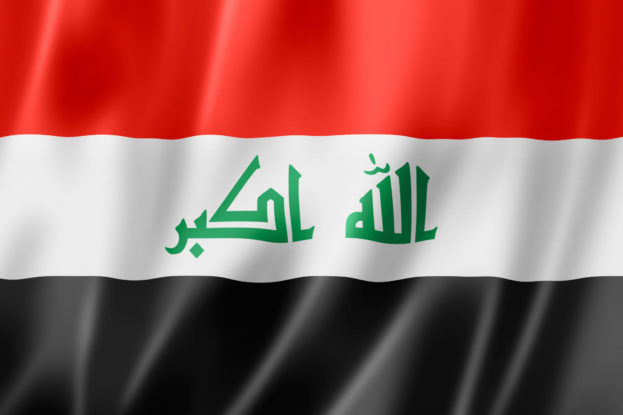
  • Headline of Latest Updates on Iraq in Past Week, 9 February 2019

    Headline of Latest Updates on Iraq in Past Week, 9 February 2019

    – Improvement of Iraq-Iqlim relationship.
    In recent trips and also the most recent visit, Nechirvan Barzani Prime Minister of Iqlim visited Adil Abdul-Mahdi more news of agreement were released.

    They reached agreement to remove customs between them, using local employees at Iqlim borders under observation of central government.
    According to unofficial news, two sides agreed that disputed lands such as Sanjar and Makhmour that Iraqi forces claimed followed by Peshmerga forces retreat to return to them and will be controlled jointly.


    – 132 days after local vote in Iqlim and a lot of tensions, there are news that two major parties (Democratic Party of Iranian Kurdistan and Patriotic Union of Kurdistan) reached an agreement on how to divide positions.

    One important content of the agreement is to reactivate the leadership position of Iqlim, which was suspended last year by parliament after Masoud Barzani resigned.
    Masoud Barzani assigned his own son, Masrour as prime minister and his nephew Nechirvan Barzani as the leader of Iqlim.


    – Local officials of Iqlim participating the ceremony of celebrating the fortieth commemorate of Islamic Republic of Iran at Iran’s consulate in Irbil, which shows the improvement in their relationship.


    – Political and religious personages reacting to Trump’s words regarding US is using its bases in Iraq to survey over Iran and its allies in the region.
    Grand Ayatollah Sistani emphasis that Iraq should not be a mean to oppress and harass neighbors.


    – Mahdi Sumaidaie, Iraqi Sunni Scholar in an interview with Al-Quds Al-Arabi papers, condemning Arab countries’ treachery when USA attacked Iraq, emphasized he is in accordance with Shiite Scholar of Iraq.
    This Scholar calling Iran “World’s Glory” because they are “Islamic Republic”.


    – Clearing operation in northwest of Mosul, west of Anbar and some other areas by joint forces.


    – Artillery attacking ISIS positions in Baghuz area, east of Syria by joint forces of Iraq, specially Hashad Sha’abi with 50 shells.


    – Different Iraqi parties including Fath and Saerun trying to pass a law to reject American soldiers from Iraq.


    – Border passage of Taribil between Iraq and Jordan reopening in presence of Al-Quds Al-Arab, Iraqi Prime Minister and the Jordanian counterpart and agreeing on transporting oil from Kirkuk to Jordan.


    – Spain King visiting Iraq and the pilot of career airplane used the previous flag of Iraq (Baath party flag) by “mistake”.


    – “Tahseen Said Ali Bek”, leader of Yazidis death. He was buried in Iqlim.

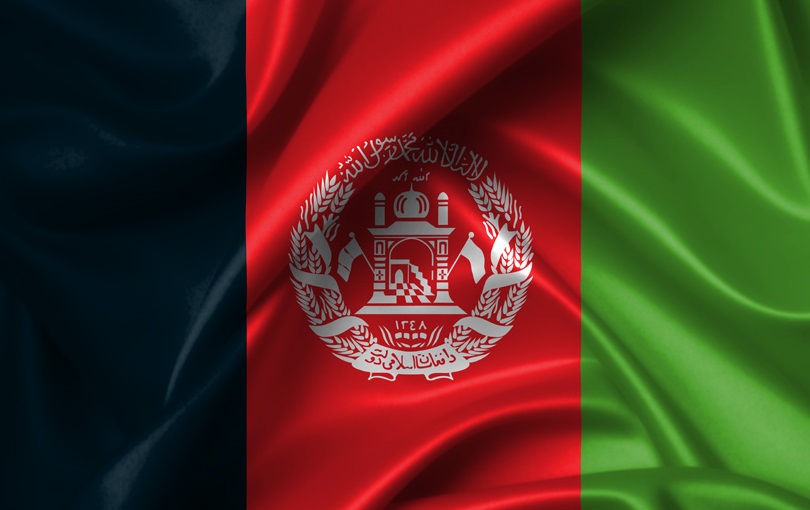
  • Latest Updates on Afghanistan, 9 February 2019; End of Moscow Summit

    Latest Updates on Afghanistan, 9 February 2019; End of Moscow Summit

    1. Samangan:
    Ten civilians martyred and eight wounded due to Taliban attacking Goula village, Darre Souf town south of Samangan.

    The engagement happened because Taliban were collecting tax and tributes.

    Seven Taliban members were killed too.


    2. Taliban’s requests in Moscow Summit:
    – Removing Taliban members from black list.
    – Releasing captives.
    – Specific roadmap for peace.
    – Reforming constitutional laws.
    – Guarantee for peace talks.
    – Islamic administration.
    – Foreign soldiers leaving Afghanistan.


    3. Transportation of ISIS terrorists to Afghanistan
    Mr. Rahim Safavi, Supreme Leader’s Counselor said: “We have accurate information that Americans are transporting ISIS terrorists into Afghanistan.”


    4. Zalmay Khalilzad, US Emissary in Afghanistan Affairs:
    There is no timetable for US soldiers leaving Afghanistan. The draft of agreement with Taliban includes mechanism of US troops leaving Afghanistan, ceasefire and expelling international terrorist groups from Afghanistan.


    5. Sare Pol:
    Martyrdom and injury of 13 Afghan security forces due to Taliban attack to a police station center of Sare Pol.

  • Ansar Allah Attacking Saudi Forces, North of Khobah

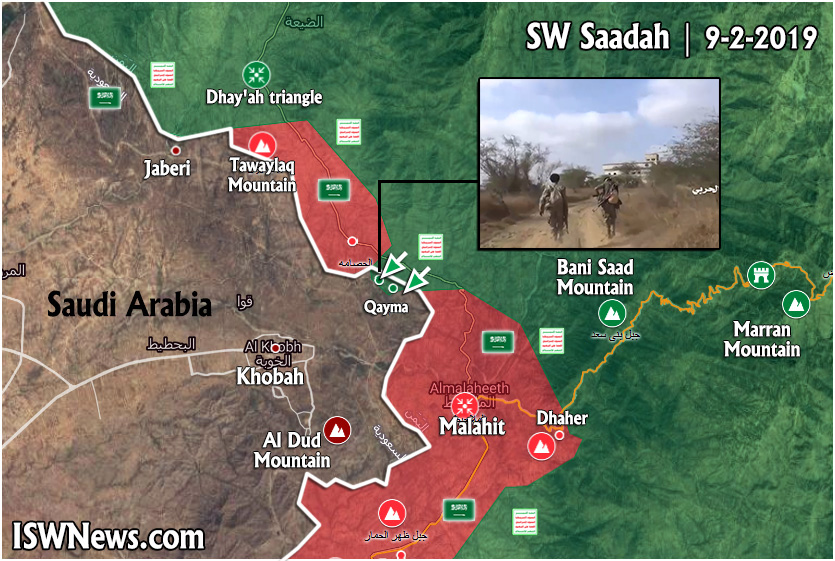
    Ansar Allah Attacking Saudi Forces, North of Khobah

    Due to terrain of the area, the attacks are usually in the form of hit-and-run.


    In recent days, AnsarAllah and Popular Committees have intensified their attacks against Saudi Coalition in southwest of Saadah province and north of Hajjah province.

  • Ansar Allah Advancing in Hajjah Province + North of Haradh Map, 9 February 2019

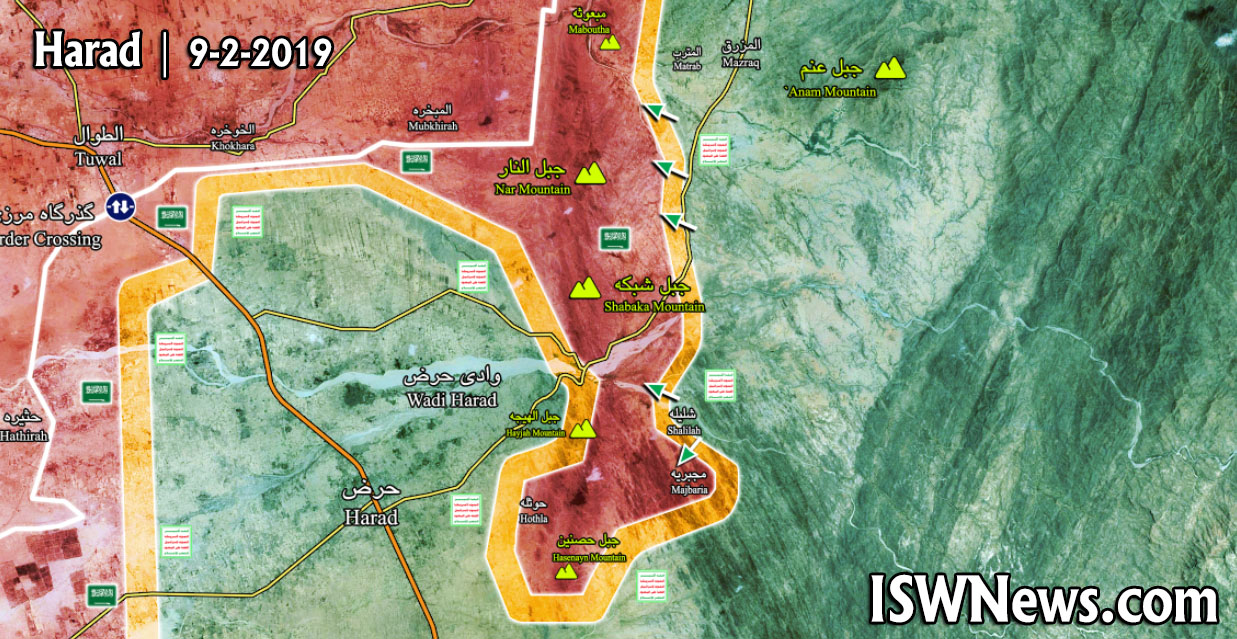
    Ansar Allah Advancing in Hajjah Province + North of Haradh Map, 9 February 2019

    During the operation, Shalilah village, Khazan height, Hamra height and Rami heights and Al Soud mountains were reclaimed.

    Interactive map

    Click to see the full size map

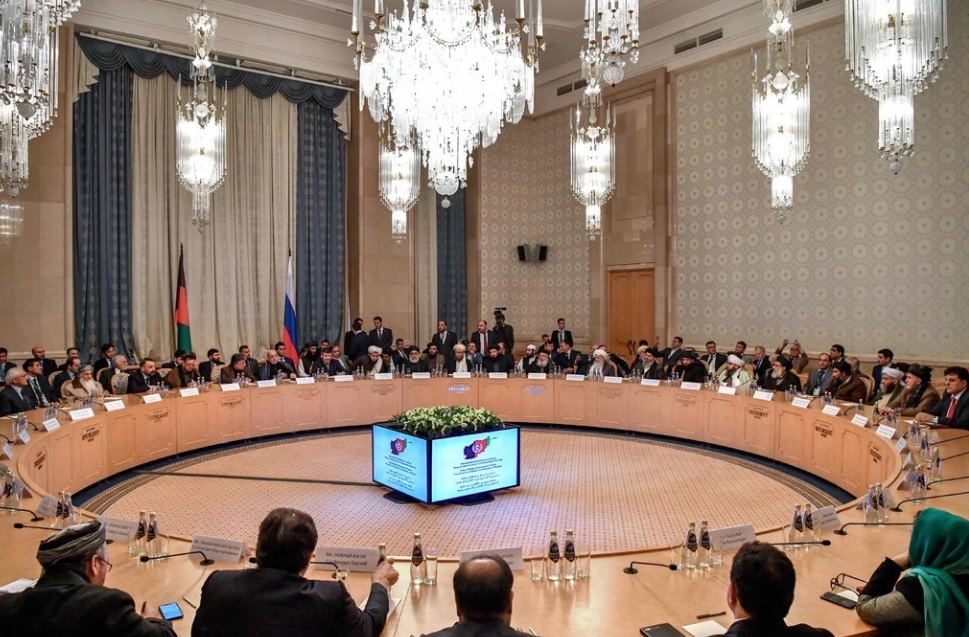
  • Joint Statement by Afghan Political Leaders and Taliban Representatives at the Moscow Summit

    Joint Statement by Afghan Political Leaders and Taliban Representatives at the Moscow Summit

    1- All parties in this conference have agreed that a dignified and lasting peace is the aspiration of all the people of Afghanistan and this principle has been achieved in Moscow.

    2- All parties agreed that in view of the current sensitive situation, the intra-Afghan dialogue must continue on regular basis.

    3- All parties agreed to support the ongoing talks in Qatar and consider these talks a positive step towards ending the imposed war on Afghanistan.

    4- All parties have agreed that systematic reforms be put in place in all national institutions including the security sector after a peace deal is signed

    5- All parties agreed that the cooperation of regional countries and major countries are essential to determine lasting and nationwide peace in Afghanistan

    6- All parties agreed that the values such as respect for the principles of Islam in all parts of the system, the principle that Afghanistan is a common home to all Afghans, support to a powerful centralize government with all Afghan ethnicities having a role it it, protecting national sovereignty and promoting social justice, to keep Afghanistan neutral in all regional and international conflicts, protecting Afghanistan’s national and religious values and undertaking a unified and single policy.

    7- All parties agreed that to determine lasting peace in Afghanistan, the following points are important : the complete withdrawal of foreign forces from the country, asking all countries to avoid interfering in Afghanistan’s internal affairs, providing assurance to the international community that Afghanistan will not be used against any other nation, protection of social, economic, political and educational rights of the Afghan women in line with Islamic principles, protection of political and social rights of the entire people of Afghanistan and protection of freedom of speech in line with Islamic principles, undertaking efforts for attracting international assistance for the reconstruction of Afghanistan’s infrastructure.

    8- All parties agreed that in order to create the atmosphere of trust and promote peace, in the first step, it is important that these items are taken into consideration, tackling the issue of all those inmates who are old, or suffering uncurable diseases or have completed their prison sentences and the removal of leaders of the Taliban from the UN blacklist, opening of an official political office in Qatar for acceleration of peace talks.

    9- All parties agreed that the next intra-Afghan meeting to be held in Doha, Qatar as soon as possible. Agreement was also made to work further on some other important issues related to the peace process in Afghanistan.


    It should be noted that the Afghan government did not participate due to the persistent refusal by the Taliban to engage in dialogue with government.

  • Libyan National Army Advances Reclaiming Al Shararah Oilfield, 8 February 2019

    Libyan National Army Advances Reclaiming Al Shararah Oilfield, 8 February 2019

    In the last week, Um al Aranib and Ghaduwwah regions and Al Wigh airbase were also claimed by Libyan Army.


    It is noteworthy that Libyan Army started a vast operation twenty days ago to clear southern part of Libya from domestic and foreign militants.

  • Are Syrian S-300 Operational?

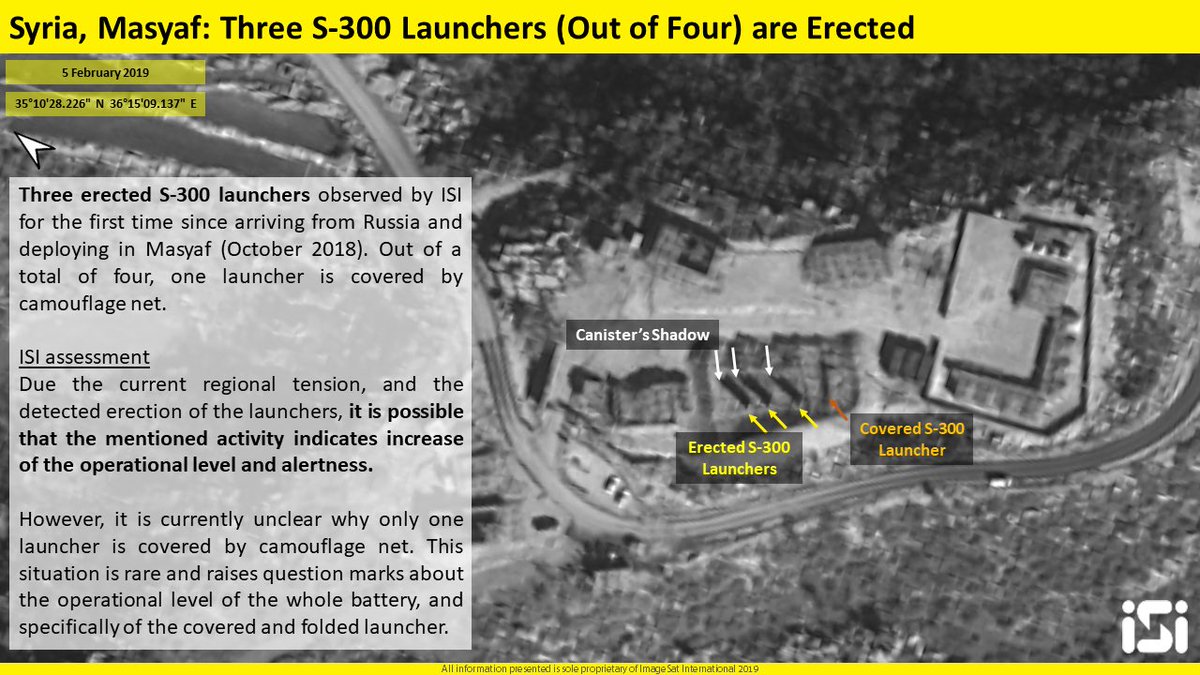
    Are Syrian S-300 Operational?

    In this image three launcher out of available four are on standby.

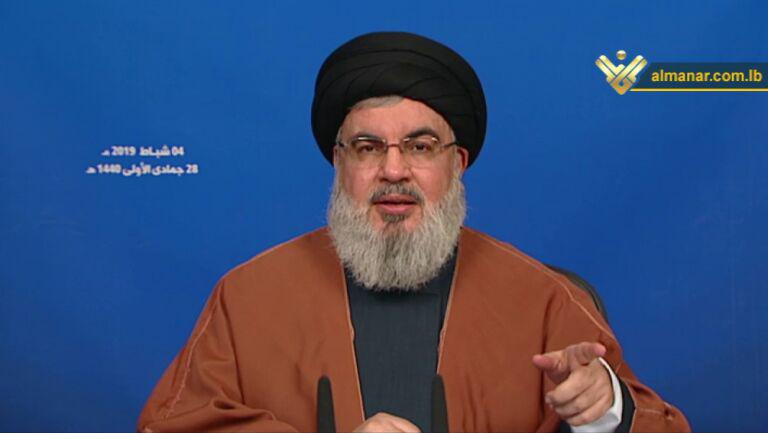
  • Hezbollah Secretary General Speech on the 40th Anniversary of Iran’s Islamic Revolution

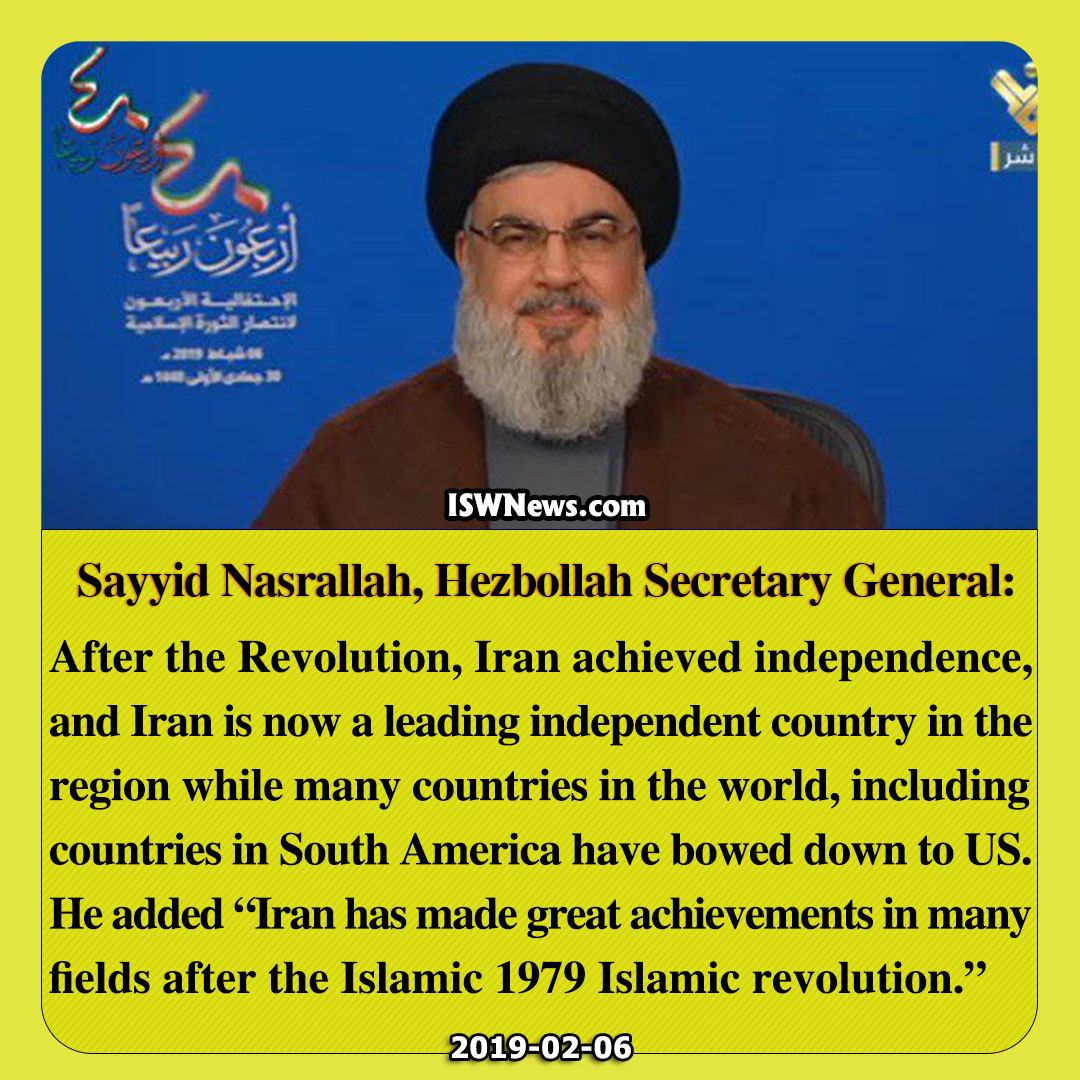
    Hezbollah Secretary General Speech on the 40th Anniversary of Iran’s Islamic Revolution

    He added “Iran has made great achievements in many fields after the Islamic 1979 Islamic revolution, and recounted that achievements Iran has made after the revolution.”

  • Latest ISIS Situation in Eastern Euphrates 6 Feb 2019

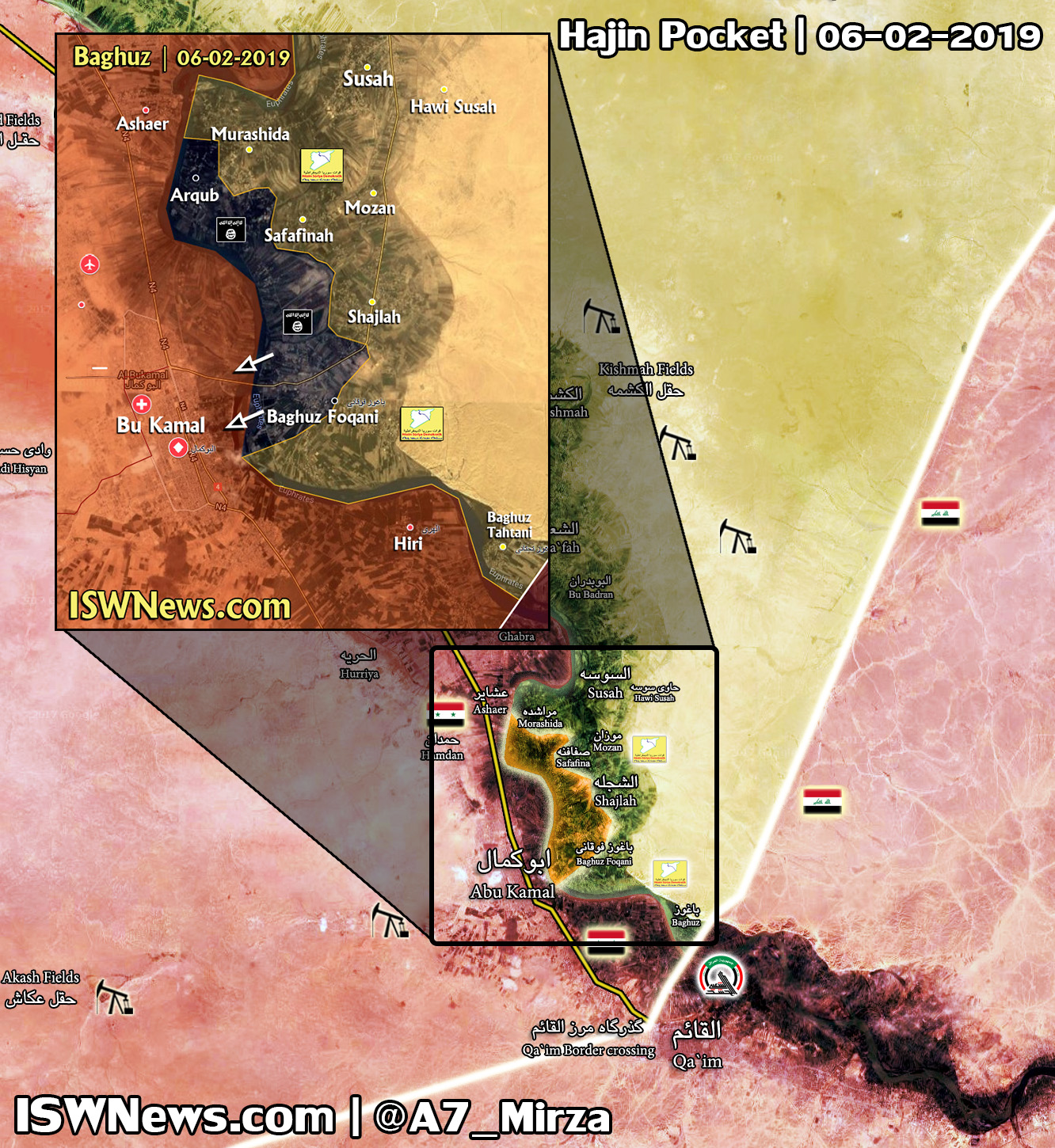
    Latest ISIS Situation in Eastern Euphrates 6 Feb 2019

    During the last few days, ISIS terrorists for several times rushed to Al Bu Kamal to pass the regions and reach Syria’s deserts.
    Last night ISIS terrorists attacked Al Bukamal from Baghuz Foqani direction and engagements lasted until morning; Russian fighters to help repel the attacks, bombed ISIS in Baghuz.


    At the moment ISIS terrorists are under siege by SDF in a small area in Baghuz Foqani and around Al Murashidah.
    It is noteworthy that a few days ago, ISIS by using underground tunnels could reach Iraq’s border but faced firm resistance by Iraqis and had to retreat.

    Click to see the full size map


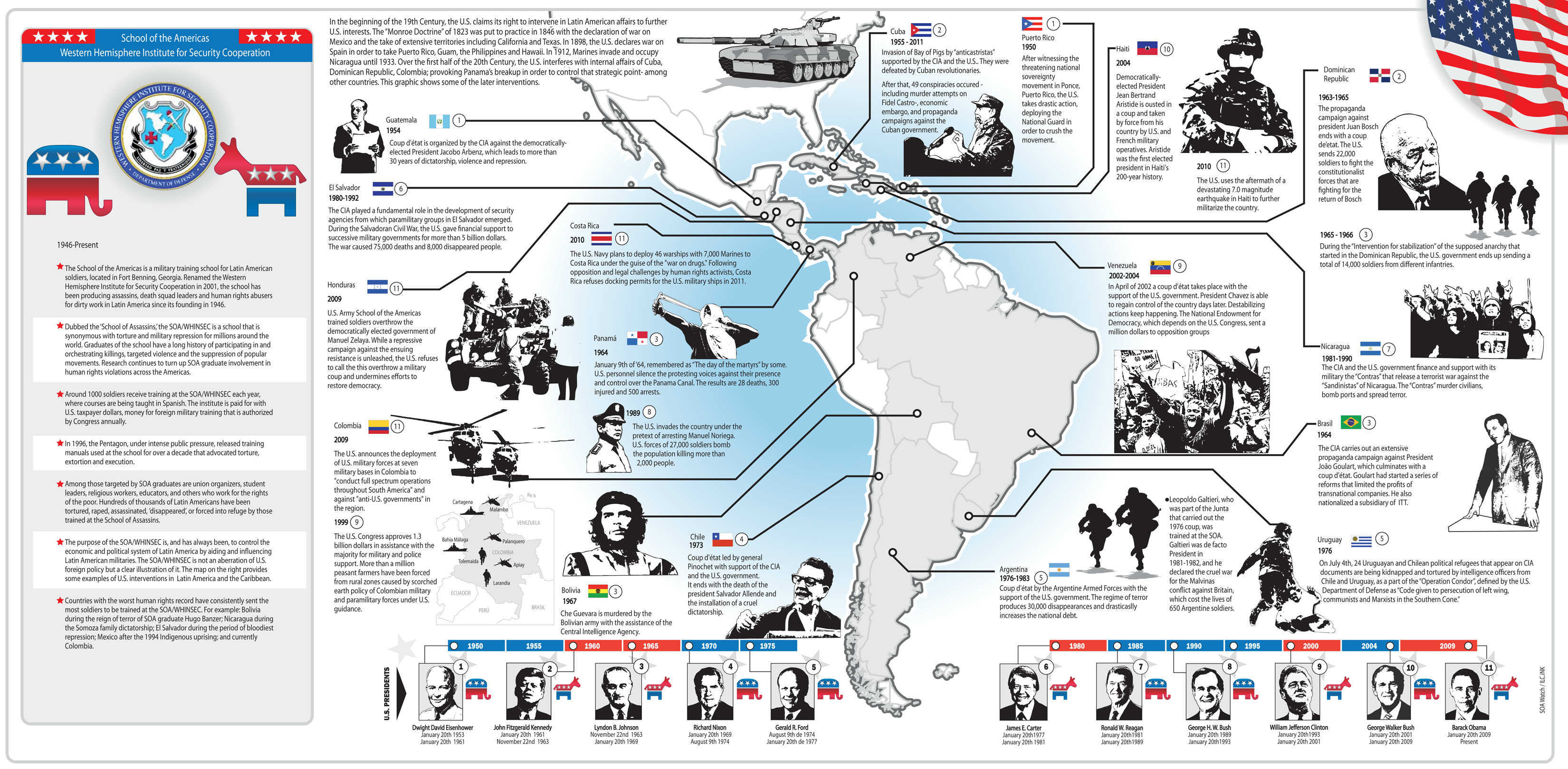
  • History of U.S. Interventions in Latin America; Review

    History of U.S. Interventions in Latin America; Review

    Key:
     Military incursions
     Covert or indirect operations
    ! Other events of note


     1846:
    The U.S., fulfilling the doctrine of Manifest Destiny, goes to war with Mexico and ends up with a third of Mexico’s territory.
     1850, 1853, 1854, 1857:
    U.S. interventions in Nicaragua.
     1855:
    Tennessee adventurer William Walker and his mercenaries take over Nicaragua, institute forced labor, and legalize slavery.

    “Los yankis… have burst their way like a fertilizing torrent through the barriers of barbarism.” –N.Y. Daily News

    He’s ousted two years later by a Central American coalition largely inspired by Cornelius Vanderbilt, whose trade Walker was infringing.

    “The enemies of American civilization– for such are the enemies of slavery– seem to be more on the alert than its friends.” –William Walker


     1856:
    First of five U.S. interventions in Panama to protect the Atlantic-Pacific railroad from Panamanian nationalists.
     1898:
    U.S. declares war on Spain, blaming it for destruction of the Maine. (In 1976, a U.S. Navy commission will conclude that the explosion was probably an accident.) The war enables the U.S. to occupy Cuba, Puerto Rico, Guam, and the Philippines.
     1903:
    The Platt Amendment inserted into the Cuban constitution grants the U.S. the right to intervene when it sees fit.
     1903:
    When negotiations with Colombia break down, the U.S. sends ten warships to back a rebellion in Panama in order to acquire the land for the Panama Canal. The Frenchman Philippe Bunau-Varilla negotiates the Canal Treaty and writes Panama’s constitution.
     1904:
    U.S. sends customs agents to take over finances of the Dominican Republic to assure payment of its external debt.
     1905:
    U.S. Marines help Mexican dictator Porfirio Díaz crush a strike in Sonora.
     1905:
    U.S. troops land in Honduras for the first of 5 times in next 20 years.
     1906:
    Marines occupy Cuba for two years in order to prevent a civil war.
     1907:
    Marines intervene in Honduras to settle a war with Nicaragua.
     1908:
    U.S. troops intervene in Panama for first of 4 times in next decade.
     1909:
    Liberal President José Santos Zelaya of Nicaragua proposes that American mining and banana companies pay taxes; he has also appropriated church lands and legalized divorce, done business with European firms, and executed two Americans for participating in a rebellion. Forced to resign through U.S. pressure. The new president, Adolfo Díaz, is the former treasurer of an American mining company.
     1910:
    U.S. Marines occupy Nicaragua to help support the Díaz regime.
     1911:
    The Liberal regime of Miguel Dávila in Honduras has irked the State Department by being too friendly with Zelaya and by getting into debt with Britain. He is overthrown by former president Manuel Bonilla, aided by American banana tycoon Sam Zemurray and American mercenary Lee Christmas, who becomes commander-in-chief of the Honduran army.
     1912:
    U.S. Marines intervene in Cuba to put down a rebellion of sugar workers.
     1912:
    Nicaragua occupied again by the U.S., to shore up the inept Díaz government. An election is called to resolve the crisis: there are 4000 eligible voters, and one candidate, Díaz. The U.S. maintains troops and advisors in the country until 1925.
     1914:
    U.S. bombs and then occupies Vera Cruz, in a conflict arising out of a dispute with Mexico‘s new government. President Victoriano Huerta resigns.
     1915:
    U.S. Marines occupy Haiti to restore order, and establish a protectorate which lasts till 1934. The president of Haiti is barred from the U.S. Officers’ Club in Port-au-Prince, because he is black.

    “Think of it– niggers speaking French!” –secretary of State William Jennings Bryan, briefed on the Haitian situation

     1916:
    Marines occupy the Dominican Republic, staying till 1924.
    ! 1916:
    Pancho Villa, in the sole act of Latin American aggression against the U.S, raids the city of Columbus, New Mexico, killing 17 Americans.

    “Am sure Villa’s attacks are made in Germany.” –James Gerard, U.S. ambassador to Berlin

     1917:
    U.S. troops enter Mexico to pursue Pancho Villa. They can’t catch him.
     1917:
    Marines intervene again in Cuba, to guarantee sugar exports during WWI.
     1918:
    U.S. Marines occupy Panamanian province of Chiriqui for two years to maintain public order.
     1921:
    President Coolidge strongly suggests the overthrow of Guatemalan President Carlos Herrera, in the interests of United Fruit. The Guatemalans comply.
     1925:
    U.S. Army troops occupy Panama City to break a rent strike and keep order.
     1926:
    Marines, out of Nicaragua for less than a year, occupy the country again, to settle a volatile political situation. Secretary of State Kellogg describes a “Nicaraguan-Mexican-Soviet” conspiracy to inspire a “Mexican-Bolshevist hegemony” within striking distance of the Canal.

    “That intervention is not now, never was, and never will be a set policy of the United States is one of the most important facts President-elect Hoover has made clear.” —NYT, 1928

     1929:
    U.S. establishes a military academy in Nicaragua to train a National Guard as the country’s army. Similar forces are trained in Haiti and the Dominican Republic.

    “There is no room for any outside influence other than ours in this region. We could not tolerate such a thing without incurring grave risks… Until now Central America has always understood that governments which we recognize and support stay in power, while those which we do not recognize and support fall. Nicaragua has become a test case. It is difficult to see how we can afford to be defeated.” –Undersecretary of State Robert Olds

     1930:
    Rafael Leonidas Trujillo emerges from the U.S.-trained National Guard to become dictator of the Dominican Republic.
     1932:
    The U.S. rushes warships to El Salvador in response to a communist-led uprising. President Martínez, however, prefers to put down the rebellion with his own forces, killing over 8000 people (the rebels had killed about 100).
    ! 1933:
    President Roosevelt announces the Good Neighbor policy.
     1933:
    Marines finally leave Nicaragua, unable to suppress the guerrilla warfare of General Augusto César Sandino. Anastasio Somoza García becomes the first Nicaraguan commander of the National Guard.

    “The Nicaraguans are better fighters than the Haitians, being of Indian blood, and as warriors similar to the aborigines who resisted the advance of civilization in this country.” –NYT correspondent Harold Denny

     1933:
    Roosevelt sends warships to Cuba to intimidate Gerardo Machado y Morales, who is massacring the people to put down nationwide strikes and riots. Machado resigns. The first provisional government lasts only 17 days; the second Roosevelt finds too left-wing and refuses to recognize. A pro-Machado counter-coup is put down by Fulgencio Batista, who with Roosevelt’s blessing becomes Cuba’s new strongman.
    ! 1934:
    Platt Amendment repealed.
     1934:
    Sandino assassinated by agents of Somoza, with U.S. approval. Somoza assumes the presidency of Nicaragua two years later. To block his ascent, Secretary of State Cordell Hull explains, would be to intervene in the internal affairs of Nicaragua.
    ! 1936:
    U.S. relinquishes rights to unilateral intervention in Panama.
     1941:
    Ricardo Adolfo de la Guardia deposes Panamanian president Arias in a military coup– first clearing it with the U.S. Ambassador.

    It was “a great relief to us, because Arias had been very troublesome and very pro-Nazi.” –Secretary of War Henry Stimson

     1943:
    The editor of the Honduran opposition paper El Cronista is summoned to the U.S. embassy and told that criticism of the dictator Tiburcio Carías Andino is damaging to the war effort. Shortly afterward, the paper is shut down by the government.
     1944:
    The dictator Maximiliano Hernández Martínez of El Salvador is ousted by a revolution; the interim government is overthrown five months later by the dictator’s former chief of police. The U.S.’s immediate recognition of the new dictator does much to tarnish Roosevelt’s Good Neighbor policy in the eyes of Latin Americans.
     1946:
    U.S. Army School of the Americas opens in Panama as a hemisphere-wide military academy. Its linchpin is the doctrine of National Security, by which the chief threat to a nation is internal subversion; this will be the guiding principle behind dictatorships in Brazil, Argentina, Uruguay, Chile, Central America, and elsewhere.
     1948:
    José Figueres Ferrer wins a short civil war to become President of Costa Rica. Figueres is supported by the U.S., which has informed San José that its forces in the Panama Canal are ready to come to the capital to end “communist control” of Costa Rica.
     1954:
    Jacobo Arbenz Guzmán, elected president of Guatemala, introduces land reform and seizes some idle lands of United Fruit– proposing to pay for them the value United Fruit claimed on its tax returns. The CIA organizes a small force to overthrow him and begins training it in Honduras. When Arbenz naively asks for U.S. military help to meet this threat, he is refused; when he buys arms from Czechoslovakia it only proves he’s a Red.

    Guatemala is “openly and diligently toiling to create a Communist state in Central America… only two hours’ bombing time from the Panama Canal.” –Life

    The CIA broadcasts reports detailing the imaginary advance of the “rebel army,” and provides planes to strafe the capital. The army refuses to defend Arbenz, who resigns. The U.S.’s hand-picked dictator, Carlos Castillo Armas, outlaws political parties, reduces the franchise, and establishes the death penalty for strikers, as well as undoing Arbenz’s land reform. Over 100,000 citizens are killed in the next 30 years of military rule.

    “This is the first instance in history where a Communist government has been replaced by a free one.” –Richard Nixon

     1957:
    Eisenhower establishes Office of Public Safety to train Latin American police forces.
    ! 1959:
    Fidel Castro takes power in Cuba. Several months earlier he had undertaken a triumphal tour through the U.S., which included a CIA briefing on the Red menace.

    “Castro’s continued tawdry little melodrama of invasion.” –Time, of Castro’s warnings of an imminent U.S. invasion

     1960:
    Eisenhower authorizes covert actions to get rid of Castro. Among other things, the CIA tries assassinating him with exploding cigars and poisoned milkshakes. Other covert actions against Cubainclude burning sugar fields, blowing up boats in Cuban harbors, and sabotaging industrial equipment.
     1960:
    The Canal Zone becomes the focus of U.S. counterinsurgency training.
     1960:
    A new junta in El Salvador promises free elections; Eisenhower, fearing leftist tendencies, withholds recognition. A more attractive right-wing counter-coup comes along in three months.

    “Governments of the civil-military type of El Salvador are the most effective in containing communist penetration in Latin America.” –John F. Kennedy, after the coup

     1960:
    Guatemalan officers attempt to overthrow the regime of Presidente Fuentes; Eisenhower stations warships and 2000 Marines offshore while Fuentes puts down the revolt. [Another source says that the U.S. provided air support for Fuentes.]
     1960:
    U.S. Green Berets train Guatemalan army in counterinsurgency techniques. Guatemalan efforts against its insurgents include aerial bombing, scorched-earth assaults on towns suspected of aiding the rebels, and death squads, which killed 20,000 people between 1966 and 1976. U.S. Army Col. John Webber claims that it was at his instigation that “the technique of counter-terror had been implemented by the army.”

    “If it is necessary to turn the country into a cemetary in order to pacify it, I will not hesitate to do so.” –President Carlos Arana Osorio

     1961:
    U.S. organizes force of 1400 anti-Castro Cubans, ships it to the Bahía de los Cochinos. Castro’s army routs it.
     1961:
    CIA-backed coup overthrows elected Pres. J. M. Velasco Ibarra of Ecuador, who has been too friendly with Cuba.
     1962:
    CIA engages in campaign in Brazil to keep João Goulart from achieving control of Congress.
     1963:
    CIA-backed coup overthrows elected social democrat Juan Bosch in the Dominican Republic.
     1963:
    A far-right-wing coup in Guatemala, apparently U.S.-supported, forestalls elections in which “extreme leftist” Juan José Arévalo was favored to win.

    “It is difficult to develop stable and democratic government [in Guatemala], because so many of the nation’s Indians are illiterate and superstitious.” –School textbook, 1964

     1964:
    João Goulart of Brazil proposes agrarian reform, nationalization of oil. Ousted by U.S.-supported military coup.
    ! 1964:
    The free market in Nicaragua:

    The Somoza family controls “about one-tenth of the cultivable land in Nicaragua, and just about everything else worth owning, the country’s only airline, one television station, a newspaper, a cement plant, textile mill, several sugar refineries, half-a-dozen breweries and distilleries, and a Mercedes-Benz agency.” –Life World Library

     1965:
    A coup in the Dominican Republic attempts to restore Bosch’s government. The U.S. invades and occupies the country to stop this “Communist rebellion,” with the help of the dictators of Brazil, Paraguay, Honduras, and Nicaragua.

    “Representative democracy cannot work in a country such as the Dominican Republic,” Bosch declares later. Now why would he say that?

     1966:
    U.S. sends arms, advisors, and Green Berets to Guatemala to implement a counterinsurgency campaign.

    “To eliminate a few hundred guerrillas, the government killed perhaps 10,000 Guatemalan peasants.” –State Dept. report on the program

     1967:
    A team of Green Berets is sent to Bolivia to help find and assassinate Che Guevara.
     1968:
    Gen. José Alberto Medrano, who is on the payroll of the CIA, organizes the ORDEN paramilitary force, considered the precursor of El Salvador‘s death squads.
    ! 1970:
    In this year (just as an example), U.S. investments in Latin America earn $1.3 billion; while new investments total $302 million.
     1970:
    Salvador Allende Gossens elected in Chile. Suspends foreign loans, nationalizes foreign companies. For the phone system, pays ITT the company’s minimized valuation for tax purposes. The CIA provides covert financial support for Allende’s opponents, both during and after his election.
     1972:
    U.S. stands by as military suspends an election in El Salvador in which centrist José Napoleón Duarte was favored to win. (Compare with the emphasis placed on the 1982 elections.)
     1973:
    U.S.-supported military coup kills Allende and brings Augusto Pinochet Ugarte to power. Pinochet imprisons well over a hundred thousand Chileans (torture and rape are the usual methods of interrogation), terminates civil liberties, abolishes unions, extends the work week to 48 hours, and reverses Allende’s land reforms.
     1973:
    Military takes power in Uruguay, supported by U.S. The subsequent repression reportedly features the world’s highest percentage of the population imprisoned for political reasons.
     1974:
    Office of Public Safety is abolished when it is revealed that police are being taught torture techniques.
    ! 1976:
    Election of Jimmy Carter leads to a new emphasis on human rights in Central America. Carter cuts off aid to the Guatemalan military (or tries to; some slips through) and reduces aid to El Salvador.
    ! 1979:
    Ratification of the Panama Canal treaty which is to return the Canal to Panama by 1999.

    “Once again, Uncle Sam put his tail between his legs and crept away rather than face trouble.” –Ronald Reagan

     1980:
    A right-wing junta takes over in El Salvador. U.S. begins massively supporting El Salvador, assisting the military in its fight against FMLN guerrillas. Death squads proliferate; Archbishop Romero is assassinated by right-wing terrorists; 35,000 civilians are killed in 1978-81. The rape and murder of four U.S. churchwomen results in the suspension of U.S. military aid for one month.
    The U.S. demands that the junta undertake land reform. Within 3 years, however, the reform program is halted by the oligarchy.

    “The Soviet Union underlies all the unrest that is going on.” –Ronald Reagan

     1980:
    U.S., seeking a stable base for its actions in El Salvador and Nicaragua, tells the Honduran military to clean up its act and hold elections. The U.S. starts pouring in $100 million of aid a year and basing the contras on Honduran territory.
    Death squads are also active in Honduras, and the contras tend to act as a state within a state.
     1981:
    The CIA steps in to organize the contras in Nicaragua, who started the previous year as a group of 60 ex-National Guardsmen; by 1985 there are about 12,000 of them. 46 of the 48 top military leaders are ex-Guardsmen. The U.S. also sets up an economic embargo of Nicaragua and pressures the IMF and the World Bank to limit or halt loans to Nicaragua.
     1981:
    Gen. Torrijos of Panama is killed in a plane crash. There is a suspicion of CIA involvement, due to Torrijos’ nationalism and friendly relations with Cuba.
     1982:
    A coup brings Gen. Efraín Ríos Montt to power in Guatemala, and gives the Reagan administration the opportunity to increase military aid. Ríos Montt’s evangelical beliefs do not prevent him from accelerating the counterinsurgency campaign.
     1983:
    Another coup in Guatemala replaces Ríos Montt. The new President, Oscar Mejía Víctores, was trained by the U.S. and seems to have cleared his coup beforehand with U.S. authorities.
     1983:
    U.S. troops take over tiny Granada. Rather oddly, it intervenes shortly after a coup has overthrown the previous, socialist leader. One of the justifications for the action is the building of a new airport with Cuban help, which Granada claimed was for tourism and Reagan argued was for Soviet use. Later the U.S. announces plans to finish the airport… to develop tourism.
     1983:
    Boland Amendment prohibits CIA and Defense Dept. from spending money to overthrow the government of Nicaragua— a law the Reagan administration cheerfully violates.
     1984:
    CIA mines three Nicaraguan harbors. Nicaragua takes this action to the World Court, which brings an $18 billion judgment against the U.S. The U.S. refuses to recognize the Court’s jurisdiction in the case.
     1984:
    U.S. spends $10 million to orchestrate elections in El Salvador— something of a farce, since left-wing parties are under heavy repression, and the military has already declared that it will not answer to the elected president.
     1989:
    U.S. invades Panama to dislodge CIA boy gone wrong Manuel Noriega, an event which marks the evolution of the U.S.’s favorite excuse from Communism to drugs.
     1996:
    The U.S. battles global Communism by extending most-favored-nation trading status for China, and tightening the trade embargo on Castro’s Cuba.

    More info:

    • Black, George. The Good Neighbor. Pantheon Books, New York: 1988. Highly recommended. An often amusing history of U.S. attitudes toward its southern neighbors.
    • Burns, E. Bradford. Latin America: A concise interpretive history. 4th ed. Prentice-Hall, Englewood Cliffs: 1986. Not only what the U.S. does to Latin America, but what Europe and the Latin Americans do to Latin America.
    • Chomsky, Noam. Year 501: The Conquest Continues. South End Press, Boston: 1993. Packed with documentation.
    • Galeano, Eduardo. Century of the Wind and Faces & Masks. Pantheon Books, New York: 1988. (Originally published as Memoria del fuego II, III: El siglo del viento, Las caras y las mascaras.) Vignettes from history, from a master Latin American novelist. As history, take it with a grain of salt.
    • Gleijeses, Piero. Shattered Hope: The Guatemalan Revolution and the United States, 1944-1954. Princeton, Princeton NJ: 1991. The definitive study of the Arévalo/Arbenz administrations and the U.S. coup.
    • Kwitny, Jonathan. Endless Enemies: The Making of an Unfriendly World. Congdon & Weed, New York: 1984. By a former Wall Street Journal reporter.

    Also

    • Blum, William. Killing Hope: U.S. Military and CIA Interventionism Since World War II. Monroe, Maine: Common Courage Press, 1995.
    • Ege & Makhijani. “180 Landings by the U.S. Marine Corps” (History Division), Counterspy (July-Aug. 1982). Foreign Affairs Division, Congressional Research Service, Library of Congress.
    • Richard Grimmet, Instances of Use of Armed Forces Abroad, 1798-2001. CRS Report for Congress, 2002.
    • Grossman, Zoltan. Over a Century of U.S. Military Interventions. Self-published, revised Jan. 1, 1995.
    • Sklar, Holly. “Who’s Who: Invading ‘Our’ Hemisphere 1831-,” Z Magazine (Feb. 1990).
    • U.S. Congress, Committee on Foreign Affairs’ Report. Background Information on the Use of United States Armed Forces in Foreign Countries. Washington, D.C.: 91st Congress, 2nd Session, 1970.
    • Zinn, Howard. A People’s History of the United States. New York: Perennial Library, Harper & Row, 1980.

    Source


    Click to see the full size image

  • Nasrallah: “The Islamic Revolution in Iran changed the course of history.”

    Nasrallah: “The Islamic Revolution in Iran changed the course of history.”

    In a televised speech broadcast by Al-Manar Channel, Sayyed Nasrallah said that “We believe that the Islamic Revolution in Iran, led by Imam Khomeini, changed the course of history. This revolution is directly linked to the fate of Palestine, the Resistance as well as the whole region,”.


    “We find ourselves among the first who attach great importance to the Islamic Revolution of Iran. Therefore, I call on all the people of Dahieya [in southern Beirut] to have a magnificent presence in celebration ceremonies that are held annually on the 40th anniversary of the victory of the Islamic Revolution,” Hassan Nasrallah, the secretary general of Hezbollah said on Monday while addressing his supporters in Beirut on the 40th anniversary of the Islamic Revolution in Iran and few days after the announcement of the formation of the Lebanese government.


    The Hezbollah chief further described the anniversary of the victory of the Islamic Revolution as a precious day, adding “we believe that the commemoration of the 40th anniversary of the victory of the Islamic Revolution marks the failure of all conspiracies and plots designed by the United States and its allies.”


    The Hezbollah chief said that the Israeli prime minister is instigating the Americans, Europeans and regional countries against the Lebanese government.

    Nasrallah also said that Hezbollah movement urges Lebanese political factions to resolve difference via dialogue.


    Source : Mehr News Agency

  • Israel’s Story

    Israel’s Story

    A study by a Toronto-based consulting and research company has revealed that over the past fifty years mainstream reporting about Israel has been distorted to portray the Jewish state in positive terms while ignoring the plight of the Palestinians under Israeli occupation. The media study, based on a computer analysis of 50 years of data, found that major U.S. newspapers have provided consistently skewed, pro-Israel reporting on Israel-Palestine. The slanting in news coverage included subtle manipulations like using word associations favorable to Israel and derogatory to Palestinians as well as persistent publication of stories praising Israel while also avoiding reporting anything supportive of the dispossessed Arab point of view.

    The researchers from 416Labs were able to evaluate headlines and articles derived from five major U.S. newspapers: the Chicago Tribune, Los Angeles Times, New York Times, Washington Post, and Wall Street Journal during the time period 1967 to 2017. June 1967 was selected as the starting point to include coverage of the Six Day War and its aftermath, when Israel attacked Jordan, Egypt and Syria to begin its military occupation of Palestinian territory on the West Bank and Gaza.


    No one should be surprised by media bias in favor of Israel given the dominance of Jewish owners and editors in the major media, but the study just might have gone one step farther and noted, as did Congressman Paul Findley in his book They Dare to Speak Out back in 1985, that much of the bias stems from the overseas correspondents covering the Middle East for the U.S. and European media also being overwhelmingly Jewish. And a review of the Israel-philia might have gone back even further in time to the foundation of the state in 1948 to find similar favorable coverage.


    Shaping the favorable perception of Israel has also involved the efforts of Zionist-dominated Hollywood movies and television to portray Jewish heroism while also at the same time ignoring the Zionist terrorism directed against both the indigenous Palestinian population and the British Mandate authorities prior to Israel’s statehood. The movie Exodus shaped many Americans’ perceptions of what had occurred in the Middle East, while the steady stream of films related to the so-called holocaust, which ignore the many problems with that standard narrative, perpetuate Jewish suffering and victimhood.


    In truth, no one should believe any country’s creation narrative, which, since the time of Virgil’s Aeneid, has been intended to present an idealized portrait that is largely fact-free. Nationalists will inevitably distort the tale to reflect their own vision of what their homeland represents and how it came to be, but Israel’s story is unusual in that it is packed with lies from start to finish. Even before the creation of a Jewish state, Zionists encouraged Jewish emigration from Europe to the then Turkish-controlled Palestine. They coined the expression “a land without people for people without a land,” a flat out lie as Palestine was fully inhabited by Muslim and Christian Palestinian Arabs plus a small Jewish minority. This expression has been more recently replaced with another one, i.e. how Israel “made the desert bloom,” as if the land were not being cultivated before large numbers of Jews arrived, making it another lie. And it is, by the way, an expression favored by Zionist presidential aspirant Kamala Harris, a prime example of “progressive except for Israel.”


    Israel was founded as a product of terrorism, some would say the “first modern” style terrorism, to include bombings of non-military targets and random massacres of civilians. In a notorious attack on the village of Deir Yassin on April 9, 1948, more than two hundred Palestinians may have been slaughtered by Jewish terrorists affiliated with the Irgun and Lehi groups. The exact count of the victims is unknown because a subsequent Zionist clean-up team systematically destroyed many of the bodies.


    Given the turmoil in Palestine and the agitation by British Jews, the U.K. was eager to cut its losses, and Harry Truman, a U.S. president who benefited from Jewish financial and political support in his reelection bid, was equally willing to support the creation of a Jewish state as a quid pro quo. Even though Jews were a distinct minority in the new Israel-Palestine, they obtained nearly half of the land in spite of the United Nations mandate that the rights of the indigenous population should not be compromised by the new arrivals.


    But the new arrivals from Europe and America disagreed with that even-handed approach. They assassinated the U.N. mediator Count Folke Bernadotte, who had himself saved many Jews in Nazi occupied Europe, and started to attack their Arab neighbors, intentionally driving 700,000 from their homes and killing many in the process. By that act of terror and a subsequent war fought against its neighbors, Israel obtained more land before the green line was eventually established as part of a 1949 Armistice Agreement managed by the U.N. to divide Israel from the West Bank and Gaza, which were under the jurisdiction of Jordan and Egypt respectively.


    And then there came the miraculous Six Day War of June 1967, regarding which glowing media accounts described how Israel was attacked by Jordan, Syria and Egypt simultaneously but fought back hard and won a decisive victory, occupying in the process the parts of Jerusalem it did not already control as well as the Golan Heights, the West Bank and Gaza. The only problem with that story is that Israel started the war, attacking and destroying the Arab air forces without a declaration of war while their planes were on the ground. Denied air cover, the Arab ground forces could not win.


    Israel also included in its Six Day War triumph the attempted sinking of the American intelligence gathering ship the U.S.S. Liberty, which was in international waters when it was attacked on June 8th. Thirty-four crewmen were killed and 171 wounded in the only attack on a U.S. Naval vessel in peace time that was never fully investigated by the Pentagon due to President Lyndon B. Johnson’s unwillingness to offend American Jews. The Israelis and their apologists have claimed the attack was a case of either “fog of war” or “a mistake,” both of which were completely self-serving lies exposed by compelling National Security Agency collected evidence that has surfaced recently. And, by the way, the Israelis continue to receive military assistance from Washington in spite of the killing of American servicemembers, $3.8 billion per annum guaranteed for the next ten years plus special appropriations as needed.


    Even when the Israelis are clearly telling lies, much of the media and chattering class has been willing to forgive them their trespasses no matter what they do or say. The whopper level lies about Israel are that it is a democracy and America’s best friend and ally. It is neither. It has more than 50 laws that discriminate against Arabs, is now self-defined as a “Jewish state,” and it has recently legalized banning non-Jews from residential areas and towns. It also occupies Palestinian territories where the original inhabitants have no rights but martial law. And the Jewish state has never been an American ally in practical terms as it is under no obligation to support Washington under any circumstances even though a U.S. Air Force general has declared that his troops are prepared to die for Israel.


    Some other recent lies include the propagation of a narrative that the Palestinians do not exist as a people, that Palestine has never been a country and therefore should never become one, and that there is no peace in the Middle East because the Arabs have never accepted the generous offers made by the Israelis to settle problems with the Palestinians, who are, by the way, solely responsible for their unfortunate situation since the expanding Israeli settlements on their land are no obstacle to peace. All lies.


    And another big lie concerns how Israel spies on the United States. Israel is the number one “friendly” country when it comes to stealing American secrets, both commercial and military. When Jonathan Pollard stole more U.S. classified information than any spy in history, Israel’s friends rushed to explain that it was all a mistake, that Pollard was just a one-off oddball. And the Israel government agreed to return what he had stolen but did not do so and instead used it to barter with America’s then enemy the Soviet Union in a deal to permit Jews to emigrate.


    Another espionage related development which produced a whole battery of Israeli lies and evasions relates to 9/11, where Mossad almost certainly had at a minimum inside knowledge regarding what was about to occur through their illegal massive spying program inside the United States. Remember the cheering Israeli movers in New Jersey as the twin towers went down? Or the hundreds of “art students” selling their work all across the U.S., which was both a scam and part of an espionage network?


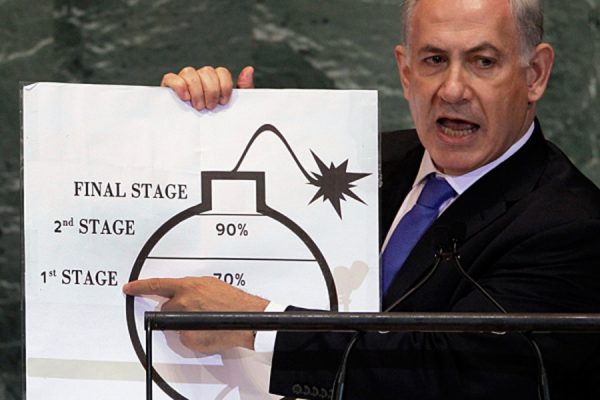
    More recent lies include repeated assertions that the Iranians have a secret nuclear program, which will produce a bomb in “six months,” something Benjamin Netanyahu has been promising since 1993. And those wily Persians are also developing ballistic missiles that can be used to attack Europe and America, a particularly dangerous lie as it has been picked up and repeated ad nauseam by the buffoonish triumvirate in Washington consisting of Bolton, Pompeo and Pence, which passes for the deep thinking in U.S. foreign policy these days. That allegation could easily lead to United States involvement in a war fought for Israel that it might reasonably avoid as it is not threatened by Iran and has no vital interests supportive of going to war against it.


    But the greatest lie of all is the current claim that anti-Semitism is surging all around the world, requiring still more protection of and deference to diaspora Jews as well as to the state of Israel. It is based on a fundamental lie, that criticism of Israel is ipso facto anti-Semitic and ignores the fact that the pushback is based overwhelmingly on how Israel and Netanyahu behave. Israel, whatever its pretensions, is a country and Judaism is a religion. It is in fact particularly dangerous, and damaging to the religion, to combine the two deliberately as is being done by Netanyahu and the many American Jews who are serial apologists for Israel.


    Indeed, Israel and its partisans are now using lies to change the way the public views the issue of anti-Semitism and are willing to do so by legislating to enforce how people think, to include the use of legal sanctions consisting of fines and imprisonment to silence critics. If legislation currently in congress is ever implemented fully, it will be the death of freedom of speech in the U.S. That such nonsense has gained currency at all is due to the Israeli corruption of both America’s government and its news media, which is not a lie, but the absolute truth that you won’t find discussed anywhere in your newspaper or on television reporting.


    This trend to criminalize criticism of Israel has led Jewish groups and some governments to work together to promulgate “hate crime” statutes and other legal barriers to protect the Israeli wrongdoing. But Israel is not and should not be protected against criticism. It is a country that behaves very badly, and, one might add, dangerously, not only to its neighbors but also to the world as it has the potential in its hands to escalate its involvement in Syria to initiate a nuclear conflagration between the U.S. and Russia. Israel’s lies should be recognized for what they are and it should be boycotted and sanctioned until it comes to its senses or, if it does not, it should be completely shunned.


    Written by Philip M. Giraldi, former CIA officer and Executive Director of the Council for the National Interest, a 501(c)3 tax deductible educational foundation that seeks a more interests-based U.S. foreign policy in the Middle East.

    Website is www.councilforthenationalinterest.org address is P.O. Box 2157, Purcellville VA 20134 and its email is inform@cnionline.org


    Source: UNZ.com