Tag: Israel

  • Drone Strike Hits Ramon Airport in Southern Palestine (Video)

    Drone Strike Hits Ramon Airport in Southern Palestine (Video)

    The attack occurred shortly after Israeli authorities claimed to have intercepted and downed three drones launched from Yemen over the Sinai Peninsula. However, the drone that hit the airport appears to be separate from those previously intercepted.

    Drone Strike Hits Ramon Airport
    Drone Strike Hits Ramon Airport

    The impact caused damage to the terminal building. According to the Israeli military, no warning sirens were triggered prior to the strike in Ramon airport, and an investigation is underway to determine why the drone was not detected before entering Israeli airspace.

    In the past, the Yemeni military has utilized the Sinai Peninsula’s airspace and adjacent Red Sea corridor to launch successful drone and missile strikes against Zionist targets. These operations intensified following the escalation of the Gaza conflict in 2023. These attacks were part of a broader campaign of solidarity with Palestinians, as the Houthis declared their intent to target Israeli interests in response to the war in Gaza.

  • Israeli Regime “Gideon’s Chariots 2” Operation; Focus on Hamas Infrastructure and Population Displacement in Gaza

    Israeli Regime “Gideon’s Chariots 2” Operation; Focus on Hamas Infrastructure and Population Displacement in Gaza

    In the initial stages, targeted airstrikes were carried out on high-rise buildings in central Gaza, which, according to the Israeli army, are used by Hamas for surveillance and military activities. Military officials emphasized that the main goal is not direct confrontation with Hamas forces, but rather the dismantling of their remaining infrastructure.

    Another objective of the operation is widespread destruction in central Gaza. The Israeli military appears to be using this filthy tactic to forcibly push civilians toward the southern part of the Gaza Strip.

    Given the complexity of the tunnel network and the possibility of Israeli hostages being held there, it is anticipated that “Gideon’s Chariots 2” could last for months. Some Israeli analysts speculate that the operation’s name might be changed in the future to present it as a new phase of conflict—potentially masking the failure of the current campaign.

    Although the Israeli military claims the operation aims to minimize harm to civilians, field realities show extensive destruction of residential areas, displacement of thousands, and psychological pressure on the civilian population—clear examples of war crimes and crimes against humanity with severe consequences for Gaza’s residents. The establishment of refugee camps in southern Gaza, while seemingly humanitarian, could in practice lead to demographic shifts and increased instability. Moreover, the Israeli regime has shown that even these camps and tents are not spared from airstrikes.

    Politically, such operations not only fail to weaken Hamas but may also strengthen the spirit of resistance and increase public support for the group. Ultimately, without a comprehensive political solution, the continuation of such operations will only exacerbate the humanitarian crisis and deepen regional divisions.

  • 23,000 American Soldiers Serving in the Israeli Military

    23,000 American Soldiers Serving in the Israeli Military

    Furthermore, Republican lawmakers in the U.S. House of Representatives have proposed legislation aimed at revising civilian aid policies. The goal is to extend benefits—similar to those received by American troops!—to Jewish-Americans serving in the Israeli military.

    The eightfold increase in Jewish-American enlistment in the Israeli army reflects the growing influence of pro-Israel lobbying organizations, such as the American Israel Public Affairs Committee (AIPAC), on U.S. policy and their strong presence within the American Jewish community.

    These groups also play a key role in fundraising efforts to support the Israeli genocidal army, often through organizations like “Friends of the Israel Defense Forces,” with donations typically granted tax-exempt status.

  • Yemen intensifies missile and drone strikes against Israel

    Yemen intensifies missile and drone strikes against Israel

    One of the cluster warheads reportedly caused a fire near Ben Gurion Airport. The attacks triggered mass panic, forcing thousands of Israeli settlers into shelters and disrupting flights at the airport.

    One of the cluster warheads reportedly caused a fire near Ben Gurion Airport

    According to data compiled by the Islamic World News, Yemen has carried out 188 missile and drone operations against Israel since the beginning of Israel’s military aggression on Gaza.

    Yemen’s military has repeatedly stated that its attacks will continue until the Israeli regime halts its aggression against the oppressed people of Gaza.

  • Ansar Allah Releases Names of Fallen Yemeni Government Officials

    Ansar Allah Releases Names of Fallen Yemeni Government Officials

    Among those named were key figures in Yemen’s political leadership, including Prime Minister Ahmed Ghalib Nasser Al-Rahwi, whose death marks a significant loss for the government’s executive branch. The list also includes several cabinet ministers across vital sectors:

    • Jamal Amer, Minister of Foreign Affairs
    • Hashim Sharafuddin, Minister of Information
    • Ahmed Abdullah Ali, Minister of Justice
    • Muhammad Al-Mawlid, Minister of Sports and Youth
    • Ali Saif Muhammad, Minister of Electricity and Energy
    • Ali Al-Yafei, Minister of Culture and Tourism
    • Radwan Ali Al-Riba’i, Minister of Agriculture and Fisheries
    • Samir Bajaala, Minister of Social Affairs and Labor
    • Muhammad Al-Kabsi, Chief of Staff to the Prime Minister

    The Israeli airstrike, carried out on Thursday, August 28, targeted senior military commanders and political leaders in Yemen. Although the attempt to assassinate the Chief of Staff and the Defense Minister was unsuccessful, the attack resulted in the deaths of the Prime Minister and several cabinet members. This operation marks the beginning of a broader intelligence and security campaign by Israeli agencies Mossad and Aman in Yemen, aimed at murdering key figures in the Yemeni government and the Ansar Allah movement.

    Military sources in Yemen told the Lebanese newspaper Al-Akhbar that the Yemeni response to the attack on the civilian government meeting will not be driven by emotion, as some might expect. Instead, they emphasized that the operation being prepared by forces in Sana’a will be precise and highly impactful. The sources added that Israeli government offices will not be spared from the firepower of Yemen’s armed forces.

  • Israeli-Linked Tanker Hit by Missile Near Yanbu Off the Saudi Coast

    Israeli-Linked Tanker Hit by Missile Near Yanbu Off the Saudi Coast

    The attack occurred last night, and the ship’s crew reported the incident to UK Maritime Trade Operations (UKMTO). The report states the assault took place 40 nautical miles southwest of Yanbu, in western Saudi Arabia. The captain described an explosion and an unidentified projectile hitting near the ship, causing water splashes, but the crew remains unharmed, and the ship continues its course.

    The Yemeni Armed Forces emphasized support for Palestinians, banning shipping to occupied Palestinian ports and targeting Israeli military sites until hostilities cease and the Gaza siege is lifted.

    This marks their 215th operation against vessels linked to Israel, the U.S., and the U.K.

    The Scarlet Ray, an Israeli oil tanker under the Liberian flag, was en route from Yanbu to occupied ports. This incident highlights ongoing cooperation between Saudi Arabia and Israel over energy transfers. Countries like Turkey, Egypt, and Saudi Arabia are working to bypass the maritime blockade imposed by Yemen on the Zionist regime.

    Yemen #Israel

  • Ceasefire in Name Only: Southern Lebanon Under Fire

    Ceasefire in Name Only: Southern Lebanon Under Fire

    This attack comes despite the ceasefire agreement reached in Nov 2024, under which Israel was obligated to halt all military operations and withdraw from southern Lebanon. However, since the ceasefire took effect, Israel has repeatedly violated it over 3,700 times, including through airstrikes, artillery shelling, and the occupation of border positions.

    International organizations and human rights groups have repeatedly warned about Israel’s continued strikes on civilian areas, the destruction of vital infrastructure such as water facilities, and the obstruction of displaced Lebanese citizens returning to their homes. These actions have not only undermined the ceasefire but have also worsened the humanitarian crisis in southern Lebanon.

  • Gallant Warns of Renewed Conflict: Israel Prepares for Second War with Iran

    Gallant Warns of Renewed Conflict: Israel Prepares for Second War with Iran

    In an interview with Israel’s Channel 12, Gallant criticized the Israeli intelligence agency Mossad’s earlier plans to counter Iran’s nuclear ambitions, calling them “ineffective and impractical.” He disclosed that the plans were officially scrapped in December 2024 after internal reviews concluded they lacked sufficient lethality, were too complex to execute, and failed to match the pace of Iran’s nuclear development.

    To reassess Israel’s strategy, Gallant formed a “Red Team” led by former Defense Minister Shaul Mofaz and a group of retired military commanders. Their conclusion: a full rejection of Mossad’s approach. Gallant now advocates for a large-scale aerial campaign, stating, “Hundreds of aircraft must drop tens of thousands of bombs over Iran to establish air dominance.”

    He also warned that any future strike must anticipate Hezbollah’s immediate involvement. However, Israel faces a critical ammunition shortage, exacerbated by the transfer of artillery shells to Ukraine.

    Gallant outlined four key outcomes of the recent Israeli military operation against Iran:

    • Collapse of Iran’s regional network: Hezbollah, Hamas, and affiliated forces in Syria were severely weakened, dismantling infrastructure built over four decades.
    • Destruction of air defense systems: Iran’s missile shield was neutralized, with uncertain prospects for recovery.
    • Damage to missile capabilities: Explosive production centers, over 200 launchers, and a significant portion of Iran’s missile stockpile were destroyed.
    • Strikes on nuclear facilities: The Isfahan site was nearly obliterated, Natanz suffered major damage, and the U.S. targeted Fordow with bunker-busting bombs.

    Gallant claimed that Israel’s deep intelligence penetration into Iran has unnerved Iranian officials and may be accelerating their pursuit of nuclear weapons. “We must remain on alert,” he said, “because the next round of war is coming.”

    When asked about targeting Iran’s Supreme Leader, Gallant admitted that such an operation was attempted during the initial strike but failed. He suggested it should remain part of future plans, whether against the current leader or his successor.

    He concluded with a warning to Tehran: “If Iran seeks revenge, it would be a grave mistake. We are now stronger, and they are weaker. The next round will be different—and we will have the upper hand.”

    Despite the assertive tone, Gallant’s remarks also reflect an acknowledgment of Israel’s limited deterrence. His admission that Iran could rebuild its missile, air defense, and nuclear infrastructure points to the temporary nature of recent military gains. Analysts suggest this could escalate regional tensions and prompt Iran to expand its own deterrence strategies.

    The former minister’s comments underscore a growing consensus in Tel Aviv: the conflict with Iran is far from over, and a second phase may be imminent.

  • Yemeni Prime Minister and Cabinet Ministers Martyred in Israeli Airstrike

    Yemeni Prime Minister and Cabinet Ministers Martyred in Israeli Airstrike

    According to the statement, a number of ministers were also injured in the attack and are currently receiving treatment at a hospital in Sanaa. Yemeni media reports confirm the deaths of Foreign Minister Jamal Amer, Information Minister Hashem Sharaf al-Din, Justice Minister Ahmed Abdullah Ali, Youth and Sports Minister Mohammed al-Mawled, and Electricity and Energy Minister Ali Saif Mohammed.

    Ahmed al-Rahawi had been appointed Prime Minister on August 23, 2024, by Mahdi al-Mashat, head of Yemen’s Supreme Political Council. His administration, operating under the slogan “Change and Construction,” had made notable progress over the past year in addressing economic hardships and managing the fallout from the ongoing conflict with Israel.

    Following the assassination, Deputy Prime Minister Mohammed Ahmed Moftah has been appointed to lead the government.

    The Israeli airstrike, carried out on Thursday, August 28, targeted senior military commanders and political leaders in Yemen. Although the attempt to assassinate the Chief of Staff and the Defense Minister was unsuccessful, the attack resulted in the deaths of the Prime Minister and several cabinet members. This operation marks the beginning of a broader intelligence and security campaign by Israeli agencies Mossad and Aman in Yemen, aimed at murdering key figures in the Yemeni government and the Ansar Allah movement.

  • Israeli Airstrikes and Heliborne Operation South of Damascus; Israel Seeks Demilitarization of All Southern Syria!

    Israeli Airstrikes and Heliborne Operation South of Damascus; Israel Seeks Demilitarization of All Southern Syria!

    On August 26, Syrian security forces discovered and seized advanced Israeli surveillance and espionage equipment near Jabal al-Manea and the 1st Armored Division. While attempting to transfer the equipment to the division’s headquarters, they were struck by Israeli airstrikes, resulting in casualties among Syrian soldiers. The strikes continued for 24 hours to prevent reinforcements from reaching the area. Despite the strikes, some Syrian forces managed to destroy parts of the equipment and evacuate the bodies of the fallen.

    Continuing the events, Israeli aircraft again targeted the Al-Kiswah and Jabal al-Mane’ areas multiple times last night and conducted a heliborne operation at the 1st Armored Division base. According to local sources, at least four Israeli helicopters participated. Israeli forces remained in the area for over two hours, though no direct clashes with Syrian troops were reported.

    While details of the operation’s objectives remain undisclosed, it’s believed the recovered surveillance equipment was significant enough to prompt Israel to launch a retrieval mission. Of course, that’s not the whole story; the strategic importance of the military installations in Al-Kiswah and especially Jabal al-Mane suggests broader goals. The sequence of airstrikes, troop deployment, and extended presence indicates Israel is pursuing more than a limited strike.

    The execution of combined operations involving airstrikes, drones, and heliborne assaults deep inside Syrian territory signals a qualitative shift in the Israeli army’s operational tactics. This style of operation was previously carried out in Masyaf during the final phase of Bashar al-Assad’s rule, during which important documents were stolen and part of an underground base was destroyed.

    Overall, the Israeli regime seeks to demilitarize southern Syria and establish a large buffer zone adjacent to the occupied Golan Heights. The fall of the previous government and the rise of a fledgling and weak regime in Damascus presents the best opportunity for Israel to pursue this goal. Through repeated airstrikes and physical occupation of parts of southern Syria, the Zionist regime aims to neutralize the Syrian army’s capabilities and maintain permanent control over potential threats. Although talks between Damascus and Tel Aviv regarding normalization of relations or peaceful coexistence are ongoing, it must be understood that Israel holds the upper hand and considers itself above the need to engage with Syria. Therefore, the regime continues its attacks and efforts to neutralize the Syrian government while simultaneously participating in negotiations, viewing them as an opportunity to extract more concessions and apply greater political pressure.

  • Israeli Drone Strike Near Damascus Leaves Six Syrian Troops Dead

    Israeli Drone Strike Near Damascus Leaves Six Syrian Troops Dead

    A Syrian Defense Ministry official confirmed that the strike hit positions of the Syrian Army’s 44th Division.

    Since the fall of Bashar al-Assad’s regime, Israel has carried out hundreds of air and drone strikes across Syria, targeting military sites and infrastructure. Tel Aviv claims these operations are part of a broader strategy to curb the influence of Iran-backed groups and Hezbollah in the region. Damascus, however, views them as blatant violations of its sovereignty.

    The repeated Israeli strikes reflect a sustained pressure campaign against Syria’s transitional government. This strategy not only weakens Syria’s defensive capabilities but also sends a message to regional actors about Israel’s determination to prevent the deployment of forces aligned with Iran.

    Beyond military casualties, the continuation of these attacks risks escalating humanitarian and security crises along Syria’s borders. The strikes could destabilize the transitional government and delay efforts to rebuild Syria’s security infrastructure—an outcome with serious implications for the broader West Asian security landscape. Notably, these attacks coincide with both public and behind-the-scenes negotiations between Syrian and Israeli officials.

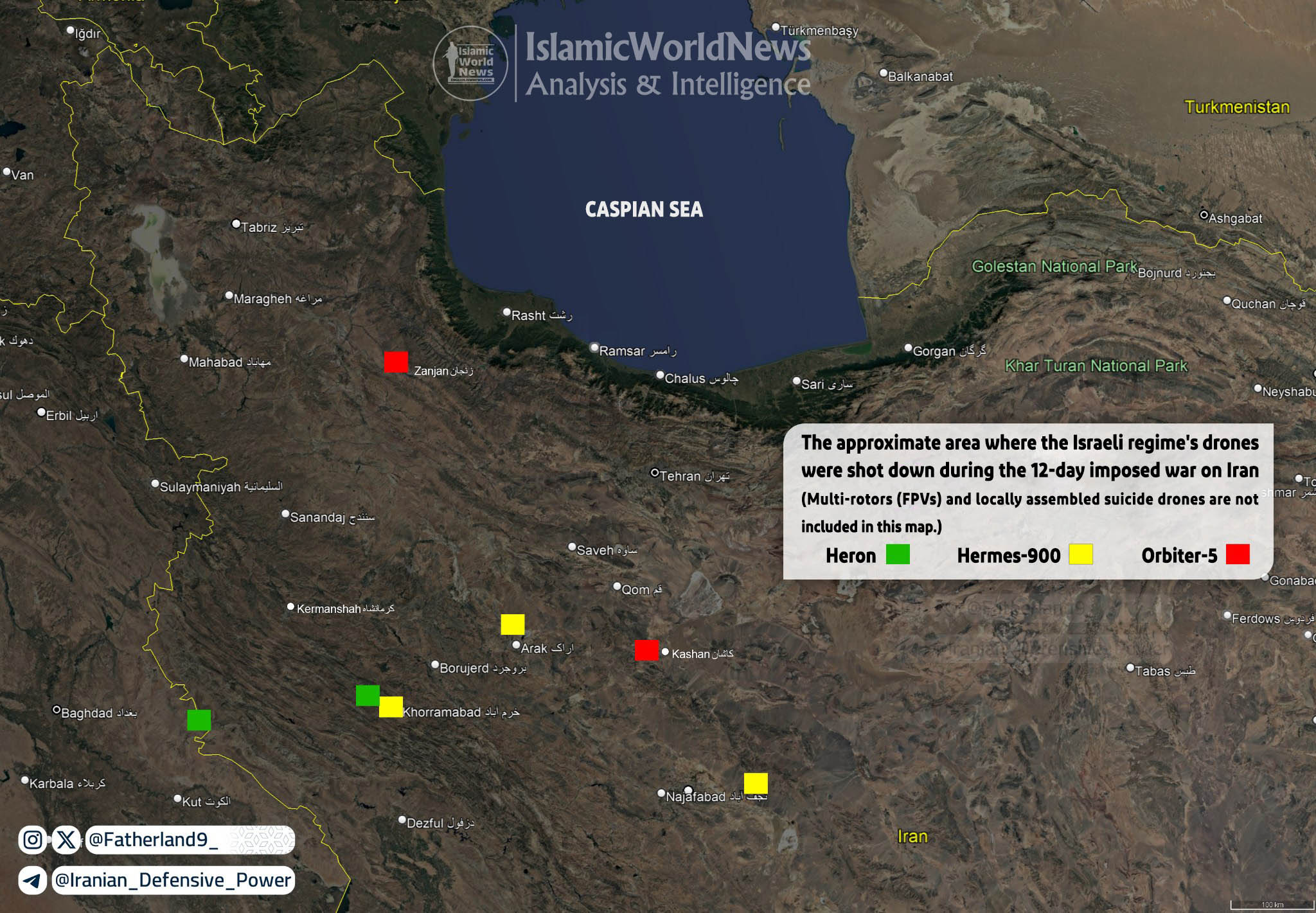
  • How Many Israeli Drones Were Shot Down Over Iran During 12-Day War?

    How Many Israeli Drones Were Shot Down Over Iran During 12-Day War?

    Based on visual documentation, the downed drones are as follows:

    A Hermes 900 drone was shot down on June 18 in eastern Isfahan province. Images of the wreckage show a rocket pod and smart guided munitions.

    Read more about Hermes-900 drone: Military Knowledge: Hermes 900 Drone

    A Hermes 900 drone was downed on June 18 near Isfahan city

    Heron drone with serial number 298 was downed on June 19 near Iran’s western borders in Ilam province. It was destroyed by the short-range Majid air defense system. Analysis of the wreckage and archival images revealed that this Heron lacked a satellite communication antenna and had to be guided by ground stations, giving it a range of about 300 km. This suggests it was likely operated from a ground station in Iraqi Kurdistan or a U.S. base in Iraq.

    Read more about Heron and Heron TP drones: Military Knowledge: Eitan (Heron TP) Drone

    Destruction of a Heron drone on the country’s western borders in Ilam province

    Another Heron drone with serial number 248 was shot down on June 19 in the mountainous areas of Lorestan province. Visual evidence shows this drone was equipped with a satellite antenna.

    Destruction of a Heron drone in the heights of Lorestan province

    An Orbiter-5 drone with serial number 8312 was downed on June 21 in Kashan.

    An Orbiter-5 drone with serial number 8312 downed on June 21 in Kashan

    A Hermes 900 drone with serial number 939 was shot down on June 22 in Markazi province.

    Another Hermes 900 was downed on June 23 in Khorramabad, Lorestan province.

    The moment a Hermes 900 drone was targeted and downed over Lorestan province
    Wreckage of Hermes 900 drone downed on June 23 in Khorramabad. The Rotax 914 engine is visible in the footage.

    An Orbiter-5 drone with serial number 8373 was shot down on June 24 in Zanjan. Interestingly, this drone featured a satellite communication antenna—something not previously seen in Orbiter-5 models. Drones of this class, due to their size and weight, are typically used as tactical drones on the front lines. However, the Orbiter-5 downed in Iran had extended capabilities thanks to its satellite link, overcoming the usual 100 km range limitation of ground control stations. This enhancement gave it a role beyond that of a tactical drone, allowing Israel to extend its surveillance deeper into Iranian territory.

    Read more about Orbiter-5 drone: Military Knowledge: Orbiter-5 Drone

    The video released by the IRGC regarding the shot down of a Orbiter-5 drone in Zanjan province

    Source: Iranian Defensive Power