Indian police attacking protesting students of Jamia Millia Islamic university arrested and wounded some students and desecrated the mosque of the university.
The protests started in other provinces such as Uttar Pradesh, Mumbai and Bengaluru.
Some of actors and directors of Bollywood also showed support for students and protesters and blamed police violence.
Other Indian Muslims also started to condemn police and government and solidarity with students using #WeStandWithAMU hashtag.
The bill proposed by the government, which was passed in both Senate and Parliament, enables non Muslim immigrants of Afghanistan, Bangladesh and Pakistan who came before 2015 to get citizenship.
Narendra Modi administration called the bill correct and should be implemented.
Tag: ISWNews
-

Indian Muslims Protesting Against the Government
-

Iraq: ISIS attacks to PMU bases near Iran’s border
Also ISIS terrorists attacked the Iraqi Army forces in al-Anbar province.
-
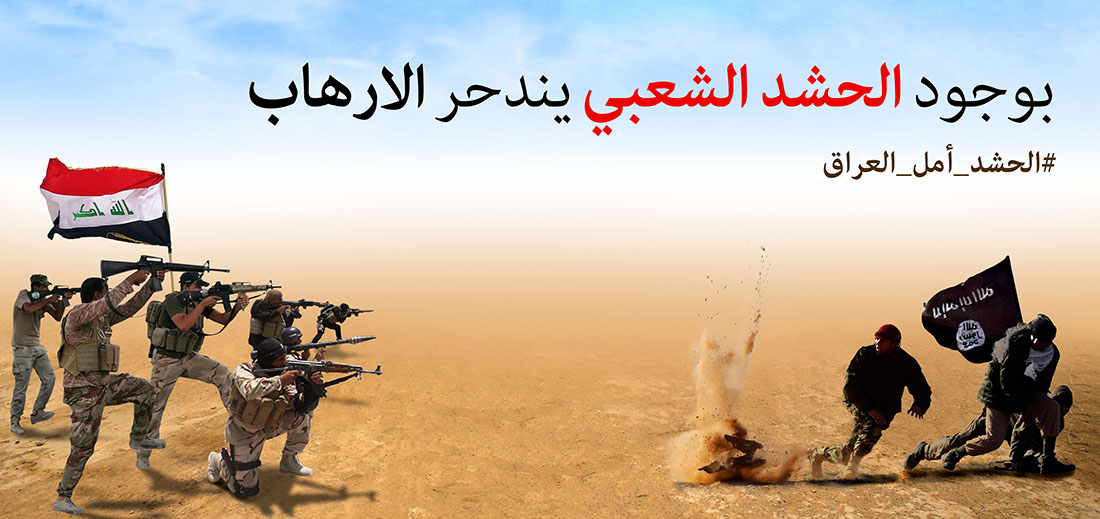
Article: The scenario of the Popular Mobilization Forces (Al-Hashd Ash-Sha’bi) extirpating, Part 1
Why do they want to extirpate the Popular Mobilization Forces?
From the very beginning of the formation of the Popular Mobilization Forces until now, especially after the defeat of the ISIS terrorist forces, there have been numerous overt and covert attempts to dissolve and remove the Popular Mobilization Forces organization in Iraq. These efforts are being pursued by the United States, Saudi Arabia, the Zionist regime, and some political spectrums and groups inside Iraq, that there are numerous cases and varied instances to prove it.
For example, Zionist drone strikes in recent months on Popular Mobilization Forces headquarters or the US condition for extension of Iraq exemption from Iran sanctions in exchange for the Popular Mobilization Forces disarmament can be mentioned. More recently, the U.S. Department of the Treasury imposed sanctions on four Iraqis on the pretext of human rights abuses whom three of them are the Popular Mobilization Forces leaders. [1] This note explains why there are some efforts to extirpate the Popular Mobilization Forces of Iraq.
– Forming out of conventional processes
The Popular Mobilization Forces in Iraq’s first and only military and defense entity that has been formed independent of existing processes such as political spectrums agreements, collusion and economic corruption or targeted US programs in Iraq. Although the militant groups under the Popular Mobilization Forces leadership are attributable to some Iraqi religious and political leaders, the ruling spirit of the Popular Mobilization Forces is completely independent of the conventional divisions in the country. This structure poses a serious threat to the United States, which is the main designer and beneficiary of current systems and structures in Iraq.
– Massive and widespread social support
Almost all provinces and regions of Iraq, including the Sunni areas, have been involved in the formation of the Popular Mobilization Forces. However, the role and contribution of Iraqi Shia have been far more effective than others. However, they can be considered as the only organization in Iraq, which has a pervasive range of members from most of Iraq cities. On the other hand, having representatives and recruitment offices in different areas of Iraq is also a strength of the organization. This has led some political parties, such as the Sadrist Movement, to consider the Popular Mobilization Forces as their serious competitor to draw public support.
– The ideological and uniting foundation
The Popular Mobilization Forces are the only institution that has not been formed under a political, religious, or tribal process. Rather, it is at the heart of the national-religious beliefs that have brought together various groups and provided the basis for the unity and unity of different groups. The multiplicity of religious and political spectrums in Iraq has caused the country to continue to face political and internal strife, so the United States and its favorable countries continuing to take advantage of this characteristic of Iraqi society. By founding the Popular Mobilization Forces, a new trend emerged, unlike previous practices that naturally had many dissenters.
– The reason for confidence in Iraqi society
Following ISIS’s entry into Iraq and the continuous defeats of the Iraqi army, an atmosphere of frustration and lack of self-esteem prevailed in Iraqi society, and the general public sought a way to make up for those failures. Most of the Iraqi youth who were highly motivated to compensate for their defeats voluntarily participated in the formation of various Popular Mobilization Forces groups, with the mandate of the Jihad of the Iraqi Marja’iyyat to confront ISIS. This has made the Popular Mobilization Forces a symbol of the Iraqi national self-confidence. Even in recent protests, the experience of victory over ISIS has given Iraqi youth confidence to fight economic and political problems. Having national self-confidence in Iraqi society means moving towards independence and relying on the power of its youth, which will lead to the formation of a powerful nation. However, a strong and independent Iraq conflicts with the interests of the US and Saudi Arabia. The US is already in the country under the pretext of the lack of security. Saudi Arabia, on the other hand, sees Iraq as its longtime rival in the leadership of the Arab states.
– Affiliation to reputation and position of Marja’iyyat
Given the effective role of the reputation and position of Marja’iyyat in the formation of Popular Mobilization Forces, the power and strength of the Popular Mobilization Forces mean the power and strength of Marja’iyyat in Iraq. It is clear that countries such as the United States and Saudi Arabia will never agree with strengthening the Shia Marja’iyyat in Iraq, and they see their interests threatened. On the other hand, some political movements that have long opposed the strengthening of Shia Marja’iyyat in Iraq will also oppose maintaining and strengthening the Popular Mobilization Forces’ power. The Sadr Movement, which has always tried to discredit Iraq’s current Marja’iyyat under the pretext of Arab and non-Arab Marja’iyyat, is also seeking the dissolution of the Popular Mobilization Forces.
– Security and military competition with the US
During the fight against ISIS, Popular Mobilization Forces, besides the gaining experiences in the intelligence and security, they succeeded in proper structuring in these parts as well. Before the recent protests, for example, the Popular Mobilization Forces intelligence units have identified and foiled various conspiracies, most notably the plot of some of the country’s top military commanders. On the other hand, one of the major bottlenecks the US has taken in the form of private and public companies in Iraq is the security and intelligence sectors. Like the highway and international airport security companies. According to the power and strength of Popular Mobilization Forces, it can be counted as a potential rival to take over the control form the US sectors.
– Capability to build and rebuild infrastructure
The experience of the Popular Mobilization Forces in the construction sector has been greatly increased over the years, and besides having the right equipment, their concern and approach have always been to rebuild and restore destroyed areas during the war. This capacity makes it possible to complete some infrastructure projects, far from political and economic collusion, if the government is well established and policy-driven. Naturally, Iraq’s move toward civilization and reconstruction, this means moving towards a sovereign, independent state that is against the interests of the United States and its favored countries.
– The capacity to attract and rely on youth
Perhaps the most important feature of the Popular Mobilization Forces that has led to many plots against it is its high capacity to attract Iraqi youth. Bringing Iraqi youth together through lofty goals means building the nation’s next generation with the aspiration to fight any aggression and oppression. The youthfulness traits also make Iraqi youths motivated spirituality to spread into society and become the dominant discourse.
Other cases can be cited as reasons for some attempts to dissolve the Popular Mobilization Forces, such as the ideological link with the Islamic Republic of Iran or the existence of some senior commanders in there who have a close relationship with Iran. However, the main goal of this note is to allude the reasons which are the inside of Iraqi society, and the key factors are within Iraq itself.
[1] In the second part, these cases and examples will be described in detail. -

Yemen: Tariq Saleh Rewarding Sudanese Commander
“The forces are returning to Sudan and to appreciate their participation in confronting Iran and it’s allies (i.e. Ansar Allah), the medal is rewarded to their commander”, Saleh twitted.
P.S. Sudanese participation in Yemen has two main points:
1. 5,000 casualties confronting Ansar Allah.
2. Looting and assault of Sudanese in Mocha and Khukhah.
For which of them did Saleh rewarded them?! -

Latest Updates on Libya, 15 December 2019
1. Fayez al-Sarraj, the Chairman of the Presidential Council of Libya and prime minister of the Government of National Accord, meeting with Tamim bin Hamad Al Thani, Qatar’s Emir, in Doha.
Fayez al-Sarraj travelled to Doha to participate in the annual Doha conference and talk with allies.
2. GNA and LNA forces engagement in Ain Zara axis and north of Hamzah base.
LNA forces attacked Zahraa bridge(Kobari Zahraa) again.
3. From the beginning of Tripoli operation by Gen Haftar so far, 35 forces of LNA have been killed and 120 injured.
4. Militia in Ujaylat rejected their alliance with LNA and showed support for GNA releasing a video. -

Opinion: Iraq Caught Up in Cognitive Warfare; What Can Be Done
The crisis in Iraq and some similar countries have been triggered by years of British-based media activity on the culture and politics of West Asian countries, with few results now to be seen; however, the worse part is that the posterity will suffer.
In cognitive warfare, people’s cognitive power is changed by an activity called perception management, and they perceive the facts upside down. Hence, the movement of the people will move in a direction that is against their interests and precisely beneficial for the West. This process is known as perception or perception management.
What emerges in the minds of individuals in the community about important issues is the perception or understanding that the cultural sections of intelligence agencies in the Western world are trying to manage the opinions of the people of each country through cultural programs and the global media. This is a British method whose extensive description requires separate research.
We have to take things in to account from a multitude of perspectives:
The US occupation of Iraq, the deadly sanctions and the humiliating “oil for food” program that the United States has been subjected to, British divisions over the past two hundred years, and the foundation of ISIS with the design of Israel and the economical support of Saudi Arabia and the US management are facts that Iraqi people, especially the Shias in the south, are simply forgotten. Even the anti-Shia Ba’athist regime has been forgotten too.
They ignore Americans who have official and evident influence in Iraqi ministries, which control the economy, especially the central bank, and then they set Iranian consulate on fire and chant slogans against Popular Mobilization Forces (Al-Ḥashd Ash-Shaʿbī) who defended the people against ISIS. But how this transformation has been possible in the memory of a nation.
Mechanism of cognitive warfare:
The inner layers of this warfare are not in the streets of Najaf, Karbala, or Baghdad, but it should be searched in the think tanks of politicians who are on the British axis. Unlike the United States, Britain is well-versed in Islam and Shia and has many connections with some Shia leaders and clerics, we are able to achieve this, and so we can enjoy it by having the clergy and the clergy. Whether before Saddam or after him. Basically, prior to the Iraq occupation and even before the destruction of the oppressive Ottoman rule, Britain studied Islam and the Shia religion and communicated with some Shia clerics. The design of the Arab countries was based on this. The emergence of British rule in the repression of the Thorat Al-Ashrin uprising (Anti-British revolution, 1920) and creating London-affiliated governments that looked like the British opposition on the face of it like Saddam is observable throughout the 20th century. The shock that the London court received from Mirza Shirazi in the tobacco boycott led them to institute false clerics and even fabricated religions such as the Baha’is.
Two centuries have passed since the “Divide and Conquer” tactics of the British, they have been updating this policy every decade, then sparking off new crises.
The British are well aware that the two elements of the inefficiency of government and false propaganda can be good triggers in any society. On the one hand, they prevent the government of Baghdad from serving the people to increase poverty; on the other hand, they attribute this situation to the Islamic Revolution and Iran by showing a few simple symbols of them. Since a year ago, the BBC’s British network concentrate its efforts to portray Iran as an enemy of the Iraqi people.
For example, the eight-year war, which was the product of British design and the implementation of the Ba’athist regime, resonates in the minds of the young Iraqi audience as the Iranian nation was that had attacked the oppressed Saddam. As a result, the audience reached the inductive analysis that it was the Iranians who had shed the blood of Iraqis for eight years. Or attribute the infrastructures that Britain itself destroyed in the Kuwaiti war to Iran. This is just one way of managing the perception of the Iraqi people.
The neglect of the main Shia factions who fought for years with Saddam in the eight-year war, the Sha’aban uprising (intifada), and afterward have caused the new Iraqi generations to have no right picture of the Ba’athist regime, the Wahhabism and the British occupation, and, on the contrary, images are instilled in them to show Iran as an enemy and oppressive. It is where Saddam’s actions are shown justified. Recall that Saddam expelled Iranian scholars and merchants at the start of his administration and later during the suppression of the Shia uprising in the year 1991, invaded the house of Supreme Ayatollah Khu’i’s, and more disastrous the barrage of Imam Ali (AS) shrine and entered the area between shrines in Karbala with tanks. These images are now completely erased in the memory of the Iraqi people. So mentioning those pictures revealing the British role and is an important step.
Over the last 20 years since the US occupation of Iraq, these images have faded, but what is being promoted is Iran phobia that, unfortunately, no action will be taken against it. Worse still, some are repeating the same cognitive warfare tricks unconsciously or biased in Iran as if Iran has taken Iraq under its control.
In fact, all of Iraq’s economy is under control of the US, and they are hampering the solution of problems and the growth of production and employment there. Two decades past and the United States has prevented the construction of power plants in southern Iraq. It has even prevented Iran from building a power plant free of charge for Najaf, but this news has never been heard by the Iraqi and Iranian people. The cognitive warfare exploits this neglect of the people and the slumber of the resistance axis precisely.
What can be done?
Iran and Iraq may not have enough tools to deal with the West, but there is a significant weakness in cognitive warfare, which is a strong dependence on Britain. The British, not in the form of a friend, but should be literally recognized as the most dangerous inhumane regime in the world.
When London receives severe damage from the countries of the region, it will undoubtedly fall back quickly. Cognitive warfare is directed neither in the US nor in Saudi Arabia but London. Israel, America, and Al Saud are indeed enemies of Islam and humanity. Still, all their actions in Iraq, Lebanon, and even the Yemeni War are based solely on the careful planning of Britain.
The only colonial government that has both a good knowledge of Shia and a deep connection between Whether an obvious connection like the British Shia and the Shirazi sect or some secret contact with some Iraqi officials, etc.
If the people of Iraq, Lebanon, Turkey, the United Arab Emirates, and others want peace, friendship, and prosperity, there is only one quick and effective way to annihilate the British economic interest in West Asia and the eradication of all those affiliated with Britain.
Note that a sign of dependence on Britain can be found in the residence and life of relatives and children of the political or cultural officials of the countries in Britain. People in the UK or its colonies (Canada and Australia) are being trained to play a role in the future, and they are kind of hostages taken from their fathers in the Muslim world.
Anyone looking to Britain in some way or another will be the same as the cognitive warfare of England. There is no other way to repel the West’s invasion and win the cognitive war, then to achieve economic prosperity and social justice, unless opposing seriously with British policies In Iraq and all Islamic countries. -

Why Muqtada Sadr Visits Iran?
Media close to him have not talked about the reasons behind his visits, sanctifications, etc. so far.
Some talk about his route to go to A’zam mosque everyday as a hint for his assassination and some say this is to blackmail Iran…
His goals, whatever they are, do not seem sincere and in near future we will find out more. -

Yemeni Armed Forces Warning to Saudi Coalition
Yayah al-Sari’:
– In despite that our forces obey the ceasefire unilaterally, enemy is violating it everyday.
– More than 30,903 ceasefire violation took place since the start of it and enemy is still besieging Durayhimi and hinders transporting food and medicine to the town.
– Due to ceasefire violations in western shore so far 175 people (63 children, 27 women and 85 men) martyred and 481 (169 children, 97 women and 215 men) wounded.
– UN and Security Council are responsible for crimes of enemy and under God’s blessings, any stupidity of enemy has a bad result for them.
We emphasize our preparation to answer any violent act of enemy and the responsibility is on enemies. -

Strange Verdict for Omar al-Bashir
According to Sudan’s laws, people older than 70 years old, who are convicted to punishment other than execution, will be sent to rehabilitation centers.
Omar al-Bashir is 75 years old who committed massacring protesters, war crime, genocide, etc. and now is only found guilty for corruption and money laundering and spending two years in rehabilitation center.
It is said that people of Sudan are gathering in the capital and other towns to protest to this verdict. -

Opinion: What Does US. Want in Syria?
Given recent developments in the region, particularly US decisions in northern Syria, the following highlights indicates Trump’s current policy in Syria:
A. Sharing the benefits with Russia and Turkey.
B. Keeping “Kurds” lever with separation inclinations.
C. Confronting Iran and Syrian government.
It is not clear what is the outcome of USA policy in Syria. Possible scenarios including “US forces pull out from some areas”, “increasing number of US forces in some areas and oil resources” and “hidden agreement with Turks or Russians”.
Unlike previous US Presidents, Trump uses a few consultants in the issues of west of Asia and as always there are differences between diplomats and generals.
But the first goal of USA in Syria is to exploit the oil resources. Trump addressed controlling the oil fields when he gave the news of al-Baghdadi death and it means USA does not have any plan to leave Syria and the end of ISIS is not what they want.
These acts are not only to confront the central government of Syria, Russia or ISIS but confronting Iran is more important. Specially now with imposing oil sanctions and maximum pressure campaign and even the possibility that USA uses the oil fields of Syria as a bargain to deal with Iran. Although it sounds unlikely, but from Trump, who is striving severely to negotiate with Iran, it’s not impossible.
Iran has not acted to confront USA directly yes, since the danger of Takfiris has not eliminated yet and Israelis are still attacking once in a while. Maybe Iran was waiting for USA to leave Syria, so did not take actions. Anyhow, USA controlling oil fields in Syria and Trump’s decision have changed the situation and even influenced Russians plan to control oil fields of north of Deir Ezzor.
USA presence in Syria will also provide their influence on Iran’s western border. The area has not a lot of influence in Iran but provides a good strategic depth in case of a war with Iran. On the other hand, gives USA the possibility to access Iran’s bases in Al Bukamal and disturb Iran’s plans to reach Mediterranean Sea.
From another point of view, USA presses Iran to reduce its forces in Syria and if there will be a negotiation, they bargain Iran’s retreat for leaving the oil resources to central government of Syria.
There is another possibility that Trump is using the oil fields of Syria to remove some threats for the coming presidential election.
Leaving Syria or Afghanistan can be similar to leaving Vietnam. In fact, Syria issue is a threat for USA and paying Obama’s heavy costs of war in Syria becomes a strong point for Trump in debates for election.
In conclusion, Trump using Hollywood style surpassing ISIS and killing Abu Bakr al-Baghdadi and controlling Syria oil field is trying to keep its superpower credit in front of Russia and Europe, confronting Iran and Moghawemat, providing security for Israel and above all of them to win the presidential election. -

Breaking: LNA Shot Down a GNA Drone Over the Tripoli Sky
However, it is not clear whether the UAV was used by the GNA or their military backer, the Turkish Army at the moment of shot down.
-

Map: Latest Updates on Tripoli Fronts, 13 December 2019
Ain Zarah axis:
The Libyan National Army (LNA) captured al-Furjan mosque. The LNA also managed to capture the police academy north of Camp Yarmouk, but was forced to withdraw from the academy hours later due to Government of National Accord (GNA) counterattacks.
South of Qara Bulli axis:
The Libyan National Army (LNA) could claim areas Qawai’a, Zatarna, Khawaliq and Ziyania in east of Tripoli and south of Qara Bulli axis.
LNA goal is to control the eastern road of Tripoli and cut the road to Misrata.
Suwani-Aziziyah road:
The news of LNA controlling Saediya and Zahra bridge was rejected by GNA. Only Tuwaisha is captured by LNA. LNA is positioned in eastern road axis.Click to see the full size map 
Click to see the full size map