Tag: Kirkuk

  • Investigating ISIS Terrorist Activities and Threats in Western Asia – Second Half of October 2018

    Investigating ISIS Terrorist Activities and Threats in Western Asia – Second Half of October 2018

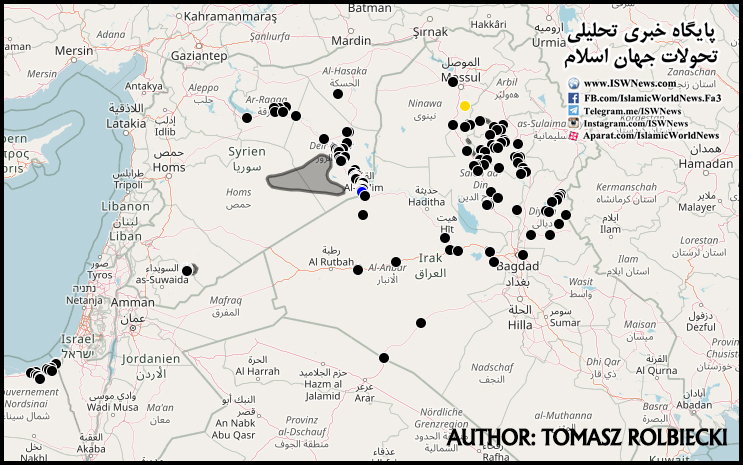
    These 224 attacks were announced by official ISIS media.

    Considering the broadness of the areas ISIS attacked, the most important in terms of security threats are as follows.


    Iraq:
    Reported attacks happened in Karkuk, Salah ad Din and then Diyala provinces more than other regions in Iraq.

    Therefore, ISIS remainder cores in northern regions are still potential threats to Iraq security.

    Recently, numerous security operations by Iraqi forces performed against ISIS and the results either success or failure will be determined later.


    ISIS activities in northern Iraq


    Syria:
    An interesting fact about ISIS activities in Syria is that they are all in the east of Euphrates River or around it and no activities observed deep inside the government controlled areas.

    This implies that Syrian government did a better job to control the ISIS cores compared to Iraqi government.

    The reports of ISIS attacks in Al Safa area are also about the battle with Syrian government which started from July.


    ISIS activities in Syria


    Reviewing the reports of ISIS attacks in Syria, they were mainly done in areas under control of SDF.
    It is noteworthy that a large number of these attacks are in Hajin area, which was passed back and forth between ISIS and SDF.

    It is predictable that SDF has a long way to completely secure the area and fight against ISIS cores; it is obvious from the depth of ISIS attacks inside SDF controlled areas. Sabotage attacks including bombs and terrorist attacks are becoming usual in SDF ruled areas.


    ISIS activities in eastern Syria


    Egypt:
    Northern Sinai governorate is the biggest security threats in Egypt and ISIS main activities are limited to Sinai peninsula.

    ISIS attacked 18 times against Egyptian forces in 16 days, which is considerable.

    An interesting fact is that all these attacks were against Egyptian troops and none of them were against Israeli troops, this is while Israeli-controlled lands have long borders with Sinai and ISIS has always announced their enmity against Israel!


    ISIS activities in Sinai peninsula


    Afghanistan:
    Last year ISIS activities increased by bomb and sabotage attacks against security forces of Afghanistan and also engaging with Taliban.
    Although it is reported that ISIS activities in north of Afghanistan are suppressed, however this terrorist group is active in east specially in Nangarhar and Kabul and this is a potential threat to capital of Afghanistan.
    In the period of 16 days, 11 attacks were reported.


    ISIS activities in eastern Afghanistan


    Other Areas:
    North of Baydah province in Yemen, Mogadishu in Somalia, Libya and northeastern border of Nigeria are some of the regions that observed ISIS attacks in the period of 16 days.

    ISIS cores in northeastern border of Nigeria, some parts of Libya and north of Baydha province in Yemen are rather active.


    Maps: Tomasz Rolbiecki

  • The Beginning of Operation for Cleaning the Northeast Regions of Diyala Province

    The Beginning of Operation for Cleaning the Northeast Regions of Diyala Province

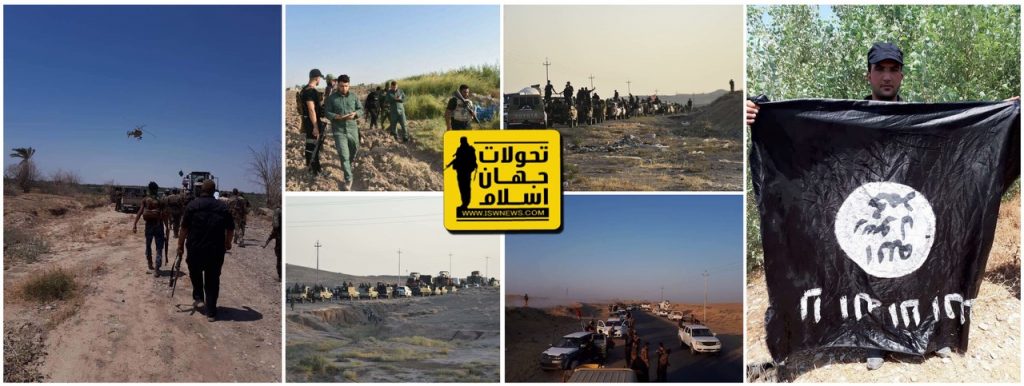
    According to one of the commanders, the main goal is to clean the triangle of Diyala-Kirkuk-Saladin provinces, which the remaining ISIS forces have tried so many times to infiltrate these three provinces via attacking this region.


    Also, The Joint Iraqi Forces in these past days, carried out several cleaning operations in different provinces including Kirkuk & Saladin.

  • Suicide Attack to Center of Keeping Votes of Recent Election in Kirkuk Iraq; Photo

    Suicide Attack to Center of Keeping Votes of Recent Election in Kirkuk Iraq; Photo

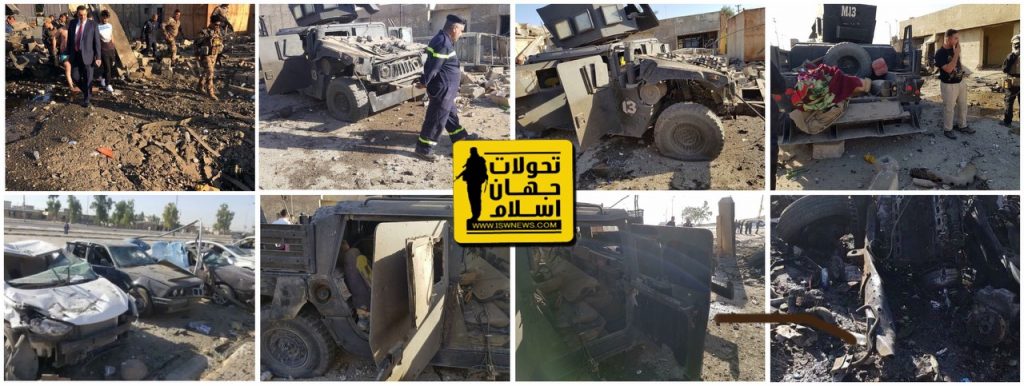
    Early morning of Sunday, two suicide vehicles exploded in Kirkuk.

    One of them tried to enter the center of keeping votes, which after failed armed engagement exploded at the door of the building.


    The second vehicle exploded on Kirkuk-Baghdad road.

    Due to these attacks 1 person killed and 21 wounded.


    In previous days, the building of keeping votes in Baghdad was set on fire, for which several persons arrested. It is noteworthy that during the following week, the votes of the boxes with objection will be counted by hand.


  • US Forces Entered Sinjar Mountain, Iraq

    US Forces Entered Sinjar Mountain, Iraq

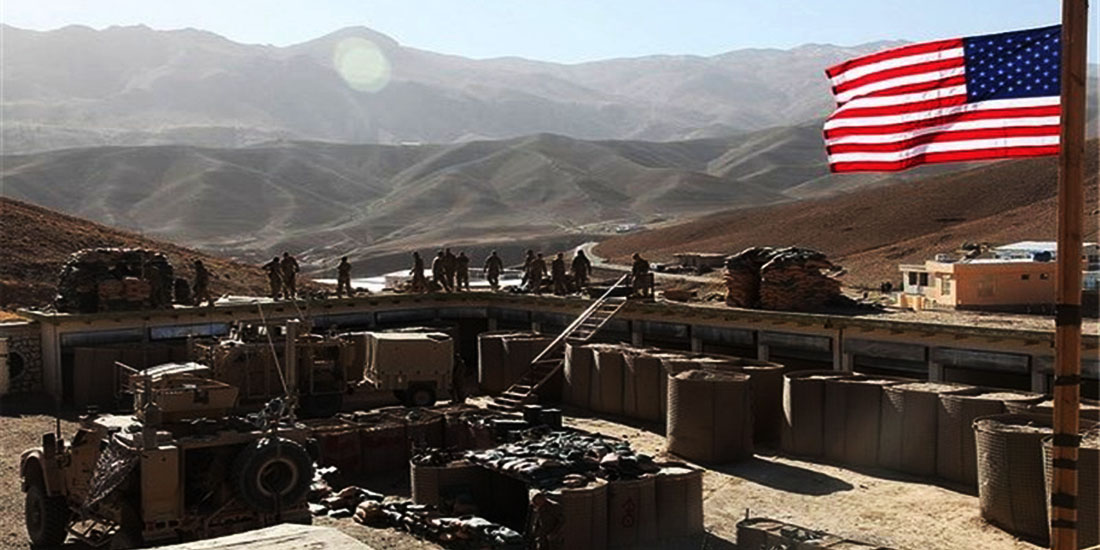
    On Friday, June 1, the US troops with military vehicle and heavy weapons entered the Sinjar area in western Mosul.


    According to Sinjar Governor Mohammad Khalil, 15 US military armored vehicles arrived in the area after the agreement with the Iraqi government and are now stationed near the Mira hill.

    Khalil said that the intention of the US forces to enter this strategic area is to create a military base in the Sinjar Mountains.


    Sinjar, a town in Nineveh Province of Iraq, is inhabited mainly by Izadi Kurds, with a Muslim Kurdish minority. Its population in 2013 was estimated at 88,023.


    It should be noted that, after Iraqi troops were retook the city and district of Kirkuk in 2017 from the Kurdish Peshmerga forces, US troops were also transferred their military assets to the K1 base in Kirkuk.

    After this US action, there were also reports of the transfer and deployment of a number of other US troops around the city of Tuz Khurmatu, south of the city of Kirkuk.


  • USA is building new military bases in Iraq.

    USA is building new military bases in Iraq.

    Iskandar Watout, a member of Security and Defense in Iraqi Parliament, told press: USA is trying to increase the number of their soldiers in Iraq and develop their bases to increase their role in the region to implement their plans and conspiracies.

    Right now, there are more than 10,000 US soldiers in Iraq under the pretext of teaching or consulting which affect the Iraqi government’s stands significantly.

    It is noteworthy that during the last few days, US transported military equipment and troops to “K1” base in Kirkuk. After theses movements, some other news leaked about transporting more troops and equipment to Taza Khuarmatu in south of Kirkuk, which was denied by Iraqi officials.

    In addition to US bases in Kurdistan (north of Iraq), more troops were transported to Ain Assad, Habbaniyah, Speicher, Taji, Liberty (Ashraf), Al Hurya and Qayyarah bases, before.

    In last days of Hawijah Liberation Operation, US placed some troops near Makhmur city south of Erbil.


  • Israel’s Strategic Ambitions Thwarted in Iraqi Kurdistan and Will be in Syria’s Deir ez-Zor

    Israel’s Strategic Ambitions Thwarted in Iraqi Kurdistan and Will be in Syria’s Deir ez-Zor

    We live in extraordinary times. The narrative of the “fight against Islamic State” that holds sway in Western society comes from a fantasy land in which nothing is as it seems; these “certain truths” have as much reality as a rainbow, while reality is distorted or obscured behind it.
    Across the “credibility gulf” we may see everything as it is, but speak a different language; no-one over there in the Western bubble can understand what we say, or even recognise it as language. A declaration that should shock this complacent and self-possessed “civilised world” to the core – that the US is fighting with the Islamic State – simply cannot be understood or accepted, regardless of evidence.

    Since the coordinated operation by Al Qaeda groups in Idlib attempted to kidnap a group of Russian military police on September 17th, it has become evident that the US military really is actively supporting and coordinating with terrorists fighting the Syrian Government. Following further attacks, including particularly the assassination of Lieutenant General Valery Asapov in Deir ez-Zor, Russia now evidently has no remaining doubts about the US “fight against ISIS”; there is no such fight.

    So now we are faced with an intolerable paradox. The US and its coalition partners in Syria are actively engaged in lethal attacks on the Syrian army and its allies within sovereign Syrian territory, both directly and in cooperation with ISIS. At the same time these Western countries’ sole stated pretext for entering Syrian territory without UN authorisation has been to fight ISIS terrorists, while the threat of Wahhabi terrorist attacks at home has been ruthlessly exploited to gain support for these foreign military actions from their domestic audiences.

    Not that this apparent US collaboration with ISIS and Al Qaeda in Syria is anything new, but long-held suspicions – now confirmed – constitute a substantial body of evidence. Events such as the transit of ISIS convoys across the Syrian desert without interference from US coalition planes, or the free pass for the tanker-pipeline taking ISIS Oil out through Turkey can also now be seen as acts of facilitation rather than merely a failure to act.

    But nothing now constitutes clearer proof of collusion than the direct and lethal attack on the Syrian Army outpost protecting Deir ez-Zor airport from ISIS fighters, conducted by both US and Australian planes. This attack of September 17th 2016 has now been revealed as a key part of the US coalition plan, as it is fought out in this same area a year later. What is more, with the strangely coincident events over the border in Iraq, where the plan by the Kurdistan Regional Government to sequester the Kirkuk oilfields out of Baghdad’s control has just been thwarted, another player in the game has come into view – Israel.

    It is almost as if Israel has finally broken, and can no longer contain itself at the sight of its own project for Syria going adrift. And it seems as though the “Kurdistan Project” was a central part of this. Following the Kurdish referendum – which even the US purported to oppose – Israel was the first to voice solidarity with this new “democratic state” in the making, that was presented as sharing its values. Notwithstanding that the ethnically-defined Kurdistan can like Israel only pretend to be democratic.

    Israel’s championing of Kurdistan as the most Western-friendly entity in the region can however be seen chiefly as opportunist, and related to its desire to obstruct Iran’s economic and cultural influence. It also betrays the considerable investment made by Israel into the development of Iraqi Kurdistan, dating back to before the first [Persian] Gulf war. While the original plan to bring oil from Kirkuk via pipeline directly to Israel was thwarted, Israel’s strong presence in Erbil, as well as its close involvement in the handling of Syrian oil stolen by ISIS and exported via Turkey has served the same purpose.

    Allegations that Israel was ‘laundering’ ISIS oil, with the profits being returned as weapons and ammunition for the terrorist Caliphate, were made at the time that Russia bombed the guts out of the IS oil tanker convoys. Natural scepticism that this accusation was just Israel bashing now look too cautious, and instead provide additional evidence of Israel’s criminal involvement and deceptions over the war on Syria.

    But something strange is operating here. So great is Israel’s influence on Western media and perceptions that it is those Western observers who are protesting Israel’s innocence of colluding with terrorist groups in Syria. They fail to notice that neither ISIS nor Al Qaeda never criticise Israel or threaten a campaign to “liberate” Al Quds from its Zionist occupation. Nor do they ever appear upset by Israel’s provision of medical care and sanctuary for terrorists escaping the Syrian Army.

    Even when Israeli leaders proclaim support for these Wahhani mercenaries, including the launching of missile strikes at Syrian army posts that threaten them, Israel is excused. In Western eyes Israel is always the victim.

    Well perhaps this is about to change, as it must. Last month Israeli jets fired missiles at a Syrian factory from Lebanese airspace, which they routinely violate. The vacuous claim that they were targeting a factory producing chemical weapons and missiles for Hezbollah was their justification for this act of war, which took place during major military exercises in Northern Israel. Syria was unable to respond to that provocation, but when Israeli jets flew into Lebanese airspace on the Syrian border on Monday, Syria fired missiles at the planes, forcing them to retreat.

    Proclaiming Israel’s right to self-defence – even when engaged in acts of armed aggression beyond its borders – Israeli jets subsequently bombed the Syrian defensive missile battery. As Netanyahu put it:

    “Today there was an attempt to harm our aircraft — this is unacceptable to us. The air force acted quickly and accurately to destroy what needed to be destroyed,” Netanyahu said.

    The timing is also clear – Russia’s Defence Minister Sergei Shoigu is visiting Israel this week. We would hope that Russia’s patience with Israel is wearing just as thin as it has with the US, and that the next time Israel pushes its luck with Syrian air defences it will be dodging Russia’s feared S400 missiles instead. Not only that of course – Israel’s excuse that it is targeting Iranian infiltration and weapons shipments to Hezbollah can no longer cut any slack with Russia, for whom Iran is now a major military and economic ally.

    The recent “intemperate remarks” about the Iranian Nuclear deal by Donald Trump, echoed immediately by Netanyahu only strengthen these ties; who could not gasp at those delusionary claims from two of the world’s most dangerous nuclear weapons states, whose only real concern is that their stranglehold on global power with the threat of nuclear annihilation might be weakened?

    Well at least Iran is under no misconceptions. As reported by the Guardian – “Ali Akbar Velayati, a senior foreign policy adviser to the Iranian supreme leader, praised the Iraqi army’s move to capture Kirkuk, framing it as a blow to Israel’s strategic ambitions.

    “With the defeat of the Kurds in Kirkuk, Barzani’s conspiracy against the region’s security was foiled. Barzani’s aim and Israel’s covert aim were to seize Kirkuk’s oilfields to serve the Israeli interest. In the Kurdistan region, they raise the flag of Israel and this means if Kurds gain independence in Iraq, we will share a border with Israel,” Velayati said, according to the IRGC-affiliated Tasnim news.

    News that the Iraqi army has retaken control of both Kirkuk and Sinjar and their oil resources, on behalf of all the Iraqi people, is welcome indeed – except in Tel Aviv. We await similar news from Deir ez-Zor.

    Source
  • Summary: Operation of the Federal Government of Iraq in disputed areas with the Iraqi Kurdistan Region

    Summary: Operation of the Federal Government of Iraq in disputed areas with the Iraqi Kurdistan Region

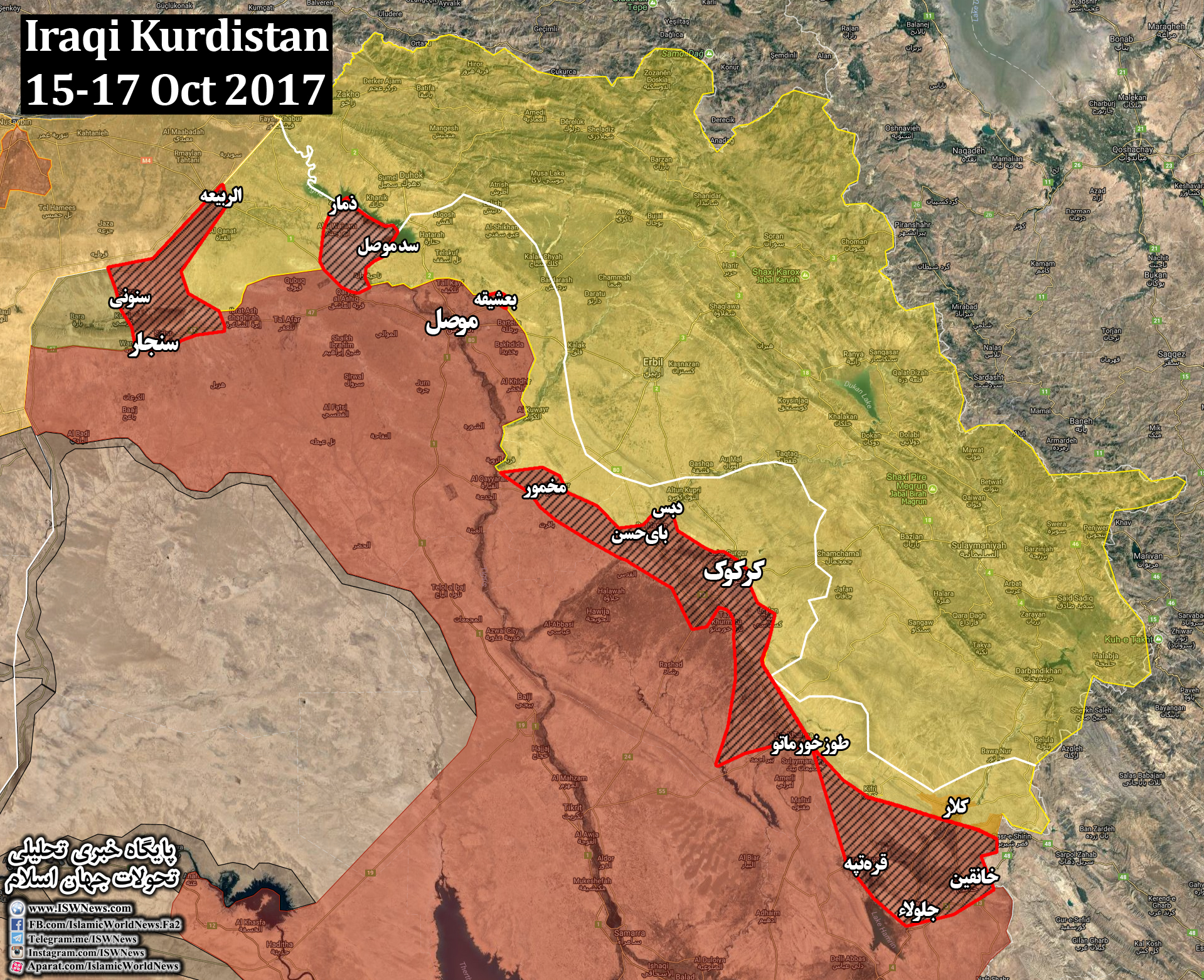
    In the first stage, anti-terrorism forces succeeded in entering and dominating in the general area of ​​the city of Kirkuk following the dispersal conflicts with the Peshmerga and PKK forces. On the same day, other federal police forces managed to dominate the North Oil Refinery.

    The results of the first day are these : the domination of the central government on the city of Kirkuk as well as the oil wells and oil facilities of the region.

    On the second day of the operation, the withdrawal of various forces from various Kurdish parties was obvious. The forces succeeded in domination over the various regions on five axes.

    First axis: Diyala province

    In this axis, the forces managed to dominate the cities of Jalola, Khanaqin and Qarat-Tepa. The Khosrawi border crossing was also controlled by Iraqi central government forces.

    Second axis: Kirkuk province

    In this axis, the forces managed to advance towards the important village of Bai Hassan and Debs. The importance of this village is located on the shore of the Zab River, as well as facilities and oil wells around the area.

    Third axis: Nineveh province, Mosul area

    In this axis, the forces succeeded in dominating the city of Ba`shiqah. The news of the troops’ arrival to Tel Oskof and Betnai is not confirmed.

    Fourth axis: Nineveh Province, Sinjar area

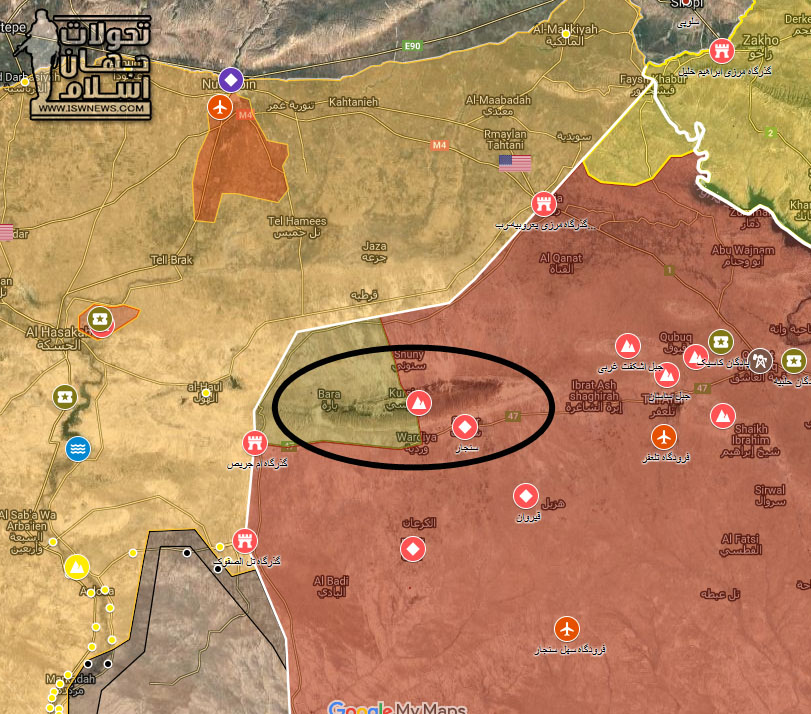
    In this axis, due to the large presence of PKK forces, the forces succeeded in dominating the city of Sinjar and part of its northern mountains, in order to control the important village of Senoni and the central al-Rabi`ah borderway . In this axis, the cooperation between the Izadi(Yazidi) forces and the central government of Iraq was very close and friendly.

    Fifth axis: Ninewa province, Mosul dam area

    In this axis, the Iraqi Army’s 16th Army Corps managed to control the Mosul Dam, the strategic city of Dhamar and  Aski village.

    Now with the withdrawal of various Kurdish forces has spread across the south of Diyala to the north of Sinjar, it must be seen that the forces under the Barzani control(KDP), will accuse PUK(Patriotic Union of Kurdistan) as a traitors! Or just the withdrawal of PUK forces was betrayal,and the retreat of the KDP forces was their tactics to prevent conflict and bloodshed!?


    HD MAP

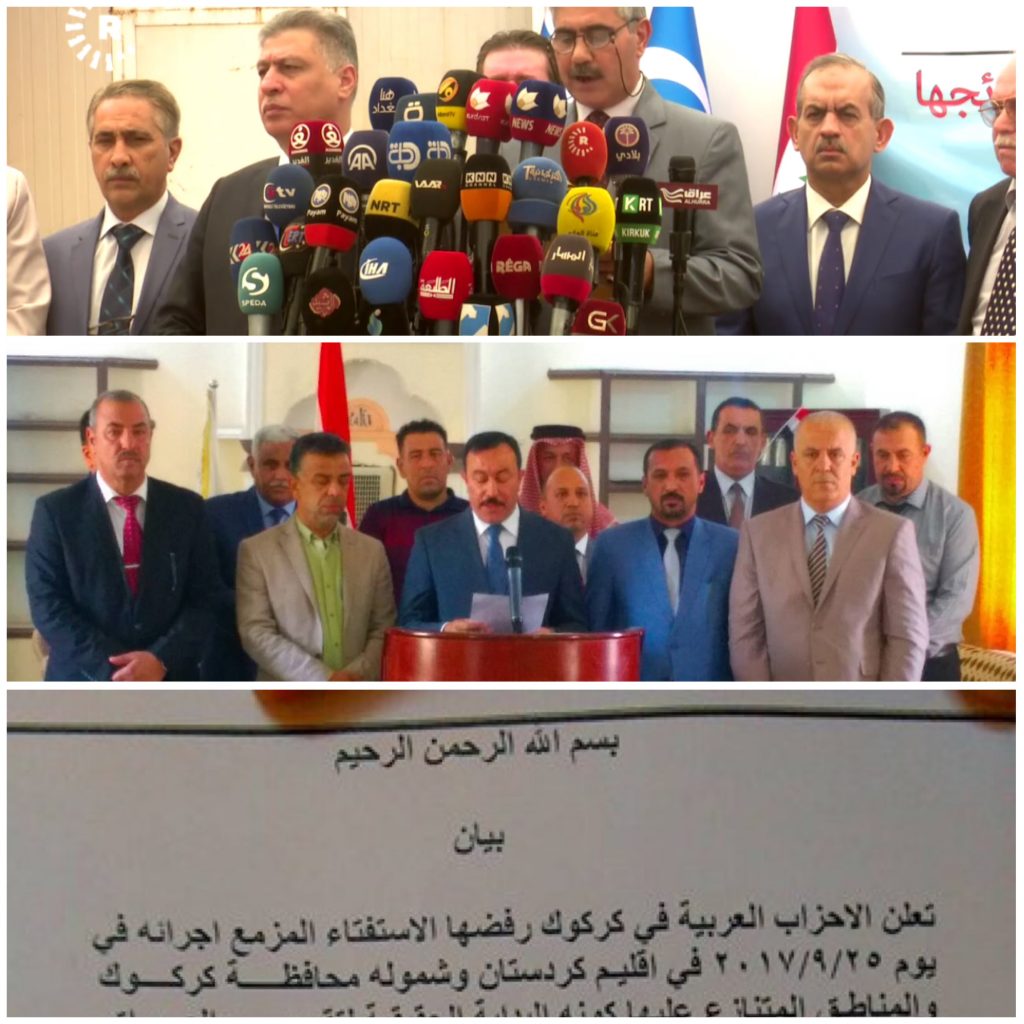
  • 13 Arab and 7 Turkmen Party of Kirkuk boycotted the referendum in Kirkuk due to the illegality

    13 Arab and 7 Turkmen Party of Kirkuk boycotted the referendum in Kirkuk due to the illegality

    In the statement that published by the Turkmen parties and the Kirkuk Arab parties on Saturday it has been mentioned that approving the referendum by the Kirkuk Provincial Council in the absence of the Turkmen and Arab parties of this province on 29/8/2017 is illegal and it is on the contrary to the constitution of Iraq.

    Meanwhile, Mas`oud Barzani has been conducting interviews with television agencies in recent days and interviewed with agencies such as Al Arabiyah, BBC Persian and several other agencies. The words used mostly by Barzani in these interviews was, “Kurdish readiness to use the weapons to hold Kirkuk,” “we want Kirkuk to be the symbol of ethnic and religious coexistence,” and perhaps it is most importantly, “the condition for postponing the referendum” .
    – “Kurdish readiness to use the weapons to hold Kirkuk,”
    These​ conditions and differences between parties and ethnic groups in Kirkuk, and since Kirkuk is now officially affiliated with and part of the central government of the country.
    With Barzani’s threat that they will use weapons to keep Kirkuk and his stubbornness the city will not have appropriate status after this referendum…

    – “We want the kirkuk to be the symbol of ethnic and religious coexistence.”
    The Kirkuk Provincial Council is composed of 41 seats, without the participation of Turkmens and the majority of Arabs on 29/8/2017, the Kurds of this association with 26 seats, were able to vote in a referendum in Kirkuk,  It is also one of the signs of the lack of coexistence and the abuse of being the majority in this province.

    – “The condition for postponing the referendum”
    While Barzani faced with a lack of international support (other than the Israeli, Saudi and Emirati regimes), and faced with the opposition of the central government of Iraq, Turkey, Iran, the United States and other European countries as they say this referendum should not be hold or should be postponed.
    Several times he has asked for a guarantee to postpone referendum to another time on another date, in reply to a journalist asked “how may you accept to postpone the referendum” he said that to approve of not holding a referendum setting another date in the Iraqi parliament can be one of these guarantees.
    *While the referendum has no legitimacy so far, it can be one of the same excuses that many believe is to gain interests like the previous years from the central government.


    Barzani’s-led party, by using Eqlim’s(Iraqi Kurdistan) parliament as a weapon more than two years ago, prevented  from adopting several laws to adjust Eqlim’s department and prevented the entry of the parliament’s chairman from the Guran (change) party into the city of Erbil and the Parliament building and In practice, the doors of this parliament remains closed until today And the government that holds the presidency and its key ministries, manages the parliament without supervision.

    But this time Barzani, in order to legitimize his referendum, is now trying to activate the same parliament that he has shut down, but on one condition that the presidential of the Eqlim should not be voted, which has been opposed by several other parties.

    The latest news is that Barzani intends to use the method used to approve the referendum in Kirkuk, and through the Eqlim’s parliament and by gathering a majority of the members, despite the absence of the chairman and vice president of Parliament, legitimize this referendum.