In his social media posts, al-Zoubaidi made no reference to his formal role within Yemen’s internationally recognized government. Instead, he emphasized the historical ties between Russia and the people of southern Yemen, noting that the meetings focused on shared interests and potential cooperation in political and economic fields. He highlighted Yemen’s promising investment opportunities in sectors such as energy, mining, agriculture, and fisheries.
This visit is widely interpreted as part of al-Zoubaidi’s broader separatist agenda. While Rashad al-Alimi, chairman of the Saudi-backed Presidential Leadership Council, had previously visited Russia and met with President Putin, southern factions believe that strengthening ties with Moscow could help advance their goal of re-establishing an independent South Yemen.
Ahmed Al-Sharaa, head of Syria’s interim government, stated: “Today, we are in a new Syria, and we are rebuilding our relations with all nations, especially the Russian Federation. We honor all past agreements and this great history, and we strive to redefine and present the nature of these ties in a renewed way. We respect our shared history, and our goal is to strengthen relations based on Syria’s sovereignty, unity, and stability.”
The Kremlin meeting between Putin and Ahmed Al-Sharaa (Abu Mohammad Al-Jolani) marks a clear effort by Moscow to preserve and redefine its role in Syria’s political landscape following the fall of Bashar al-Assad’s government. Having supported Assad as a strategic ally for years, Russia now seeks to maintain its traditional influence within Syria’s new power structure through pragmatic diplomacy. The revival of the joint cooperation committee signals Russia’s intent to secure long-term economic and security presence in Syria.
Putin also stressed joint economic projects, food supply support for Syria, and collaboration in energy and infrastructure. This shift indicates Russia’s strategy to transition from direct military involvement to sustainable economic engagement—leveraging its political influence for strategic gains without incurring the costs of past military operations.
Senior Syrian commanders—including heads of air defense, artillery, and armored units—held joint meetings with Russian counterparts to discuss training, operational experience, and combat readiness.
The visit highlights the strategic military dimension of Syria-Russia relations, beyond politics. With key Russian bases in Syria like Hmeimim and Tartus, Moscow aims to secure its long-term presence by offering military support and specialized training to Syrian forces.
Syrian President Al-Assad held talks with his Russian counterpart Putin at the Kremlin in a surprise visit on July 25.
In the meeting with his Syrian counterpart, Putin pointed out that he had the opportunity to talk about the entire interactions between the two countries, saying: I would be very interested to ask your opinion on the situation in the region in general, which is unfortunately deteriorating, as well as on Syria, which is directly affected.
Putin expressed hope that the two sides could discuss trade and economic relations and promising trends and approaches in this regard.
President Al-Assad, for his part, underscored that his visit to Moscow today coincides with the 80th anniversary of the establishment of relationship between the two nations, which have undergone very difficult tests over the past decades, and that the relations between our two countries are based on mutual trust and maintaining this trust shows the maturity of both the Syrian and Russian nations.
In light of the events that are taking place around the world and in the Eurasian region, our meeting today is very important to discuss the situation and the details of developments, prospects and possible scenarios, Assad stressed.
In this meeting, in addition to discussing regional tensions and the current situation in Palestine and the Red Sea, the two sides exchanged views on ways to resolve the military and political crisis in Yemen, and emphasized the efforts of influential countries and international organizations to hold negotiations between the various political factions of Yemen.
Russian and Yemeni officials also condemned the US-UK airstrikes against Yemen, considering their measures as the root cause of insecurity and instability in the West Asia region
The visit and meeting of the Ansar Allah movement’s officials in Russia is not a new development, as there have been multiple meetings and discussions between Abdul-Salam and Bogdanov in recent years. However, the significant aspect of this visit is the formation of this meeting in this volatile period of time.
The common ground between the Ansar Allah movement of Yemen and the Russian Federation lies in their opposition to US projects in the West Asia region, and Moscow considers direct military engagement by the Ansar Allah movement with the US-led coalition in the Arabian Sea and the Red Sea as highly important.
It can be considered that the Russian Federation’s main goal is to keep the US and the European Union occupied in this region, while the Ansar Allah movement’s main objective in this relation is to gain legitimacy and attract support from the Russian government regarding internal issues of Yemen and the future decisions to be made by the United Nations Security Council.
At the beginning of the delegation’s work, wreaths and flowers were laid at the Tomb of the Unknown Soldier in Alexander Garden.
The official part of the bilateral talks took place at the Command of Land Forces, where the Iranian military delegation met with Oleg Salyukov, the commander-in-chief of the Russian ground forces. Sides discussed issues of military cooperation and interaction aimed at implementing projects, the goals of which were improvement of the combat readiness of the armed forces of both countries.
“Iran is considered by the Russian Federation as one of the key states in the Middle East and Iran is Russia’s strategic partner, and constant intensive political dialogue is a characteristic feature of the current stage of our partnership,”‘ stressed Commander-in-Chief of the Russian Armed Forces Land Forces General Oleg Salyukov.
The parties reached agreements on further enhancing cooperation between the land forces in various fields. Also, during this trip, the Iranian delegation is going to visit the military training institutes of the Russian Ground Force and defense industry companies.
During the visit, the delegation is to visit military educational institutions of Russian Land Forces and defence industry enterprises.
According to the Ministry of Defence of the Russian Federation, Ukrainian drones tried to attack some targets in capital Moscow early this morning (August 1, 2023).
Two drones were destroyed over the areas of Naro-Fominsk and Odintsovo in Moscow and the third drone was shot down by electronic warfare, and as a result of the operation, the third drone hit one of the towers of Moscow.
The building had also been attacked by Ukrainians two days ago.
The air-strike is the third drone attack by Ukraine on Moscow in the past ten days, but it has not resulted in severe casualties and damage.
Ukraine’s goal of repeating such attacks is to transfer more insecurity and threats into the Russian soil; so, to this end, Moscow seems to be the best target to pursue the objective.
Pictures of the place where the wreckage of the Ukrainian drone hit a building in MoscowThe moment the Ukrainian drone hit a building in MoscowThe moment the Ukrainian drone arrived in Moscow
According to Russian news sources, the capital city of Moscow was attacked by several Ukrainian UJ-22 suicide drones at dawn today. The Russian army air defense systems reportedly managed to destroy some of these drones and some others hit residential buildings.
The Russian Ministry of Defense stated the number of attacking drones as eight, five of which were shot down by the Pantsir short-range air defense systems and the other three with electronic warfare.
The Ukrainian army drone attack did not result in any casualties; However, the drones hit several buildings and caused minor damage in the residential areas of Moscow.
The city of Moscow is located 470 kilometers from the northern borders of Ukraine and has rarely been attacked since the onset of war. During the past days, the Russian army has continuously attacked the city of Kiev with drones and missiles; Hence, the Ukraine attack on Moscow can be considered as Ukraine’s retaliationary response to Russia’s attacks.
A quadrilateral meeting of the foreign ministers of Iran, Russia, Turkey and Syria was held in Moscow on May 10 with the aim of reviewing the developments in Syria and resolving the differences between Ankara and Damascus. One of the important achievements of this meeting was the meeting between the foreign ministers of Turkey and Syria for the first time after 12 years since the start of conflicts in Syria.
At the beginning of this meeting, Russian Foreign Minister Sergey Lavrov described the meeting of the foreign ministers of Turkey, Syria, Iran and Russia as important and said: “We have continuously moved to achieve this result. The process of normalizing relations between Turkey and Syria creates new opportunities for the Astana meeting to resolve the Syrian crisis. The beginning of the normalization process between Turkey and Syria has a positive effect on the situation in the region and the Middle East in general.”
Moscow quadrilateral meeting
The Russian Foreign Minister further proposed the development of a road map within the framework of the process of normalizing relations between Ankara and Damascus and said: “The road map for the settlement of the Syrian case should be prepared for the next meeting of the foreign ministers of Turkey, Syria, Iran and Russia, and then to be presented to the presidents.”
At the end of this meeting, a joint statement was issued by the four countries. In this statement, it is stated that according to the UN Security Council Resolution 2254 and the official statements in the Astana process, the participants reaffirmed their commitment to the territorial integrity of Syria, non-interference in internal affairs and the fight against all forms of terrorism, separatism and extremism. The participants also agreed that the deputy ministers of foreign affairs should undertake the task of designing a road map to advance relations between Turkey and Syria in coordination with the ministries of defense and intelligence chiefs of the four countries.
Al-Assad, who is visiting Russia in an official trip, emphasized that Damascus supports Moscow in the Ukraine war, adding that this is his first visit to Russia after the onset of the conflict.
He underlined that he reiterates Damascus’ support for Moscow in the war against Nazism, which is backed by the West.
According to the Syrian president, the Syrian nation appreciates the Russian government and people for their commitment in respecting sovereignty and territorial integrity of Syria.
Al-Assad went on to say that he is grateful for Russia’s aides in the recent earthquake in Syria in particular the Russian Defense Ministry and Army who played a key role in assisting the quake-hit Syrians.
Today the return of balance in the world is necessary, he said, warning that otherwise, the world would lead to explosion, bloodshed and destruction.
We are happy with the results of the joint committee of Russia and Syria, the Syrian president said, noting that his visit to Moscow will be the onset of a new phase of relationship between Moscow and Damascus.
Putin, for his part, expressed satisfaction with al-Assad’s visit to Russia, saying that we are constantly in touch and we witness a great progress in the ties of the two states.
Unfortunately, the people of Syria were subjected to the earthquake calamity, which deteriorated their pains, the Russian president said, adding that we as the loyal friends of the Syrians will do our best to decrease their woes.
According to the Russian chief executive, thanks to joint efforts made by the two countries and the firm contributions by armed forces of Russia in Syria, remarkable results have been achieved in the fight against terrorism, and these efforts pave the way for stabilizing social, economic and political circumstances in the Arab country; so, the bilateral ties is continuously developing and the trade exchanges are growing.
It is noteworthy that Bashar al-Assad arrived in Moscow, heading a high-ranking delegation, on March 14. The Syrian president was welcomed by Deputy Minister of Foreign Affairs of the Russian Federation and Special Presidential Representative for the Middle East and Africa Mikhail Bogdanov, Russian Ambassador to Syria is currently held by Aleksandr Yefimov and Syrian Ambassador to Moscow Bashar Jaafari upon his arrival at an airport in the Russian capital.
On December 28, the defense ministers of three countries, Russia, Turkey and Syria, held a tripartite meeting in Moscow and discussed issues related to the solution of the Syrian crisis, migrants and the fight against terrorism in Syria.
According to the announcement by the Russian Ministry of Defense, in this meeting, solutions to the Syrian crisis were discussed and the need to continue the dialogue to achieve stability in Syria was emphasized. After this meeting, the defense ministers of Russia, Syria and Turkey pointed out the constructiveness of the talks and the need to continue the talks of the three countries in order to increase the stability of the situation in Syria and the whole region.
The Turkish defence ministry also announced in a statement that the Turkish defence minister Hulusi Akar and the head of its National Intelligence Organisation (MIT), Hakan Fidan, met Syrian defence minister Ali Mahmoud Abbas and Syrian intelligence chief Ali Mamlouk in Moscow along with Russia’s defence minister Sergei Shoigu on Wednesday.
It should be noted that after eleven years, this is the first time that the defense ministers of Syria and Turkey meet each other. Holding this meeting simultaneously with the threats of the Turkish authorities to start a new ground operation in northern Syria with the aim of clearing the border areas with Syria and confronting the Kurdish militias is considered as an important and strategic measure. An action that can determine the future of the battles in Syria.
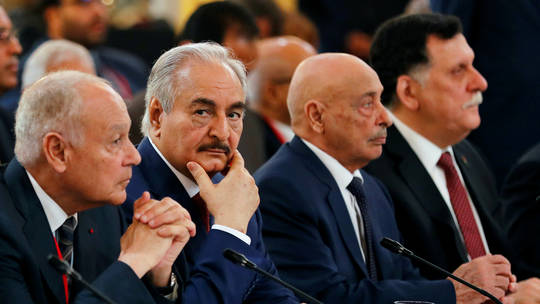
Due to the enforced ceasefire by Russia and Turkey on their supported parties in Libya, yesterday General Haftar and Fayez al-Sarraj travelled to Moscow for the preliminary talks. Both sides reached agreement apparently but General Haftar asked time until today to investigate the issue before signing it and finally he walked out on them and returned to Libya.
According to Erdogan, Haftar fled from Moscow not to sign the ceasefire. He expressed conditions that were not acceptable by Turkey and GNA. He said: If Haftar continues his attacks we won’t hold back from answering his actions.
Next Sunday, Turkish, European, African and Arabic leaders will talk about Libya issue in Berlin conference.