Tag: Pakistan

  • Pakistan Army’s Air Attack On Hotel In Eastern Afghanistan

    Pakistan Army’s Air Attack On Hotel In Eastern Afghanistan

    According to local sources, the Qari Zadran Hotel is the venue of meetings and gatherings of militants of the Hafiz Gul Bahadur group, a subsidiary of the Tehrik-e-Taliban Pakistan (TTP); so, after its recent threats, the Pakistan Army bombed the militants’ positions once again.

    The Taliban government of Afghanistan has not yet officially reacted to the air attack, but spokesman for the Taliban security command in Kabul Khalid Zadran stated sarcastically that the outcome of bloodshed in Afghanistan would be similar to the outcome of the occupation of the country by the United States and the Soviet Union.  

    Pakistani media Aaj News (a 24-hour Pakistani news television channel) also confirmed the Pakistan Army’s air attack on the gathering venue of militants under the command of Hafiz Gul Bahadur in Khost city, citing the number of casualties of the Tehrik-e-Taliban group as much as 20 militants.

    Pakistani officials have repeatedly warned the Taliban government in recent days that if the Taliban do not act against terrorist groups that threaten Pakistan’s interests from Afghanistan’s soil, the government in Islamabad will use all its might to target terrorist groups’ hideouts and bases in Afghanistan’s territories in order to protect its national interests.

    In the latest case today during a ceremony to celebrate Pakistan’s Independence Day in capital Islamabad, Chief of Staff of the Pakistan Army Lieutenant-General Asim Munir asked the Taliban caretaking government for the last time to prevent terrorist groups from entering and attacking Pakistan from Afghanistan’s soil, otherwise the Pakistan Army will attack these groups’ hideouts and bases in Afghanistan.

    Thus, it is likely that the most recent air attack was carried out by the Pakistan Air Force by the use of their unmanned combat aerial vehicle (UCAV).

    Read more: Infographic: Airstrikes On Taliban Positions In Afghanistan

  • Baloch Separatists Attacked Chinese Engineers In Gwadar, Casualties Were Reported

    Baloch Separatists Attacked Chinese Engineers In Gwadar, Casualties Were Reported

    The attack was carried out by the BLA Majeed Brigade. In this attack, two Balochistan Liberation Army militants and four Chinese nationals were killed and 13 Pakistani security forces were killed and wounded.

    This is not the first time Balochistan Liberation Army (BLA) has targeted Chinese nationals working in Pakistan. On 26 April, 2022, a female BLA suicide bomber exploded herself near a car carrying Chinese nationals near Karachi University, killing three Chinese nationals and one Pakistani.

    It is worth mentioning that the Balochistan Liberation Army terrorist group has carried out 188 operations during the year 2022, which has resulted in the death of 369 Pakistani servicemen and the injury of 155 others.

    Read more: Report On The Activities Of Balochistan Liberation Army In 2022

  • Over 250 Killed, Injured In Terrorist Attack In Bajaur

    Over 250 Killed, Injured In Terrorist Attack In Bajaur

    ISWNews Analysis Group: Following a terrorist attack at a public rally of the Jamiat Ulama-e-Islam Pakistan party, which is led by Maulana Fazlur Rehman, in Bajaur District of Malakand Division of Khyber Pakhtunkhwa province in Pakistan, 40 people, including Maulana Ziaullah Jan Haqqani who is one of the senior leaders of the Jamiat Ulama-e-Islam Pakistan party, were killed and more than 200 other civilians were injured.

    Senior Pakistani officials and figures have condemned the terrorist attack.

    Zabihullah Mujahid, spokesman for the Taliban caretaker government in Afghanistan, also strongly condemned the terrorist attack at the rally of supporters of the Jamiat Ulama-e-Islam Pakistan party in a statement and described the act as a crime against humanity.

    Despite media speculation against Tehreek-e-Jihad Pakistan and even the ISIS terrorist group, none of these groups has yet claimed responsibility for the terrorist attack.

    Moreover, some local and anti-government sources in Pakistan believe that such attacks have been orchestrated by the Pakistani army’s intelligence agency dubbed the Directorate-General for Military Intelligence of Pakistan with the aim of creating tension and separation among religious sects in the country as well as diverting the conflicts to Afghanistan.

    The moment of the explosion in the gathering of Jamiat Ulama Islam in Bajaur district
  • Top Commander Of Tehrik-E Taliban Pakistan Assassinated In Eastern Afghanistan

    Top Commander Of Tehrik-E Taliban Pakistan Assassinated In Eastern Afghanistan

    ISWNews Analysis Group: On July 13, unidentified gunmen assassinated Qari Mohammad Dawezi, the highest field commander of the Tehrik-e Taliban Pakistan (TTP) and one of the close associates of leader of the (TTP) Omar Khaled Khorasani, in Sharan city, the center of Paktika province located in eastern Afghanistan.

    Qari Mohammad Dawezi, known as Mohammad Ibrahim, comes from the Kurram District of ​​Khyber Pakhtunkhwa province and is an important field commander of the Pakistani Taliban Movement.

    He is trusted by the leader of the group and is also a member of the leadership council of the terrorist group Jamaat-ul-Ahrar Pakistan.

    Read more: Tehrik-i-Taliban Pakistan And The Jamaat-ul-Ahrar Group

    Mia Jafar and Qari Qadim were also his two brothers who were killed in Taliban clashes with US/NATO forces in Afghanistan.

    The Pakistani government set a prize of one million Pakistani rupees for providing any information about his hideout.

    It should be noted that the Taliban government has not commented on the killing of Qari Muhammad Dawezi, the commander of the Tehrik-e Taliban Pakistan in Paktika province.

    Dawezi was probably assassinated by order of Pakistan’s Inter-Services Intelligence (ISI) with the aim of retaliating a terrorist attack on an army base by elements of the Afghan Taliban group or other factions opposed to him in the Tehrik-e Taliban Pakistan.  

    General Asim Munir Ahmed Shah HI, Chief of Staff of the Pakistani Army, threatened militants from Pakistan’s Taliban Movement and other terrorist groups on Afghan soil that they would take revenge on them during a visit to the wounded personnel from an armed attack by the Jihadi Movement of Pakistan (TJP) on an army base in Balochistan province on July 12.

    Read more: Identification Of Formation And History Of Activities Of Tehrik-E-Taliban Pakistan

  • Shia Communities Of Parachinar, Takfiri Tribes Reconcile

    Shia Communities Of Parachinar, Takfiri Tribes Reconcile

    Five days after heavy attacks by Takfiri tribes and militant groups against Shia communities in the villages of Pawar, Boshra Bangash, Dandar, Khar Kalay and Balish Khel located in the Parachinar town, the mediation by the local tribal council (Jirga-e-Qaumi) consisted of 30 elders from Shia and Sunni tribes in the Kohat, Orakzai and Hangu regions led to a ceasefire and a five-article peace treaty was signed on July 14.

    According to the peace treaty between Shia and Takfiri tribes in Parachinar town, all fronts and trenches of the warring parties will be handed over to the Pakistani army and every party, which violates the ceasefire, will not be forgiven.

    Furthermore, in case of violation of one of the clauses of the peace treaty, the violating party will be fined 120 million Pakistani PKR.

    The conflict between Shia and Takfiri tribes kicked off on July 9, and three days later.
    Following the arrival of more than a thousand Taliban militants from Afghanistan and other Takfiri groups from eastern border regions of Afghanistan into Kurram District, the clash was accompanied by an increase of attacks by Takfiri groups to most Shia-populated areas in Parachinar town.

    As a result of the attacks, 14 Shia people, including several children, were martyred.

    Read more: Siege Of Shia Muslims Tightened In Parachinar

  • Second Fatal Raid By Tehreek-E-Jihad Against Pakistan Army In Balochistan + Video

    Second Fatal Raid By Tehreek-E-Jihad Against Pakistan Army In Balochistan + Video

    ISWNews Analysis Group: As a result of the attack by militants of the Tehreek-e-Jihad Pakistan (a subsidiary of the Tehreek-e-Taliban Pakistan) on a Pakistani army base in the Zhob area of Balochistan province, 29 Pakistani soldiers and 5 militants of Tehreek-e-Jihad Pakistan were killed and wounded.

    This is the second lethal raid by militants of Tehreek-e-Jihad Pakistan (TJP) on a Pakistani army base in Balochistan province in less than four months.

    On May 12, militants of the group also assaulted a border military base of the Pakistani army in the town of Muslim Bagh, located in the Killa Saifullah District of Balochistan province, killing more than 30 Pakistani soldiers. During the raid some six militants from Tehreek-e-Taliban were also killed.

    Video: Clash of TJP militants with Pakistan Army
  • Siege Of Shia Muslims Tightened In Parachinar

    Siege Of Shia Muslims Tightened In Parachinar

    ISWNews Analysis Group: In continuation of the armed conflicts between Takfiris and Shia tribes in Parachinar town, hundreds of armed Taliban militants from Afghanistan as well as other Takfiri groups crossed the border areas of Mirzaki, Mangal Karkin and Mangal Aryon in Dand Aw Patan district of Paktia province to the Shia-populated area of ​​Pewar in the western parts of Parachinar town, the center of Kurram Agency, which is located in Kohat Division of Khyber Pakhtunkhwa province.

    Takfiri terrorists, who are mostly militants from groups affiliated to the Taliban both in Afghanistan and Pakistan, besieged the Shia-populated area of ​​Pewar from four sides, and attacked the area twice in less than 12 hours using light and heavy weapons. It seems that they are likely to be Lashkar-e-Jhangvi and al-Qaeda terrorist organizations, with approximately 1,000 to 1,500 armed members.

    A number of attacks by Takfiri terrorists on Shia tribes have also been reported in Karkala and Balish Khel regions.

    According to local sources, since the onset of the armed clashes between Takfiri groups and Shia tribes, at least 12 people have been killed and 42 others injured.

    Parachinar conflicts – click to view in full size

    It should be noted that recently the Tehrik-e-Taliban Pakistan (TTP) group denied involvement in the Parachinar clashes and its members’ involvement in this tension in a statement, emphasizing the existence of secret intelligence agencies behind these clashes.

    However, close relations between the Tehrik-e-Taliban Pakistan, an umbrella organization of various militant groups operating along the Afghan–Pakistani border has issued a statement, ruling out any involvement of the group and its members in the recent confrontations in Parachinar town.

    The TTP underlined that some intelligence agencies have been involved in the armed clashes; however, it denied accusations on the TTP militants’ close ties with the Taliban caretaker government and the dispatching of Taliban militants and other Takfiri groups from Afghanistan to Parachinar town. Despite the denial statement by the Tehrik-e-Taliban group, the likelihood of participation of the terrorist group’s elements in the Parachinar clashes has been increased to the highest possible level.

    Read more: 6 People Killed In Takfiri Terrorists’ Raid On Pakistan’s Parachinar

    A picture of the bodies of the Takfiris of Kurram Agency district who were killed in the counter attack of Parachinar Shiites. In their messages, the Takfiris have called Parachinar Shiites terrorists and claim that Shiites have attacked Sunni families! But in fact, they were the initiators of this conflict, and the published images prove the false claim about Shia attacks on Sunni women and children.
  • 6 People Killed In Takfiri Terrorists’ Raid On Pakistan’s Parachinar

    6 People Killed In Takfiri Terrorists’ Raid On Pakistan’s Parachinar

    ISWNews Analysis Group: As a result of the escalation of land disputes between the Shia and Takfiri tribes of Boshahreh Bangash and Dander, the Takfiris besieged the Shia village of Peywar at midnight on July 9 and targeted the residents of the village with light and heavy weapons, which ended up in the martyrdom of one of the residents of the village and injury of several others.

    Following the fatal incident, Shia militants also attacked Takfiri positions, where they killed and injured several Takfiri elements.

    Because of the increase in armed clashes, Taliban militants also crossed from mountainous regions around the Tri-Mangal border crossing in Paktia province in eastern Afghanistan and raided Shia areas in support of Takfiri militants.

    The Takfiri militants, due to unresolved land disputes and high casualties in their recent clashes with Shia forces, asked their elders to declare jihad (religious fight) against Shia people and seek help from the Taliban forces and Afghanistan.

    At present, the armed clashes have temporarily subsided (until the end of Monday, July 10) as a result of mediation by the local tribal council (Jirga-e-Qaumi).

    Nevertheless, there are serious concerns about the expansion of clashes between Shia and Takfiri forces as well as the resumption of crimes by Pakistani-Afghan Takfiri armed groups against Shia population in Parachinar, which is a small Pashtun town.

    On the other hand, the arrival of Zainabiyoun Brigade to defend Shia tribes in Parachinar can also add fuel to the fire of armed conflicts and be a strong reason for declaring jihad and sending Takfiris from the region to the town.

    Furthermore, the intervention of Pakistani-Afghan Takfiri militant groups in sectarian clashes in Kurram Agency would deal a devastating blow to Islamabad’s government and could be the opening of a sectarian confrontation in other parts of the country.

    Direction of clashes between Takfiris and Shiites of Parachinar in Kurram Agency – click to view in full size
  • Identification Of Formation And History Of Activities Of Tehrik-E-Taliban Pakistan

    Identification Of Formation And History Of Activities Of Tehrik-E-Taliban Pakistan

    In the early 1990s, Hafiz Muhammad Saeed and Abdullah Azzam, two of Osama bin Laden’s mentors, the leader of the Al-Qaeda terrorist group, created another terrorist group called Lashkar-e-Taiba, and Maulana Sufi Muhammad set up the Tehreek Nifaz Shariat-i-Muhammadi group in Pakistan. Members of the extremist group were sent to Afghanistan along with Al-Qaeda members to fight against the then Soviet Union.
    After the victory of the Mojahedin-e Afghan in Afghanistan, these groups found the opportunity to create military training bases on both sides of the Durand Line ( forms the Afghanistan–Pakistan border, a 2,670-kilometre international land border between Afghanistan and Pakistan in South Asia) and built dozens of training bases in those areas. The bases of extremist groups such as Lashkar-e-Taiba, Jaish-e-Mohammed and Al-Qaeda were located in the Muridke area of Lahore province, Pakistan, under the supervision of Pakistan’s Inter-Services Intelligence (ISI), which trained paramilitary forces and transferred them into Afghanistan.
    All members of these groups were involved in the conquest of Afghanistan, because of the fact that members of these groups had participated in jihad (fight) against the communist government of Afghanistan and had sacrificed for the success of the Taliban Islamic Emirate in the war-torn country. Eventually, in 2007 the foreign conquerors of the Afghan war, who were consisted of 13 Pakistani militant groups, reached a conclusion to unite and found Tehrik-e-Taliban Pakistan (TTP) umbrella organization.

    The examination and identification of the Tehrik-i-Taliban Pakistan movement is not possible without referring to the history of the Taliban in Afghanistan. Because on the one hand, these two groups are linked to each other in terms of political structure and beliefs, and on the other hand, their hideouts, human resources, spiritual and military leaders have close ties with each other along the Durand Line.

    The term “Taliban” was originally used to describe a political and ideological group that emerged in 1994 in the border town of Spin Boldak, Kandahar province, located in southern Afghanistan, having its roots in a Deobandi Islamic school of thought as well as the Wahhabi belief. They conquered the important city of Kandahar with a fatwa of jihad from their spiritual leader Mullah Mohammad Omar Mujahid and then, they set out for the city of Jalalabad and the capital of Afghanistan, Kabul, in a bid to overthrow the then communist government in the country.
    At a time when the Taliban were engaged in jihad to overthrow the communist government in Afghanistan and then, it clashed with the Mujahideen government composed of Tajiks, Hazaras, and Uzbeks, the tribal areas of Pakistan, including North and South Waziristan districts, were their safe route and arms supply line. Following the Taliban’s three years rule over Afghanistan and the terrorist attack in the United States on September 11, 2001, some Western countries led by the US and NATO kicked off invading Afghanistan with Pakistan’s green light. Simultaneously with the attack by the US and NATO forces on Afghanistan in 2001, radical members of the Afghan Taliban, including the Uzbek Taliban, the Islamic Movement of Uzbekistan (IMU), the Chechen immigrants, the East Turkestan Islamic Party, as well as several Arab members of the Al-Qaeda terrorist group took refuge in northern and northwestern Pakistan (North and South Waziristan districts).

    Pakistan’s cooperation with the US in attacking Afghanistan, along with former Pakistani Prime Minister Pervez Musharraf’s order to besiege Pakistan’s tribal areas and arrest Al-Qaeda fugitives despite coordination with tribal elders, turn into a headache for the Pakistani army.
    The Pakistani army entered South Waziristan District in 2003 after five decades and it continued the military operations to North Waziristan District in order to arrest Al-Qaeda members. The killing of tribal elders and spiritual figures in these areas by the Pakistani army led to the first clash between the Pakistani army and the Afghan Taliban, Al-Qaeda, Lashkar-e-Taiba, Jaish-e-Mohammed, and armed tribesmen from North and South Waziristan districts in 2004. Those clashes led to the withdrawal of the Pakistani army from Waziristan and the tribes took control of these areas.

    The failure of the plan to set up an Islamic government in Pakistan as well as the sectarian and ethnic structure, the educational system of religious schools based on Wahhabism sect, the dispatch of Pakistani jihadi forces to Afghanistan, economic and social disorder, especially in North and South Waziristan districts, foreign and domestic support by anonymous individuals and various groups are among the reasons for the formation of the Taliban group in Pakistan.

    However, the drone attack by the United States’ Central Intelligence Agency (CIA) on a religious school affiliated to Tehrik-e-Nifaz-e-Shariat-e-Mohammadi in Bajaur Agency (District) in 2206, which caused several casualties, was the main cause of the emergence of the Tehrik-e-Taliban Pakistan. For the reason that it prompted all armed and radical groups in Pakistan to declare jihad against the US and the Pakistani government.
    In 2007, numerous militants from 13 groups, including Mullah Nazir’s group in North Waziristan District, Tehrik-e-Nifaz-e-Shariat-e-Mohammadi led by Sufi Muhammad, Jaish-e-Mohammed, Lashkar-e-Taiba, Al-Qaeda, Afghan Taliban fugitives and other groups with different races led by Baitullah Mehsud from North Waziristan District founded the Tehrik-e-Taliban Pakistan. They declared their goal as defending Prophet Muhammad’s religion, fighting against the Pakistani and the US army, and establishing an Islamic emirate with the focus on the Pashtun people in Pakistan.
    In 2008, leader of the Afghan Taliban Mullah Mohammad Omar Mujahid dispatched a delegation led by Mullah Abdullah Zakir to Pakistan and asked for financial assistance from the Pakistani Taliban. Mullah Mohammad Omar Mujahid also asked the Pakistani Taliban to put aside their differences and to help him fight the US and NATO by sending troops.
    Baitullah Mehsud, Hafiz Gul Bahadur and Mullah Nazir who had a history of fighting in Afghanistan accepted the proposal of the leader of the Afghan Taliban and pledged allegiance to Mullah Mohammad Omar Mujahid; so, they formed a council of mujahideen union. However, this council did not last more than a year and did not have any specific performance.
    The clash between Tehrik-e-Taliban Pakistan and the army of the country was not very intense until 2007. But in 2007 to 2009, the volume of clashes intensified sharply. So, all military operations of armed groups against the Pakistani army from 2001 to 2007, which were about 30 operations and the volume of operations reached 269 attacks from 2007 to 2009. These clashes mostly took place in Khyber Pakhtunkhwa tribal areas and other border regions witnessed fewer tensions.

    The most important operation of the Pakistani Taliban can be considered the assassination of former prime minister and leader of the Pakistan People’s Party Benazir Bhutto. The assassination was carried out on December 27, 2007 by a suicide bomber named Karamatullah Bilal from Pakistani militants; he also had a history of membership in the Al-Qaeda terrorist group. After firing several bullets at Bhutto, he carried out a suicide operation and took the lives of 22 people, including Benazir Bhutto.
    However, Al-Qaeda denied any involvement in the suicide attack and eventually, Baitullah Mehsud, leader of the Pakistani Taliban, was identified as the first suspect in the assassination of Benazir Bhutto. In the following months, he was wanted by the government of Prime Minister Pervez Musharraf due to other terrorist attacks until he was killed in a drone operation by the US Central intelligence Agency (CIA) in North Waziristan in 2009.
    However, his death was not confirmed by the spokesman for the Tehrik-e-Taliban Pakistan and the cause of his death was stated as illness. Two days after the death of Baitullah Mehsud, the 42-member council of the Taliban appointed his deputy Hakimullah Mehsud as the leader of the group. He intensified jihadi operations against the army and government of Pakistan as well as the expanded attacks against Shia civilians. Then, he was killed in a drone attack by the US Central Intelligence Agency in North Waziristan District in 2013. After the death of Hakimullah Mehsud, the 42-member council of the Taliban also appointed Maulana Qazi Fazlullah Hayat as the leader of the Tehrik-e-Taliban Pakistan.

    The deadliest military operations of the Tehrik-e-Taliban Pakistan movement against the Pakistani army and government took place on December 16, 2014. In the attack, five members of the Pakistani Taliban entered the country’s Defense Ministry’s military university in Peshawar province, while wearing uniforms. As a result of the attack, 149 military students who were children of army soldiers were killed and 122 others were injured.
    After these attacks, the Pakistani army tried to enter into talks with the Tehrik-e-Taliban Pakistan movement. Following the first sessions of talks between government representatives and the TTP, Maulana Omar’s sect separated from the Tehrik-e-Taliban Pakistan movement to show their objection. At the end of 2014, Mehsud’s sect also announced its separation from the Tehrik-e-Taliban Pakistan movement and it established a branch of the Tehrik-e-Taliban in South Waziristan District. This separation dealt a heavy blow to the organizational structure of the Tehrik-e-Taliban Pakistan movement and even despite the joining of the Jamaat-ul-Ahrar group led by Omar Khalid Khorasani to the Tehrik-i-Taliban Pakistan movement, their situation did not improve much.

    Read more: Tehrik-i-Taliban Pakistan And The Jamaat-ul-Ahrar Group

    The most important operations against the Pakistani army positions can be considered as an attack on PNS Mehran Air Station in Karachi and a 15-hour-long clash with the military forces that resulted in the killing of 13 Pakistani soldiers and the destruction of several military aircraft. The second deadliest attack of the decade also took place in 2016. In this suicide attack, which was carried out by a member of Jamaat-ul-Ahrar terrorist group (a subsidiary of the Tehrik-e-Taliban Pakistan) at a ceremony honoring Christmas in an amusement park in eastern Lahore province, more than 70 Pakistani Christians were killed and injured.

    After Qazi Fazlullah Hayat was killed by the US forces in Kunar province in eastern Afghanistan and the second leader of the Tehrik-e-Taliban Pakistan movement Khalid Mehsud was killed by the American forces in Paktika province in Afghanistan in 2017, another commander of Tehrik-e-Taliban Pakistan named Noor Wali Mehsud from Mehsud tribe in South Waziristan District was appointed as the new leader of Tehrik-e-Taliban Pakistan movement.
    Noor Wali Mehsud was from Miran Shah town of South Waziristan District, who had studied religious lessons in Faisalabad area of Punjab province. He is one of the most radical leaders of Tehrik-e-Taliban Pakistan who participated in the war between the Afghan Taliban and the United Front or Northern Alliance (Ahmad Shah Massoud and …). After Noor Wali Mehsud was appointed as the leader of Tehrik-e-Taliban Pakistan, Mehsud’s sect also rejoined Tehrik-e-Taliban Pakistan movement after three years.

    Currently, Tehrik-e-Taliban Pakistan movement cooperates with various sub-branches militant groups throughout this country and foreign groups from the Haqqani Network to the Jaish ul-Adl. The active members of the group are estimated to be between 20k to 25k people, and 6 thousand of whom have been sent to help the Afghan Taliban.

    At the same time when the US forces withdrew from the war-stricken country of Afghanistan and the downfall of the Afghan government in Kabul on August 15, 2021, the Tehrik-e-Taliban Pakistan movement, which was under pressure from the Pakistani army, entered into talks with the government in Islamabad with the mediation of Sirajuddin Haqqani, leader of Haqqani Network.
    During these negotiations, representatives of the Tehrik-e-Taliban Pakistan movement demanded the implementation of the Islamic laws and traditions in Pakistan’s tribal areas as well as the release of prisoners affiliated to the Taliban sect, who have been arrested by the government forces. The requests were accepted by the Pakistani government and a short-term ceasefire was established following the negotiations. But shortly afterwards, the government in Pakistan did not take any action to implement the demands and then, the Taliban resumed their attacks and as a result of this situation, the attempts for reconciliations doomed to fail.

    In general, it seems that achieving a sustainable peace in Pakistan is a difficult path. Because the country’s society is still facing incorrect tribal cultures and the so-called Islamic government has not been able to meet the expectations and values of an “Islamic government” that was pursued by the groups such as the Tehrik-e-Taliban Pakistan movement. On the other hand, the Pakistani army has the first say in the country’s nationwide programs and their anti-terrorism plan has so far caused more than 18,000 casualties on the Tehrik-e-Taliban Pakistan movement and other groups. Given such conditions, talking about sustainable peace in Pakistan is nothing more than a slogan.

    Author: Ahmad Alavi, correspondent and analyst of Afghanistan and Central Asia

  • Tehrik-i-Taliban Pakistan And The Jamaat-ul-Ahrar Group

    Tehrik-i-Taliban Pakistan And The Jamaat-ul-Ahrar Group

    The Tehrik-i-Taliban Pakistan (TTP) is a group made up of multiple tribal, geographical, and ideological offshoots, who has a complicated relationship between its central leadership and different factions.

    The complexity is not only dependent on the atmosphere in which the Tehrik-i-Taliban Pakistan (TTP) exists, but also on how the group was formed as well as its goals, its relationship with Afghanistan’s Taliban on the one hand and the Pakistani government on the other; moreover, the formation of the Tehrik-i-Taliban Pakistan in 2007 as a result of a gathering of 13 large and small groups, which adds to the complexity of the group’s relationships.

    Those groups that make up the Pakistani Taliban today include Lashkar-e-Islam (LeI), Baloch Mazari Group, Jundallah Group, Jamaat ul-Ahrar (JuA), Ghazi Abdul Rashid Shahid Brigade (GARSB), Tehrik-e Taliban Punjab (TT Punjab), Musa Shaheed Karwan group, Amjad Farooqi Group and Hakimullah Mehsud Group.

    Among these groups, Jamaat-ul-Ahrar (JuA) has always had a complex and fluid relationship with the central command of the Tehrik-i-Taliban Pakistan as an effective faction within it.

    It can be said that following the killing of first leader of the Tehrik-i-Taliban Pakistan (TTP) Baitullah Mehsud in 2009 and also the killing of Hakimullah Mehsud, who was the second leader of the Pakistani Taliban, in 2013, as well as the Mehsud tribe’s failure in keeping on the leadership of the TTP and the next leadership under Fazlullah Khorasani, who did not come from the Mehsud tribe but came from Swat region, doubled the complexity of internal relations of the Tehrik-i-Taliban Pakistan.

    Read more: Identification Of Formation And History Of Activities Of Tehrik-E-Taliban Pakistan

    One of the consequences of the withdrawal of leadership from the Mehsud region and tribe was the separation of different groups from the Tehrik-i-Taliban Pakistan. Among the main issues was Omar Khalid Khorasani, a leading commander of the Mohmand Agency in the Tehrik-i-Taliban Pakistan and leader of Jamaat ul-Ahrar, who did not tolerate Fazlullah Khorasani’s leadership and separated from the Tehrik-i-Taliban Pakistan in 2014.

    Some sources also claim that Fazlullah Khorasani, then leader of the Tehrik-i-Taliban Pakistan, expelled him from the movement due to Omar Khalid Khorasani’s relations with groups, which are more extremist than the TTP.

    Prior to the event, Omar Khalid Khorasani, who had more heart for Salafi jihadist groups than other movements, tried to mediate between the ISIS and Jabhat al-Nusra terrorist groups in Syria through Jamaat ul-Ahrar’s exclusive media outlet dubbed “Revival of Caliphate”. In fact, it seems that Omar Khalid Khorasani had warm relations with leaders of the Orakzai Taliban especially Hafiz Saeed Khan [also known as Mullah Saeed Orakzai] who joined the ISIS and became Emir (leader) of ISIS in Khorasan. However, as a result of the killing of Fazlullah Khorasani in 2018, the leadership of Tehrik-i-Taliban Pakistan once again went to Taliban of the Mehsud region and specifically to Mufti Noor Wali Mehsud nicknamed Abu Mansoor Asim.

    Following the leadership of the Mehsud tribe over the Tehrik-i-Taliban Pakistan once more, Mufti Noor Wali Mehsud tried to bring the separated groups back to the movement, and among them, the paramilitaries of the Hakimullah Mehsud Group were the first group to return to the Tehrik-i-Taliban Pakistan.

    The Amjad Farooqi Group also returned to the Tehrik-i-Taliban Pakistan, as well as the Lashkar-e-Jhangvi’s (LeJ) Usman Saifullah group led by Mullah Khosh Mohammed Sindi, pledged allegiance to Noor Wali Mehsud. Later in 2020, Jamaat ul-Ahrar, led by Omar Khalid Khorasani, along with Hizb al-Ahrar led by Omar Khorasani, pledged allegiance to the Tehrik-i-Taliban Pakistan.

    Omar Khalid Khorasani was eventually killed on August 7, 2022 in Paktika province of Afghanistan by the United States’ drones. But his group still continues its existence and apparently under the leadership of Omar Khorasani, Omar Khalid Khorasani’s personal guard who had previously split from the group and formed Hizb al-Ahrar, simultaneously and in on one day rejoined the Tehrik-i-Taliban Pakistan.

    Following the killing of Omar Khalid Khorasani, the complicated relationship of Jamaat ul-Ahrar with Tehrik-i-Taliban Pakistan did not come to an end, but it even became more complicated.

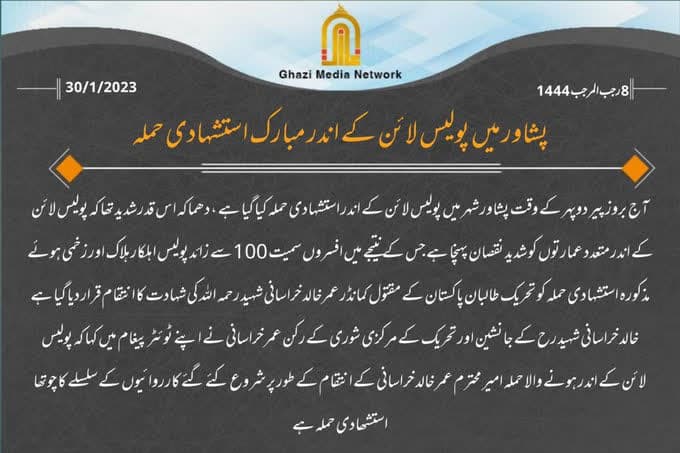
    The issue became more obvious after a series of operations by Jamaat ul-Ahrar under the name of taking revenge for Omar Khalid Khorasani’s blood, at the top of the revenge incidents was Police Lines Mosque operation in Peshawar, Pakistan’s Khyber Pakhtunkhwa province, on January 30, 2023.

    As a result of the suicide operation in Peshawar, a bomb exploded during prayer and at least 100 people were killed and more than 170 were injured. The Police Lines Mosque was located in the headquarters of the Pakistani security forces and residence of police officers; thus, most of worshipers and casualties of suicide attack were security forces and police staff.

    Hours after the terrorist attack, Omar Khalid Khorasani’s branch took responsibility for the bomb blast through issuing a statement and they considered it in revenge for the assassination of Omar Khalid Khorasani. But Mohammad Khorasani, spokesman for the Tehrik-i-Taliban Pakistan, underlined that operations against mosques and public places are wrong.

    The statement of Ghazi Media, the media arm of Jamaat-ul-Ahrar, about the operation of Police Lines Mosque in Peshawar
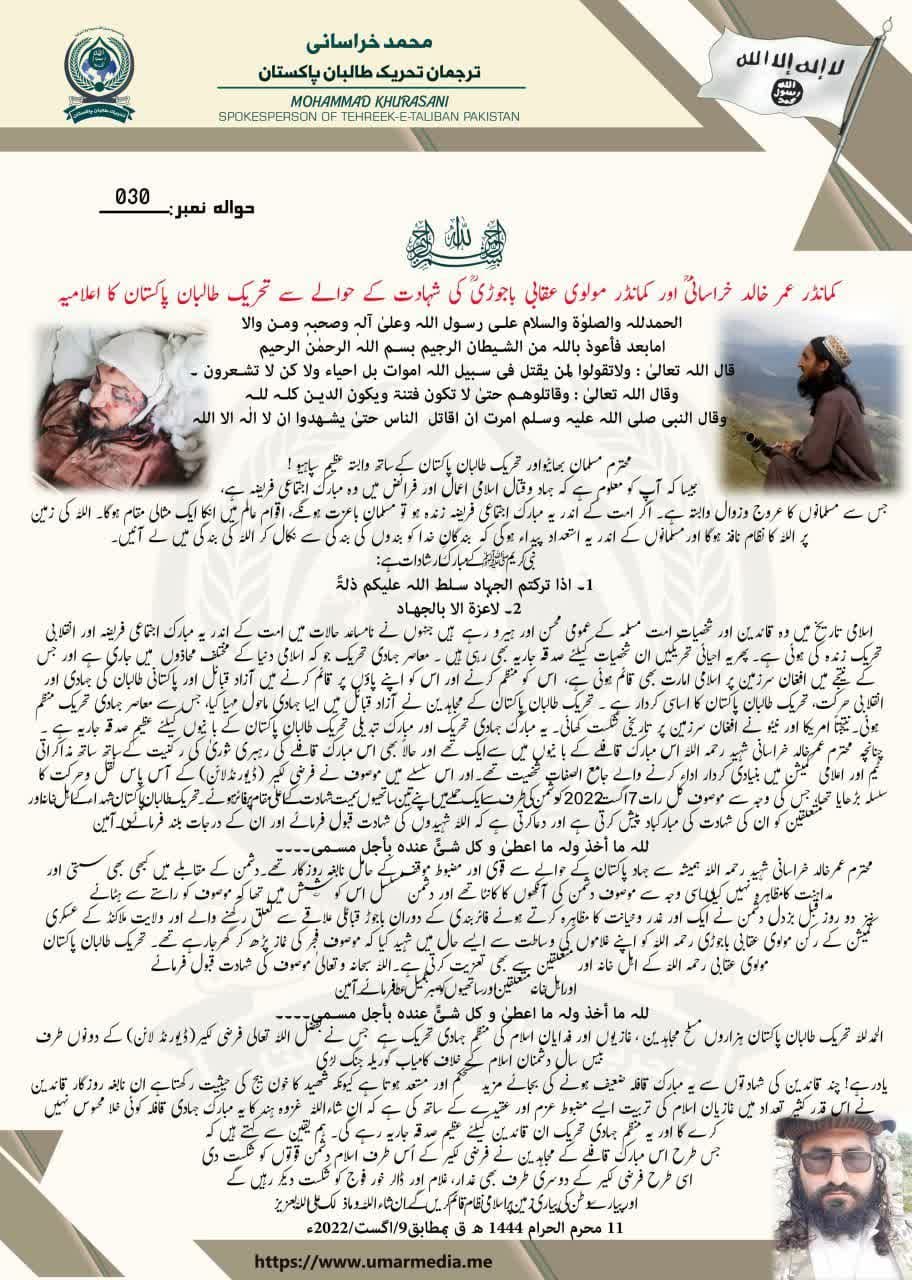
    The statement of Mufti Noor Wali Mehsud, the leader of Tehreek-e-Taliban Pakistan, regarding the killing of Omar Khalid Khorasani
    Omar Khalid Khorasani next to Shahidullah Shahid, who later becomes the second leader of ISIS Khorasan province

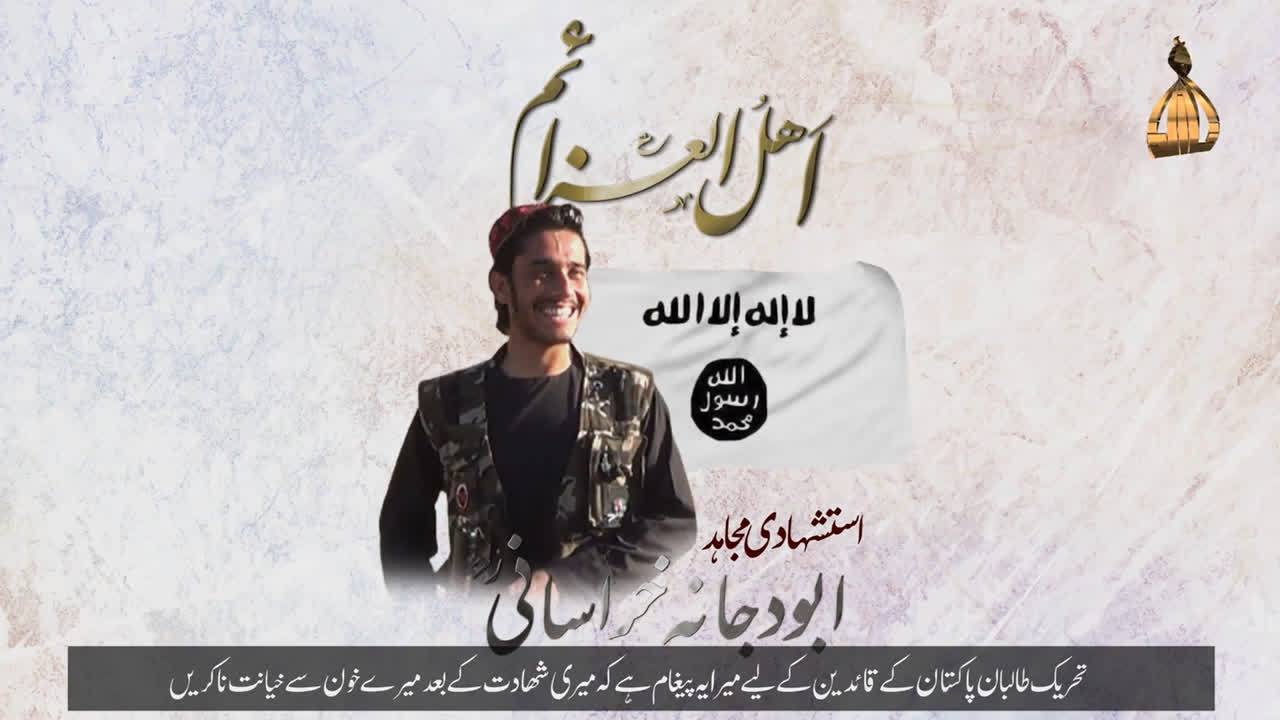
    Jamaat ul-Ahrar recently released a video from its new media outlet dubbed Ghazi Media that dealt with several suicide operations and considered all of them in revenge for the assassination of Omar Khalid Khorasani. Interestingly, the Peshawar Police Line Mosque operation was not among the highlighted operations in this video. Remarkably, in the final scenes of the film, one of the suicide elements named Abu Mallal al-Hummam Khalil Muhammad al-Balawi also known as Abu Dujana al-Khorasani, who spoke before his operation in Ghazi Media outlet, sent a message to the leaders of the Tehrik-i-Taliban Pakistan not to betray the blood of martyrs.

    In conclusion, it seems that complicated relationship between the Tehrik-i-Taliban Pakistan and Jamaat al-Ahrar would not end up in convergence even after killing of Omar Khalid Khorasani due to challenges facing the Tehrik-i-Taliban Pakistan in relation to Pakistani government in new circumstances on one hand and more extremist approach of Jamaat ul-Ahrar on other hand.

    Ahl al-Azaim movie poster showing suicide operations in revenge for the assassination of Omar Khaled Khorasani

    Author: Yasser Qazvini Haeri, ISIS and terrorism expert

  • Commanders Of Pakistan’s Jamaat-Ul-Ahrar Survive Assassination Attempt

    Commanders Of Pakistan’s Jamaat-Ul-Ahrar Survive Assassination Attempt

    ISWNews Analysis Group – As a result of the explosion of the homemade bomb at the location of the militants of the Jamaat-ul-Ahrar group, who are allies of the Pakistani Tehrik-i-Taliban Pakistan (TTP) in the Khogyakhil border area located in Goshta district of Nangarhar province, several militants of the JuA group, including Qari Imran Orakzai and Atif Mohmand were killed or wounded.

    According to local sources, Qari Imran Orakzai’s is in critical condition, but Atef Mohmand is reported to be suffering from minor injury.

    Jamaat-ul-Ahrar group is an ally and offshoot branch of the Pakistani Tehrik-i-Taliban Pakistan (TTP) that has several bases in Mohmand Dara city and Goshta districts in Nangarhar province as well as parts of Kunar province in eastern Afghanistan.

    After the assassination of leader of Jamaat-ul-Ahrar Omar Khalid Khorasani, who was also one of the founding members of the Tehreek-i-Taliban Pakistan, on August 7, 2022 by the United States, another scenario was that the Tehreek-i-Taliban Pakistan might be behind his assassination.

    Therefore, the possibility has been raised again for the killing of two senior commanders of Jamaat-ul-Ahrar, and some sources pointed to the Tehreek-i-Taliban Pakistan as responsible for the assassination of Qari Imran Orakzai and Atif Mohmand.

  • Taliban Cmdr. Killed In Afghanistan, Pakistan Border Clash

    Taliban Cmdr. Killed In Afghanistan, Pakistan Border Clash

    ISWNews Analysis Group – As a result of the border clash between Taliban military personnel and Pakistani border guards on June 25, at the Angur Ada border crossing between the South Waziristan of Pakistan’s Khyber Pakhtunkhwa and Afghanistan’s Paktika Province, six Taliban forces, including intelligence commander of the Taliban’s 203 Mansoori Corps Qari Sibghatullah Takal as well as five Pakistani soldiers were killed and injured.

    This is the twelfth border clash between the Taliban and Pakistani border forces since the group came to power in Afghanistan.

    The last confrontation between Taliban military staff and Pakistani border guards occurred on February 20, 2023 at the Torkham border crossing located in Mohmand Dara district in Nangarhar province, where a Pakistani soldier was injured; then, trade activities at the crossing were suspended by Pakistan for several days.

    Read more: Infographic: Taliban Border Clashes With Neighboring States Of Afghanistan

    Every time following such incidents the Taliban officials pledge to observe international border laws and sack rogue military commanders, but they have not yet been successful in completely preventing such provocations by their border commanders.

    Angur Ada crossing and the direction of the border conflict between the Taliban and the Pakistan Border Guards