The images were taken during today’s joint operation by the Turkish army and terrorists against the Syrian army positions in Nayrab front near Saraqib.
This afternoon, the Turkish military, in clear violation of international law, launched joint artillery and ground attacks with various terrorist groups against the Syrian army in Idlib province. However, the attacks failed and two Turkish soldiers were killed.
Tag: Syria news
-

Video: Aerial footage of Turkish artillery attacks on Syria
-
Syria: Turkish-backed Militants Attack Repelled Completely!
According to the latest news from the Idlib front, the Syrian army has repelled the heavy attacks of Tahrir al-Sham and Turkish-backed forces by destroying seven tanks, armored and military vehicles and inflicting casualties on the terrorists.
In this attack, Turkish troops directly supported the militants.
The Turkish Ministry of Defense also issued a statement announcing the deaths of two Turkish soldiers and five wounded in air strikes by the Russian and Syrian army in Idlib. The statement also cited the deaths of 50 Syrian Army personnel and the destruction of five tanks and four armored vehicles, which are not confirmed by the ground sources so far. -
Breaking: Two Turkish soldiers killed in Idlib
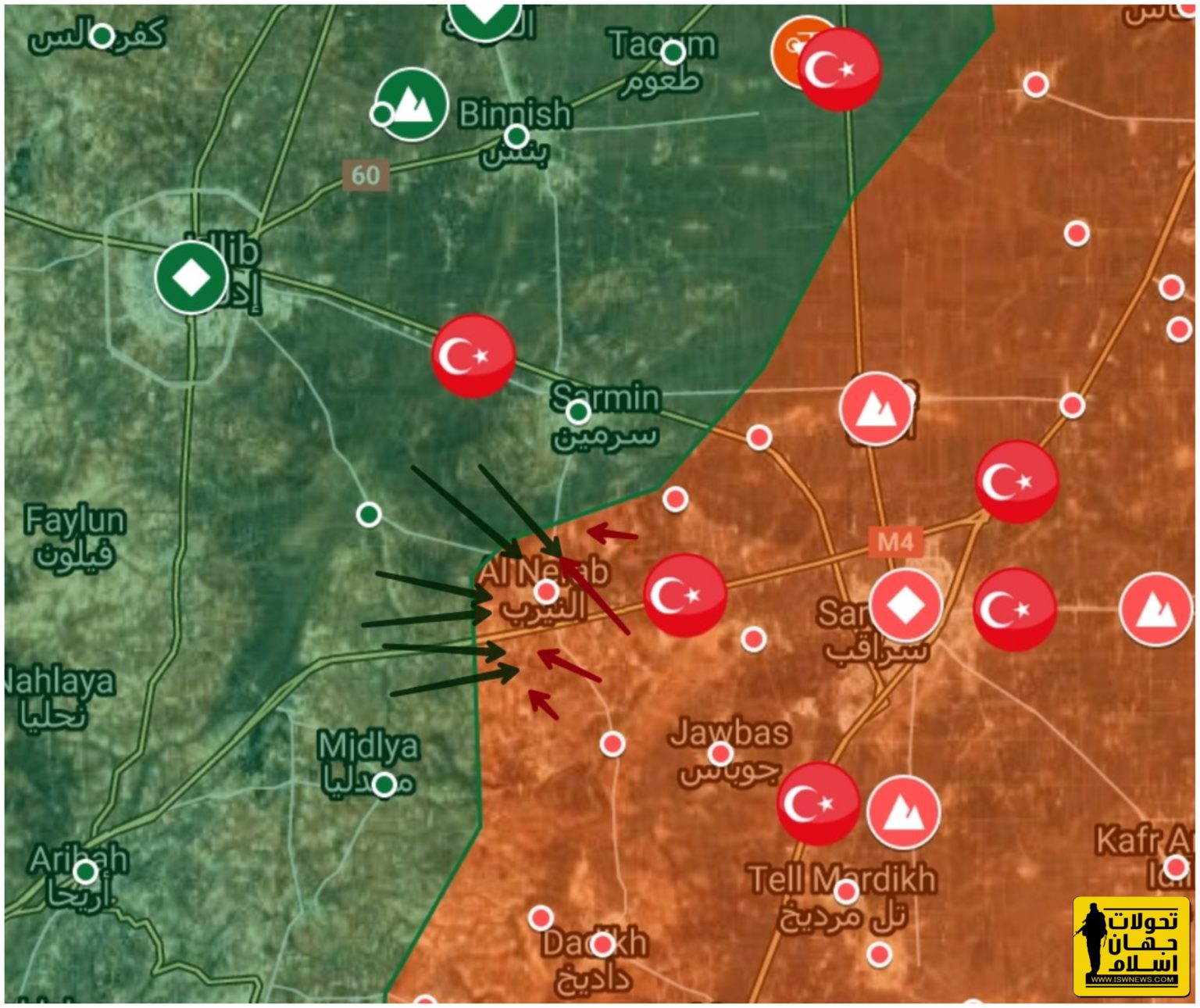
As of this afternoon, various terrorist groups with ground and artillery support from the Turkish army, have launched heavy attacks against the Syrian army’s positions on the Nayrab-Saraqib axis.
However, there has been no change in the field map so far and heavy clashes continue. -
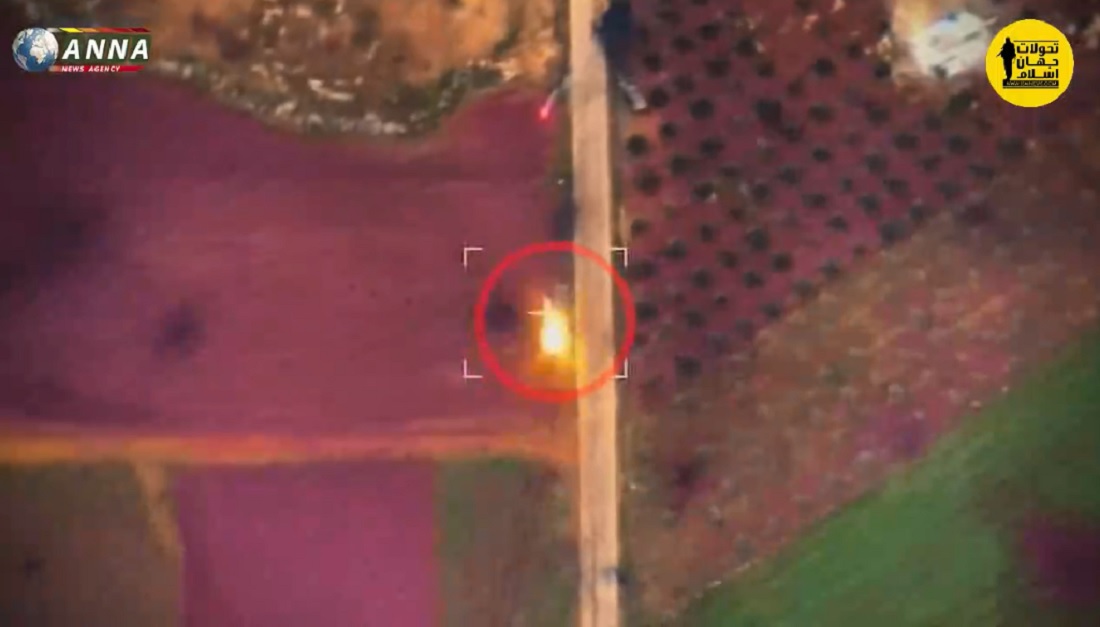
Video: Aerial images of hunting down terrorists in southwest Aleppo
Following the Syrian army advances along the M5 highway towards Aleppo and the liberation of various areas, including Kafar Halab and Miznaz which are located on the old road of Idlib-Aleppo; terrorists have repeatedly tried to push the Syrian army back from the Kafr Halab. But the constant monitoring and surveillance on terrorists movements in the area and the appropriate artillery and aerial cover helped the ground forces effectively to repel all attacks.
-
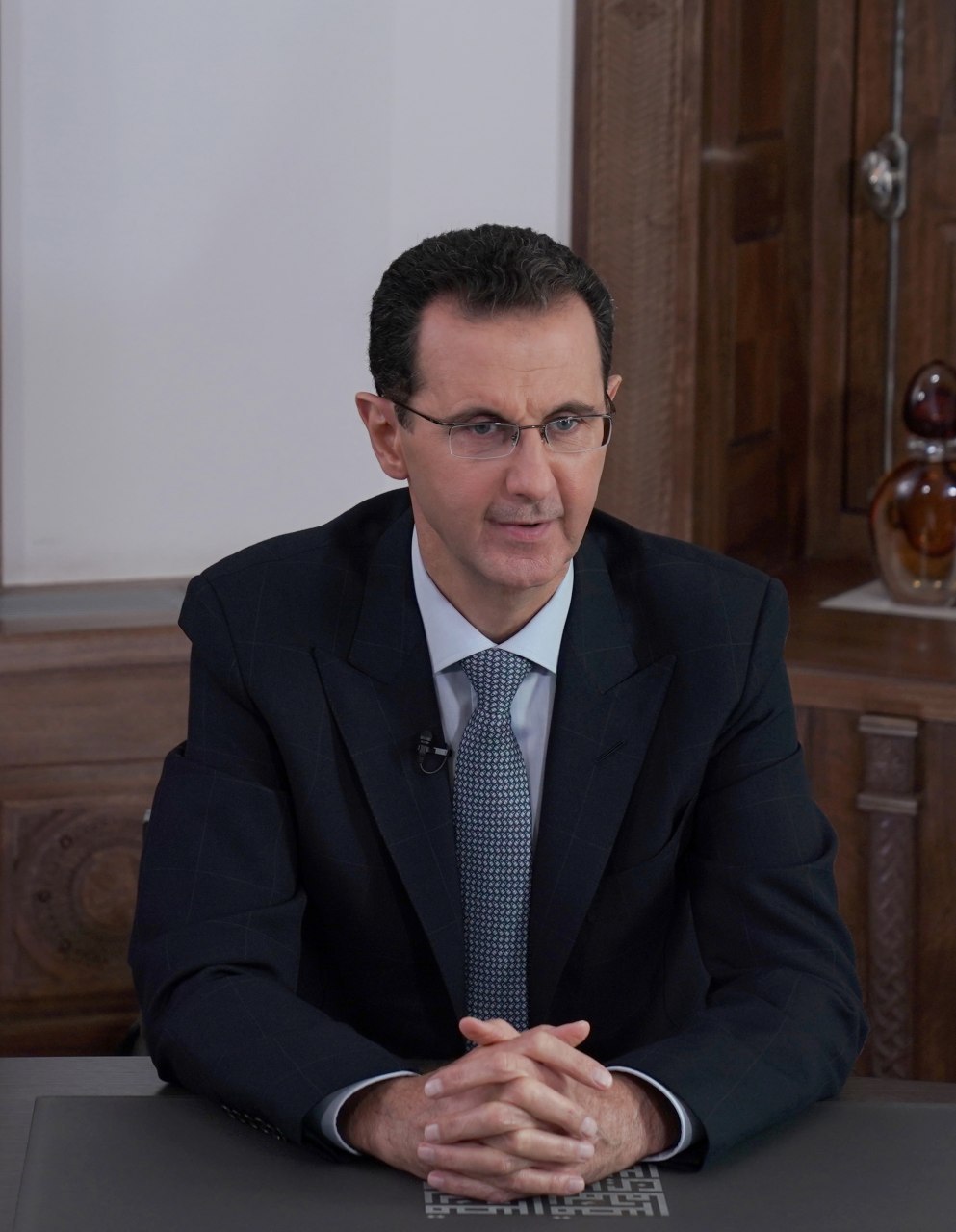
Bashar al-Assad: The nose of the terrorism will be rubbed in the dirt! + Video
Syrian President Bashar al-Assad said the military will not give up until it achieves total victory “sooner or later” and the “complete victory” is in sight.
Summary of Bashar al-Assad’s remarks:
– With every mortar that fell in Aleppo, fears gone away and the desire to resist increased. With every martyr who fell to the ground, his spirit grew, his patriotic spirit and faith in the country deepened. In the real world of the original Aleppo, the historic Aleppo remained rooted and authentic.
– Years of barbaric bombing and tens of thousands of martyrs and orphans, mothers who lost sons and widows, years of siege without water and electricity and other essential services of life, wanted to get Aleppo to his knees.
– Aleppo will rise from ashes of war and once again will regain its economic position in Syria.
– Victory in this operation does not mean victory in war, but in the patriotic logic, victory came from the moment when resistance began and based on this logic, Aleppo and Syria have won.
– This liberation does not mean the end of war and it does not mean the end of the schemes nor the end of terrorism or the surrender of enemies and it doesn’t mean our enemies will surrender, but it means that we rubbed their noses in the dirt as a prelude for complete victory and ahead of their defeat sooner or later.
– The operation for liberation of the outskirts of Aleppo and Idlib will continue regardless of the noises coming from the north; as the operation continues to liberate all Syrian territory and the complete defeat of the terrorists and the establishment of stability.
– I praise the brothers, friends and allies of Syria, they were shoulder to shoulder with the Army on the ground and in the air, and their blood was mixed with the blood of the Syrian Army and the soil of Aleppo was colored with their blood. -

Map: Investigation of the latest military situation in the Idlib region and the progress of the Syrian Army
1. What happened in Russia-Turkey talks?
Russians stated in the negotiation that Turkey did not obliged to Sochi agreement regarding differentiate between terrorists and opposition groups and built several new observation posts and deployed extensive force to Idlib. Russia considers the operation fighting the terrorism but did not close the negotiations and try to force the new conditions upon Erdogan.
Erdogan, on the other hand, started being unreasonable, threatened Syria and condemned Russia’s and Iran’s support for the operation.
2. Continuation of Syrian Army and allies operation:
Syrian Army and allies could so far liberate about 2,000 km2 in west of Aleppo and Idlib provinces and seven Turkish observation posts with more than 500 Turkish troops are besieged. This can reduce the risk of Turkey extensively assaulting Syria since besieged Turkish troops are the best target to answer any assault by Turkey.
As can be inferred from Bashar Assad and Russian officials statements, operation of northwest of Syria will continue at least until liberation of Idlib and possible scenarios and axes of engagement and advance are not clear. Syrian army can move toward border of Turkey and besiege terrorists or liberating towns one by one in Idlib and Aleppo push back them toward Turkey’s border.
Erdogan however by sending numerous troops and equipment to Syria is obviously looking to get more bargaining chips. Putin refuse to meet him or accept his proposal and continuation of the operation challenged Turkish policies fundamentally and Erdogan is facing dilemma of retreating or confronting.
Erdogan is aware of consequences (more refugees to Turkey, war extended to Turkey, etc.) of confronting Syrian army more, therefore, avoids having an open war with Syria for now. However wars start with miscalculation and Erdogan is not immune of it either.
We will hear more news of liberating new lands in Syria, unless Erdogan stops dreaming to pray in Umayyad Mosque and get along with Russia.
Click to see the full size map -

Map: Latest Military Situation in Western Aleppo
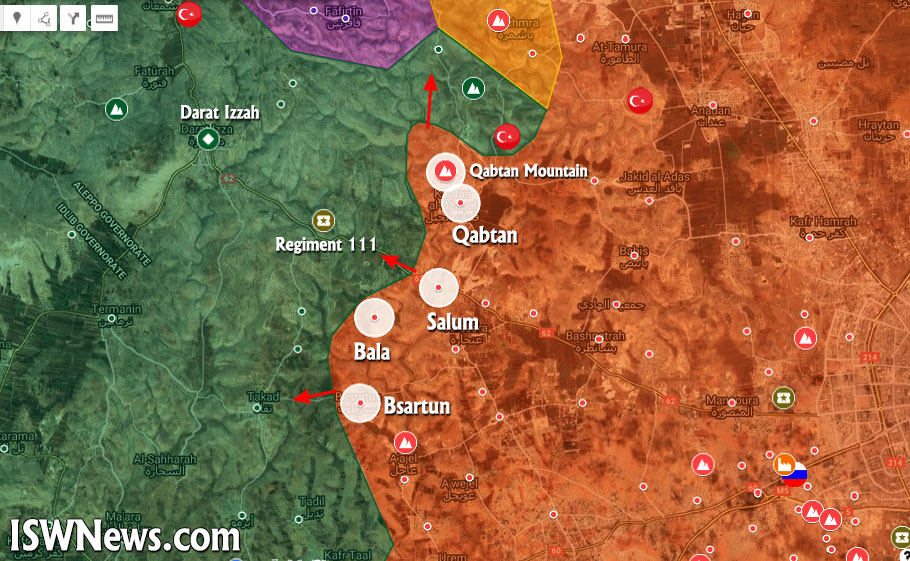
The most important areas liberated from today morning: Anjarah, Hawr, Qasemiyah, Salum, Bala, Basartun, Qabtan al-Jabal, Jabal mountain, Sheikh Aqil, Baqdaniya.
At the moment Syrian army forces are near Regiment 111 and after it, Darat Izza is not very far…Click to see the full size map -

Article: Damascus policy towards Syrian Democratic Forces and Arab tribes
From the beginning of crisis in Syria, to prevent the protests to expand and reach the biggest minority of the country, the government tried to collaborate and give space to Kurds of the area and Democratic Union Party (PYD) to prepare the situation for presence of military forces of the party in Kurdish inhabited areas. In the following sense, two months after the protests started in Syria in the middle of 2012, the government signed an agreement with the party and let them to come back to Syria. Near the end of 2012, Syrian government supported People’s Protection Units (YPG) after attack of opposition militias to Raas al-Ain town and left the service, security, military and economic affairs of Hasakah province, except the security square, to PYD.
Although Syrian Kurds, after expanding their reign over Kurdish and even Arabic areas located in East of Euphrates river called “Jazirah”, started the system of self-government under support of USA, but their relation with Syrian government was in the state not peace nor war. There were limited engagements between them for time to time but never became a full enmity.
In this situation, PYD (close to PKK in Turkey) as the main player of Kurds in Syria started the project of expansion and establishing Kurds in 2012 and from the beginning removed Kurdish National Council (ENKS), as the party close to opposition of Syria and Kurdistan Democratic Party (KDP) in Iraq (led by Barzani), from the battle.
In fact, in the battle between two idealogies of Barzani and Öcalan, PYD led by Öcalan won.
They established YPG as the military branch of PYD in March 2012 under command of officers from Qandil area as the first step and also formed the security and police forces of Asayish in the same year. In November 2013, formed self-government office in north of Syria, which divides the area ruled by Kurds to three cantons of Island, Kobani and Afrin and in 2014 three councils of lawmakers and executive to govern the three cantons.
In October 2015, they formed Syrian Democratic Forces (SDF) from Arabs, of east of Euphrates, Kurds and Assyrians, with proposal of then US special envoy in coalition entitled fighting ISIS and under support of the coalition.
However, the main player was still YPG and SDF was a distraction to avoid Turkey’s bad relationship with PKK forces. After establishment of SDF, Syrian Democratic Council (SDC) was formed as the political branch of it. Then in March 2016 SDF reported of a federal Kurdish government surprisingly which caused Syrian government and regional and international sides engaged in Syria to react negatively. However due to Turkey’s assault to Afrin area and occupying it, the issue of federal Kurdish government was suspended.
In 2018, Kurds stepped down from federal government and just formed self-government system in north and east of Syria by establishing local councils under the names of different regions. (Jazirah, Kobani, Manbij, Raqqah, Deir Ezzor, Tabqah, Afrin)
After the areas under control were expanded in east of Euphrates under support of USA, to manage the Arab-Kurd confrontation, SDF followed both attract and surpass policies using USA and Arabic capacities in Arabic tribes of the area.
On the other hand, to revive the sovereignty on east of Euphrates area, having an upper hand to manage their relationship with SDF and confront USA occupation of the area, Syrian government started to approach tribes of the area by holding numerous sessions in Hasakah town to attract nomads to themselves and confront USA plans in the area. Therefore, the title and agenda of these sessions were more about confronting USA occupation and plans of dividing Syria rather than sovereignty of Damascus on north and east of Euphrates. Currently and after Turkey occupied some parts and after the Sochi agreement between Turkey and Russia, the situation is ready for return of Syrian army and Russian police to some of the area. Even though the sovereignty of Syrian government has increased in some areas ruled by SDF, they still reject to join central government and relying on USA, they try to have more in their hands in future negotiation with Syrian government.
Therefore, Syrian government tries to use its pressure levers to manage Kurds and lower their bargaining ability in negotiations by approaching the chiefs of tribes there and giving privileges such as dropping charges against them, fixing some issues of local tribes, to make the younger generation to rebel against their chiefs and leave SDF and join the army.
In the same sense, after Ali Mamluk visit to Qamishli and meeting chiefs and seniors of tribes, a high committee representing Damascus met with Salih Muslim, the former co-chairman of PYD, in Qamishli.
In this meeting, the Damascus negotiating team offered the local administration which was contained in the reformed constitution in 2012, for the areas controlled by SDF but Kurdish team did not approve nor reject it. According to Faisal Azuz, presented in the negotiations, both sides tried to reach a plan between self-government and local administration plan that was mentioned in article 107 of the constitution.
In conclusion, Syrian government plan regarding Kurds and Arabic tribes of east of Euphrates is to have full sovereignty in the area and their tactic is to approach and attract Arabic tribes of the area, who are the majority, prepare the situation of division between Kurds and Arabs and eventually having upper hand in negotiations with Kurds. In another word, they want to use the tribes to bring Kurds close to the central government and reduce their demands in the negotiations. However, the primary issue of Syrian government at the moment is Idlib and east of Euphrates comes after it. -

Map: Syrian Army and Resistance axis great victory in Aleppo province
In today’s advances in west of Aleppo, an area of 180 km2 was liberated from terrorists. Also in the shortest distance, terrorist were repelled at least for 10 km from Aleppo city. The road of Aleppo to Nubl and Zahraa was liberated after many years eventually.
Some of the areas liberated today:
Biyanon, Tal Muasybin, Hayyan, Kafr Hamra, Andan, Hraytan, Maarat al-Artiq, Mallah, Al-Layarmun, Salat, Laf Dael, Yaqid al-Adas, Kafr Bissin, Babis, Bashantra, Bashqatin, Hutah and many other farms and hights and residental areas…
Maybe after liberating Aleppo city in previous years, today’s achievements can be as important as it. The liberated areas were occupied from early time of the war by terrorists and used as leverage by Turkey and militants against Syria.
Some of the areas liberated today remind us of bitter memories and those who lost their lives in the way of dignify and divine goals. Today’s victory would not be possible without their sacrifice. History never forgets them.
Interactive mapClick to see the full size map -
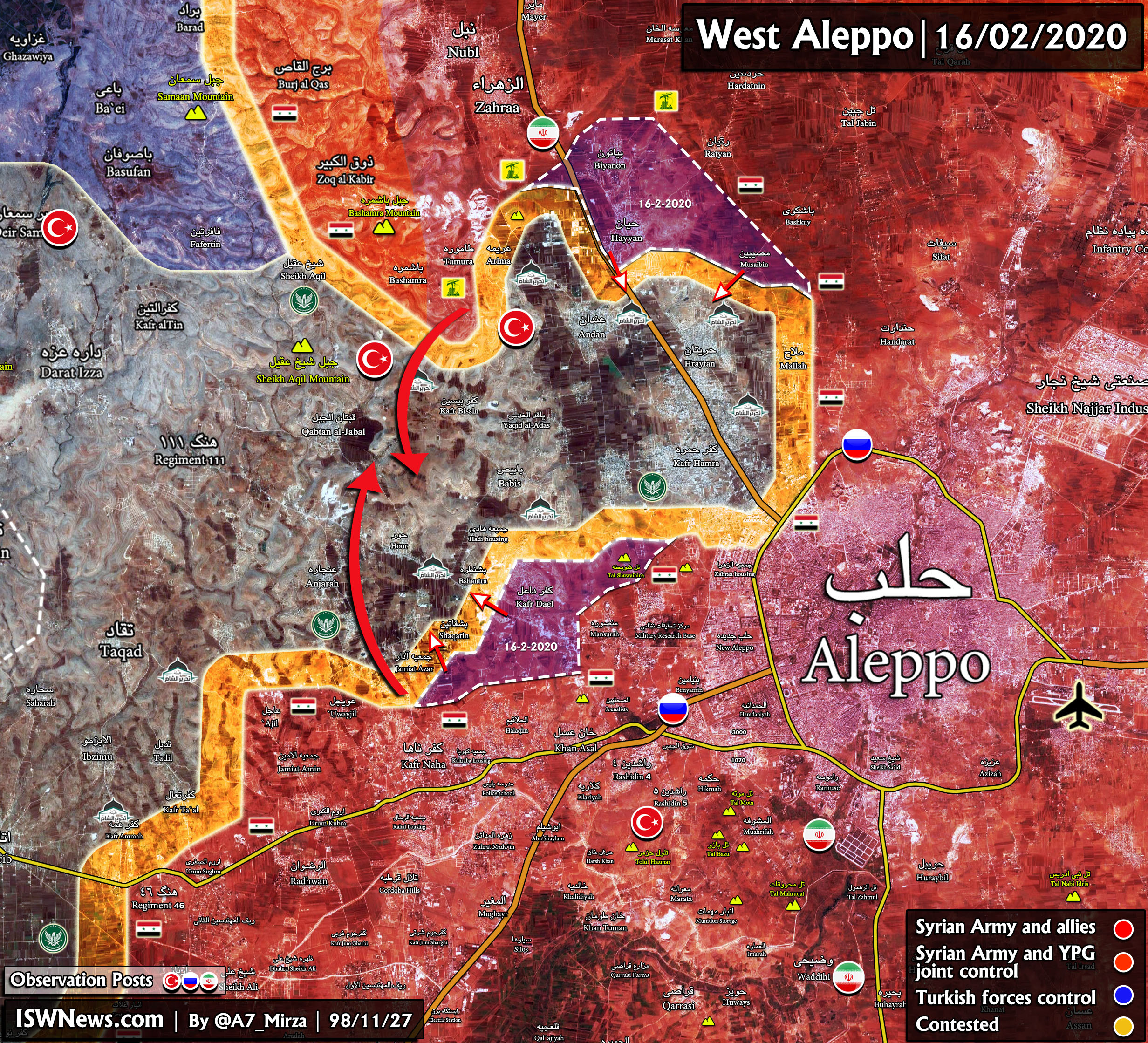
Map: Latest updates on military situation in west of Aleppo
Clashes are continuing in outskirts of Kafr Dael and Bashqatin. According to locals, terrorists are evacuating their positions in areas Kafr Hamra, Andan and Hraytan in northwest of Aleppo city and set ablaze some of their warehouses to destroy their documents and evidences.
Following the Syrian Army advances in west of Aleppo and closing the pocket in northwest of Aleppo, terrorists forced to evacuate and retreat from those areas. By liberation of these areas, the main road from Aleppo to Nubl and Zahraa will be cleansed after many years and terrorists threats and mortar attacks on Aleppo city will end forever.
In Kafr Halab axis on the other hand, for the several times terrorists attack to Miznaz and Kafr Halab was defeated. According to Syrian Army sources in this attack, more than 60 terrorists were killed.
There is news that there will be a ceasefire in Idlib area to evacuate civilians from Kafr Halab and Sarmin humanitarian corridors.Click to see the full size map