Author: Mirza

  • ISIS Attack And Alleged US-led Airstrikes Against Popular Mobilization Units In al-Jamouna Area At Syrian-Iraqi Border

    ISIS Attack And Alleged US-led Airstrikes Against Popular Mobilization Units In al-Jamouna Area At Syrian-Iraqi Border

    General info

    The desert area between Iraq and Syria has been controlled by radical jihadists for a long time. Both Syria and Iraq have been unable to secure this large area and it has become a foothold used by al-Qaeda and ISIS.

    As the ISIS influence had been growing, the roads in this desert area became an important supply line used by ISIS to transfer infantry, weapons and military equipment.

    With the start of the ISIS decline about a year and a half ago, the terrorist group made a special effort in order to maintain control over the desert. Constant Syrian and Russian airstrikes on ISIS targets and a lack of the support from local tribes were undermining the ISIS power in the area. At the same time, ISIS remained very powerful on the Iraqi side of the border even in 2017 when the key ISIS stronghold of Mosul was liberated in the country.

    The successes of anti-ISIS forces in Mosul, Palmyra, in central Syria and along the Syrian-Iraqi border and the start of the battle for Raqqah, ISIS increased operations in the Akashat desert.

    In genreal, ISIS conducts surprise attacks with one or several  suicide bomber then shell its opponents with heavy gun fire from multiple directions. Then, if the terrorist group wants to capture the area, ISIS infantrymen join the operation.

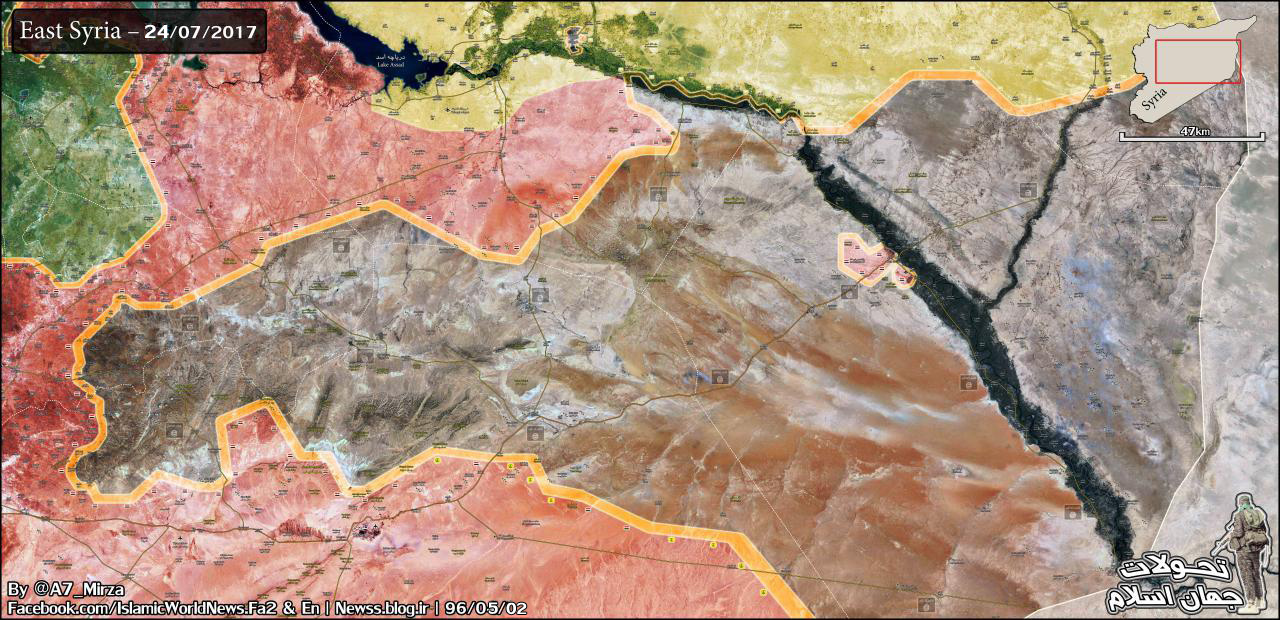
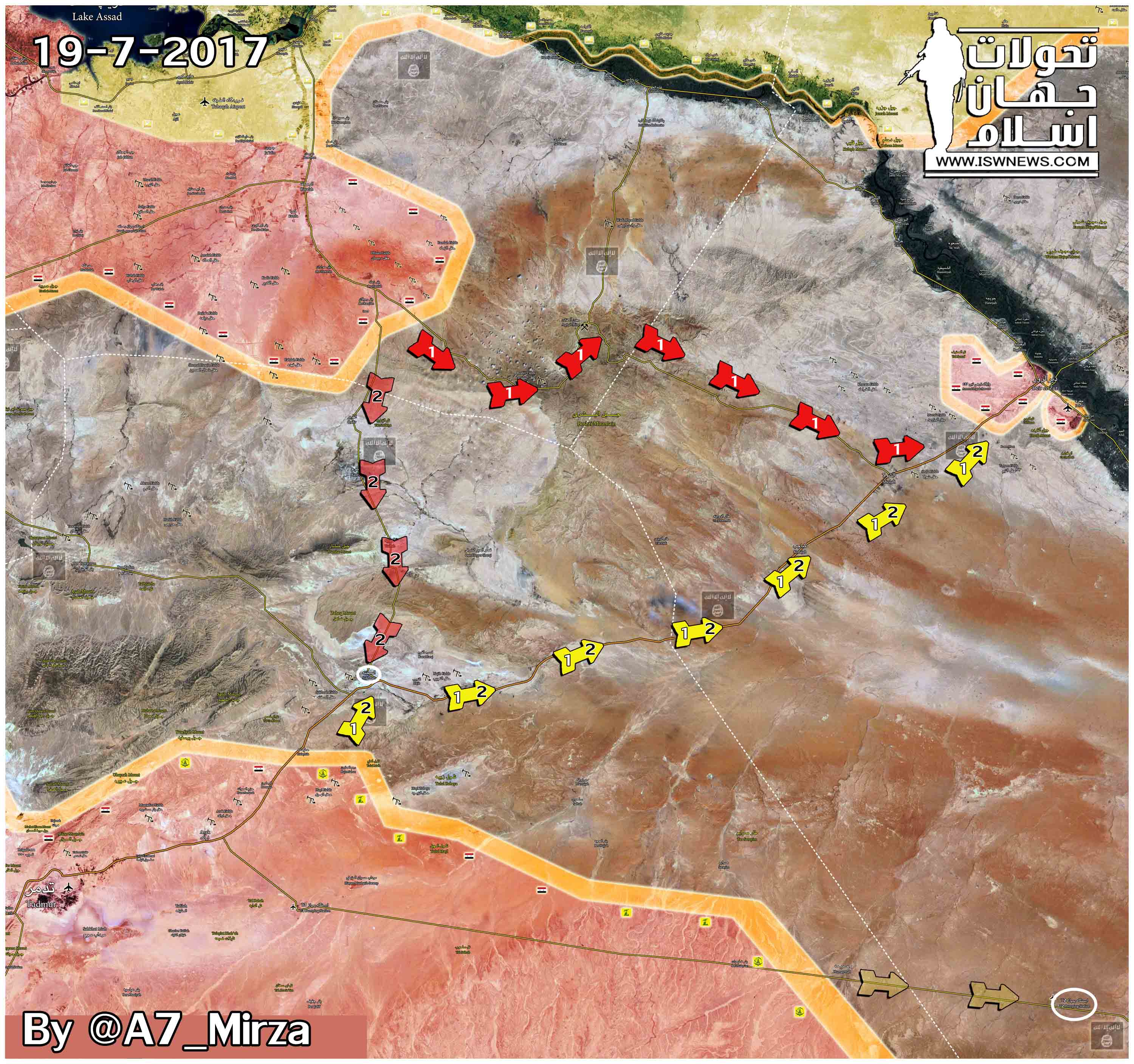
    The area of ISIS attacks in the Iraqi desert is highlighted (yellow) in the map below. ISIS has conducted at least 7 relatively large attacks the Iraqi army since the Syrian army and its allies reached the borders bypassing the al-Tanf area earlier this year.

    Review: ISIS Attack And Alleged US-led Airstrikes Against Popular Mobilization Units In al-Jamouna Area At Syrian-Iraqi Border

    Click to see the full-size map

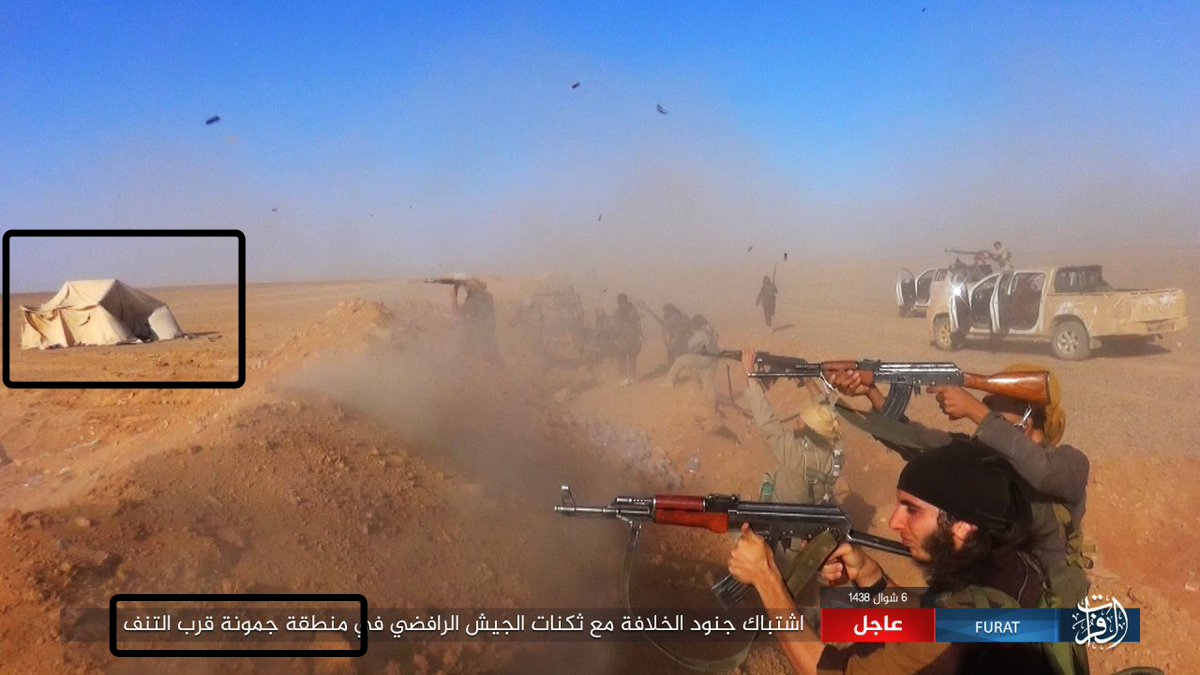
    One of the  previous attacks also took place in Al-Jamouna area. Following images show it.

    Review: ISIS Attack And Alleged US-led Airstrikes Against Popular Mobilization Units In al-Jamouna Area At Syrian-Iraqi Border

    Click to see the full-size image

    The US-led coalition bombing

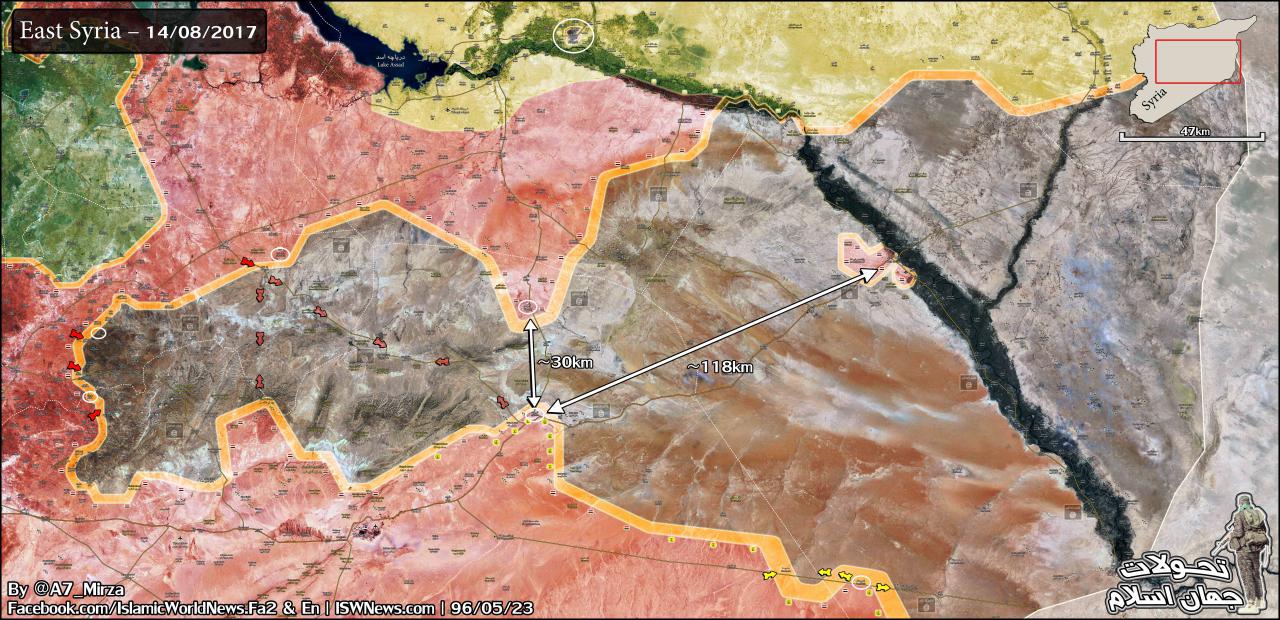
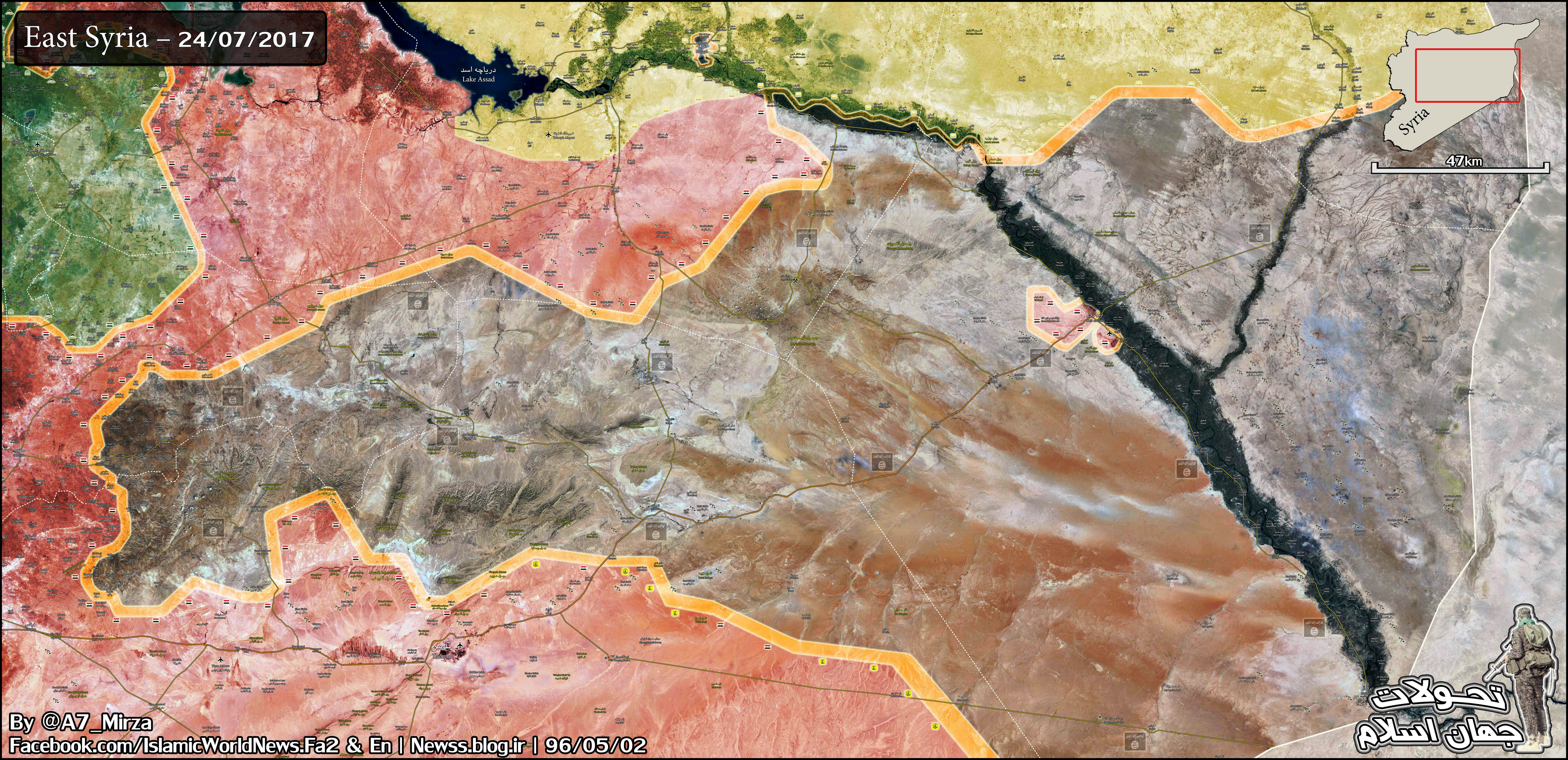
    The map below shows the overall situation in the area.

    According to the PMU statement and local sources the US-led coalition conducted military strikes on fortified positions of the PMU located about 2 kilometers from the Syrian-Iraqi border, inside Iraq. However, the ISIS attack took place in another place in the al-Jamouna area. ISIS repotedly advanced on the newly constructed positions (their exact location is unknown).

    Review: ISIS Attack And Alleged US-led Airstrikes Against Popular Mobilization Units In al-Jamouna Area At Syrian-Iraqi Border

    Click to see the full-size image

    Considering the available photos and videos, it’s possible to suggest that ISIS attacked PMU units working on establishing fortified positions in order to strengthen their presence in the border area.

    Pictures of the ISIS attack:

    Review: ISIS Attack And Alleged US-led Airstrikes Against Popular Mobilization Units In al-Jamouna Area At Syrian-Iraqi Border

    Click to see the full-size image

    ISIS photos and videos

    As usual, ISIS did not avoid releasing evidence that could increase the morale of its member. The ISIS video started with showing 15 dead ISIS fighters killed during the attack against the PMU. Thus, the real ISIS casualties could be higher. It’s clear that the ISIS media avoided releasing all info about the group’s casualties.

    In turn, according to various sources, between 40 and 80 PMU members were killed as a result of the ISIS attack and the alleged strikes of the US-led coalition.

    Review: ISIS Attack And Alleged US-led Airstrikes Against Popular Mobilization Units In al-Jamouna Area At Syrian-Iraqi Border

    Click to see the full-size image

    Conclusion

    Despite wide combat expirience, the resistance forces still has some weak points. Their enemies are well aware of these points and know how they can use them. At the same time, the resistance forces face some difficulties because they are composed mainly of voluntary and non-permanent forces.

    The forces gathering in an environment that increase their weakness is the biggest factor in this incident.

    In general, ISIS conducts its attacks when the resistance forces are the least vigilant. For example, a hour before the morning prayers involves the drowsiness of many forces and the provision of the adequate light. ISIS uses the element of surprise and engages with them in a close combat. Furthermore, ISIS has a wide expirience of clashes in desert areas.

    The ISIS video allows to see that the PMU had set up no fortifications to defend its forces. Although, the new base was under constructuion but even the core of the base didn’t have notable fortifications. Many tents were located without any defense.

    There were dozens of vehicles and construction equipment that could easily be used for the construction of temporary trenches and fortifications. However, this was not done.

    ISIS started its attack with heavy caliber fire in the twilight. The video allows to see that many PMU members were not even carrying personal weapons. Despite fact that the video allows to see more than 5 PMU vehicles with high caliber machine guns, no signs were spotted that the PMU was using them.
  • Taliban Increases Attacks Against Government Forces Across Afghanistan

    Taliban Increases Attacks Against Government Forces Across Afghanistan

    Mohammad Radmanesh, deputy spokesman of the Afghan Defense Ministry, denied these reports. However, the situation in the area remains tense.

    The Afghan Army and security forces faced a lot of problems because of the increased number of attacks of the Taliban and ISIS across the country, especially in Jowzjan province.

    The Taliban is rapidly expandin in northern Afganistan and there are a chance that more villages and towns will fall in the hands of the movement soon. Jowzjan Governor released a statement saying that if army reinforcements do not arrive, four cities, including Aqcha, will soon fall.

    Local sources from the Cheharboolak countryside in Balakh province claimed that approximately 5000 families were displaced as a result of the Taliban activity. The Taliban is now advancing in the vicinity of Cheharboolak city.

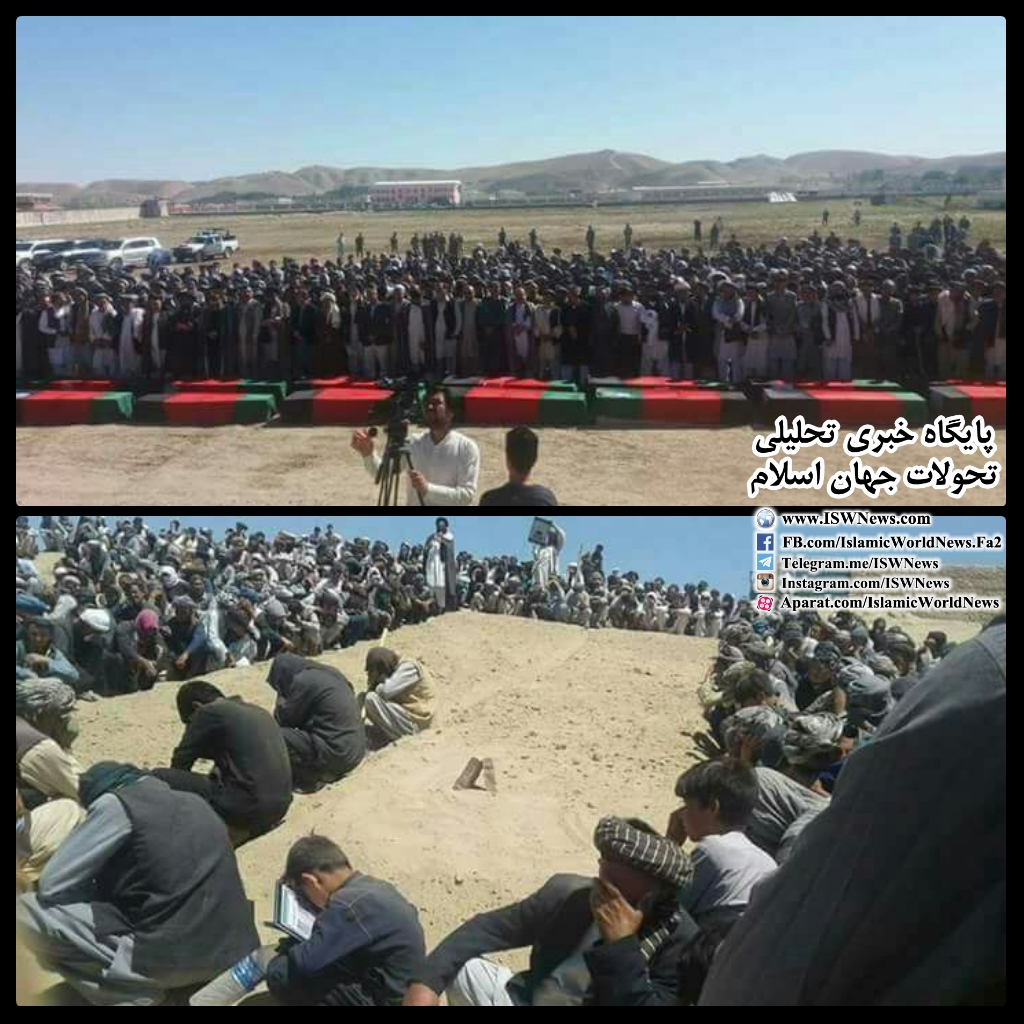
    Pictures of funeral of the martyrs of Mirza Ulang village:

  • US And ISIS: Unannounced Allies Against Syrian Arab Army

    US And ISIS: Unannounced Allies Against Syrian Arab Army

    With the death of the city’s defenders, ISIS easily took control of a territory that located close to the airbase.

    ISIS had conducted over than 100 suicide attacks against government forces defending the airbase and the part of the city that still under the control of the Syrian forces but was unable to overrun the SAA defense.

    However, the US airstrikes dramatically changed the situation in the area. Over 80 elite SAA troops that resisted ISIS for years died in that attack.

    The US-led coalition said that it was a mistake.

    This claim was ridiculous. If they in that same day searched the phrase “the updated Syrian civil war map” in Google, they would’ve easily found the location of the government forces and avoided comitting such a mistake.

    “Accident airstrikes” on SAA targets when the frontline does not change for a very long time is hardly possible.

  • New operation started by Syrian army & Fatemiyun division in Zamlat al Khinzir Mountain & Sawwanah Mountain

    New operation started by Syrian army & Fatemiyun division in Zamlat al Khinzir Mountain & Sawwanah Mountain

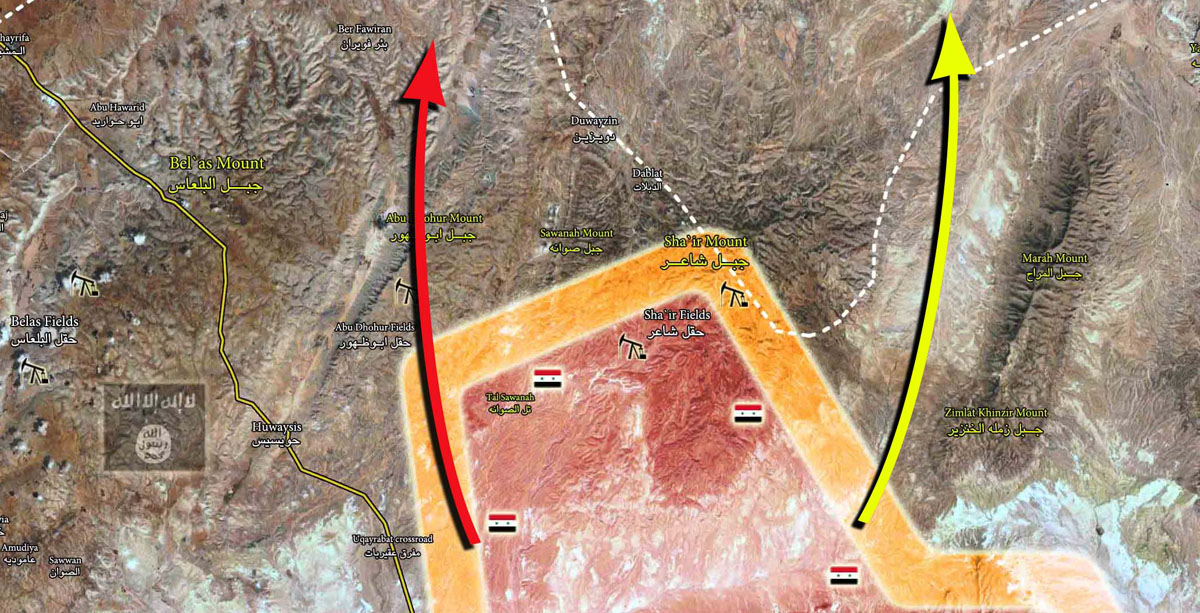
    ِDuring the operation,in first axis, Fatemiyun division is pushing toward “Zamlat Al-Khinzir” mountain while in second axis, Syrian army is pushing north toward “Sawwanah” mountain.

    Now operation is in progress …

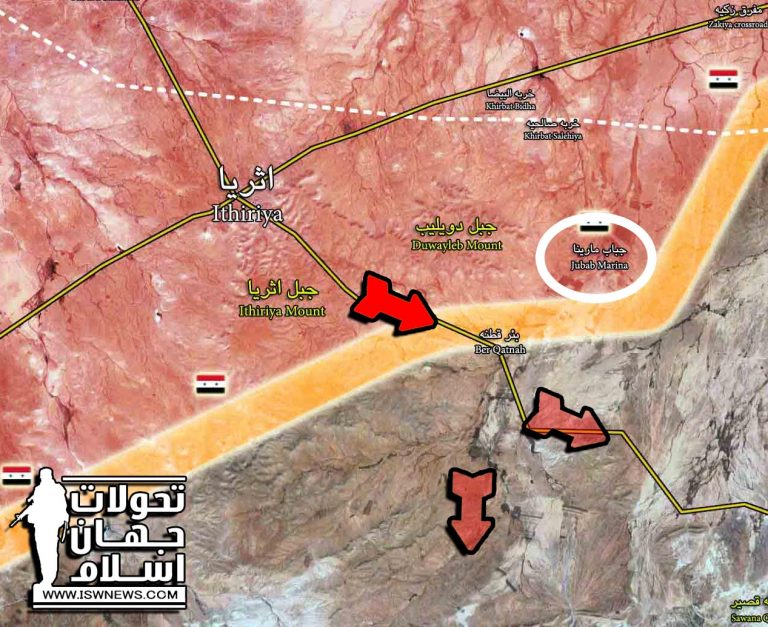
    Any reports about SAA advances in south of Ithiriya axis is not correct. They had been forced to retreat after fierce battle with ISIS near Ber Qatna & Ber Hasiyah area.

    click on map

  • Syrian Army prepares for massive assault in east Hama: maps

    Syrian Army prepares for massive assault in east Hama: maps

    The Syrian Arab Army (SAA) is preparing for an all-out assault against the Islamic State (ISIL) forces in the eastern countryside of Hama, targeting every axis that the terrorist group is presently occupying.

    With their recent success against ISIL in Al-Raqqa and Homs, the Syrian Arab Army is finally in position to close the gap in the Hama Governorate and expel the remaining terrorists in central Syria.

    One of the most important axes the Syrian Arab Army is currently attacking is just south of the Ithriya-Raqqa Highway, where the Islamic State has carved out a niche around this rugged terrain.

    Recently, the Ithriya axes has been the scene of some of the most intense battles between the Syrian Army and ISIL, as the former presses south from Jubab Marina and Duwaylib Mountain.

    As a result of these intense battles, the Syrian Arab Army has managed to score some important gains, which have paved their way to reach the strategic Beir Qatna area.

    If the Syrian Army takes control of the Beir Qatna area, this will ignite their eventual operation to link up their forces in near the Al-Sukhnah axis in east Homs.

    [/media-credit]

    As the map illustrates above, the Syrian Army is going to push along the Ithriya-Sukhnah Road until it is fully secure.

    East Salamiyah Axis: 

    The eastern Salamiyah axis is a bit more complicated than Ithriya area because this region is made up of several important towns that stretch across the Homs Governorate border.

    Currently, the Syrian Arab Army’s Qalamoun Shield forces of the 3rd Division, alongside the Tiger Forces, are attacking the Islamic State militants around Salba, which is an imperative town located near the ISIL stronghold of ‘Uqayrbat.

    The map above illustrates the Syrian Army’s attack and their push to the imperative town of ‘Uqayrbat.

    ‘Uqayrbat is strategically located along the main highway from Salamiyah City; it is also a crossroads town that leads to Al-Sukhnah and Ithriya.

    Once ‘Uqayrbat is liberated, the Syrian Arab Army will have full control of the east Hama pocket because the Islamic State cannot remain in the region without it.


  • Latest field developments in central Syria + What is the next move ?!

    Latest field developments in central Syria + What is the next move ?!

    The recent developments in central Syria have paved the way for the Syrian military and their allies to reach areas in the region that were once securely under the Islamic State’s (ISIL) control.

    However, with the Syrian Arab Army’s recent advance in the southern countryside of Al-Raqqa, the prospect of a complete victory against the Islamic State has become a reality.

    Victory at Al-Sukhnah:

    The Islamic State’s biggest loss in central Syria this year was not at Palmyra; it was the strategic desert city of Al-Sukhnah, which was considered the terrorist group’s main stronghold in this region.

    While the battle was not easy, the Syrian Army and their allies were able to finally break-through the enemy’s defenses earlier this month and begin a two week long process to liberate the city.

    With Al-Sukhnah liberated, the Syrian Arab Army and their allies from Liwaa Fatemiyoun and Hezbollah were able to push north from the city and begin an imperative operation to clear the rugged terrain between the Al-Raqqa and Homs governorates.

    Special Airborne Operation:

    Al-Sukhnah was no doubt a devastating defeat for ISIL, but it would also be the stepping stone for the Syrian Army’s airborne operation that resulted in the liberation of more than 20km of territory between the Al-Raqqa and Homs governorates this past weekend.

    Led by the airborne units of the Tiger Forces, the Syrian Army landed well behind enemy lines this past weekend, surprising the terrorist group with a powerful assault at the Al-Kadeer area.

    Following the death of more than 30 Islamic State terrorists, the Syrian Army was able to liberate Al-Kadeer and Makman, allowing them to link up with their forces and clear 20km of ground.

    Al-Kom’s liberation: 

    The Syrian Arab Army is still rolling along the Homs-Raqqa axis after launching another powerful assault on Monday morning that targeted the strategic Al-Kom(Kawm) area.

    Unable to hold their positions, the Islamic State was forced to frantically retreat from several points in the area after the Syrian Army plowed their front-lines.

    By nightfall on Monday, the Syrian Arab Army had successfully taken control of the Al-Kom area, forcing the Islamic State to withdraw all of their forces to Taybah in preparation for a massive enemy assault.

    The Road to Besiege ISIL in Central Syria

    The Syrian Army has now descended upon the Taybah area of the Homs Governorate, where they hope to link up with their troops & Resistance forces south of their positions.

    The only thing standing in the Syrian Army’s way is a large Islamic State force that is attempting to save their comrades in central Syria by preserving their last supply line from the east.

    If ISIL loses Taybah in the coming days, then their forces in the Hama and Homs governorates will be effectively besieged from all sides.


    Review other active axes

    On the Humaymah-T2 axis ; Despite the fire control of the Army and Resistance over the Hamima , the area has not yet completely cleared ,due to the geographic situation of the area and ISIS repeatedly attacking the desert-based bases in the (like what is happening in the Iraq-Syria border) and preventing forces to advance. With advancement in the south-east and reaching forces to Duwaykhilah area, Humaymah will be surrounded . So this strategy paves the way for further progress on Humaymah axis

    In south of Ithiriya axis ; SAA NDF advances and gained some territories in south of Ithriya especially in south of Duwaylib mount.
    Jbab Marina has been liberated ans some progress made between Jbab Marina and Ithiya mount.
    If SAA could break through ISIS defence lines and liberate the Ber Qatna, it would be the begginnig of operation in this axis towards Sukhnah or Sha’er mountain

    In east of Salamiyah axis ; Like always, this front is one the hot fronts for SAA forces, but the lazy one ! Most of the operations in this axis were done for repelling ISIS attacks or extending security belt for strategic areas and villages or diversion ops …

    Therefore in recent days military sources reported some SAA movements in Tarfawi and east of Mab`ujah axis but there is no signifcant changes military maps yet.

    please click on maps for download in original size

  • 1953 Iran Coup: British Approached U.S. to Topple Mossadegh

    1953 Iran Coup: British Approached U.S. to Topple Mossadegh

    The recent release of a tranche of declassified CIA documents, including memos covering this particular period, are a timely reminder not only of the staggering mendacity and perfidy of both countries in asserting the right to lecture the rest of world about democracy and human rights, but the extent to which they have wrought so much damage and devastation across the world since the Second World War.

    Operation Ajax, the name by which the plan to undermine and topple Mossadegh’s government is known, was undertaken in response to the Iranian leader’s decision to nationalize the country’s oil industry with a view to husbanding the revenue for the benefit of the Iranian people, rather than allow it to continue to be sucked out of the country by the then British state-owned Anglo-Iranian Oil Company (AIOC) – forerunner of today’s global oil conglomerate BP.

    Britain had been in control of Iran’s oil since 1908, when the country was still known as Persia. London set up APOC with the development and exploitation of this energy bonanza in mind, the UK government taking over a controlling-share of the concession that had been granted to English mining entrepreneur William Knox D’Arcy by Persia’s [Iran’s] monarch in 1901. It came at point when Britain’s navy was shifting from coal to oil-powered engines, thus making a secure oil supply of critical strategic and military importance for a country’s whose empire at the time covered almost a quarter of the planet’s land surface.

    None other than Britain’s future Prime Minister Winston Churchill affirmed the importance of control over Iran’s oil, when he wrote, “Fortune brought us a prize from fairyland beyond our wildest dreams. Mastery itself was the prize of the venture.” Note the colonial grandeur of Churchill’s sentiments – a turgid celebration of the opportunity for enrichment that was so unabashed it would make a low-rent mafia hood blush. Meanwhile, the record shows that throughout the AIOC’s presence and operations in Iran, Tehran received a derisory percentage of the huge revenue garnered from the oil that was extracted from its territory.

    Mohammad Mossadegh became the country’s prime minister in 1951 on the back of a rise in national consciousness vis-à-vis the colonial and imperialist powers. Soon after coming to power he nationalized Iran’s oil and confiscated the assets of the AIOC. In a speech explaining his motives, he said,

    Our long years of negotiations with foreign countries have yielded no results thus far. With the oil revenues we could meet our entire budget and combat poverty, disease, and backwardness among our people. Another important consideration is that by the elimination of the power of the British company, we would also eliminate corruption and intrigue, by means of which the internal affairs of our country have been influenced. Once this tutelage has ceased, Iran will have achieved its economic and political independence.

    Britain responded by making it impossible for Iran to sell its newly nationalized oil on the world market. However, this wasn’t enough, and having persuaded the Americans that Iran was ‘in danger’ of turning communist, a plan to remove Mossadegh was hatched with the CIA playing the lead role.

    In one of the recently declassified US State Department memos covering this sordid episode, the insouciance with which the possibility of a coup to topple Iran’s government is first mooted is simply staggering. Under the subheading ‘Problem’, a section of the memo reads,

    The British Foreign Office has informed us that it would be disposed to attempt to bring about a coup d’etat in Iran, replacing the Mosadeq (sic) Government with one which would be more “reliable”, if the American Government agreed to cooperate. British and American intelligence agencies have had very tentative and preliminary discussions regarding the practability of such a move but cannot go further unless the State Department is prepared seriously to consider it as a matter of policy. The intelligence representative have requested a definite statement on this point.

    In London the plan was signed off by the aforesaid Winston Churchill, at the time Britain’s prime minister, while in Washington Dwight D Eisenhower, as US president, authorized its implementation.

    When Mossadegh got wind of the plan he closed the British Embassy in Tehran and expelled its staff. Discovering that the country’s then monarch, the Shah, was also in cahoots with the plan, he forced him to flee the country. However by now the CIA had succeeded in bribing various Iranian army and police officers, along with key journalists and members of the Iranian parliament. Together they helped to whip up an anti-Mossadegh atmosphere in the country, accusing him of being a communist, thus playing to the religiosity of a section of the population.

    On August 191, 1953, Mossadegh was arrested along with thousands of his supporters. Upon his arrest, the Shah returned from exile to become Washington’s placeman, ruling the country with uncommon brutality and corruption until he was ousted in the Iranian Revolution of 1979.

    Ultimately, no region has suffered more at the hands of US imperialism than the Middle East. It is, indeed, still suffering at its hands as these words are being written, with Iran in Washington’s crosshairs for daring to assert its independence, dignity, and resistance to hegemony.

    As for Mohammad Mossadegh, he goes down in history as a leader with the courage to defy US and Western imperialism. It is a legacy which lives on in the obdurate refusal of the Iranian people to submit to Washington’s writ today, over half a century later

    Source: http://ahtribune.com/history/1834-mossadegh.html

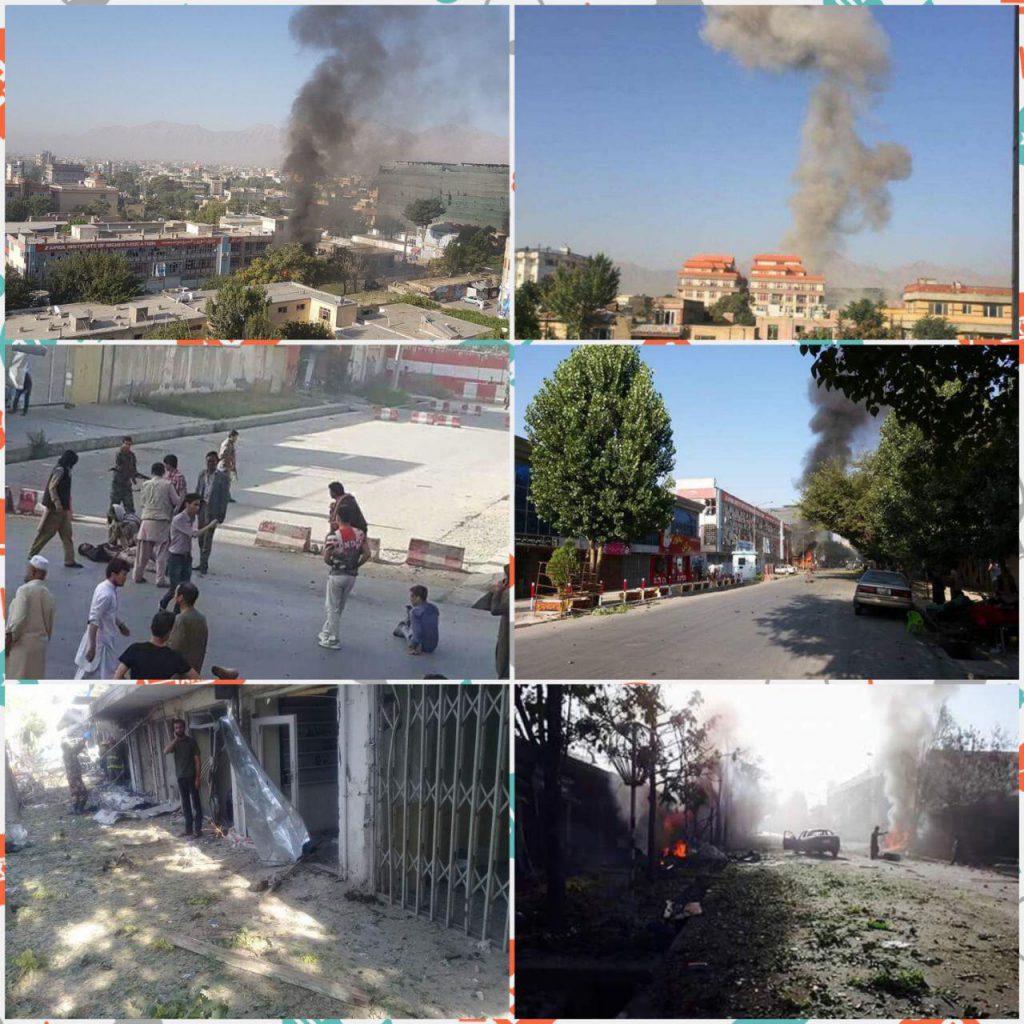
  • 24 people were killed in Terrorist bombing in Kabul

    24 people were killed in Terrorist bombing in Kabul

    There was an explosion on 6:30 local time in the third district of Kabul, Afghanistan.
    The interior ministry of Afghanistan declared the death toll was 12 and 10 others were injured, but as it cleared out the number of martyrs were 24. There were also 42 injured.
    The explosion has occurred near the residence of Mohammad Mohaqeq, the second deputy of the chief executive of the government.
    Taliban has claimed responsibility and has stated that security forces were the targets of this operation. But the majority of the victims are civilians, as it is always the case.
    Also there were plans for a demonstration of the “light movement” which was cancelled.

  • Latest progress by Syrian army in eastern Syria & possible axis

    Latest progress by Syrian army in eastern Syria & possible axis

    In recent days, the Syrian army leaded by Soheil Hassan, advancing and defeating ISIS defense lines in southern province of #Raqqah
    therefore , a large number of oil and gas wells were freed through the last week.
    Also Resistance forces are approaching to Al-Sukhnah in #Tadmur–#DeirezZor axis. It is also possible for them to advance towards T2 station in Hamimah axis

    Regarding the type of advancements, two points can be considered :
    – #SAA can approach to Al-Sukhnah from the top
    and bottom in parallel with downstream advancements of the Resistance Forces , and surround the large amount of #ISIS in center of Syria!
    Of course, considering the suicide nature of ISIS behavior, this move has its own advantages and disadvantages that are not included in this article.

    – SAA can continue its advances in southern Raqqah province & reach to Deir ez Zur , meantime resistance forces will advance towards Deir ez Zur along the highway.

    Remember these two, in the coming weeks, we will say more about this