According to Hashd al-Shaabi organization, a fighter of this organization named “Ali Anwar Sabih al-Saadi” was martyred in the American attacks and two others were wounded.
Al Jazeera reported, quoting an American official, that the attacks were carried out against the PMU’s Kataeb Hezbollah in response to recent operations against American bases in the region.
After this attack, the U.S. government officially accepted the responsibility of this military operation.
The United States Terrorist Headquarters in West Asia (CENTCOM) announced in a statement: In response to attacks by the Iranian-backed militia group Kataib Hezbollah (KH), including the attack on al-Asad Airbase in western Iraq on Jan. 20, on Jan. 24 at 12:15 a.m. (Iraq time), U.S. CENTCOM forces conducted unilateral airstrikes against three facilities used by Iranian-backed Kataib Hezbollah militia group and other Iran-affiliated groups in Iraq. These strikes targeted KH headquarters, storage, and training locations for rocket, missile, and one-way attack UAV capabilities.
Aftermath of US airstrikes in al-QaimAftermath of US airstrikes in Jurf al-Nasr
The beginning of the year according to the Gregorian calendar was overshadowed by the murder of the legendary Saleh al-Arouri, a prominent Hamas figure and one of the founders of the al-Qassam Brigade. Experts interpret this terrorist act of Zionism in different ways, some argue that the Zionists’ goal is to drag Lebanon into a full-scale war (Shahid al-Arouri was killed in the southern suburbs of Beirut), after which the Neocon Republicans, with the support of the Zionist lobby, will begin to demand that Biden join the war on the side of Zionism.
Others claim that the goal of the occupiers is to stop the attacks of Hamas fighters from Lebanon and weaken the resistance of the West Bank. Still others talk about revenge for the organization of the al-Aqsa flood.
I will briefly answer the widespread opinions in the media:
1 – Biden said two months ago that the United States would not fight against Hezbollah, and Iranian officials constantly emphasize that the American administration regularly sends messages in which it claims that it does not want to expand the conflict and regional wars. 2 – Hamas has enough forces and personnel to carry out rotation, replacements and at the same time not lose its combat potential. Plus the guardianship of Hezbollah, which has set itself the task of becoming a “new Hamas” to help the Gaza Strip and the West Bank. 3 – Revenge caused by the hysteria of the Zionists will not affect the Palestinian resistance in any way, since the planning of the special operation “flood of al-Aqsa” primarily included rapid response moves from the Hamas Shura Council and other resistance factions, in case of loss of high-ranking officials of the Islamic Resistance movements.
In general, there are many opinions and they all have a fair basis, but I would like to consider the tragedy through the opinions in the media. For example, what if we assume that the Zionists’ desire to influence certain people in Jordan and their connection with Syria and the West Bank was behind the murder of Saleh al-Arouri?
The fact is that the late deputy head of the Hamas Politburo was on good terms with the Islamic Action Front (the political wing of the Muslim Brotherhood of Jordan) and at the same time was an important link within the Axis of Resistance. Moreover, he was one of the few Hamas leaders with whom Assad’s representatives personally maintained relations.
Thus, we see a certain triangle where Shahid al-Arouri was chosen by the IRGC as a symbol of the alliance hidden from prying eyes. The scheme of the alliance looks like this, Syria under the supervision of the Iranians, as a point of shipment of weapons – then Jordan, the transit corridor – the Palestinian resistance of the West Bank, the final route of Syrian weapons. The legendary al-Arouri was a link between ideological enemies in the person of the Syrian Baathists and the Jordanian Ikhwans. Therefore, it was important for Zionism to kill a political figure associated with the external parties of the West Bank resistance, since the supply of weapons is still carried out by third parties and hidden “smugglers”.
The statement of the Hashemite autocracy about the allegedly violent military campaign against “Syrian drug trafficking” is designed to deceive public opinion in their country. The so–called “fight against cartels” is ostentatious, and the kingdom’s real goals are to reduce the supply of weapons to the resistance in the West Bank. For the sake of the security of Zionism, Amman is even ready to risk the lives of its soldiers, who often suffer losses in skirmishes with “Syrian smugglers.” Outside observers ask the question, why did the Jordanian autocracy start a “war on drugs” at the time of the beginning of the total genocide by the Zionists of the Gaza Strip?
By launching a war against the arms corridor from Syria, the Abdullah regime has created problems for itself not only on the border with the Syrian Republic, but also incurred the wrath of the kingdom. Now the Jordanians, who are in solidarity with the Palestinians, will think not only about how to help the West Bank, but also about their own self-defense against the dictatorship of the pro-Zionist kingdom. The desperate attempts of the Hashemite monarchy to prevent the strengthening of the Palestinian resistance are designed not only to please the Zionists, but also to send a signal to the opposition forces within the autocracy that the regime will defend itself in the event of a popular uprising.
The content of the article is purely the personal opinion of the author.
According to a statement from Hezbollah, this attack was carried out in response to recent Israeli regime assassinations in Lebanon and Syria, as well as repeated attacks by the regime’s army on civilians and homes in southern Lebanese villages.
This is the second attack by Hezbollah on the air command base in Mount Meron. The Lebanese resistance fighters targeted the Meron Air Surveillance Base with the launch of 40 Katyusha rockets and 22 guided anti-tank missiles (Dehlaviyeh-3 missile or 9M133 Kornet-M Russian anti-tank guided missile), in the first attack on January 6.
The Meron Air Surveillance Base is located at the top of Mount Meron in northern Israeli-occupied territories, the highest peak in occupied Palestine. This military base is considered the sole center for the management, protection, and air control in northern occupied Palestine and, alongside the Ramon-Mitzpe base in the southern occupied territories, is one of Israel’s two main air command bases.
The Meron base is involved in organizing, coordinating, and managing all Israeli air operations in Syria, Lebanon, Turkey, Cyprus, and the northern sector of the Mediterranean Sea. The base is also the main center for electronic disruption operations in the airspace of these areas, with a large number of skilled Israeli officers and soldiers actively operating there.
The Israeli regime’s army spokesman Daniel Hagari emphasized that the battles in Khan Younis city are very difficult and intense, and that the regime suffered heavy losses in this area.
Yesterday, a group of Israeli reserve forces from the 261st Infantry Brigade entered nearly 600 meters in the Al-Maghazi refugee camp to blow up several buildings. They were tasked with demolishing 10 buildings with the help of engineering forces. On the other side, Palestinian forces fired two rocket-propelled grenades (RPGs) at the Israeli forces, the first RPG hit a tank, which was stationed there to protect those soldiers, and killed two soldiers; and the second RPG hit a building, where explosives had been laid. The second RPG caused the explosives in the building to detonate, collapsing two buildings and causing a large number of Israeli soldiers to be killed and trapped under the rubble. In this incident, a total of 21 people were killed.
Furthermore, during other clashes in the southern Gaza Strip, three more Israeli occupation soldiers, including a captain and two majors, were killed, bringing the total number of Israeli military casualties on Monday to 24.
It is worth mentioning that with the death of these individuals, the claimed casualties by the Israeli regime after the start of the ground offensive in the Gaza Strip have increased to 218. Also, the total number of military casualties according to the Israeli regime’s claim has reached 555 since the onset of the conflict (October 7, 2023) until now.
Neostrim is affiliated to the international company BASF Central Asia, which is supported by Israeli investors. Morover, a number of the company’s shareholders are also Israeli Zionists.
According to the report, the attack on this warehouse was carried out by an unidentified person who first placed an oxygen capsule in the warehouse and then set it on fire using gasoline before fleeing the scene. The Kazakh security forces continue their efforts to identify and arrest this assailant.
This fire is related to suspicious events and actions in recent months in Middle Eastern countries and is estimated to be due to the spontaneous anti-Israeli actions of the people in this region.
In this regard, several Tajik, Kazakh and Uzbek citizens have been arrested on charges of underground activities against the Israeli regime, and the warehouses of Israeli companies Technopark and Saxovat Broyler in Tashkent, the capital of Uzbekistan, have also experienced unusual fires.
In the south of the Gaza Strip, during the last week, Israeli forces slowly expanded the zone of control in Khan Yunis city. Israeli forces are slowly advancing west of Khan Yunis. In the south of the city, the zone of control has been extended to the vicinity of Absan al-Kabirah.
In the center of the Gaza Strip, clashes continue in al-Bureij and al-Maghazi and in the east of Nusirat. During the last week, Israeli forces advanced in the southern areas of al-Maghazi. Also, partial advances have been made in the east of Nusirat.
In the north of the Gaza Strip, the Israeli occupying forces have re-entered the Sheikh Ijlin area and south of Rimal after withdrawing from Gaza City two weeks ago. The reason for this limited advance is the increase in Palestinian activity in these areas. During the last two weeks, thousands of Palestinians had flocked to these areas waiting for food trucks, and the situation had gone out of the control for the occupying forces.
Late on January 22, the local sources announced several explosions in Sana’a, the capital city of Yemen, Saada, Taiz, Hajjah and Al-Bayda. An hour later, it became clear that the positions of Yemen’s Ansar Allah movement were the target of a new round of US airstrikes.
According to the Yemeni media, the targeted areas were Sana’a: Al-Hafa base 4 times, Al-Dailami airbase (at Sana’a airport) 4 times, Sarf area 2 times. Taiz: Al-Barah area in the Muqbana district once, Al-Jand area in the Taiziyah district once and Al-Baydha: once in the Radaa district.
However, Brigadier General Yahya Saree, the spokesman of the Yemeni Armed Forces, released a short message about the attacks of the American coalition fighter jets, and said that in the past hours, 18 airstrikes have been carried out against Yemen, 12 of which were in Sana’a province, three in Hudaydah province, two in Taiz province and one attack in al-Bayda province. Brigadier General Saree also emphasized that these attacks will not go unanswered, and the Yemeni army will respond to all American and British attacks.
The US CENTCOM also released a statement explaining the details of the air attack on Yemen.
It is stated in this statement that on January 22 at 23:59 (Yemen time), CENTCOM forces alongside UK Armed Forces, and with the support from Australia, Bahrain, Canada, and the Netherlands, conducted strikes on 8 Houthi (Ansar Allah Movement) targets in the areas under the control of the Houthis in Yemen. These strikes are intended to degrade Ansar Allah’s capability to attack American and British ships in the Red Sea, Bab al-Mandab Strait and the Gulf of Aden.
According to the US claim, the targets that were bombed tonight included missile systems and launchers, air defense systems, radars, and deeply buried weapons storage facilities.
The United States also announced that tonight’s military aggression against Yemen is separate and distinct from the actions carried out by the American naval coalition under the title “Operation Prosperity Guardian” in the Red Sea.
According to IWN research, this is the ninth air attack by the American coalition on Yemen, under the pretext of securing international shipping in the Arabian and Red seas.
By examining the satellite images, the exact geographical location of the Jaish-ul-Adl terrorist group base was identified in Pakistan. This base is located in Panjabuni mountain in the northwest of Panjgur town with coordinates 27.2133, 63.7078. The distance between this terrorist headquarters and the Iranian border is about 40 kilometers.
After Iran’s preemptive attack on the positions of the Jaish ul-Adl terrorist group on January 16, it was said that the headquarters of this group is located in the Green mountain (Koh-i-Sabz) in the northeast of Panjgur; But further investigations showed that the main and correct location of the headquarters is located in another place.
It should be noted that this terrorist base is only one of the headquarters of the Jaish-ul-Adl terrorist group in Baluchistan province of Pakistan, and the militants of this group have a large presence in the southwestern regions of Pakistan.
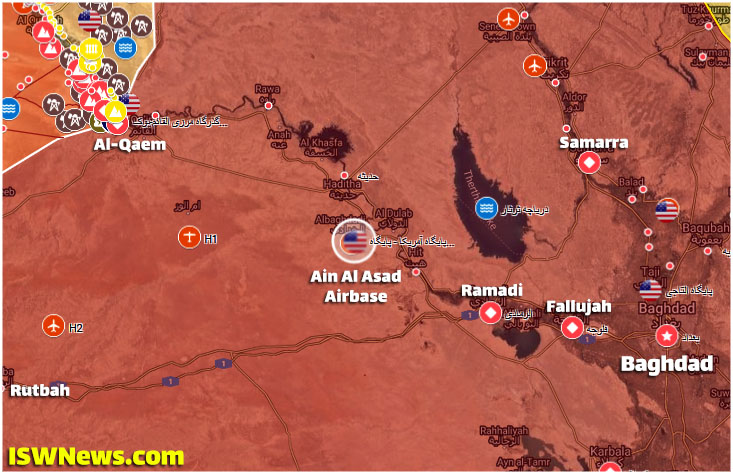
In the early hours when the incident occurred, some media outlets, citing US sources, reported that the resistance forces used short-range ballistic missiles to target the Ain al-Asad base, and there were reports of injuries and casualties among US forces.
Several hours after this attack, the US Central Command (CENTCOM) also confirmed reports of a missile attack on Ain al-Asad airbase by issuing a statement. The statement said that around 18:30 (local time), several ballistic missiles and rockets were fired by Iran-backed militia groups towards Ain al-Asad airbase. Most of the missiles were intercepted by the base’s air defense systems, but some of them hit the military base. According to initial assessment, some US personnel suffered traumatic brain injuries and at least one Iraqi soldier was injured.
Therefore, given the confirmation of the missile attack, it can be speculated that the resistance forces used short-range ballistic missiles, including Al-Aqsa 1 and Sarem, which have recently been unveiled by the Iraqi resistance.
This attack was carried out in a hybrid tactic by using rockets and ballistic missiles to yield better result. In this way, by firing a large number of rockets towards Ain al-Asad airbase, the base’s defense systems faced a large number of rockets, increasing the chances of short-range ballistic missiles hitting targets inside the base.
Based on available information, this attack is considered the second major strike on Ain Al Asad airbase in terms of volume and power of the fired projectiles after Iran’s missile attack on the base. Undoubtedly, these types of attacks are several stages higher and more powerful than routine daily attacks on US positions in the region and will greatly increase the casualties and damages.
The names of these servicemen are as follows: Hojatullah Omidvar, Ali Aghazadeh, Hossein Mohammadi, Saeed Karimi and Mohammad Amin Samadi.
The public relations of the Islamic Revolutionary Guard Corps (IRGC): “Once again, the evil and criminal Zionist regime invaded the city of Damascus, the capital of Syria, and during the warplanes attack of the aggressor regime, a number of Syrian forces and four military advisors of the Islamic Republic of Iran were martyred.”
It seems that this attack was in response to the IRGC’s missile attack on the Mossad headquarters in Erbil, Iraq, during which several Mossad officers and associates were killed, including a businessman namely Poror Dezai.
On January 18, a US Army MQ-9 drone took off from Ali Al Salem Air Base in Kuwait, around 16:00 local time, and flew into Iraqi airspace.
The US Army drone arrived in Miqdadiyah city in Diyala Governorate around 18:30 in the evening and was targeted and shot down by the Islamic Resistance in Iraq at 18:45.
No further details have been disclosed in this regard, and thus far, no official reactions have been shown by Iraqi and US authorities.
This video was broadcast as a TV report by the official media of Iran and made available to the public.
In this report, the IRGC drone is shown monitoring the headquarters of Jaish ul-Adl terrorists in the mountainous region near the Iran-Pakistan border. The base is one of the main headquarters of the Jaish ul-Adl terrorist group in Pakistani territory. As it is clear in the images, they show different parts of the base, observation hills, armed individuals stationed there, and a training ground for terrorist training and shooting exercise. The terrorist base is located deep in the mountains and valleys of the Kouh-Sabz (Green Mountain), making ground access difficult.
According to IRGC data, terrorists have been using this headquarters for training and planning terrorist operations inside Iranian territory for two decades. Recently, about 50 terrorists entered this headquarters for planning, coordination, and preparation for a large terrorist operation inside Iran. Three days ago (on January 16), they were targeted by Iranian drone and missile attacks, thwarting their evil intentions and resulting in the killing and injury of some terrorists.
Monitoring of Jaish-ul-Adl terrorist headquarters in Pakistan’s Sabz Mountain
The release of this video once again proves the accuracy of Iran’s claim regarding the existence of Jaish ul-Adl terrorist bases in border areas in western Pakistan. Iran had repeatedly informed the friendly and brotherly country, Pakistan, about these bases and had urged them to take action against these terrorist bases by providing information about them to the Pakistani government and army. Unfortunately, due to various reasons, the Pakistani government and army refrained from destroying these bases or taking effective action against Jaish ul-Adl terrorists. Therefore, to prevent new terrorist disasters in Iranian territory, Iran was forced to intensify its targeting of the terrorists’ base in the Kouh-Sabz, which was not welcomed by the Pakistani government.
On the other hand, however, the Pakistani government, in order to escape intense public pressure and scorn by its Indian rivals, was forced to carry out a retaliatory operation; but against whom? Against some Pakistani migrants who had turned into a tragic disaster, resulting in the loss of lives of women and children. However, Pakistan claimed that it has targeted the headquarters and hideouts of the Balochistan Liberation Army-Balochistan Liberation Front (BLA – BLF) in Iranian territory. Some Pakistani media outlets have gone so far as to make a strange claim that Iran is harboring terrorists from BLA-BLF! This claim is being made while the government and army of Pakistan can never find a terrorist base in Iran like the one in the Kouh-Sabz of Pakistan and publish its videos, or release images to prove their claim!
Once again, we refer you to the statements of the Ministry of Foreign Affairs regarding the recent events of the past few days, as well as Friday’s phone conversation between the Iranian foreign minister and his Pakistani counterpart. Iran, before and after the attack, even after Pakistan’s attack on Iranian soil, addressed Pakistan in a friendly and brotherly tone, but strongly reminded them of their previous security commitments and urged them to act in line with them.
As we have said before, Pakistani brothers should not interpret the friendly and brotherly tone in Iranian officials’ statements as a sign of weakness. Iran still emphasizes brotherliness and friendship with the Pakistani people and the preservation of the territorial integrity of this country, but it will not hesitate in facing terrorists and protecting Iranians’ lives. If the security shortcomings of the friendly and brotherly Pakistani government do not turn into active and effective cooperation, Iran will not hesitate to carry out such preemptive operations again in the future.
On Friday, Iran FM Hossein Amirabdollahian also emphasized the serious pursuit of security and military cooperation between the two countries in a phone conversation with Jalil Abbas Jilani. For his part, Jilani emphasized the common approach of the two nations in combating terrorism and stressed the necessity of maintaining constructive and fraternal relations with Tehran, inviting Amirabdollahian to visit Islamabad.
Therefore, it is now possible to hope for a joint security plan between the two countries in border areas of Pakistan and Iran, and perhaps now is the time for Pakistan to seriously consider its fight against terrorist groups in the west of the neighboring country.
The video of the TV report that was broadcasted by the official media of Iran. With English subtitles.