Category: West Asia

  • Military Knowledge: Examination Of Prototype Of Yasin Training Jet

    Military Knowledge: Examination Of Prototype Of Yasin Training Jet

    The prototype production of a fighter jet is the last step before mass production of the same jet. Hence, we examine the prototype of Yasin fighter jet production.

    The examination of the different pictures of the fighter jet that have been published thus far, several transformations in the final prototype of the Yassin fighter jet are obvious. The first change is visible in the training fighter jet’s landing gear.

    Change in landing gear
    The above photo is the landing gear Yasin jet in its final design and the below picture shows Yasin fighter in its first type; so, the images indicate appropriately that the front landing gear of the final design has been reinforced and the way it folds is similar to the way that the landing gear of Kowsar fighter jet folds. The position of the landing gear has been transferred from the left side to the middle of the jet.

    Change in canopy of fighter jet
    As it can be seen in the photos, the prototype possesses a cabin with a greater arc in comparison to the fuselage of the jet, but in the final design it has an angle, which is such that two pilots are being placed in the cockpit in a stepped way and they enjoy the maximum angle of view. Furthermore, the cockpit doors, which could be opened totally in the prototype, can be opened in two pieces in the final design.

    Changing air intake, exhaust of hot gases in engine
    As it can be seen clearly in the photos, the air intake of the engine has become smaller, which is perhaps linked to shifts in the engine of the fighter jet. Moreover, some changes have been made in the exhaust component of the hot gases of the engine, because its exhaust section is located outside a cover.

    The Iranian engineers also added VHF and UHF antennas, which are being used for secure communications. They also added an air brake under the fuselage and in front of the rear landing gear of the jet that helps reduce the speed of the jet in the landing process.

    Change in tail of the fighter
    The manufacturers of the fighter jet also changed its vertical rudder in order to reduce aircraft dragging, and it seems that they have changed the location of the horizontal rudder as well, and the horizontal rudder is slightly smaller than the prototype.

    We can mention to the following aspects of the training aircraft among other important points:

    In accordance to the photos released of the banner available in the production line of the Yasin combat training fighter jet, its various parts will be manufactured by different organizations in Iran. The cockpit displays are going to be produced by Sairan (Iran Electronics Industries), which was producing cockpit displays for the Kawsar fighter jets in the past.

    The canopy glass and its door, the ejection seat and the landing gears are going to be produced by the Iran Aircraft Manufacturing Industries Corporation. The wings as well as horizontal and vertical rudders will be made by Iran Helicopter Support and Renewal Industries (PANHA). And the radome and the cockpit will be manufactured by the Owj Aviation Industries. The manufacturers of the fuselage and the engine of the jet are not visible because of the angle that the picture is located.

    Various parts of Yasin manufactured by different organizations

    Given the available pictures of the engine, the Owj Aviation Industries will utilize engines without afterburner for the fighter jet, which is being produced by the Iran Aviation Industries Organization (IAIO). It is known as the Owj-Y engine, which is a light turbojet engine without afterburner, possessing a thrust of 3500 lb-ft equivalent to 16 kilonewtons. The engine possesses a maximum speed of 16,600 rpm and it can provide the Yasin fighter jet with a maximum speed of Mach 0.8 and a maximum altitude of 40k feet.

    Furthermore, a single-seater model of the jet is going to be manufactured for close air support (CAS). The Yasin jet has three spaces, including the central space, which can be applied to carry an external fuel tank and the other two spaces can be utilized to carry arms. In the training prototype of Yasin jet, the two spaces are used for all sorts of training armaments.

    For instance, the Yassin fighter jet can carry and apply arms, including the Yassin advanced precision-guided smart bomb, the Maverick missile, various types of Iranian SDB bombs, and the Shafaq missile for the close air support operations.

    The Yassin fighter jet does not need any radar in order to utilize the weaponries and it can conduct close air support operations to defend ground forces.

    The production of the Yassin fighter jet is considered a step forward concerning the training for Iranian pilots, because they have been using a propeller plane such as Bonanza, and after that they fly a PC7 plane, and it would be better for them to get trained by an advanced fighter jet, when they are accepted in the fighter squadron.

    The fighter jet can meet all requirements of the Iranian air force, including all sorts of training drills and firings. The Yasin fighter can be categorized in the Yak-130 class and it seems to be very essential and functional for the training pilots to fly by using the new generation of fighter jets.

    Read more: Video: Iran unveils Yasin training jet

  • Israeli Air Attack On Syria; 3 Syrian Soldiers Wounded

    Israeli Air Attack On Syria; 3 Syrian Soldiers Wounded

    According to a Syrian military source, “At 07:15 local time on Sunday, the Israeli enemy attacked targets in Tartus and Hama provinces with several missiles from the north of Lebanon, and the air defense shot down most of the missiles.This attack resulted in the injury of three soldiers and the occurrence of material damages.”

    It is said that one of the targets of this attack was the scientific research center in Masyaf located in Hama province. No further information has been released in this regard.

  • What Are Undisclosed Details Of Saudi-Iran Agreement In China?

    What Are Undisclosed Details Of Saudi-Iran Agreement In China?

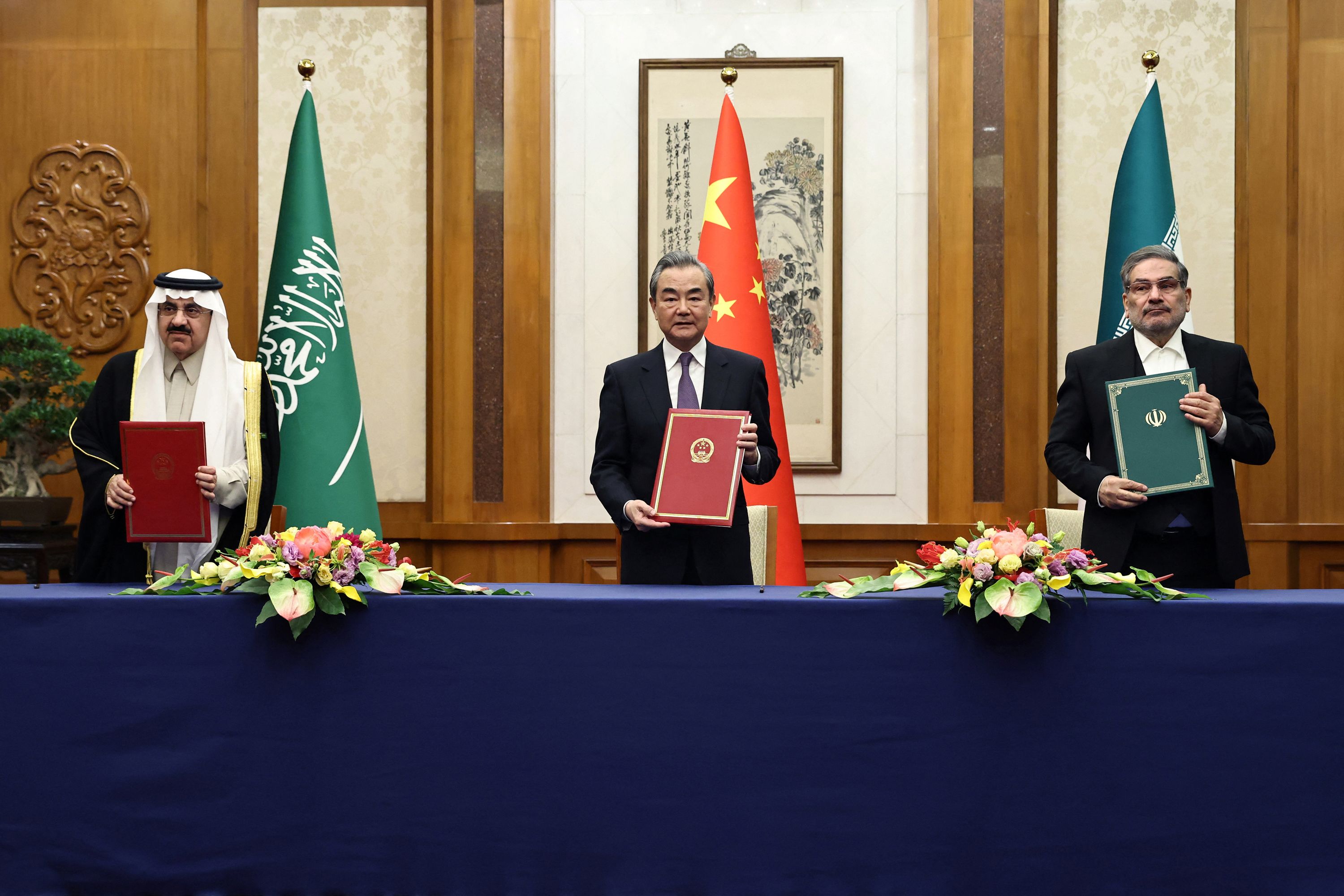
    Following Iranian President Ebrahim Raisi’s visit to China in February and his talks with his Chinese counterpart Xi Jinping, the finalization of the agreement between Saudi Arabia and Iran was cemented. After the February consensus, Shamkhani left Tehran for Beijing on March 6 in order to carry out intensive talks with Al-Aiban. The two counterparts held negotiations to restore political relationship as well as resolve security and regional issues, but there have not been released the details of the talks in official sources. The agreement was declared on March 10, when China, Saudi Arabia and Iran issued a joint statement and signed the deal.

    What was the other states’ reaction to Saudi-Iran deal?

    The authorities of both Saudi Arabia and Iran as well as the most states in the West Asia region and the world welcomed the agreement and described it as a prelude to resolution of other disputes and regional issues, including the Yemen war.

    Meanwhile, Coordinator for Strategic Communications at the US National Security Council John Kirby told correspondents that Saudi Arabia informed the United States of the talks with Iran, but Washington did not play any role in the negotiations. Kirby also adopted a hostile stance, when he said we should wait and see if Iran would respect the other side of the deal or not!

    Secretary General of Lebanon’s Hezbollah movement Hassan Nasrallah depicted the agreement as an important development in the region, which will promise new horizons in the region and Lebanon.

    Mohammad Abdul Salam, spokesman of Yemen’s Ansar Allah movement, who is in charge of negotiations of the National Salvation government, said that restoration of natural relations among regional states is necessary, noting that lack of security has its roots in foreign interventions in particular by the US and the Israeli regime. He said that Iranophobia project is in line with foreigners’ interests, who want to misuse internal rifts to create conflict and aggression in Yemen.

    China’s Foreign Ministry issued a statement, announcing that the Iran-Saudi Arabia agreement is a victory for peace.

    What are the benefits of the deal for China?

    China could gain more credit at international arena and showed that it is a superpower in rivalry with the US after hosting the negotiations between Saudi Arabia and Iran. They also underlined that the United States’ policies and supports for Arab countries are inefficient. As part of its foreign policy, China has not been involved in hard competition with ultra-regional powers in any dispute so far, and the issue has been shown in the Ukraine war and the dispute with Taiwan, but their involvement in the Saudi-Iran agreement indicates that they pursue a special engagement in the West Asia region and they want to adopt soft competition and semi-hard competition with the US.

    On the other hand, the resolution of conflict between Saudi Arabia and Iran would guarantee oil and other raw materials required by China.

    What are the potential and undisclosed aspects of the deal?

    Undoubtedly, the recent agreement between Riyadh and Tehran to restore relationship is a positive news for both countries and the West Asia region. It seems that Saudi Arabia has reached to the conclusion after eight years of war with Yemen that it cannot dominate a popular government and force by resorting to the most advanced and best Western and Eastern military equipment. The Saudis were of the opinion in the beginning of the war on Yemen that the Ansar Allah movement is a militia group, which would be weakened and forced to succumb following some classic operations and aerial bombardment, but the military and political support by Iran along with popular backing of people residing in western provinces of Yemen led to the consolidation of the National Salvation government and the preservation of strategic lands of the Arab country under the rule of Islamic resistance axis. Therefore, Saudi Arabia’s defeat in the war on Yemen is the main reason behind the Saudi’s intention to the negotiating table.

    Given the significant role by Iran in Yemen’s developments, it is expected that the peace negotiations in the war-torn country would reach more important results in the coming months. The deployment of foreign forces in different regions and bases inside Yemen, the activities of the separatist groups such as the Southern Transitional Council (STC) and terrorist groups like al-Qaeda and the ISIS, as well as the dependence of anti-Ansar Allah movement factions to the United Arab Emirates (UAE) and Saudi Arabia are expected to be the potential hurdles in the formation of peace in Yemen.

    Another issue, which can be mentioned as one of security aspects of the Saudi-Iran deal, is security threats and media activities of both sides against each other. Over the last years, Saudi-funded media apparatus established anti-Iran research centers such as Rasana and Iran International TV network in order to create propaganda campaign, which was along with fomenting unrest in Iran by the West. Seemingly, Saudi Arabia and Iran have reached agreements in this respect, but the details of the accords have not been announced yet.

    In a bigger picture at the current regional and international levels, Iran has been facing more harsh tensions and threats by the Western states and Israel on its nuclear dossier and its regional influence comparing to the circumstances in the past years. The expansion of the Zionist regime’s influence in security periphery of Iran, the exacerbation of economic sanctions imposed by Europe, numerous military drills by the US and Israel as well as their joint threats against Iran’s nuclear and defense facilities are all among the West’s new plots against the Islamic Republic. Of course, Saudi Arabia showed via signing the agreement that it intends to get rid of potential Iranian response to the Western states’ strikes and it tries not to turn into a possible battle ground for potential future confrontation between the West and Iran.

    In conclusion, the agreement between Saudi Arabia and Iran should be viewed as a mid-term ceasefire. The Saudis’ strategic measures and projects in the Central Asian states and in Azerbaijan Republic can violate Iran’s interests and security, and despite China’s assurances, there is not any guarantee for their sincerity in dealing with the Iranians.

    Read more:
    Analysis Of Recent Developments In Iran, World Regarding Hybrid Warfare
    A Failed Attack On The Facilities Of Iran’s Ministry of Defense in Isfahan; What Was The Nature Of The Blasts In Tehran And Other Iranian Cities?

  • Tareq Saleh’s Controversial Visit To Taizz; Prelude To Operations Against Ansar Allah And Islah Party?

    Tareq Saleh’s Controversial Visit To Taizz; Prelude To Operations Against Ansar Allah And Islah Party?

    Taizz city was one of the main strongholds of opponents of Ali Abdullah Saleh especially the Islah Party in the onset of revolution in Yemen and even before the turning point. Following the aggression by the Saudi-led coalition, the Islah Party could mobilize its militants to control parts of the city and it kicked off confrontations with followers of Ansar Allah movement and Ali Abdullah Saleh. The climax of the conflicts occurred when the late president betrayed Ansar Allah and the movement’s fighters retreated from urban areas and took a position in northern areas of the city.

    After over a decade of war in Yemen, several transformations and clashes happened in the country, but Taizz witnessed fewer changes due to its geographical situation, density of population and the spread of conflicts in other fronts.

    At present, Ansar Allah controls strategic points in northern, eastern and western areas of the city. The strategic areas encompass the International Airport, major roads, including Taizz-Aden, Taizz-Sanaa and Taizz- Al-Hudaydah, as well as the heights overlooking the city.

    The urban areas, military bases and administrative offices are under the control of the Islah Party and in some point under the supervision of the resigned government of Yemen. Moreover, there is side road in the southern Taizz, which connects the western entrance of the city to Al-Tarba town and Yemen’s southern cities. The side road is controlled by the militants of the Islah Party, which is utilized by the Saudi-led coalition to enter the battle grounds in Taizz.

    Tareq Saleh is nephew of the late president of Yemen, who is commander of the Popular Resistance Committees, which is under supervision of the Saudi-led coalition. Tareq Saleh became a member of the presidential council of the resigned government of Yemen following the resignation of former President of Yemen Abdrabbuh Mansur Hadi. Tareq Saleh has a close relationship with the United Arab Emirates (UAE), and he contributes to certain programs of Saudi Arabia, including their confrontation against the Southern Transitional Council (STC). Some of his covert efforts and supports in forming the Popular Resistance Committees, handing over the control of the southern front of Al-Hudaydah and western parts of Taizz to al- Mocha Port, as well as his cooperation in the formation of Al-Dara’ Al-Watan militants paved the way for enhancing his power and influence in the developments of the occupied territories of Yemen.

    As part of his latest attempts, Tareq Saleh met with a military delegation from Saudi Arabia and he visited the headquarters of the Popular Resistance Committees in Taizz, which are of great importance. According to local sources, he plans to implement a military operation in Taizz Governorate to take control of the region. The initiation of the operation can start along with Taizz- Al-Hudaydah and Taizz-Aden roads. Among the axes of confrontations, his militants’ attack on Ansar Allah’s strongholds in Taizz Governorate seems to be more probable than their strike on the Islah Party’s positions. The attack can happen along Albarh-Kamb-Hajda-Taizz fronts, because the Karsh front is controlled by the militants of the Southern Transitional Council. Furthermore, the Tareq forces require abundant equipment and militants to start operation in urban areas, but he cannot afford such an operation given the current circumstances in Taizz. In addition, he has started reaching consensus with certain commanders of the Islah Party.

    Therefore, provided that the Yemen peace negotiations by the mediation of Omen and the United Nations fails to reach a conclusion or stops, one of the areas, which may experience conflicts, would be Taizz front. Of course, victory in this front would not be an easy job for any party, but the incursion into the axis can create new headaches for the Asar Allah movement.

    Read more: Latest Military Map of Yemen; Knowing the Parties Involved in the Yemen War (Map Update)

  • Israeli Strike Deactivates Aleppo International Airport

    Israeli Strike Deactivates Aleppo International Airport

    According to a statement by the Syrian Ministry of Defense, the fighter jets of the Israeli army pounded the international airport from the Mediterranean Sea and through the western swathes of Latakia Governorate early morning local time. The airstrike caused material damages at the airport and deactivated it.

    The Aleppo International Airport is considered as one of the main points, where other countries have been sending their humanitarian aids for quake-hit people in northern Syria. Definitely, the stoppage of activities at the airport will disrupt aid efforts for the quake-hit people and refugees inside Syria, and the situation will create more agony for those people.

    Syria’s Ministry of Foreign Affairs and Expatriates announced in response to the airstrike by the Zionist regime on Aleppo that targeting the international airport by the Israelis is a double heinous crime, because the airport is a civilian airfield and also a necessary route to dispatch humanitarian aids to the quake-hit people in the Arab country.

    Iran’s Foreign Ministry Spokesman Nasser Kanaani has categorically condemned the aggressive and inhumane airstrike by the apartheid Zionist regime on the Aleppo International Airport, calling on international entities to act immediately and effectively to stop the crimes of the regime.

    It is noteworthy that the Israeli regime’s army fired some missiles through the occupied Golan Heights to target some points in the Syrian capital Damascus and its neighboring areas, including residential and civilian regions. As a result of the heinous attack, which occurred on February 19, 2023, some five Syrian people lost their lives and 15 others were injured.

  • A Look At Turkish Drone Attacks On Northern Syria

    A Look At Turkish Drone Attacks On Northern Syria

    The research group published the statistics of at least 130 drone attacks on different targets in northeastern Syria throughout 2022.

    The number of Turkish drone attacks on Syria intensified 46 percent in comparison to the same strikes in 2021.

    As a result of the drone attacks, some 87 people, including 25 civilians, were killed and 151 people, including 79 civilians, were injured. On fourth of the drone strikes targeted vehicles and more than half of the drone attacks happened in Al-Hasakah Governorate.

    It is worth mentioning that the Turkish drone strikes on Syria have been intensified following a tripartite meeting among Turkiye, Russia and Iran. The greatest number of drone attacks occurred in November 2022.

    Furthermore, Minister of National Defense of Türkiye Hulusi Akar ordered an operation codenamed Claw-Sword in the same month. Following the kickstart of the operation, the Turkish aircraft pounded targets in al-Malikia, Minnaq, Ayn Daqnah, Ayn al-Arab, Ayn Issa, Tell Rifaat, Maraanaz, Maraanaz and Al-Biluna in northern Syria.

    Read more: Operation Claw-Sword, Turkish airstrikes on northern Iraq and Syria + Video

  • US Chairman Of Joint Chiefs Of Staff Visits Syria

    US Chairman Of Joint Chiefs Of Staff Visits Syria

    It is said that some objectives of the visit include the evaluation of operations against the ISIS terrorist group as well as the protection measures and the defense in the face of strikes on the US forces in Syria.

    Milley addressed correspondents as saying that he believes the US military forces and the Syrian Democratic Forces (SDF) have achieved good progress in guaranteeing permanent defeat of the ISIS terrorists.

    Asked about the significance of the US forces’ mission in Syria to take risk their lives, the American military official replied, “If on your opinion the security of the US and its allies is of importance, the answer of your question is positive.”

    The trip to Syria has happened in a situation that Milley traveled to the occupied territories of Palestine and held talks with a number of Israeli officials one day before the Syrian visit.

    According to Hebrew-language media outlets, the issue of Iran was the main topic of the United States chairman of the Joint Chiefs of Staff and the Israeli officials.

  • Israel To Open Embassy Near Iran Borderline!

    Israel To Open Embassy Near Iran Borderline!

    On March 3, Cohen issued a statement declaring the establishment of a permanent embassy in Turkmenistan’s capital Ashgabat.

    He explained that the relationship between Turkmenistan and Israel is important and strategic, which is part of the efforts to strengthen Israel’s ties with the whole region. We will keep on enhancing economic ties as well as cooperation in healthcare and cyber defense sectors between the two sides.

    Cohen went on to say that the inauguration of the permanent embassy in Turkmenistan is another sign that indicates the consolidation of 30-year-old strategic ties between Israel and Turkmenistan.

    The Zionist regime selected Shemi Tzur, who is considered as one of the most active diplomats of the regime, to become Israeli ambassador to Ashgabat.

    Tzur was born in 1946 in the occupied Palestine and his family had been residing in Tabriz, East Azarbaijan Province, Iran. Tzur was ambassador of the regime in Cyprus, New Zealand, Turkmenistan, Finland, and Estonia.

    The veteran diplomat has also been Consul at the Consulate General of the Zionist regime in Sydney, Acting Ambassador to Fiji, Acting Ambassador to Angola and Mozambique, Ambassador Non-resident to Armenia, Kyrgyzstan, Tonga, Samoa and Cook Islands and opened the Israeli embassy of in Uzbekistan.

    Tzur also was in charge of Eurasia Department in Israel’s Foreign Ministry, and traveled to Turkmenistan 15 times over the last two years; so, he has been performing as special envoy of the Israeli regime to Ashgabat.

    Turkmenistan’s capital city of Ashgabat is located 25 kilometers away from Iran’s borderline. Israel has recently shown attention to the Central Asian country, because Turkmenistan is located near Iran and has around 1,000 kilometers joint borders.

    The establishment of permanent embassy of the Zionist regime in Turkmenistan would improve the regime’s influence near Iran’s security periphery and set up a stronghold for the Israelis to create different security and economic problems for the Iranian northeastern cities as well as get in the way of relationships between Iran and the Central Asian nations.

  • Yemen: Saudi Coup To Regain Control Of Socotra

    Yemen: Saudi Coup To Regain Control Of Socotra

    Following the deployment of forces affiliated to Saudi Arabia in a new base in the Mori area, located on the outskirts of Hadibu Airport, dozens of the UAE-backed forces and the Southern Transitional Council militants were put on alert and stationed on the outskirts the airport. The UAE forces and the STC have established a new checkpoint in the streets leading to the airport and control the passage of cars.

    The activities of the Saudis on Socotra began after the senior Saudi military held a meeting with Ramzi Mahrous, the former governor of Socotra, and transferred him to Socotra for unspecified measures. Southern media believe that Saudi Arabia is planning a coup against the UAE to control the island of Socotra, and in this regard, it has transferred Ramzi Mahrous and a number of Islah Party militants to this island.

    Ramzi Mahrous is a member of the Islah party and the former governor of the Socotra, who was defeated in the tensions of June 2020 with the militants of the Southern Transitional Council and left this island.

    It should be noted that the Socotra archipelago is currently under the control of the UAE and the American and Israeli advisers, and its center is the Socotra island. The important role of Socotra Island to control the sea route and its natural resources is one of the reasons for Saudi Arabia’s attempt to control this island.

    Read more: UAE Forces Yemeni Residents To Leave Abd al Kuri Island

  • Iran Air Defense Systems Appear From Underground Base In Major Drills! (Video)

    Iran Air Defense Systems Appear From Underground Base In Major Drills! (Video)

    The joint military drills were conducted by Iran’s Army and the Islamic Revolution Guards Corps (IRGC) in air defense regions in the western, northwester, eastern, southern, northern and central parts of the country.

    The exercises kicked off under the command of Khatam al-Anbia Air Defense Base in an area of more than one million kilometers on February 28.

    In the drills, drones, fighter jets and air defense units of the Islamic Republic of Iran Air Defense Force, as well as air defense and drone units of the Aerospace Force of the Islamic Revolution Guards Corps plus 2,000 observation posts from all Army, IRGC and the Law Enforcement Command of the Islamic Republic of Iran participated in monitoring the airspace of the country.

    During the major exercises, the Iranian armed forces unveiled an underground air defense base for the first time, when the domestically developed Sevom Khordad (3rd Khordad) medium range air defense missile system came out of an underground tunnel.

    The Iranian armed forces also applied other air defense systems such as Khatam, Talash, Majid, Bavar-373 and Mersad 16 in the Modafean Aseman-e Velayat 1401 drills.

    Read more: Bavar-373 long-Range Air Defense System

    The commanders of the military exercises arranged that more than 100 fighter jets and drones play the role of aggressive forces to conduct mock strikes on critical centers, including nuclear facilities, power plants, military and economic bases, through different directions and altitudes as well as by the use of electronic warfare often at nights in order evaluate the performances of aggressive forces as well as air defense units carefully.

    The drills are the fourth specialized joint air defense exercises codenamed the Modafe’an Aseman-e Velayat, which is carried out on the basis of the armed forces’ annual joint drills in a broaden area of about two third of Iran’s airspace.

    The military exercises were conducted in greater number and area this year, which can be seen as a response to several drills by the armies of the United States and the Israeli regime with the aim of getting ready to carry out airstrikes on Iran.

    Following the escalation of the hybrid warfare by the West against the Islamic Republic, the scale of military threats by the heads of the Zionist regime has been mounted and the regime’s army has been time and again speaks of preparations for bombing Iran’s nuclear and military facilities! In such circumstances, it seems that showing the Iranian armed forces’ preparedness to avert the potential aggressions is necessary.

    Read more: Iran’s Air Defense Drill Modafe’an-e Aseman-e Velayat 1400 + Images

    Exit of Sevom Khordad air defense system from the underground tunnel

    Read more: Iran Unveils New Underground Airbase “Eagle 44” + Video

  • Turkish Drone Attack On Sinjar; Two YBS Members Were Killed

    Turkish Drone Attack On Sinjar; Two YBS Members Were Killed

    According to the Kurdistan Region’s Counter-Terrorism Group, one of the field commanders of the Sinjar Resistance Forces (YBS) along with his bodyguard was killed in the Turkish drone attack. Some sources have announced the name of this commander as “Shirzad Qairani”.

    It is worth mentioning that on February 27, Turkish drones targeted a car in Khana Sor area in the suburbs of Sinjar, during which Pir Ceko, the commander of the 80th brigade of the Popular Mobilization Organization, was martyred along with two other people.

    Read here: Turkish Drone Attack On Sinjar; A PMU Field Commander Was Martyred

  • Clashes In Aden And Abyan; STC President Banned From Entering Aden

    Clashes In Aden And Abyan; STC President Banned From Entering Aden

    Since September 2022 the Southern Transitional Council president has not been able to enter the city; although, the STC militants have refused to hand over their military bases in that area.

    These developments could cause fierce skirmishes between the Southern Transitional Council and the Saudi-led coalition forces, but they refuted such a confrontation because of being scared of losing the conflict. Of course, the United Arab Emirates (UAE) played a role and due to the fact that the door of negotiations is still open, fierce fighting did not occur in the southern Yemen.

    Meanwhile, the Yemeni Congregation for Reform, frequently called al-Islah Party welcomed a decision by Yemeni politician serving as the chairman of the Presidential Leadership Council Rashad Muhammad al-Alimi to remove members of the Southern Transitional Council from positions of the resigned government.

    Simultaneous with the tensions between the Islah Party and the Southern Transitional Council, the Islah Party’s leader Salah Batis expressed readiness to take part in clashes erupting in southern city of Aden on February 26.

    On February 22, the Southern Transitional Council recalled four brigades of its militants from Ahwar town in south central Yemen and dispatched them to Mudiyah village in northern Abyan Governorate as a result of tensions between the STC and the Saudi-led coalition.

    Mudiyah tribes continued advancing in Umran Wadi region and captured some checkpoints on February 26.

    In Aden, the Saudi-led forces and the Al-Dara Al-Watan militants reacted to the arbitrary withdrawal of Prime Minister of Yemen’s resigned government Maeen Abdulmalik Saeed from Aden to Cairo, Egyptian capital, they sealed his residence and avoided the entry of staff and ministers to Al-Maashiq Palace, and even issued unlimited time off for them. These acts by the Saudis can be seen as their reaction to the STC’s threats to sack and expel pro-Saudi forces from southern provinces of Yemen as well as hand over fronts in southern areas to the Ansar Allah movement.

    The Southern Transitional Council militants gathered in streets of Crater district of the Aden Governorate and blocked the entrance of the area in response to the Saudi-led coalition’s measures. Furthermore, a convoy of vehicles carrying Governor of Aden Governorate Ahmed Hamed Lamlas, who is a member of the Southern Transitional Council, was raided by unknown armed people in Crater district on February 26. The governor of Aden survived the assassination attempt, while two of his security guards were injured.

    Read more:
    Murad Tribe Trapped Into Aden Conflict
    Latest Reports Of Clashes In Aden; STC Not To Surrender To Saudi Arabia