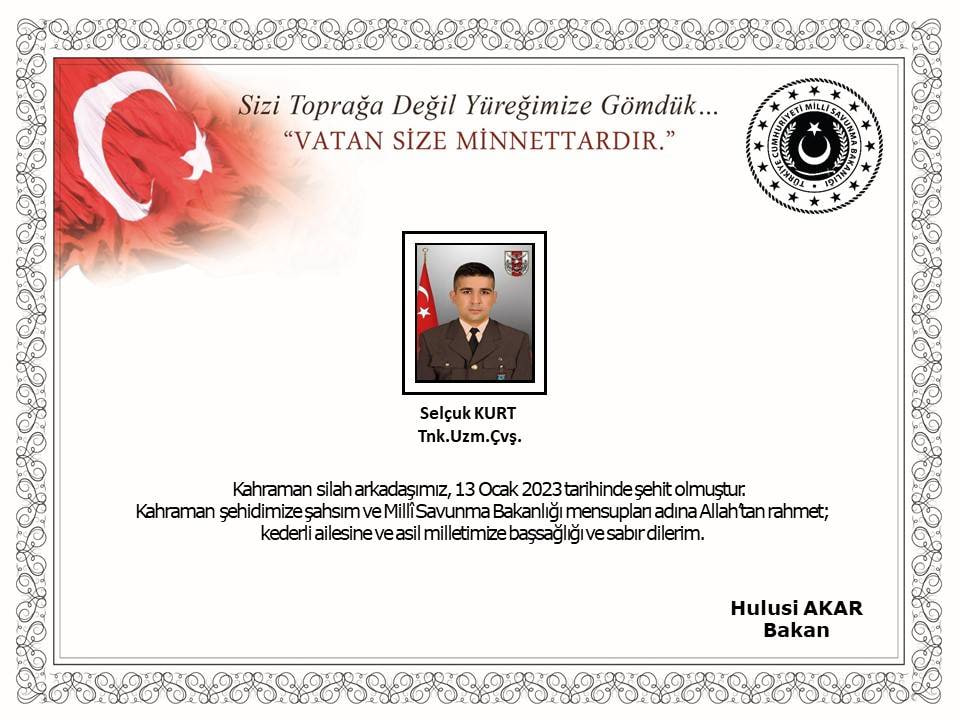
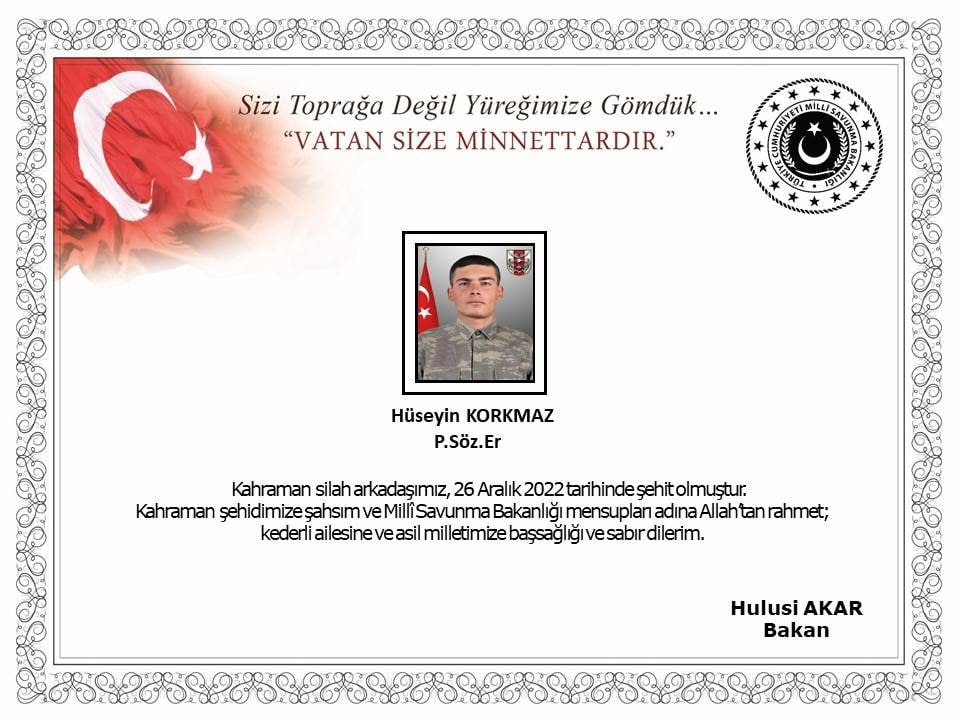
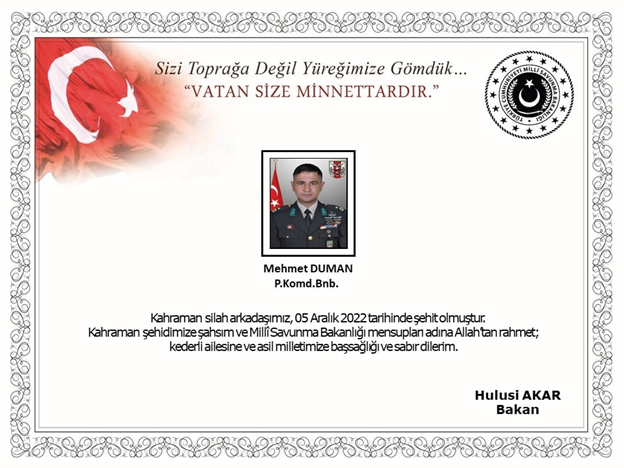
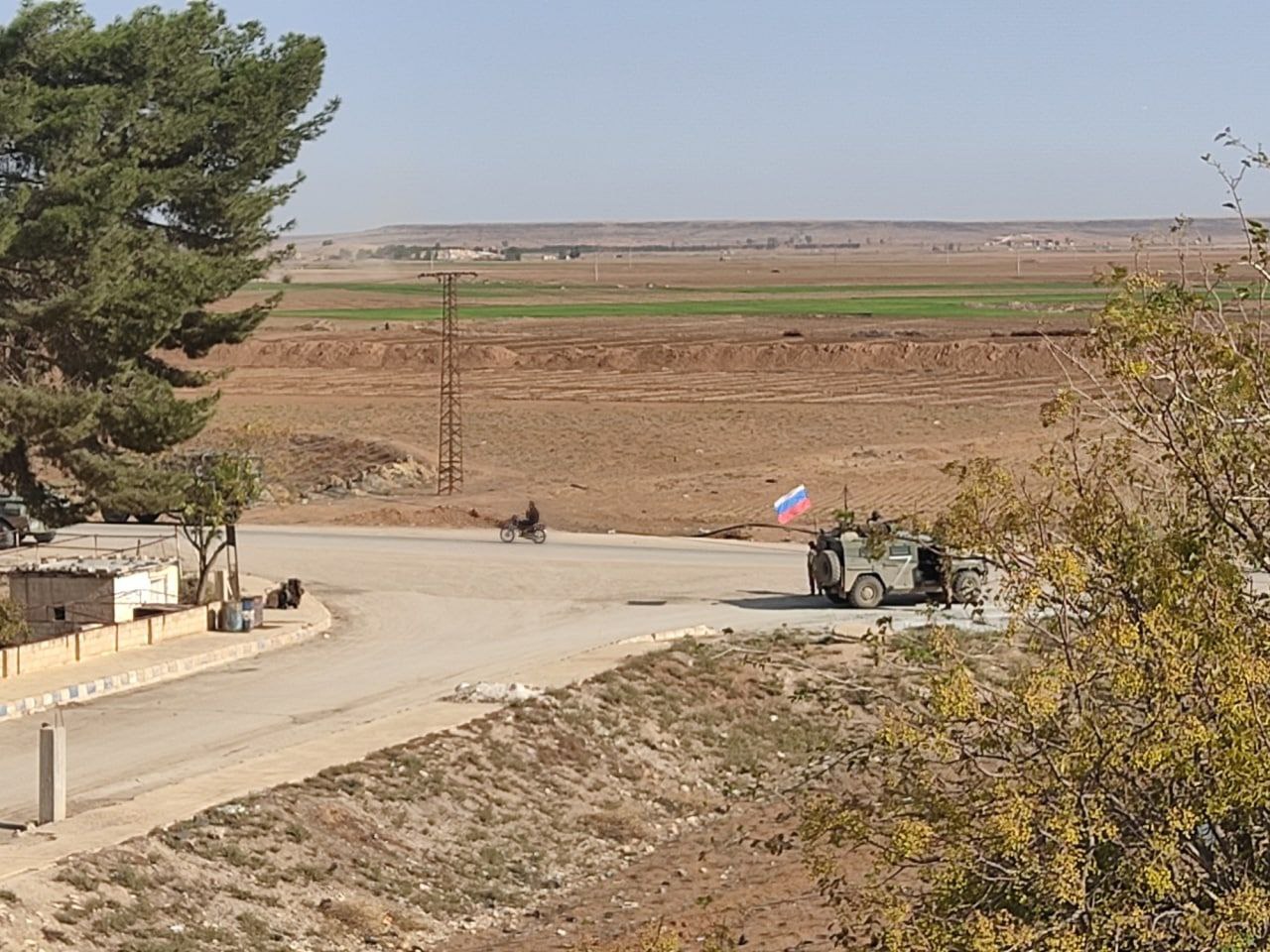
According to the statement of the Turkish ministry, the personnel was injured very seriously in a rocket attack by the Kurdish militants on a Turkish base in Hazwan village near al-Bab city in northern Aleppo Governorate, northwestern Syria. The man was moved to a healthcare center, but he succumbed to injuries.
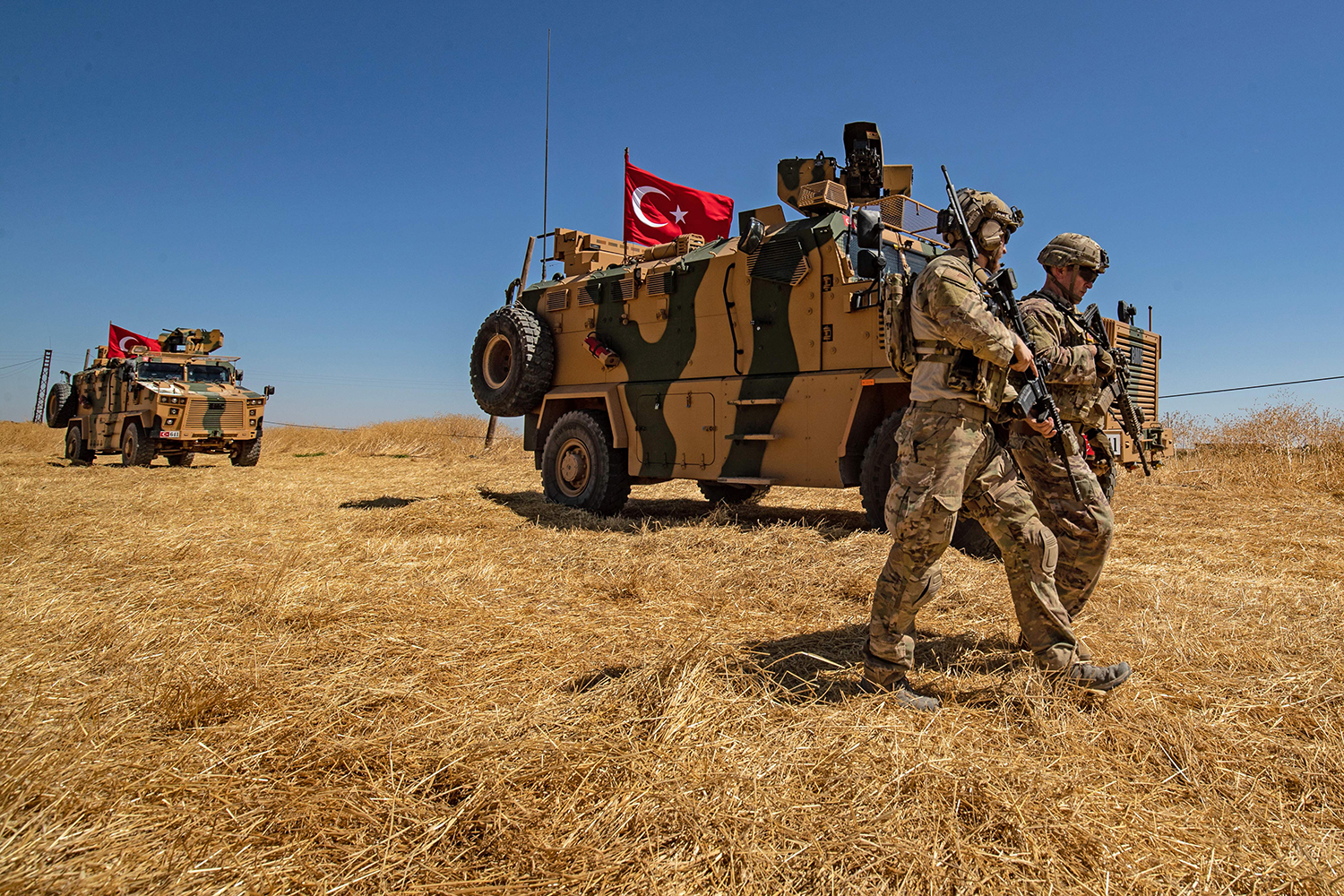
In drone and artillery attacks, the Turkish Army targeted some strongholds of the Kurdish militants in Tal Rifat, Maranaz, Bineh, Abin and Zor Maghar in Aleppo Governorate in response to the fatal attack. Turkiye announced that 11 Kurdish militants were killed in the retaliatory attacks.
On September 9, 2022, also, the Ministry of National Defense declared that a Turkish military personnel was killed during the Operation Olive Branch in northern Syria.
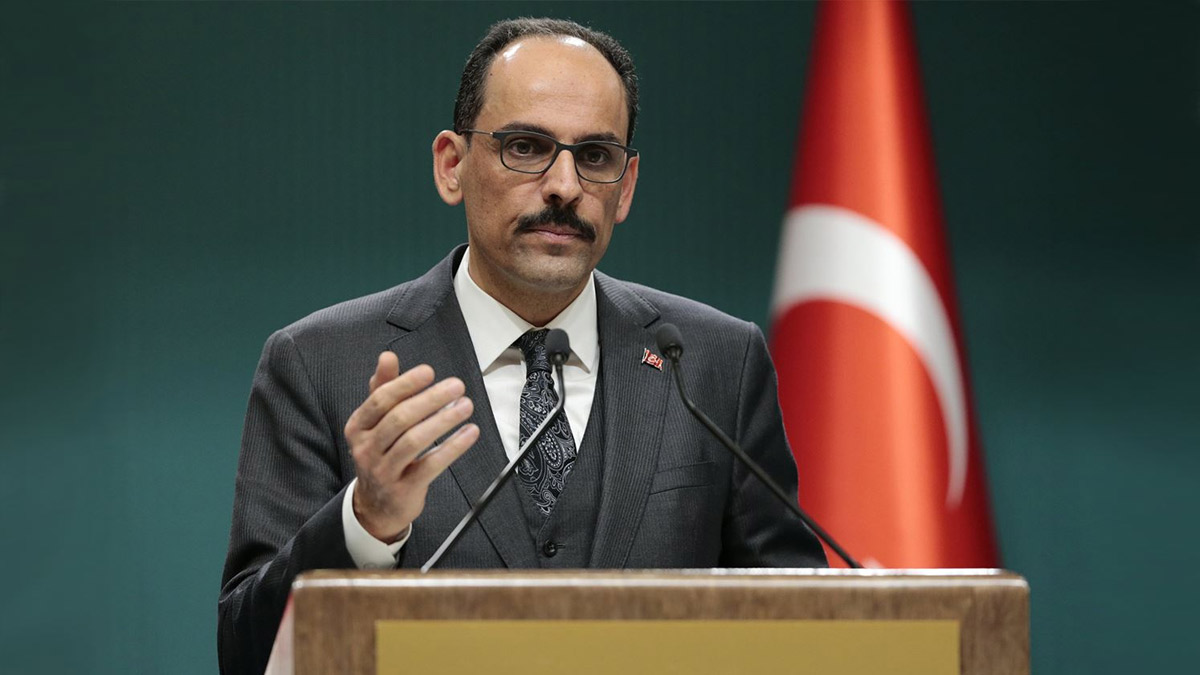
Declaring Turkiye’s readiness to initiate the military strike in the Arab country, Kalın said on Saturday that Russia’s effort to maintain peace does not mean that Ankara has put aside the option of a new military operation in northern Syria.
Turkish President Recep Tayyip Erdogan already addressed a gathering of the Justice and Development Party as saying that we will initiate ground operation in the best time possible aimed at clearing northern Syrian cities of Tall Rifat, Manbij and Ayn al-`Arab from the Kurdish militants.
Erdogan made the remarks in a situation that his Syrian counterpart Bashar al-Assad underlined in a meeting with Russian Presidential Special Envoy for Syria Alexander Lavrentiev a few days ago that the end of occupation and support for terrorism are one of the conditions ahead of the normalization of ties with Turkiye.
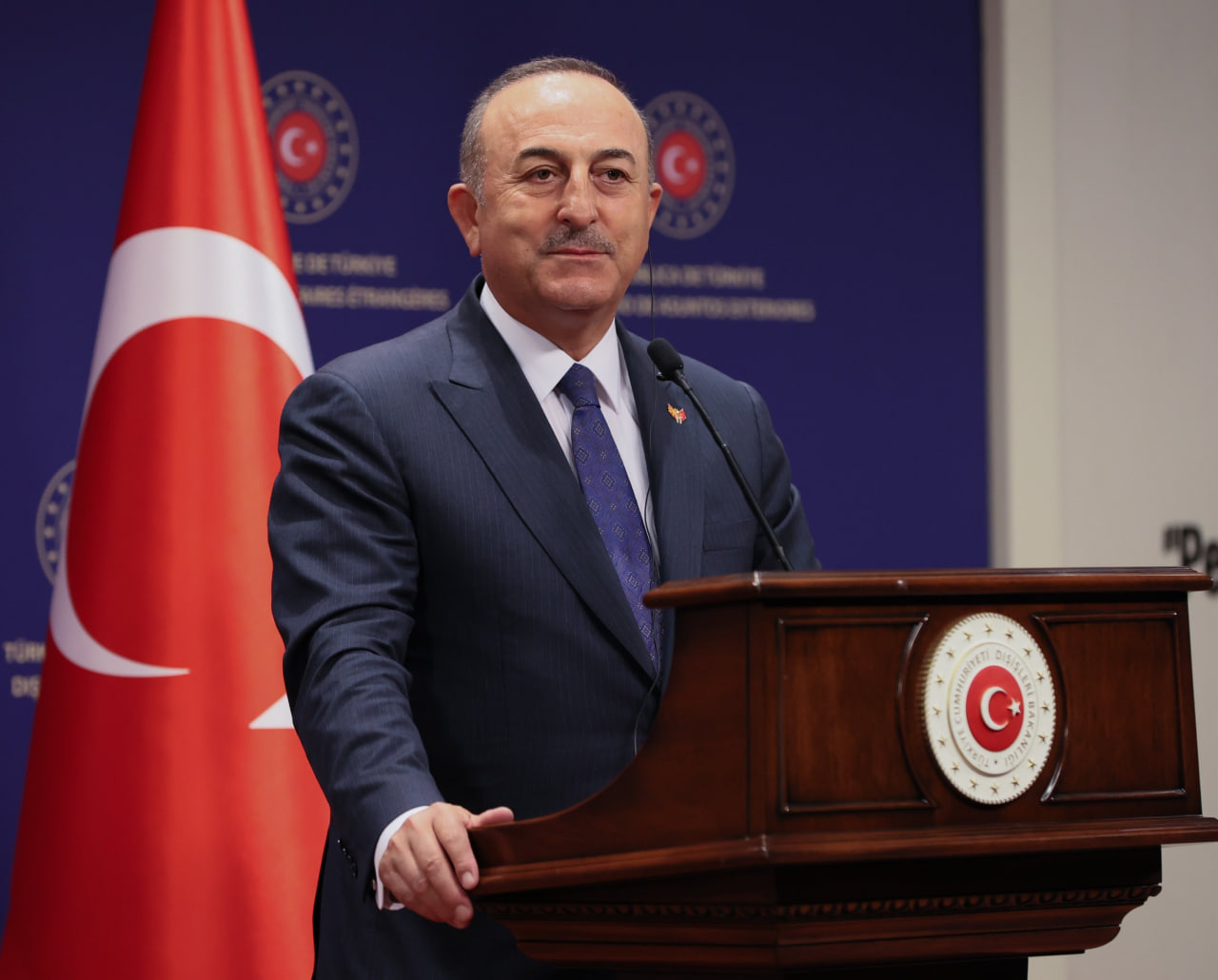
Turkish Foreign Minister, Mevlut Cavusoglu said on December 31, in response to journalists’ questions, that the meeting with the Syrian authorities will probably take place in the middle of January. It is said that this date was determined after the Turkish Foreign Minister’s phone call with Russian Foreign Minister Sergey Lavrov.
Cavusoglu said:
“We have not yet decided where to hold this meeting. It may be held in a third country. The names of some countries have also been mentioned. Normalizing relations with a country requires several meetings, not one. Otherwise, no progress will be made in it.”
Turkish Foreign Minister continued his speech and said:
“Some terrorist groups are seeking to take advantage of the resulting vacuum in Syria, and Ankara is a supporter of Syria’s territorial and border integrity and has no ambitions for it.”
It is worth mentioning that the first tripartite meeting between Syria, Turkey and Russia was held in Moscow in December 28, 2022. During this meeting, Turkish Defense Minister Hulusi Akar and Hakan Fidan, the head of the country’s National Intelligence Organization, met with Syrian Defense Minister Ali Mahmoud Abbas, Syrian Intelligence Chief Ali Mamluk and Russian Defense Minister Sergei Shoigu. They discussed solving the Syrian crisis, immigrants and fighting terrorism in Syria. At the end of this meeting, the defense ministers of Russia, Syria and Turkey pointed out the constructiveness of the talks and the need to continue the talks of the three countries in order to increase the stability of the situation in Syria and the entire region.
On December 30, Syria’s Al-Watan newspaper has published details of Moscow tripartite meeting and claimed that meeting ended after Turkey agreed to the complete withdrawal of its forces from the occupied areas in northern Syria.
According to this newspaper, Ankara is also committed to respecting the sovereignty and territorial integrity of Syria And the implementation of the 2020 agreement regarding the opening of the M4 road was also discussed in this meeting. The parties participating in this meeting also emphasized that the Kurdish militias are the mercenaries of the US and Israel and are considered the biggest danger for Syria and Turkey.
All the matters agreed in this meeting will be followed up by the specialized committees that have been formed to ensure the good implementation and follow-up of the agreements, and in order to further coordinate between the parties, more meetings will be held in the future.
This news has been published while Turkish Defense Minister Hulusi Akar announced yesterday:
“If the conditions are right, it is possible to hold a meeting between Turkish President Recep Tayyip Erdogan and his Syrian counterpart Bashar Assad. The positive trend of developments, including the talks between the ministers and intelligence chiefs of Turkey and Syria, makes it possible for the leaders of the two countries to meet.”
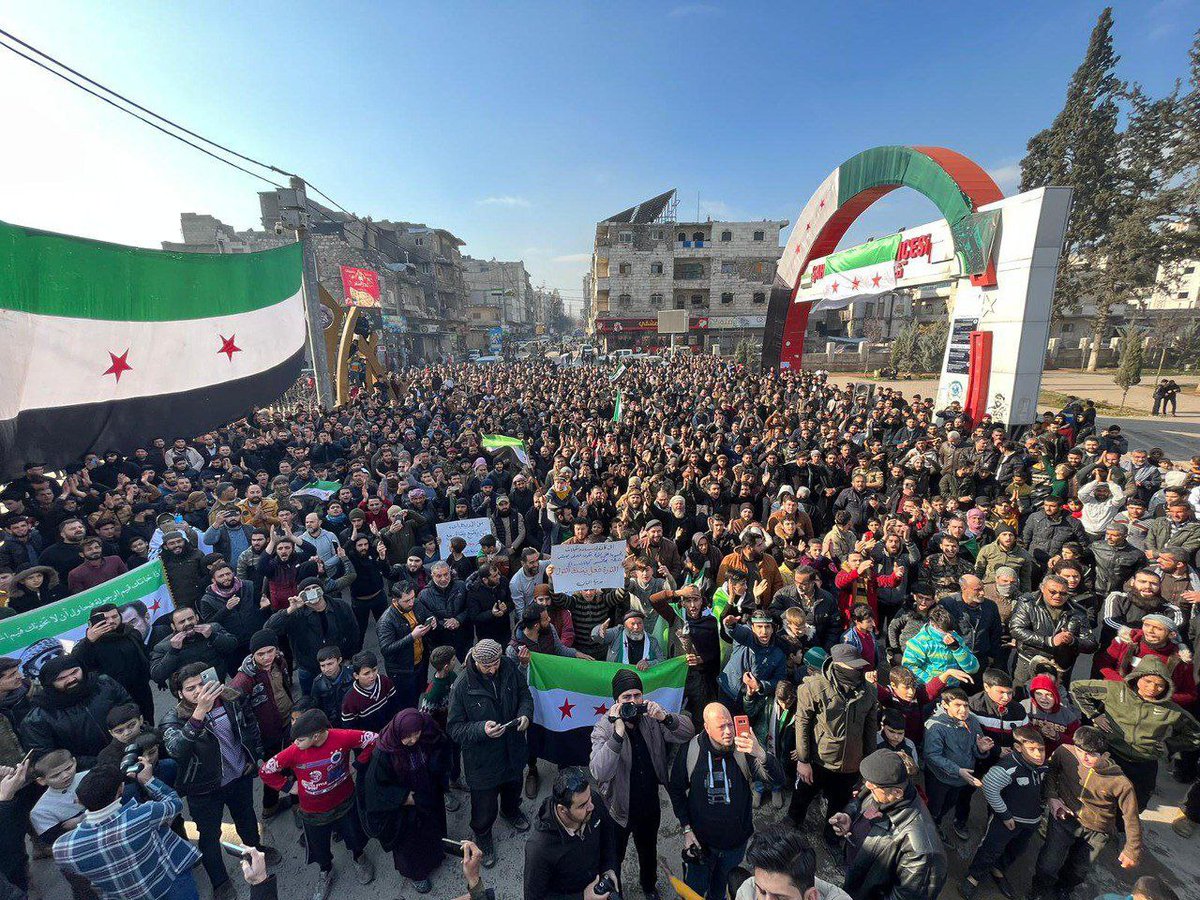
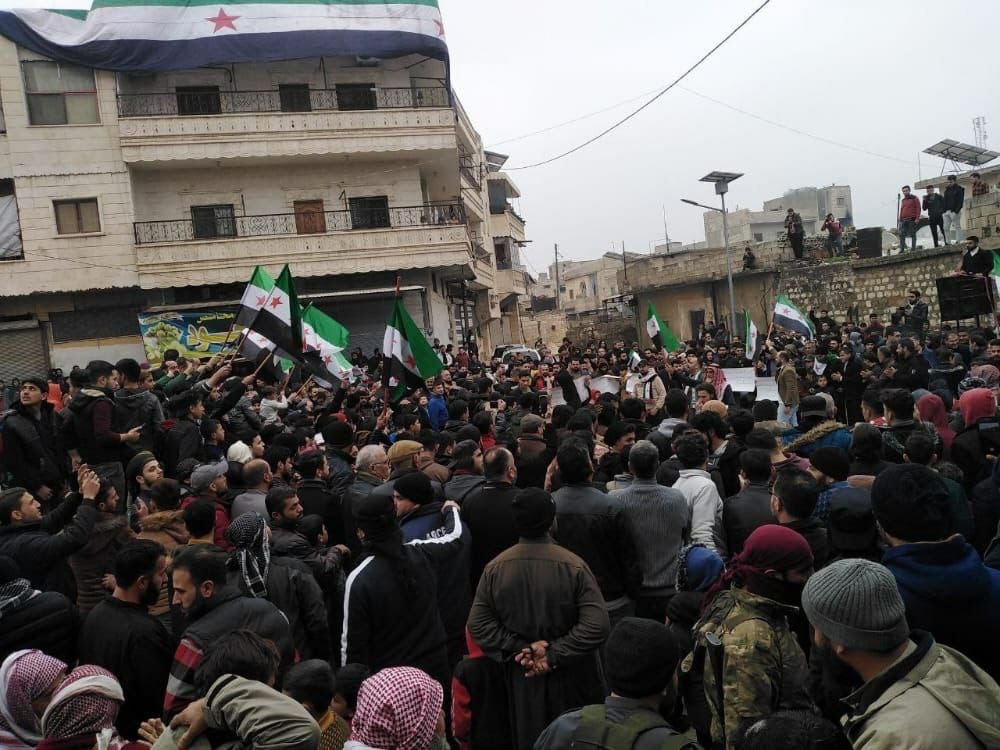
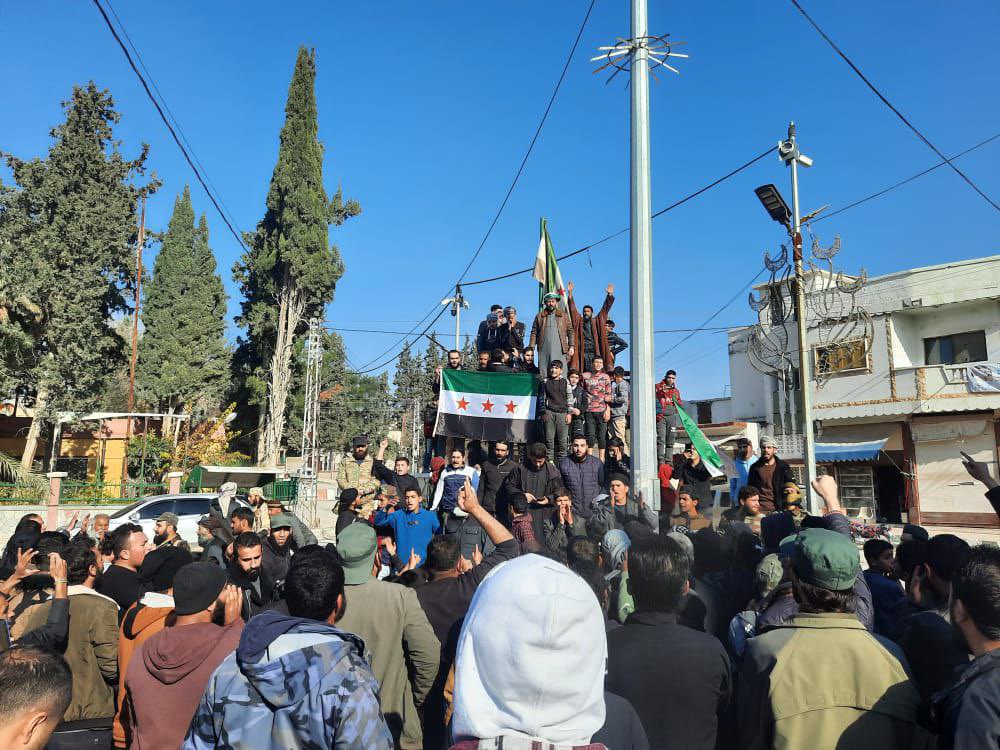
After the Turkish Defense Minister statement, a number of pro-Syrian militants and residents of the cities of Tal Abydh, al-Bab and several other regions in northern Syria, as well as the city of Jassim in southern Syria, by organizing a protest rally against these words, expressed their opposition to any cooperation and reconciliation with Syrian government. Demonstrators demanded the beginning of a new round of military actions by Turikish-backed militants against the Syrian army on different fronts.
Protests in the cities of Al-Bab, Tal Abyadh and Jasem against the possible agreement between Turkey and Syria
It is worth mentioning that in the meeting of the defense ministers of Turkey, Syria and Russia in Moscow, which was held on December 28, the solutions to the Syrian crisis were discussed and the need to continue the dialogue to achieve stability in Syria was emphasized. At the end of this meeting, the defense ministers of Russia, Syria and Turkey pointed out the constructiveness of the talks and the need to continue the talks of the three countries in order to increase the stability of the situation in Syria and the entire region.
On December 28, the defense ministers of three countries, Russia, Turkey and Syria, held a tripartite meeting in Moscow and discussed issues related to the solution of the Syrian crisis, migrants and the fight against terrorism in Syria.
According to the announcement by the Russian Ministry of Defense, in this meeting, solutions to the Syrian crisis were discussed and the need to continue the dialogue to achieve stability in Syria was emphasized. After this meeting, the defense ministers of Russia, Syria and Turkey pointed out the constructiveness of the talks and the need to continue the talks of the three countries in order to increase the stability of the situation in Syria and the whole region.
The Turkish defence ministry also announced in a statement that the Turkish defence minister Hulusi Akar and the head of its National Intelligence Organisation (MIT), Hakan Fidan, met Syrian defence minister Ali Mahmoud Abbas and Syrian intelligence chief Ali Mamlouk in Moscow along with Russia’s defence minister Sergei Shoigu on Wednesday.
It should be noted that after eleven years, this is the first time that the defense ministers of Syria and Turkey meet each other. Holding this meeting simultaneously with the threats of the Turkish authorities to start a new ground operation in northern Syria with the aim of clearing the border areas with Syria and confronting the Kurdish militias is considered as an important and strategic measure. An action that can determine the future of the battles in Syria.
According to Turkish media, this soldier was killed during a conflict with Kurdish militias in northern Iraq. With the death of this Turkish soldier, the number of Turkish Army casualties in operation “Claw Lock” increased to 71 servicemen.
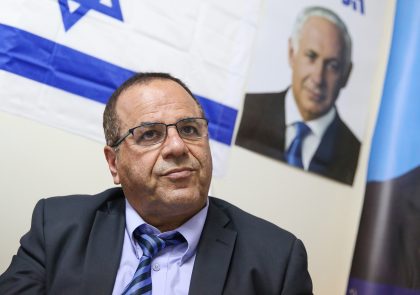
Ayoob Kara, politician and the former Israel’s minister of communications and a member of the Likud Party answers:
The governments of Azerbaijan, Georgia, Turkey, and Kazakhstan earlier in the year signed a declaration on improving the transportation potential throughout the region. Following that, the Azerbaijani, Kazakh, Georgian and Turkish foreign and transport ministries decided that there should be accelerated transport routes throughout the region, which will include the development of the Middle Corridor, a rail freight and ferry system that will link China with Europe.
It starts in Southeast Asia and China, and runs through Kazakhstan, the Caspian Sea, Azerbaijan, Georgia and Turkey before reaching southern and central Europe. This will permit trains to travel from China to Europe within 20-25 days, thus helping to reconnect the former Silk Road. As a former Israeli minister, I believe that Israel should be supportive of the establishment of the Middle Corridor, as it will help to strengthen the Abraham Accords if it is expanded to include Israel, the United Arab Emirates and other countries in the region.
The entire Middle East region used to be connected by train under the rule of the Ottoman Turks. There are a number of remnants of this wonderful train system in Israel, including the Ottoman train stations in Beersheba, Jaffa, and Jerusalem. These Ottoman train stations are historic landmarks from a bygone era when train travel across the Middle East was possible. Ottoman-era trains used to travel from Jaffa to Jerusalem, Haifa and other areas of the former Ottoman Turkish Empire, such as Medina and Damascus.
However, since Israel was declared to be independent, there has been no train travel between Israel and the Arab world. This was one of many causalities of the Israeli-Palestinian conflict. Yet in the wake of the Abraham Accords, this all has the potential to change, as the Arab countries no longer view Israel to be the pariah that they once viewed it to be. If anything, the Persian Gulf countries now view Israel to be a partner in the struggle against Iran, as do the Turkic republics like Azerbaijan, who greatly disdain how the mullahs are treating the Azerbaijani population in the Islamic Republic.
Thus, if this Middle Corridor is built, we Israelis can try to connect onto it as well, as it will help to counter the mullahs in Tehran by creating a stronger connection between the Turkic republics, Israel and the Arab world. We can connect to it via Turkey by ferry, and then from there, have another set of trains going from Israel to Jordan and Saudi Arabia and from there, to the United Arab Emirates. In our times, this is within the realm of the possible.
This will thus help to greatly expand trade between China, the Turkic republics, Israel and the Arab countries. Already, Israel, Saudi Arabia, and Jordan know that it is necessary to have a train that crosses from Israel to the Gulf states.They are talking about it and thinking about it. They are starting with trucks with containers that I arranged, where they bring containers from Abu Dhabi to Israel crossing from Saudi Arabia to Jordan to Haifa.They could continue from there to Turkey via ship and from there to Europe and anywhere else.
That means that we can have a train traveling from Europe to Turkey and from there, ships can go to Haifa, and from Haifa to Jordan, Saudi Arabia and from there, to the Gulf states, and they can go back in the opposite direction. I am in Bulgaria now to check how I can make it more relevant. After that, a Saudi Arabian agreement with Israel can start with a new train, like what existed in the Ottoman times with the Hijaz Railway. The people of Hijaz want to make it happen again. This is in the plan of the Abraham Accords Agreement and it will happen in the future.
Ayoob Kara, politician and the former Israel’s minister of communications
Postscript:
For many years, Israel has been seeking to establish deep relations with the Central Asian countries through different ways and models. For example, Israel’s relations with Kazakhstan in the fields of military, security and energy have been very strong and there have been high-level visits between the Zionist regime and Kazakhstan in the past.
In a country like Uzbekistan, the existence of a “large community of Tajik Jews from Bukhara” is very important for Israel and the regime has always sought to influence the community as well as the Central Asian society.
Needless to say, Israel has had more secret relations in Tajikistan. One of the reasons for these relations was to help the Government of the Republic of Tajikistan to suppress and destroy the Islamist groups close to Iran, so that they can compete with the position of the Islamic Republic of Iran in Tajikistan and overcome its influence.
Now, due to the sensitivity created on the countries of Central Asia, we are witnessing the presence and strong role of different countries in the developments of this geographical area. The activity and influence of America, European countries and Persian Gulf countries, especially Saudi Arabia, has been very impressive in the last few years and now Turkey is also displaying its influence and power in this region via various means.
One of Turkey’s initiatives in this region is the creation and implementation of the “Middle Corridor”, which has attracted the attention of other countries and has been seriously welcomed by the United States and the Europeans.
Israel’s attempt to get connected with the “Middle Corridor” plan is completely noticeable. There are two reasons for this fact: 1. Israel’s need for the Central Asian region regarding the required resources and the definition of a new playing field to confront the Islamic Republic of Iran 2. The influence of the Israel in the region, especially in Azerbaijan, which is one of the most important claimants in the “Middle Corridor” plan
According to Ayoob Kara, the former Israel’s minister of communications, we can surely say that this plan is basically aimed at isolating Russia and Iran in the region.
On the other hand, It is quite conceivable that China will go along with the Middle Corridor plan because it is important for China to maintain its economic power, export and the market for its products in the foreign relations.
Although the capacity of this corridor is debatable and the implementation of this plan is somewhat impossible, only these attemts can be considered as serious alarms for the position of Iran and Russia in the region, which requires more attention from the Iranian authorities to review the country’s regional policies.
These days, the state-affiliated media in Azerbaijan intend to convey to their addressees that Iranian armed forces have been deployed along the Azerbaijan border and are planning to attack this country.
Khazar TV, in a report on Monday announced the objectives of these military exercises: “The exercise is a response to the threats from the Islamic Republic of Iran and it is made up of 5 military units. If Iran trespasses the Azerbaijan border, it will face the armies of two friendly nations, Azerbaijan and Turkey.
This exercise is intended to practice modern battles by using a combination of artillery, commando forces and marines to penetrate the enemy lines and remove booby traps. This exercise also includes deployment of pontoon bridges over river, heliborne operations, using tanks and landing forces behind the enemy lines. The aerial bombardment is carried out using airplanes and helicopters.
According to the Turkish ministry of defense, Turkish F-16 jets have also joined this exercise and one of the training sites for bombing the simulated enemy was near Astara. The number of F-16 used in this exercise has not yet been mentioned.
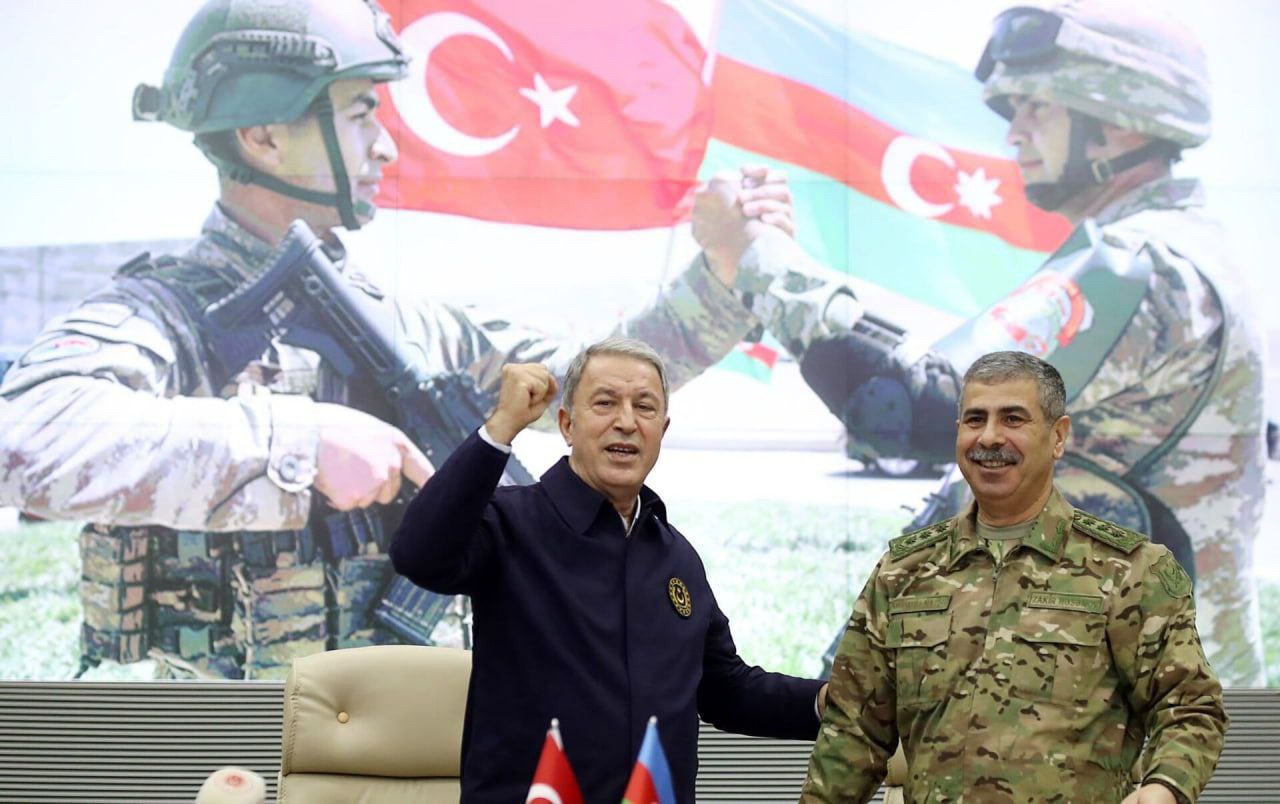
Turkish Defence Minister Hulusi Akar arrived in Baku, the capital of Azerbaijan on Tuesday, December 15, along with a military delegation. He is participating in this exercise along with Azerbaijani Defense Minister Zakir Hasanov.
On December 5, the death of one of the Turkish army forces was announced. According to Turkish media, he was injured by an IED attack in northern Iraq and died after being transferred to a medical center due to the severity of his injuries. Following the death of this Turkish army commando, the number of casualties of the Turkish army in the “Claw Lock” operation increased to 70 people.
On December 4 the Turkish Bashiqa military base in the Zelkan region, located in north of Mosul was targeted with eight rockets. No group took responsibility for the attack so far.
On December 3 also the Bashiqa military base was targeted by a rocket attack by the Islamic resistance of the “Ahrar al-Iraq” brigade.
On December 3, the Turkish Bashiqa military base in the Zelkan region, located in north of Mosul was targeted with four rockets. Ahrar al-Iraq group took responsibility for the attack.
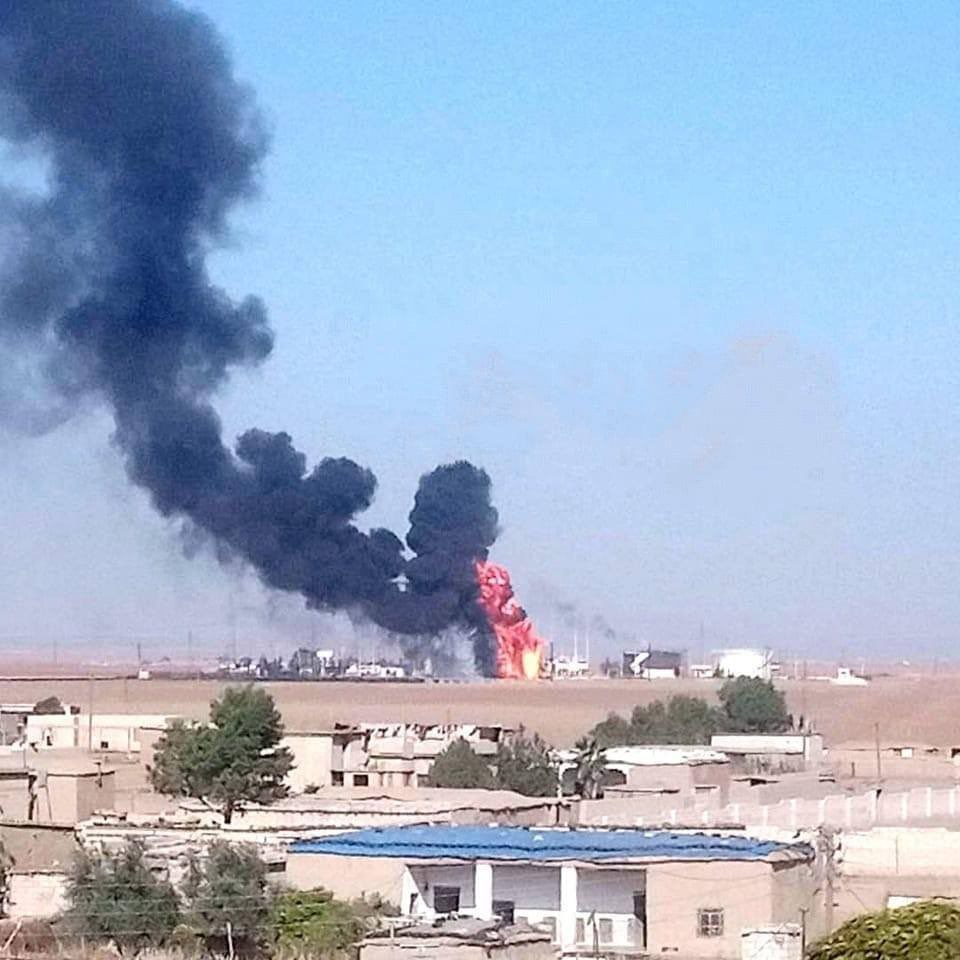
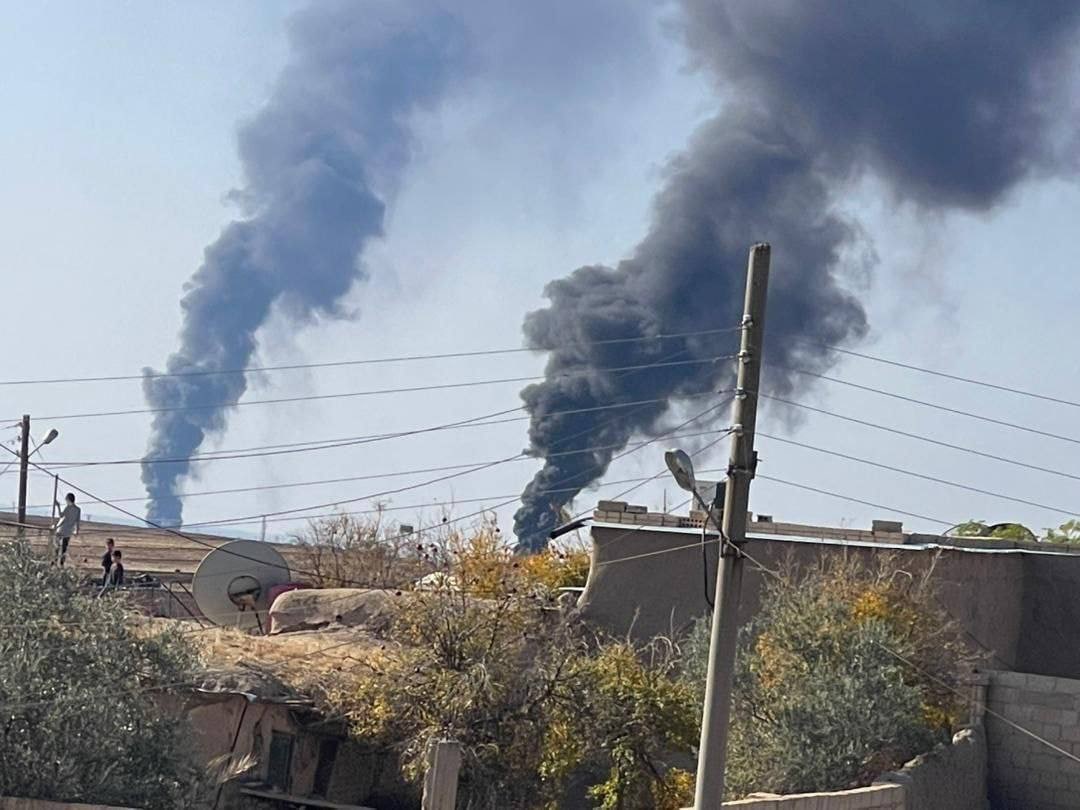
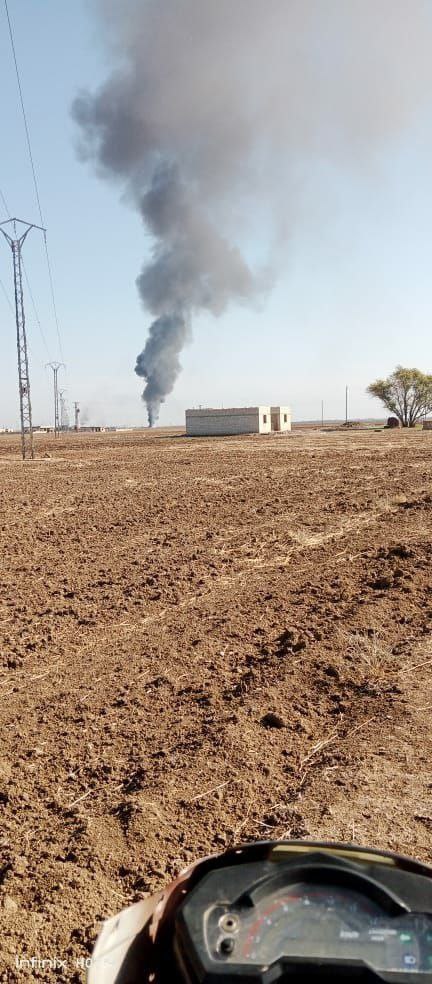
Following the Turkish army air strikes on the northern regions of Syria with the pretext of Operation Claw-Sword, Turkish drones targeted two oil fields near the village of Mulla Abbas and the northern outskirts of Qahtaniyah in east of Qamishli in Hasakah province. These attacks caused fires in the oil fields. Also, a checkpoint belonging to the Syrian Democratic Forces (SDF) near Hemo village in west of Qamishli city was targeted by Turkish drones.
Images of the attacks on two oil fields near Mulla Abbas village and the northern outskirts of Qahtaniyah in east of Qamishli.
After the first round of attacks, the Turkish drones targeted the joint base of the Russian military and the SDF in the outskirts of the town of Tal Tamar, during which one SDF member was killed and two others were injured. After this attack, the Russian military began the process of evacuating their headquarters from the Tal Al-Hamra region.
The withdrawal of Russian soldiers from their headquarters in Tal Al Hamra area
In addition to the drone attacks on Tal Tamar, the Turkish army and its militants targeted the two villages of Umm al-Khair and Tal Tawil in the outskirts of Tal Tamar with artillery attacks.
On the other hand, at the same time as the Turkish armed forces attacks on northern Syria, the President of Turkey, Recep Tayyip Erdoğan, said to the parliamentarians of the Justice and Development Party:
“We will find and punish all those who were involved in the explosion of Istiklal Street in Istanbul. Turkey will not remain silent in the face of these attacks. Recent events have shown that the parties who guaranteed that Turkey would not be attacked from Kurdish-controlled areas didn’t kept their promises.”
He said about Turkey’s military operations in northern Syria:
“Air operations in northern Syria have just begun. We will also begin ground operations at the most appropriate time. We will begin clearing northern Syria of Kurdish militias from the cities of Tal Rafaat, Manbij and Ain al-Arab, and the steps we take will guarantee the territorial integrity and security of Syria and Iraq.”
It is worth noting that the increase of these attacks simultaneously with the threats of the Turkish president to start ground operations in the northern regions of Syria is considered a serious warning for the Kurdish militias and the Syrian government. Therefore, it is likely that the senior commanders of the Syrian Democratic Forces (SDF) will negotiate with Iran, America, Russia, and even the Syrian government to get help and get rid of this crisis, just like what we have seen in the past years.