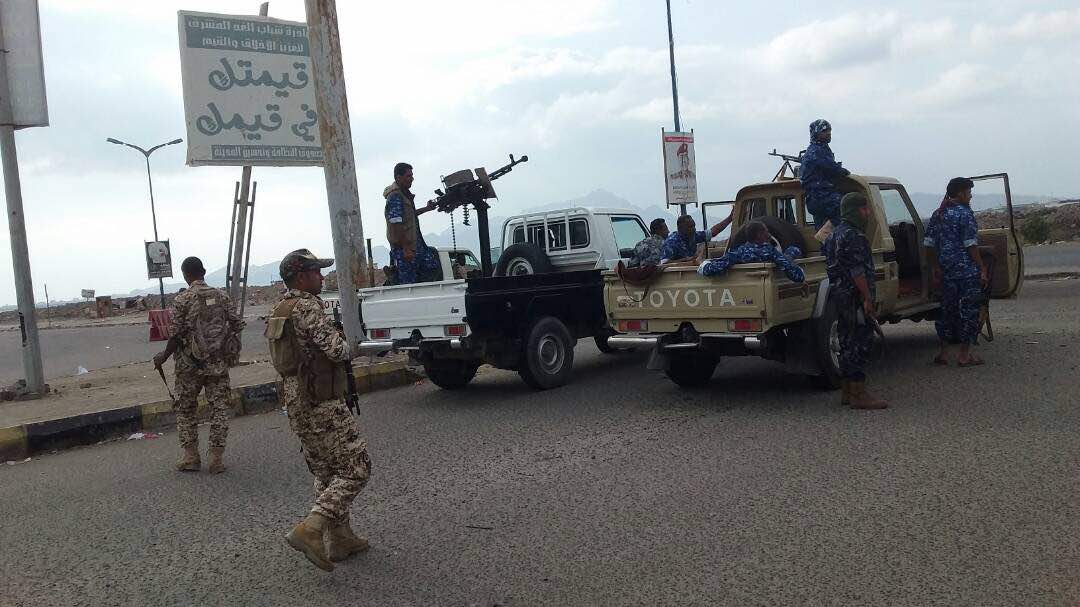
The spokesman of the Yemen Armed Forces stated that the joint operation have targeted a military parade of Saudi-led coalition forces and due to this attack several Saudi-led forces and commanders were killed and wounded.
He added that these forces was preparing to deploy in Al Dhale and Taiz fronts.
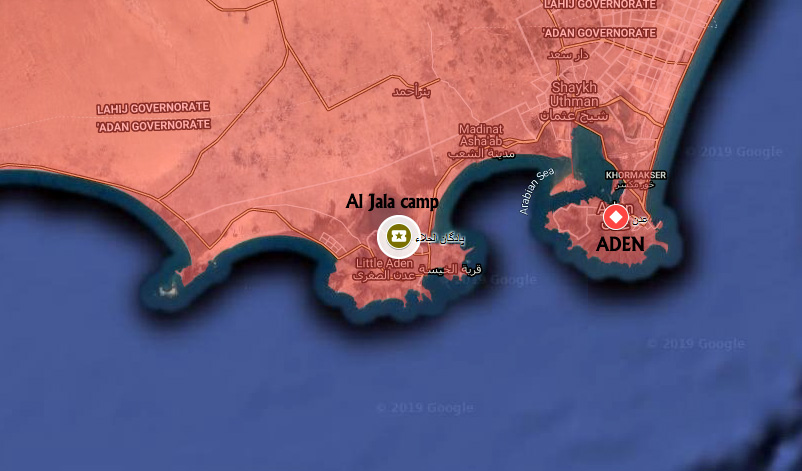
According to pro-coalition sources, during the recent Ansar Allah operation against the Saudi-led forces in the Al Jala military camp, so far, 32 coalition forces, including Brigadier General Munir Al-Yafei one of the most prominent leaders of the Hizam al Amni(Security belt forces, backed by UAE) have been killed in the attack. The casualties are rising.
Tag: Aden
-

Breaking | Ansar Allah Joint Missile and Drone Attack on Al Jala Camp in Aden
-

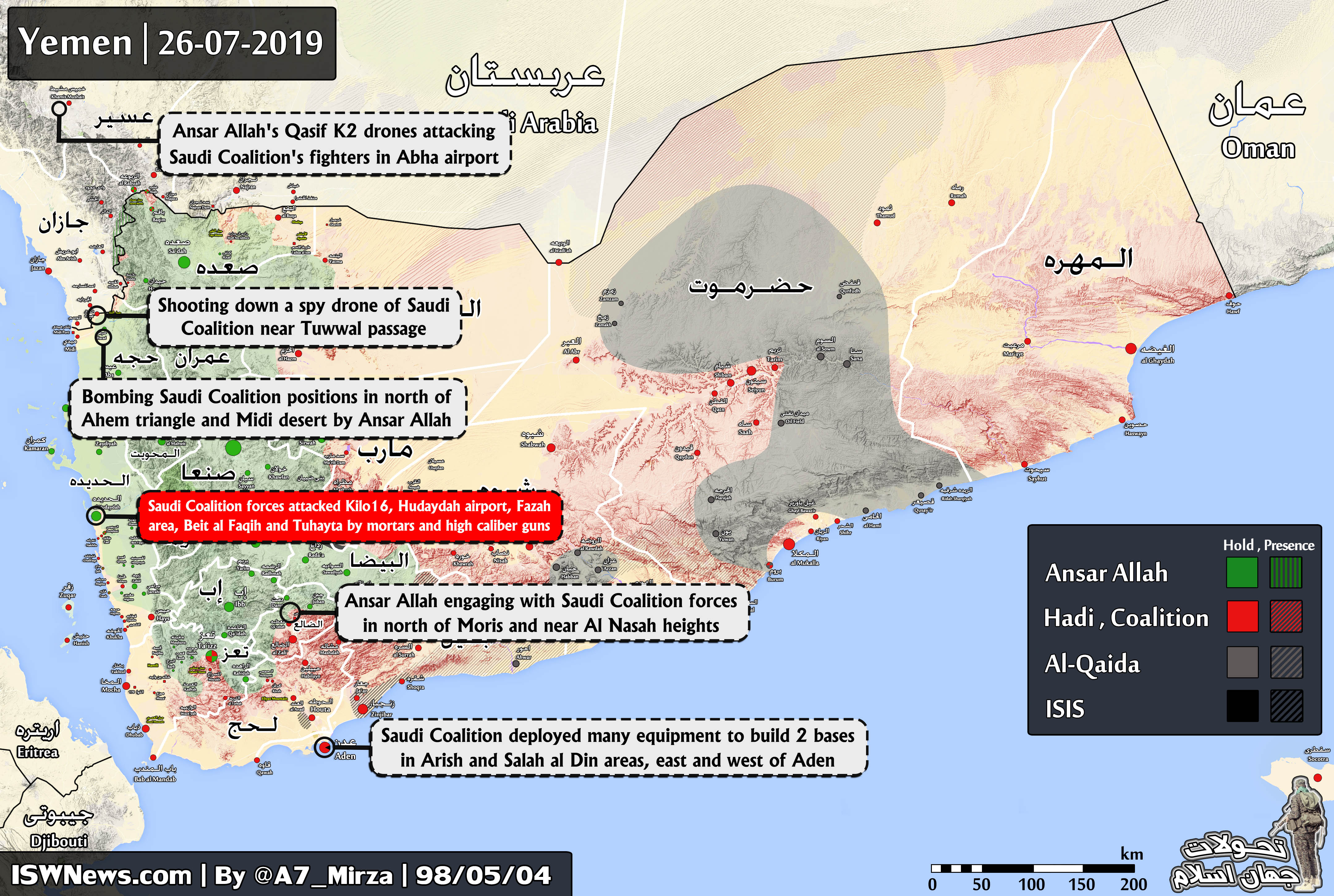
Latest Updates on Yemen, 26 July 2019
1. Ansar Allah’s Qasif K2 drones attacking Saudi Coalition’s fighters in Abha airport.
Yemeni Armed Forces spokesperson stated that the attacks hit hangars of Saudi warplanes and interfered the flights of Abha airport but Saudi Coalition reported to destroy the drones over Asir airspace before reaching there.
2. Hajjah:
– Shooting down a spy drone of Saudi Coalition near Tuwwal passage.
– Bombing Saudi Coalition positions in north of Ahem triangle and Midi desert by Ansar Allah.
3. Aden:
Saudi Coalition deployed many equipment to build 2 bases in Arish and Salah al Din areas, east and west of Aden.
4. Abyan:
Several brigades were deployed to Abyan by Saudi Coalition. These movements are due to Emirati forces retreat from frontlines with Ansar Allah.
5. Dhale:
Ansar Allah engaging with Saudi Coalition forces in north of Moris and near Al Nasah heights.
6. Al Hudaydah:
Saudi Coalition forces attacked Kilo16, Hudaydah airport, Fazah area, Beit al Faqih and Tuhayta by mortars and high caliber guns.
Click to see the full size map -

Investigating Aspects of Ansar Allah’s Possible Operation in South of Yemen + Maps
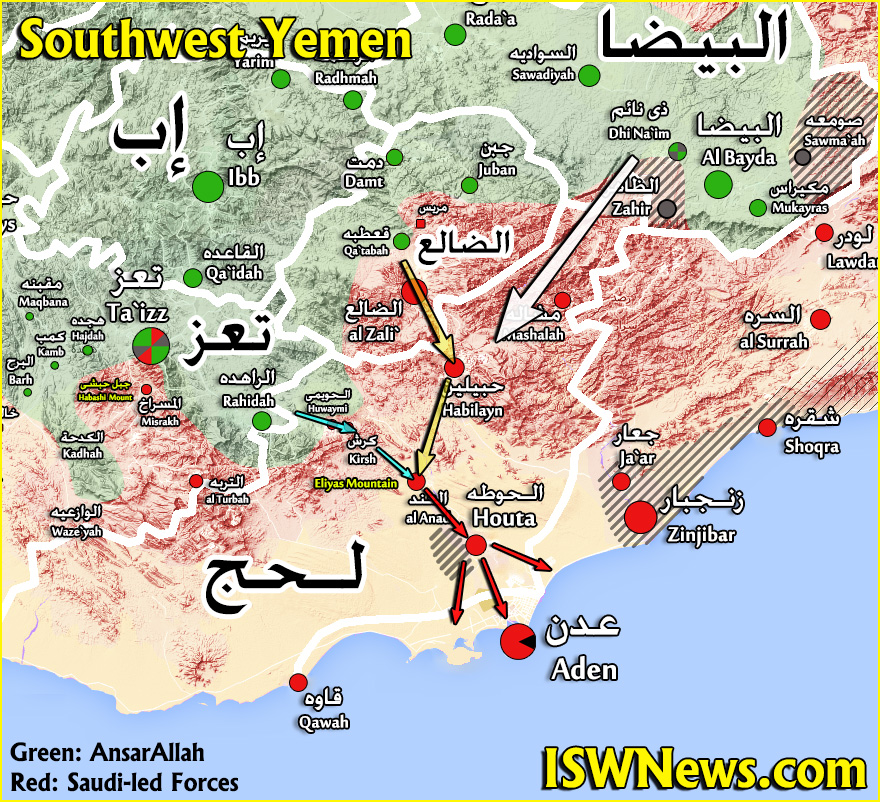
After claiming Qatabah city, possible direction of Ansar Allah’s operation in Dhale province can be as follows:
1. Toward Sadrayn base, northeast of Qatabah.
2. Toward Moris, north of Qatabah and south of Juban.
3. Toward Sanah.
4. In Azariq district.
5. Toward capital of Dhale province.Options 1 and 2 provide security for Ibb, Zamar and Baydha provinces. Options 3 and 4 are prerequisite to enter Dhale city. This axis paves the way toward Aden.
If Ansar Allah takes control over Zamar-Dhale strip, by activating other fronts such as Krash in Taiz-Aden route, reaching Aden harbor is not difficult compared to other operations such as Taiz and al Hudaydah.
Possible route for AnsarAllah to advance in south of Dhale and Krash fronts (Taiz-Aden):
Route toward Al Anad base from Krash axis is not difficult and if entering Lahij province from south of Dhale and reaching Habilayn, AnsarAllah can attack Lahij center and then Aden harbor.
Baydha-Lahij from the road from Baydha(Zaher to Yafe to Habilayn) to Lahij is the second axis for Ansar Allah’s operation or logistic and back up route for their advance in Dhale.
Blue: Krash-Anad axis | Yellow: Dhale-Habilayn southern axis | White: Baydha till Halibayn | Red: Final axes to Aden
Conclusion:
Considering latest evolutions of war in Yemen in despite of economical and political pressures and siege, AnsarAllah has changed its defensive stance to attacking and liberating Qatabah is not their final advance.
But it should be considered that moving toward south of Dhale and Aden and even keeping the position and frontlines in other northern and eastern fronts, requires minimum military equipment which is difficult to procure for AnsarAllah due to limited access to the Red Sea (Sweden agreement and al Hudaydah ceasefire).Advancing after 5 years of defense under the most severe attacks is more like a miracle…
-

Investigating UAE’ Foreign Policy
First part: Africa
Strengthen strategic foreign influence, as Emirates call it, interfere in many Asian and African countries affairs. Its goals being beyond just Emirates’ position, are in the interest of western exploiting countries such as UK.
Controlling Aden Gulf and countries adjacent to it, confronting Islamic Resistance, controlling the situation in African countries and securing Europe’s energy are the main tasks Emirates should do on behalf of Britain.Emirates sees the Resistance Axis (Iran, AnsarAllah, Hezbollah) and Turkey-Qatar Coalition on one hand and Saudi-Bahrain- Egypt-Kuwait axis on the other hand as regional rivals.
– Somalia:
To control Aden Gulf, Emirates infiltrated in self-governed area of Somaliland, north of Somalia and erected a military base in Barbara harbor according to request of the local parliament and it is said by paying high stakes bought the exploitation right of the harbor for 30 years.
Somaliland during Somalia civil war in 1991 claimed independence and no country acknowledged that and is considered as a self-governed land. By donating privileges to countries like UAE, they try to get independence.
– Eritrea and Ethiopia:
To infiltrate in the Horn of Africa and also to help assaulting Yemen, Emirates started building a military coastal base in 2015 in Asab harbor, south of Eritrea at the border with Djibouti and Strait of Bab al Mandeb.
This harbor has benefits for three sides, UAE, Eritrea and Ethiopia. Emirates intensifies its presence in Africa and Yemen providing agriculture and food, Eritrea benefits financially and Ethiopia has access to sea.
– Libya:
Emirates is supporting General Gaddafi and opposed Haftar government (supported by UN and Qatar) widely, after fall of Qaddafi. Libya National Army under command of General Haftar and supported by Emirates could claim vast lands in west, east and center of Libya with several operations.
Emirates not only pays all the costs and provides all the equipment for General Haftar but also deployed 12 fighter jets (6 Mirages and 6 F-16s whose pilots and technicians are mainly European) to eastern airbases of Libya to support the operations.It is said recently that this movement is trying to candidate Saif al-Islam Gaddafi for presidential election.
– Egypt:
After Abdel Fattah el-Sisi took the power from Muslim Brotherhood in Egypt, to confront Turkey-Qatar axis, el-Sisi submitted to Saudi-Emirates axis. Therefore Egypt is a main player in Saudi Coalition and signed numerous contracts with Saudi and UAE.Second Part: Asia
– Yemen:
After accompanying Saudi Coalition in attacking Yemen widely, Emirates follows two policies; to form groups separated from Saudi Coalition and to control southern harbors and islands. Groups adherent to Emirates have formed under the names “Hizam al Amni” and “Quwat an Nukhbah” in southern and eastern parts of Yemen.
UAE’ approach to war in Yemen is first to confront AnsarAllah and then to confront Mansoor Hadi’s forces.Although Emirates apparently supports Mansoor Hadi in confrontation with AnsarAllah but in reality they have deep differences with Muslim Brotherhood and Mansoor Hadi’s idealogy and are continuously looking for positions in parliament or government.
Engagements in different cities such as Taiz, Shabwah and Aden are evidences for it.
After repelling Ali Abdullah Saleh intrigue by AnsarAllah, Emirates is trying to attract his family and movement and trying to have a role beside AnsarAllah and Saudi in Yemen’s political field.
During the last year, Emirates occupied Socotra islands and repelled Mansoor Hadi’s troops out of there. It also is erecting a military base there and buying the lands from Yemeni owners. About Perim island and other islands, Emirates’ approach is same and trying to have cultural and military influence.Conclusions
As mentioned, Emirates expansion based on the resources and wealth out of the Persian Gulf, trying to stabilize its wealth by using other locations such as Aden Gulf countries and north of Africa. Also to confront Iran in western Asia, being Britain’s police of the region.Thus forming coalition with Saudi Arabia and its ambitious crown prince, participating in war against Yemen, investing in Aden Gulf, supporting Sisi and Haftar and etc. are all to serve in UK’s interests and if in future Emirates claim to confront Iran in future, it will not be surprising.
In addition, Emirates interference in civil wars of African countries and Afghanistan and also Pakistan’s financial dependence are among topics to be explained in future articles. -

Answering Key Questions about Yemen War – Part One
The imagination that AnsarAllah in western coast war has rattled and about to collapse is wrong, since the method and details of the tactics used by AnsarAllah, specially for general audience are not clear.
(The reasons can be media lack of reporting, biased news from media of governments and etc. which are not our topic here.)
Nonetheless understanding AnsarAllah’s tactics and goals in different fields and examining Yemen war form the beginning until now is the basis to understand evolutions in Yemen.Al Hudaydah battle which started seven months ago has reached the dead end right now which even made Americans intolerant and forced Saudi Coalition to insanely attack al Hudaydah from all aspects and putting political deadline on there hand.
Saudi Coalition operation in al Hudaydah has ceased temporarily and it is rumored that AnsarAllah demanded international organizations to interfere.
As Muhammed Ali Al Houthi said indeed there are negotiations but AnsarAllah will not retreat from their goals either for sure. The reason has roots in AnsarAllah establishment principles.
1. How Yemen war started and AnsarAllah gained power.
The Shiite-Sunni confrontation dates back to old times and 28 years ago when Ali Abdullah Saleh established Arabic Republic of Yemen and submitted northern lands to Saudi Arabia, Shias became angrier.
Hussein Badreddin al-Houthi under the influence of Islamic revolution in Iran, started fighting against arrogance and Ali Abdullah Saleh and martyred in this way and his successors in six wars until 2010 and finally in a revolution in 2012 forced Ali Abdullah Saleh to resign from power.
After his resignation, Mansoor Hadi in an agreement with AnsarAllah and from a no-rival election with the goal of peaceful power transition became the president of transitioning government.He first claim his goal to be fighting against terrorism (al Qaeda), however after a short period of time, started confronting AnsarAllah and put Southerners in power mainly and ignored the peace treaty contents and kept officials from previous government in power.
AnsarAllah did not sit back; entered Sanaa and in a short time took over presidency palace and other governmental buildings in August 2014.
After that they started some political negotiations between groups and in initial stages due to dissociative plans of Mansoor Hadi to form six different states in Yemen, they left the negotiations but after several months of disagreement and political victory of AnsarAllah, Mansoor Hadi reached to an agreement with AnsarAllah.
But Mansoor Hadi and Khaled Bahah(president and prime minister) in a vague movement, resigned in parliament. Parliament declining it and AnsarAllah takes it as a treachery, the government was dismissed and a presidency council with a transition parliament were formed.
Mansoor Hadi fled to Aden and considered his resignation under pressure of AnsarAllah and under support of Saudi Arabia started the confrontation with AnsarAllah.
2. What are sides of confrontation in Yemen?
AnsarAllah: whose military and political supporters are Iran, Hezbollah, Syria, Iraq and other Moghawemat groups in Saudi Arabia, Bahrain and etc.
Side led by Mansoor Hadi: Islah party, Southerners movement, socialists, Naseris, Salafists and etc. with Southerners incline more to UAE and other groups led by Mansoor Hadi incline more toward Saudi Arabia.
Al Qaeda, ISIS and subgroups: which had influence on other parts of Yemen but now are concentrated in center and east of Yemen.
National Congress Party: which followed Ali Abdullah Saleh at first and in coalition with AnsarAllah and then after Ali Abdullah Saleh separation from AnsarAllah, it also divided into two branches. Followers of Saleh joined Saudi Coalition and the other joined AnsarAllah.
3. What will happen if al Hudaydah falls?
Possible scenarios are:
– Continuation of war: engagements will continue in other areas such as Sa’adah, Sanaa, other coastal areas (toward primary targets) and other fronts such as Bayda, Jawf and Taiz (toward secondary targets).– Incipient of political negotiations: which is most likely to happen and its flow will be complicated as we have seen in Yemen before.
However defeating AnsarAllah politically is not possible and agreement on peaceful transition of power under international organizations supervision is more plausible.
If al Hudaydah survives, AnsarAllah by defeating the pricey seven months operation of Saudi Coalition will achieve a great victory which helps them to have a higher hand in political negotiations in future.
To be continued …
-

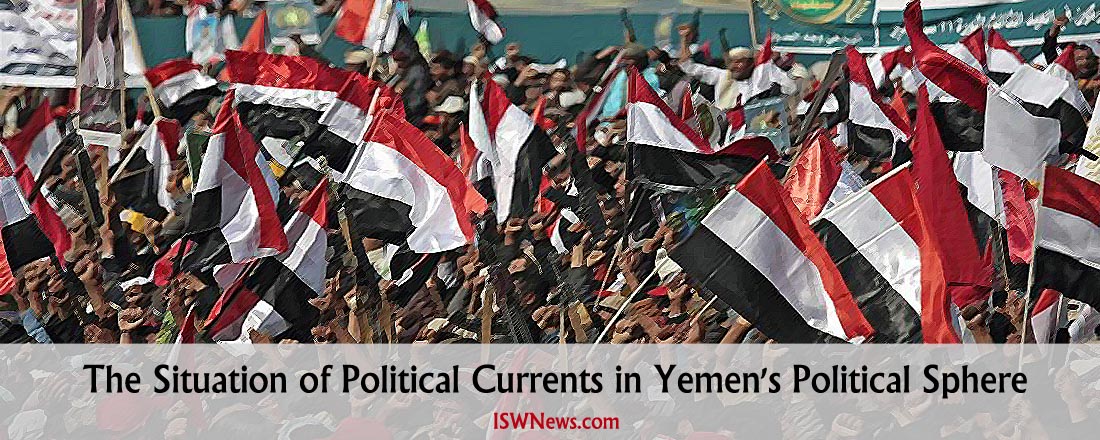
The Situation of Political Currents in Yemen’s Political Sphere
1. Zaidi ( including three groups, one is close to Iran, one to Saudi Arabia & Zaidi intellectuals )
2. Republican ( with Arabic ethnical tendencies towards Egypt & United Arab Emirates )
3. Muslim Brotherhood – Salafi ( close to Saudi Arabia, Qatar and Turkey )
4. Southerners ( with unification, Seperatist, Sufi & Salafi tendencies )Until 1962, the unipolar (political) system of Zaidi(1) was ruling in Sana’a.
From 1962 to 2000, the bipolar system of Saleh-Al-Ahmar(2&3) was ruling in Sana’a and with oppressing the two Zaidi(1) & Southern(4) current, Yemen seemed to be stable.
From 2000, Ali Abdullah Saleh, with the help of Zaidi(1) current, tried keep Muslim Brotherhood-Salafi(3) current away from power in order to make preparation for presidency of his son.
Ahmed Ali Abdullah Saleh. but the 2011 revolution led to his downfall.
The GCC’s, (Persian Gulf Cooperation Council) plan was an attempt to keep “Bipolar” system(2&3) in power and keep Zaidi & Southern current away from center of power.
However, with regards to downfall of Ali Abdullah Saleh, their efforts led to dominance of Salafi-Muslim Brotherhood current over Sana’a.
The dictatorship of Salafi-Muslim Brotherhood current in Sana’a, led to convergence of Houthi(1) & Saleh(2), and finally in 2014, Ansarallah entered Sana’a and the Salafi-Muslim Brotherhood current was ousted from Sana’a.
With Saleh’s death in 2017, the Zaidi(1) “Unipolar” system came into power once again in Sana’a, and the system put itself against these three other groups which despite their ideological & historical differences, are converged now.
Regarding to failure of all these four currents to rule over yemen alone, the chances for Ansarallah’s survival in Sana’a is very low. Although the repetition of past is not certain, but it is probable.
United Arab Emirates, which are in fact representing Britain, managed to make majority of southerners(4) & leftovers of Saleh’s system(2) dependant to itself. However, The Salafi-Muslim Brotherhood current(3) which is the main force in Hadi’s organization, is supported by Saudi Arabia and has issues with UAE.
But how the UAE managed to contain “Bin Salman” so that the initiative don’t fall into the hands of Salafi-Muslim Brotherhood current?
About this matter, it has been said that attacking non-military targets in Yemen and making it public in medias is one of the tactics of UAE. Even in the popular incident of “October 2016 Sana’a funeral airstrike” (مجزرة الصالة الکبری) in Kholan tribe which was held for father of former interior minister Jalal al-Rowaishan, around 17 commanders of Hadi’s army were killed. in similar cases, serious cases are ongoing against “Bin Salman” in international community, and UAE is using it as an instrument to control “Bin Salman”.
UAE’s scenario to continue the war, is to gain control over Yemen’s coasts & ports and to make Ahmed Abdullah Saleh, Ali’s son, ruler of Yemen. If this scenario happens, the Zaidi(1) current will be restricted to “Azal” region, the Salafi-Muslim Brotherhood(3) to “Saba” region.
The Britain which was ousted out of “Aden” in 1967, is coming back to this region, which is one of the strategic regions in the world. However, this time they are pursuing another goal and thats weakening “Shia Political Islam (Zaidi)” & Sunni Political Islam (Muslim Brotherhood)”. Britain knows it better that the ruler of “Sana’a”, will have control over “Aden” too, so Britain can’t leave Sana’a alone and give it to Zaidis or Muslim Brotherhood.
M.Pirbodaghi
-

Latest updates on Yemen; 28 January 2018/ Aden blood day; southerners’ engagements among each other.
- al Hamayat al Ra`asiya forces led by Hadi settle near Bin Dagahr the resident of Prime Minister Hadi and the streets to important places and residents of leaders. On the other hand, Aden security forces under commandment of Shalal Shaya` are beside al Hizam al Amni forces related to Emirates.
- Sunday morning Hadi troops try to prevent followers of Southern Transitional Council to rally in appointed places. In despite of engagement between Hadi forces and Aydrus forces which results in two deaths and four wounds, hundreds of southern troops enter the protesters gathering place in Khormaksar, Aden.
- Huna Aden website close to Hadi reports that situation in Aden is under control of Hadi forces.
- Shalal Shaya` leader of security forces in Aden enters the protesters gathering place in Khormaksar.
- Aydrus forces occupy a barrack “Naqal”. This barrack is near Tareq barrack and a place for Hadi troops. Some of Hadi troops are captured.
- Engagements reach Arish in Khormaksar and Jolah Caltex square in Mansura and are spreading out. Both sides are fighting heavily.
- Prime Ministry and High Council of Justice buildings are occupied by Aydrus forces.
- Huna Aden website: a whole battalion of Aydrus forces surrounds to Hadi forces.
- Barrack under commandment of Naser son of Hadi falls.
- Bin Daghar asks all military units to ceasefire and return to barracks.
- General Fadhl Hassan commander of the fourth military region joins Aydrus forces and claims all units under his leadership supporting southern Moghawemat.
- Hadi forces occupy all inspection posts and barracks of Hizam al Amni related to Emirates in Dar al Saad area.
- Hadi forces take over the Prime Ministry building which was occupied by Aydrus forces before.
- Fights in Aden today result in 12 deaths and 23 wounded.
- Hadi forces occupy Tawahi and Khormaksar districts and recapture High Council of Justice and some other governmental buildings.
- Southern Transitional Council issue an announcement, in which emphasizes on changing Bin Daghar government using peaceful means.
- Hadi asks for immediate ceasefire in Aden.
- In Aden battlefield alliance and northern forces (AnsarAllah, Islah and Motamar) only observe and only southerners are fighting. It seems this is a blood shedding early referendum between southerners to choose between unity and independence or Saudi and emirates.