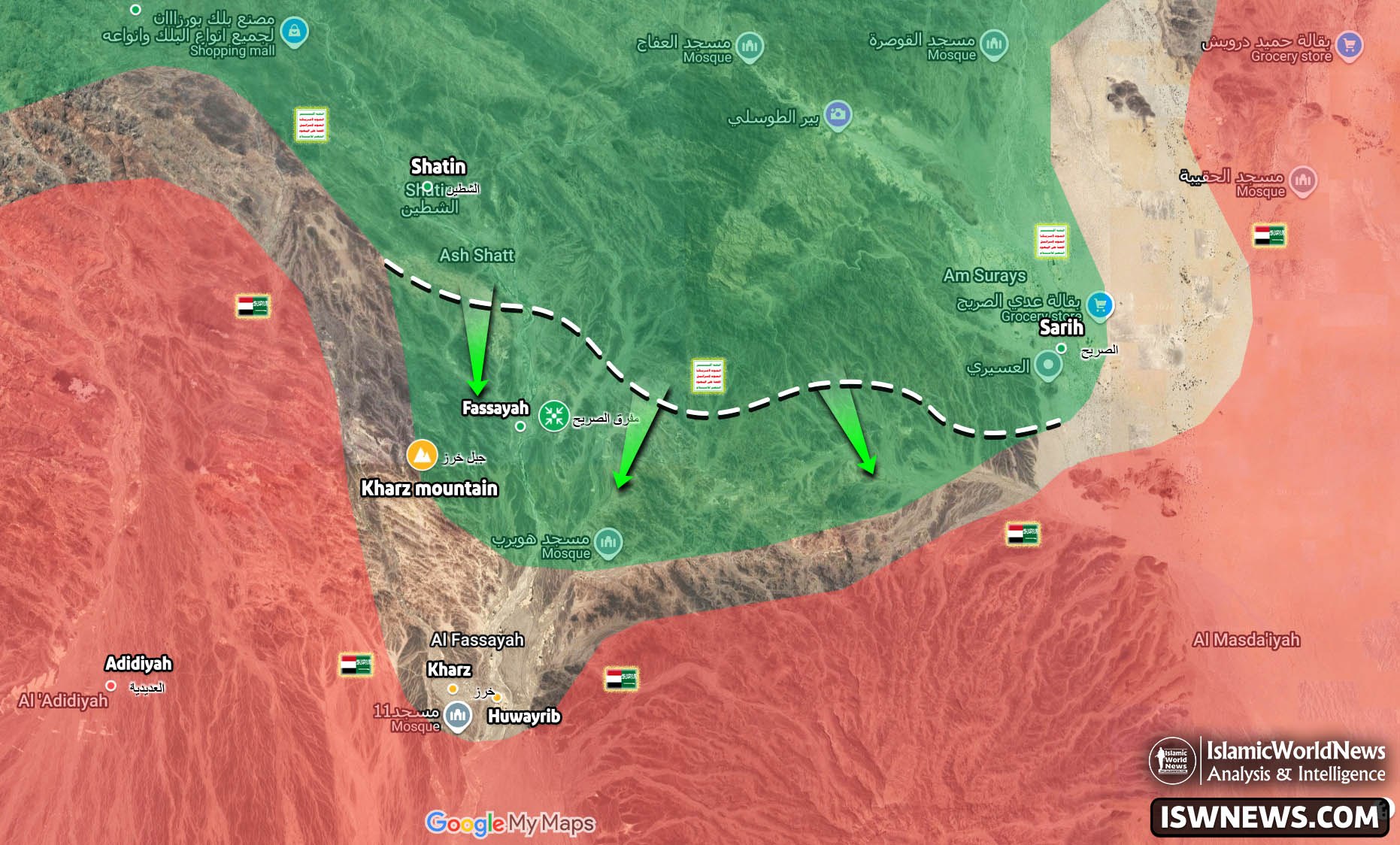
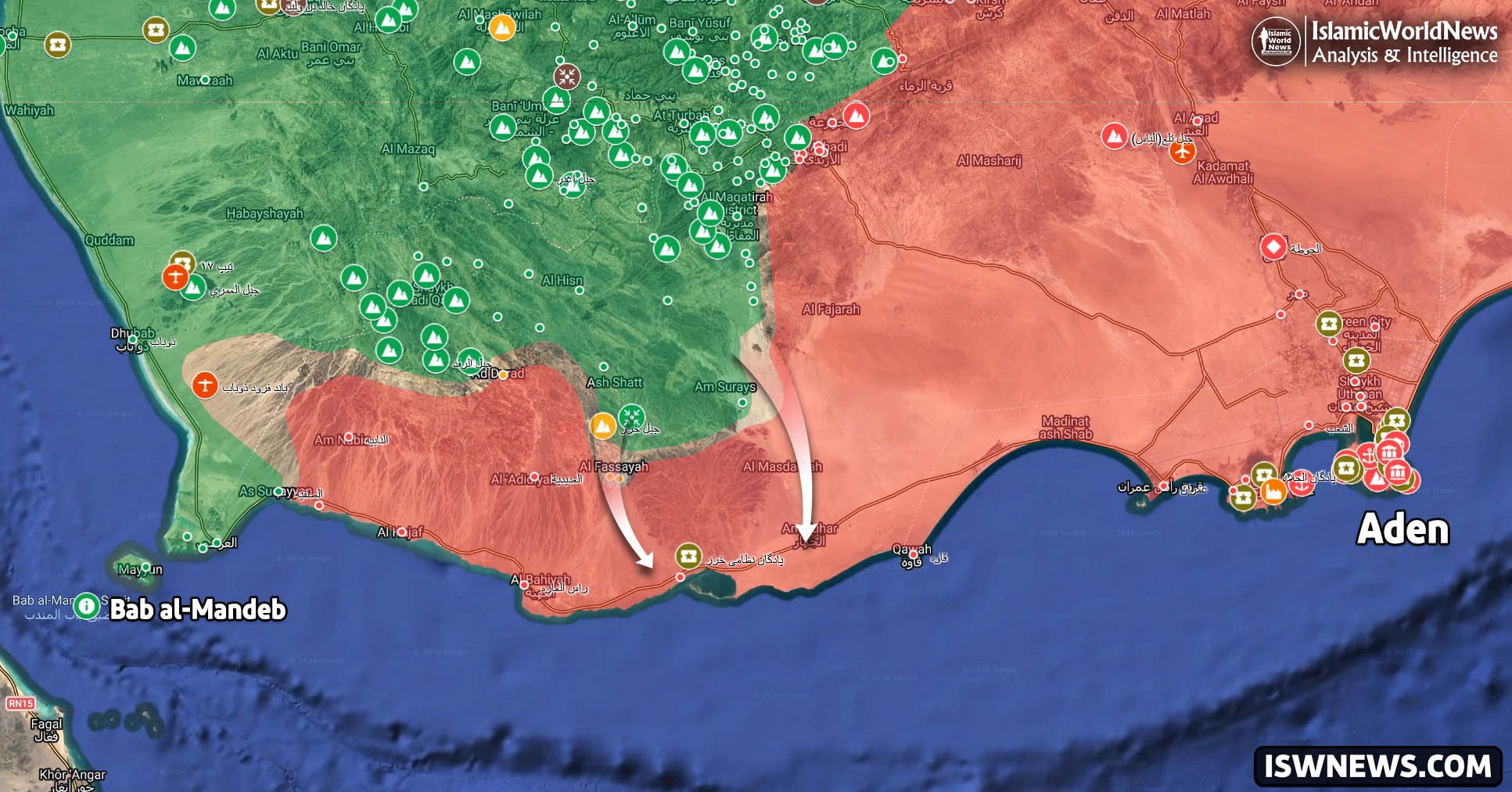
According to the latest field reports in southwestern Lahij Governorate, Yemeni armed forces and popular committees, after pushing back Al-Amaliqa and Tariq Saleh’s forces from the al-Sarih junction, succeeded in clearing the al-Fasayha area. Tariq Saleh’s forces have currently withdrawn from this axis, and Al-Amaliqa forces are resisting Yemeni Army attacks in the Huwayrib and Kharaz areas.
Yemeni forces have also attacked from the Durad axis toward the Ghayl al-Barir and al-Adidiyah areas, which has not yet yielded definitive results.
On the eastern axis of the Bab al-Mandeb Strait, the 17th Brigade of the Al-Amaliqa forces has withdrawn from the al-Saqiya area, and as of this moment, no reliable news has been received of Yemeni forces entering this area.
Last night’s Yemeni Army operation on this axis was a combination of media warfare, missile attacks on the Kharaz and Ras al-Arah bases, and a ground assault. The dissemination of news of a large-scale withdrawal from Ras al-Arah was in this context, and this has not materialized on the battlefield as of this moment.
Sayyed Abdul-Malik Badreddin al-Houthi, leader of Ansar Allah movement: “The name “Al-Houthi” is not a name that we call ourselves. Rather, enemies and some friends call it for us, and we do not want it because it is relative to the city of “Houth”, and our project is not limited to a city but rather a Quranic path.”
Answer: Ansar Allah movement is a Yemeni movement which was founded by martyr Sayyid Hussein Badreddin al-Houthi and was known as “the Believing Youth” before.
The movement was known as Houthis as well between Yemenis and media at the early years of the activities. Houthis comes from the family of Sayyid Hussein Badreddin, the founder of the movement, which is the name of a district in Amran province, north of Yemen.
What is wrong with using Houthisfor Ansar Allah movement?
Like other countries of west of Asia, Yemen also had many races and tribes, which was influential on the government of the area. This is used by western media mastermind to label a vast popular movement in Yemen by name of a tribe and to label the current war as a tribal war. Dividing Islamic countries is usually done using two methods: 1. Religion and 2. Race In Yemen the race is being used by Saudis. This doesn’t mean that the religious differences are not used for discord and dividing in Yemen but the racial and tribal differences are the main trick for warmongering. Therefore using Houthis for the popular vast movement of Yemeni Ansar Allah helps the MSM to overlook tens of parties, political movement and tribes and millions of people who joined Ansar Allah.
To further read and understand about the demographics of different provinces of Yemen, it is highly recommended to read series of “Answering Key Questions” articles.
1. Jawf:
– AnsarAllah reclaiming some heights in Astar front, Khab and Shaaf districts in an operation against Saudi Coalition.
– AnsarAllah’s operation in Anbarah area, Motun district.
2. Sanaa:
– AnsarAllah shooting down an American drone MQ1 of Saudi Coalition over Sanaa (images).
– AnsarAllah artillery and drone joint operation to target Saudi Coalition forces gathering location in Nihm.
3. Mike Pompeo US Secretary of State:
– Houthis operate only under command of (Ayatollah Sayed) Ali Khamenei, Iran’s leader and Qasem Soleimani, commander of Iran’s Quds Corps, and should know they will not win.
– Pressure on Iran forces Houthis to respect Sweden Agreement.
– Lebanon’s Hezbollah endangers Middle East’s stability and we have talked with Israel about this Iran’s supported group.
4. How do Lebanese Hezbollah and Iran support AnsarAllah? Are they present in Yemen?
Presence of Iranian or Hezbollah counselors has been declined by all parties (AnsarAllah, Hezbollah and Iran) but Sayyed Hassan Nasrallah in a recent speech claimed that if we have a martyr from our forces in Yemen, won’t conceal it.
The foreign support of AnsarAllah which usually is referred to Iran and Hezbollah, is only political than military.
Indeed some political mediators are between AnsarAllah and supporters but unlike Syria and Iraq that Quds Force present in battlefield, it seems very unlikely in the case of Yemen.
AnsarAllah military capabilities due to 14 years of fighting against Ali Abdullah Saleh government and Saudi Arabia have increased substantially and specially on the ground they are not weaker than other western Asian countries even their supporters, if not stronger.
To have a better feeling, please refer to our movie archive of AnsarAllah battles in al Hudaydah, Jizan and Bayda. (spectacular fight between two AnsarAllah then martyred troops Abu Sayf Al Razahi and Issa Ali Al Akdah in Nate’ Baydah and other fronts is recommended.)
5. What is Dammaj story? What is the story of AnsarAllah fighting Wahhabism?
Dammaj is a Wahhabi village in southeast of Sa’adah which has a population of 15 thousand. In the last century, Muqbil ibn Hadi Al Wade’i had an organized plan to advertise Wahhabism in Yemen which started from Dammaj.
Muqbil ibn Hadi Al Wade’i, is a Wahhabi scholar who has many books and articles against Islamic revolution in Iran and was head of Dammaj Dar al Hadith(place for teaching,etc). In an article, he considers Imam Khomeini a pagan.
Muqbil ibn Hadi Al Wade’i died in May 2001 and Yahya Ali al Hajuri succeeded him.
Al Wade’i activities coincided AnsarAllah gaining strength and the belief war of Shia-Wahhabism and also Wahhabis activities against Shias by supporting Ali Abdullah Saleh government, helped sparking the war against AnsarAllah.
AnsarAllah engaged against Dammaj Wahhabis in two steps:
1. From 15 to 22 October 2011:
AnsarAllah surrounded Dammaj due to advertising against Shia and dividing between religions.
Yahya Ali Al Hajuri(successor of Al Wade’i) with help of Tariq Saleh equiped his troops and engaged against AnsarAllah.
With interfrence of Saleh army and Saudi Arabia, AnsarAllah leader after a short engagement ended siege and demanded the Wahhabism activities and their evacuation from Dammaj.
2. October 30, 2013 to February 2014:
AnsarAllah surrounded Dammaj to prevent import of weapons and foreigners (Saudi) and Wahhabi scholars including Al Hajuri issued Jihad rule (fight) against AnsarAllah.
AnsarAllah determined to clearing Dammaj under commandment of Abdullah Yahya al Hakem, a brave commander of AnsarAllah who is now their intelligence commander, attacked Dammaj.
Heavy engagement ended by 250 killed and 500 wounded for Wahhabis and 130 killed for AnsarAllah with unknown number of wounded.
Therefore Wahhabis who could not resist against AnsarAllah, after heavy casualties evacuated Dammaj, in which 12,000 people moved out.
Dammaj issue was not a reason to start Yemen war as the confrontation between AnsarAllah, Wahhabism and Government was older; six war between AnsarAllah and Ali Abdullah Saleh Government and Saudi is a testimony.
6. Among AnsarAllah officials, who are famous and powerful?
AnsarAllah started in 1986 as “the Believing Youth” by Shiite scholar Salah Ahmad Falitah and some other youth including Muhammad Badr Al Din Houthi(brother of Sayyid Hussain) and later in 1990, Muhammad Yahay Asan and then Martyr Sayyid Hussain Badr Al Din Houthi were claimed as General Secretary.
Upon flourishing the movement with name of Sayyid Hussain Badr Al Din Houthi, it was named Houthis and after his martyrdom and under leadership of Sayyid Abdul Malik Badr Al Din Houthi and stronger Shiite organization activities, it became AnsarAllah.
Sayyid Abdul Malik Badr Al Din Houthi is the current leader and Sayyid Muhammad Ali Al Houthi(head of Presidency Council), Martyr Saleh Ali Al Sammad(late head of Political High Council), Mahdi Al Mashat(current head of Political High Council), Sayyid Yahya Badr Al Din Houthi(Minister of Education), Abdullah Yahya Hakem(head of Intelligence and a battle commander), Muhammad AbdulSalam(AnsarAllah spokesman) and Muhammad Al Bukhayti(a battle commander and a member of political office) are his fellows in AnsarAllah who will be introduced in more details in future articles.
During Thursday and Friday, AnsarAllah conducted heavy counterattack against Saudi Coalition in southern coast of al Hudaydah and could cut logistic line of Saudi Coalition in these regions.
Continuation of this issue and cut logistic line for Saudi Coalition forces toward al Hudaydah will indeed have a great influence on reducing the intensity of Coalition attacks to al Hudaydah.
As indicated in the map, Saudi Coalition logistic lines in Al Jah and north Fazah regions are cut completely.
Also Tuhayta region is under siege by AnsarAllah forces and Hays region is almost surrounded.
On the other hand inside al Hudaydah there are heavy engagements and AnsarAllah is defending in Nana square(16km), Rabsah neighborhood, around coastal guard base, around Saleh housing and July 7 neighborhood.
Yemen Western Coast Military Situation | Click to see the full-size image
Saudi Coalition advances has been halted on Friday and considering torn logistic lines in southern coasts and heavy casualties of armored vehicles of Saudi Coalition, if AnsarAllah resists longer, it is possible that the battle continues in favor of AnsarAllah.
Talking about straits is a long discussion which includes world’s geography; nevertheless, to understand the current situation in Yemen, we need to discuss several issues which shows the domain of AnsarAllah’s influence on the region.
As Iranian President, Mr. Rouhani, stated that Iran’s strategic depth (as head of Moghawemat (resistance)) is from Indian Subcontinent in east to Mediterranean Sea in west to Red Sea in south to Caucasus in north. This region contains many straits, closing each of them can change the world.
One of these points (straits), which is under control of Islamic Moghawemat, is Bab al Mandab Strait which connects Red Sea to Gulf of Aden in southwest of Yemen. Daily about five million barrels of oil and oil products are transported through this strait either toward Europe or Asia.
Indeed, Saudi Arabia’s economy depends on this strait and any attack by AnsarAllah to this strait is a huge blow to their economy. Maybe Saudi Arabia can bring its oil from Persian Gulf to Red Sea by pipelines but connection between Suez Canal and Asian regions, low capacity of western harbors of Saudi and etc. confirms the importance of Bab al Mandab Strait and Yemen western coast.
First question: Who can change the equilibrium in Bab al Mandab Strait?
AnsarAllah is a Yemeni movement and follower of Islamic Moghawemat which using same military strategies as Iran and Hezbollah use, could expand their influence range from Red Sea to Persian Gulf.
After US being threatened by Iranian President, AnsarAllah hitting Saudi Alliance’s warship in Red Sea, shows a bit its power and reaches on this strait.
However this is not a new action by AnsarAllah and in previous situations when Syria as part of Moghawemat was attacked severely by “USA-Europe-Saudi” Coalition (Will Middle East Region’s Incidents Spark The Third World War?), AnsarAllah showed some of its power by missile attacks against Riyadh and southern regions of Saudi Arabia. Therefore it can be said that if Hezbollah is Sword of Damocles on Israel’s neck, AnsarAllah is Sword of Damocles on Saudi’s neck.
Future of war in Yemen, will AnsarAllah reach the end?
In the conclusion of article (Latest Situation and Reports On Yemen April 22, 2018; Map Update) we mentioned that if the war becomes very difficult for one side, higher layers of war will be used and after operation in al Hudaydah by Saudi Coalition we observed that a new generation of Yemeni drones and short-range missiles emerged in western coast fights.
Reckoning and destroying the Alliance’s equipment and forces using UAVs and missiles to obstacle the Alliance’s operation in western coast had great effect however to completely stop the operation, AnsarAllah needs more accurate plan.
On the earth, recently Yemenis claimed to start operations in western coast and to reclaim occupied districts Durayhimi and Tuhayta. Putting aside the possibility of bluffing, if we put these claims beside recent threats claimed by General Mohammad Qaderi, Commander of Yemeni Coastal Guard that we will target Saudi and Emirates harbors and open a sea war, the future of war in western coast needs more thoughts.
Observing what we predicted in article “Discussion on Aspects of the Saudi Coalition Operation in al-Hudaydah”, Saudi Coalition attacking al Hudaydah and route “Jarrahi-Tuhayta-Zabid-Husseiniya-Beit faqih-Mansouria” simultaneously wants to strengthen its defensive line and to cut AnsarAllah’s reach to sea.
In other axes such as in north of Hajjah, due to operation in south of al Hudaydah, advancing is not fast and it seems the primary objective of the Alliance is al Hudaydah and then other regions of western coast.
Other axes such as Sadaa, Nihm, Taiz, Baydha have same situation, only in Baydha front, AnsarAllah fighting with al Qaeda, ISIS and the Alliance supported forces feels more under pressure and it is possible that the frontline becomes unstable in next months.
AnsarAllah like before using side attacks and blocking the coastal road and resisting in suburban areas, tries to erode Saudi Coalition’s power but considering the high substitution rate of the Coalition for their lost equipment and troops, this strategy might not work as effective.
Operations such as attacking military vessels and oil tankers, accurate missile attacks, drone reckoning and attacking flights and etc. are more effective on the war and AnsarAllah knows it better; as they used them more often in recent months.
Latest changes to frontlines in September:
In the last month, frontlines did not change significantly except the western coast in south of al Hudaydah is unstable and the claiming of either side is not stable usually.
<Latest situation of south of al Hudaydah and main axes of engagement in September>