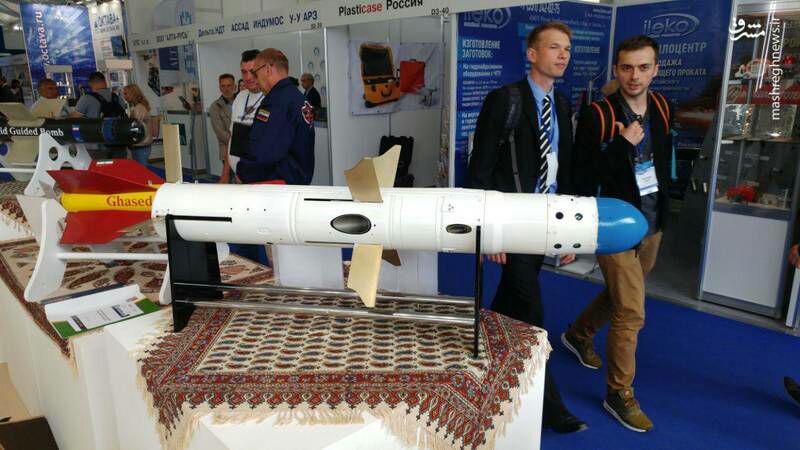
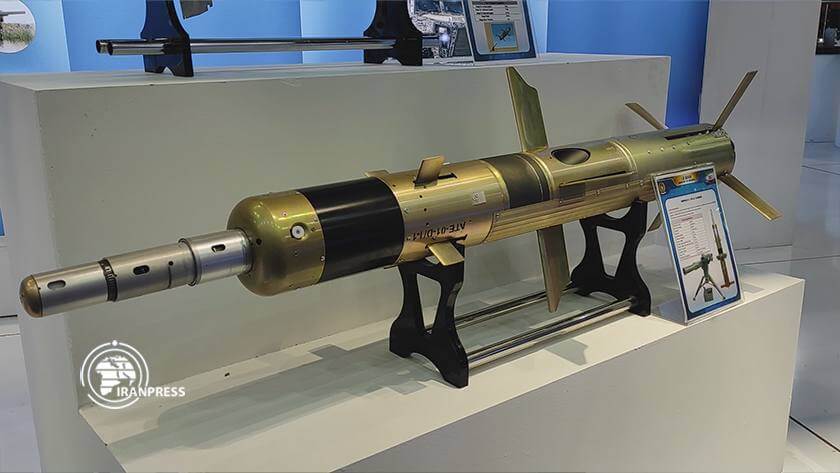
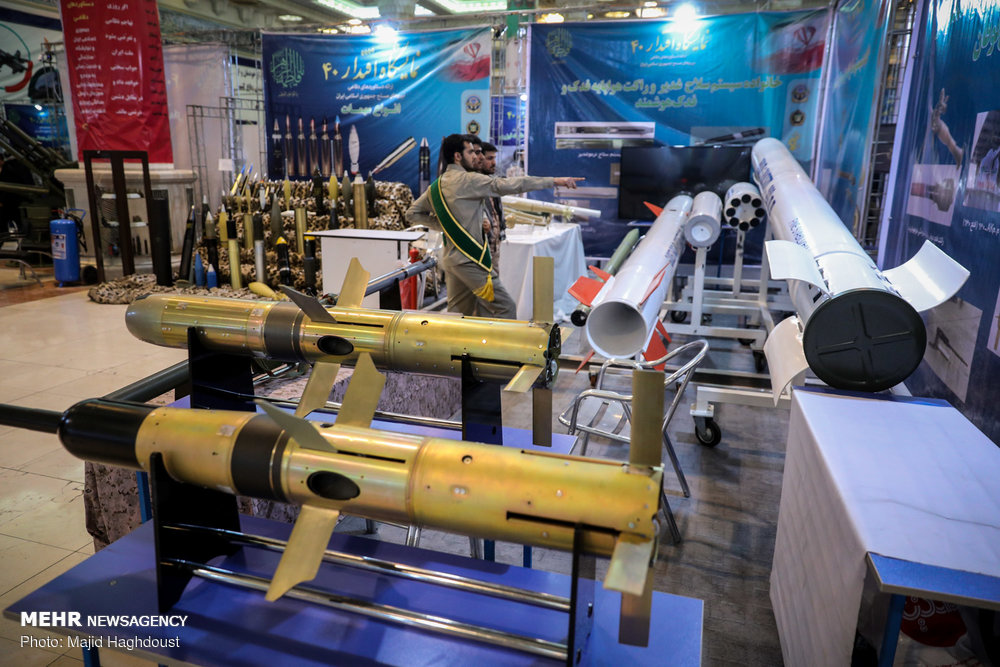
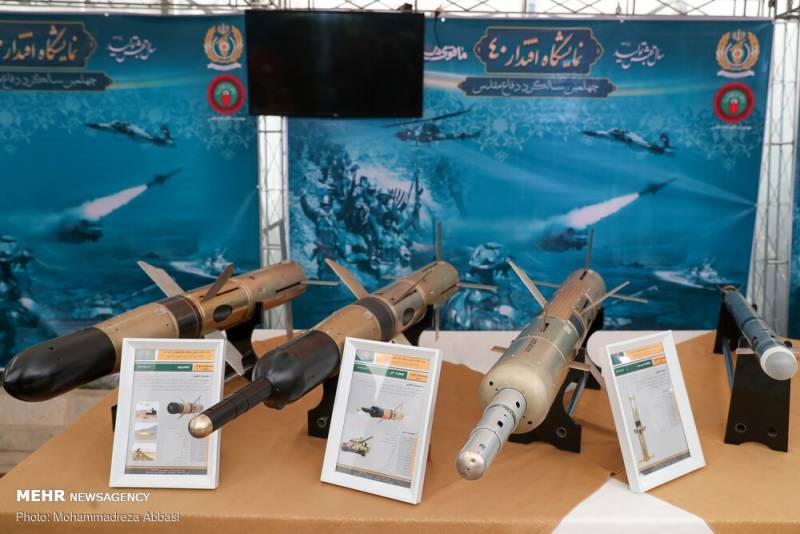
The Qassem Basir is an evolution of the Haj Qassem missile, first revealed in August 2020. That missile, itself a development of the Fateh tactical missile family (Fateh-110, Fateh-313, Zulfaqar), featured a larger diameter—90 cm compared to Zulfaqar’s 68 cm—and extended its range to 1,400 km thanks to a more powerful engine. Its warhead and guidance systems were derived from the Zulfaqar design.
Just a month after Haj Qassem’s debut, Iran showcased the Zulfaqar Basir at the Aerospace National Park. Like the Persian Gulf missile and Fateh-110 upgrades, it incorporated an optical seeker, resulting in a 700 km-range anti-ship ballistic missile. Given the similarities between Zulfaqar and Haj Qassem’s warhead design, experts anticipated a future upgrade—now realized with the Qassem Basir.
Optical Seekers: The Missing Link in Iranian Missile Accuracy
Iranian ballistic missiles traditionally rely on inertial navigation systems (INS) using precision gyroscopes, supplemented by satellite-based GPS for mid-course corrections. While INS alone can achieve sub-10-meter accuracy at short ranges (<500 km), longer-range precision has depended on GPS—an Achilles’ heel in electronic warfare environments.
A clear example is Operation True Promise II, where Iranian missiles penetrated enemy defenses but suffered from degraded accuracy due to GPS signal disruption near the target zone.
The Qassem Basir addresses this vulnerability by eliminating reliance on satellite navigation. It uses INS for mid-course guidance and switches to its onboard optical seeker during the final phase, enabling high-precision targeting even under GPS-denied conditions.
Speed, Maneuverability, and Resilience
With mid-phase speeds exceeding Mach 10 and terminal speeds around Mach 5, combined with a maneuverable warhead, the Qassem Basir is designed to evade advanced Israeli and American missile defense systems. The integration of an optical seeker in the nose cone minimizes terminal-phase error, ensuring the warhead strikes its target with exceptional accuracy.
This innovation marks a strategic shift in Iran’s missile doctrine—enhancing survivability, precision, and independence from vulnerable navigation systems. Whether this represents a permanent solution or a transitional upgrade, it undeniably raises the bar for Iran’s long-range strike capabilities.
Video of the unveiling of the Qassem Basir missile and how it works
However, integrating an optical seeker into ballistic missile warheads presents a significant technical challenge namely, the limitations imposed by high terminal speeds. For instance, missiles like the Persian Gulf and Zulfaqar Basir reach speeds of around Mach 3 before impact. In contrast, more advanced systems like the Haj Qassem missile strike their targets at speeds between Mach 4.5 and 5, even without executing evasive maneuvers.
At such velocities or potentially even higher, the performance of optical seekers can degrade. The intense aerodynamic and thermal stress may interfere with the seeker’s functionality or even damage its protective glass covering. In a recently released video, a completely black screen appears at a distance of 161 kilometers from the target, which could indicate either that the seeker was inactive or that a retractable protective cover was still in place.
The latter explanation seems more plausible, given the extreme reentry speeds involved. Without adequate shielding, the seeker’s optics could be compromised before it has a chance to engage the target. This highlights the delicate balance between precision guidance and survivability in high-speed missile design.
Similarity of the nose of the Qassem Basir missile (left image) with the nose and protective covering of the Fateh Mobin missile (right image)
Will Optical Seekers Ultimately Prove Effective in Iranian Ballistic Missiles?
Iran’s ballistic missiles in the 1,200–1,700 km range have demonstrated the ability to penetrate enemy missile defense systems in large numbers and reach their targets. However, accuracy has occasionally suffered due to reliance on GPS, which is vulnerable to jamming and signal disruption. These missiles typically rely on maneuverable warheads and high terminal speeds to evade interception. Yet, with the introduction of optical seekers such as in the Qassem Basir missile, there appears to be a shift in design priorities.
To protect the seeker and ensure precise targeting, Qassem Basir’s warhead reportedly performs more aggressive maneuvers during the final phase of flight, likely to reduce speed and allow the seeker to lock onto its target without damage. While this upgrade significantly improves accuracy, it introduces a new vulnerability: reduced terminal velocity, which could make the warhead more susceptible to interception in heavily defended zones.
Qassem Basir missile – Click to view full-size image
Despite this trade-off, Qassem Basir represents a cost-effective and accessible solution for enhancing Iran’s missile precision. It may not be ideal as a first-strike weapon against areas protected by dense missile shields, but it could serve effectively as a follow-up missile, launched after enemy defenses are saturated, to strike with high confidence.
According to available reports, this warhead upgrade is being applied to other Iranian ballistic systems as well, marking a major leap in precision capabilities. This evolution not only strengthens Iran’s strategic arsenal but also sends a powerful message to adversaries across land and sea.
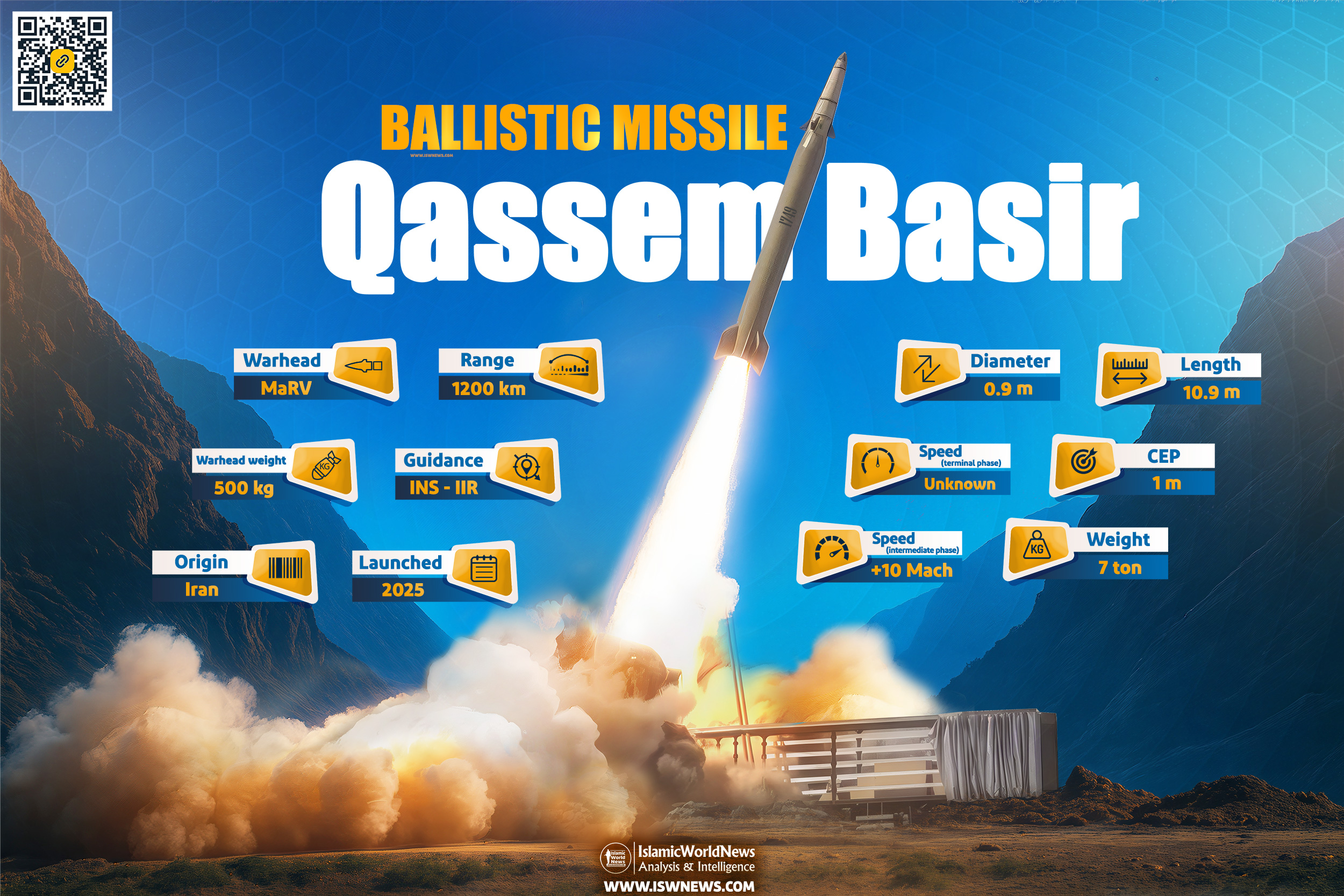
Specifications of Qassem Basir missile:
Type: Ballistic Origin: Iran Manufacturer: Ministry of Defence and Armed Forces Logistics Launched: 2025 Length: 10.9 meters Diameter: 0.9 meters Engine: Single stage Fuel: Solid composite Range: 1200 km Speed in intermediate phase: +10 Mach Speed in terminal phase: Unknown CEP: 1 meter Weight: 7 tons Warhead: Detachable MaRV Warhead weight: 500 kg Guidance: INS – IIR
Qassem Basir missile – Click to view full-size image
An intriguing point about this well-designed missile that has remained largely unnoticed by the media is that it bears a strong similarity to the Coyote Block 2 used in the US Army’s LIDS system. We have previously explored the LIDS system in a separate article, which you can read here: Military Knowledge: FS-LIDS And M-LIDS Anti-Drone Systems
In recent years, the United States has deployed the mobile LIDS system (M-LIDS) on the battlefield to enhance the defense of occupied areas in eastern Syria against drone attacks by resistance forces. The reverse engineering of this product is quite significant!
The Ghaem-118 interceptor missile is also very similar to the Coyote-2 interceptor in terms of technical specifications. The Ghaem-118 has a range of 25 kilometers and can detect and lock onto targets using three methods: radar, electro-optical, and infrared.
Click to view larger images
The engine and booster section of the Ghaem-118 is quite similar to that of the Coyote-2 interceptor.
The Ghaem-118 features a five-launcher system mounted on the Aras-3 vehicle, making its design more comparable to the American M-LIDS model, which serves as its mobile prototype.
Additionally, an unnamed radar system observed next to the Ghaem-118 launcher bears a strong resemblance to the American AN/TPQ-50 fire control and detection radar, which has also been integrated into the LIDS system.
Iran’s Ministry of Defense and the IRGC Ground Forces have not released the full specifications of the Ghaem-118. However, a video showcasing its field test has been made available. As more information about the Ghaem-118 is disclosed in the future, we will provide further insights in a separate article.
Image of the American Coyote Block 2 missileVideo of the American Coyote-2 test in the LIDS system
Based on the provided images and information, the 359 loitering missile is larger than the 358 missile, with both its length and diameter nearly doubled.
The missile features four movable wings at the front and four large fixed wings at the rear. These wings have been proportionately enlarged to match the dimensions of the fuselage. Notably, the rear fixed wings include small control surfaces at their tips, which enhance the missile’s maneuverability and control.
Control surfaces at the ends of the 359 missile’s rear wings
The 359 missile features a new, larger engine that boosts its speed to 1,000 kilometers per hour. It has a range of over 150 kilometers and can reach a flight altitude of more than 30,000 feet (9,200 meters).
One notable improvement of the 359 missile compared to the previous 358 model is its recoverable capability. Unlike the 358, which could not be recovered, the 359 is equipped with a recovery parachute. This means that if the missile fails to intercept a hostile target or is used for reconnaissance and surveillance operations, it can be safely recovered using the parachute.
The recovery parachute of 359 missile
The 359 missile is equipped with a significantly larger warhead, which provides enhanced destructive and explosive power compared to its predecessor, the 358 missile. This increased capacity makes the 359 a formidable weapon on the battlefield. Additionally, it can be equipped with an electro-optical payload specifically designed for reconnaissance and surveillance operations, allowing it to gather critical intelligence in situations where a high-explosive warhead may not be necessary.
In terms of performance, the 359 missile has undergone comprehensive improvements, making it more advanced and effective than the 358. It is now capable of targeting adversaries at higher altitudes and achieving faster speeds. With a maximum flight altitude that surpasses 30,000 feet and a top speed of 1,000 kilometers per hour, the 359 missile can effectively engage airborne warning and control system (AWACS) aircraft as well as aerial refueling tankers.
Moreover, the missile boasts an extended cruising range of over 150 kilometers, which significantly enhances Iran’s strategic capabilities in air defense. This extended range not only allows for greater flexibility in deployment but also improves the country’s ability to monitor and protect its airspace from potential aerial threats. Overall, the advancements in the 359 missile position it as a critical asset in Iran’s defense arsenal.
Click to view full sizeUnveiling of the 359 missile in the television documentary Guardian of the Sky
The 358 missile is the world’s first UAV-based defense missile, introducing a groundbreaking defense concept that combines the capabilities of unmanned aerial vehicles (UAVs) and missiles to target hostile aircraft effectively. Iran is the first nation to deploy this type of system in real battlefield conditions. Evidence suggests that this system was first employed by Iran’s regional ally, the Yemeni army (Ansar Allah Movement).
History:
According to information disclosed by the IRGC in the documentary “Parchamdar” (Flagship), footage has been released showing the moment an MQ-1B drone was shot down by a 358 missile. So far, four drones of this type have been shot down in Yemen, and the released video likely dates back to 2016 or 2017, during the field testing phase of the 358 missile. Consequently, the design and development of this weapon must have occurred one or two years before the destruction of the MQ-1B drone.
Image of the destruction of an American MQ-1B belonging to the UAE on the Yemeni front by a 358 missile
But the official sighting of this missile dates back to 2018 and 2019. In 2018, its wreckage was discovered by the Saudi army, and in 2019, an American warship intercepted and seized a shipment of Iranian weapons en route to Yemen in the Gulf of Aden.
358 missile design:
The 358 missile features a cylindrical body measuring 150 mm in diameter and 2.7 meters in length. It employs an infrared imaging seeker (IIR) in its nose to locate and lock onto targets.
Following the camera, there is a 360-degree laser proximity sensor, and beyond the proximity sensors, a 10-kg fragmentation warhead with an effective radius of 30 meters.
Components of the 358 missile
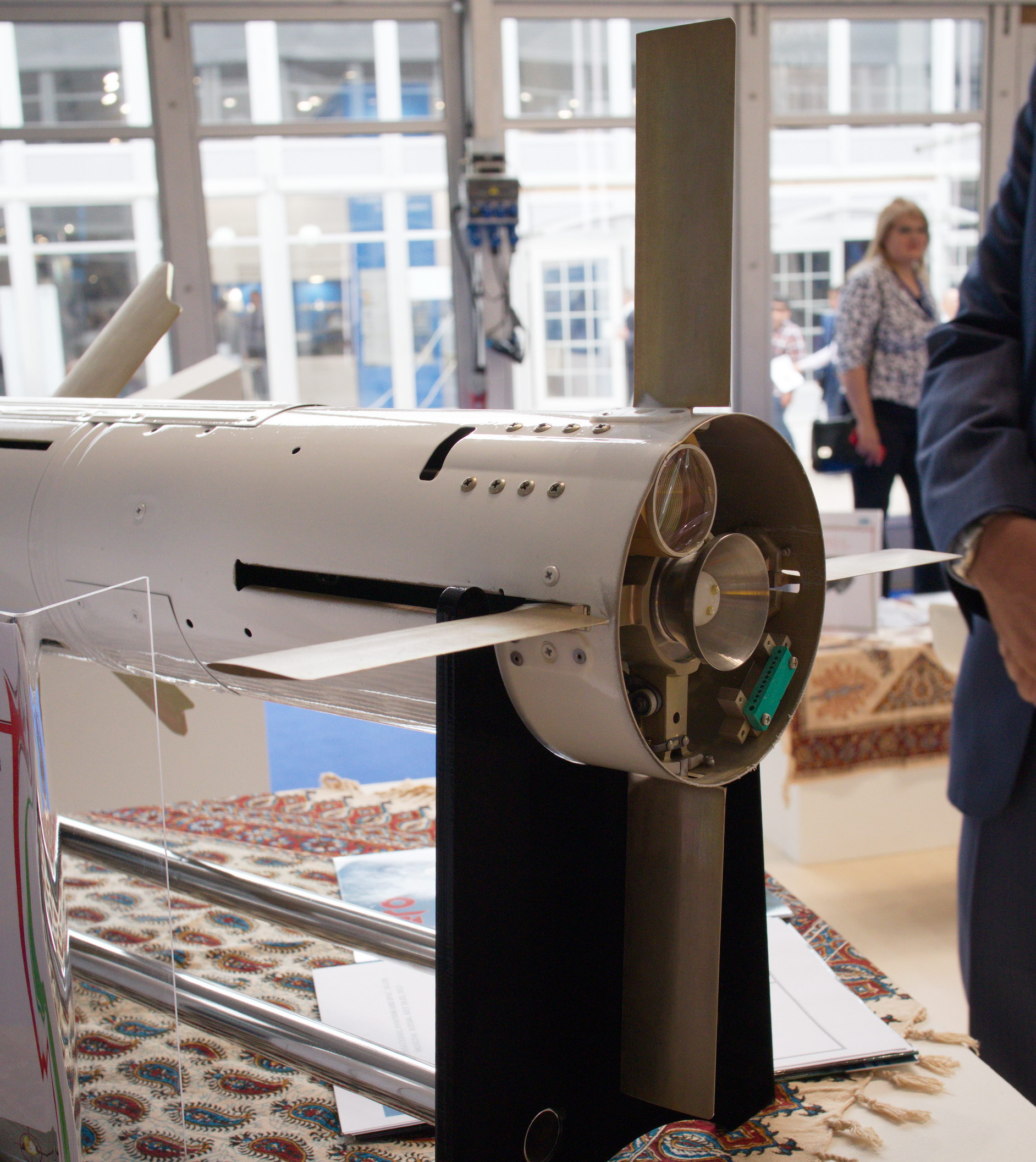
At the front of the missile, just after the warhead, are four movable canards used for guidance. These canards are similar in appearance and function to those on the R-27 missile. They start narrow and sharp, widening towards the tip, and are large enough to provide part of the necessary lift force.
Alongside the large steering canards, there are four very small triangular fins designed to stabilize airflow during extremely fast, unbalancing turns.
The middle section of the missile contains the inertial guidance equipment and the missile computer. Additionally, because the antenna is located in this section, the communication equipment is also housed here.
In the middle section, near the rear of the rocket, are four large fixed wings that generate lift. This section also houses the rocket’s fuel tank.
At the rear of the missile are four small fixed stabilizer fins and the missile’s mini-jet engine. The engine has four air intakes recessed into the fuselage.
This missile cannot take off independently, so a rocket booster is installed at the bottom of the missile to assist in the initial launch.
An examination of shipments seized in 2019 and 2022 by the US and UK reveals that the engine used in the 358 drone is a Titan type from the Dutch company AMT. A review of the supply chain indicates that the engine was purchased indirectly from the manufacturer by a company in Hong Kong.
The Titan engine has a diameter of 147 mm and a length of 385 mm. It weighs 3645 grams without a starter and 5211 grams with a starter. This engine provides a thrust of 392 newtons, which is equivalent to 88.12 pound-forces, and has a fuel consumption of 43.3 grams per kilonewton per second.
Announced specifications of the Titan series engines produced by the Dutch company AMT
The 358 missile has a loitering range of 100 km, a flight ceiling of 8,500 meters, and a speed of 700 km/h, with a total weight of 58 kilograms.
There is no evidence that the missile can be recovered after firing, so it is used as a loiterer only in areas with a high probability of enemy aircraft. In other scenarios, the 358 missile is kept ready for launch when targets are detected by surveillance cameras and radars.
The missile can be launched from simple launchers, similar to suicide drones. Additionally, truck launchers have been developed for this missile to enhance stealth.
358 missile truck launcherAn example of a launcher used by the Resistance forces in the regionClick to view full size
One of the most intriguing aspects of the 358 missile is its high level of customization. In its full configuration, the missile has 16 wings and fins. The operator can adjust the number of fins or change the position of the main wing based on specific needs and field conditions. This flexibility significantly enhances the missile’s maneuverability and usability.
Installation location of the 358 missile wings and fins
For example, during the official unveiling and hot testing of this missile in the joint air defense exercise “Eghtedar 1403“, the very small triangular fins on the front of the missile, as well as the small fins at the end of the missile, were removed.
The use of the 358 missile in the Eghtedar 1403 exercise without the small triangular fins on the front section and the small fins at the end of the missile
How it works:
The 358 drone-based system consists of two main components: the 358 missile and thermal search cameras. This system can be utilized in two ways: The first method involves ground-based thermal search cameras scanning for targets such as drones and helicopters to introduce them to the 358 drone. Radar, serving as an auxiliary element of the system, can help determine the search direction for the ground-based cameras. Once the target is located, the 358 drone is launched and moves towards it. In the final stage, the drone locks onto the target with its thermal seeker and engages it.
A type of thermal camera used to find aerial targets that has been used in Yemen.
The second method involves the 358 missile loitering the skies of the battle area where helicopters and drones are likely to be present. By patrolling the tense battle zone, the drone searches for targets preloaded into its computer, such as helicopters and drones. In this mode, the 358 missile can operate either completely independently based on the information in its computer or receive target direction and location updates from the operator. Once it acquires the target, it locks on and engages.
Promotional video of the preparation and firing of the 358 missile during the Eqtedar 1403 exercise
Users:
The 358 missile has been used by Iran, the Iraqi Islamic Resistance, Hezbollah, as well as Ansar Allah and the Yemeni army. Russia could also become a user of this missile if the need arises.
In 2023, Russian Defense Minister Major General Sergei Shoigu visited an exhibition of Iranian military achievements. During this visit, Brigadier General Hajizadeh, Commander of the IRGC Aerospace Force, introduced the 358 missile and its truck-mounted launcher to Shoigu.
Russian Defense Minister Sergei Shoigu visits the 358 missile at the Iranian military achievements exhibition
Similar variants in Yemen:
As mentioned, the 358 missile is also used by the Yemeni army and has demonstrated significant success in shooting down American and Saudi coalition aircraft.
It is likely that Yemen has localized the production of this missile. In Yemen, the 358 missile is produced and used under the names Saqar-1 and Saqar-2. The Saqar-1 missile is similar to the 358 missile, while the Saqar-2 missile is an improved version of the Saqar-1 missile.
Saqar-1 missile
According to the information officially announced by the Yemeni army regarding the Saqar-1 missile, its specifications are identical to those of the Iranian 358 missile in all its components. However, the specifications of the Saqar-2 resemble those of the Iranian 359 missile, which we will discuss later in the article.
Based on the information released by the Yemeni army about the Saqar-2 missile, this missile boasts a range of 150 kilometers, which is 50 kilometers more than the Saqar-1 (358 missile). Additionally, the flight altitude has increased from 28,000 feet (8,500 meters) in the Saqar-1 to 35,000 feet (10,600 meters). However, the images published during the latest Yemeni army parade on the occasion of the September 21 Revolution of the Saqar-2 missile actually show the same Saqar-1 missile (missile 358) with a configuration lacking the small triangular fins and fins at the end, as seen in the test and unveiling of the 358 missile in Iran’s Eqtedar 1403 exercise.
An infographic of the Saqar-2 missile has also been released, stating the missile’s length to be 6 meters. However, upon examining the published images of the Saqar-2 missile during the Yemeni army parade, it is evident that the displayed missile is approximately 3 meters long, similar to the Saqar-1. Therefore, it is likely that the Yemeni army has not published the actual image of the Saqar-2 missile for security reasons. Alternatively, in the most optimistic scenario, a more powerful engine has been used in this version.
Infographic published about the Saqar-2 missileSaqar-2 missile in Yemeni army parade, similar to the 358 missile without the small triangular fins and no fins at the end of the missileClick to view full size
359 missile:
In 2025, during the broadcast of a television documentary, the Islamic Revolutionary Guard Corps of Iran unveiled a more advanced version of the 358 missile, known as the 359 missile.
Based on the images and information provided, the 359 missile has larger dimensions than the 358 missile, and its length and diameter have almost doubled.
Unveiling of the 359 missile in the television documentary Guardian of the Sky
The missile is equipped with four movable canards at the front and four large fixed wings at the rear. The wings are enlarged in proportion to the fuselage. One of the interesting features of the fixed wings is that small control surfaces are used at the ends of the wings, which improve the maneuverability and control of the missile.
Control surfaces at the ends of the 359 missile’s rear wings
The 359 missile features a new and larger engine, which increases its speed to 1,000 kilometers per hour. It has a range of over 150 kilometers and a flight altitude of over 30,000 feet (9,200 meters).
The warhead of the 359 missile is larger and has greater destructive and explosive power compared to the 358 missile. Additionally, if necessary, the 359 missile can be equipped with an electro-optical payload for reconnaissance and surveillance operations instead of a high-explosive warhead.
Another notable feature of the 359 missile is its recoverability. According to published images, unlike the 358 missile, which was not recoverable, the 359 missile is equipped with a recovery parachute. Therefore, if the interception of hostile targets is unsuccessful for any reason, or if the 359 missile is used for reconnaissance and surveillance operations, it can be recovered using a parachute.
Recovery parachute in 359 missile
More images of the 359 missile:
Click to view full size
It’s worth noting that in 2020, the United States, inspired by the Iranian 358 defense missile, designed and developed a defense system called LIDS. The Coyote-2 interceptor in this system operates in a manner very similar to the 358 missile.
358 missile specifications: Type: Loitering anti-aircraft missile Manufacturer: Islamic Revolutionary Guard Corps Country of manufacture: Iran Entered service: 2016 to 2019 Length: 2.7 meters Diameter: 150 mm Wingspan: Approximately 1 meter Missile weight: 58 kg Warhead weight: 10 kg high-explosive fragmentation Warhead impact radius: 30 meters Maximum speed: 700 km/h Loitering range: 100 km Flying altitude: 8,500 meters (28,000 feet)
Missile 358 posters in Persian, English, Russian, Chinese, Arabic and Hebrew:
Almas anti-armor missile is an Iranian air-to-surface (air-launched) and surface-to-surface (ground-launched) missile, which is produced in three variants Almas-1, Almas-2 and Almas-3.
Almas missile was seen for the first time in spring 2020 during the mass delivery of UAVs to the Islamic Republic of Iran Army and was officially unveiled and fired by the Ababil 3 UAV during the army’s UAV exercise in the following January.
After the unveiling of the Almas missile and its similarity with the Israeli “Spike” missile, the attention of many military experts was drawn to this missile. Some experts believe that after the 2006 Israel–Hezbollah War, a number of Spike missiles fell into the hands of resistance fighters and these missiles were transferred to Iran, and Iranian experts reverse-engineered this missile and produced the Almas family of missiles.
Almas family missiles use a tandem-charge high-explosive anti-tank (HEAT) or thermobaric warhead. The Almas warhead is located just behind the camera at the tip of the missile. Almas missile guidance system is based on image infrared homing (IIR) and elctro-optical sensors.
The Almas missile is a top-attack missile and hits the weakest point in the armor from above and damages them. This greatly increases the efficiency of this missile. In addition, the Almas missile has a “fire and forget” capability; This helps in reducing the damage to the missile crew.
Almas anti-armor missile ground launcher
Due to the increase in defense technologies in modern battle tanks and the development of various active defense systems to deal with anti-tank missiles, the destruction of tanks has become more difficult. Israel is also a leader in this field with Trophy active protection system. By installing the Trophy active protection system on its most important tank, the Merkava Mark-4, Israel has made it difficult to destroy this tank with an anti-tank missile.
The first solution to deal with the active protection system is to launch two anti-armor missiles in a short time interval to prevent the proper functioning of the defense system. Dehlavieh dual missile launcher is one of the smart solutions to counter and defeat the trophy active defense system produced by Iran. This system is produced in Hezbollah’s combat unit under the name of the Tharullah system, which has a function completely similar to the Dehlavieh dual missile launcher.
One of the other ways to deal with active defense systems is to attack the battle tank from above (top-attack) because most of the active defense systems do not have the ability to react against such attacks. Therefore, top-attack missiles are a good option to deal with these systems. For this reason, Iran started building and designing Almas missile by taking the example of Israeli Spike anti-armor missile.
Almas-1 missile: Almas 1 missile is very similar to Spike LR anti-armor missile in terms of design and specifications. Almas-1 uses four fins with the same combination as the Toophan missile. In the Almas missile, a solid fuel engine with a hot gas outlet similar to the Toophan missile can be seen on its body. According to the images and announced specifications, this missile uses an image seeker and fiber-optic wire to find and destroy targets. The range of this missile is 4000 meters and it weighs 15 kg.
Almas-1 ATGM missileAlmas-1 anti-armor missile live test
Almas-2 missile: Almas 2 missile is a more advanced version of the Almas 1 missile, and its range has been increased to about 8,000 meters when fired from a ground-based launcher. This missile has the ability to penetrate 1000 mm of armor. Like Almas 1, this missile can be fired from ground and air launchers.
Almas-2 missile test
Almas-3 missile: Almas 3 missile is the latest and newest version of the Almas family of missiles. Almas-3 is larger than Almas 1 and 2 and seems to have been sampled from the Spike ER missile. Considering that the configuration of Almas 3 and Spike ER are very similar to each other, it is likely that their specifications are also close to each other. Hence, Almas-3 probably has a range of about 10 km. The warhead of this missile is a two-stage high-explosive or thermobaric type, and it uses an infrared and electro-optical seeker for guidance and has the ability to penetrate 1000 mm of armor. Also, if the fiber-optic wire is replaced with RF link to guide this missile and fire it from aircraft, a range of about 16 km is envisioned for the Almas-3 missile.
Almas-3 and Almas-2 missiles in the backgroundAlmas-3 missile under the wing of Mohajer-10 drone
In the picture below, you can see the family of Almas missile in a frame. From left to right, the missiles are Almas-1, Almas-2 and Almas-3. In this picture, the similarity of appearance and dimensions of Almas 1 and 2 variants and the difference of their dimensions and appearance with Almas-3 missile are clearly visible.
From left to right, Almas-1, Almas-2 and Almas-3 missiles
Almas missile specifications: Type: Air-to-surface and surface-to-surface anti-armor missile Length: 1100 mm Almas1&2 – 1600 mm Almas3 Diameter: 130 mm Almas1&2 – 170 mm Almas3 Range: 4 km Almas1 – 8 km Almas2 – 10 km Almas3 Weight: 15 kg Almas1&2 – 34 kg Almas3 Warhead: tandem-charge high-explosive/thermobaric Armor penetration rate: ~ 600 mm (Almas1), ~ 1000 mm (Almas2&3) Engine: Solid-propellant rocket Guidance: Infrared homing (IIR) and electro-optical Launch platform: ground-based launchers and aircraft Origin: Iran
Almas Anti-Armor Missile – click to view full sizeAlmas missile – click to view full size
Infographics of Almas missile in Russian, Farsi, Arabic and Hebrew:
The Fattah-2 missile utilizes the configuration of hypersonic cruise missiles. The acronym HCM, which stands for Hypersonic Cruise Missile, is written on its nose cone. The shape and combination of the nose cone is similar to the X-51 hypersonic cruise missile. However, the X-51 missile uses a ramjet engine that requires air intake, whereas in the Fattah-2 missile, air intake and ramjet engines are removed, and instead, a liquid fuel rocket engine is used. This will not affect the missile’s performance.
Phrase “HCM” meaning hypersonic cruise missile on Fattah-2 body
Design: The Fattah-2 missile consists of two parts. The first part is the Fattah solid fuel booster, which has not changed from the initial version. The second part is the gliding warhead, which separates from the booster and has a liquid fuel rocket engine.
The overall shape of the Fattah-2 gliding warhead is very similar to the Boeing X-51 missile, but with the difference that its air intake has been eliminated and a rocket engine is used instead of a ramjet engine.
Similarity of Fattah-2 and X-51 warheads
The explosive material is located at the beginning of the warhead, followed by an inertial guidance and GPS system along with a computer that is responsible for guiding the warhead to the final stage of impact. After the guidance system, there is a detonator container (yellow piece), followed by a liquid fuel tank and an oxidizer tank, and finally a rocket engine that appears to have the ability to change the missile’s trajectory.
Various components of Fattah-2 warhead
At the end of the warhead, there are four fins, two of which form a line with the bottom of the warhead and are fixed, responsible for producing lift force. The other two fins are designed to change direction and have the ability to rotate around an axis connected to the body.
Four fins, two of which are fixed and two other fins with the ability to change the direction
The speed of this missile is stated as Mach 10 in some sources, but it is unclear for how long this speed can be sustained. However, it can be assumed that the speed exceeds Mach 5 at the moment of impact. The range of the missile has been reported as 1500 to 1800 kilometers by some news agencies, but it is unlikely that the range will be significantly different from that of the Fattah-1 missile, and a range of less than 1400 kilometers does not seem reasonable for Iran’s operational needs.
The operation of the Fattah-2 missile: The solid fuel booster of the Fattah-2 missile carries it to a certain altitude from space, and then the warhead separates from it and moves towards the atmosphere. In this state, the missile will travel at a fast falling rate until it reaches the atmosphere, and then, like an HGV (Hypersonic Glide Vehicle), it will glide to the ground in the atmosphere at an altitude of less than 100 kilometers. Considering the high speed announced for the Fattah booster in Fattah-1, it must be more than Mach 15 at the time of entering the atmosphere. Therefore, due to the high lift force of the Fattah-2 warhead, it must spend a considerable amount of time gliding in the atmosphere and continuously reduce its altitude.
In a part of the middle stage and at the end of the warhead, it drastically reduces its altitude and its speed also decreases. In this stage, the rocket engine embedded in the warhead turns on and stabilizes the warhead’s speed at Mach 5 or higher. The Fattah-2 warhead spends a lot of time at low altitudes and will cruise through the final stage of its path like cruise missiles thanks to its engine. A significant point is the amount of drag force and tolerance for high-speed entry into the atmosphere because aerodynamically, the warhead is not designed for such speeds.
Conventional designs of hypersonic cruise missiles use a booster for initial speed and a ramjet engine for further movement along their path, and they are often launched from aircraft. These engines have a risk of reducing their speed to less than Mach 5 at their maximum range due to fuel shortages. However, Fattah-2 uses a solid fuel ballistic missile booster for movement in a part of its path and reaching an initial speed of more than Mach 15, which provides the missile with a considerable speed for a long time. Then, at the end of its path or near the point of impact, it uses an engine to compensate for the speed reduction and stabilize its speed at Mach 5. This is an interesting and very creative idea that has been implemented by Iranian experts. This initiative eliminates the limitations of HGVs for the Aerospace Force of the Islamic Revolution Guards Corps (IRGC).
Unlike conventional HGV versions, the Fattah-2 warhead is more suitable for flying at low altitudes. Most HGVs travel much of their path at an altitude of less than 100 kilometers and more than 30 kilometers, where air density is lower. However, the Fattah missile can fly in an altitude of less than 12 kilometers due to its aerodynamic shape, but it seems to try to maintain itself at an altitude between 12 and 30 kilometers to experience less speed reduction. Overall, the Fattah-2 missile is more of a hypersonic glide vehicle than a hypersonic cruise missile. However, its performance includes both types of hypersonic missiles.
It can be said that the operation of the Fattah-2 missile is a completely unconventional definition compared to other conventional hypersonic missiles, and the Fattah-2 missile has created a new classification and standard in this field: Hypersonic Cruise Glide Vehicle (HCGV).
It should be mentioned that the feature of not using a ramjet engine does not exclude this warhead from the hypersonic category. Also, using a rocket to start flight and fly into space cannot prevent the cruise flight of intermediate and final stages. Iran’s technology in making ramjet engines for use in long-range hypersonic weapons has not yet reached its final evolution. Therefore, having all the components available and the ability to mass-produce Fattah-2 is a suitable and creative solution to overcome the current technological gap. Clearly, this technological bottleneck will also be resolved in the near future.
Specifications of Fattah-2 hypersonic missile: Type: Hypersonic Glide Vehicle (HGV) Country of Origin: Iran Producer: IRGC Aerospace Force Unveiled: 2023 Length: ~ 12 meters Diameter: 80 cm first part, 50 cm second part Fuel: First stage: solid Second stage: liquid Range: more than 1400 km Speed: ~ Mach 5 (in the last phase), ~ Mach 15 (in the first phase) Weight: 3500 to 4100 kg Warhead: ~ 500 kg Explosives weight: ~ 200 kg Guidance: combination of INS and GPS
Fattah 2 hypersonic missile – click to view in full size
More images of Fattah-2 missile:
Click to view in full size
Infographics of Fattah-2 hypersonic glide vehicle in Russian, Hebrew, Farsi and Azeri:
History: The Islamic Republic of Iran, as the first purchaser of the BGM-71 TOW missile in 1971, launched a repair and assembly line for BGM-71TOW and FGM-77A Dragon missiles in cooperation with Emerson Energy Systems and Hughes Missile Systems at the Iran Electronics Industries (IEI). In May 1975, the project of joint production of BGM-71TOW and AGM-65 Maverick missiles were stalled due to disagreements over pricing issue. Following the victory of the Islamic Revolution in 1979, negotiations were completely halted and the United States did not allow technology transfer to the Islamic Republic of Iran.
During the Holy Defense (Iran-Iraq War of 1980 to 1988), the Islamic Republic had a great need for anti-tank missiles to counter the massive armor of the Ba’athist Iraqi army. Iran’s initial inventory of anti-armor missiles was TOW missiles, which was added to by purchasing Malyutka (9M14 Malyutka) missiles from the black market. The Iranian fighters were very satisfied with TOW missiles and they stated a success rate of 95%. Therefore, Iran proceeded to reverse engineer TOW missiles.
The Toophan missile and the experiences gained from this missile were used in the Sadid-1 missile and afterward, this success continued in the Sadid and Ghaem precision-guided bomb families.
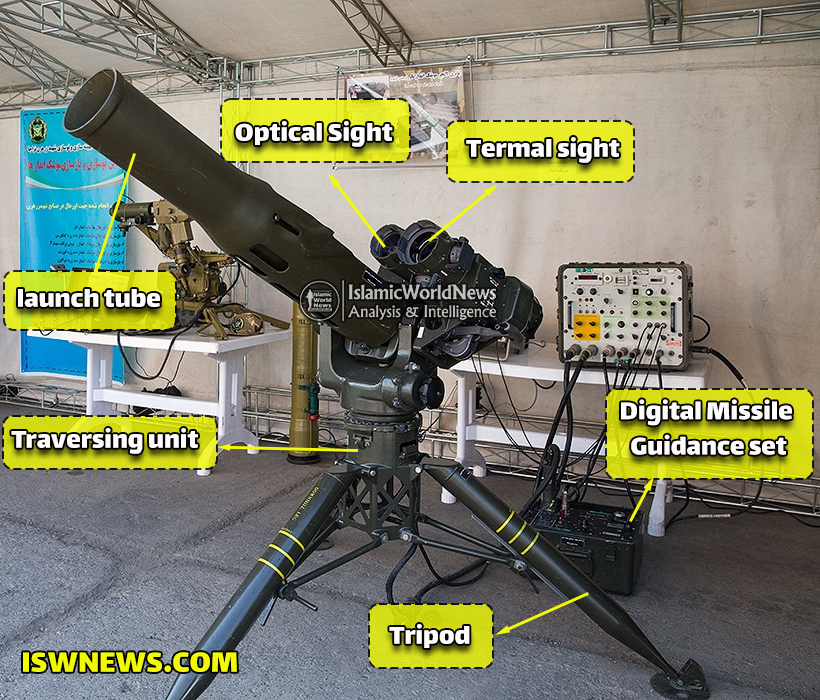
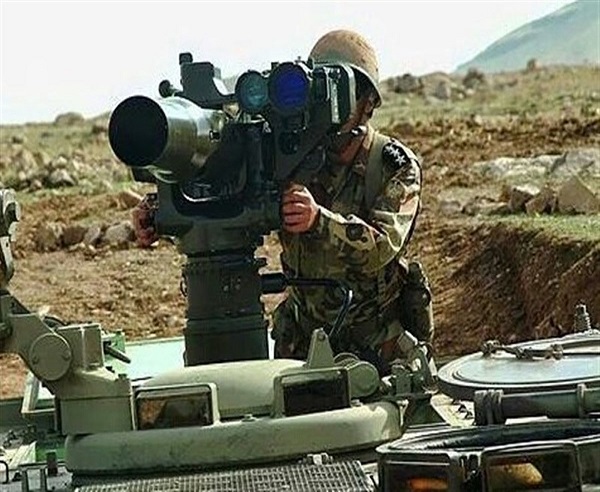
Design: As stated, the Toophan missile is designed and manufactured based on the US-made BGM-71 TOW anti-armor missile. The Toophan anti-armor missile is packaged inside a disposable tube and this tube is loaded onto the launcher at the time of firing. Toophan can be fired from two types of ground-based and air-based missile launchers.
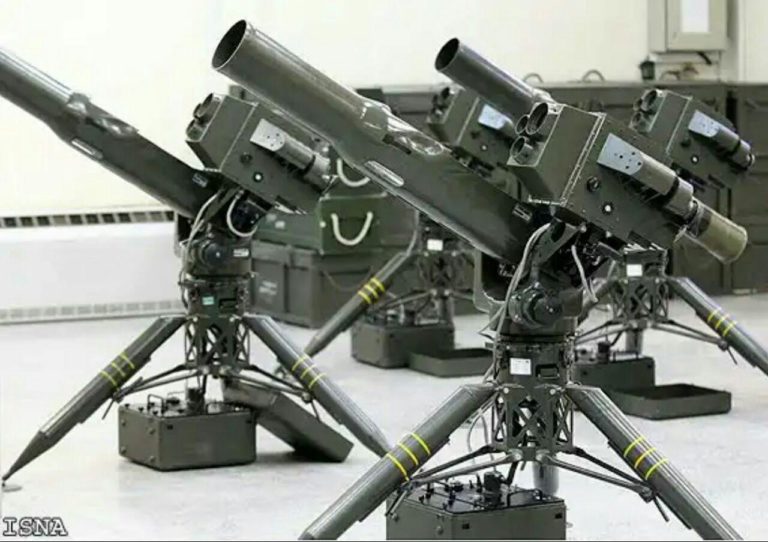
The ground-based missile launcher is installed on various vehicles, armored personnel carriers, tanks and vessels and it consists of a tripod, electro-optic sight, missile-containing tube, and command center. The electro-optic sight consists of two lenses; one for the daytime camera to detect targets during the day and the other for thermal vision to track the xenon lamp at the end of the Toofan missile. The daytime camera can be replaced with a night vision or another thermal camera to detect targets at night as well.
The Toophan anti-armor missile family uses semi-automatic command to line of sight (SACLOS) guidance. In this type of guidance, the operator must keep the camera on the target until the missile hits the target. The presence of a xenon lamp is for determining the position of the missile and in this way, the thermal lens determines the position of the missile and the main camera determines the position of the target and both pieces of information are sent to the control center (Digital Missile Guidance Set-DMGS); then, this center processes the received information. It sends the necessary commands for path correction via wire to the missile and the missile also corrects its path based on those commands.
Click to view full size
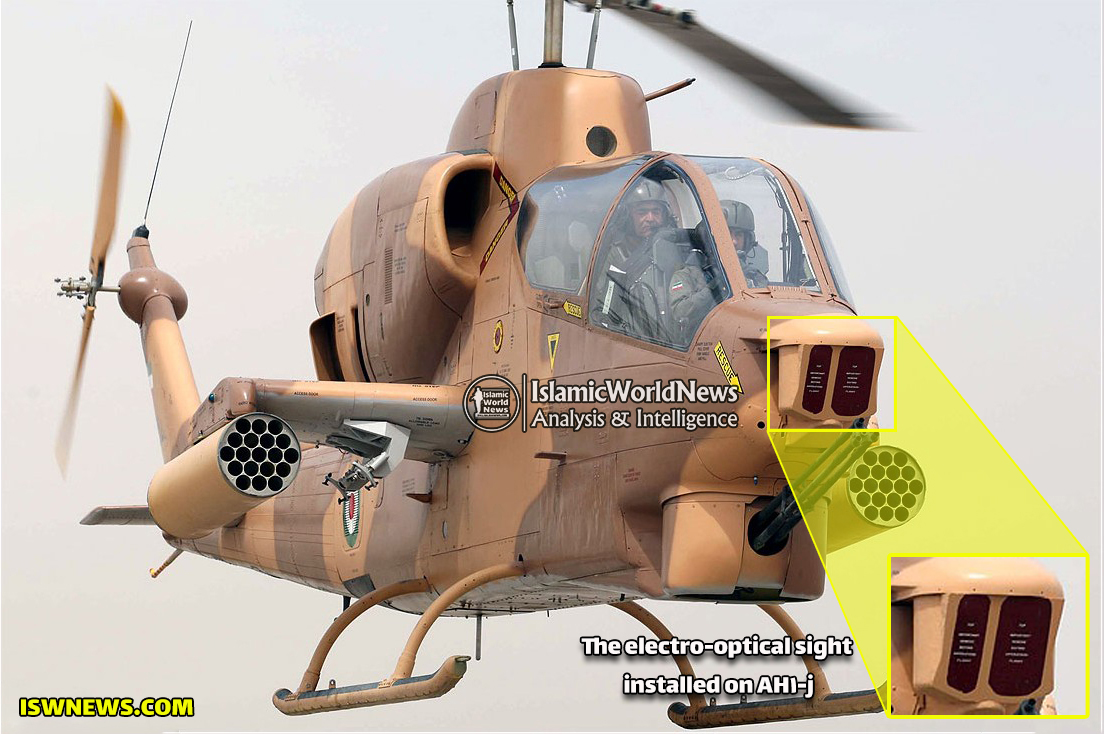
As mentioned, the Toophan missile has an air-based launcher platform. Some AH-1J International helicopters of the Islamic Republic of Iran Air Force have the ability to carry and launch TOW missiles, which are known as Tow-Cobra. This helicopter needs an electro-optic sight called M65 or Telescopic Sight Unit for firing TOW missiles, which has a 13x zoom capacity and is installed in the nose of the helicopter. This sight actually has the same application as an electro-optic sight mounted on a ground tripod. The helicopter’s electro-optic sight first targets and then aims, and also sends information needed for path correction via wire to TOW by tracking missiles. In Iranian Toophan variant, exactly these steps are observed.
Electro-optical site installed on AH1-J helicopter
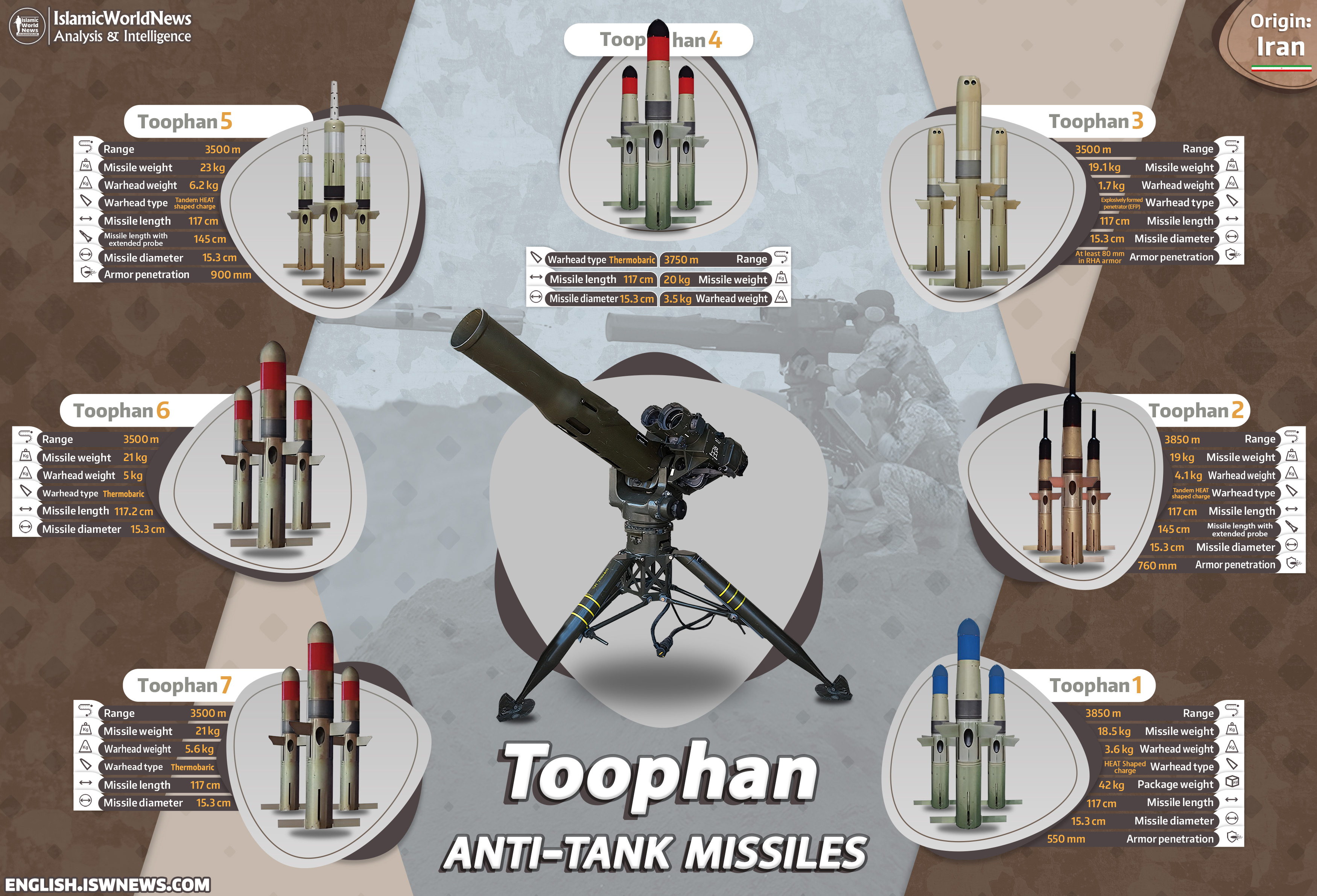
Types of Toophan missiles: As it has been mentioned above, the Toophan missile family was planned to produce 11 types of missiles in the industries of the Ministry of Defense of the Islamic Republic of Iran, and we managed to find 10 specifications of the missiles, which are being explained underneath. Regarding the eleventh type of Toophan missile, we think it was a heavy upgrade based on the Spike model and the missile was renamed, which we will deal with at the end.
Toophan Anti-Tank Missiles – click to view full size
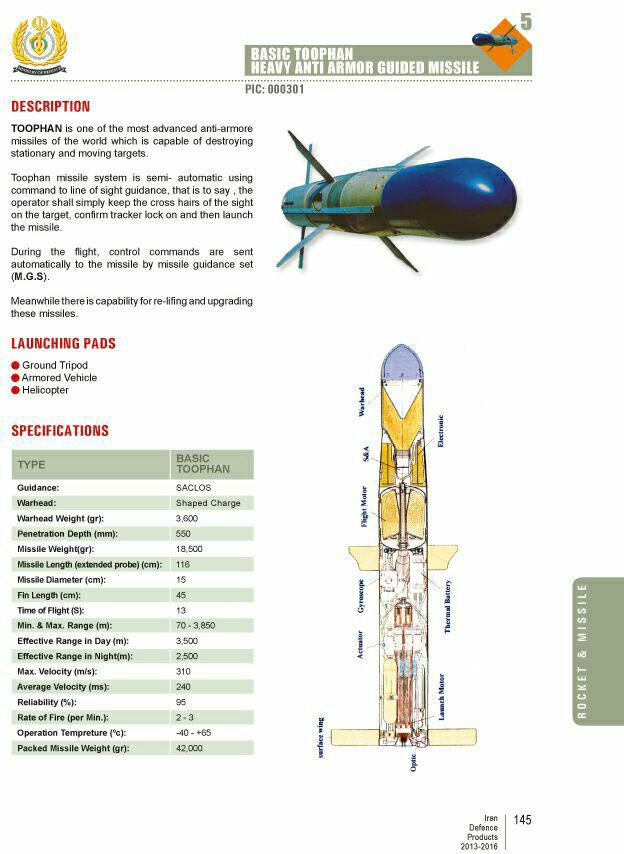
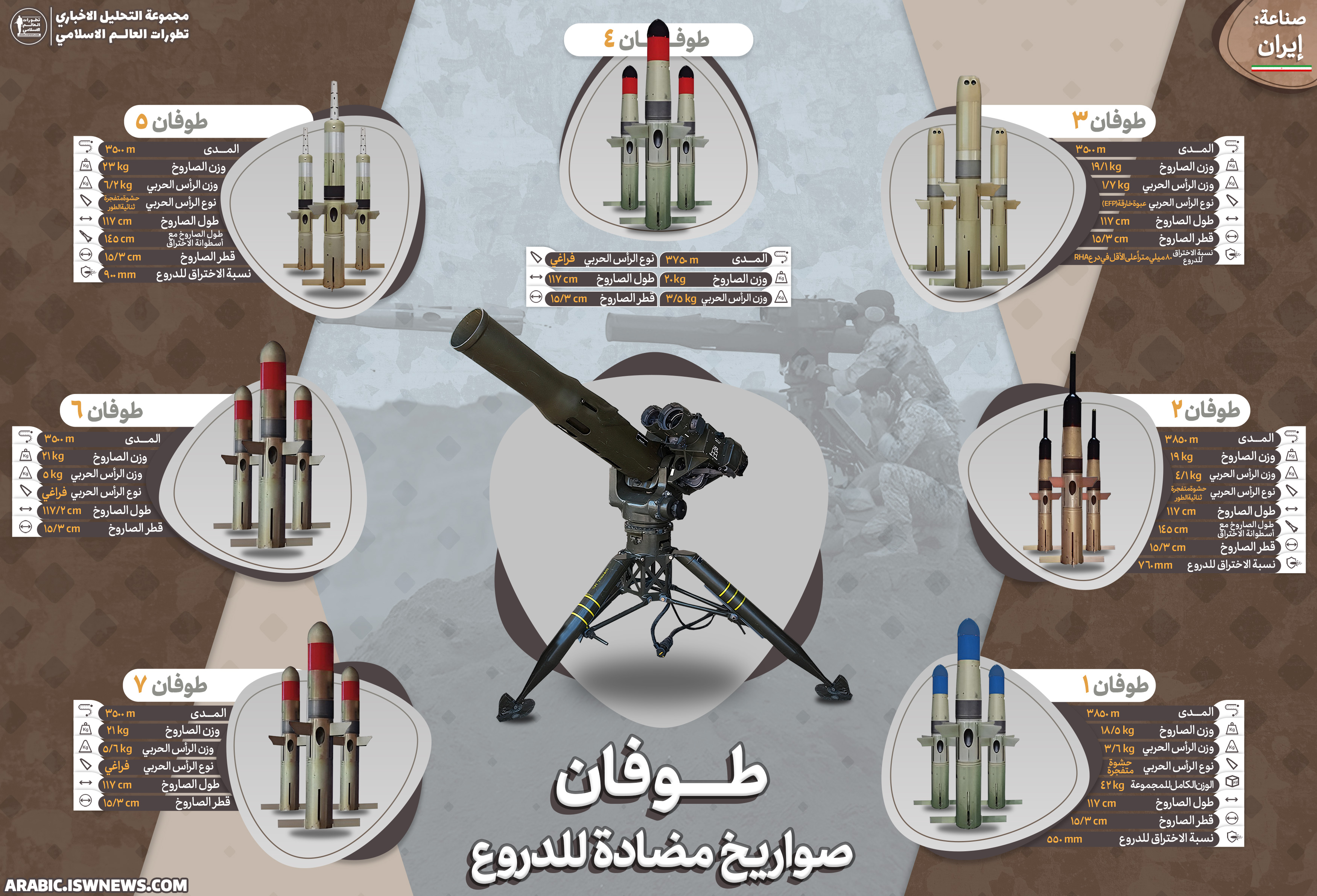
1- Toophan-1 missile: It is a reverse-engineered BGM-71 TOW version B missile. The US variant has a range of 3,750 km and a penetration rate of 430 mm, while the Iranian Toophan-1 missile has a range of 3,850 km and a penetration rate of 550 mm.
Published specifications of Toophan-1
Specifications of Toophan-1 missile: Maximum range: 3850 meters Minimum range: 70 meters Effective range: 3.5 km Effective range at night: 2.5 km Missile weight: 18.5 kg Warhead weight: 3.6 kg Type of warhead: HEAT shaped-charge Package weight: 42 kg Missile length: 117 cm missile diameter: 15.3 cm Armor penetration rate: 550 mm
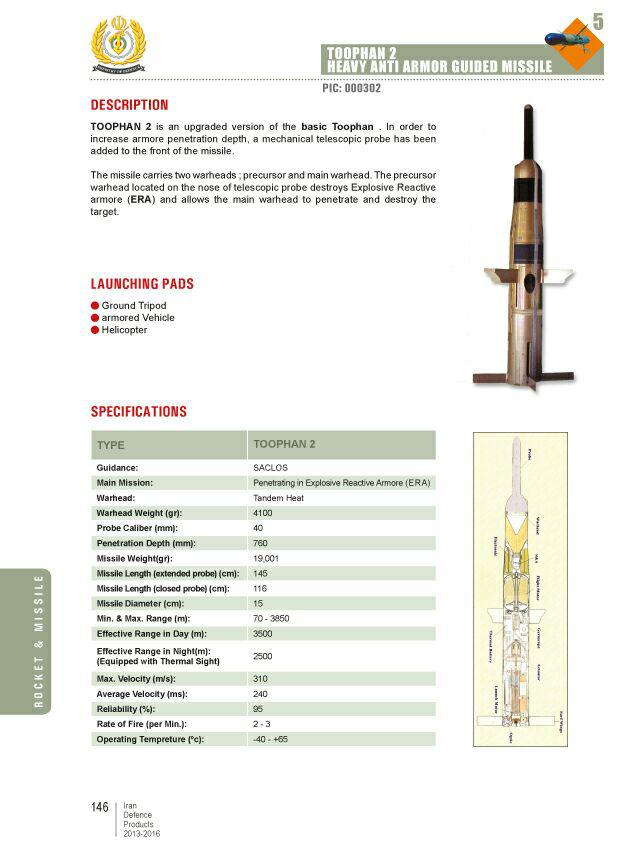
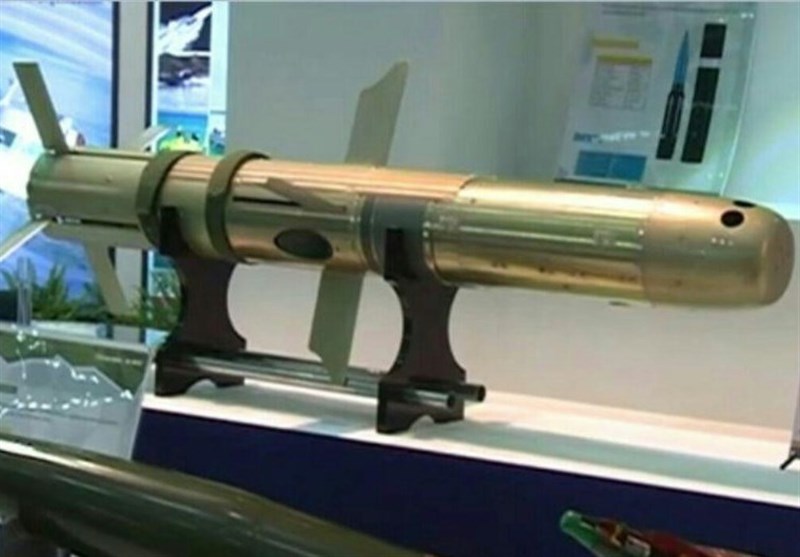
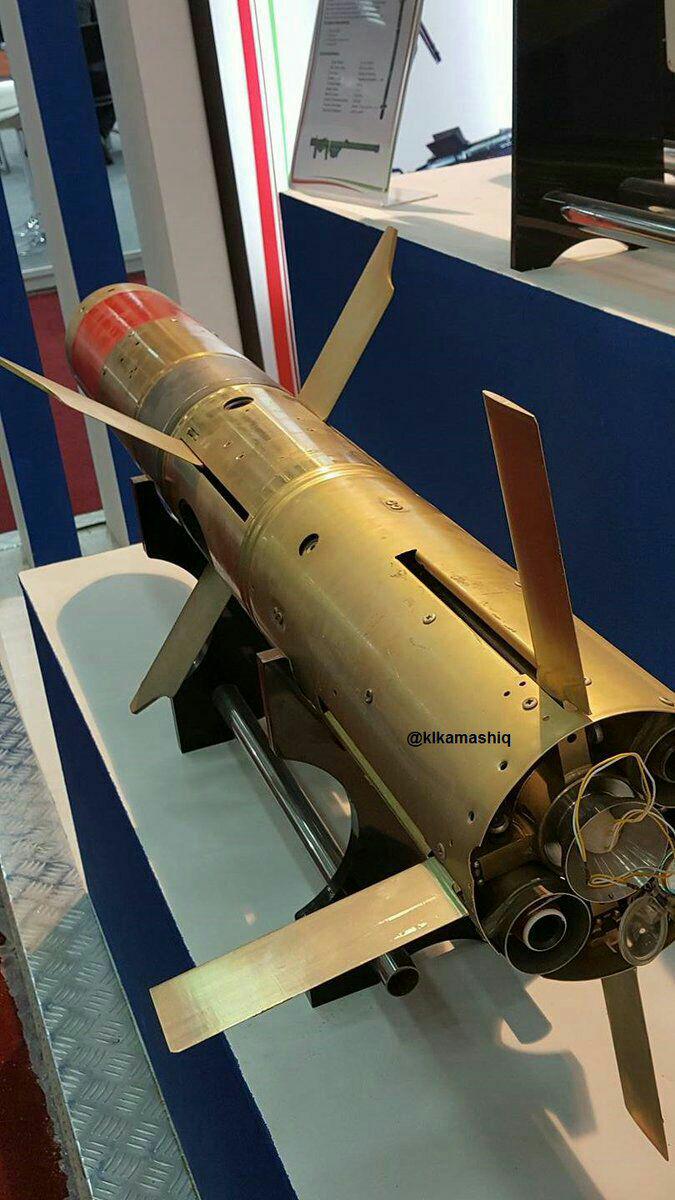
2- Toophan-2 missile: Toophan-2 was developed with the aim of increasing penetration rate, And by adding a penetrating extended probe and a heavier two-stage warhead, it not only gained the power to penetrate 760 mm rolled armor, but also has the ability to pass through all types of reactive armor. The extended probe in Toophan 2 missile has a small warhead to destroy the reactive armor so that the main warhead engages with the main armor. The extended probe is inside the missile, after firing it comes out of the tube, opens and is placed in its place as the missile head.
Published specifications of Toophan-2
Specifications of Toophan-2 missile: Maximum range: 3850 meters Minimum range: 70 meters Effective range: 3.5 km Effective range at night: 2.5 km Missile weight: 19 kg Warhead weight: 4.1 kg Type of warhead: Tandem HEAT shaped-charge Missile length: 117 cm Length of missile with the extended probe: 145 cm Missile diameter: 15.3 cm Armor penetration rate: 760 mm
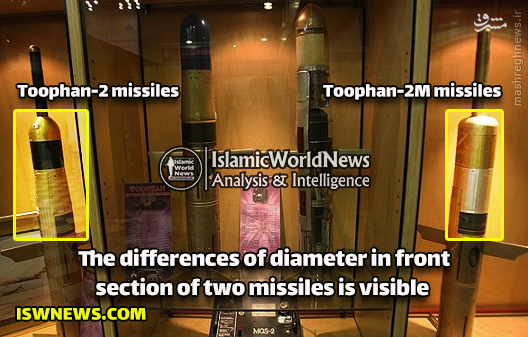
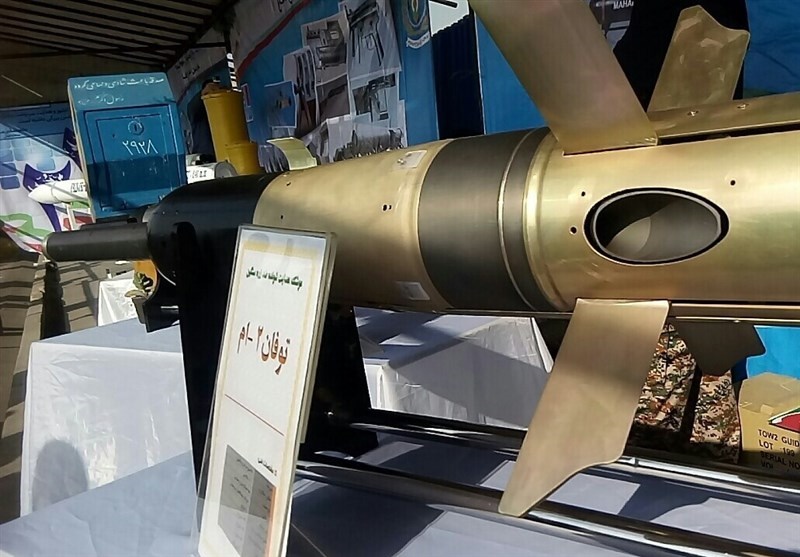
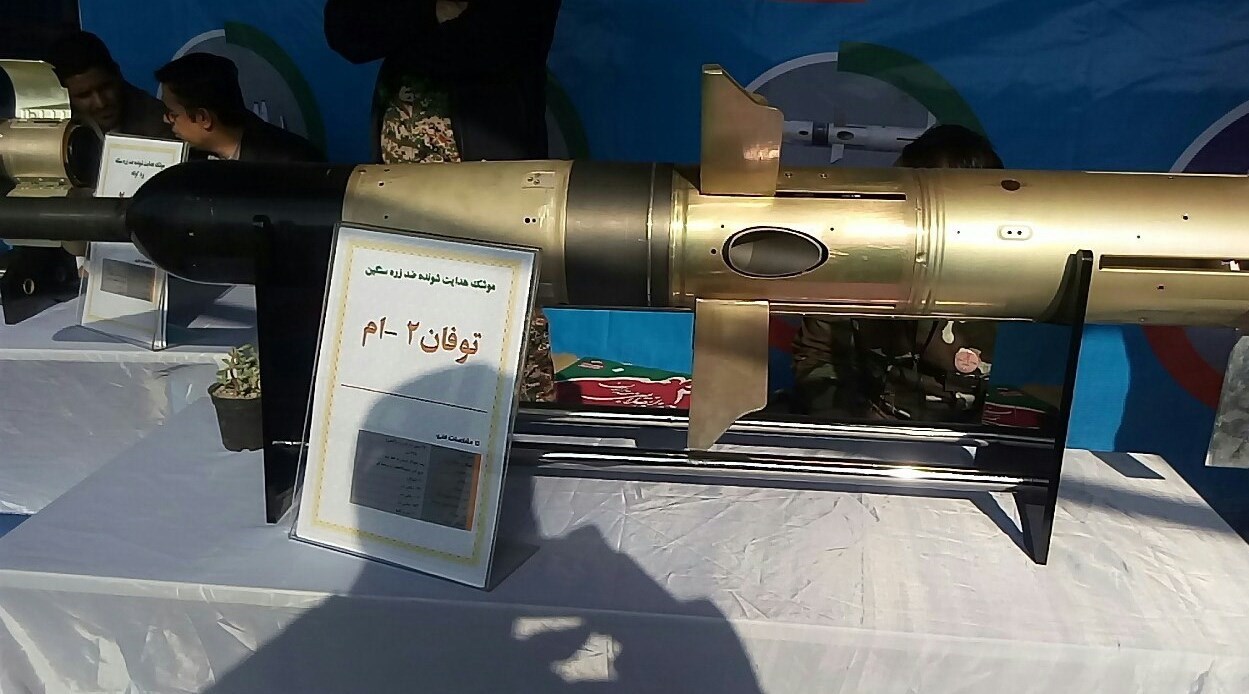
3- Toophan-2M missile: Iran’s defense industry sought to upgrade and develop the Toophan-2 missile, this led to the production of the Toophan-2M variant. This upgraded missile had the ability to penetrate 900 mm of armor. In the overall design of the Toophan-2 missile, the existence of an extended probe and a two-stage warhead has been preserved. The new missile has a larger nose diameter than its previous model due to carrying more explosives. The specifications of Toophan-2M have not been published in full, but due to its similarity with the Toophan-2 variant, its specifications can be guessed to some extent.
The diameter difference between Toophan-2 and Toophan-2M missiles
Specifications of Toophan-2M missile: Maximum range: 3850 meters Minimum range: 70 meters Effective range: 3.5 km Effective range at night: 2.5 km Missile weight: 21 kg Warhead weight: 6.1 kg Type of warhead: Tandem HEAT shaped-charge Missile length: 117 cm Length of missile with the extended probe: 145 cm Missile diameter: 15.3 cm Armor penetration rate: 900 mm
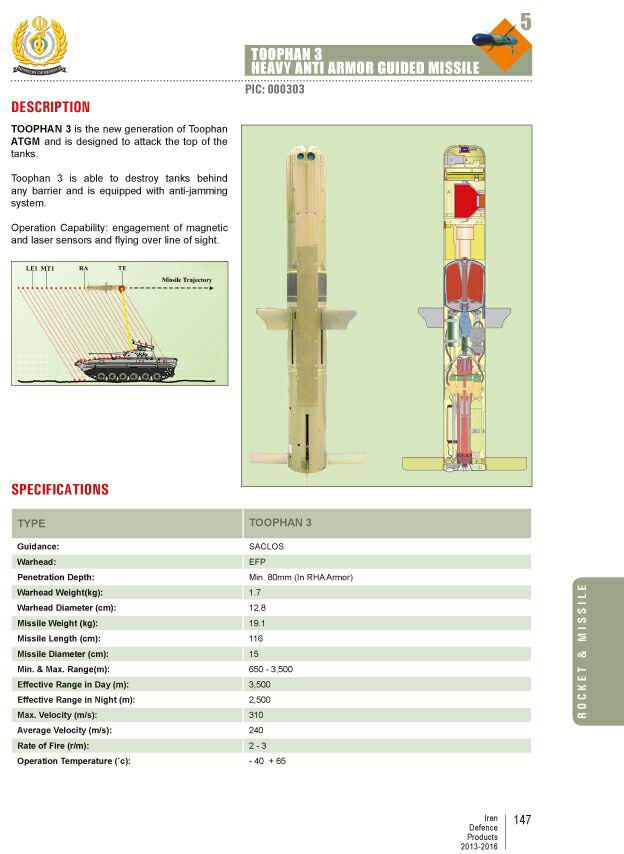
4- Toophan-3 top attack missile: Toophan-3 is a special member of the Toophan anti-armor missile family. This missile attacks armored targets from above and attacks the weakest point of tanks. Top Attack anti-armor missiles have two mechanisms, the first type is diving on the target and the second type explodes on top of the target, which Toophan-3 is of the second type.
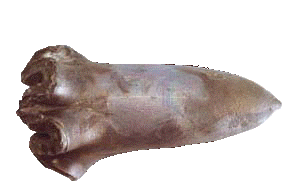
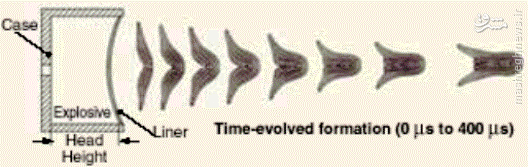
The Toophan-3 missile flies at a height of 2 to 3 meters above the ground and when it passes over the target, the missile’s sensors detect the target and give the command to detonate the Explosively Formed Penetrator (EFP) warhead. The EFP is a special type of shaped charge that deform a metal plate into a slug or rod shape and accelerate it toward the target.
The advantage of using top attack missiles like Toophan-3 is that they can attack targets behind hills or obstacles.
Toophan-3, like other members of the Toophan anti-armor family, uses line-of-sight guidance (SACLOS) and uses wires to transmit course correction information.
Published specifications of Toophan-3. The picture also shows how Toophan-3 works.
Specifications of Toophan-3 missile: Maximum range: 3500 meters Minimum range: 650 meters Effective range: 3.5 km Effective range at night: 2.5 km Missile weight: 19.1 kg Warhead weight: 1.7 kg Warhead type: EFP Missile length: 117 cm Missile diameter: 15.3 cm Armor penetration rate: at least 80 mm in armor
5- Toophan-3M top attack missile: Like the Toophan-3 missile, this missile is a top attack missile and uses the EFP warhead and SACLOS guidance. The range of this variant has increased to 3,750 meters and the minimum penetration power has increased from 80 mm to 150 mm.
Specifications of Toophan-3M missile: Maximum range: 3750 meters Minimum range: 100 meters Effective range: 3.5 km Effective range at night: 2.5 km Missile weight: 21.5 kg Warhead weight: 4 kg Warhead type: EFP Missile length: 117 cm Missile diameter: 15.3 cm Armor penetration rate : at least 150 mm in armor
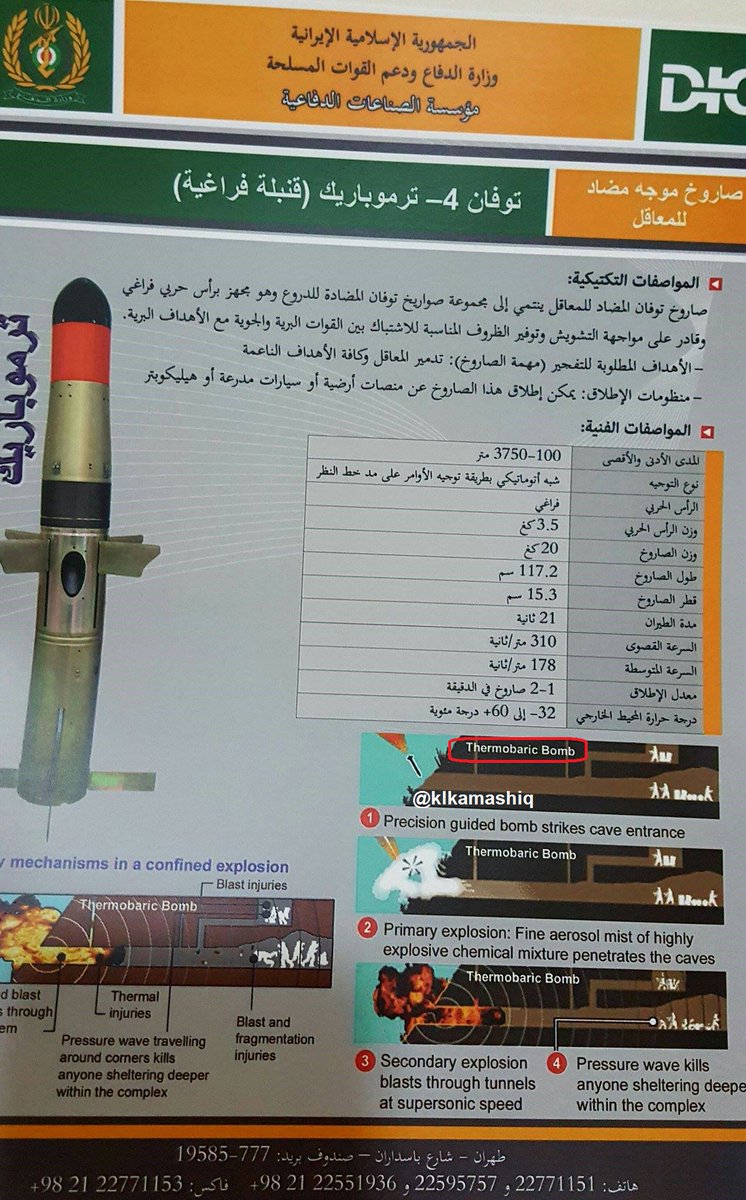
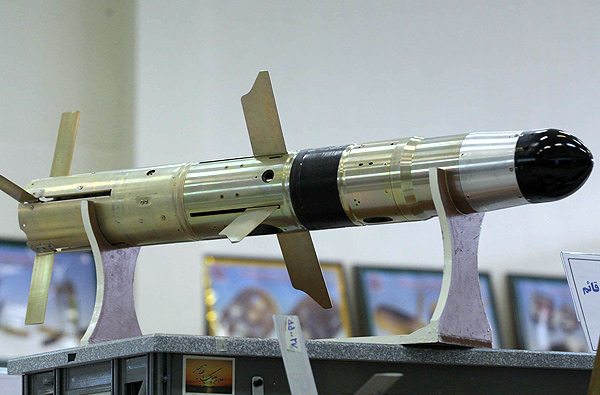
6- Toophan-4 missile: Toophan-4 is the first member of the Toophan anti-armor family that is equipped with a thermobaric warhead. This variant also uses SACLOS method for guidance. Toophan 4 missile was displayed for the first time at the Baghdad Defense Exhibition in 2017.
Published specifications of Toophan-4 and how it works
Specifications of Toophan-4 missile: Maximum range: 3750 meters Minimum range: 100 meters Effective range: 3.5 km Effective range at night: 2.5 km Missile weight: 20 kg Warhead weight: 3.5 kg Warhead type: Thermobaric Missile length: 117 cm Missile diameter: 15.3 cm
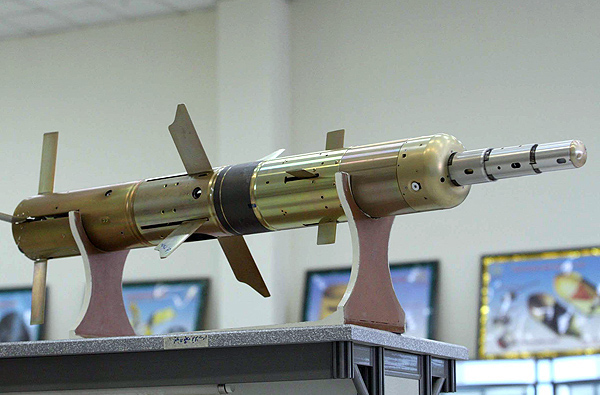
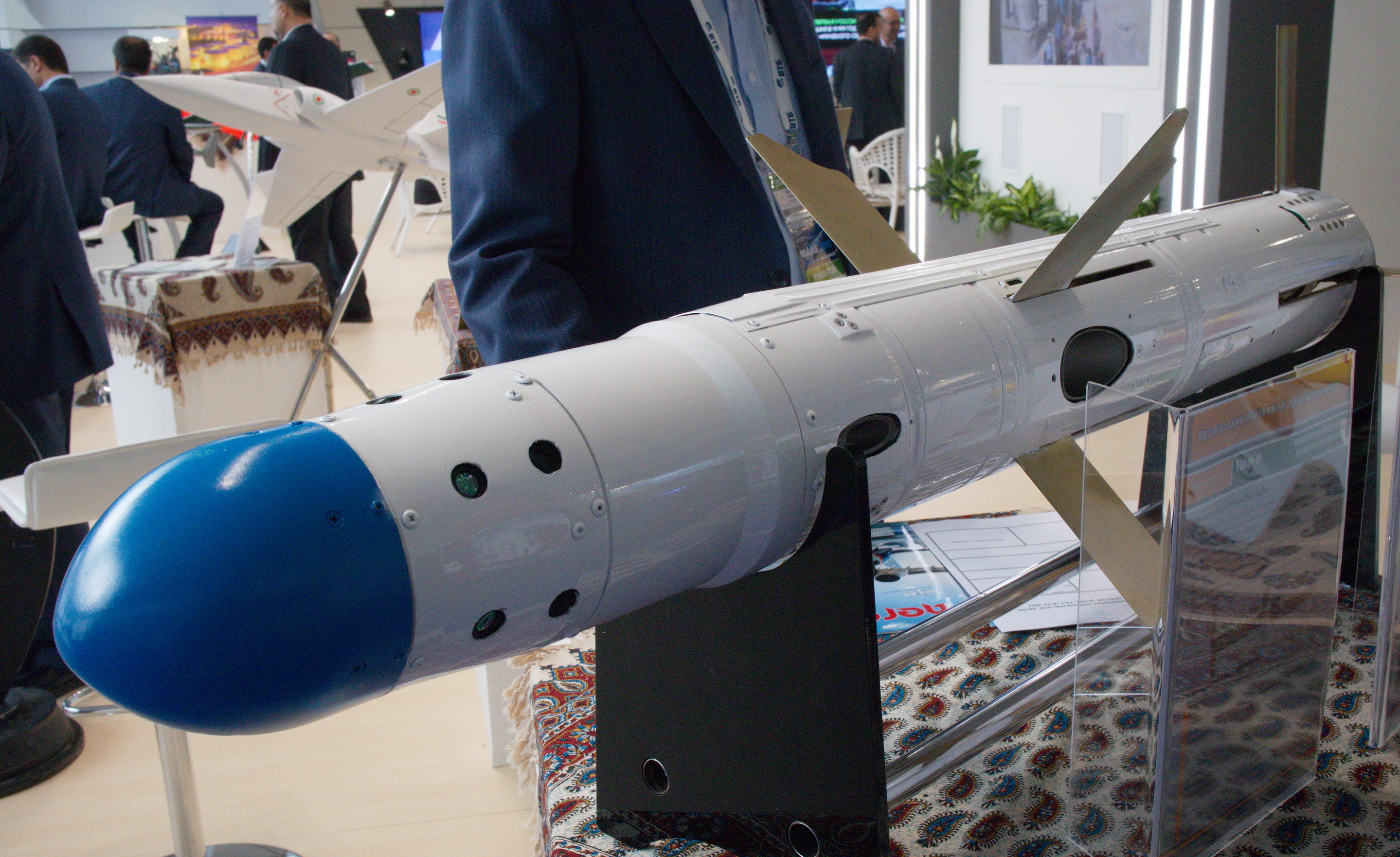
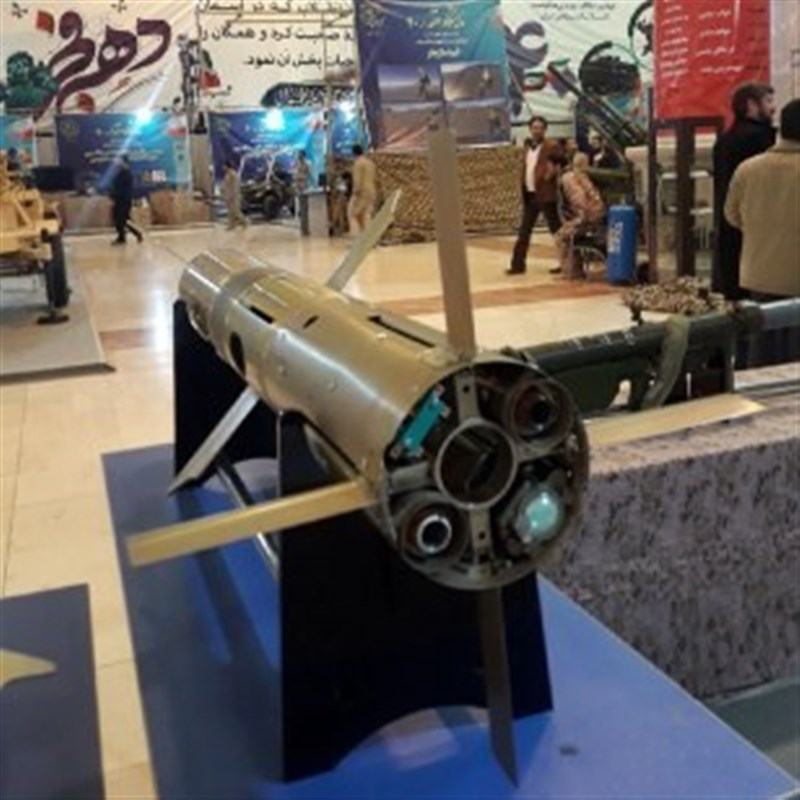
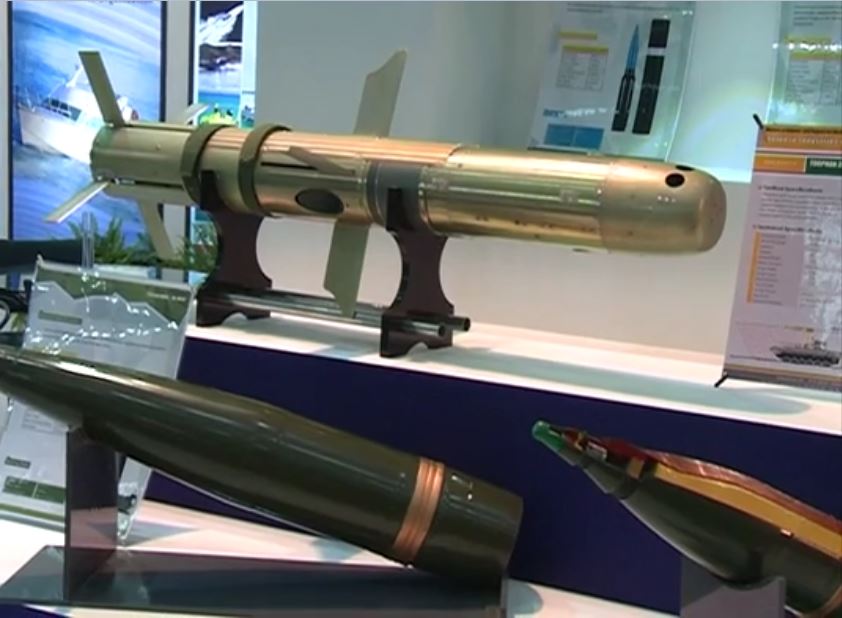
7- Toophan-5 missile: Like the Toophan-2 missile, Toophan-5 is designed to penetrate explosive reactive armor (ERA). This missile also has an extended probe containing explosives and a larger warhead to be able to penetrate reactive armor and pass through the main armor. But Toophan-5 uses a type of laser beam riding for guidance. Another difference between Toophan-5 and previous missiles is that it has three rows of fins, one row is located in the beginning of the missile and near its tip, and the other two rows are placed in the middle and end of the missile like other types of Toophan. The presence of this type of fins makes the missile react faster and make it more stable during flight. It seems that the main reason for using three fin rows is for its type of guidance.
An image of the Toophan-5 missile, which clearly shows three rows of fins.
Due to the type of guidance in Toophan-5 missile, a different launcher is used to fire and guide this missile. This launcher uses three types of lenses. One is for the day vision camera, which is used to find targets during the day. The second lens is for the thermal vision camera, which is used for targeting at night or for targeting after a smoke screen. The third lens is intended to shine the laser beam to the end of the missile during flight and guide it towards the target; This beam is irradiated to the center of the target selected by the operator.
Special launcher for launching Toophan-5 missile
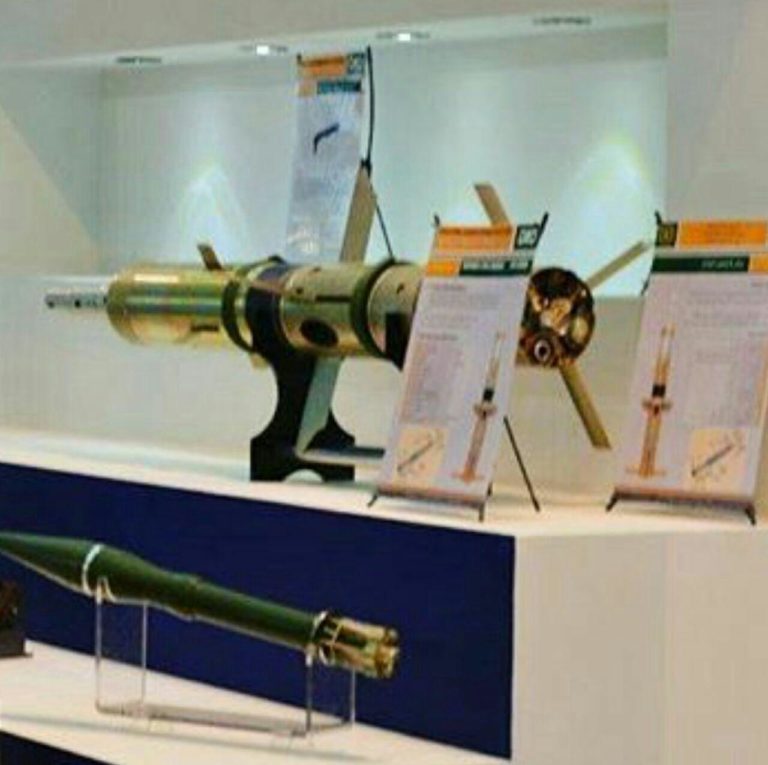
It is worth mentioning that the wire guidance type of Toophan-5 missile was also displayed at the Baghdad International Exhibition in 2017, which indicates that the cheaper version the missile is also in production line.
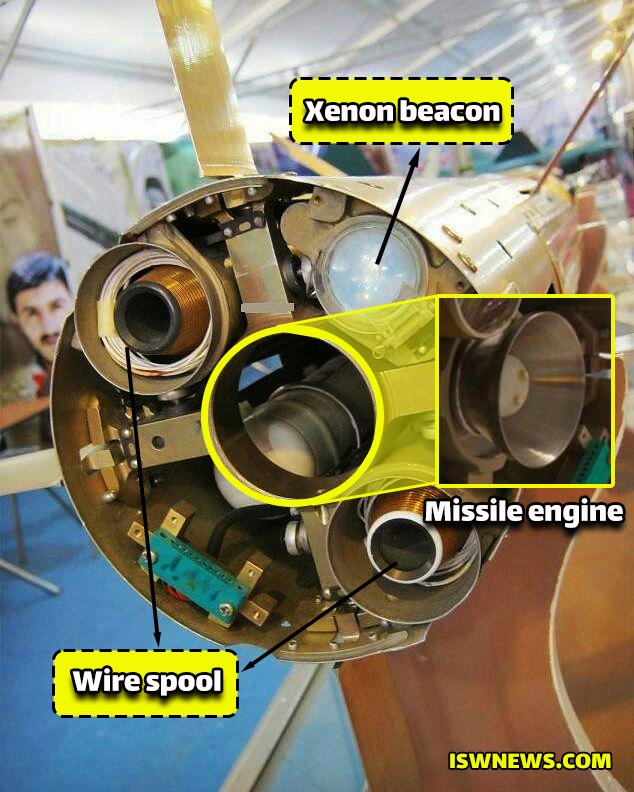
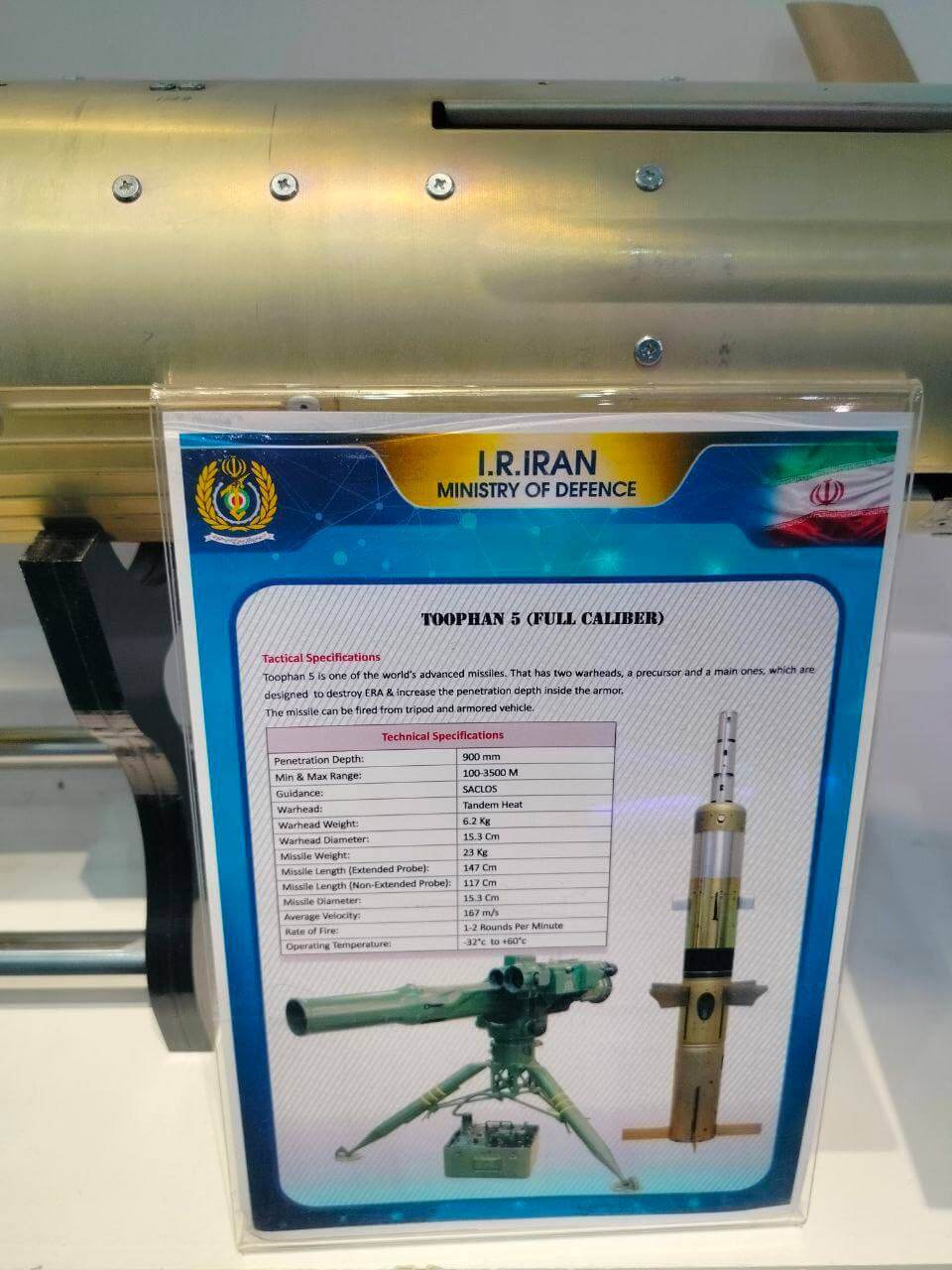
A picture of the Toophan-5 missile in the Baghdad exhibition, where the wire spindle and xenon lamp can be seenPublished specifications of Toophan-5Click to view full size image
Specifications of Toophan-5 missile: Maximum range: 3500 meters Minimum range: 100 meters Effective range: 3.5 km Effective range at night: 2.5 km Missile weight: 23 kg Warhead weight: 6.2 kg Type of warhead: Tandem HEAT shaped-charge Missile length: 117 cm Length of the missile with the extended probe: 145 cm Missile diameter: 15.3 cm Armor penetration: 900 mm
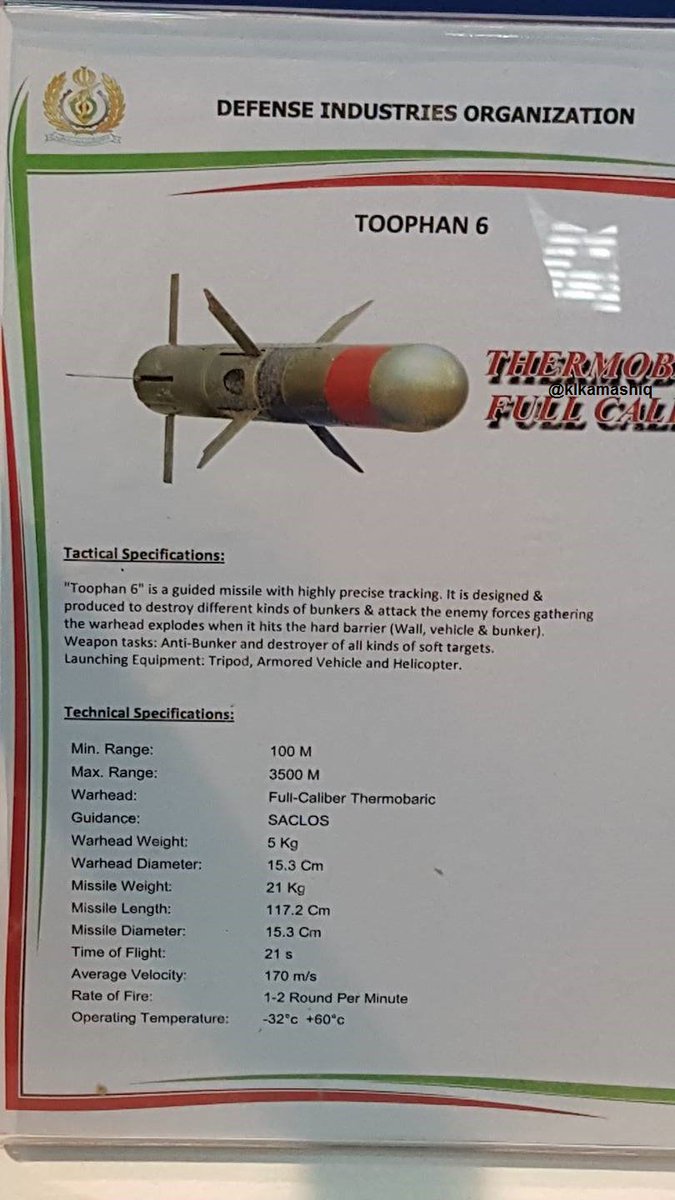
8- Toophan-6 missile: Toophan-6 was first unveiled at the 2017 Baghdad International Exhibition. Like Toophan-4, this missile uses a thermobaric warhead and wire guidance. Toophan-6 uses a 5 kg warhead, but Toophan-4 uses a 3.5 kg warhead. This missile can be fired from the conventional tripods, all types of vehicles and helicopters.
Specifications published about the Toophan-6 missile
Specifications of Toophan-6 missile: Maximum range: 3500 meters Minimum range: 100 meters Effective range: 3.5 km Effective range at night: 2.5 km Missile weight: 21 kg Warhead weight: 5 kg Warhead type: Thermobaric Missile length: 117.2 cm Missile diameter: 15.3 cm
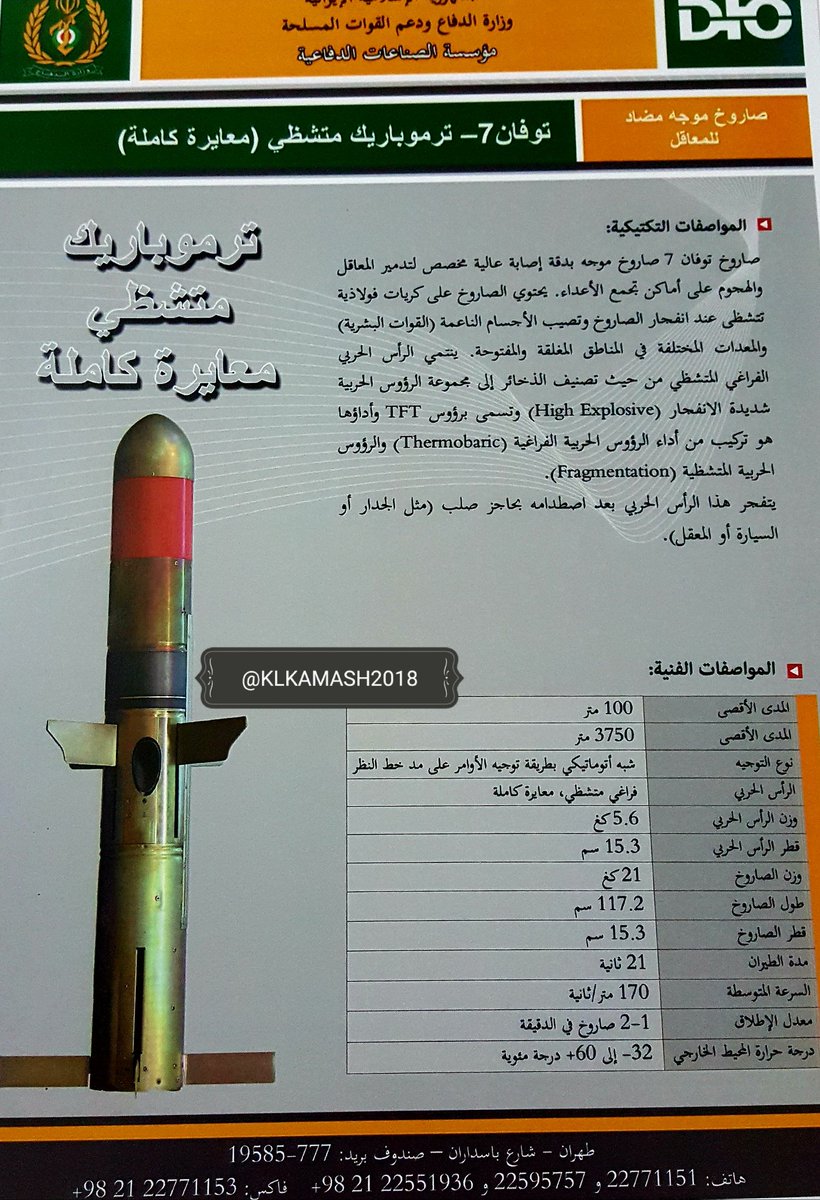
9- Toophan-7 missile: Toophan-7 is the third thermobaric member of the Toophan family, which was introduced after Toophan-4 with 3.5 kg and Toophan-6 with 5 kg of explosives. Toophan-7 with a thermobaric warhead and shrapnel fragment capability has 5.6 kg of explosives. The missile uses semi-automatic command-to-line-of-sight (SACLOS) guidance by wire.
Specifications published about the Toophan-7 missile
Specifications of Toophan-7 missile: Maximum range: 3500 meters Minimum range: 100 meters Effective range: 3.5 km Effective range at night: 2.5 km Missile weight: 21 kg Warhead weight: 5.6 kg Warhead type: thermobaric Missile length: 117 cm Missile diameter: 15.3 cm
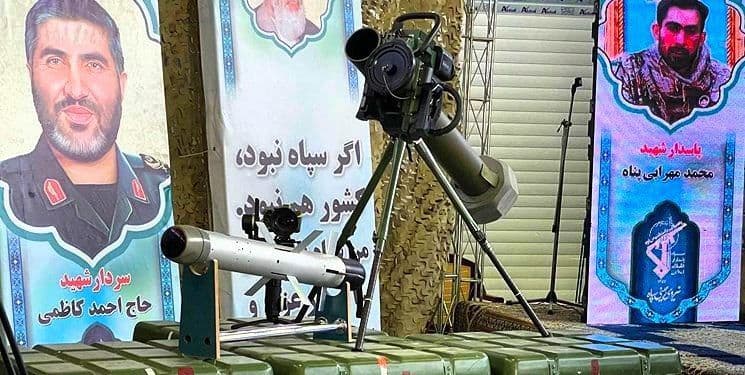
10- Ghaem anti-helicoptermissile: Ghaem or Qaem anti-helicopter missile is a semi-heavy guided missile that is intended for use against UAVs and low flying or stationary helicopters. This missile looks very similar to the Toophan-1 missile and it is difficult to distinguish it. The exact specifications of this missile have not been revealed, but it is said that it’s a laser-guided missile and is resistant to electronic warfare.
Ghaem anti-helicopter missile
Ghaem-M missile: This missile, like the Ghaem missile, is an anti-helicopter missile and has the ability to destroy air targets with low speed and low altitude, especially attack helicopters. with the difference that this missile uses several proximity fuses that improve its performance. Also, in this variant, a fragmentation warhead with 500 shrapnels and a weight of 1.7 kg was used. These two changes have been made in order to cause more damage if the missile does not hit the target directly. In the published images, it seems that the engine gas output in the middle part of the missile has become larger, which indicates the possibility of using a larger engine to reach a range of 6 km. Also, there is a laser beam receiver at the end of the missile, which confirms the laser beam guidance method like Tofan-5 missile. Unfortunately, the altitude of fire is not mentioned in the published information about this missile. But if the altitude of fire is 5 km, it will be able to deal with most drones and helicopters.
The front part of the Ghaem-M missile, whose sensors are clearly visible.The end part of the Ghaem-M missile, which has a laser receiving lensClick to view full size
Specifications of Ghaem-M missile: Maximum range: 6000 meters Minimum range: 500 meters Missile weight: 19.5 kg Warhead weight: 1.7 kg Type of warhead: Fragmentation (500 shrapnels) Missile length: 116 cm Missile diameter: 15.3 cm Maximum speed: 310 meters per second Average speed: 240 meters per second
11- Almas anti-tank missile: Almas missile is an anti-armor missile that has always been considered as an independent category. However, when it comes to looking at the configuration of the Almas anti-tank missile, we will realize the great similarity in the essence of the Almas missile and the Toofan missile. Both Toophan and Almas missiles have two rows of wings and an engine in the middle section, with hot gas from the engine coming out next to the middle wings.
In Almas missile, the middle wings are closed forward while in Toophan missiles these wings are closed backward. In Almas missile, the middle wings have a simple shape, but in Toophan missile, the shape of the middle wings is special.
Almas anti-tank missile is a top-attack missile with fire and forget capability. The guidance method of Almas missile is similar to the first type, using a camera on a tripod, tracking and targeting are accomplished and then the missile is fired towards a target and the missile independently goes towards the target and attacks it from above.
It seems that with the addition of this generation and its very significant changes compared to the base model of Toophan, it was necessary to change its name and end the Toophan missile project.
Almas fire-and-forget top attack missile
More images of Toophan ATGMs:
Click to view full size image
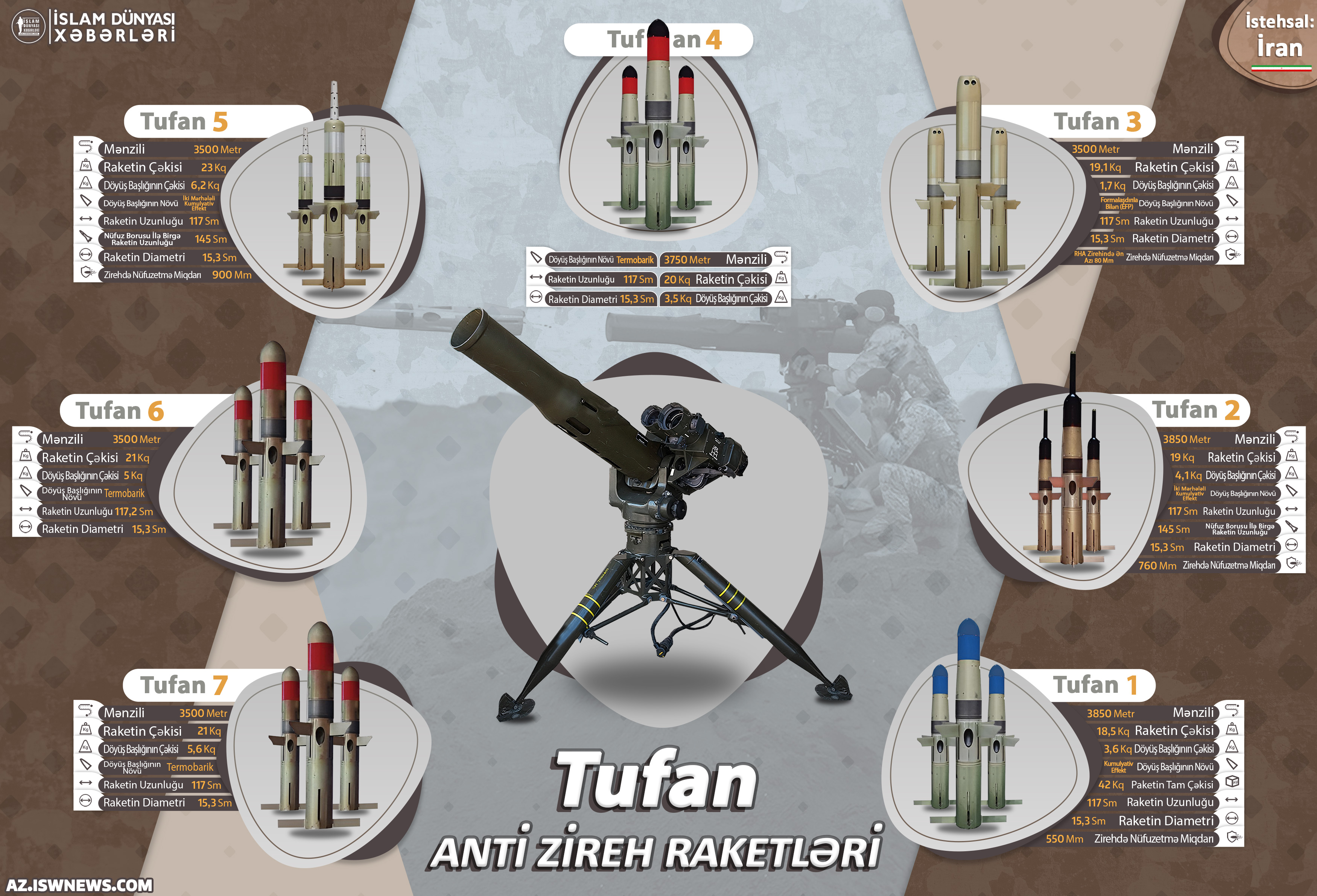
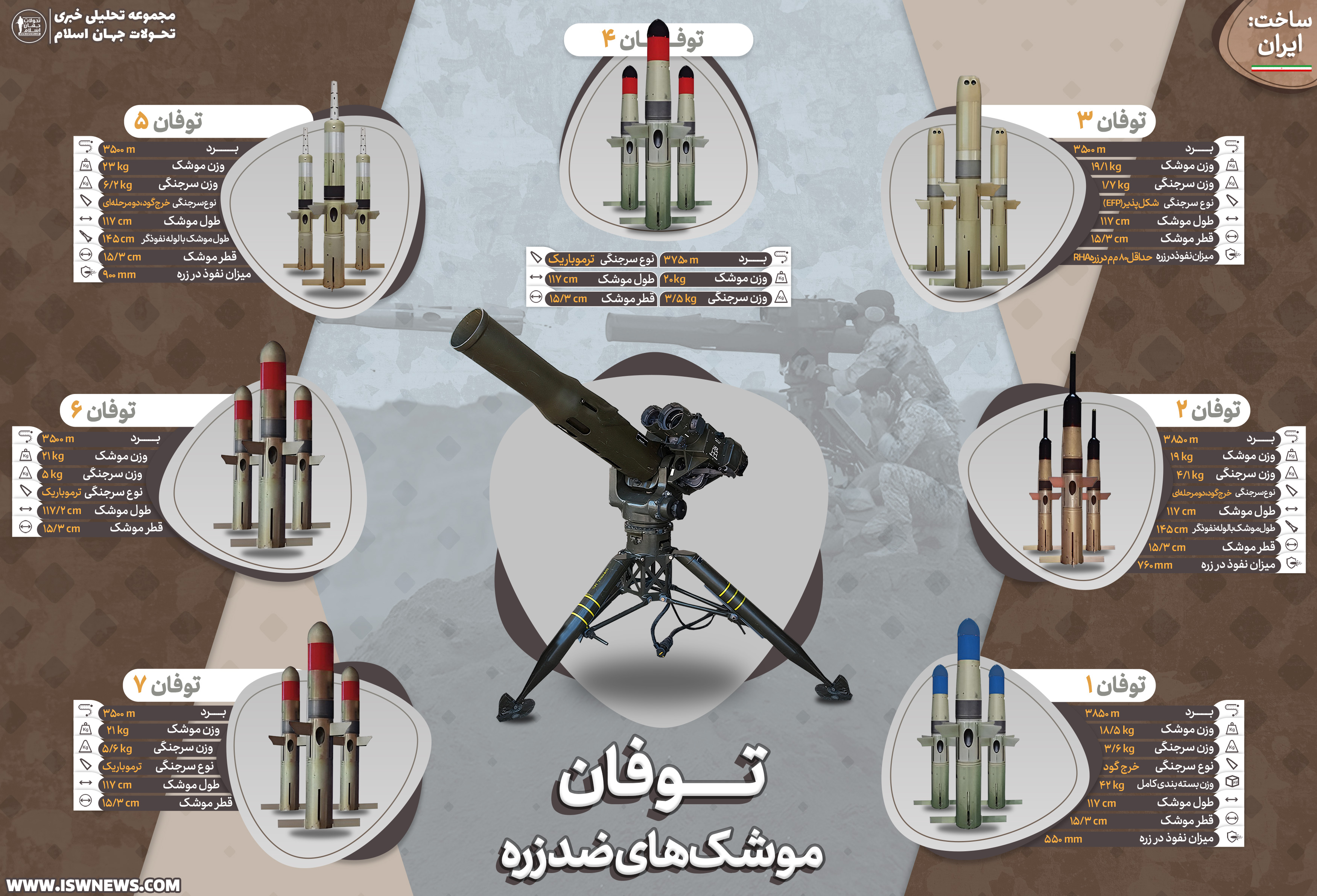
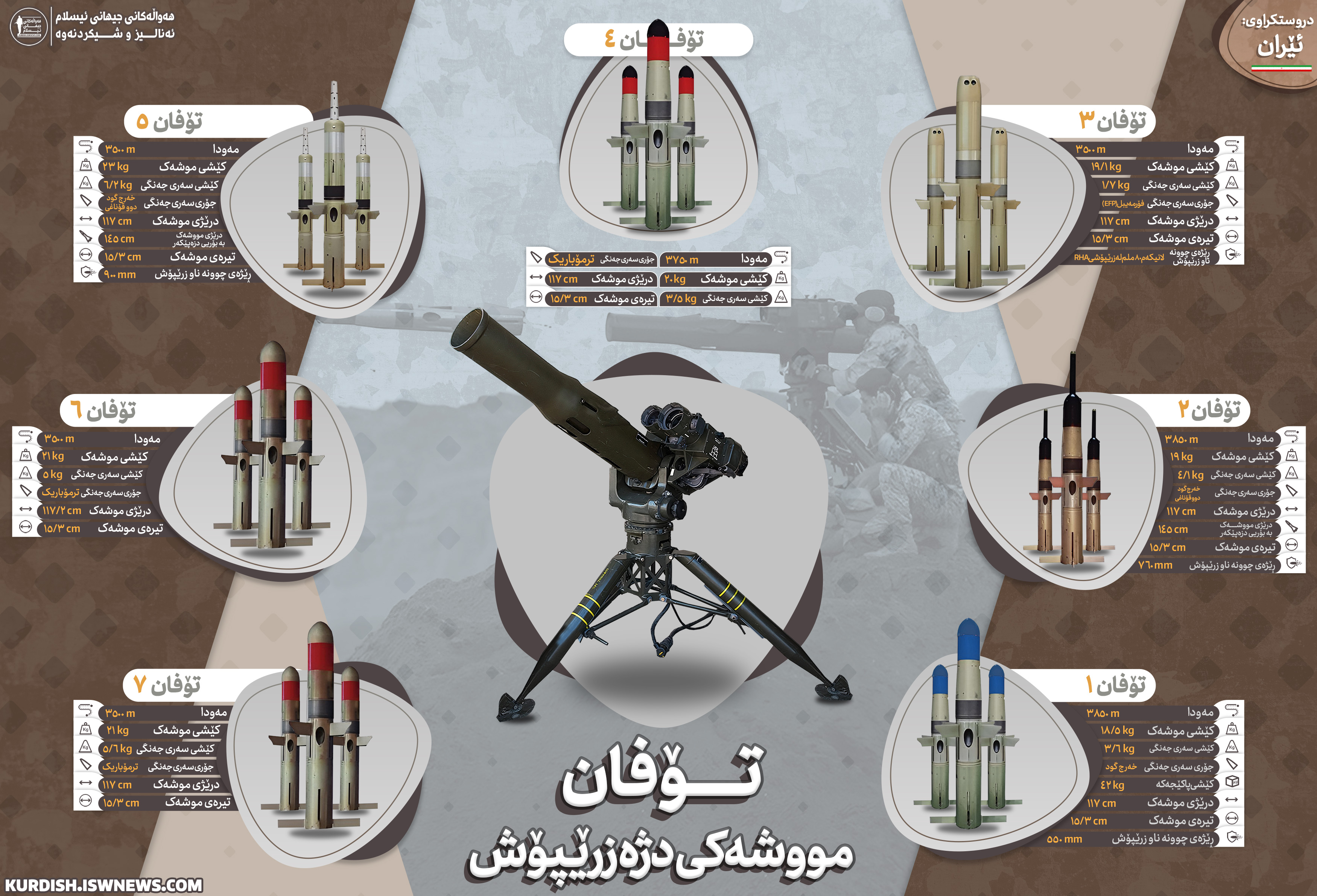
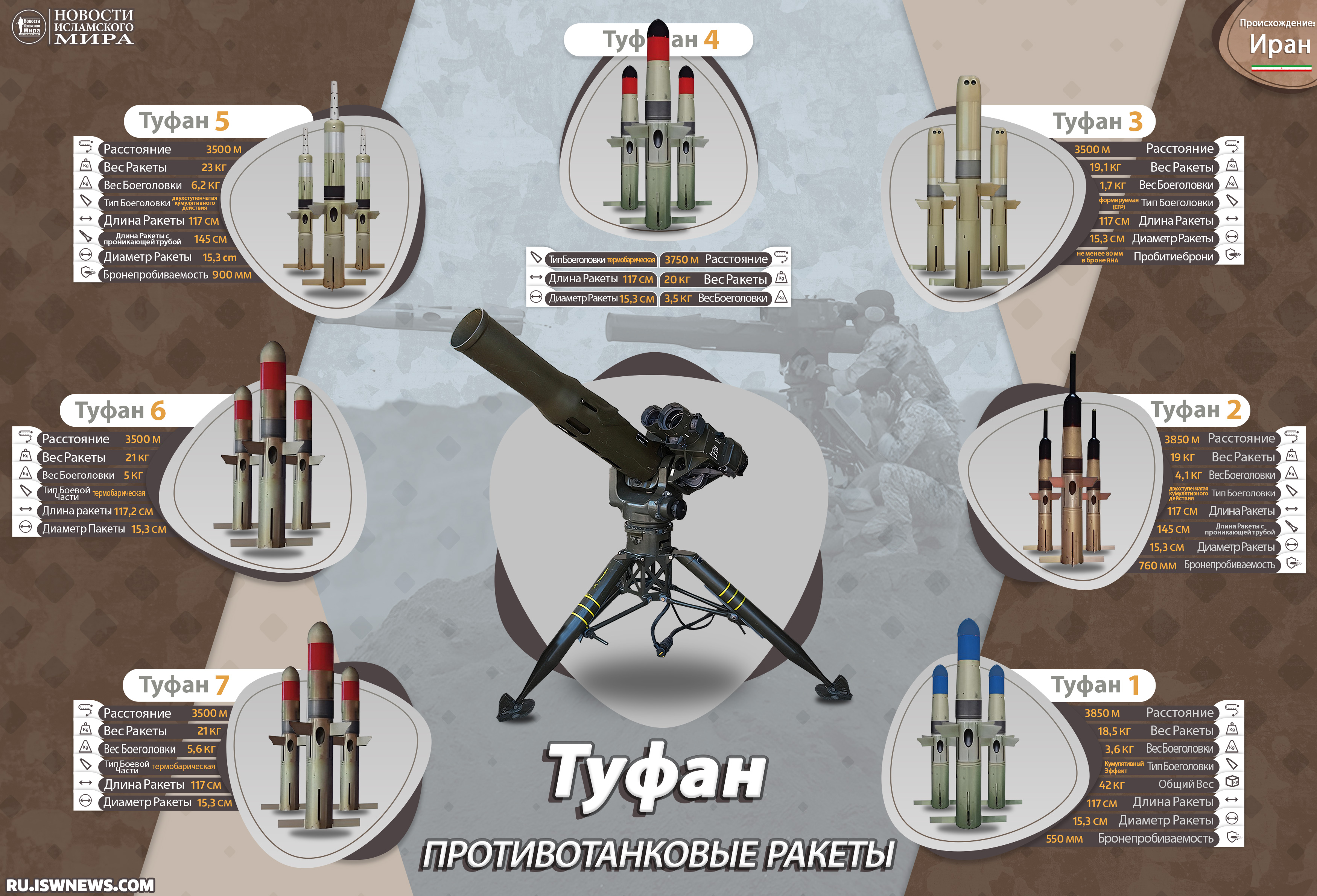
Infographics of Toophan anti-armor missiles in Arabic (صواريخ طوفان المضادة للدروع), Russian (Противотанковые ракеты Туфан), Kurdish, Azeri (Tufan Anti Zireh Raketləri), Persian (موشک ضد زره توفان) and Hebrew (טופאן טילים נגד טנקים):
The Abu Mahdi cruise missile was developed and built under the “Meshkat” project. The project Mashkat is a project in which the Russian KH-55 cruise missile was reverse engineered by Iran; And based on that, at first the Ya-Ali cruise missile with a range of 700 km, then the cruise missiles Soumar with a range of 700 km, Hoveyzeh with a range of more than 1,300 km and finally an anti-ship cruise version named “Abu Mahdi” with a range of more than 1,000 km were made. The Meshkat project has another long-range cruise missile that has not been officially unveiled and there are no pictures of it.
Abu Mahdi cruise missile is the first Iranian naval cruise missile with a range of 1000 km, which can be used against both sea and land targets, And can be launched from the fixed and mobile ground launchers and warships. Therefore, this missile with such a range is considered among the strategic cruise missiles.
It is worth noting that few countries have the ability to domestically manufacture such a cruise missile in this range and more ranges, and other countries have to pay exorbitant costs to purchase this type of strategic cruise missile. For example, Russian Kalibr, the US’s Tomahawk and French MdCN cruise missiles are included in this category.
History: The long-range cruise missile “Martyr Abu Mahdi Al-Muhandis” was unveiled for the first time together with ballistic missile “Martyr Haj Qasem” in August 20, 2020, on the occasion of Iran’s Defense Industry Day. At the unveiling ceremony, Amir Hatami, the then Minister of Defense, stated that the range of this cruise missile is more than 1000 km.
At the time of the unveiling, a video of the test-fire of the Abu Mahdi missile was published, with the words “Talaiyeh” written on it. According to the process of naming cruise missiles from Soumar, Hoveyzeh and then Paveh, using the names of war zones of the Iraq-Iran war on Iranian ground cruise missiles is a common practice in Iran. However, with the martyrdom of this prominent resistance commander, Abu Mahdi Al-Muhandis, Iran put the name of this martyr on the country’s first land-attack cruise missile.
A picture of Abu Mahdi cruise missile test-fire in 2020 with the name of Talaiyeh written on it
This missile with changes in the engine section and with a new name was unveiled again on July 25, 2023 during a ceremony and its mass production line was officially opened by the Ministry of Defense of Iran. Also, in this ceremony, the Abu Mahdi missile officially entered the service of the IRGC and Army combat units.
Design: Abu Mehdi long-range cruise missile has used the features of Soumar and Hoveyzeh cruise missiles in its design. According to the published images, different parts of the Abu Mahdi missile can be examined as follows
Different parts of Martyr Abu Mahdi long-range cruise missile
The main radar of the missile is located in the nose, and after the radar, a compartment or cabin is intended for the computer.
After the radar is the warhead, which is indicated by the words WARHEAD CABIN on the missile. Abu Mahdi cruise missile uses a penetrating warhead with a 410-kilogram high-explosive warhead that can cause a lot of damage to the target.
After the warhead, there is a ground detection radar and other missile guidance systems.
In the middle section, the missile wings and the fuel tank are located. This missile has folding wings structure that allow it to be placed inside the sea and land launch containers. The Abu Mehdi’s wings use a square design with a round tip, which is completely identical to the previous design.
Click to view full size
The fuel tank and the wings are placed in one part, and the fuel tank extends to the missile engine, And the engine is placed under the missile. At the time of the initial unveiling in August 2020, the Abu Mehdi’s engine was similar to the Hoveyzeh cruise missile engine; But in the version that was unveiled in 2023 and has reached mass production, a different engine is used. The name of this engine has not been officially announced, but it can be assumed that this engine is an optimized turbojet engine (probably Tolou type) with the same flight conditions as the initial unveiling model.
The engine difference between the prototype version and the mass-produced version of the Abu Mahdi cruise missile
At the end of the missile, there are control fins and rocket booster. The control fins are responsible for changing the direction of the missile. The Abu Mahdi cruise missile uses a large booster with retractable mesh stands like the Hoveyzeh and Soumar models.
Close-up video of the Abu Mahdi missile and its launcher boxA video of the test-fire of the Abu Mahdi cruise missile from the ground mobile launcher and testing the guidance and accuracy of this missile
In the case of the Abu Mahdi missile, considering the high range of the missile and the fact that it engages with sea targets that are mobile, two issues are very critical. The first issue is the initial detection of the target and the second issue is guiding the missile towards the moving target.
Detecting the target in the sea and correcting the missile’s flight path in relation to the moving target: Abu Mehdi cruise missile has a range of 1000 km, which definitely takes more than an hour to travel such a distance. Considering that this cruise missile is designed based on the KH55 missile and the KH55 has a speed of about 700 km/h, then the Abu Mehdi cruise will probably have a speed approximately equal to this missile, and this means that it will take about 85 minutes to travel a distance of 1,000 km. If a ship is traveling at 32 knots (about 60 km/h), then it has moved about 85 km from its initial location since the missile was fired, and finding such an object is beyond the capabilities of the missile’s small seeker radar. One of the method to solve this problem is to use helicopters, fighter jets, fast boats or drones. All these items are at risk of discovery and destruction. However, the use of stealthy drones such as Shahed-171 greatly increases the probability of success in detecting and chasing the vessel.
Another method is to use spy satellites to discover the primary and the secondary position of the target. It is also possible to track the radar by the radars of surface vessels and coastal radars. It is also possible to use the radars of surface vessels and coastal radars to track the target.
Missile guidance systems
1- The main seeker and radar: RADAR HATCH is written on the nose of the missile. This brings to mind that the main radar can be accessed through this hatch and it is possible to change the mode of the radar; In other words, this hatch is for the radar adjustment and checkup. This missile uses active radar homing (ARH) and passive radar (PRH). It is also possible to use both modes. For example, the missile can use the passive mode until it approaches the target and use its active radar mode when it is near the target.
Radar hatch on the nose of missile
In another image, there is a hatch with the words ATB CABIN. This hatch is for access to the radar processor. Also, this cabin has a small air intake for cooling.
Air intake and radar processor cabin on Abu Mahdi missile
– Active radar homing (ARH): It is a missile guidance method in which the missile containing a radar transceiver and its special computer independently tracks the target in the final stage of guidance. In this method, the missile is sent to the target position, and if the target characteristics are changed, new characteristics are sent to it along the way. Considering Abu Mahdi’s range of 1000 km, this radar method will be active during target detection, which is suitable for attacking land targets and sea targets. Of course, this radar can also help the flight system during the flight.
– Passive radar homing (PRH): Passive radar is a radar systems that detect and track objects by processing reflections from non-cooperative sources of illumination in the environment. Passive radar is not able to produce radar waves, but this type of radar has the ability to detect the sources of the waves and allows it to attack the radar of air defense systems. Missiles with passive radars are very hard to detect, but easier to break their locks. These types of radars require very powerful computers to be able to separate and process a large amount of environmental waves. In the case of the Abu Mahdi missile, due to the lack of sufficient space, there is only the possibility of having a small advanced computer to detect the radar waves and its propagation direction, which can be used to attack radar targets.
According to the published video of Abu Mahdi cruise missile test, several corner reflectors are used in the upper part of the target, which is to engage the missile’s radar, and the missile finally hits the middle part of the metal structure, which is completely similar to the performance of conventional anti-ship cruise missiles. High accuracy of hitting the target is seen in the tests.
The corner reflector on the dummy target and the point where the missile hits the middle of the dummy target
This method of target detection was also used for anti-ship missiles such as Ghadir, Ghadr, Kosar, etc. In this method, the missile finds the target using its search radar and then scans the target and finds the middle part of the target and attacks it. This collision causes maximum damage to the vessels, which ultimately leads to the vessel being split in half and sinking.
2- Inertial guidance: An inertial navigation system (INS) is a navigation device that uses motion sensors (accelerometers), rotation sensors (gyroscopes) and a computer to continuously calculate by dead reckoning the position, the orientation, and the velocity (direction and speed of movement) of a moving object without the need for external references, which keeps the position of the missile on its right path.
3- GPS guidance: In this method, the missile is guided to the target using the Global Positioning System (GPS). This system, along with the inertial guidance system, can greatly increase the accuracy of the missile. The accuracy of some types of missile with this type of guidance reaches an accuracy of less than 1 meter. It is also possible for Abu Mahdi to access GLONASS and BeiDou navigation systems, which is the Russian and Chinese version of GPS.
4- TERCOM system: Terrain contour matching or TERCOM uses a contour map of the terrain that is compared with measurements made during flight by an on-board radar altimeter. A TERCOM system considerably increases the accuracy of a missile compared with inertial navigation systems (INS). The increased accuracy allows a TERCOM-equipped missile to fly closer to obstacles and at generally lower altitudes, making it harder to detect by ground radar. Topographical maps are very accessible today because they are used for commercial purposes and Abu Mehdi takes advantage of this.
In the lower part of the Abu Mahdi missile, a part with a different shape and material can be seen, which seems to be the location of the altimeter radar or terrain detection. This radar is responsible for a part of the mission for guiding the missile along with the INS, And it significantly increases the accuracy of the missile.
Terrain detection radar located in the lower part of the missile
The technical specifications of the Abu Mahdi long-range cruise missile have not been officially announced, but considering the family of missiles in project Meshkat, and also the technical specifications of the KH55 cruise missile, it is possible to accurately estimate the specifications of the Abu Mahdi cruise missile, which we will mention below.
Abu Mahdi cruise missile specifications: Type: Land-attack and anti-ship cruise missile Unveiled: 20 August 2020 Origin: Iran Manufacturer: Aerospace Industries Organization (AIO) Length: 600 cm Wingspan: 310 cm Diameter: 55 cm Weight: 1650 kg Warhead: 410 kg HE Accuracy: 3 meters CEP Range: more than 1000 km Flight altitude: under 50 meters Guidance: GPS/INS – TERCOM – ARH/PRH Engine: Turbojet Speed: about 700 km/h Launch platform: Fixed and mobile ground launchers and ships
Abu Mahdi long-range cruise missile – click to view full size
More pictures of the Abu Mahdi cruise missile:
Click to view full size
Abu Mahdi cruise missile infographic in Persian (موشک کروز ابومهدی), Russian (крылатая ракета Абу Махди), Arabic, Hebrew (טיל שיוט אבו מהדי), Chinese (阿布·马赫迪 巡航导弹), Azeri (Raketi Əbu Mehdi) and Kurdish (موشەکی کروز ئەبومەهدی):
The entire process of designing and producing of this missile was carried out by the Aerospace Industries of the Islamic Revolutionary Guard Corps of Iran.
The missile was first unveiled on 11 May 2014 when Iranian leader Grand Ayatollah Ali Khamenei visited the Aerospace Force of the Army of the Guardians of the Islamic Revolution. In the same exhibition, the Ya Ali (AS) cruise missile was announced as a land cruise missile with a turbojet engine, a range of 700 km and a warhead of 200 kg. In another interview in 2014, General Hajizadeh, commander of IRGC Aerospace Force announced that this missile can be installed and used by the IRGC’s Sukhoi 22.
Based on the images released from the unveiling ceremony of Ya Ali (AS) cruise missile, it can be said that this missile has a cylindrical body, fixed rectangular wings, a jet engine at the end of the body and an air intake below it, and control fins at the end of the body.
The dimensions of this missile have not been officially announced, but in some sources, the length of the missile is 4.9 meters and its diameter is 35 centimeters.
No detailed information is available about the engine of this missile. Two Toloue-4 and TJ100 engines are considered as the main options, the most likely of which is the Toloue-4 engine. The Toloue-4 engine is installed on Ghader and Noor cruise missiles as well as the Karrar drone.
The guidance system of this missile has not been officially announced, but this missile can obviously use Terrain contour matching (TERCOM) or Digital Scene Matching Area Correlator (DSMAC) method. However, considering the time of unveiling and use of this missile, the most likely method is to use an altitude measuring radar along with the inertial system and GPS, which helps the autopilot in guiding the missile. One of the weaknesses of this missile is not using a camera in the last stage of hitting, which could increase the accuracy of this missile.
Click to view full size
Ya-Ali (a.s) cruise missile is considered the first achievement of Meshkat project. This project is defined to achieve a 2000 km cruise missile; Its first prototype is the Ya-Ali cruise missile. After this missile, Soumar and Abu Mahdi cruise missiles were also built with higher ranges.
Specifications of Ya-Ali cruise missile: Length: 4.9 meters Diameter: 35 cm Range: 700 km Warhead weight: 200 kg Engine: Toloue-4 turbojet Launch platform: capable of firing from land, air and sea launchers Origin: Iran Designer and manufacturer: Islamic Revolutionary Guard Corps Aerospace Force
Ya-Ali cruise missile – click to view full size
Posters of Ya-Ali cruise missile in Farsi, Arabic (صاروخ كروز يا علي), Russian (Крылатая ракета Йа Али), Hebrew (טיל שיוט יא עלי), Chinese (亚阿里巡航导弹), Kurdish (موشەکی کروزی یاعەلی) and Azeri (Ya Əli (Ə) Qanadlı Raketi):
Most ballistic missiles have the ability to reach speeds higher than 5 Mach, but they are not considered hypersonic because they follow a ballistic path and have bullet-like movement. In general, it is easy for air defense systems to detect a ballistic trajectory at any speed. But maneuvering in the final phase is an important characteristic that creates a fundamental difference in missile classification. A hypersonic ballistic missile is a ballistic missile that has the ability to maneuver before hitting its target while maintaining a speed of more than 5 Mach.
For example, the Khorramshahr missile has a speed of near 16 Mach in the intermediate phase outside the atmosphere and a speed of near 8 Mach when entering the atmosphere, but it lands directly on the target like a bullet, so it is just a ballistic missile.
A review of the Fattah missile shows that this missile has a lot of similarity to the Kheibar Shekan missile in appearance. The tail fins and warhead have a lot of similarity to each other. The similarity is such that even the front ramp of the warhead control fins is the same. Therefore, it is assumed that the diameter of the Fattah and Kheibar Shekan missiles are also the same.
Given the great similarity between the two missiles and also the software reviews that were done, it can be assumed that the two missiles have the same diameter, equal to 80 centimeters. Also, considering that the length of the warhead has been announced as 3.6 meters, with a software review of the missile, the total length of the missile can be considered as 11.5 meters.
Estimation of the length of the Fattah missile
Another similarity between these two missiles is their range. In addition to the visual similarity of the Kheibar Shekan and Fattah missiles, the range of these two missiles is also similar to each other. The Kheibar Shekan has a range of 1450 kilometers and Fattah has a range of 1400 kilometers.
The missile body, along with the end fins and the fins on the cap, is entirely composite (carbon fiber). The body color is also of the radar wave absorbing type, which helps increase missile stealth. The use of warhead fins is when the missile comes down from an altitude of 30 kilometers and enters the atmosphere. Because at higher altitudes it has no effect on warhead maneuvering. This is useful for maneuvering near the target.
The warhead fins of Fattah missile
As it is clear, the aerodynamic shape of the Fattah and Kheibar Shekan warheads are the same, but due to the addition of an engine and fuel in the final section, it has been tried to maintain the aerodynamics of the warhead and reduce drag by making the missile tip longer.
Comparison of warheads of Fattah and Kheibar Shekan missiles
As mentioned, the warhead has propulsion with the ability of change thrust vector, and the presence of this engine allows the warhead to maintain its speed at a speed of more than Mach 5 when maneuvering near the target. When the warhead enters the atmosphere, its speed is greatly reduced due to the strong air resistance, and by performing heavy maneuvers with the help of its fins, its speed is reduced again; But with the warhead engine, it is possible to increase the speed to more than Mach 5. Also, with the thrust vector nozzle, it is possible to perform heavier maneuvers. It should be noted that this engine can be turned on when the warhead is separated from the missile, which increases the flight height of the warhead and greatly increases its range.
Fattah warhead engine with thrust vector nozzle
The next issue is how the Fattah missile works and whether it is hypersonic or not. This missile has a warhead with the ability to change thrust vector, which allows it to maneuver from the time the warhead separates from the body at an altitude of 300 kilometers above the ground. So after separating from the body, the Fattah missile’s warhead maneuvers with a low or depressed trajectory to escape anti-ballistic missile systems and changes or adjusts its path several times during flight. It should be noted that Fattah does not need much maneuvering outside the atmosphere; in addition to performing regular maneuvers to adjust its path, this missile has the ability to change its ballistic path shape. The next point is the ability to maneuver from a distance of 100 kilometers before hitting the target, which also puts it in the category of MaRV ballistic missiles.
So, Fattah follows a non-ballistic path both outside the atmosphere and when it is in Earth’s atmosphere and near its target. However, it should be noted that the mentioned capabilities alone do not make Fattah hypersonic. What puts the Fattah missile in the category of hypersonic ballistic missiles is that in addition to the mentioned capabilities, the missile’s speed at the moment of impact on the target is also higher than 5 Mach. This has been made possible by keeping the engine on for 50 seconds at different stages of flight to maintain warhead speed. As a result, by combining all of these features, we can consider Fattah as a hypersonic ballistic missile.
Fattah missile specifications: Length: ~ 11.5 meters Diameter: ~ 80 cm Weight: 4000 to 4600 kg Warhead length: 3.6 meters Warhead weight: ~ 1000 kg Weight of explosives: ~ 500 kg Speed: more than Mach 13 Range: 1400 km (increasable) Fuel: solid compound Flight trajectories: ballistic (maneuverability from the mid-phase) Origin: Iran
Fattah hypersonic missile – click to view full size
“Fattah hypersonic ballistic missile” posters collection in Persian, Russian, Arabic, Azeri, Kurdish and Hebrew:
The first type of Shafagh missile was unveiled and introduced in 2014 during a ceremony in the presence of the then Defense Minister, General Dehghan. This missile (first type) has a range of 8 to 12 km with a penetration rate of 1500 mm in armor. This amount of armor penetration is considered a very good number for an air-to-ground missile. For example, Kornet ME anti-armor missile has a penetration rate of 1300 mm in rolled steel.
The Shafagh air-to-ground and anti-tank missile in its two prototypes is very similar to the Shahab Sagheb defense missile that was used in the Ya Zahra (S) and Herz-9 air defense systems. Ya Zahra (S) air defense system, which was unveiled in 2013, is modeled after the French Cortal air defense system, which was captured by the Islamic Republic of Iran Army during the Iraq-Iran war. This French air defense system is also produced in China under the name FM90 or HQ7.
Cortal air defense systemFM90 air defense systemYa Zahra air defense systemClick to view full size
The Shahab Sagheb missile is also made from the R440 missile belonging to the Cortal defense system and is very similar to it.
R440 missile belonging to the French Cortal systemShahab Sagheb missile belonging to the Ya Zahra (S) air defense systemClick to view full size
Prototypes of Shafagh missile: As mentioned, the first Shafagh missile was installed on the Army’s Air Force helicopters in 2014, but before that in 2013, this missile was seen on the Karrar drone. In those years, it was stated that the Shafagh missile has a range of 8 to 10 km and uses an infrared seeker (IIR) in the last stage to attack targets independently; So Shafagh is a fire-and-forget missile capable of penetrating 1 to 1.5 meters of armor. The prototypes of the Shafagh missile have an accuracy of more than 30 cm at a distance of 10 km and have a speed equal to Mach 2 to 2.7 depending on the release height and the distance to the target. The high speed and fire-and-forget ability turned Shafagh missile into a very dangerous one, because the tanks’ defense system has very little reaction time to deal with this missile and the helicopter can quickly move away from the danger zone after firing.
Another variant of Shafagh missile was unveiled again in 2019 with the same name as Shafagh. The main difference between the two missiles unveiled at a different time interval was the appearance of the front fins. In the first prototype, Shafagh lacked the front fins, but in the secondary prototype, keeping the front fins, the Shafagh missile was completely similar to the Shahab Sagheb missile. Structurally, the maximum range of the second Shafagh missile was increased to 12 km. The Shafagh missile has a maximum speed of Mach 2 to 2.7 in both variants.
The first Shafagh missile unveiled in 2014The second Shafagh missile unveiled in 2019Shafagh missile seen in 2013Click to view full size
The main difference between the Shafagh missile in the first variant and the Shahab Sagheb missile was the removal of the front fins in the Shafagh missile, but in the secondary variant, the Shafagh missile can be distinguished from its IIR seekers compared to the Shahab Sagheb.
Safagh 1 and 2 specifications: Length: 2.9 meters Weight: 60 kg in first variant – 84 kg in second variant Maximum speed: Mach 2 to 2.7 Range: 8 to 12 km in second variant
The enhanced Shafagh missile: The enhanced Shafagh (شفق بهینه) missile was unveiled as a new generation of Shafagh missile in 2022. The new Shafagh missile has been described as a two-stage missile with a 13 kg warhead. This missile with a length of 1.89 meters and a weight of 50 kg is capable of destroying all types of tanks, personnel carriers, concrete trenches, floats and defense infrastructures in all weather conditions, day and night.
Due to the aerodynamic redesign and probably the solid fuel engine propulsion of the Shafagh missile, its range has increased to 20 km. There is only one other anti-armor missile in this range, and that is the Nimrod 2 missile manufactured by the Israeli Aerospace Industries. Also, in terms of appearance, Shafagh missile can be compared with Nimrod missile. The main difference in appearance between Shafagh and Nimrod is in the middle fin of these two missiles, which in Shafagh is a trapezoid with two slanted sides, and in Nimrod this trapezoid is with one slanted side and one straight side. In terms of length, the Nimrod is one meter longer and its range is up to 36 km.
Shafagh air-to-surface missile on Cobra helicopterNimrod air-to-surface missileClick to view full size
The maximum speed of Shafagh (enhanced) missile is 750 meters per second. The probable circular error (CEP) rate of this missile is 20 cm. The Shafagh (enhanced) missile which is a fire-and-forget missile, uses an infrared seeker and laser guidance to accurately target and hit targets.
Shafagh (enhanced) missile specifications: Type: Fire-and-forget Introduction: 2022 Length: 1.89 meters Diameter: 20 cm Weight: 50 kg Warhead weight: 13 kg Speed: 750 meters per second Range: 20 km Guidance: Infrared homing, semi-active laser Origin: Iran
Shafagh air-to-surface missile – Click to view full size
More images of Shafagh 1 and 2 missiles and the enhanced Shafagh:
Click to view full size
Shafagh air-to-ground missile posters in English, Russian, Arabic, Azeri and Hebrew:
Zolfaghar missile is equipped with a warhead weighing 579 kg and its range is 700 km. The guidance method of this missile is based on Inertial and global navigation satellite system and electro-optical terminal with the ability to guide until the last moment. Zolfaghar has anti-jamming capability and is resistant to any electronic warfare.
In the Zolfaghar missile, the nose of the missile has changed from a pointed to a curved one. This change reduces the thermal effect of drag at high speeds; Therefore, the speed of this type is higher than the Fateh-110 models and has reached Mach 5.
Zolfaghar ballistic missile guidance has been optimized. In this missile, the pointed shape of the warhead guide canards has been changed to trapezoidal shape. Also, these canards have been moved to the end of the warhead and behind the guidance, control and navigation section.
The warhead of the Zolfaghar missile is detachable. Detachable warhead, while reducing the negative effects of connecting the body to the warhead in the final phase of the attack, reduces the possibility of intercepting by enemy air defense systems and reduces the probability of enemy air defense missiles hitting the Zolfaghar warhead.
So far, the dimensions of this missile have not been officially announced; But by examining the available images, it can be seen that its length has increased compared to the Fateh-110 missile.
Zolfaghar missile has high agility due to its light weight and small dimensions, and like other missiles of the Fateh family, it can be installed and launched on a mobile chassis. This increases its survivability on the battlefield. Zolfaghar missile can be fired from a dual launchers.
Zolfaghar Ballistic Missile
In September 2020, a new type of this missile named “Zolfaghar Basir” with optical guidance and anti-ship mission was unveiled.
The Zolfaghar ballistic missile has been used in two operations “Laylat al-Qadr” and “Strike of Muharram” against the ISIS terrorist organization in Syria.
On the last night of Qadr in the month of Ramadan, which coincides with Sunday June 18, 2017, the IRGC Aerospace Force with the operational name “Laylat al-Qadr”, used 6 Zolfaghar missiles to attack the command headquarters and positions of ISIS in the Syria’s Deir Ezzor province. The missiles targeted ISIS positions in Deir Ezzor, at a distance of about 650 kilometers. This operation was carried out in response to the ISIS terrorist attack on Iranian Parliament in Tehran in 8 June 2017, which resulted in the martyrdom of 18 civilian.
In another operation on the morning of October 1, 2018, the IRGC Aerospace Force with the operational name “Strike of Muharram” (Zarbat-e Muharram) with 6 surface-to-surface ballistic missiles from Kermanshah in the west of Iran, destroyed the positions of ISIS terrorists in the Hajin area in the east of the Euphrates River in Syria. The 4 out of the 6 fired missiles were of the Zolfaghar type. Simultaneously with this operation, 7 IRGC drones have also targeted the positions of terrorists in the east of the Euphrates. This operation was carried out in response to the ISIS terrorist attack in September 22, 2018 in Ahvaz city, which resulted in the martyrdom of 25 Iranians and the wounding of 69 others.