In this meeting, Assad and bin Salman discussed the developments in the Arab countries and the positive reflection of the relations between these countries and emphasized that this atmosphere indicates a collective movement towards common views.
The President of Syria appreciated the efforts of Saudi Arabia for convergence among Arab countries and said that joint actions between the Arab countries will help to realize the interests of their nations.
He congratulated bin Salman on the successful holding of the Jeddah summit and emphasized that this summit will increase cohesion among Arab countries.
The parties also expressed their satisfaction with the re-establishment of Riyadh-Damascus relations and said that this will stabilize the region.
It is worth mentioning that the President of Syria, who attended the 32nd meeting of Arab League in Saudi Arabia, met and talked with a number of senior officials of the Arab countries. The meeting between the President of Syria and the Crown Prince of Saudi Arabia was held after the end of the summit of the heads of the Arab League.
Despite the fact that negotiations between delegations of the Sudanese army and the RSF paramilitary group have been ongoing in the Saudi Arabian city of Jeddah since May 6, some Western media have been citing certain American diplomats as saying for several days that the Sudanese warring parties will soon ink a ceasefire agreement. Conversely, the text of the Jeddah statement does not mention a comprehensive truce.
Given the history of such talks and internal agreements in Sudan, the appearance of this agreement seems to be also similar to their last year agreement, which led to the current dispute in the African nation. The fresh agreement is also expected to pave the way for the second phase of the negotiations, which will again be possible with the mediation by Saudi Arabia and the United States. In addition to the issue, the news stories on an accord in Jeddah indicate other important points:
1- No reconciliation has been made over the disputed issues; so, the new agreement is just a move to create optimism concerning the decline of the internal and external process of the crisis in Sudan.
2- The warring parties in the negotiations put forward their own conditions for the cessation of hostilities based on the viewpoint that each of the sides has the upper hand in the Sudanese developments; however, the US and Saudi mediators halted the discussions and called on the parties to conclude a ceasefire agreement and open safe corridors to allow the dispatch of humanitarian aid. That means the settlement of the dispute in Sudan is also subject to wishes of Saudi Arabia and the United States, while other foreign rivals such as the United Arab Emirates (UAE), Egypt and so on, who have a say in the Sudanese developments, have been sidelined.
What are the conditions of the Sudanese warring parties?
According to statements issued by the Sudanese army officials, the army’s conditions for the cessation of hostilities with the Rapid Support Forces and the opening of safe corridors to dispatch humanitarian aid are as follows:
1- The withdrawal of the Rapid Support Forces from central districts and government buildings of the capital city of Khartoum, including the Khartoum Electricity Distribution Department, the Aljaili Petroleum Refinery as well as residential areas
2- The clearing of trenches and the removal of fronts created during the recent clashes
3- The gathering of the Rapid Support Forces at an agreed military base on the outskirts of Khartoum, which is agreed upon by the Sudanese Armed Forces. The RSF paramilitary group must remain at the military base until a decision is made on their integration into the official armed forces.
The commanders of the RSF paramilitary group also proposed their own conditions:
1- The payment of salaries of the personnel of the Rapid Support Forces by the Sudanese Ministry of Finance
2- The suspension of military flights by the Sudanese Armed Forces as well as the deployment of foreign observers to monitor the cessation of hostilities
3- The assurances for a safe exit route for the commanders and personnel of the Rapid Support Forces from Khartoum to a predetermined destination
4- The authorization to assemble all paramilitary forces, military equipment from the positions of the Rapid Support Forces even in areas where they were stationed before the onset of the recent confrontations
5- The permission for the deployment of the Rapid Support Forces in all positions that they control at present and the provision of medical services to the RSF injured personnel at hospitals
What is the framework of the Jeddah statement?
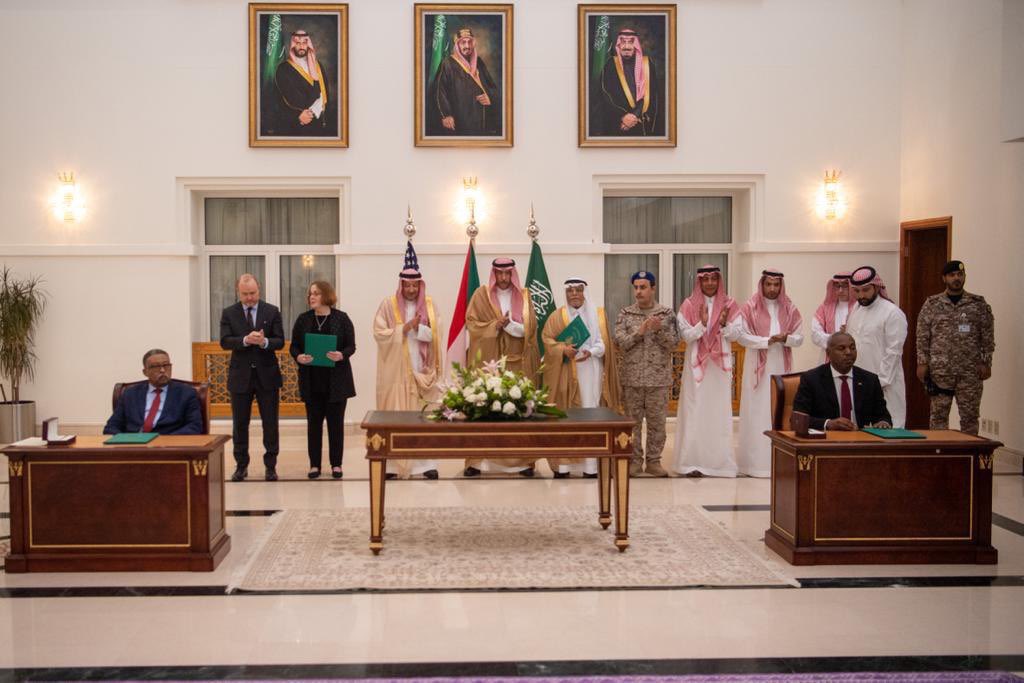
The delegates of the Sudanese Armed Forces as well as the Rapid Support Forces issued a joint statement dubbed “Jeddah Statement” on May 12 after six days of negotiations in the presence of representatives from the United States and Saudi Arabia.
In the Jeddah Statement, the Sudanese warring parties agreed upon guaranteeing safety of lives and properties of civilians, protecting civilian facilities, creating safe humanitarian routes as well as preserving sovereignty and integrity of Sudan. International organizations are also expected to monitor the implementation of the warring sides’ commitments by the use of satellites, field reports and news stories come from social media networks.
The Jeddah Statement does not mention a comprehensive end of hostilities; however, the American authorities called it a first step toward reaching a ceasefire agreement.
In general, the statement or agreement is not sufficient and effective to pave the ground for resolving the current crisis in Sudan because of the lack of an all-inclusive truce and assessing the implementation of the parties’ conditions as well as the precise monitoring of the warring side’s commitments.
In 28 days of civil war in Sudan, more than 500 people lost their lives and 3,000 others were injured, while tens of thousands were also displaced and foreign countries evacuated their nationals and diplomats from the African country.
The mentioned issues along with Sudan’s economic and political woes indicate a looming crisis that will not be simply resolved even with the complete cessation of hostilities and the formation of an all-inclusive government.
Twenty-one days after the military clashes erupted in Sudan, the power struggle between the Sudanese Armed Forces and the Rapid Support Forces (RSF) continues in Khartoum and other cities in the African state.
Since the onset of the conflict, ceasefire agreements brokered by the United States and Saudi Arabia have been unstable and have not been respected by either party.
At present, the Saudi kingdom and the US are resorting to mediation efforts in a bid to direct negotiations on a stable ceasefire and dispatching humanitarian aid to the Sudanese people; so, the first round of such negotiations was held on May 6, in Jeddah port city on the Red Sea.
National Security Advisor to the President of the United States Jake Sullivan has also traveled to Saudi Arabia since Friday and has welcomed the negotiations between the Sudanese warring sides in a joint statement with the Saudi officials.
Many foreign nationals and diplomats left the war-torn country.
The living conditions of the Sudanese people have been reported to be dire and most government agencies have become a battleground between the army and the paramilitary forces. The Sudanese people hardly have access to food, water, medicine and fuel.
Communication services have also been fully cut off as a result of power outages and generator failures.
The United Nations Children’s Agency (UNICEF) and other human rights organizations of the international body warned against the massacre of civilians. And the US and some European states called for an urgent meeting of the Human Rights Council (HRC) to review the situation in Sudan.
Another ship was also subjected to WBIED attack on Jeddah port on December 14, 2020, according to the United Nations.
The tanker is named “BORAIDA” and belongs to the Saudi Navy. As a result of this explosion, the hull on the right side of the “BORAIDA” tanker was seriously damaged, and a year after the attack, it is still anchored at Pier #8 of the King Faisal Naval Base.
It should be mentioned that the BW Rhine tanker belonging to Hafnia Singapore Company was unloading diesel fuel loaded from Yanbu refinery in Jeddah port in the morning of December 14, 2020, when it was attacked by Ansar Allah suicide boat. The blast did not cause oil spills or pollution to the sea, but the ship’s hull was severely damaged by the fire.
« In the name of God, the Merciful, the Compassionate. ‘So should anyone aggress against you, assail him in the manner he assailed you. (Surah Al-Baqarah – 194) God Almighty has spoken the truth‘
In response to the crimes of the Saudi-American enemies against the people of our country and the continuation of the siege and aggression, the Yemeni Armed Forces, with the help of God Almighty, launched the military “Operation December 7” targeting a number of enemy military targets in Riyadh, Jeddah, Taif, Jizan, Najran and Asir.
The operation was carried out by firing a number of ballistic missiles and 25 drones as follows:
Six Samad-3 drones and a number of Zulfiqar missiles targeted the positions of the Ministry of Defense (Saudi Arabia), King Khalid Airport and other military targets in the city of Riyadh, the capital of the Saudi enemy.
Six Samad 2 and 3 drones targeted King Fahd Air Base in Taif and Aramco in Jeddah.
Five Samad 1 and 2 drones targeted the enemy military positions in Abha, Jizan and Asir areas.
Eight Qasef 2K drones and a large number of missiles targeted critical positions in the Abha, Jizan and Najran areas.
The Yemeni Armed Forces want all the citizens and residents of the targeted areas to stay away from the military areas and places, because they have become legal targets for our armed forces. The Yemeni Armed Forces will respond the escalation of tensions by enemy and, God willing, will carry out more military operations in legal defense of their people and country.
‘And victory is only from God. (Surah Ali ‘Imran – 126) God Almighty has spoken the truth‘
Long live free, dear, independent Yemen. »
It should be noted that last night, the Saudi coalition positions in Riyadh, Jeddah, Jizan, Khamis Mushait and other cities in the country were targeted by a large number of Yemeni missiles and drones. The operation comes in response to more than a thousand Saudi coalition airstrikes on Yemen in the past month.
The Saudi coalition claimed to have shot down five Ansar Allah drones in southern Saudi Arabia. The claim comes as flights at Jeddah airport have been disrupted.
Earlier onn February 15, the pro-Saudi media claimed that an Ansar Allah drone had been shot down on the southern border of Saudi Arabia.
Later, a spokesman for the Yemeni Armed Forces, Brigadier General Yahya al-Sari’, said in a statement that two Qasef 2k and Sammad-3 drones attacked Saudi coalition positions at Jeddah and Abha airports.
No further information were released on the aftermath of the attack.
“Mohammad Abdul Salam” spokesman and person in charge of Ansar Allah negotiations: “Those who invaded Yemen by killing and besieging should not expect open meetings and diplomacy under the fire of war and siege, but should expect a reciprocal response.”
Recently, a group called “Al-Wa’ada Al-Haq” claimed responsibility for the drone attack on Riyadh on January 23. Also today, Riyadh came under airstrikes again, and with the severe censorship on the official sources and the Saudi media, the details of this attack are still unknown. An hour ago, local sources announced the rerouting and delay of 7 flights at Jeddah airport, and the reason and other details of this incident are still unknown.
According to tonight’s tweet of Mohammad Abdul Salam and the recent developments in Saudi Arabia, the question arises whether the recent developments in Saudi Arabia are related to Ansar Allah? We are waiting for the official news, detailed information and more.
British tanker BW Rhine, a Singapore-flagged LR1 product tanker belonging to the fleet of Hafnia, has been hit from an “external source” whilst discharging at Jeddah just after midnight, according to a release from the BW subsidiary. The “external source” caused an explosion and subsequent fire onboard.
The tanker is said to have exploded due to a collision with a Ansar Allah naval mine. Hull damage has occurred at water ballast tank five on the port side and cargo tank four on the port side.
The Red Sea is a vital shipping lane for both cargo and global energy supplies, making any mining of the area a danger not only to Saudi Arabia but to the rest of the world. Mines can enter the water and then be carried away by the currents that change by the season in the Red Sea.
Two Quds 2 missiles where used and distribution station of the refinery was targeted and hit with precision.
The facility is located in north of Jeddah and near King Abdulaziz International Airport.
It is noteworthy that Quds 2 type winged missiles were recently become operational in Yemeni Army and hit the selected target deep inside Saudi Arabia precisely after flying near 650 km.
Yahya al-Sari’ added that the attack was a retaliation to continuation of siege and assault by Saudi Arabia against Yemeni people and asked civilians and the foreign companies to have distance from critical infrastructure of Saudi Arabia because the operations will continue.
Image: The morning of Nov 23rd and the continuation of the fire after last night attack
– The Southern Transitional Council Chairman Eidros al-Zubaidi traveled to Jeddah to negotiate with the Saudis, along with a delegation of southern Yemeni leaders.
– Cabinet of Mansour Hadi in a letter to Mansour Hadi, calls for the cancellation of the UAE’s participation in the Saudi coalition and the war in Yemen.
– Security Belt forces(Hizam Al Amni forces) seize al-Kud security headquarters,west of Zinjibar.
– Two days ago, Security Belt forces have seized the police and special forces headquarter in the Zinjibar city, the capital of Abyan province, but control of the base has been restored to police and special forces, and the parties have stopped clashes to prevent civilian casualties.
It seems the southern forces paused the military operations for now, waiting for Eidros al-Zubaidi and the outcome of his talks with the Saudis in Jeddah, Saudi Arabia.